1. Introduction
Conventional chondrosarcoma (CS) represents the second most common primary bone sarcoma and produces cartilage matrix [
1]. They are generally slow-growing tumors that infiltrate bone and soft tissue. Grade is an important prognostic factor, and the criteria established by Evans et al. are still applied today [
2]. While grade I displays low metastatic potential and an overall 10-year survival rate of 88–95%, grade II and III tumors are associated with increased metastatic potential, 10–30% and 32–71% respectively, and a 10-year survival of 50–70% depending on anatomical location. Dedifferentiated CS has a dismal prognosis, with a 5-year overall survival of only 7–24% [
3]. Due to high levels of chemo- and radio-resistance, treatment is centered around surgery with adjuvant radiation and chemotherapy in selected cases [
4,
5,
6,
7]. Chemotherapy has demonstrated limited benefits in most CS subtypes, particularly in conventional CS, with similar resistance observed in response to radiotherapy [
5,
6].
Systemic treatment options for unresectable, recurrent, or metastatic CS remain limited, particularly for conventional CS, although selected subtypes and clinical settings may warrant chemotherapy, radiotherapy, or palliative approaches [
4,
5,
6,
7]. Although conventional CS is relatively radioresistant, radiotherapy, including proton or particle therapy, may be considered in selected settings such as skull base, axial, unresectable, incompletely resected, or for palliative disease where local control is difficult, and dose delivery near critical structures is important [
8,
9]. These approaches should be framed as selected clinical local-control strategies that require validation rather than representing broadly effective systemic or curative treatments for all CS [
8,
9]. Ozekibart (INBRX-109) has generated interest as an investigational death receptor 5 (DR5) agonist, but its clinical role remains under evaluation and should not be described as an established clinical benefit [
10].
This overall adjuvant therapeutic failure suggests that the biological drivers of disease progression and resistance remain incompletely understood.
Isocitrate Dehydrogenase 1/2 (
IDH1/2) mutations are most characteristic of central and periosteal cartilaginous tumors and can be detected in enchondromas, whereas peripheral CS arising from osteochondromas follow distinct
EXT1/EXT2-associated biology [
11]. Although
IDH1/2 mutations are frequent early events in central/periosteal cartilaginous tumors and are present in some enchondromas, their role in progression and prognosis remains incompletely understood [
11].
A second potential signaling node is AXL, which has been implicated in survival, migration, and therapy resistance across several cancers and has been discussed as a potential therapeutic axis in primary bone tumors, although CS-specific evidence remains limited [
12].
Because CS comprises biologically distinct entities, the present manuscript focuses primarily on central and periosteal conventional CS and dedifferentiated CS, where relevant to
IDH1/2, AXL, and progression biology [
1,
11,
13,
14]. Peripheral CS arising from osteochondroma follows a distinct
EXT1/EXT2-associated pathway and does not share the same
IDH1/2-mutant biology [
15,
16,
17]. Findings should not be generalized to peripheral CS, clear cell CS, mesenchymal CS, or other nonconventional subtypes without subtype-specific evidence [
1,
15,
16,
17]. Specific emphasis will be given to the roles of
AXL and
IDH as potential biomarkers and emerging targeted therapies capitalizing on
IDH and
AXL dysregulation.
2. AXL
The AXL Receptor tyrosine kinase is a member of the TYRO3/AXL/MER (TAM) family of receptor tyrosine kinases (RTKs) and is primarily activated by growth arrest-specific 6 (GAS6) [
18]. Ligand-dependent AXL autophosphorylation activates downstream phosphoinositide 3-kinase/protein kinase B/mammalian target of rapamycin (PI3K/AKT/mTOR) and Yes-associated protein 1/transcriptional co-activator with PDZ-binding motif (YAP1/TAZ) signaling, pathways that regulate cell survival, motility, and invasion [
12,
18]. In non-CS tumors, AXL has been associated with invasive phenotypes, therapy-induced plasticity, therapeutic resistance, and poor clinical outcomes [
6,
12,
18,
19].
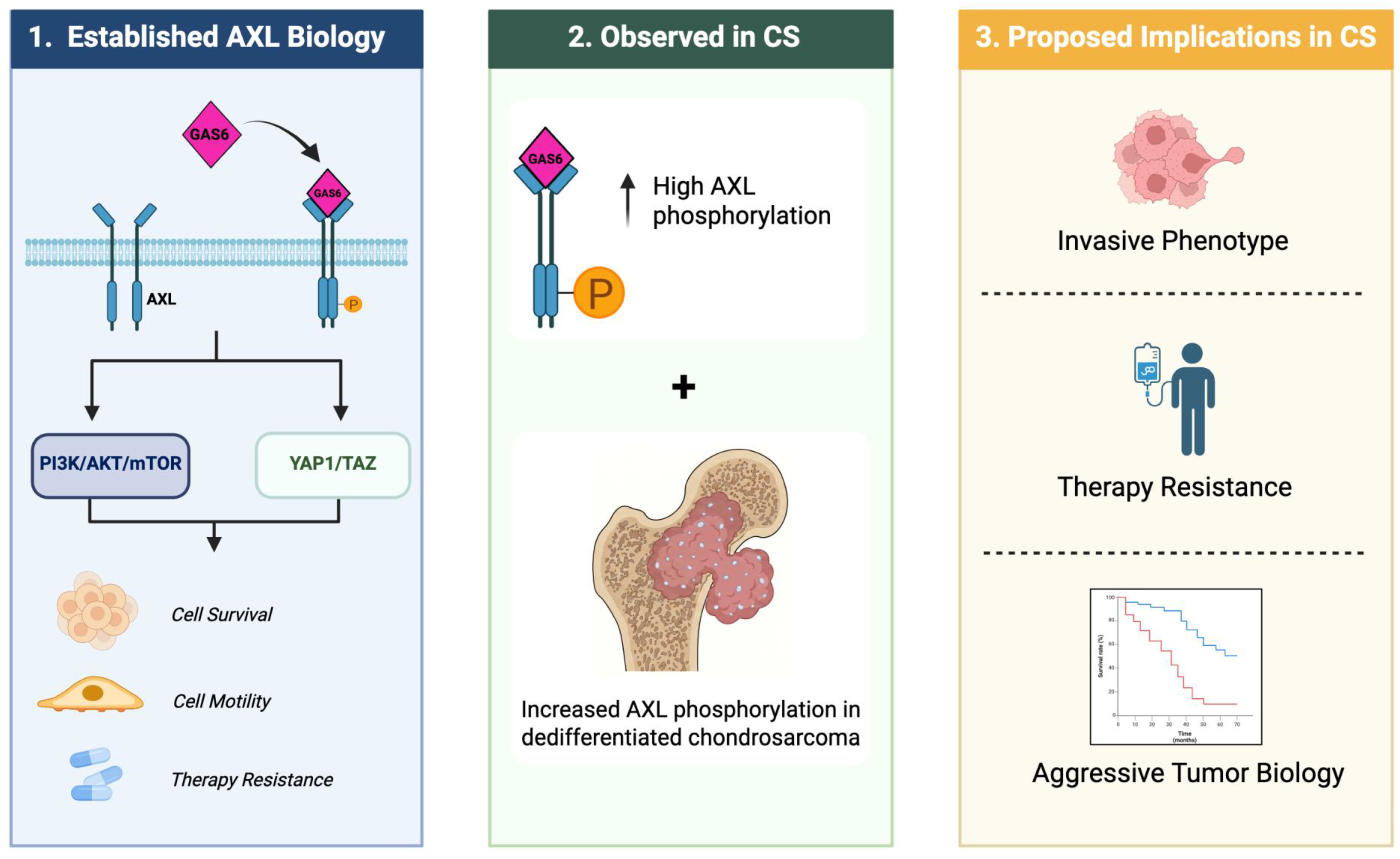
In CS, available evidence supports AXL phosphorylation as a candidate marker of RTK pathway activity in some tumors, but it does not yet establish AXL as an independent driver of CS progression (
Figure 1). Zhang et al. performed functional RTK profiling in human CS specimens and identified AXL as one of the most highly phosphorylated RTKs in human tumor specimens, suggesting a correlation between AXL signaling and an aggressive tumor phenotype, supporting AXL as a candidate signaling node [
20]. However, this evidence remains primarily correlative and requires functional validation before AXL can be considered a driver in CS. Reviews of CS molecular pathology have discussed potential convergence between RTK activation and PI3K/AKT/mTOR signaling, but this remains a pathway-level synthesis rather than definitive proof of AXL dependency in CS [
5]. These findings collectively support the hypothesis that AXL-associated pathway activation may participate in CS progression, although direct functional dependency remains insufficiently established [
5,
12,
18,
20].
Furthermore, Zhang et al. identified high levels of AXL phosphorylation in dedifferentiated CS, suggesting that AXL activity may be related to aggressive CS biology, reinforcing the importance of measuring functional AXL activity rather than expression alone [
20]. Src-family kinase signaling has also been explored in CS progression, chemoresistance, and migration. Preclinical work suggests that Src-family kinases may contribute to chemoresistance and migration in CS models, and that dasatinib may sensitize selected
TP53-mutant CS cells to doxorubicin [
21]. These findings support interpreting AXL within a broader kinase-network framework rather than as an isolated signaling axis; however, this still needs to be verified with further clinical evidence [
12,
21]. Collectively, current evidence from multiple tumor systems supports a model in which AXL may function as a dynamically regulated signaling node involved in kinase activity, growth factor signaling, and therapy-associated resistance, while its precise functional role in CS remains incompletely defined [
5,
6,
12,
18,
19,
20].
At present, available CS-specific AXL data are insufficient to determine whether AXL activation varies systematically by anatomic site, grade, or low-metastatic-risk locations [
20]. Future studies should therefore stratify
AXL expression and AXL phosphorylation by grade, histologic subtype, and anatomical site before assigning prognostic significance [
1,
20].
Evidence of AXL in Non-CS Bone Sarcoma Models
Protein Kinase C Iota (PRKCI) silencing has been reported to suppress downstream AKT/mTOR activation in osteosarcoma (OS) models [
22].
Although this may support a possible regulatory relationship between
PRKCI/GAS6/AXL in primary bone tumor biology, it should not be taken as direct evidence that
PRKCI regulates AXL-driven proliferation in CS without validation in CS-specific models [
22].
Cross-tumor and primary bone cancer literature suggests potential convergence among AXL, insulin-like growth factor/insulin receptor (IGF/IR), PI3K/AKT/mTOR, and YAP1/TAZ signaling; however, the extent to which these interactions operate specifically in CS remains incompletely defined [
12].
Furthermore, in colorectal cancer, Dunne et al. identified AXL as a regulator of inherent and chemotherapy-induced invasion and reported that
AXL expression predicted poor clinical outcome in early-stage colon cancer [
19]. Although these findings support the broader role of AXL in invasion and therapy-associated tumor plasticity, they are derived from a non-chondrosarcoma malignancy and should therefore be interpreted only as a supportive biological context for CS.
3. IDH
Importantly, the molecular framework discussed here applies primarily to central and periosteal CS. Peripheral chondrosarcoma arising from a preexisting osteochondroma follows a distinct
EXT1/EXT2-associated pathway and should not be assumed to share the same
IDH-mutant biology as central/periosteal CS [
15,
16,
17].
Mutations in
IDH1 and
IDH2 are characteristic high-frequency alterations in central and periosteal cartilaginous tumors, including many CS, but they are not universal across all subtypes [
11,
15,
16,
17].
IDH1 or
IDH2 mutations have been reported in approximately 56% of central and periosteal cartilaginous tumors, including CS, while the mutations were rare in other mesenchymal tumors, supporting a lineage-specific role [
11]. Subsequently, a meta-analysis of over 400 CS patients estimated
IDH mutations in approximately half of CS patients, indicating a high-frequency of alteration in CS cohorts [
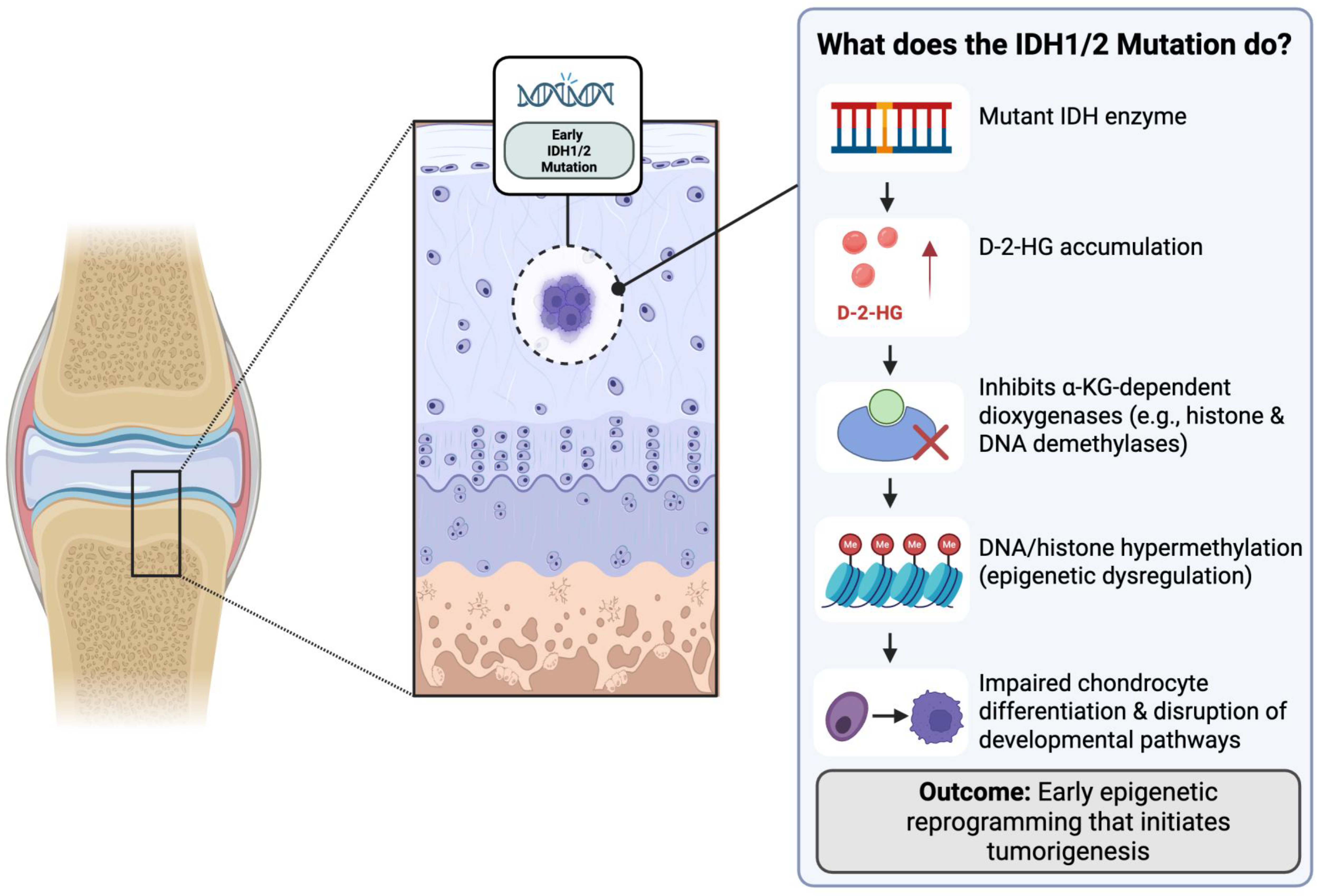
23]. Foundational studies in
IDH-mutant cancers demonstrated that mutant
IDH acquires a neomorphic activity that converts α-ketoglutarate (α-KG) to D-2-hydroxyglutarate (D-2-HG); however, evidence is limited in CS (
Figure 2) [
24].
Mechanistic studies outside of CS showed that D-2-HG competitively inhibits α-KG–dependent dioxygenases, including histone and DNA demethylases [
25]. This inhibition results in widespread DNA and histone hypermethylation that is associated with impaired differentiation, yet limited information surrounds this effect in CS. Pathmanapan et al. identified distinct metabolic signatures in
IDH-mutant CS compared to wild-type tumors [
26].
In CS cell lines, mutant IDH inhibition decreases D-2-HG levels, confirming on-target metabolic effects; however, this does not necessarily translate into reversal of tumorigenic phenotypes, suggesting that additional pathways sustain malignant behavior [
27].
Rather than primarily increasing proliferation, several studies indicate that mutant
IDH primarily alters cellular differentiation, although direct CS-specific mechanistic proof remains incomplete.
IDH-mediated epigenetic changes have been proposed to disrupt normal endochondral ossification and maintain chondrocytes in an immature state that promotes tumor formation [
3]. Aberrant DNA methylation has been reported in CS and is biologically consistent with altered epigenetic regulation in
IDH-mutant tumors, although methylation patterns may also reflect additional subtype- and progression-associated changes [
28]. These findings support a model in which
IDH1/2 mutations may contribute to early epigenetic and differentiation changes, although additional genetic and microenvironmental events are required for progression [
3,
28].
IDH1/2 mutations support a model in which early metabolic and epigenetic reprogramming contribute to cartilaginous tumor formation in many central and periosteal tumors, but this model should not be interpreted as a universal or linear progression model for all CS subtypes [
11,
13,
14,
15,
16,
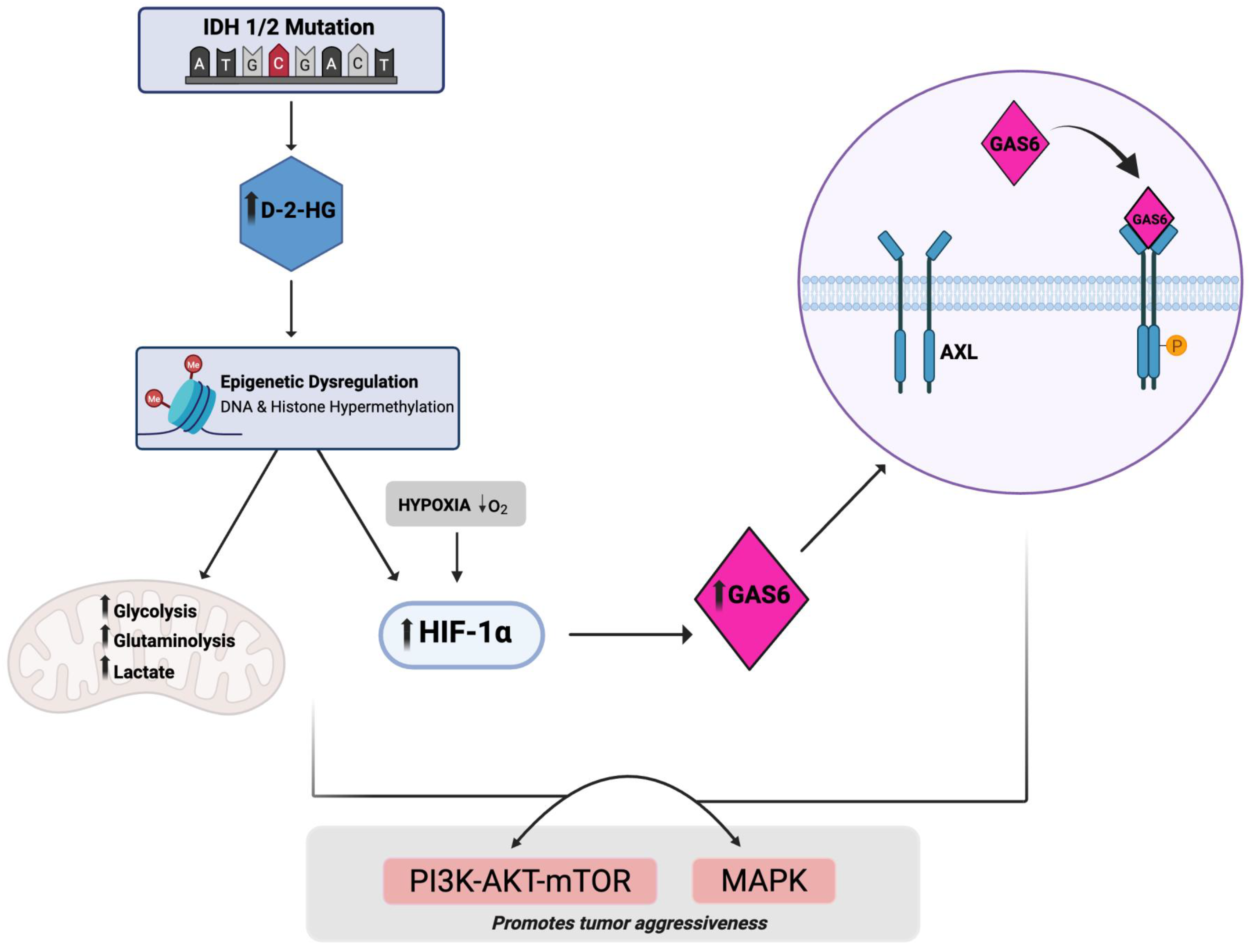
17]. No study to date has definitively established a direct mechanistic pathway by which
IDH1/2 mutation induces AXL activation in CS. Current evidence instead consists of separate observations that
IDH1/2-mutant and wild-type CS display distinct metabolic profiles and that AXL phosphorylation can be detected in human CS specimens [
20,
26].
Cross et al. support that
IDH1/2 mutation often occurs early, while alterations such as
telomerase reverse transcriptase (
TERT) promoter mutation are associated with progression and outcome [
14]. However, this model should not be generalized to all CS subtypes or interpreted as a universal linear sequence. Building on, Dermawan et al. further reported that dedifferentiated CS displays distinct methylation patterns and enrichment of
TP53 and
TERT alterations [
13]. Together, these findings support a multi-hit progression model in which dedifferentiated CS is not simply a more aggressive extension of
IDH-mutant biology, but often reflects additional progression-associated alterations, including
TP53 pathway disruption,
TERT dysregulation, and
Cyclin-Dependent Kinase Inhibitor 2A (
CDKN2A)/p16 loss [
13,
14].
The relationship between
TERT promoter alteration and telomerase biology in CS is complex. Earlier studies reported that most chondrosarcomas lacked detectable telomerase activity [
29]. By contrast, later genomic studies identified
TERT promoter mutations as progression-associated events in central CS [
14]. Therefore,
TERT dysregulation should be discussed as part of telomere-maintenance and progression biology rather than equated simplistically with uniformly detectable telomerase activity across CS [
14,
29].
Because
TP53 pathway disruption and
CDKN2A/p16 loss are associated with progression and dedifferentiation, AXL activation should not be interpreted in isolation but rather in the context of these cooperating alterations [
13,
14,
30]. Accordingly,
IDH1/2 mutations may be viewed as early lineage-associated events in many central/periosteal cartilaginous tumors, whereas malignant progression, dedifferentiation, and metastasis likely depend on cooperating alterations and may also occur through
IDH-wildtype evolutionary trajectories.
IDH-wildtype CS should also be explicitly considered. Evolutionary studies of central CS indicate that
IDH status alone does not define all progression trajectories [
14]. Recent work further suggests that
IDH1/2 alterations may be absent or even lost during tumor evolution in some metastatic central CS cases [
31]. These observations reinforce that CS progression cannot be modeled as a single linear
IDH1/2-mutant pathway [
14,
31].
The CS tumor microenvironment has been shown to vary in composition and phenotype, particularly in high-grade and dedifferentiated tumors. Using immunohistochemical profiling, Richert et al. examined 57 surgically resected CS specimens, including conventional and dedifferentiated tumors, and identified a macrophage-dominant immune infiltrate, particularly in high-grade tumors [
32]. Providing further support, Kostine et al. performed an analysis of 49 resected CS samples and identified program death ligand 1 (PD-L1) expression on tumor cells together with CD8
+ cytotoxic T-cell infiltration [
33]. The coexistence of tumor-infiltrating cytotoxic T-cells with PD-L1 expression suggests a potential rationale for exploring immune checkpoint-based approaches in selected dedifferentiated CS cases [
33]. These studies demonstrate that CS, particularly high-grade and dedifferentiated tumors, can contain immunosuppressive microenvironmental features [
32]. However, whether these immune patterns are directly driven by
IDH1/2 mutation status remains unresolved.
Reviews of CS biology, integrating data from human tumor specimens and experimental models, further show interactions between metabolic alterations and oncogenic signaling patterns, including PI3K/AKT/mTOR [
5,
6]. Mutant
IDH generates the oncometabolite 2-HG, which inhibits a-ketoglutarate-dependent dioxygenases and produces widespread epigenetic dysregulation.
In broader
IDH-mutant cancer contexts, epigenetic dysregulation can alter the expression of growth factor receptors and survival pathways; however, the extent to which this directly drives PI3K/AKT/mTOR activation in CS remains incompletely established [
5,
6,
25]. Because PI3K/AKT/mTOR signaling promotes cell survival, proliferation, and resistance to apoptosis in many tumor contexts, epigenetic and metabolic changes in CS may plausibly intersect with survival pathways; however, direct
IDH-driven activation of this axis in CS remains incompletely established as well [
5,
6,
25].
3.1. Interactions Between IDH1/2 Mutations and AXL Signaling in CS
No study to date has definitely established a direct mechanistic pathway by which
IDH1/2 mutation induces AXL activation in CS. Current evidence instead consists of separate observations that
IDH1/2-mutant and wild-type CS display distinct metabolic profiles and that AXL phosphorylation can be detected in human CS specimens [
20,
26].
IDH1/2 mutations have been demonstrated to result in the accumulation of the oncometabolite D-2-hydroxyglutarate (D-2-HG) [
24,
27].
In other
IDH-mutant contexts, D-2-HG has been linked to altered hypoxia-related signaling; however, a direct
IDH1/2 to hypoxia-inducible factor-1 alpha (HIF-1α) to GAS6/AXL regulatory axis has not been demonstrated in CS and should therefore be interpreted as extrapolative rather than established CS biology.
IDH-mutant and
IDH-wildtype CS display distinct metabolic profiles, including differences in pathways related to glycolysis, glutamine metabolism, and oncometabolite production; however, these observations do not establish that glycolytic or glutamine-related changes directly drive AXL phosphorylation, aggressive behavior, or therapeutic resistance in CS [
26]. Whether these metabolic features directly predict aggressive behavior or therapeutic response in CS remains incompletely established.
Aberrant AXL signaling can activate downstream pathways such as PI3K–AKT–mTOR and mitogen-activated protein kinase (MAPK), which play critical roles in cell survival, migration, and immune evasion [
5,
6,
12,
18]. The coexistence of frequent
IDH1/2 mutations and aberrant AXL phosphorylation in CS raises a testable possibility of pathway convergence, but current evidence does not prove that IDH-associated metabolic states directly regulate AXL signaling or downstream CS phenotypes [
14,
20,
26]. Future studies may directly compare
AXL expression, AXL phosphorylation, and downstream pathway activation in
IDH1/2-mutant versus
IDH1/2-wildtype CS cohorts using available transcriptomic, proteomic, or phosphoproteomic datasets where associated molecular and clinical data are available [
14,
20,
26].
AXL has also been implicated in glioma growth, migration, and invasion, and experimental inhibition of AXL signaling suppressed glioma growth and invasion in preclinical models [
34]. However, glioma biology differs substantially from CS, including the prognostic meaning of
IDH mutation. Therefore, glioma data may provide useful conceptual context for AXL-associated invasion and resistance, but should not be directly extrapolated to CS without disease-specific validation.
3.2. IDH1/2 and AXL as Biomarkers
The prognostic meaning of
IDH1/2 mutation in CS is best interpreted through a multi-factor framework that accounts for tumor grade, histologic subtype, clinical endpoint,
IDH1 versus
IDH2 status, and cooperating genomic alterations rather than through
IDH status alone [
13,
14,
23,
30,
35]. Meta-analytic data suggest that the prognostic significance of
IDH1/2 mutations is not uniform across cohorts, reinforcing the need to interpret
IDH status in relation to grade, histologic subtype, clinical endpoint, and co-alterations such as
TERT,
TP53, and
CDKN2A [
23]. The apparent discrepancies across studies may partly reflect differences in cohort composition and outcome structure, because different analyses have evaluated various distinct endpoints, including overall survival, relapse-free survival, metastasis-free survival, and grade-stratified subgroup outcomes [
23,
30,
35].
A useful explanatory framework is that
IDH1/2 mutations may function as early lineage-associated and differentiation-altering events in many central and periosteal cartilaginous tumors, whereas progression, dedifferentiation, metastasis, and therapeutic resistance are likely shaped by additional genomic events [
3,
11,
13,
14,
30,
31]. Under this model, conflicting prognostic data may reflect differences in cohort composition and endpoint selection rather than true contradiction [
23,
30,
35]. Studies enriched for lower-grade or less aggressive central tumors may identify
IDH-mutant disease with favorable relapse-free or metastasis-free outcomes, whereas cohorts enriched for high-grade, dedifferentiated,
IDH1-mutant,
TERT-altered,
TP53-disrupted, or
CDKN2A/p16-altered tumors may show worse outcomes [
13,
14,
30,
35].
IDH1 mutations, particularly when co-occurring with
TERT promoter alterations, have been associated with poorer prognoses and are observed in approximately 20% of CS cases, whereas
IDH2 mutations do not correlate with worse outcomes even in the presence of
TERT [
14]. These findings highlight the distinct biological behavior of
IDH1 versus
IDH2 mutations and underscore the importance of stratifying patients based on specific mutational profiles. Similarly, Zhu et al. performed sequencing of
IDH1/2 in 89 central CS cases and identified
IDH1/2 mutations in 46% of tumors. Although
IDH1/2 mutation status was not associated with overall survival, mutant tumors showed longer relapse-free and metastasis-free survival within the high-grade CS subgroup, supporting the interpretation that the prognostic significance of
IDH1/2 mutations is context-dependent rather than uniformly adverse [
30]. Zhu et al. also reported recurrent co-alterations involving
TERT,
CDKN2A/2B, and
TP53 in subsets of high-grade and dedifferentiated CS, suggesting that progression may depend on cooperating genomic alterations rather than
IDH1/2 mutation alone [
30].
Complementing these findings, Nacev et al. analyzed 2138 sarcomas across 45 histologic subtypes using MSK-IMPACT and demonstrated recurrent
IDH1 mutations alongside
TERT promoter alterations in CS [
36]. However, because this was a broad multi-sarcoma sequencing cohort, CS-specific prognostic conclusions still require subtype- and grade-stratified outcome studies [
36].
Patients with
IDH-mutant atypical cartilaginous tumors (ACT) and grade I CS generally demonstrate favorable outcomes, with high long-term survival and rare metastatic events.
IDH status should not be interpreted here as the sole determinant of prognosis [
3]. In contrast, the prognostic significance of
IDH1/2 mutations in higher-grade CS remains inconsistent across cohorts. In one recent analysis of grade II/III and dedifferentiated CS,
IDH-wildtype status was associated with longer overall survival than
IDH-mutant disease, with particularly poor outcomes reported among dedifferentiated
IDH-mutant tumors [
35]. However, this finding should be interpreted alongside other studies reporting different associations between
IDH status and outcome, including cohorts in which
IDH1/2 mutations were associated with longer relapse-free and metastasis-free survival in high-grade CS [
30]. Rather than representing a simple contradiction, these findings suggest that the apparent prognostic direction of
IDH1/2 mutation depends on cohort composition, endpoint selection, and progression-associated co-alterations.
IDH status alone is therefore insufficient as a universal prognostic marker and should instead be interpreted in relation to grade, histologic subtype, clinical endpoint,
IDH1 versus
IDH2 status, and cooperating alterations such as
TERT,
TP53, and
CDKN2A/p16 [
13,
14,
30,
35].
In this context, AXL activation may act as a potential candidate biomarker of aggressive signaling in selected CS cases, but its prognostic value has yet to be validated in sufficient CS cohorts. Together, these findings may suggest that
IDH status helps define prognostic subsets only when interpreted alongside tumor grade, histologic subtype, clinical endpoint,
IDH1 versus
IDH2 status, and cooperating alterations such as
TERT,
TP53, and
CDKN2A/p16, while AXL phosphorylation may represent a candidate marker of RTK pathway activity in selected CS cases, but whether it provides prognostic information beyond established clinicopathologic and genomic variables remains unvalidated [
13,
14,
20,
30,
35].
3.3. Therapeutic Targeting of IDH1/2 and AXL in CS
While surgery with negative margins is the foundation of treatment in most CS patients, chemotherapy and/or radiation therapy can be added in selected settings. Responses are limited clinically due to high levels of chemo- and radio-resistance, and effective systemic options remain limited for unresectable, recurrent, or metastatic disease. This therapeutic gap has driven the investigation of molecularly targeted and immune-based approaches in advanced CS [
5,
6,
7]. Recent genomic characterization studies have expanded the list of candidate therapeutic targets in CS, and molecularly guided systemic therapy remains investigational for most patients [
37]. Beyond IDH inhibition, candidate investigational strategies in advanced CS include kinase-pathway inhibition, immune-based approaches in selected dedifferentiated tumors, and epigenetic therapy, but none have become a validated standard for most patients with advanced CS [
6,
7,
32,
33,
38]. The clinical relevance of
IDH1 mutations has been evaluated in a phase I trial of the selective IDH1 inhibitor ivosidenib in 21 patients with advanced
IDH1-mutant CS, including 13 conventional CS cases. Patients received daily oral doses of 500 mg, which were well tolerated with no treatment-related deaths and only one grade 3 adverse event. Treatment resulted in marked reductions in plasma 2-hydroxyglutarate to levels comparable to those of healthy individuals, confirming on-target metabolic inhibition [
4]. Clinically, ivosidenib was associated primarily with disease stabilization rather than objective tumor regression. Although median progression-free survival was modest, a subset of patients experienced prolonged disease control, indicating a heterogeneous response distribution rather than uniform benefit [
4].
The clinical experience with ivosidenib highlights an important therapeutic disconnect that on-target suppression of D-2-HG does not necessarily translate into objective tumor regression in CS [
4]. This may reflect the role of
IDH1/2 mutation as an early metabolic and differentiation-altering event, while established malignant behavior may be sustained by cooperating alterations, persistent epigenetic states, or bypass signaling [
3,
13,
14,
27,
30,
39]. Consistent with this possibility, mutant IDH1 inhibition can reduce D-2-HG levels in CS cell lines without consistently reversing tumorigenic properties [
27]. Future studies should therefore evaluate mechanisms of limited response or resistance to IDH-directed therapy.
Because
IDH1/2-mutant CS can exhibit epigenetic dysregulation, epigenetic therapies, including DNA methyltransferase and histone deacetylase inhibitors, have been proposed as investigational strategies. However, these approaches remain preclinical or early-stage in CS and should not be interpreted as established therapeutic options [
28,
38,
39].
Together, these findings support mutant IDH as a pharmacologically targetable alteration in CS, but they also indicate that on-target metabolic inhibition is not sufficient to produce consistent objective tumor regression, highlighting the need to define intrinsic and acquired resistance mechanisms in the future [
4,
27,
39].
Collectively, current studies suggest that
IDH mutations function as early differentiation-disrupting events, whereas genomic alterations and microenvironmental changes act as downstream drivers to tumor progression [
3,
11,
13,
14,
23,
36].
AXL-directed therapy remains far less developed in CS than IDH-directed therapy. Several AXL-targeting strategies, including selective AXL inhibitors, have been evaluated across other non-CS solid tumor settings, but CS-specific clinical evidence remains lacking [
40]. This gap likely reflects the limited amount of CS-specific AXL functional data, the absence of prospectively validated biomarkers, and the lack of clinical trials stratifying CS patients by AXL phosphorylation or pathway activation [
20,
40]. Therefore, AXL inhibition in CS should currently be viewed as a hypothesis-generating strategy rather than an established treatment approach [
20,
40]. Future studies should prioritize patient selection based on AXL phosphorylation, pathway activation, and co-alterations that may identify tumors more likely to depend on AXL-associated signaling [
20].
The clinical role of epigenetic therapy in CS remains undefined, and available evidence does not establish DNA methyltransferase or histone deacetylase inhibition as an effective standard treatment. CS remains therapeutically challenging because of histologic and molecular heterogeneity, limited sensitivity to conventional systemic therapy, and the lack of validated targeted treatments for most patients with advanced disease. Emerging molecularly guided approaches are promising but remain investigational and require subtype-specific validation [
7].
Taken together,
IDH1/2 mutation and AXL-associated signaling remain biologically relevant but incompletely validated therapeutic concepts in CS. Their clinical interpretation requires attention to subtype, grade, endpoint, and co-alterations, and combined IDH/AXL-directed strategies remain untested in CS models or clinical trials [
12,
13,
14,
20,
23,
30,
35,
40]. CS-specific AXL data remain limited, with much of the therapeutic rationale extrapolated from other broader solid tumor or primary bone cancer literature [
12,
18,
20,
40]. Finally, combined IDH/AXL targeting has not yet been validated in CS models or clinical trials.




 and
and