1. Introduction
Biliary tract cancer (BTC) is a heterogenous group of rare malignancies encompassing intrahepatic, extrahepatic and hilar cholangiocarcinoma, gallbladder cancer and ampullary cancer. In the United States in 2025, there were estimated to be 12,610 new cases with an estimated 4400 deaths from BTC [
1]. The majority of BTC diagnoses are made in the advanced stages where curative resection is not possible. For decades, the standard-of-care treatment for BTC was gemcitabine plus cisplatin based on the results of the ABC-02 trial [
2]. However, in recent years, based on the results of the TOPAZ-1 and KEYNOTE-966 trials, gemcitabine plus cisplatin with immune checkpoint therapy (durvalumab or pembrolizumab) is now the standard first-line regimen for advanced or unresectable BTC [
3,
4].
Durvalumab, an anti-programmed death-ligand 1 (PD-L1) agent, with gemcitabine and cisplatin demonstrated a 7.2-month median progression-free survival (PFS) and 12.8-month median overall survival (OS) [
3]. Similarly, pembrolizumab, an anti-programmed death-1 (PD-1) agent, with gemcitabine and cisplatin resulted in a 6.5-month PFS and 12.7-month median OS [
4]. While PD-L1 expression has become a predictive biomarker in various solid tumors, its use in BTC continues to be limited [
5,
6]. Currently, the only immunologic markers predictive of durable responses to immunotherapy in BTC are mismatch repair deficiencies (deficient mismatch repair (dMMR) or microsatellite instability-high (MSI-H)) or high tumor mutation burden (TMB-H). TMB-H and dMMR/MSI-H are both rare in BTC, with a reported incidence of <5% of all cases [
6]. The TOPAZ-1 and KEYNOTE-966 trials reported PD-L1 status but given the low incidence of MSI-H tumors in the study populations and some missing biomarker data, the authors were unable to assess outcomes by MSI or PD-L1 status, suggesting the reported OS benefits were not attributable to MSI status or PD-L1 expression [
3,
4].
Gemcitabine has long been the backbone of chemotherapy regimens for the treatment of BTC [
2]. Gemcitabine is metabolized to diphosphate and triphosphate nucleosides by nucleoside kinases [
7]. Studies suggest that administering gemcitabine at a fixed-dose rate (FDR) of 10 mg/m
2/min may impact efficacy compared to higher doses given over the standard 30 min infusion times. While numerically higher survival was reported with FDR gemcitabine-based regimens, outcomes did not satisfy criteria for superiority over doses given over 30 min [
8,
9,
10]. FDR gemcitabine safety is comparable to 30 min infusions, but is noted to cause higher rates of grade 3/4 neutropenia and thrombocytopenia [
9,
10]. While FDR gemcitabine has only been evaluated in pancreatic cancer populations, not BTC exclusively, both tumor types are treated with gemcitabine- and fluoropyrimidine-based regimens and share anatomic origins with overlapping tumor biology. The NCCN Guidelines for Pancreatic Cancer consider FDR gemcitabine to be a reasonable alternative to standard 30 min gemcitabine infusions [
8].
Cisplatin is a platinum analog indicated in the treatment of various malignancies. It carries multiple black-box warnings of nephrotoxicity, neurotoxicity, myelosuppression and nausea and vomiting. Pre- and post-treatment with intravenous (IV) fluids is recommended to reduce the risk of nephrotoxicity. The risk of these toxicities may preclude the use of cisplatin in patients with pre-existing renal insufficiency, hearing impairment, poor performance status, or conditions where fluid boluses may cause adverse events (i.e., heart failure) [
11]. Additionally, nationwide shortages of platinum analogs, particularly in recent years, have necessitated the development of alternative treatment options when these medications are not available for use [
12].
Oxaliplatin is a platinum analog commonly used in combination with fluoropyrimidines or gemcitabine in BTC and various other gastrointestinal malignancies [
13,
14,
15,
16]. In gastric cancer, oxaliplatin-based regimens demonstrated similar efficacy with lower rates of toxicity compared to cisplatin-based regimens. Patients treated with cisplatin are reported to experience more nephrotoxicity, nausea and vomiting, whereas neuropathy and hypersensitivity reactions are reported at higher rates with oxaliplatin-based regimens [
17]. BTC is most often diagnosed in people aged 65–74 years [
1]. Older patients are more likely to have multiple comorbidities, may not be surgical candidates, and can be frail at diagnosis [
17]. This can limit their ability to receive standard chemotherapy and immunotherapy for BTC, particularly due to the intensity of adverse effects with cisplatin. At our institution, gemcitabine and cisplatin are often prescribed in an every-two-week schedule with durvalumab given once every four weeks for both tolerability and patient convenience. In light of recent cisplatin shortages, and often based on patient-specific factors, oxaliplatin is selected as a substitute instead of cisplatin with gemcitabine and durvalumab. The purpose of this retrospective analysis was to review the safety and efficacy of every-two-week gemcitabine and oxaliplatin (GemOx) with every-four-week durvalumab in advanced or metastatic BTC patients.
2. Materials and Methods
We performed a retrospective review of patients with advanced or metastatic BTC who were treated with GemOx and durvalumab from 30 September 2022 to 14 January 2026 at UT MD Anderson (MDA). The primary outcome was overall survival (OS), defined as the treatment start date to date of death or last follow-up for patients living at the time of data collection. Categorical data were tabulated with frequency and percentage; continuous data were summarized using descriptive statistics. The Kaplan–Meier method was applied to estimate time to event outcomes.
Eligible patients were adults with confirmed advanced or metastatic BTC who received GemOx and durvalumab as front-line therapy at MDA. Notably, patients with recurrent disease were evaluated. Patients must have received this treatment at our center along with radiographic follow-up every 8–12 weeks at our center. Any patients who received recommendations for GemOx and durvalumab but received treatment elsewhere were excluded. Secondary outcomes included time to progression (TTP) defined from treatment start date to treatment end date and disease control rate (DCR) at the first radiographic evaluation. TTP was also noted with only disease progression as an event; all patients without progression were censored at the end treatment date. We utilized TTP given the retrospective nature of our review. TTP allows us to focus specifically on outcomes pertaining to the drug therapy, capture time on treatment via discreet data points, and avoid capturing mortality from other causes. Disease control was classified as any disease response or stability per radiology review. Toxicities were evaluated based on the need for dose reductions or therapy discontinuation. Time on treatment was evaluated based on the start and end date of treatment doses. Any patients noted to still be on treatment at the time of this review were censored at the date of last follow-up. A landmark time analysis of patients who remained on first-line treatment at 3 months was completed to account for time bias and treatment switching effects. To further evaluate the efficacy of oxaliplatin in comparison to cisplatin-based regimens, a 1:2 matched comparator cohort of patients treated with gemcitabine, cisplatin and durvalumab between 19 February 2018 and 8 March 2024 was utilized.
Data collection points included patient demographics (age, gender, race, ECOG performance status), site of disease (intrahepatic, extrahepatic, hilar and gallbladder), baseline carbohydrate antigen 19-9 (CA 19-9), relevant molecular testing results, virology status, type of second-line treatment, and date of death or last follow-up. In regard to GemOx and durvalumab treatment, we collected treatment starting date, starting doses and chemotherapy schedule. Date of progression, treatment discontinuation, date of death or last follow-up, and reasons for dose adjustments or dose delays were also included. For the matched comparator cohort, patients were matched 1:2 on age, sex, race, tumor stage, and ECOG performance status. The outcome measure for the matched cohort was median overall survival (OS). Our study was approved by the Institutional Review Board and a waiver of consent was granted due to patients being lost to follow-up, no longer at the institution, or having died.
3. Results
Twenty-nine patients were included with a median age of 72 years old (range 56–85 years old). Patients were mostly Caucasian (97%) and had an ECOG performance status of 0–1 (97%). Slightly more male patients (55%) were in the analysis. Sixty-six percent had intrahepatic cholangiocarcinoma, 3% extrahepatic cholangiocarcinoma, 14% hilar cholangiocarcinoma, and 17% gallbladder cancer. Ninety-three percent had locally advanced or metastatic disease. No patients had MSI-H or dMMR disease. PD-L1 status was not checked in the majority of cases. Only one patient had PD-L1-positive disease (PDL combined positive score > 1). Tissue molecular analysis was performed on tissue when available (90%). Fourteen patients had no alterations or mutations. Four patients (13%) had a fibroblast growth factor receptor (FGFR) mutation or fusion. Three patients (10%) had Kristen rat sarcoma (KRAS) mutations (G12D, G12C, and G12A). Two patients (7%) had an isocitrate dehydrogenase 1 (IDH1) mutation. One patient (3%) had a germline BRCA 2 mutation. Ninety percent had no hepatitis viral history. Seventy-nine percent (
n = 23) had no previous history of prior therapy. Overall demographics are included in
Table 1.
Reasons patients did not receive cisplatin could be either singular or multifactorial (
Table 1). The most common reason was due to baseline renal insufficiency (
n = 15, 52%). Cisplatin use was also avoided in those with baseline hearing impairment (
n = 8, 28%). Additional reasons were due to cisplatin national shortage (
n = 2), previous reaction or intolerance to cisplatin or carboplatin (
n = 2), or functional status concerns/age (
n = 3).
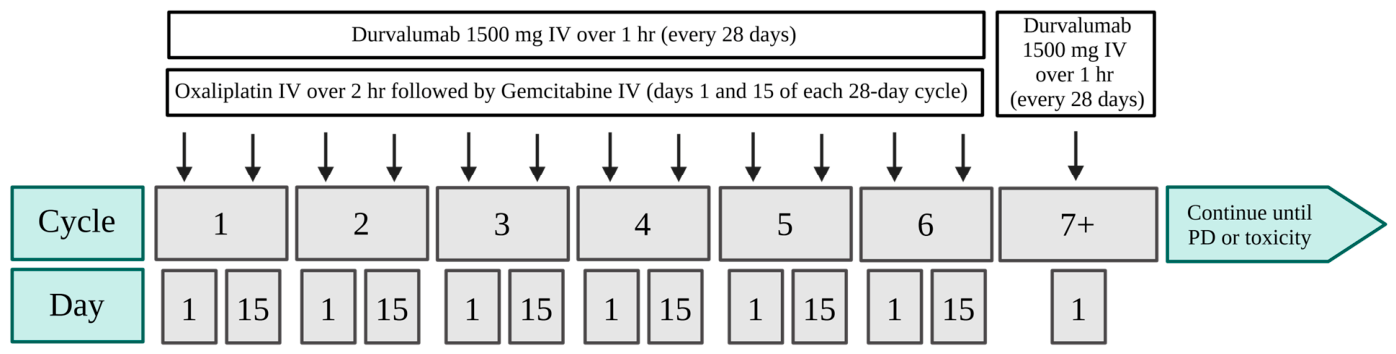
Median follow-up was 20.6 months (range 95% CI 14.7-NA). Cycle length was every 28 days with gemcitabine and oxaliplatin given on days 1 and 15, and durvalumab given on day 1 (
Figure 1). Durvalumab was dosed at 1500 mg flat dose. Gemcitabine was given at an FDR (10 mg/m
2/minute) in 13 patients (45%) with the remainder receiving gemcitabine at a standard administration rate of 30 min. All those that received FDR gemcitabine had a starting dose of 600 mg/m
2. Those with standard-rate gemcitabine had a median starting dose of 900 mg/m
2 (range 600 mg/m
2–1000 mg/m
2). Median oxaliplatin starting dose was 70 mg/m
2 (range 42.5 mg/m
2–85 mg/m
2). Full dosing specifics are included in
Table 2. Oxaliplatin was given for a median of 2.5 months (range 1 month–7 months) while gemcitabine was given for a median of 3.25 months (range 1.5 months–13 months). Durvalumab was given for a median of 3 months (range 2 to 14 months). Mean total time on treatment for all patients was 4.69 months (range 0.95–14.26 months). Three patients transitioned to receive maintenance treatment with durvalumab (
n = 1) or durvalumab and gemcitabine (
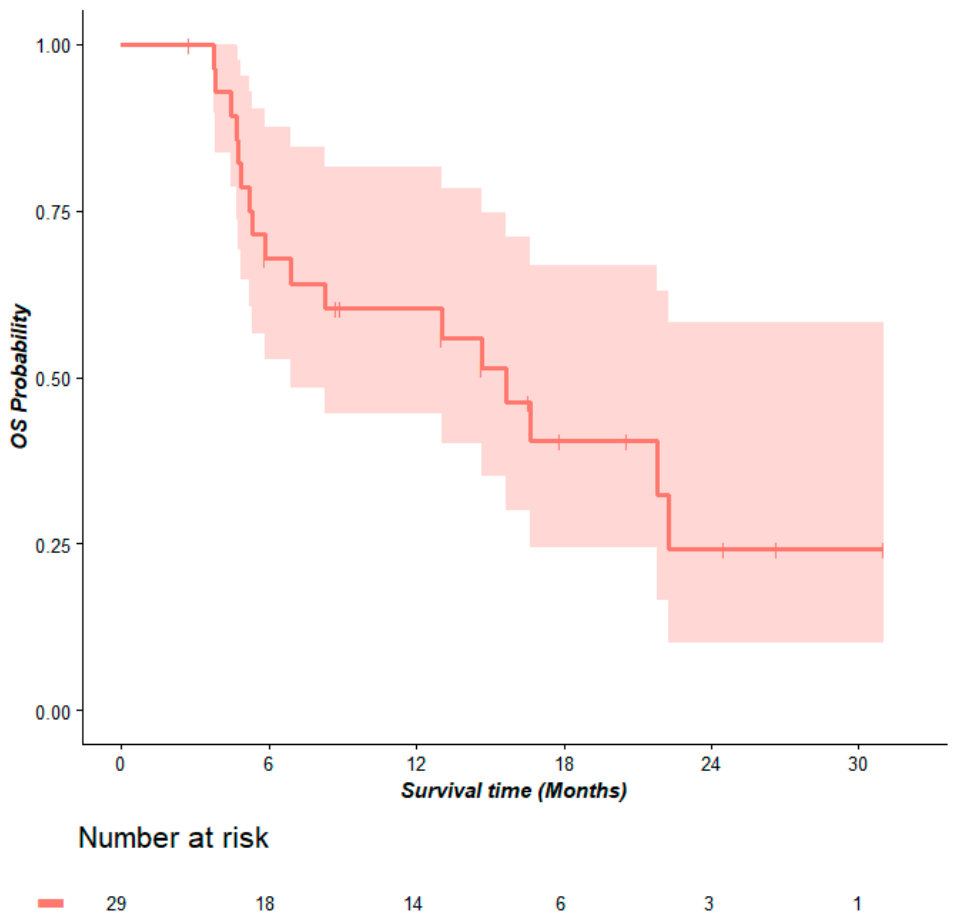
n = 2). At the data cutoff for this review, two patients were still receiving treatment. Median OS was 15.7 months (95% CI: 6.9-NA) (
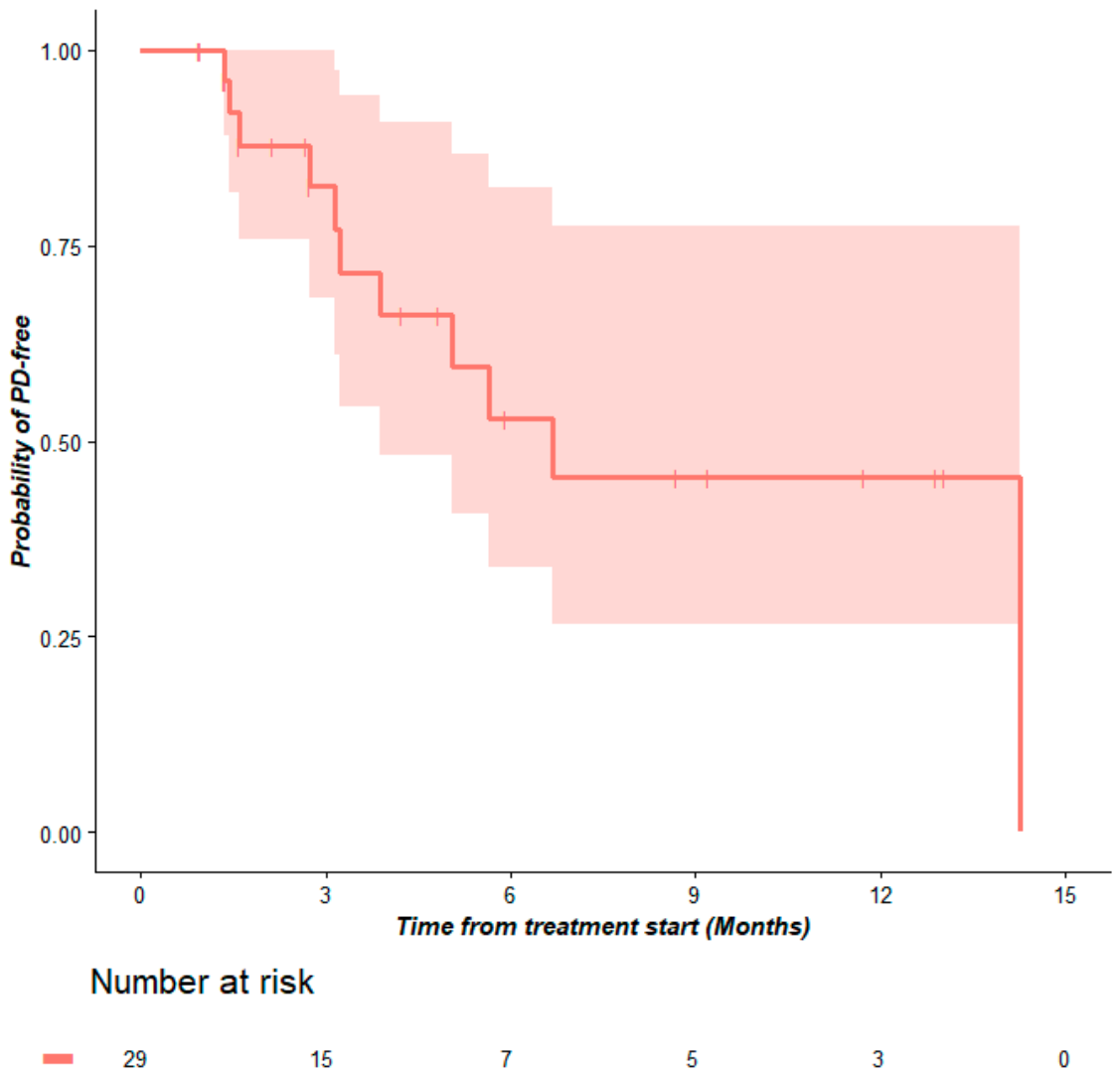
Figure 2). One-year survival rate was 60.3%. Median TTP disease was 6.7 months (range 95% CI: 3.88-NA) (
Figure 3). DCR was 76% (95% CI: 57.9–87.8%). Outcomes are summarized in
Table 3. At 3 months, there were 15 patients who survived at least 3 months and remained on first-line GemOx and durvalumab. Of these 15 patients, 9 died. The median OS time was 13.6 months (95% CI: 5.28, NA). The 12-month survival probability was 58.3% (95% CI: 37.4%, 90.9%). The number of patients who survived at least 6 months and were still on first-line GemOx and durvalumab at 6 months was seven. Landmark analysis at 6 months was not completed due to the limited sample size.
Sixty consecutive intrahepatic cholangiocarcinoma patients who received gemcitabine + cisplatin + durvalumab during a similar time period were included in the matched control. Median age was 66 (range 41–83 years old). Fifty percent were male and fifty percent female. Most patients were Caucasian (83%) and had an ECOG performance status of 0–1 (100%). Most patients had metastatic disease (80%). Median follow-up time for this cohort was 42.6 months and median OS was 15.3 months (95% CI 13.3–27.1). Twelve-month survival probability was 66.7%.
Twelve patients (41%) required at least one dose reduction of gemcitabine, oxaliplatin or both medications. Reasons for adjustments could be singular or multifactorial. Reasons for dose adjustments were thrombocytopenia and/or anemia (n = 8), neuropathy (n = 3), fatigue (n = 3), and/or appetite loss (n = 2). Thirteen (45%) patients experienced at least one dose delay while on treatment, with only three patients having two or more delays. The most common reasons for treatment delays were anemia, thrombocytopenia, and fatigue. Reasons for discontinuing treatment included disease progression (n = 10), transition to local therapy (n = 7), declining performance status and/or poor tolerance (n = 5), resection (n = 2), recurrent infections (n = 1), hypersensitivity, (n = 1), and death (n = 1). This death occurred close to treatment time; however, based on retrospective review, it was not deemed to be due to acute chemotherapy or immunotherapy toxicities. Four patients (13.7%) had one hospital admission while on therapy. Reasons for admission were acute kidney injury (n = 1), nausea/vomiting (n = 2), and oxaliplatin hypersensitivity (n = 1). Most patients received second-line therapy (59%). Second-line therapy consisted of irinotecan/liposomal irinotecan-based therapy, targeted therapy, or a clinical trial.
4. Discussion
BTCs represent a rare group of malignancies. Given this rarity, treatment advancements can be challenging due to pharmaceutical interest in rare tumors and the time necessary for trials to accrue. Advancements can be slow as evidenced by the >10 years between ABC-02 and the TOPAZ-1 and KEYNOTE-966 trials for the standard front-line therapy to change [
2,
3,
4]. Oxaliplatin and carboplatin are both well established for having less nephrotoxicity, ototoxicity, and emesis than cisplatin [
11,
13,
17,
18]. As BTC patients can be elderly with chronic comorbidities and may already be on other potentially nephrotoxic medications, we must find alternatives for these patients to give them full treatment potential. At our center, when cisplatin is contraindicated or unavailable due to shortages, we utilize oxaliplatin as a substitute. Our review of 29 patients shows the clinical feasibility of utilizing oxaliplatin as an alternative platinum agent in advanced BTC patients who have contraindications to cisplatin-based therapy. Our results of median OS of 15.7 months, median TTP of 6.7 months, and DCR of 75.9% showed similar efficacy to utilizing a different platinum agent. TOPAZ-1 and KEYNOTE-966 reported median OS of ~13 months with median PFS of ~7 months [
3,
4]. Additionally, treatment was well tolerated with only 41% of patients requiring dose modifications with no unforeseen adverse effects reported. Any-grade toxicity in TOPAZ-1 was reported at 99.4%. Admissions were seen in 13.7% of patients on durvalumab plus GemOx, similar to the serious toxicity noted in TOPAZ-1 (15.7%). Seventeen percent of patients discontinued treatment due to tolerance/declining performance status, similar to the discontinuation rate of 13% in the TOPAZ-1 study. In addition to aligning with the median OS seen in both TOPAZ-1 and KEYNOTE-966, our institutional 1:2 matched cohort of intrahepatic cholangiocarcinoma patients treated with gemcitabine + cisplatin + durvalumab showed a similar median 15-month OS.
The National Comprehensive Cancer Network (NCCN) lists GemOx as an alternative recommended regimen for primary treatment of unresectable BTC disease [
6]. GemOx has been utilized in advanced BTC based on phase 2 evaluations and a phase 3 non-inferiority trial [
16,
19,
20,
21]. The results of these trials show similar outcomes to our analysis. This combination has also been evaluated in a phase 3 adjuvant trial owing to its safety profile in this population [
22]. Sun et al. reported a phase 3b single-arm, open-label, multicenter Chinese study of GemOx with durvalumab in the front-line advanced BTC setting [
23]. Median follow-up at time of reporting was approximately 3 months. Given the short follow-up, efficacy results were not reported, but the authors reported no new safety concerns. No phase 3 trials in advanced BTC are currently evaluating GemOx with immune checkpoint inhibitor therapy. There are, however, combination trials with oxaliplatin as the platinum backbone in phase 2 trials ongoing in BTC [
24,
25,
26,
27]. Recently, Shi G.M. and colleagues evaluated gemcitabine, oxaliplatin, toripalimab and lenvatinib in a phase 2–3 trail of neoadjuvant treatment for patients with resectable high-risk intrahepatic cholangiocarcinoma, further demonstrating the activity of oxaliplatin in BTC [
14].
Recent developments in BTC treatment have shown the importance of molecular profiling not only for potential actionable mutations but also in regard to prognostic indicators. Our study had 13% FGFR alterations, 10% KRAS mutations, 7% IDH mutations, and 3% BRCA mutations. In the TOPAZ-1 trial, these mutation profiles slightly differed (3% FGFR, ~20% KRAS mutations, 9% IDH, and 4% BRCA) [
28,
29]. FGFR alterations are known to be more favorable [
30]. Also known is that KRAS mutations are known to be poorer in prognosis. Therefore, our study had slightly more favorable mutational alterations compared to the TOPAZ-1 trial; however, our incidences align with reports for the overall BTC population [
6].
Limitations are present in our review, including the small sample size and the single-center retrospective design. Overall baseline characteristics of our cohort are heterogenous; due to the small sample size, subgroup analyses of the results were not performed. Given known racial and geographic variations in BTC incidence, including higher prevalence among Asian and Hispanic populations, the predominantly Caucasian population in this study may limit global generalizability. Additionally, we were unable to retrospectively evaluate reasons why starting treatment doses were lower as overall the performance status for our cohort was documented as 0–1. Reasons regarding why oxaliplatin was only administered for a median of 2.5 months are multifactorial, including neuropathy, increasing fatigue, anemia and thrombocytopenia. Two dosing schemes were used for gemcitabine (standard 30 min rate and FDR) which could have impacted toxicity patterns as it is known that FDR gemcitabine can cause more grade 3/4 neutropenia and thrombocytopenia, primary reasons for dose reductions in our population. Providers at our institution use both gemcitabine dosing strategies based on various reports utilizing these different strategies [
3,
7,
8,
9,
15]. Lack of PD-L1 expression data for our population is a limitation, though at present there are no validated predictive biomarkers for utilizing chemotherapy with immune checkpoint inhibitors in advanced or metastatic BTC [
10]. Despite these limitations, our findings along with long follow-up on this regimen provide optimism for oxaliplatin as an alternative to cisplatin. Our analysis is hypothesis-generating and calls for prospective, multicenter validation in a larger cohort with prospective biomarker collection.
5. Conclusions
Our results provide an alternative to cisplatin-based chemotherapy. Treatment with GemOx plus durvalumab was well tolerated with results aligning with current standard front-line BTC treatment. Given the rarity of BTC, a dedicated, prospective study utilizing an alternative-based regimen is not likely. Therefore, retrospective evaluations including ours and extrapolating from prior literature point to oxaliplatin as a substitute platinum agent. For advanced BTC patients with contraindications to cisplatin therapy, oxaliplatin may be an option in combination with gemcitabine and durvalumab or pembrolizumab.
Author Contributions
Conceptualization, methodology, M.A.S., J.E.R. and M.J.; formal analysis, L.X.; investigation, M.A.S. and J.E.R.; resources, all authors; data curation, M.A.S. and J.E.R.; writing—original draft preparation, all authors; writing—review and editing, all authors; supervision, M.J. All authors have read and agreed to the published version of the manuscript.
Funding
Ware grateful to the Marther fund and the Mark Mobius fund for their support in funding the matched cohort.
Institutional Review Board Statement
The study was conducted in accordance with the Declaration of Helsinki and approved by the Institutional Review Board of The University of Texas MD Anderson (protocol PA16-0738, 17 June 2025).
Informed Consent Statement
Patient consent was waived due to the retrospective nature of this evaluation.
Data Availability Statement
The data presented in this study are available on request from the corresponding author due to privacy reasons.
Acknowledgments
The authors acknowledge Fen Saj at U.T. M.D. Anderson Cancer Center for providing data collection for the matched cohort utilized in this evaluation.
Conflicts of Interest
The authors have no conflicts to disclose.
References
- Siegel, R.L.; Kratzer, T.B.; Giaquinto, A.N.; Sung, H.; Jemal, A. Cancer statistics, 2025. CA Cancer J. Clin. 2025, 75, 10–45. [Google Scholar] [CrossRef]
- Valle, J.; Wasan, H.; Palmer, D.H.; Cunningham, D.; Anthoney, A.; Maraveyas, A.; Madhusudan, S.; Iveson, T.; Hughes, S.; Pereira, S.P.; et al. Cisplatin plus gemcitabine versus gemcitabine for biliary tract cancer. N. Engl. J. Med. 2010, 362, 1273–1281. [Google Scholar]
- Oh, D.Y.; He, A.R.; Qin, S.; Chen, L.T.; Okusaka, T.; Vogel, A.; Kim, J.W.; Suksomboonchareon, T.; Lee, M.A.; Kitano, M.; et al. Durvalumab plus gemcitabine and cisplatin in advanced biliary tract cancer. N. Engl. J. Med. 2022, 1, EVIDoa2200015. [Google Scholar]
- Kelley, R.K.; Ueno, M.; Yoo, C.; Finn, R.S.; Furuse, J.; Zhenggang, R.; Yau, T.; Klumpen, H.J.; Chan, S.L.; Ozaka, M.; et al. Pembrolizumab in combination with gemcitabine and cisplatin compared with gemcitabine and cisplatin alone for patients with advanced biliary tract cancer (KEYNOTE-966): A randomised, double-blind, placebo-controlled, phase 3 trial. Lancet 2023, 401, 1853–1865. [Google Scholar]
- Topalian, S.L.; Hodi, F.S.; Brahmer, J.R.; Gettinger, S.N.; Smith, D.C.; McDermott, D.F.; Powderly, J.D.; Carvajal, R.D.; Sosman, J.A.; Atkins, M.B.; et al. Safety, activity, and immune correlates of anti-PD-1 antibody in cancer. N. Engl. J. Med. 2012, 366, 2443–2454. [Google Scholar] [PubMed]
- National Comprehensive Cancer Network. Biliary Tract Cancers. Version 2. 2025. Available online: https://www.nccn.org/professionals/physician_gls/pdf/btc.pdf (accessed on 6 March 2026).
- Gemzar (Gemcitabine) Prescribing Information; Hospira, Inc.: Lak Forest, IL, USA; Available online: https://labeling.pfizer.com/ShowLabeling.aspx?id=4464 (accessed on 29 April 2026).
- National Comprehensive Cancer Network. Pancreatic Adenocarcinoma. Version 2. 2026. Available online: https://www.nccn.org/professionals/physician_gls/pdf/pancreatic.pdf (accessed on 1 June 2026).
- Poplin, E.; Feng, Y.; Berlin, J.; Rothenberg, M.L.; Hochster, H.; Mitchell, E.; Alberts, S.; O’Dwyer, P.; Haller, D.; Catalano, P.; et al. Phase III, randomized study of gemcitabine and oxaliplatin versus gemcitabine (fixed-dose rate infusion) compared with gemcitabine (30-minute infusion) in patients iwth pancreatic carcinoma E6201: A trial of the Eastern Cooperative Oncology Group. J. Clin. Oncol. 2009, 29, 3778–3785. [Google Scholar]
- Xie, J.; Yuan, J.; Lu, L. Gemcitabine fixed-dose rate infusion for the treatment of pancreatic carcinoma: A meta-analysis of randomized controlled trials. Diagn. Pathol. 2014, 9, 214. [Google Scholar]
- Gold, J.M.; Raja, A. Cisplatin. In StatPearls [Internet]; StatPearls Publishing: Treasure Island, FL, USA, 2023; [Updated 22 May 2023]. Available online: https://www.ncbi.nlm.nih.gov/books/NBK547695/ (accessed on 14 January 2026).
- Lin, J.K.; Xu, Y.; Xiang, J.J.; Singhi, E.K.; Jiang, C.; Chavez-MacGregor, M.; Shih, Y.C.T. Nationwide response to carboplatin and cisplatin shortages in lung cancer. JAMA Oncol. 2025, 11, 1538–1540. [Google Scholar] [CrossRef]
- Devanabanda, B.; Kasi, A. Oxaliplatin. In StatPearls [Internet]; StatPearls Publishing: Treasure Island, FL, USA, 2023; [Updated 16 May 2023]. Available online: https://www.ncbi.nlm.nih.gov/books/NBK557690/ (accessed on 14 January 2026).
- Shi, G.M.; Huang, X.Y.; Liang, F.; Liang, X.; Dong, R.; Ye, Q.H.; Gao, Q.; Ji, Y.; Yu, Z.P.; Zhai, W.L.; et al. Neoadjuvant GOLP in resectable high-risk intrahepatic cholangiocarcinoma. N. Engl. J. Med. 2026, 394, 983–995. [Google Scholar]
- Andre, T.; Tournigand, C.; Rosmorduc, O.; Provent, S.; Maindrault-Goebel, F.; Avenin, D.; Selle, F.; Paye, F.; Hannoun, L.; Houry, S.; et al. Gemcitabine combined with oxaliplatin (GEMOX) in advanced biliary tract adenocarcinoma: A GERCOR study. Ann. Oncol. 2004, 15, 1339–1343. [Google Scholar] [CrossRef] [PubMed]
- Andre, T.; Reyes-Vidal, J.M.; Fartoux, L.; Ross, P.; Leslie, M.; Rosmorduc, O.; Clemens, M.R.; Loubet, C.; Perez, N.; Mehmud, F.; et al. Gemcitabine and oxaliplatin in advanced biliary tract carcinoma: A phase II study. Br. J. Cancer 2008, 99, 862–867. [Google Scholar] [CrossRef]
- Urun, M.; Kara, M. A comparative analysis of the efficacy and safety of cisplatin and oxaliplatin-based chemotherapy regimens in elderly patients with metastatic gastric cancer. East. J. Med. 2025, 30, 63–68. [Google Scholar] [CrossRef]
- Feng, G.; Zhou, X.; Chen, J.; Li, D.; Chen, L. Platinum drugs-related safety profile: The latest five-year analysis from FDA adverse event reporting system data. Front. Oncol. 2023, 12, 1012093. [Google Scholar] [CrossRef]
- Kim, H.J.; Lee, N.S.; Lee, S.C.; Bae, S.B.; Kim, C.K.; Cheon, Y.G.; Kim, Y.S.; Moon, J.H.; Cho, Y.D.; Park, S.H.; et al. A phase II study of gemcitabine in combination with oxaliplatin as first-line chemotherapy in patients with inoperable biliary tract cancer. Cancer Chemother. Pharmacol. 2009, 64, 371–377. [Google Scholar] [CrossRef]
- Jang, J.S.; Lim, H.Y.; Hwang, I.G.; Song, H.S.; Yoo, N.; Yoon, S.; Kim, Y.H.; Park, E.; Byun, J.H.; Lee, M.A.; et al. Gemcitabine and oxaliplatin in patients with unresectable biliary cancer including gall bladder cancer: A Korean Cancer Study Group phase II trial. Cancer Chemother. Pharmacol. 2010, 65, 641–647. [Google Scholar] [CrossRef]
- Kim, S.T.; Kang, J.H.; Lee, J.; Lee, H.W.; Oh, S.Y.; Jang, J.S.; Lee, M.A.; Sohn, B.S.; Yoon, S.Y.; Choi, H.J.; et al. Capecitabine plus oxaliplatin versus gemcitabine plus oxaliplatin as first-line therapy for advanced biliary tract cancers: A multicenter, open-label, randomized, phase III, noninferiority trial. Ann. Oncol. 2019, 30, 788–795. [Google Scholar] [CrossRef]
- Edeline, J.; Benabdelghani, M.; Bertaut, A.; Watelet, J.; Hammel, P.; Joly, J.P.; Boudjema, K.; Fartoux, L.; Bouhier-Leporrier, K.; Jouve, J.L.; et al. Gemcitabine and oxaliplatin chemotherapy or surveillance in resected biliary tract cancer (PRODIGE12-ACCORD18-UNICANCER GI): A randomized phase III study. J. Clin. Oncol. 2019, 37, 658–667. [Google Scholar] [CrossRef]
- Sun, H.; Zhou, J.; Qin, S.; Zheng, T.; Geng, Z.; Yuan, Y.; Zhou, J.; Liu, J.; Li, H.; Gu, S.; et al. 45P Durvalumab plus gemcitabine-based (gem-based) chemotherapy as first-line therapy for Chinese patients (pts) with advanced biliary tract cancers (aBTC): A phase IIIb, single arm, open-label, multicenter study (TopDouble). ESMO Ann. Oncol. 2024, 35, S229. [Google Scholar] [CrossRef]
- Peking Union Medical College Hospital. Pembrolizumab with or Without Lenvatinib or Chemotherapy in First-Line Treatment of Advanced Biliary Tract Cancer NLM Identifier: NCT06230471. Available online: https://clinicaltrials.gov/study/NCT06230471 (accessed on 6 March 2026).
- Peking Union Medical College Hospital. Tuvonralimab and Iparomlimab Based Regimens for the Neoadjuvant Treatment of Biliary Tract Cancer. Available online: https://clinicaltrials.gov/study/NCT07267078 (accessed on 6 March 2026).
- Peking Union Medical College Hospital. Toripalimab with or Without Lenvatinib or Chemotherapy in First-Line Treatment of Advanced Biliary Tract Cancer NLM Identifier: NCT06362317. Available online: https://clinicaltrials.gov/study/NCT006362317 (accessed on 6 March 2026).
- Yue, J. Phase II Study of Neoadjuvant Tislelizumab Plus Radiotherapy and GP Chemotherapy for Borderline Unresectable Hilar Cholangiocarcinoma NLM Identifier: NCT07030140. Available online: https://clinicaltrials.gov/study/NCT07030140 (accessed on 6 March 2026).
- Walle, J.W.; Qin, S.; Antonuzzo, L.; Tougeron, D.; Lee, C.K.; Tan, B.J.; Ikeda, M.; Guthrie, V.; McCoon, P.; Lee, Y.S.; et al. Impact of mutation status on efficacy outcomes in TOPAZ-1: A phase III study of durvlaumab (D) or placebo (PBO) plus gemcitabine and cisplatin (+GC) in advanced biliary tract cancer. ESMO Ann. Oncol. 2022, 33, S1457. [Google Scholar]
- Oh, D.Y.; Qin, S.; Antonuzzo, L.; Tougeron, D.; Lee, C.K.; Tan, B.R.; Ikeda, M.; Wang, J.; Lin, H.Y.; Lee, Y.S.; et al. Analysis of clinically actionable alterations in baseline tumor versus plasma samples in participants of the TOPAZ-1 study of durvalumab plus gemcitabine and cisplatin in advanced biliary tract cancer. J. Clin. Oncol. 2025, 43, 625. [Google Scholar] [CrossRef]
- Stenzinger, A.; Vogel, A.; Lehmann, U.; Lamarca, A.; Hofman, P.; Terracciano, L.; Normanno, N. Molecular profiling in cholangiocarinoma: A practical guide to next-generation sequencing. Cancer Treat. Rev. 2024, 122, 102649. [Google Scholar] [CrossRef] [PubMed]
| Disclaimer/Publisher’s Note: The statements, opinions and data contained in all publications are solely those of the individual author(s) and contributor(s) and not of MDPI and/or the editor(s). MDPI and/or the editor(s) disclaim responsibility for any injury to people or property resulting from any ideas, methods, instructions or products referred to in the content. |




 ,
,