The Use and Utility of Adjuvant Checkpoint Inhibitors in Elderly Patients with Melanoma: A Single Institution Experience

 , , , , ,
  , and
, and
Simple Summary
Abstract
1. Introduction
2. Materials and Methods
2.1. Study Cohort and Institutional Review Board Approval
2.2. Variables of Interest
2.3. Statistical Analysis
3. Results
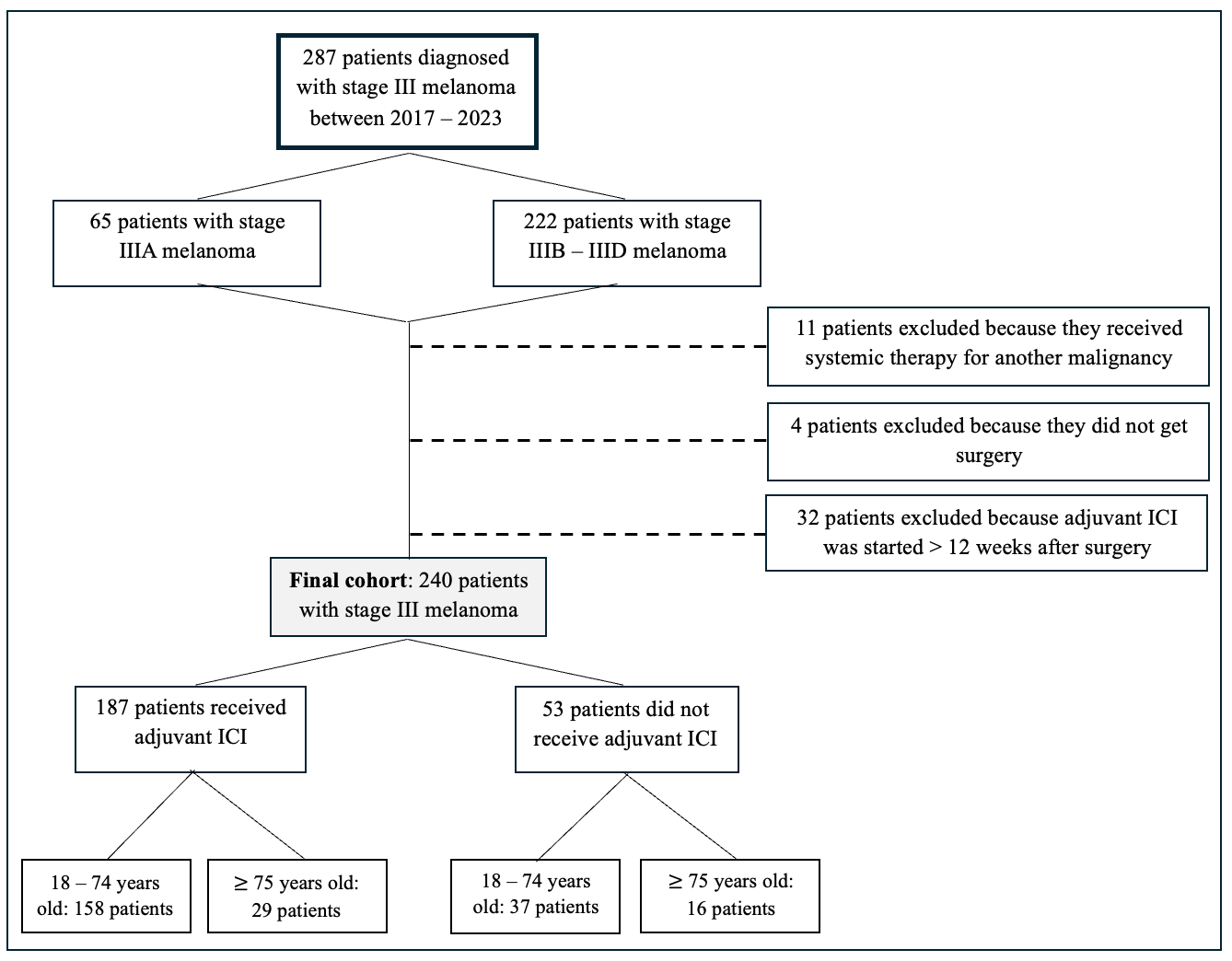
3.1. Receipt of First-Line Adjuvant Immunotherapy
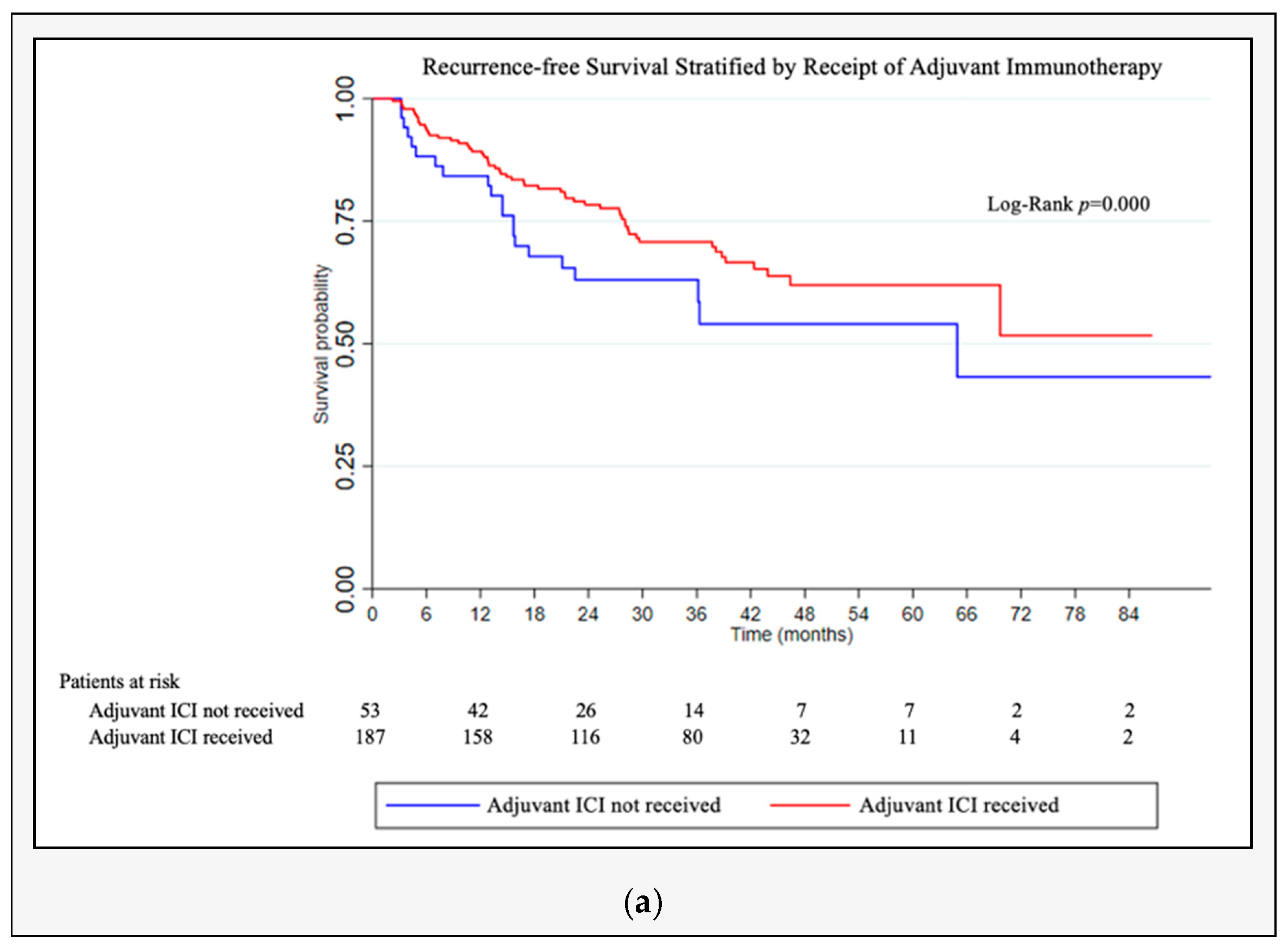
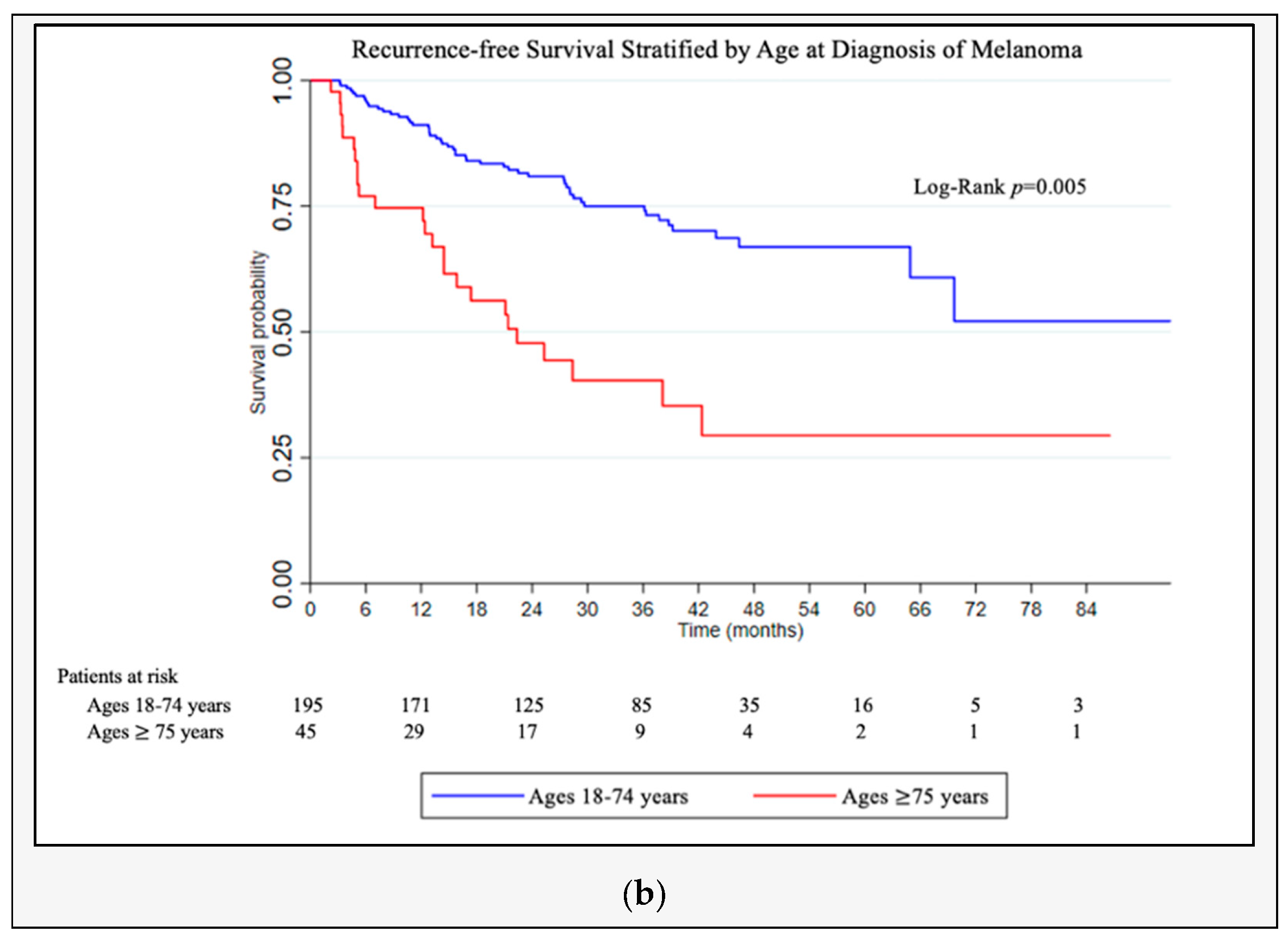
3.2. Recurrence-Free Survival (RFS)
3.3. Overall Survival (OS)
3.4. Toxicity from First-Line Adjuvant Immunotherapy
3.4.1. Likelihood of Experiencing Toxicity
3.4.2. Likelihood of Interruption in Treatment Due to Toxicity
3.4.3. Likelihood of Treatment Discontinuation Due to Toxicity
4. Discussion
5. Conclusions
Author Contributions
Funding
Institutional Review Board Statement
Informed Consent Statement
Data Availability Statement
Conflicts of Interest
Abbreviations
| CCI | Charlson–Deyo Comorbidity Index |
| ECOG | Eastern Cooperative Oncology Group |
| ICI | Immune Checkpoint Inhibitors |
| irAEs | Immunotherapy-related Adverse Events |
| RFS | Recurrence-free Survival |
Appendix A

| Odds of Experiencing Grade 3–4 Toxicity | Odds of Pausing Treatment Due to Grade 3–4 Toxicity | Odds of Treatment Cessation Due to Grade 3–4 Toxicity | ||||
|---|---|---|---|---|---|---|
| Variable | aOR (95% CI) | p-Value | aOR (95% CI) | p-Value | aOR (95% CI) | p-Value |
| Age at Diagnosis | ||||||
| 18–74 | Reference | Reference | Reference | |||
| ≥75 | 1.10 (0.41–2.96) | 0.854 | 0.65 (0.20–2.09) | 0.466 | 0.64 (0.16–2.66) | 0.542 |
| Sex | ||||||
| Male | Reference | Reference | Reference | |||
| Female | 2.29 (1.08–4.85) | 0.030 | 2.24 (1.01–5.00) | 0.048 | 3.04 (1.11–8.29) | 0.030 |
| Charlson Comorbidity Index | ||||||
| 0 | Reference | Reference | Reference | |||
| 1 | 3.16 (1.30–7.67) | 0.011 | 2.92 (1.15–7.38) | 0.024 | 1.57 (0.46–5.42) | 0.474 |
| 2 | 1.81 (0.67–4.94) | 0.245 | 1.42 (0.48–4.20) | 0.529 | 1.42 (0.39–5.16) | 0.597 |
| ≥3 | 0.74 (0.21–2.65) | 0.646 | 0.77 (0.19–3.18) | 0.720 | 1.42 (0.30–6.54) | 0.659 |
| ECOG | ||||||
| 0 | Reference | Reference | Reference | |||
| 1 | 1.06 (0.43–2.60) | 0.907 | 0.86 (0.32–2.31) | 0.766 | 1.07 (0.33–3.42) | 0.910 |
| 2–4 | 1.93 (0.41–9.18) | 0.406 | 1.42 (0.25–8.17) | 0.692 | 1.24 (0.13–12.2) | 0.852 |
| Unknown | - | - | - | |||
| Stage III | ||||||
| IIIA with lymph node metastasis ≤ 1 mm | Reference | Reference | Reference | |||
| IIIA with lymph node metastasis >1 mm | 0.84 (0.08–8.42) | 0.882 | 0.99 (0.10–10.3) | 0.996 | 1.30 (0.12–14.1) | 0.827 |
| IIIB | 2.36 (0.76–7.37) | 0.139 | 2.46 (0.73–8.29) | 0.147 | 1.41 (0.34–5.90) | 0.640 |
| IIIC | 2.13 (0.76–5.96) | 0.152 | 2.00 (0.66–6.07) | 0.224 | 1.28 (0.36–4.55) | 0.708 |
| IIID | 2.00 (0.27–14.9) | 0.497 | 3.42 (0.45–26.3) | 0.236 | 1.95 (0.16–23.2) | 0.598 |
References
- Swetter, S.M.; Johnson, D.; Albertini, M.R.; Barker, C.A.; Bateni, S.; Baumgartner, J.; Bhatia, S.; Bichakjian, C.; Boland, G.; Chandra, S.; et al. NCCN Guidelines® Insights: Melanoma: Cutaneous, Version 2.2024. J. Natl. Compr. Cancer Netw. 2024, 22, 290–298. [Google Scholar] [CrossRef]
- Eggermont, A.M.M.; Blank, C.U.; Mandalà, M.; Long, G.V.; Atkinson, V.G.; Dalle, S.; Haydon, A.M.; Meshcheryakov, A.; Khattak, A.; Carlino, M.S.; et al. Adjuvant pembrolizumab versus placebo in resected stage III melanoma (EORTC 1325-MG/KEYNOTE-054): Distant metastasis-free survival results from a double-blind, randomised, controlled, phase 3 trial. Lancet Oncol. 2021, 22, 643–654. [Google Scholar] [CrossRef]
- Eggermont, A.M.; Kicinski, M.; Blank, C.U.; Mandala, M.; Long, G.V.; Atkinson, V.; Dalle, S.; Haydon, A.; Meshcheryakov, A.; Khattak, A.; et al. Five-Year Analysis of Adjuvant Pembrolizumab or Placebo in Stage III Melanoma. NEJM Evid. 2022, 1, EVIDoa2200214. [Google Scholar] [CrossRef] [PubMed]
- Weber, J.; Mandalà, M.; Del Vecchio, M.; Gogas, H.J.; Arance, A.M.; Cowey, C.L.; Dalle, S.; Schenker, M.; Chiarion-Sileni, V.; Marquez-Rodas, I.; et al. Adjuvant Nivolumab versus Ipilimumab in Resected Stage III or IV Melanoma. N. Engl. J. Med. 2017, 377, 1824–1835. [Google Scholar] [CrossRef]
- Larkin, J.; Del Vecchio, M.; Mandalá, M.; Gogas, H.; Fernandez, A.M.A.; Dalle, S.; Cowey, C.L.; Schenker, M.; Grob, J.-J.; Chiarion-Sileni, V.; et al. Adjuvant Nivolumab versus Ipilimumab in Resected Stage III/IV Melanoma: 5-Year Efficacy and Biomarker Results from CheckMate 238. Clin. Cancer Res. 2023, 29, 3352–3361. [Google Scholar] [CrossRef]
- Eggermont, A.M.; Chiarion-Sileni, V.; Grob, J.-J.; Dummer, R.; Wolchok, J.D.; Schmidt, H.; Hamid, O.; Robert, C.; Ascierto, P.A.; Richards, J.M.; et al. Prolonged Survival in Stage III Melanoma with Ipilimumab Adjuvant Therapy. N. Engl. J. Med. 2016, 375, 1845–1855. [Google Scholar] [CrossRef] [PubMed]
- Bastiaannet, E.; Battisti, N.; Loh, K.P.; de Glas, N.; Soto-Perez-De-Celis, E.; Baldini, C.; Kapiteijn, E.; Lichtman, S. Immunotherapy and targeted therapies in older patients with advanced melanoma; Young International Society of Geriatric Oncology review paper. J. Geriatr. Oncol. 2019, 10, 389–397. [Google Scholar] [CrossRef]
- van Holstein, Y.; Kapiteijn, E.; Bastiaannet, E.; Bos, F.v.D.; Portielje, J.; de Glas, N.A. Efficacy and Adverse Events of Immunotherapy with Checkpoint Inhibitors in Older Patients with Cancer. Drugs Aging 2019, 36, 927–938. [Google Scholar] [CrossRef]
- Weichenthal, M.; Mangana, J.; Gavrilova, I.; Lugowska, I.; Shalamanova, G.K.; Kandolf, L.; Chiarion-Sileni, V.; Mohr, P.; Karanikolova, T.S.; Teterycz, P.; et al. Adjuvant Use of Pembrolizumab for Stage III Melanoma in a Real-World Setting in Europe. Cancers 2024, 16, 3558. [Google Scholar] [CrossRef]
- Paulson, K.G.; Gupta, D.; Kim, T.S.; Veatch, J.R.; Byrd, D.R.; Bhatia, S.; Wojcik, K.; Chapuis, A.G.; Thompson, J.A.; Madeleine, M.M.; et al. Age-Specific Incidence of Melanoma in the United States. JAMA Dermatol. 2020, 156, 57–64. [Google Scholar] [CrossRef]
- Elias, R.; Giobbie-Hurder, A.; McCleary, N.J.; Ott, P.; Hodi, F.S.; Rahma, O. Efficacy of PD-1 & PD-L1 inhibitors in older adults: A meta-analysis. J. Immunother. Cancer 2018, 6, 26. [Google Scholar] [CrossRef]
- Özkan, A.; Kapiteijn, E.; Bos, F.v.D.; Aarts, M.; Berkmortel, F.v.D.; Blank, C.; Bloem, M.; Blokx, W.; Boers-Sonderen, M.; Bonenkamp, J.; et al. Adjuvant immunotherapy in older patients with stage III and resected stage IV melanoma: Toxicity and recurrence-free survival outcomes from the Dutch melanoma treatment registry. Eur. J. Cancer 2024, 212, 115056. [Google Scholar] [CrossRef]
- de Meza, M.M.; Ismail, R.K.; Rauwerdink, D.; van Not, O.J.; van Breeschoten, J.; Blokx, W.A.; de Boer, A.; van Dartel, M.; Hilarius, D.L.; Ellebaek, E.; et al. Adjuvant treatment for melanoma in clinical practice—Trial versus reality. Eur. J. Cancer 2021, 158, 234–245. [Google Scholar] [CrossRef]
- Ikeguchi, A.; Machiorlatti, M.; Vesely, S.K. Disparity in outcomes of melanoma adjuvant immunotherapy by demographic profile. Melanoma Manag. 2020, 7, 2–10. [Google Scholar] [CrossRef]
- Wu, Q.; Wang, Q.; Tang, X.; Xu, R.; Zhang, L.; Chen, X.; Xue, Q.; Wang, Z.; Shi, R.; Wang, F.; et al. Correlation between patients’ age and cancer immunotherapy efficacy. Oncoimmunology 2019, 8, e1568810. [Google Scholar] [CrossRef]
- Mulligan, K.M.B.; Kakish, H.; Pawar, O.B.; Ahmed, F.A.; Elshami, M.M.; Rothermel, L.D.; Bordeaux, J.S.; Sheng, I.Y.; Mangla, A.; Hoehn, R.S. Disparities in Receipt of Adjuvant Immunotherapy among Stage III Melanoma Patients. Am. J. Clin. Oncol. 2024, 47, 509–516. [Google Scholar] [CrossRef]
- Bateni, S.B.; Johns, A.J.; Gingrich, A.A.; Gholami, S.; Bold, R.J.; Canter, R.J.; Kirane, A.R. Elderly Age Is Associated With More Conservative Treatment of Invasive Melanoma. Anticancer Res. 2020, 40, 2895–2903. [Google Scholar] [CrossRef] [PubMed]
- Jourdain, H.; Lavaud, J.; Descours, C.; Auditeau, E.; Bernard, P. Management of Melanoma in Elderly Patients over 80 Years. Acta Derm.-Venereol. 2024, 104, adv41029. [Google Scholar] [CrossRef]
- Jochems, A.; Bastiaannet, E.; Aarts, M.J.; van Akkooi, A.C.; Berkmortel, F.W.v.D.; Boers-Sonderen, M.J.; Eertwegh, A.J.v.D.; de Glas, N.G.; de Groot, J.W.B.; Haanen, J.B.; et al. Outcomes for systemic therapy in older patients with metastatic melanoma: Results from the Dutch Melanoma Treatment Registry. J. Geriatr. Oncol. 2021, 12, 1031–1038. [Google Scholar] [CrossRef]
- van der Kooij, M.K.; Wetzels, M.J.; Aarts, M.J.; Berkmortel, F.W.v.D.; Blank, C.U.; Boers-Sonderen, M.J.; Dierselhuis, M.P.; de Groot, J.W.B.; Hospers, G.A.; Piersma, D.; et al. Age does matter in adolescents and young adults versus older adults with advanced melanoma; a national cohort study comparing tumor characteristics, treatment pattern, toxicity and response. Cancers 2020, 12, 2072. [Google Scholar] [CrossRef] [PubMed]
- Balch, C.M. Decreased Survival Rates of Older-Aged Patients with Melanoma: Biological Differences or Undertreatment? Ann. Ann. Surg. Oncol. 2015, 22, 2101–2103. [Google Scholar] [CrossRef] [PubMed]
- Lodde, G.; Forschner, A.; Hassel, J.; Wulfken, L.M.; Meier, F.; Mohr, P.; Kähler, K.; Schilling, B.; Loquai, C.; Berking, C.; et al. Factors influencing the adjuvant therapy decision: Results of a real-world multicenter data analysis of 904 melanoma patients. Cancers 2021, 13, 2319. [Google Scholar] [CrossRef]
- Betof, A.S.; Nipp, R.D.; Giobbie-Hurder, A.; Johnpulle, R.A.N.; Rubin, K.; Rubinstein, S.M.; Flaherty, K.T.; Lawrence, D.P.; Johnson, D.B.; Sullivan, R.J. Impact of Age on Outcomes with Immunotherapy for Patients with Melanoma. Oncologist 2017, 22, 963–971. [Google Scholar] [CrossRef]
- Perier-Muzet, M.; Gatt, E.; Péron, J.; Falandry, C.; Amini-Adlé, M.; Thomas, L.; Dalle, S.; Boespflug, A. Association of immunotherapy with overall survival in elderly patients with melanoma. JAMA Dermatol. 2018, 154, 82–87. [Google Scholar] [CrossRef]
- Archibald, W.J.; Victor, A.I.; Strawderman, M.S.; Maggiore, R.J. Immune checkpoint inhibitors in older adults with melanoma or cutaneous malignancies: The Wilmot Cancer Institute experience. J. Geriatr. Oncol. 2020, 11, 496–502. [Google Scholar] [CrossRef]
- Ksienski, D.; Truong, P.T.; Croteau, N.S.; Chan, A.; Sonke, E.; Patterson, T.; Clarkson, M.; Hackett, S.; Lesperance, M. Immune related adverse events and treatment discontinuation in patients older and younger than 75 years with advanced melanoma receiving nivolumab or pembrolizumab. J. Geriatr. Oncol. 2022, 13, 220–227. [Google Scholar] [CrossRef]
- Lens, M.; Schachter, J. Immune Checkpoint Inhibitors in the Treatment of Advanced Melanoma in Older Patients: An Overview of Published Data. Cancers 2025, 17, 1835. [Google Scholar] [CrossRef]
- Arora, S.; Kumar, L. Immune checkpoint inhibitors in older patients with cancer. Cancer Res. Cancer Res. Stat. Treat. 2021, 4, 368–369. [Google Scholar] [CrossRef] [PubMed]
- Samani, A.; Zhang, S.; Spiers, L.; Suwaidan, A.A.; Merrick, S.; Tippu, Z.; Payne, M.; Faust, G.; Papa, S.; Fields, P.; et al. Impact of age on the toxicity of immune checkpoint inhibition. J. Immunother. Cancer 2020, 8, e000871. [Google Scholar] [CrossRef] [PubMed]
- Gomes, F.; Lorigan, P.; Woolley, S.; Foden, P.; Burns, K.; Yorke, J.; Blackhall, F. A prospective cohort study on the safety of checkpoint inhibitors in older cancer patients—The ELDERS study. ESMO Open 2021, 6, 100042. [Google Scholar] [CrossRef]
- Pathmanathan, S.; Babu, H.S.; Dzienis, M.R.; Azer, M.; Eastgate, M.A. Toxicity and response to ipilimumab and nivolumab in elderly patients with metastatic melanoma: A multicenter retrospective analysis. J. Clin. Oncol. 2022, 40, e21540. [Google Scholar] [CrossRef]
- De Luca, R.; Meraviglia, S.; Blasi, L.; Maiorana, A.; Cicero, G. Nivolumab in metastatic melanoma: Good efficacy and tolerability in elderly patients. Curr. Oncol. 2020, 27, 75–80. [Google Scholar] [CrossRef]
- Ridolfi, L.; De Rosa, F.; Petracci, E.; Tanda, E.T.; Marra, E.; Pigozzo, J.; Marconcini, R.; Guida, M.; Cappellini, G.C.A.; Gallizzi, G.; et al. Anti-PD1 antibodies in patients aged ≥ 75 years with metastatic melanoma: A retrospective multicentre study. J. Geriatr. Oncol. 2020, 11, 515–522. [Google Scholar] [CrossRef]
- Blaise, M.; Fontas, E.; Seitz-Polski, B.; Troin, L.; Picard, A.; Rousset, P.; Long-Mira, E.; Razzouk-Cadet, M.; Chassang, M.; Passeron, T.; et al. Real-world experience of adjuvant immunotherapy for stages III–IV melanoma: A monocentric observational study. JEADV Clin. Pract. 2025, 4, 425–439. [Google Scholar] [CrossRef]
- Gawaz, A.; Wolff, I.; Nanz, L.; Flatz, L.; Forschner, A. Efficacy of adjuvant immune checkpoint inhibitors pembrolizumab or nivolumab in melanoma patients ≥ 75 years: Results of a real-world cohort including 456 patients. Cancer Immunol. Immunother. 2024, 73, 185. [Google Scholar] [CrossRef] [PubMed]
- Wildiers, H.; Heeren, P.; Puts, M.; Topinkova, E.; Janssen-Heijnen, M.L.; Extermann, M.; Falandry, C.; Artz, A.; Brain, E.; Colloca, G.; et al. International society of geriatric oncology consensus on geriatric assessment in older patients with cancer. J. Clin. Oncol. 2014, 32, 2595–2603. [Google Scholar] [CrossRef]
- Cook, S.L.; Amin, A.; Bari, S.; Poonnen, P.J.; Khasraw, M.; Johnson, M.O. Immune Checkpoint Inhibitors in Geriatric Oncology. Curr. Oncol. Rep. 2024, 26, 562–572. [Google Scholar] [CrossRef]
- Bruijnen, C.P.; Koldenhof, J.J.; Verheijden, R.J.; Bos, F.v.D.; Emmelot-Vonk, M.H.; Witteveen, P.O.; Suijkerbuijk, K.P.M. Frailty and checkpoint inhibitor toxicity in older patients with melanoma. Cancer 2022, 128, 2746–2752. [Google Scholar] [CrossRef] [PubMed]
- Segura, S.; Podlipnik, S.; Boada, A.; Martí, R.M.; Sabat, M.; Yélamos, O.; Inés, Z.-M.; Antoni, A.-M.; Daniel, L.-C.; Joaquim, S.; et al. Melanoma-specific survival is worse in the elderly: A multicentric cohort study. Melanoma Res. 2023, 33, 532–538. [Google Scholar] [CrossRef]
- Russo, A.E.; Ferraù, F.; Antonelli, G.; Priolo, D.; McCubrey, J.A.; Libra, M. Malignant melanoma in elderly patients: Biological, surgical and medical issues. Expert Rev. Anticancer Ther. 2015, 15, 101–108. [Google Scholar] [CrossRef]
- Cil, E.; Gomes, F. Toxicity of Cancer Immunotherapies in Older Patients: Does Age Make a Difference? Drugs Aging 2024, 41, 787–794. [Google Scholar] [CrossRef]
- de Glas, N.A.; Bastiaannet, E.; Bos, F.v.D.; Mooijaart, S.P.; van der Veldt, A.A.M.; Suijkerbuijk, K.P.M.; Aarts, M.J.B.; Berkmortel, F.W.P.J.v.D.; Blank, C.U.; Boers-Sonderen, M.J.; et al. Toxicity, response and survival in older patients with metastatic melanoma treated with checkpoint inhibitors. Cancers 2021, 13, 2826. [Google Scholar] [CrossRef]
- Aziz, N.A.; Burke, D.; Khalifa, W.; Ragavan, S.; Board, R.; Oladipo, O. Real-World Impact of Low-Grade Toxicities to Adjuvant Pembrolizumab in Stage III Melanoma. JCO Oncol. Pract. 2025, 21, 1665–1671. [Google Scholar] [CrossRef] [PubMed]
- National Institutes of Health (NIH). Common Terminology Criteria for Adverse Events (CTCAE) v6.0 (MedDRA 28.0); National Institutes of Health (NIH): Rockville Pike, MD, USA, 2025.
- Szumilas, M. Explaining Odds Ratios. J. Can. Acad. Child Adolesc. Psychiatry 2010, 19, 227–229. [Google Scholar] [PubMed]
- Georgiev, P.; Han, S.; Huang, A.Y.; Nguyen, T.H.; Drijvers, J.M.; Creasey, H.; Pereira, J.A.; Yao, C.-H.; Park, J.S.; Conway, T.S.; et al. Age-Associated Contraction of Tumor-Specific T Cells Impairs Antitumor Immunity. Cancer Immunol. Res. 2024, 12, 1525–1541. [Google Scholar] [CrossRef]
- Boussiotis, V.A. Molecular and Biochemical Aspects of the PD-1 Checkpoint Pathway. N. Engl. J. Med. 2016, 375, 1767–1778. [Google Scholar] [CrossRef]
- Barnhill, R.L.; Piepkorn, M.W.; Cochran, A.J.; Flynn, E.; Karaoli, T.; Folkman, J. Tumor vascularity, proliferation, and apoptosis in human melanoma micrometastases and macrometastases. Arch. Dermatol. 1998, 134, 991–994. [Google Scholar] [CrossRef]
- Tumeh, P.C.; Harview, C.L.; Yearley, J.H.; Shintaku, I.P.; Taylor, E.J.M.; Robert, L.; Chmielowski, B.; Spasic, M.; Henry, G.; Ciobanu, V.; et al. PD-1 blockade induces responses by inhibiting adaptive immune resistance. Nature 2014, 515, 568–571. [Google Scholar] [CrossRef] [PubMed]
- Al-Danakh, A.; Safi, M.; Jian, Y.; Yang, L.; Zhu, X.; Chen, Q.; Yang, K.; Wang, S.; Zhang, J.; Yang, D. Aging-related biomarker discovery in the era of immune checkpoint inhibitors for cancer patients. Front. Immunol. 2024, 15, 1348189. [Google Scholar] [CrossRef]
- Franceschi, C.; Campisi, J. Chronic inflammation (Inflammaging) and its potential contribution to age-associated diseases. J. Gerontol. Ser. A Biol. Sci. Med. Sci. 2014, 69, S4–S9. [Google Scholar] [CrossRef]
- Ascierto, P.A.; Del Vecchio, M.; Merelli, B.; Gogas, H.; Arance, A.M.; Dalle, S.; Cowey, C.L.; Schenker, M.; Gaudy-Marqueste, C.; Pigozzo, J.; et al. Nivolumab for Resected Stage III or IV Melanoma at 9 Years. N. Engl. J. Med. 2026, 394, 333–342. [Google Scholar] [CrossRef] [PubMed]
- Long, G.V.; Hauschild, A.; Santinami, M.; Kirkwood, J.M.; Atkinson, V.; Mandala, M.; Merelli, B.; Sileni, V.C.; Nyakas, M.; Haydon, A.; et al. Final Results for Adjuvant Dabrafenib plus Trametinib in Stage III Melanoma. N. Engl. J. Med. 2024, 391, 1709–1720. [Google Scholar] [CrossRef] [PubMed]
- Boostani, M.; Pellacani, G.; Goldust, M.; Nádudvari, N.; Rátky, D.; Cantisani, C.; Lőrincz, K.; Bánvölgyi, A.; Wikonkál, N.M.; Paragh, G.; et al. Diagnosing Actinic Keratosis and Squamous Cell Carcinoma With Large Language Models From Clinical Images. Int. J. Dermatol. 2026, 65, 1246–1248. [Google Scholar] [CrossRef]
- Boostani, M.; Zouboulis, C.C.; Pellacani, G.; Navarrete-Dechent, C.; Boussingault, L.; Kiss, T.; Goldfarb, N.; Cantisani, C.; Nádudvari, N.; Bánvölgyi, A.; et al. ChatGPT, Gemini, and Claude in clinical and dermoscopic image analysis of basal cell carcinoma and its common mimickers: A comparative performance analysis. JID Innov. Skin. Sci. From Mol. Popul. Health 2026, 6, 100463. [Google Scholar] [CrossRef] [PubMed]
- Boostani, M.; Lallas, A.; Goldust, M.; Nádudvari, N.; Lőrincz, K.; Bánvölgyi, A.; Holló, P.; Wikonkál, N.M.; Paragh, G.; Kiss, N. Diagnostic performance of multimodal large language models in distinguishing melanoma from nevi in clinical and dermoscopic images. JAAD Int. 2025, 23, 58–60. [Google Scholar] [CrossRef]
- Luke, J.J.; Ascierto, P.A.; Khattak, M.A.; Merino, L.d.l.C.; Del Vecchio, M.; Rutkowski, P.; Spagnolo, F.; Mackiewicz, J.; Chiarion-Sileni, V.; Kirkwood, J.M.; et al. Pembrolizumab Versus Placebo as Adjuvant Therapy in Resected Stage IIB or IIC Melanoma: Final Analysis of Distant Metastasis-Free Survival in the Phase III KEYNOTE-716 Study. J. Clin. Oncol. 2024, 42, 1619–1624. [Google Scholar] [CrossRef]
- Kirkwood, J.M.; Del Vecchio, M.; Weber, J.; Hoeller, C.; Grob, J.-J.; Mohr, P.; Loquai, C.; Dutriaux, C.; Chiarion-Sileni, V.; Mackiewicz, J.; et al. Adjuvant nivolumab in resected stage IIB/C melanoma: Primary results from the randomized, phase 3 CheckMate 76K trial. Nat. Med. 2023, 29, 2835–2843. [Google Scholar] [CrossRef]
- ECOG-ACRIN Cancer Research Group. A Randomized Phase III Study of Management of Treatment Naive Primary Melanoma in Elderly Patients. 2026. Available online: https://ecog-acrin.org/clinical-trials/ea6244-skin-cancer-melanoma/ (accessed on 3 March 2026).
- Bai, Y.; Liu, H.; Meng, H. Sex-specific reporting patterns and onset timing of immune-related adverse events associated with nivolumab and pembrolizumab: A dual-database pharmacovigilance analysis. Front. Immunol. 2026, 17, 1837640. [Google Scholar] [CrossRef]
- Tan, F.; Zhou, L.; Huang, G.; Li, Y.; Yin, W.; Xia, H. Analysis of Immune-Related Adverse Events of Pembrolizumab Using FAERS Database. Oncology 2025, 103, 1147–1159. [Google Scholar] [CrossRef]
- Unger, J.M.; Vaidya, R.; Albain, K.S.; LeBlanc, M.; Minasian, L.M.; Gotay, C.C.; Henry, N.L.; Fisch, M.J.; Lee, S.M.; Blanke, C.D.; et al. Sex Differences in Risk of Severe Adverse Events in Patients Receiving Immunotherapy, Targeted Therapy, or Chemotherapy in Cancer Clinical Trials. J. Clin. Oncol. 2022, 40, 1474–1486. [Google Scholar] [CrossRef] [PubMed]
- Duma, N.; Abdel-Ghani, A.; Yadav, S.; Hoversten, K.P.; Reed, C.T.; Sitek, A.N.; Enninga, E.A.L.; Paludo, J.; Aguilera, J.V.; Leventakos, K.; et al. Sex Differences in Tolerability to Anti-Programmed Cell Death Protein 1 Therapy in Patients with Metastatic Melanoma and Non-Small Cell Lung Cancer: Are We All Equal? Oncologist 2019, 24, e1148–e1155. [Google Scholar] [CrossRef] [PubMed]
- Vitale, E.; Rizzo, A.; Maistrello, L.; Guven, D.C.; Massafra, R.; Mollica, V.; Monteiro, F.S.M.; Santoni, M.; Massari, F. Sex differences in adverse events among cancer patients receiving immune checkpoint inhibitors: The MOUSEION-07 systematic review and meta-analysis. Sci. Rep. 2024, 14, 28309. [Google Scholar] [CrossRef] [PubMed]
- Wahli, M.N.; Hayoz, S.; Hoch, D.; Ryser, C.O.; Hoffmann, M.; Scherz, A.; Schwacha-Eipper, B.; Häfliger, S.; Wampfler, J.; Berger, M.D.; et al. The role of immune checkpoint inhibitors in clinical practice: An analysis of the treatment patterns, survival and toxicity rates by sex. J. Cancer Res. Clin. Oncol. 2023, 149, 3847–3858. [Google Scholar] [CrossRef]


| Age 18–74 Years (N = 195) | Age 75+ Years (N = 45) | p-Value | |
|---|---|---|---|
| n (%) | n (%) | ||
| Sex | 0.490 | ||
| Male | 106 (54.4%) | 27 (60.0%) | |
| Female | 89 (45.6%) | 18 (40.0%) | |
| Charlson Comorbidity Index | <0.001 | ||
| 0 | 106 (54.4%) | 12 (26.7%) | |
| 1 | 35 (17.0%) | 9 (20.0%) | |
| 2 | 6 (3.1%) | 6 (13.3%) | |
| 3+ | 23 (11.8%) | 18 (40.0%) | |
| ECOG | <0.001 | ||
| 0 | 151 (77.4%) | 22 (48.9%) | |
| 1 | 35 (17.9%) | 14 (31.1%) | |
| 2–4 | 6 (3.1%) | 5 (11.1%) | |
| Unknown | 3 (1.5%) | 4 (8.9%) | |
| Tumor Location | 0.002 | ||
| Trunk or Extremities | 167 (85.6%) | 30 (66.7%) | |
| Head and Neck | 21 (10.8%) | 14 (31.1%) | |
| Other | 7 (3.6%) | 1 (2.2%) | |
| Stage III | 0.202 | ||
| III | 2 (1.0%) | 1 (2.2%) | |
| IIIA with lymph node metastasis ≤ 1 mm | 46 (23.6%) | 4 (8.9%) | |
| IIIA with lymph node metastasis > 1 mm | 10 (5.1%) | 1 (2.2%) | |
| IIIB | 52 (26.7%) | 7 (15.6%) | |
| IIIC | 81 (41.5%) | 27 (60.0%) | |
| IIID | 4 (2.1%) | 5 (11.1%) | |
| Ulceration | 0.960 | ||
| No | 104 (53.3%) | 25 (55.6%) | |
| Yes | 78 (40.0%) | 17 (37.8%) | |
| Unknown | 13 (6.7%) | 3 (6.7%) | |
| Lymphovascular Invasion | 0.690 | ||
| No | 161 (82.6%) | 36 (80.0%) | |
| Yes | 18 (9.2%) | 6 (13.3%) | |
| Unknown | 16 (8.2%) | 3 (6.7%) | |
| Receipt of Adjuvant ICI | 0.016 | ||
| No | 37 (19.0%) | 16 (35.6%) | |
| Yes | 158 (81.0%) | 29 (64.4%) |
| Covariate | aOR (95% CI) | p-Value |
|---|---|---|
| Age at Diagnosis | ||
| 18–74 | Reference | |
| ≥75 | 0.30 (0.11–0.80) | 0.017 |
| Sex | ||
| Male | Reference | |
| Female | 1.14 (0.53–2.42) | 0.743 |
| Charlson Comorbidity Index | ||
| 0 | Reference | |
| 1 | 0.40 (0.15–1.06) | 0.066 |
| 2 | 0.47 (0.16–1.38) | 0.168 |
| ≥3 | 0.30 (0.10–0.89) | 0.030 |
| ECOG | ||
| 0 | Reference | |
| 1 | 0.61 (0.25–1.51) | 0.288 |
| 2–4 | 0.25 (0.05–1.24) | 0.091 |
| Unknown | 0.36 (0.06–2.13) | 0.262 |
| Tumor location | ||
| Trunk or Extremities | Reference | |
| Head and Neck | 1.10 (0.39–3.11) | 0.862 |
| Other | 0.15 (0.01–2.88) | 0.207 |
| Stage III | ||
| IIIA with lymph node metastasis ≤ 1 mm | Reference | |
| IIIA with lymph node metastasis > 1 mm | 5.35 (0.85–33.6) | 0.074 |
| IIIB | 7.19 (2.47–20.9) | 0.000 |
| IIIC | 11.1 (3.49–35.4) | 0.000 |
| IIID | 43.3 (2.85–659) | 0.007 |
| Ulceration | ||
| No | Reference | |
| Yes | 0.80 (0.30–2.13) | 0.525 |
| Unknown | 21.1 (1.24–359) | 0.035 |
| Lymphovascular Invasion | ||
| No | Reference | |
| Yes | 1.28 (0.32–5.09) | 0.967 |
| Unknown | 0.24 (0.04–1.37) | 0.123 |
| (a) | ||||||
| Patient’s Choice | Not Offered by Physician | Comorbid Autoimmunity | Other Comorbid Condition | Unknown Reason | ||
| N(%) | 31 (58%) | 8 (15%) | 5 (9%) | 3 (6%) | 6 (11%) | Total = 53 |
| (b) | ||||||
| Age Group | Total Number of Patients in Study | Patients Who Were Eligible but did not Receive Adjuvant ICI | ||||
| Patient’s Choice | Not Offered by Physician | Other Comorbid Condition | Total | |||
| N (%) | N (%) | N (%) | N (%) | |||
| 75–80 years | 17 | 1 (6%) | 1 (6%) | - | 2 (12%) | |
| 80–90 years | 27 | 6 (22%) | 1 (4%) | 2 (7%) | 9 (33%) | |
| >90 years | 1 | - | - | - | - | |
| Covariate | aHR (95% CI) | p-Value |
|---|---|---|
| Age at Diagnosis | ||
| 18–74 | Reference | |
| ≥75 | 1.79 (1.04–3.10) | 0.037 |
| Sex | ||
| Male | Reference | |
| Female | 0.71 (0.43–1.16) | 0.177 |
| Tumor location | ||
| Trunk or Extremities | Reference | |
| Head and Neck | 1.58 (0.84–2.97) | 0.158 |
| Other | 2.32 (0.45–11.9) | 0.313 |
| Stage III | ||
| IIIA with lymph node metastasis ≤ 1 mm | Reference | |
| IIIA with lymph node metastasis > 1 mm | 3.77 (1.05–13.6) | 0.043 |
| IIIB | 0.98 (0.33–2.91) | 0.967 |
| IIIC | 3.84 (1.47–10.0) | 0.006 |
| IIID | 14.3 (3.72–54.6) | 0.000 |
| Ulceration | ||
| No | Reference | |
| Yes | 1.46 (0.83–2.59) | 0.192 |
| Unknown | 0.55 (0.05–2.40) | 0.273 |
| Lymphovascular Invasion | ||
| No | Reference | |
| Yes | 2.74 (1.50–5.00) | 0.001 |
| Unknown | 0.88 (0.24–3.30) | 0.852 |
| Receipt of Adjuvant ICI | ||
| No | Reference | |
| Yes | 0.76 (0.63–0.92) | 0.005 |
| Covariate | aHR (95% CI) | p-Value |
|---|---|---|
| Age at Diagnosis | ||
| 18–74 | Reference | |
| ≥75 | 3.07 (1.43–6.57) | 0.004 |
| Sex | ||
| Male | Reference | |
| Female | 1.06 (0.50–2.26) | 0.876 |
| Tumor location | ||
| Trunk or Extremities | Reference | |
| Head and Neck | 3.52 (1.61–7.73) | 0.002 |
| Other | 2.85 (0.25–32.9) | 0.402 |
| Stage III | ||
| IIIA with lymph node metastasis ≤ 1 mm | Reference | |
| IIIA with lymph node metastasis > 1 mm | 4.31 (0.68–27.3) | 0.121 |
| IIIB | 2.20 (0.52–9.31) | 0.286 |
| IIIC | 2.76 (0.73–10.4) | 0.136 |
| IIID | 29.0 (5.38–155) | 0.000 |
| Ulceration | ||
| No | Reference | |
| Yes | 0.65 (0.27–1.60) | 0.352 |
| Unknown | 7.44 (1.19–46.6) | 0.032 |
| Lymphovascular Invasion | ||
| No | Reference | |
| Yes | 1.44 (0.43–4.78) | 0.553 |
| Unknown | 0.02 (0.001–0.47) | 0.014 |
| Receipt of Adjuvant ICI | ||
| No | Reference | |
| Yes | 0.91 (0.67–1.23) | 0.546 |
| Odds of Experiencing Any Toxicity | Odds of Pausing Treatment Due to Any Toxicity | Odds of Treatment Cessation Due to Any Toxicity | |||||||
|---|---|---|---|---|---|---|---|---|---|
| Variable | N | aOR (95% CI) | p-Value | N | aOR (95% CI) | p-Value | N | aOR (95% CI) | p-Value |
| Age at Diagnosis | |||||||||
| 18–74 | 33 | Reference | 30 | Reference | 18 | Reference | |||
| ≥75 | 8 | 1.16 (0.48–2.82) | 0.736 | 5 | 1.04 (0.48–2.25) | 0.929 | 3 | 1.64 (0.71–3.77) | 0.247 |
| Sex | |||||||||
| Male | Reference | Reference | Reference | ||||||
| Female | 1.97 (1.07–3.63) | 0.029 | 1.54 (0.87–2.74) | 0.142 | 1.68 (0.89–3.17) | 0.107 | |||
| Charlson Comorbidity Index | |||||||||
| 0 | Reference | Reference | Reference | ||||||
| 1 | 1.55 (0.69–3.52) | 0.291 | 2.37 (1.11–5.09) | 0.026 | 1.97 (0.85–4.54) | 0.114 | |||
| 2 | 1.15 (0.49–2.69) | 0.751 | 1.41 (0.62–3.19) | 0.412 | 1.40 (0.57–3.42) | 0.458 | |||
| ≥3 | 0.83 (0.31–2.17) | 0.700 | 2.33 (0.98–5.55) | 0.056 | 2.45 (0.95–6.27) | 0.063 | |||
| ECOG | |||||||||
| 0 | Reference | Reference | Reference | ||||||
| 1 | 1.07 (0.49–2.31) | 0.867 | 0.74 (0.36–1.53) | 0.418 | 1.15 (0.53–2.49) | 0.724 | |||
| 2–4 | 1.31 (0.28–6.09) | 0.727 | 0.79 (0.21–3.00) | 0.723 | 0.94 (0.22–3.93) | 0.930 | |||
| Unknown | - | 0.56 (0.08–3.87) | 0.556 | 0.88 (0.13–6.07) | 0.893 | ||||
| Stage III | |||||||||
| IIIA with lymph node metastasis ≤ 1 mm | Reference | Reference | Reference | ||||||
| IIIA with lymph node metastasis > 1 mm | 1.24 (0.26–5.92) | 0.788 | 0.13 (0.02–0.70) | 0.018 | 0.16 (0.03–0.88) | 0.035 | |||
| IIIB | 1.18 (0.45–3.13) | 0.735 | 0.47 (0.21–1.07) | 0.072 | 0.27 (011–0.63) | 0.003 | |||
| IIIC | 0.94 (0.39–2.27) | 0.889 | 0.28 (0.13–0.59) | 0.001 | 0.15 (0.07–0.34) | 0.000 | |||
| IIID | 1.06 (0.19–5.85) | 0.950 | 0.25 (0.05–1.29) | 0.097 | 0.12 (0.02–0.78) | 0.026 | |||
Disclaimer/Publisher’s Note: The statements, opinions and data contained in all publications are solely those of the individual author(s) and contributor(s) and not of MDPI and/or the editor(s). MDPI and/or the editor(s) disclaim responsibility for any injury to people or property resulting from any ideas, methods, instructions or products referred to in the content. |
© 2026 by the authors. Licensee MDPI, Basel, Switzerland. This article is an open access article distributed under the terms and conditions of the Creative Commons Attribution (CC BY) license.
Share and Cite
Bhatty, M.A.; Chakraborty, N.N.; Zablonski, K.G.; Boone, J.M.; Seibert, H.; Lal, T.; Kakish, H.; Stevens, M.N.; Sheng, I.Y.; Hanna, A.N.; et al. The Use and Utility of Adjuvant Checkpoint Inhibitors in Elderly Patients with Melanoma: A Single Institution Experience. Cancers 2026, 18, 1893. https://doi.org/10.3390/cancers18121893
Bhatty MA, Chakraborty NN, Zablonski KG, Boone JM, Seibert H, Lal T, Kakish H, Stevens MN, Sheng IY, Hanna AN, et al. The Use and Utility of Adjuvant Checkpoint Inhibitors in Elderly Patients with Melanoma: A Single Institution Experience. Cancers. 2026; 18(12):1893. https://doi.org/10.3390/cancers18121893
Chicago/Turabian StyleBhatty, Maira A., Natalie N. Chakraborty, Kevin G. Zablonski, Jarred M. Boone, Hailey Seibert, Trisha Lal, Hanna Kakish, Madelyn N. Stevens, Iris Y. Sheng, Andrew N. Hanna, and et al. 2026. "The Use and Utility of Adjuvant Checkpoint Inhibitors in Elderly Patients with Melanoma: A Single Institution Experience" Cancers 18, no. 12: 1893. https://doi.org/10.3390/cancers18121893
APA StyleBhatty, M. A., Chakraborty, N. N., Zablonski, K. G., Boone, J. M., Seibert, H., Lal, T., Kakish, H., Stevens, M. N., Sheng, I. Y., Hanna, A. N., Mangla, A., Hoehn, R. S., & Rothermel, L. D. (2026). The Use and Utility of Adjuvant Checkpoint Inhibitors in Elderly Patients with Melanoma: A Single Institution Experience. Cancers, 18(12), 1893. https://doi.org/10.3390/cancers18121893