Reduced Local Tumor Progression After Thermal Ablation During Atezolizumab Plus Bevacizumab Treatment for Hepatocellular Carcinoma
 , , , , , and
Simple Summary
Abstract
1. Introduction
2. Materials and Methods
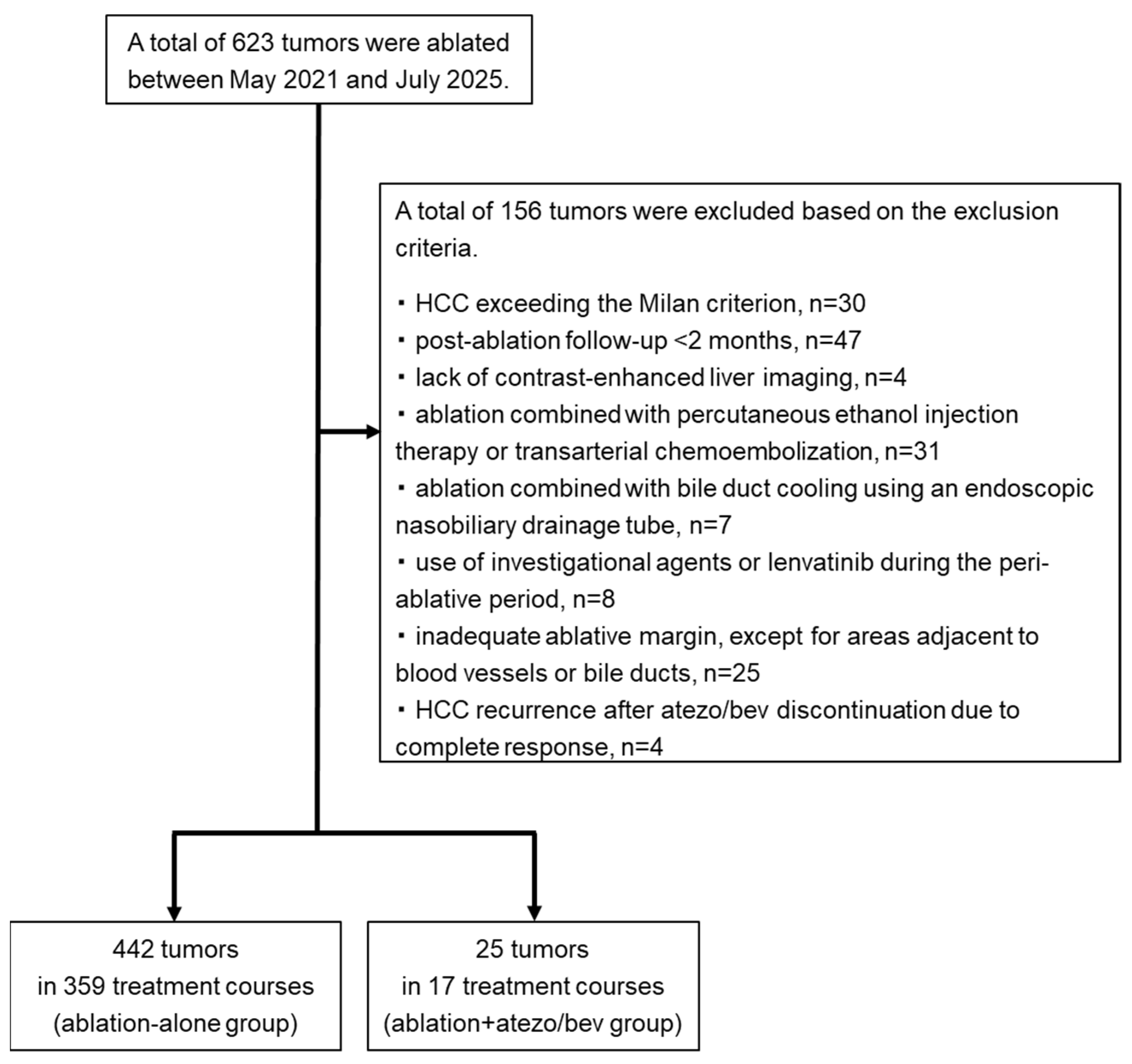
2.1. Study Population
2.2. Thermal Ablation Technique
2.3. Definition of a High-Risk Location
2.4. Atezo/Bev Treatment
2.5. Evaluation of Treatment Effect and Safety
2.6. Follow-Up Surveillance
2.7. Statistical Methods and Analysis
3. Results
3.1. Characteristics of Ablated Tumors and Treatment Courses
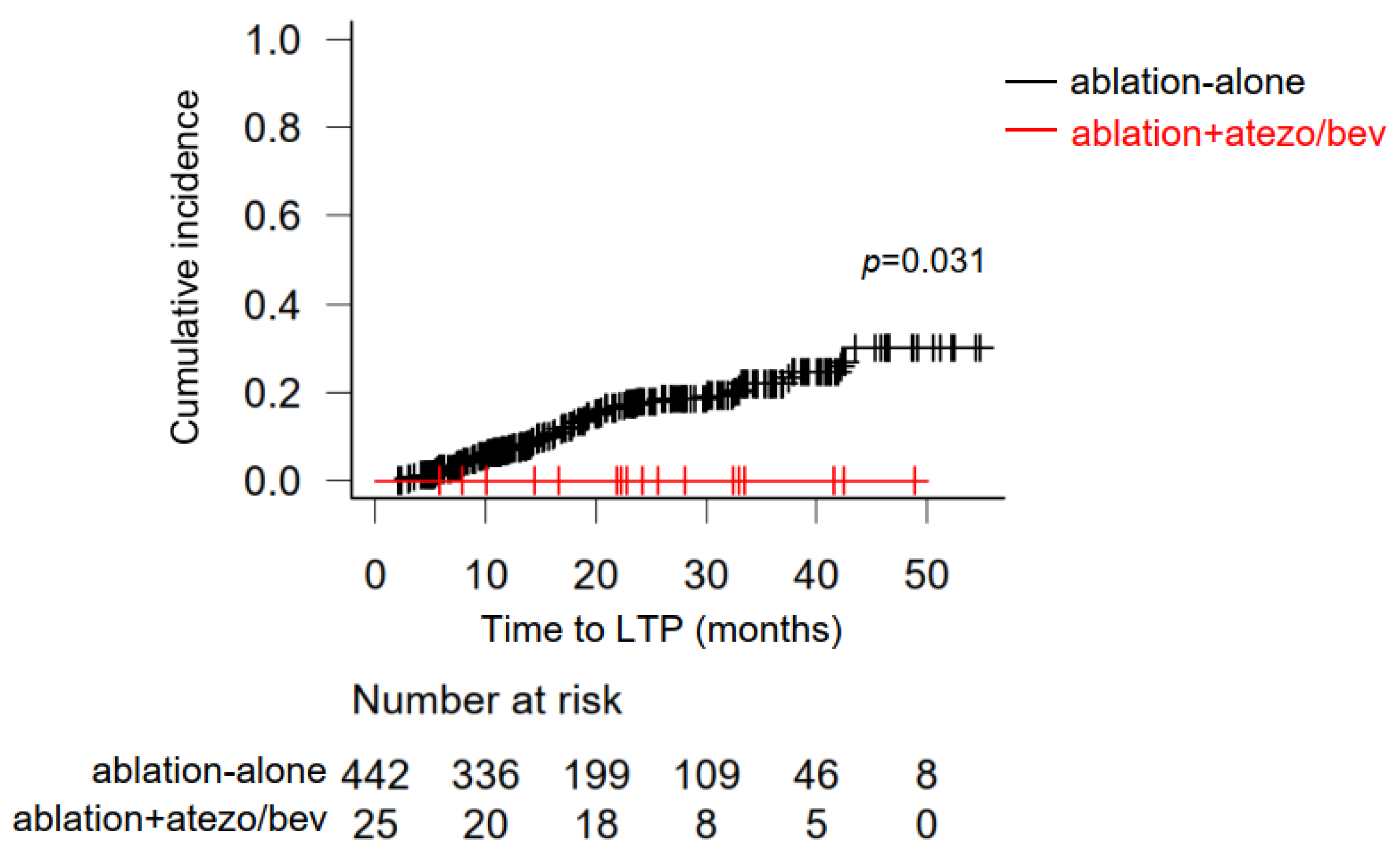
3.2. Comparison of LTP Between the Ablation-Alone and Ablation + Atezo/Bev Groups
3.3. Factors Associated with LTP After Ablation
3.4. Comparison of Ablation Procedure-Related Complications Between the Ablation-Alone and Ablation + Atezo/Bev Groups
4. Discussion
5. Conclusions
Supplementary Materials
Author Contributions
Funding
Institutional Review Board Statement
Informed Consent Statement
Data Availability Statement
Acknowledgments
Conflicts of Interest
Abbreviations
| ABC conversion | atezolizumab plus bevacizumab curative conversion |
| AFP | alpha-fetoprotein atezo/bev atezolizumab plus bevacizumab |
| ALBI | albumin–bilirubin |
| CI | confidence interval |
| CR | complete response |
| CT | computed tomography |
| DCP | des-gamma-carboxy prothrombin |
| EOB-MRI | gadolinium–ethoxybenzyl diethylenetriamine pentaacetic acid-enhanced magnetic resonance imaging |
| HCC | hepatocellular carcinoma |
| HR | hazard ratio |
| LRT | locoregional treatment |
| LTP | local tumor progression |
| MWA | microwave ablation |
| PD | progressive disease |
| RFA | radiofrequency ablation |
| VEGF | vascular endothelial growth factor |
References
- Llovet, J.M.; Kelley, R.K.; Villanueva, A.; Singal, A.G.; Pikarsky, E.; Roayaie, S.; Lencioni, R.; Koike, K.; Zucman-Rossi, J.; Finn, R.S. Hepatocellular carcinoma. Nat. Rev. Dis. Primers 2021, 7, 6. [Google Scholar] [CrossRef]
- Llovet, J.M.; Villanueva, A.; Marrero, J.A.; Schwartz, M.; Meyer, T.; Galle, P.R.; Lencioni, R.; Greten, T.F.; Kudo, M.; Mandrekar, S.J.; et al. AASLD Panel of Experts on Trial Design in HCC. Trial design and endpoints in hepatocellular carcinoma: AASLD consensus conference. Hepatology 2021, 73, 158–191. [Google Scholar] [CrossRef]
- Lee, M.W.; Kang, D.; Lim, H.K.; Cho, J.; Sinn, D.H.; Kang, T.W.; Song, K.D.; Rhim, H.; Cha, D.I.; Lu, D.S.K. Updated 10-year outcomes of percutaneous radiofrequency ablation as first-line therapy for single hepatocellular carcinoma < 3 cm: Emphasis on association of local tumor progression and overall survival. Eur. Radiol. 2020, 30, 2391–2400. [Google Scholar] [CrossRef]
- Guo, H.L.; Yao, J.Q.; Zheng, X.; Huang, T.Y.; Zhang, X.E.; Zhang, R.; Wu, W.X.; Xie, X.Y.; Xu, M. Radiofrequency ablation for recurrent hepatocellular carcinoma: 10-year outcomes of local tumor progression vs intrahepatic distant recurrence. Insights Imaging 2025, 16, 191. [Google Scholar] [CrossRef]
- Hori, T.; Nagata, K.; Hasuike, S.; Onaga, M.; Motoda, M.; Moriuchi, A.; Iwakiri, H.; Uto, H.; Kato, J.; Ido, A.; et al. Risk factors for the local recurrence of hepatocellular carcinoma after a single session of percutaneous radiofrequency ablation. J. Gastroenterol. 2003, 38, 977–981. [Google Scholar] [CrossRef]
- Sakakibara, M.; Ohkawa, K.; Katayama, K.; Imanaka, K.; Ishihara, A.; Hasegawa, N.; Kimura, H. Three-dimensional registration of images obtained before and after radiofrequency ablation of hepatocellular carcinoma to assess treatment adequacy. AJR Am. J. Roentgenol. 2014, 202, W487–W495. [Google Scholar] [CrossRef] [PubMed]
- Dong, T.T.; Wang, L.; Li, M.; Yin, C.; Li, Y.Y.; Nie, F. Clinical results, risk factors, and future directions of ultrasound-guided percutaneous microwave ablation for hepatocellular carcinoma. J. Hepatocell. Carcinoma 2023, 10, 733–743. [Google Scholar] [CrossRef] [PubMed]
- Verhagen, C.A.M.; Gholamiankhah, F.; Buijsman, E.C.M.; Broersen, A.; van Erp, G.C.M.; van der Velden, A.L.; Rahmani, H.; van der Leij, C.; Brecheisen, R.; Lanocita, R.; et al. Clinical and imaging-based prognostic models for recurrence and local tumor progression following thermal ablation of hepatocellular carcinoma: A systematic review. Cancers 2025, 17, 2656. [Google Scholar] [CrossRef] [PubMed]
- Kudo, M.; Kawamura, Y.; Hasegawa, K.; Tateishi, R.; Kariyama, K.; Shiina, S.; Toyoda, H.; Imai, Y.; Hiraoka, A.; Ikeda, M.; et al. Management of hepatocellular carcinoma in Japan: JSH consensus statements and recommendations 2021 update. Liver Cancer 2021, 10, 181–223. [Google Scholar] [CrossRef]
- Bruix, J.; Chan, S.L.; Galle, P.R.; Rimassa, L.; Sangro, B. Systemic treatment of hepatocellular carcinoma: An EASL position paper. J. Hepatol. 2021, 75, 960–974. [Google Scholar] [CrossRef]
- Llovet, J.M.; Castet, F.; Heikenwalder, M.; Maini, M.K.; Mazzaferro, V.; Pinato, D.J.; Pikarsky, E.; Zhu, A.X.; Finn, R.S. Immunotherapies for hepatocellular carcinoma. Nat. Rev. Clin. Oncol. 2022, 19, 151–172. [Google Scholar] [CrossRef]
- Cheng, A.L.; Qin, S.; Ikeda, M.; Galle, P.R.; Ducreux, M.; Kim, T.Y.; Lim, H.Y.; Kudo, M.; Breder, V.; Merle, P.; et al. Updated efficacy and safety data from IMbrave150: Atezolizumab plus bevacizumab vs. sorafenib for unresectable hepatocellular carcinoma. J. Hepatol. 2022, 76, 862–873. [Google Scholar] [CrossRef]
- Abou-Alfa, G.K.; Lau, G.; Kudo, M.; Chan, S.L.; Kelley, R.K.; Furuse, J.; Sukeepaisarnjaroen, W.; Kang, Y.K.; Van Dao, T.; De Toni, E.N.; et al. Tremelimumab plus durvalumab in unresectable hepatocellular carcinoma. NEJM Evid. 2022, 1, EVIDoa2100070. [Google Scholar] [CrossRef]
- Yau, T.; Galle, P.R.; Decaens, T.; Sangro, B.; Qin, S.; da Fonseca, L.G.; Karachiwala, H.; Blanc, J.F.; Park, J.W.; Gane, E.; et al. CheckMate 9DW investigators. Nivolumab plus ipilimumab versus lenvatinib or sorafenib as first-line treatment for unresectable hepatocellular carcinoma (CheckMate 9DW): An open-label, randomised, phase 3 trial. Lancet 2025, 405, 1851–1864. [Google Scholar] [CrossRef] [PubMed]
- Shimose, S.; Iwamoto, H.; Shirono, T.; Tanaka, M.; Niizeki, T.; Kajiwara, M.; Itano, S.; Yano, Y.; Matsugaki, S.; Moriyama, E.; et al. The impact of curative conversion therapy aimed at a cancer-free state in patients with hepatocellular carcinoma treated with atezolizumab plus bevacizumab. Cancer Med. 2023, 12, 12325–12335. [Google Scholar] [CrossRef] [PubMed]
- Kudo, M.; Aoki, T.; Ueshima, K.; Tsuchiya, K.; Morita, M.; Chishina, H.; Takita, M.; Hagiwara, S.; Minami, Y.; Ida, H.; et al. Achievement of complete response and drug-free status by atezolizumab plus bevacizumab combined with or without curative conversion in patients with transarterial chemoembolization-unsuitable, intermediate-stage hepatocellular carcinoma: A multicenter proof-of-concept study. Liver Cancer 2023, 12, 321–338. [Google Scholar] [CrossRef] [PubMed]
- Kikuchi, T.; Takeuchi, Y.; Nouso, K.; Kariyama, K.; Kuwaki, K.; Toshimori, J.; Iwado, S.; Moriya, A.; Hagihara, H.; Takabatake, H.; et al. Predictive factors for transition to conversion therapy in hepatocellular carcinoma using atezolizumab plus bevacizumab. Liver Int. 2024, 44, 1456–1463. [Google Scholar] [CrossRef]
- Heimbach, J.K.; Kulik, L.M.; Finn, R.S.; Sirlin, C.B.; Abecassis, M.M.; Roberts, L.R.; Zhu, A.X.; Murad, M.H.; Marrero, J.A. AASLD guidelines for the treatment of hepatocellular carcinoma. Hepatology 2018, 67, 358–380. [Google Scholar] [CrossRef]
- Marrero, J.A.; Kulik, L.M.; Sirlin, C.B.; Zhu, A.X.; Finn, R.S.; Abecassis, M.M.; Roberts, L.R.; Heimbach, J.K. Diagnosis, staging, and management of hepatocellular carcinoma: 2018 practice guidance by the American Association for the Study of Liver Diseases. Hepatology 2018, 68, 723–750. [Google Scholar] [CrossRef]
- Mazzaferro, V.; Regalia, E.; Doci, R.; Andreola, S.; Pulvirenti, A.; Bozzetti, F.; Montalto, F.; Ammatuna, M.; Morabito, A.; Gennari, L. Liver transplantation for the treatment of small hepatocellular carcinomas in patients with cirrhosis. N. Engl. J. Med. 1996, 334, 693–699. [Google Scholar] [CrossRef]
- Ogawa, T.; Kawamoto, H.; Kobayashi, Y.; Nakamura, S.; Miyatake, H.; Harada, R.; Tsutsumi, K.; Fujii, M.; Kurihara, N.; Kato, H.; et al. Prevention of biliary complication in radiofrequency ablation for hepatocellular carcinoma-Cooling effect by endoscopic nasobiliary drainage tube. Eur. J. Radiol. 2010, 73, 385–390. [Google Scholar] [CrossRef]
- Kudo, M.; Finn, R.S.; Qin, S.; Han, K.H.; Ikeda, K.; Piscaglia, F.; Baron, A.; Park, J.W.; Han, G.; Jassem, J.; et al. Lenvatinib versus sorafenib in first-line treatment of patients with unresectable hepatocellular carcinoma: A randomised phase 3 non-inferiority trial. Lancet 2018, 391, 1163–1173. [Google Scholar] [CrossRef] [PubMed]
- Teratani, T.; Yoshida, H.; Shiina, S.; Obi, S.; Sato, S.; Tateishi, R.; Mine, N.; Kondo, Y.; Kawabe, T.; Omata, M. Radiofrequency ablation for hepatocellular carcinoma in so-called high-risk locations. Hepatology 2006, 43, 1101–1108. [Google Scholar] [CrossRef] [PubMed]
- Nakabori, T.; Higashi, S.; Abe, Y.; Mukai, K.; Ikawa, T.; Konishi, K.; Maeda, N.; Nakanishi, K.; Hasegawa, S.; Wada, H.; et al. Safety and feasibility of combining on-demand selective locoregional treatment with first-line atezolizumab plus bevacizumab for patients with unresectable hepatocellular carcinoma. Curr. Oncol. 2024, 31, 1543–1555. [Google Scholar] [CrossRef] [PubMed]
- Nakabori, T.; Higashi, S.; Mukai, K.; Ikawa, T.; Maeda, N.; Kawabata, M.; Hosokawa, K.; Kozumi, K.; Urabe, M.; Kai, Y.; et al. Efficacy of locoregional treatment for oligo-drug-resistant lesions during first-line atezolizumab plus bevacizumab therapy for unresectable hepatocellular carcinoma: A single-center retrospective study. Oncology 2025, 104, 227–239. [Google Scholar] [CrossRef]
- Kudo, M. A novel treatment strategy for patients with intermediate-stage HCC who are not suitable for TACE: Upfront systemic therapy followed by curative conversion. Liver Cancer 2021, 10, 539–544. [Google Scholar] [CrossRef]
- Kudo, M. Atezolizumab plus bevacizumab followed by curative conversion (ABC conversion) in patients with unresectable, TACE-unsuitable intermediate-stage hepatocellular carcinoma. Liver Cancer 2022, 11, 399–406. [Google Scholar] [CrossRef]
- Tamai, H.; Okamura, J. New next-generation microwave thermosphere ablation for small hepatocellular carcinoma. Clin. Mol. Hepatol. 2021, 27, 564–574. [Google Scholar] [CrossRef]
- Kang, D.H.; Park, S.J.; Lee, S.A.; Lee, S.; Kim, D.H.; Kim, H.K.; Yun, S.C.; Hong, G.R.; Song, J.M.; Chung, C.H.; et al. Early surgery or conservative care for asymptomatic aortic stenosis. N. Engl. J. Med. 2020, 382, 111–119. [Google Scholar] [CrossRef]
- Aminian, A.; Al-Kurd, A.; Wilson, R.; Bena, J.; Fayazzadeh, H.; Singh, T.; Albaugh, V.L.; Shariff, F.U.; Rodriguez, N.A.; Jin, J.; et al. Association of bariatric surgery with major adverse liver and cardiovascular outcomes in patients with biopsy-proven nonalcoholic steatohepatitis. JAMA 2021, 326, 2031–2042. [Google Scholar] [CrossRef]
- Kanda, Y. Investigation of the freely available easy-to-use software “EZR” for medical statistics. Bone Marrow Transplant. 2013, 48, 452–458. [Google Scholar] [CrossRef] [PubMed]
- Abd El Aziz, M.A.; Facciorusso, A.; Nayfeh, T.; Saadi, S.; Elnaggar, M.; Cotsoglou, C.; Sacco, R. Immune checkpoint inhibitors for unresectable hepatocellular carcinoma. Vaccines 2020, 8, 616. [Google Scholar] [CrossRef]
- Kamal, A.; Elmoety, A.A.A.; Rostom, Y.A.M.; Shater, M.S.; Lashen, S.A. Percutaneous radiofrequency versus microwave ablation for management of hepatocellular carcinoma: A randomized controlled trial. J. Gastrointest. Oncol. 2019, 10, 562–571. [Google Scholar] [CrossRef] [PubMed]
- Sugimoto, K.; Imajo, K.; Kuroda, H.; Murohisa, G.; Shiozawa, K.; Sakamaki, K.; Wada, T.; Takeuchi, H.; Endo, K.; Abe, T.; et al. Microwave ablation vs. single-needle radiofrequency ablation for the treatment of HCC up to 4 cm: A randomized-controlled trial. JHEP Rep. 2024, 7, 101269. [Google Scholar] [CrossRef] [PubMed]
- Hu, Z.I.; McArthur, H.L.; Ho, A.Y. The abscopal effect of radiation therapy: What is it and how can we use it in breast cancer? Curr. Breast Cancer Rep. 2017, 9, 45–51. [Google Scholar] [CrossRef]
- Singh, P.; Toom, S.; Avula, A.; Kumar, V.; Rahma, O.E. The immune modulation effect of locoregional therapies and its potential synergy with immunotherapy in hepatocellular carcinoma. J. Hepatocell. Carcinoma 2020, 7, 11–17. [Google Scholar] [CrossRef]
- Oura, K.; Morishita, A.; Tadokoro, T.; Fujita, K.; Tani, J.; Kobara, H. Immune microenvironment and the effect of vascular endothelial growth factor inhibition in hepatocellular carcinoma. Int. J. Mol. Sci. 2024, 25, 13590. [Google Scholar] [CrossRef]
- McHugh, P.P.; Gilbert, J.; Vera, S.; Koch, A.; Ranjan, D.; Gedaly, R. Alpha-fetoprotein and tumour size are associated with microvascular invasion in explanted livers of patients undergoing transplantation with hepatocellular carcinoma. HPB 2010, 12, 56–61. [Google Scholar] [CrossRef]
- Marques, F.; Ghallab, M.; Vibert, E.; Boleslawski, E.; Soubrane, O.; Adam, R.; Farges, O.; Mabrut, J.Y.; Régimbeau, J.M.; Cherqui, D.; et al. Prognostic impact of surgical margins for hepatocellular carcinoma according to preoperative alpha-fetoprotein level. HPB 2022, 24, 848–856. [Google Scholar] [CrossRef]
- Furukawa, M.; Nakanishi, T.; Okuda, H.; Ishida, S.; Obata, H. Changes of plasma des-gamma-carboxy prothrombin levels in patients with hepatocellular carcinoma in response to vitamin K. Cancer 1992, 69, 31–38. [Google Scholar] [CrossRef]
- Ueda, S.; Saeki, T.; Osaki, A.; Yamane, T.; Kuji, I. Bevacizumab Induces Acute Hypoxia and Cancer Progression in Patients with Refractory Breast Cancer. Clin. Cancer Res. 2017, 23, 5769–5778. [Google Scholar] [CrossRef]
- Zhang, X.; Wang, R.; Niu, B.; Zhang, L. Protein Induced by Vitamin K Absence or Antagonist II in Primary Liver Cancer: Basic Research Insights and Clinical Applications. J. Clin. Transl. Hepatol. 2025, 13, 1067–1079. [Google Scholar] [CrossRef]
- Presta, L.G.; Chen, H.; O’Connor, S.J.; Chisholm, V.; Meng, Y.G.; Krummen, L.; Winkler, M.; Ferrara, N. Humanization of an anti-vascular endothelial growth factor monoclonal antibody for the therapy of solid tumors and other disorders. Cancer Res. 1997, 57, 4593–4599. [Google Scholar] [PubMed]
- Verheul, H.M.W.; Pinedo, H.M. Possible molecular mechanisms involved in the toxicity of angiogenesis inhibition. Nat. Rev. Cancer 2007, 7, 475–485. [Google Scholar] [CrossRef]
- Kim, Y.J.; Merle, P.; Finn, R.S.; Kudo, M.; Klümpen, H.-J.; Lim, H.Y.; Ikeda, M.; Granito, A.; Masi, G.; Gerolami, R.; et al. Regorafenib for Hepatocellular Carcinoma in Real-World Practice (REFINE): A Prospective, Observational Study. Liver Cancer 2025, 14, 391–407. [Google Scholar] [CrossRef]
- Peck-Radosavljevic, M.; Abdelgafur, A.; Granito, A.; Gasbarrini, A.; Ma, Y.T.; Mena, E.; Lledó-Navarro, J.L.; Presa, J.; Weinmann, A.; Levy, M.T.; et al. An International Phase 4 Study of Lenvatinib and Sorafenib in Real-World Patients with Unresectable Hepatocellular Carcinoma: Final Analysis. Liver Cancer 2026. [Google Scholar] [CrossRef]



| Concurrent Atezolizumab Plus Bevacizumab | ||||
|---|---|---|---|---|
| Variable | All Tumors (n = 467) | Without (n = 442) | With (n = 25) | p-Value |
| Tumor diameter, mm | 15 (5–30) | 15 (5–30) | 17 (7–29) | 0.125 |
| Tumor location, C/A/P/M/L | 7/174/149/41/96 | 6/165/139/39/93 | 1/9/10/2/3 | 0.485 |
| High-risk location, yes/no | 69/398 | 65/377 | 4/21 | 0.776 |
| Ablative margin, Rvf1′/2/3 | 50/373/44 | 46/355/41 | 4/18/3 | 0.436 |
| Concurrent Atezolizumab Plus Bevacizumab | ||||
|---|---|---|---|---|
| Variable | All Courses (n = 376) | Without (n = 359) | With (n = 17) | p-Value |
| Age, years | 75 (41–93) | 75 (41–93) | 73 (51–82) | 0.388 |
| Sex, male/female | 299/77 | 283/76 | 16/1 | 0.216 |
| Primary/Recurrent | 77/299 | 76/283 | 1/16 | 0.215 |
| Etiology, viral/non-viral | 148/228 | 137/222 | 11/6 | 0.040 |
| Child–Pugh grade A/B | 348/28 | 331/28 | 17/0 | 0.627 |
| ALBI score | −2.678 (−3.635 to −1.042) | −2.679 (−3.635 to −1.042) | −2.603 (−3.300 to −2.275) | 0.648 |
| ALBI grade, 1/2/3 | 223/144/9 | 214/136/9 | 9/8/0 | 0.746 |
| Platelet count, 104/μL | 14.4 (3.4–43.1) | 14.2 (3.4–43.1) | 13.6 (7.9–24.2) | 0.483 |
| PT-INR | 1.04 (0.88–1.46) | 1.04 (0.88–1.46) | 1.03 (0.98–1.17) | 0.830 |
| Serum AFP, ng/mL | 5 (<2–295) | 5 (<2–295) | 5 (<2–89) | 0.423 |
| Serum DCP †, mAU/mL | 34 (<30–1280) | 34 (<30–1134) | 54 (<30–1280) | 0.018 |
| Device, RFA/MWA | 338/38 | 323/36 | 15/2 | 0.686 |
| Concomitant ablation of multiple tumors, yes/no | 77/299 | 71/288 | 6/11 | 0.129 |
| Sonazoid-enhancement, yes/no | 151/225 | 141/218 | 10/7 | 0.131 |
| Preparing artificial pleural effusion or ascites, yes/no | 194/182 | 184/175 | 10/7 | 0.624 |
| Univariate Analysis | Multivariate Analysis | |||||
|---|---|---|---|---|---|---|
| Variable | HR | 95% CI | p-Value | HR | 95% CI | p-Value |
| Tumor diameter ≥ 20 mm | 1.361 | 0.807–2.293 | 0.248 | |||
| High-risk location | 1.689 | 0.933–3.054 | 0.084 | 1.617 | 0.866–2.826 | 0.126 |
| Ablation margin of Rvf1′ † | 1.844 | 0.929–3.273 | 0.083 | 1.703 | 0.873–3.074 | 0.113 |
| Ablation margin of Rvf3 ‡ | 0.542 | 0.170–1.727 | 0.300 | |||
| During atezolizumab plus bevacizumab treatment | 0.121 | 0.001–0.840 | 0.027 | 0.124 | 0.001–0.859 | 0.015 |
| Univariate Analysis | Multivariate Analysis | |||||
|---|---|---|---|---|---|---|
| Variable | HR | 95% CI | p-Value | HR | 95% CI | p-Value |
| Age ≥ 65 | 2.559 | 0.929–7.054 | 0.069 | 2.744 | 0.993–7.582 | 0.052 |
| Sex, male | 0.972 | 0.543–1.738 | 0.923 | |||
| Recurrent hepatocellular carcinoma | 1.117 | 0.606–2.059 | 0.723 | |||
| Etiology, non-viral | 1.438 | 0.851–2.430 | 0.174 | |||
| Microwave ablation | 0.810 | 0.325–2.021 | 0.652 | |||
| Child–Pugh grade B | 1.820 | 0.725–4.569 | 0.202 | |||
| Modified ALBI grade 1 | 0.598 | 0.318–1.125 | 0.111 | |||
| Serum AFP ≥ 10 ng/mL | 2.116 | 1.251–3.581 | 0.005 | 2.197 | 1.280–3.665 | 0.005 |
| Serum DCP ≥ 40 mAU/mL | 1.113 | 0.673–1.839 | 0.677 | |||
| Concomitant ablation of multiple tumors | 1.529 | 0.875–2.672 | 0.136 | |||
| Sonazoid-enhancement | 0.682 | 0.398–1.169 | 0.164 | |||
| Preparing artificial pleural effusion or ascites | 0.712 | 0.433–1.171 | 0.181 | |||
| During atezolizumab plus bevacizumab treatment | 0.128 | 0.001–0.885 | 0.032 | 0.132 | 0.001–0.913 | 0.037 |
| Concurrent Atezolizumab Plus Bevacizumab Treatment | |||
|---|---|---|---|
| Variable | Without (n = 359) | With (n = 17) | p-Value |
| Total (%) | 14 (3.9) | 0 (0) | 1.000 |
| Portal thrombosis | 6 | 0 | |
| Hepatic infarction | 2 | 0 | |
| Bile duct stricture | 2 | 0 | |
| Formation of biloma | 2 | 0 | |
| Arterial bleeding | 1 | 0 | |
| Ischemic colitis | 1 | 0 | |
Disclaimer/Publisher’s Note: The statements, opinions and data contained in all publications are solely those of the individual author(s) and contributor(s) and not of MDPI and/or the editor(s). MDPI and/or the editor(s) disclaim responsibility for any injury to people or property resulting from any ideas, methods, instructions or products referred to in the content. |
© 2026 by the authors. Licensee MDPI, Basel, Switzerland. This article is an open access article distributed under the terms and conditions of the Creative Commons Attribution (CC BY) license.
Share and Cite
Nakabori, T.; Mukai, K.; Miyanaga, T.; Takiyama, H.; Sekiya, K.; Kinomoto, T.; Masumoto, T.; Murata, J.; Urabe, M.; Kai, Y.; et al. Reduced Local Tumor Progression After Thermal Ablation During Atezolizumab Plus Bevacizumab Treatment for Hepatocellular Carcinoma. Cancers 2026, 18, 1800. https://doi.org/10.3390/cancers18111800
Nakabori T, Mukai K, Miyanaga T, Takiyama H, Sekiya K, Kinomoto T, Masumoto T, Murata J, Urabe M, Kai Y, et al. Reduced Local Tumor Progression After Thermal Ablation During Atezolizumab Plus Bevacizumab Treatment for Hepatocellular Carcinoma. Cancers. 2026; 18(11):1800. https://doi.org/10.3390/cancers18111800
Chicago/Turabian StyleNakabori, Tasuku, Kaori Mukai, Taku Miyanaga, Hiroki Takiyama, Keita Sekiya, Takumi Kinomoto, Takanori Masumoto, Jun Murata, Makiko Urabe, Yugo Kai, and et al. 2026. "Reduced Local Tumor Progression After Thermal Ablation During Atezolizumab Plus Bevacizumab Treatment for Hepatocellular Carcinoma" Cancers 18, no. 11: 1800. https://doi.org/10.3390/cancers18111800
APA StyleNakabori, T., Mukai, K., Miyanaga, T., Takiyama, H., Sekiya, K., Kinomoto, T., Masumoto, T., Murata, J., Urabe, M., Kai, Y., Takada, R., Morishima, T., Shigekawa, M., & Ohkawa, K. (2026). Reduced Local Tumor Progression After Thermal Ablation During Atezolizumab Plus Bevacizumab Treatment for Hepatocellular Carcinoma. Cancers, 18(11), 1800. https://doi.org/10.3390/cancers18111800