Communication

Impact of PSMA-Based Radiopharmaceuticals on the Clinical Management of Prostate Cancer

1
Radiotherapy Complex Unit, Ospedale del Mare, Azienda Sanitaria Locale Napoli 1 Centro, 80147 Napoli, Italy
2
Department of Biomedical Sciences, Humanitas University, Via Rita Levi Montalcini 4, Pieve Emanuele, 20072 Milan, Italy
3
Nuclear Medicine Unit, IRCCS Humanitas Research Hospital, Via Manzoni 56, Rozzano, 20089 Milan, Italy
4
Medicina Futura, 80143 Napoli, Italy
5
Oncology Complex Unit, Santa Maria delle Grazie Hospital, Azienda Sanitaria Locale Napoli 2 Nord, 80078 Pozzuoli, Italy
6
Interuniversity Research Center for Sustainability (CIRPS), 00038 Rome, Italy
*
Author to whom correspondence should be addressed.
Cancers 2026, 18(11), 1799; https://doi.org/10.3390/cancers18111799
Submission received: 16 March 2026 / Revised: 25 April 2026 / Accepted: 27 May 2026 / Published: 1 June 2026
(This article belongs to the Special Issue Insights from the Editorial Board Member)

Simple Summary

Prostate cancer can be managed using a range of therapeutic strategies, from the local (such as radiation therapy or focal treatments) to systemic ones. The introduction of next-generation imaging, mainly PSMA-based PET/CT has significantly changed the diagnostic workflow, as well as the selection of targeted therapies, including both systemic and localized treatments. In this context, we discuss the use of PSMA primarily for guiding radiation therapy in case of oligometastatic disease, in which it has demonstrated meaningful benefits for patients’ quality of life. Moreover, a large overview was made regarding the results from the clinical trial, specifically in guiding focal treatments that represent an important alternative in case of localized and indolent disease. Finally, a large overview was made about the future of PSMA PET in prostate cancer patients, with an important emphasis on the standardization of interpretation and cures.

Abstract

Background: Prostate cancer (PCa) is biologically heterogeneous, requiring management strategies that balance oncologic benefit with preservation of quality of life. Prostate-specific membrane antigen (PSMA) has emerged as a key theranostic biomarker enabling highly sensitive molecular imaging and targeted therapy. Purpose: The present manuscript aims to summarize the clinical role of PSMA-PET/CT in PCa across staging, treatment selection, and response assessment, with a special focus on its contribution to personalized management. Key Findings: PSMA-PET/CT demonstrates superior accuracy compared with conventional imaging, frequently leading to stage migration and changes in therapeutic strategy. It improves detection of metastatic and recurrent disease, guides selection for systemic and PSMA-targeted therapies, and supports metastasis-directed treatment in oligometastatic settings, potentially delaying androgen-deprivation therapy and preserving quality of life. Additionally, PSMA-PET enhances intra-prostatic lesion delineation for focal therapies and radiotherapy planning. Limitations include reduced sensitivity for very small lesions, possible false positives, variability among tracers, and issues related to access and standardization. Conclusions: PSMA-PET/CT is a cornerstone of precision imaging in PCa, enabling more individualized treatment decisions across the disease continuum. Ongoing studies will further define its long-term clinical impact and integration into routine care.

1. Background

Cancer is a very complex disease and the second leading cause of death globally. Several factors have been associated with the growth and progression of different types of cancer, including chemical, physical, and biological carcinogens. Numerous diagnostic and conventional methods are available for detection, management and treatment [1,2,3]. Prostate cancer (PCa) is the second most detected cancer in males globally, with 396,792 deaths and 1,466,680 new cases in 2022. Several factors are involved in the progression of PCa, such as the environment and genetic alterations [4,5,6].
The growing emphasis on personalized medicine highlights the need to tailor PCa management to individual patient priorities, including the preservation of quality of life (QoL), even when doing so may modestly compromise life expectancy. PCa exhibits substantial biological heterogeneity: while curative strategies are often effective, they may also produce significant morbidity. Conversely, many prostate tumors follow an indolent course, raising concerns regarding unnecessary treatment. The delineation between clinically significant and indolent disease therefore remains central to patient management, particularly in the context of demographic aging.
Prostate-specific membrane antigen (PSMA) has emerged as an important theranostic biomarker, offering high specificity for prostate tissue and enabling both precise molecular imaging and targeted radionuclide therapy [7,8]. PSMA-based approaches enhance risk stratification and support individualized decisions across the entire PCa continuum, from diagnosis and staging through surveillance, treatment selection, and response assessment [9].
In the following paragraphs, we aim to describe the utility of PSMA PET/CT in patients with PCa by analyzing selected clinical settings that represent the future development of next-generation imaging in this highly prevalent male disease. The discussion is intentionally narrative rather than systematic, reflecting insights derived from clinical practice and our daily experience.

2. Epidemiology, Screening, and Surveillance

PCa is the second most diagnosed malignancy among men globally [10]. Despite widespread use of PSA testing, population-based screening remains controversial. Although screening increases cancer detection rates, demonstrated benefits in overall or cancer-specific survival remain inconclusive. However, overdiagnosis and overtreatment represent key concerns, underscoring the importance of personalized management pathways. Management strategies for low- and intermediate-risk disease include (i) watchful waiting, a symptom-driven conservative approach recommended for patients with limited life expectancy or those unsuitable for curative therapy [11]; (ii) active surveillance, a structured monitoring protocol for individuals with low-risk localized disease and life expectancy ≥10 years, combining PSA testing, imaging, and repeat biopsies [12]; and (iii) active monitoring, a less intensive PSA-based follow-up strategy used in selected patients [13]. These three approaches have a common endpoint: to avoid treatments in patients who cannot benefit from them while minimizing adverse effects on QoL.
Indeed, definitive local therapies, such as radical prostatectomy and external-beam radiotherapy, may produce both early and late toxicity affecting urinary, sexual, and bowel function [14]. Systemic therapy with androgen-deprivation therapy (ADT) is associated with fatigue, sexual dysfunction, psychological distress, metabolic syndrome, bone demineralization, and increased cardiovascular risk [15]. These adverse effects must be carefully balanced against therapeutic benefit, particularly in older or frail patients. Therefore, a personalized approach to PCa management is urgently needed, particularly in the context of an aging population.

3. Mechanism of PSMA

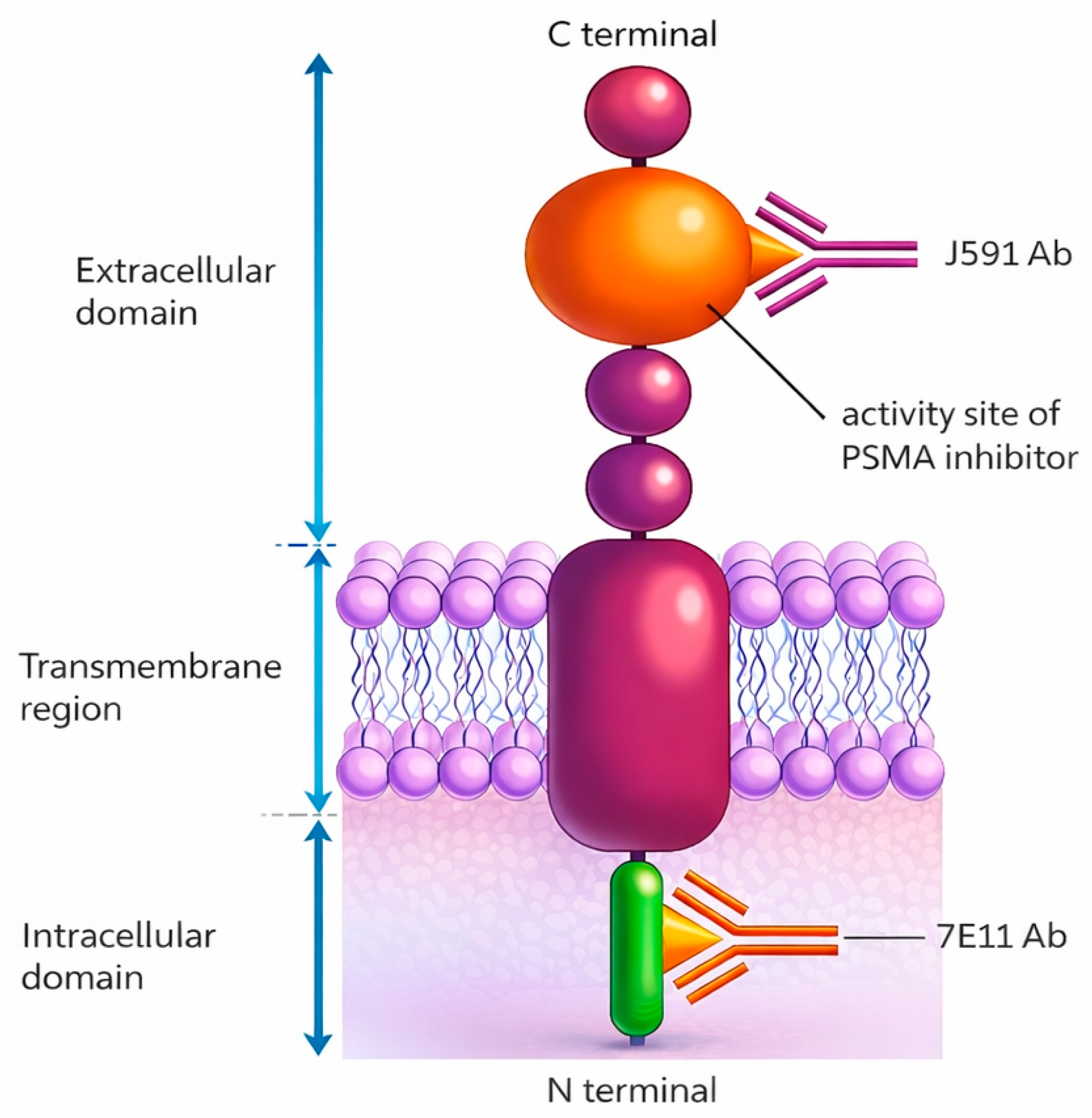
PSMA is a type II transmembrane glycoprotein highly overexpressed on prostate cancer cells, particularly in advanced, metastatic, and castration-resistant disease. Its extracellular domain functions as a glutamate carboxypeptidase (also known as folate hydrolase), enabling ligand binding with high specificity. Upon binding of small-molecule inhibitors or radiolabeled ligands, the PSMA–ligand complex undergoes clathrin-mediated internalization, resulting in intracellular accumulation [16]. While PSMA is physiologically expressed in normal prostate epithelium, salivary glands, proximal renal tubules, and small intestine, its expression is significantly upregulated in PCa, with reported increases of up to 100–1000-fold compared to benign tissue. This property forms the biological basis for both diagnostic imaging (i.e., PSMA-PET) and targeted radionuclide therapy, as radioactive payloads are selectively delivered and retained within tumor cells while sparing most normal tissues. Additionally, PSMA expression is upregulated by androgen deprivation, further enhancing target availability in advanced disease [17]. Figure 1 presents a schematic representation of how PSMA targets PCa cells. PSMA, also known as glutamate carboxypeptidase II (GCPII) or folate hydrolase 1 (FOLH1), is a type II transmembrane glycoprotein composed of a short intracellular domain, a transmembrane segment, and a large extracellular catalytic domain.

4. Role of PSMA PET/CT in Clinical Management

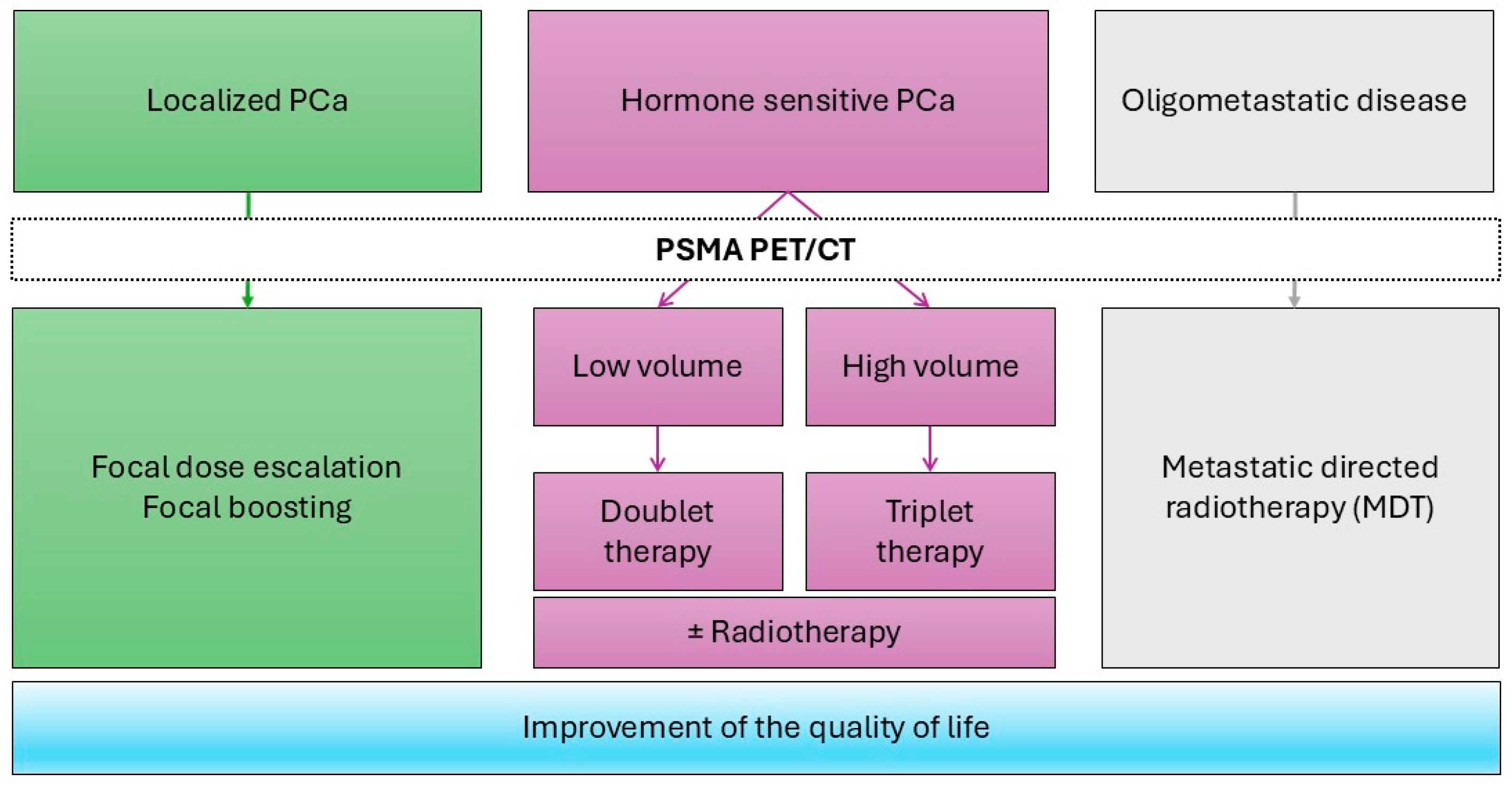
PET/CT with [68Ga]Ga- or [18F]F-labeled PSMA ligands has rapidly become a powerful tool for staging and restaging due to its high sensitivity and favorable biodistribution. Validated indications include (1) initial staging of unfavorable intermediate- to high-risk PCa; (2) localization of biochemical recurrence or persistence after curative therapy; (3) evaluation of non-metastatic castration-resistant PCa following negative conventional imaging and (4) pre-treatment assessment for PSMA-targeted radioligand therapy [7,8]. Emerging studies suggest potential roles within active surveillance protocols and in guiding initial intra-prostatic lesion characterization, although broader implementation awaits further validation [9]. In Figure 2, the settings of disease and PSMA utility are reported. The image illustrates the role of PSMA PET/CT in guiding management across three major clinical settings of PCa: localized disease, hormone-sensitive disease, and oligometastatic disease. In patients with localized PCa, PSMA PET/CT improves intraprostatic tumor localization, enabling more precise treatment planning. In this context, it supports strategies such as focal dose escalation or focal boosting, with the aim of improving local control while minimizing toxicity. In the setting of hormone-sensitive PCa, PSMA PET/CT allows for more accurate disease burden stratification, distinguishing between low-volume and high-volume metastatic disease. This distinction has direct therapeutic implications: patients with low-volume disease are typically candidates for doublet systemic therapy, whereas those with high-volume disease may benefit from intensified triplet regimens. In both cases, PSMA imaging may also inform the addition of radiotherapy to the primary tumor or metastatic sites. For patients with oligometastatic disease, PSMA PET/CT enables sensitive detection of a limited number of metastatic lesions, thereby supporting the use of metastasis-directed therapies (MDT), such as stereotactic body radiotherapy (SBRT), with the goal of delaying systemic treatment escalation. Overall, the integration of PSMA PET/CT into these clinical scenarios facilitates more personalized treatment strategies, ultimately contributing to an improvement in patients’ QoL.
Although promising, PSMA-PET/CT has a limited detection rate for PSA values below 0.2 ng/mL (about 30% for any radiolabeled peptides, with or without physiological bladder uptake) [18]. Indeed, in this context, in case of radical prostatectomy, salvage radiotherapy should be performed independently from the PSMA-PET positivity [19]. A major role could be played by MRI in this setting of disease, although limited data are available for low PSA values. In this context, clinical trials are urgently needed. Unknown bone uptakes (UBUs) are often reported for all types of PSMA agents, mainly for [18F]F-PSMA-1007, thus negatively altering the detection rate, with the risk of overtreatment/overdiagnosis [20]. In order to overcome these confounding results, CT coregistered images and MRI scan would be useful for the correct differentiation between benign and malignant findings. Also, clinical data would always be taken into consideration.

5. PSMA PET/CT to Guide Treatment Decision-Making

5.1. Influence on Systemic Therapy Selection

PSMA-PET/CT has substantially improved the detection of metastases at initial diagnosis, resulting in notable stage migration [21]. This has implications for the classification of hormone-sensitive metastatic PCa (mHSPC), which traditionally relies on CHAARTED and LATITUDE criteria derived from conventional imaging. Because PSMA-PET identifies smaller deposits, many patients are upstaged to metastatic disease, potentially altering the appropriateness of doublet or triplet systemic regimens or primary-tumor radiotherapy. Conversely, its specificity can significantly affect the overdiagnosis provided by conventional imaging techniques, such as bone scans [22]. A multicenter series demonstrated that 22% of patients classified as low-volume by conventional imaging were reclassified as high-volume by PSMA-PET, while nearly a third were downstaged to non-metastatic disease—underscoring the modality’s reclassification power [21,22]. The identification of stage migration with PSMA-PET, as demonstrated by the ProPSMA trial [23], and the effect, provided by the VISION trial [18], for the selection of patients to be submitted to radioligand therapy based on PSMA are two great advantages obtained by receptorial imaging. We analyzed preliminary data regarding the utility of PSMA-PET/CT as baseline imaging for monitoring the response to therapy with advanced mHSPCa. Indeed, in 40 patients, we found that total PSMA-positive lesion burden was significantly correlated with PSA values, and the best response to PSA was correlated with a significant reduction in total PSMA-positive lesions. Furthermore, progressive disease was more often associated with a large total number of PSMA-positive lesions. The data were discussed in the annual congress of the European Association of Nuclear Medicine in 2024 [24]. The collection of data is still ongoing to include a large patient population, and results will be published in the upcoming months.
Patient selection for a precise treatment strategy can be considered useful in case of alternative approaches. To date, PSMA-PET plays an important role in the identification of receptor expression, its heterogeneity, and its tumor volume and for monitoring the efficacy of therapies [25]. In clinical practice, PSMA-PET/CT is widely used to evaluate the expression of receptors to choose the best candidates for PSMA-based radioligand therapy; however, large variability in terms of criteria has also been reported across the diverse clinical trials. In Table 1, some studies are reported relative to the utility of PSMA in guiding systemic treatments. This table summarizes major trials demonstrating the impact of PSMA PET on clinical decision-making in PCa. PSMA PET improves staging accuracy (proPSMA), enables selection of patients for targeted radioligand therapy (VISION, TheraP), and significantly influences management in recurrent disease (CONDOR, EMPIRE-1). Across settings, its use frequently leads to earlier initiation, intensification, or modification of systemic therapy, supporting more personalized treatment strategies.

5.2. Oligometastatic Disease and MDT

The oligometastatic state (commonly defined as ≤5 lesions) represents a window in which MDT may delay systemic treatment. The introduction of next-generation imaging has significantly increased the detection of OMD or oligorecurrent disease, thus prolonging the time free of systemic treatment.
PSMA-PET excels at identifying limited metastatic disease, enhancing patient selection for MDT [30]. Randomized evidence from the ORIOLE trial confirms that MDT guided by PSMA-PET prolongs progression-free survival [31]. Additional trials (LIGHTHOUSE, OSPREY [32,33] show that PSMA-PET reveals metastatic disease missed by conventional imaging, facilitating earlier intervention. The EAU recognizes MDT as a strategy to defer ADT initiation, improving QoL. Indeed, this practice can be useful both in patients at the hormone-sensitive stage and in those in castrate-resistant conditions, thus improving both local control and potential symptoms.
Table 2 lists the list of clinical trials related to the use of PSMA-PET for the detection of OMD, which is able to guide local therapy and to delay systemic treatment. There are some key studies supporting the role of PSMA PET in guiding MDT. PSMA PET improves detection of occult disease and refines patient selection, as shown in ORIOLE and Oligo-PELVIS. It enhances staging accuracy (OSPREY) and enables precise targeting of nodal and metastatic lesions, leading to improved outcomes. Ongoing trials such as LIGHTHOUSE are further evaluating its role as a companion diagnostic to guide early integration of PSMA-targeted systemic therapies.

5.3. Intra-Prostatic Dose Escalation

The prostate gland is anatomically divided into distinct zones such as the peripheral zone (PZ), the transition zone (TZ), and the central zone (CZ), each characterized by different proportions of glandular and stromal components. The PZ, which constitutes approximately 70–75% of the glandular tissue in young men, is predominantly composed of glandular elements with relatively sparse stroma. In contrast, the TZ (5–10% in young individuals, increasing with age due to benign prostatic hyperplasia) has a more balanced glandular-to-stromal ratio, while the CZ (approximately 20–25%) contains a higher proportion of stromal tissue surrounding the ejaculatory ducts. Notably, about 70–80% of prostate cancers arise in the peripheral zone, likely due to its higher density of secretory epithelial cells and greater exposure to carcinogenic and inflammatory stimuli. This zonal predilection underpins the rationale for imaging-guided, focal therapeutic approaches, aimed at selectively targeting dominant intraprostatic lesions (DILs) while sparing surrounding normal tissue.
Focal dose escalation to DILs improves biochemical control, as demonstrated in the FLAME trial [35]. However, MRI alone is limited by inter-reader variability and potential for lesion under-detection. PSMA-PET provides complementary biologic characterization and often delineates larger gross tumor volumes. Trials such as HypoFocal and ARGOS/CLIMBER are evaluating integrated PSMA-PET/MRI guidance for focal boosting [36]. Early findings suggest improved tumor delineation and potential enhancements in local control. However, the limited available data renders this approach experimental.
PSMA-PET/CT has an important role in guiding focal therapies, not only in radiation treatment approaches, but also in High-Intensity Focused Ultrasound (HIFU). Some preliminary data about this latter approach have been recently discussed in the last European Association of Nuclear Medicine (EANM) congress [37]. From our own institutional experience, we found that after 12 months of focal procedures, patients with a primary score equal to 4 and 5 (n = 37/48 enrolled subjects) at PSMA-PET/CT showed a reduction in PSA to 58% and 75%, respectively. Additional analysis is still ongoing for establishing the utility of PSMA for guiding and monitoring the response to focal therapies in a larger population, and the results will be published in the upcoming months.
A list of ongoing or published trials has been reported in Table 3. The table summarizes studies exploring the role of PSMA PET in guiding focal and MDT. PSMA PET improves lesion detection and delineation, enabling more accurate targeting in both oligometastatic (BULLSEYE) and localized disease (PROBE, PRIMARY). Early clinical experiences, such as the UCLA cohorts, further support its value in enhancing the precision of focal therapies compared to conventional imaging. Ongoing trials will clarify its impact on treatment outcomes and its role as a standard tool for treatment planning.

6. Future Directions

Despite its substantial clinical utility, PSMA PET/CT presents several limitations that should be carefully considered in clinical practice. Sensitivity decreases for lesions smaller than 5 mm, and false-positive uptake may occur in benign or inflammatory conditions. Diagnostic performance may also vary among tracers; for example, [18F]F-PSMA-1007 has been associated with increased non-specific bone uptake [20]. In addition, access to PSMA imaging remains uneven across regions, and its cost-effectiveness is still under evaluation [42]. Variability in acquisition protocols and interpretation criteria further contributes to interobserver variability, underscoring the need for standardized imaging frameworks. In this context, structured reporting systems have been developed to improve reproducibility and clinical communication. PSMA-RADS provides a five-point scale analogous to BI-RADS or PI-RADS, facilitating standardized interpretation and transparent reporting of uncertainty [43]. Similarly, the PROMISE framework introduces molecular TNM classification (miTNM), integrating lesion location, extent, and PSMA expression relative to reference organs [44]. Despite their complementary roles, neither system has yet achieved universal adoption, and interpretative variability persists, particularly in low-uptake lesions, treated sites, and atypical metastatic patterns. Ongoing harmonization efforts are therefore essential, not only for clinical consistency but also for regulatory approval and reproducibility in clinical trials [45]. In this regard, the recent update from the Prostate Cancer Working Group 4 (PCWG4) represents an important step toward the broader integration of PSMA PET into standardized clinical pathways.
Beyond technical considerations, the expanding use of PSMA PET/CT across multiple clinical scenarios—including surveillance, focal therapy planning, and treatment response assessment—raises concerns regarding potential overutilization and increasing healthcare costs. Comprehensive health-economic evaluations incorporating long-term outcomes and quality-adjusted life years (QALYs) are still evolving and will be critical to define its sustainable implementation.
Access to PSMA PET/CT remains highly heterogeneous worldwide, reflecting disparities in infrastructure, regulatory approval, radiochemistry capabilities, and reimbursement policies [46,47,48]. While high-income countries are progressively incorporating PSMA imaging into clinical guidelines, access may still be limited in rural areas due to centralized production facilities. In contrast, middle- and low-income settings often face substantial logistical and economic barriers, including limited cyclotron availability and restricted distribution networks, further widening disparities in precision oncology care.
Ongoing prospective trials, such as PATRON and THUNDER, are expected to better define the long-term clinical impact and optimal indications of PSMA PET/CT [49,50]. In parallel, emerging innovations—including biology-guided radiotherapy and quantitative PSMA PET biomarkers—may further enhance prognostic stratification and support more refined treatment personalization. As highlighted in Table 1, Table 2 and Table 3, these developments will be instrumental in consolidating the role of PSMA PET within future clinical practice.

7. Conclusions

PSMA PET/CT has emerged as a central component in the management of PCa, offering superior diagnostic performance and enabling increasingly personalized therapeutic strategies. Its clinical utility spans the entire disease continuum, from initial staging and early detection of recurrence to treatment selection, metastasis-directed approaches, and precision radiotherapy planning, including focal dose escalation. Beyond its diagnostic role, PSMA PET/CT is progressively reshaping clinical decision-making by refining risk stratification and guiding therapy selection according to disease extent and biological characteristics. However, challenges related to accessibility, standardization, and cost, as well as the need for prospective outcome-driven evidence, remain important considerations.
Ongoing clinical trials and advances in imaging standardization and quantitative biomarkers are expected to further consolidate its role within routine practice. As these data mature, PSMA PET/CT is likely to become fully integrated into precision oncology frameworks, supporting optimized treatment pathways and outcomes that balance oncologic control with preservation of QoL.

Author Contributions

Conceptualization, L.M. and L.E.; methodology, M.S.; investigation, G.F.; resources, C.G.; data curation, L.E.; writing—original draft preparation, C.G., L.M., L.E., M.S. and G.F.; writing—review and editing, C.G., L.M., L.E., M.S. and G.F.; supervision, C.G., L.M., L.E., M.S. and G.F. All authors have read and agreed to the published version of the manuscript.

Funding

This research received no external funding.

Institutional Review Board Statement

Not applicable.

Informed Consent Statement

Not applicable.

Data Availability Statement

The original contributions presented in this study are included in the article. Further inquiries can be directed to the corresponding author.

Conflicts of Interest

Author Marco Spadafora was employed by the company Medicina Futura. The remaining authors declare that the research was conducted in the absence of any commercial or financial relationships that could be construed as a potential conflict of interest.

References

  1. Siegel, R.L.; Kratzer, T.B.; Wagle, N.S.; Sung, H.; Jemal, A. Cancer statistics 2026. CA Cancer J. Clin. 2026, 76, e70043. [Google Scholar] [CrossRef]
  2. Khan, S.; Mosvi, S.N.; Vohra, S.; Poddar, N.K. Implication of calcium supplementations in health and diseases with special focus on colorectal cancer. Crit. Rev. Clin. Lab. Sci. 2024, 61, 496–509. [Google Scholar] [CrossRef] [PubMed]
  3. Luo, X.M.; Khan, S.; Malik, A.; Aldakheel, F.M.; Chaudhary, A.A.; Bazerbashi, S.; Tabatabaie, D. Calcium supplementation in colorectal cancer prevention: A systematic meta-analysis of adverse events. Biocell 2021, 46, 759–767. [Google Scholar]
  4. Raychaudhuri, R.; Lin, D.W.; Montgomery, R.B. Prostate Cancer: A Review. JAMA 2025, 333, 1433–1446. [Google Scholar] [CrossRef] [PubMed]
  5. Khan, S.; Simsek, R.; Fuentes, J.D.B.; Vohra, I.; Vohra, S. Implication of Toll-Like Receptors in growth and management of health and diseases: Special focus as a promising druggable target to Prostate Cancer. Biochim. Biophys. Acta Rev. Cancer 2025, 1880, 189229. [Google Scholar] [CrossRef] [PubMed]
  6. Zhang, F.; Luo, Z.; Xue, Q.; Guo, X.; Fu, Q.; Zhang, W.; Xiong, Y.; Alisha, P.A.; Okoli, U.A.; Zhang, G.; et al. Assessing the efficacy of darolutamide in metastatic hormone-sensitive prostate cancer based on subgroup meta-analysis and reconstructed individual patient data. Discov. Oncol. 2025, 16, 2041. [Google Scholar] [CrossRef]
  7. Claes, P.; Ahmadi Bidakhvidi, N.; Giesen, A.; Joniau, S.; Van Laere, K.; Koole, M.; Jentjens, S.; Deroose, C.M.; Goffin, K. PSMA PET/CT and PET/MRI in primary staging of prostate cancer and its effect on patient management. Clin. Transl. Imaging 2023, 12, 31–54. [Google Scholar] [CrossRef]
  8. Huang, S.; Ong, S.; McKenzie, D.; Mirabelli, A.; Chen, D.C.; Chengodu, T.; Murphy, D.G.; Hofman, M.S.; Lawrentschuk, N.; Perera, M. Comparison of 18F-based PSMA radiotracers with [68Ga]Ga-PSMA-11 in PET/CT imaging of prostate cancer—A systematic review and meta-analysis. Prostate Cancer Prostatic Dis. 2024, 27, 654–664. [Google Scholar] [CrossRef]
  9. Evangelista, L.; Mansi, L.; Spadafora, M. PSMA-Targeted radiopharmaceuticals: From diagnosis to risk & quality of life. Eur. J. Nucl. Med. Mol. Imaging 2025, 53, 19–23. [Google Scholar] [CrossRef]
  10. James, N.D.; Tannock, I.; N’Dow, J.; Feng, F.; Gillessen, S.; Ali, S.A.; Trujillo, B.; Al-Lazikani, B.; Attard, G.; Bray, F.; et al. The Lancet Commission on prostate cancer: Planning for the surge in cases. Lancet 2024, 403, 1683–1722. [Google Scholar] [CrossRef]
  11. Coen, J.J.; Feldman, A.S.; Smith, M.R.; Zietman, A.L. Watchful waiting for localized prostate cancer in the PSA era: What have been the triggers for intervention? BJU Int. 2011, 107, 1582–1586. [Google Scholar] [CrossRef][Green Version]
  12. Bruinsma, S.M.; Bangma, C.H.; Carroll, P.R.; Leapman, M.S.; Rannikko, A.; Petrides, N.; Weerakoon, M.; Bokhorst, L.P.; Roobol, M.J.; the Movember GAP3 consortium. Active surveillance for prostate cancer: A narrative review of clinical guidelines. Nat. Rev. Urol. 2016, 13, 151–167. [Google Scholar] [CrossRef] [PubMed]
  13. Russell, J.R.; Siddiqui, M.M. Active surveillance in favorable intermediate risk prostate cancer: Outstanding questions and controversies. Curr. Opin. Oncol. 2022, 34, 219–227. [Google Scholar] [CrossRef]
  14. Fridriksson, J.Ö.; Folkvaljon, Y.; Nilsson, P.; Robinson, D.; Franck-Lissbrant, I.; Ehdaie, B.; Eastham, J.A.; Widmark, A.; Karlsson, C.T.; Stattin, P. Long-term adverse effects after curative radiotherapy and radical prostatectomy: Population-based nationwide register study. Scand. J. Urol. 2016, 50, 338–345. [Google Scholar] [CrossRef]
  15. Bagrodia, A.; DiBlasio, C.; Wake, R.; Derweesh, I. Adverse effects of androgen deprivation therapy in prostate cancer: Current management issues. Indian. J. Urol. 2009, 25, 169–176. [Google Scholar] [CrossRef]
  16. El-Hennawy, G.; Ahmed, T.; Amin, M.T.; Mostafa, R. Impact of tumor burden on physiological organ biodistribution in 18F-PSMA PET/CT of patients with prostate cancer. Clin. Transl. Imaging 2025, 13, 633–639. [Google Scholar] [CrossRef]
  17. Laudicella, R.; Bauckneht, M.; Burger, I.A.; Cacciola, A.; Fanti, S.; Farolfi, A.; Ficarra, V.; Iagaru, A.; Liberini, V.; Pergolizzi, S.; et al. The role of PSMA-based radioligand therapy in hormone-sensitive prostate cancer. Eur. J. Nucl. Med. Mol. Imaging 2025, 52, 2723–2735. [Google Scholar] [CrossRef] [PubMed] [PubMed Central]
  18. Burgard, C.; Frei, M.; Blickle, A.; Hartrampf, P.E.; Hoffmann, M.A.; Schreckenberger, M.; Schmid, H.P.; Unterrainer, L.; Rogasch, J.; Galler, M.; et al. PSMA PET/CT in biochemical recurrence of prostate cancer with PSA levels ≤ 0.2 ng/mL: A German multicenter analysis of conventional PSMA tracers, including [68Ga]Ga-PSMA-11, [68Ga]Ga-PSMA I&T, and [18F]FPSMA-1007. Eur. J. Nucl. Med. Mol. Imaging 2025, 52, 4368–4376. [Google Scholar] [CrossRef] [PubMed] [PubMed Central]
  19. Zamboglou, C.; Staus, P.; Wolkewitz, M.; Peeken, J.C.; Ferentinos, K.; Strouthos, I.; Farolfi, A.; Koerber, S.A.; Vrachimis, A.; Spohn, S.K.B.; et al. Better Oncological Outcomes After Prostate-specific Membrane Antigen Positron Emission Tomography-guided Salvage Radiotherapy Following Prostatectomy. Eur. Urol. Focus 2025, 11, 242–250. [Google Scholar] [CrossRef] [PubMed]
  20. Woo, S.; Freedman, D.; Becker, A.S.; Leithner, D.; Mayerhoefer, M.E.; Friedman, K.P.; Arita, Y.; Han, S.; Burger, I.A.; Taneja, S.S.; et al. Equivocal bone lesions on PSMA PET/CT: Systematic review and meta-analysis on their prevalence and malignancy rate. Clin. Transl. Imaging 2024, 12, 485–500. [Google Scholar] [CrossRef]
  21. Wang, J.H.; Shi, X.; Tran, P.T.; Sutera, P. Integrating Prostate Specific Membrane Antigen-PET into Clinical Practice for Prostate Cancer. PET Clin. 2025, 20, 205–217. [Google Scholar] [CrossRef] [PubMed] [PubMed Central]
  22. Unterrainer, L.M.; Hope, T.A.; Fendler, W.P.; Grogan, T.; Ndlovu, H.; Armstrong, W.; Barbato, F.; Benz, M.R.; Rettig, M.B.; Kishan, A.U.; et al. Low- and High-Volume Disease in Metastatic Hormone-Sensitive Prostate Cancer: From CHAARTED to PSMA PET—An International Multicenter Retrospective Study. J. Nucl. Med. 2025, 66, 54–60. [Google Scholar] [CrossRef]
  23. Hofman, M.S.; Lawrentschuk, N.; Francis, R.J.; Tang, C.; Vela, I.; Thomas, P.; Rutherford, N.; Martin, J.M.; Frydenberg, M.; Shakher, R.; et al. Prostate-specific membrane antigen PET-CT in patients with high-risk prostate cancer before curative-intent surgery or radiotherapy (proPSMA): A prospective, randomised, multicentre study. Lancet 2020, 395, 1208–1216. [Google Scholar] [CrossRef] [PubMed]
  24. Zanca, R.; Aliprandi, M.; Cecchi, L.; Bertocchi, A.; Borea, F.; Cordua, N.; Zucali, P.; Evangelista, L. Assessing the Supplementary Role of PSMA PET Parameters in Metastatic Hormone-Sensitive Prostate Cancer Patients Initiating First-Line Therapy; Abstract EANM24. Eur. J. Nucl. Med. Mol. Imaging 2024, 51, S526. [Google Scholar]
  25. Droghetti, M.; Bianchi, L.; Presutti, M.; Vetrone, L.; Farolfi, A.; Mei, R.; Giunchi, F.; Degiovanni, A.; Mottaran, A.; Piazza, P.; et al. Immunohistochemistry analysis of PSMA expression at prostatic biopsy in high-risk prostate cancer: Potential implications for PSMA-PET patient selection. Front. Oncol. 2024, 14, 1324631. [Google Scholar] [CrossRef] [PubMed] [PubMed Central]
  26. Sartor, O.; de Bono, J.; Chi, K.N.; Fizazi, K.; Herrmann, K.; Rahbar, K.; Tagawa, S.T.; Nordquist, L.T.; Vaishampayan, N.; El-Haddad, G.; et al. Lutetium-177-PSMA-617 for Metastatic Castration-Resistant Prostate Cancer. N. Engl. J. Med. 2021, 385, 1091–1103. [Google Scholar] [CrossRef] [PubMed] [PubMed Central]
  27. Hofman, M.S.; Emmett, L.; Sandhu, S.; Iravani, A.; Joshua, A.M.; Goh, J.C.; Pattison, D.A.; Tan, T.H.; Kirkwood, I.D.; Ng, S.; et al. [177Lu]Lu-PSMA-617 versus cabazitaxel in patients with metastatic castration-resistant prostate cancer (TheraP): A randomised, open-label, phase 2 trial. Lancet 2021, 397, 797–804. [Google Scholar] [CrossRef] [PubMed]
  28. Morris, M.J.; Rowe, S.P.; Gorin, M.A.; Saperstein, L.; Pouliot, F.; Josephson, D.; Wong, J.Y.C.; Pantel, A.R.; Cho, S.Y.; Gage, K.L.; et al. Diagnostic Performance of 18F-DCFPyL-PET/CT in Men with Biochemically Recurrent Prostate Cancer: Results from the CONDOR Phase III, Multicenter Study. Clin. Cancer Res. 2021, 27, 3674–3682. [Google Scholar] [CrossRef] [PubMed] [PubMed Central]
  29. Jani, A.B.; Dhere, V.R.; Goyal, S.; Schreibmann, E.; Patel, P.R.; Hershatter, B.; Shelton, J.W.; Hanasoge, S.; Sebastian, N.T.; Patel, S.A.; et al. [18F]F-Fluciclovine or [68Ga]-PSMA-11 Molecular Imaging To Guide Dose Escalation of Salvage Radiotherapy After Radical Prostatectomy for Prostate Cancer: The EMPIRE-2 Trial. Eur. Urol. 2025, 89, 368–377. [Google Scholar] [CrossRef] [PubMed]
  30. Sutera, P.; Phillips, R.M.; Deek, M.; Ozyigit, G.; Onal, C.; Tran, P.T. The Promise of Metastasis-Directed Therapy for Oligometastatic Prostate Cancer: Going Beneath the Surface with Molecular Imaging. J. Nucl. Med. 2022, 63, 339–341. [Google Scholar] [CrossRef]
  31. Phillips, R.; Shi, W.Y.; Deek, M.; Radwan, N.; Lim, S.J.; Antonarakis, E.S.; Rowe, S.P.; Ross, A.E.; Gorin, M.A.; Deville, C.; et al. Outcomes of Observation vs Stereotactic Ablative Radiation for Oligometastatic Prostate Cancer. JAMA Oncol. 2020, 6, 650–659. [Google Scholar] [CrossRef]
  32. Koontz, B.F. Detection of true positive M1 lesions by 18 F-rhPSMA-7.3 PET in newly diagnosed prostate cancer: Results from the phase 3 prospective LIGHTHOUSE study. J. Clin. Oncol. 2023, 41, 315. [Google Scholar] [CrossRef]
  33. Pienta, K.J.; Gorin, M.A.; Rowe, S.P.; Carroll, P.R.; Pouliot, F.; Probst, S.; Saperstein, L.; Preston, M.A.; Alva, A.S.; Patnaik, A.; et al. A Phase 2/3 Prospective Multicenter Study of the Diagnostic Accuracy of Prostate Specific Membrane Antigen PET/CT with 18 F-DCFPyL in Prostate Cancer Patients (OSPREY). J. Urol. 2021, 206, 52–61. [Google Scholar] [CrossRef]
  34. Supiot, S.; Pasquier, D.; Buthaud, X.; Magné, N.; Beckendorf, V.; Sargos, P.; Crehange, G.; Pommier, P.; Loos, G.; Hasbini, A.; et al. Oligopelvis-GETUG P07: A multicenter phase II trial of combined salvage radiotherapy and hormone therapy in oligorecurrent plevic node relpases of prostate cancer. J. Clin. Oncol. 2020, 38, 93. [Google Scholar] [CrossRef]
  35. Kerkmeijer, L.G.W.; Groen, V.H.; Pos, F.J.; Haustermans, K.; Monninkhof, E.M.; Smeenk, R.J.; Kunze-Busch, M.; de Boer, J.C.J.; Zijp, J.v.d.V.v.; van Vulpen, M.; et al. Focal Boost to the Intraprostatic Tumor in External Beam Radiotherapy for Patients with Localized Prostate Cancer: Results from the FLAME Randomized Phase III Trial. J. Clin. Oncol. 2021, 39, 787–796. [Google Scholar] [CrossRef]
  36. Ramadan, S.; Loblaw, A.; Dhar, A.; Fakir, H.; Mendez, L.C.; Warner, A.; Wronski, M.; Conyngham, J.; Kassam, Z.; Kalia, V.; et al. PSMA MRI Guided prOstate SBRT (ARGOS)/Comprehensive, Longitudinal Evaluation of IMaging BiomarkErs Post Radiotherapy (CLIMBER) Phase I/II Trial. Int. J. Radiat. Oncol. Biol. Phys. 2025, 123, 395–405. [Google Scholar] [CrossRef]
  37. Jandric, J.; Fasulo, V.; Guglielmo, P.; Vallone, C.; Rodari, M.; Lazzeri, M.; Buffi, N.; Lughezzani, G.; Evangelista, L. The Power Duo: PSMA PET/CT and Focal Ablation in Prostate Cancer (PCa) Care. EANM Innov. 2025, 1, S534–S535. [Google Scholar]
  38. Privé, B.M.; Janssen, M.J.R.; van Oort, I.M.; Muselaers, C.H.J.; Jonker, M.A.; van Gemert, W.A.; de Groot, M.; Westdorp, H.; Mehra, N.; Verzijlbergen, J.F.; et al. Update to a randomized controlled trial of lutetium-177-PSMA in Oligo-metastatic hormone-sensitive prostate cancer: The BULLSEYE trial. Trials 2021, 22, 768. [Google Scholar] [CrossRef] [PubMed] [PubMed Central]
  39. Singh, M.; Katdare, A.; Ghosh, S.; Choudhury, S.; Phurailatpam, R.; Patil, D.; Tiwari, M.; Anaz, M.; Chougle, N.H.; Sable, N.; et al. PSMA-PET Guided Intraprostatic Boost in Prostate SBRT (PROBE): A Phase 2 Trial. Int. J. Radiat. Oncol. Biol. Phys. 2025, 125, 203–213. [Google Scholar] [CrossRef] [PubMed]
  40. Morris, M.J.; Castellano, D.; Herrmann, K.; de Bono, J.S.; Shore, N.D.; Chi, K.N.; Crosby, M.; Piulats, J.M.; Fléchon, A.; Wei, X.X.; et al. 177Lu-PSMA-617 versus a change of androgen receptor pathway inhibitor therapy for taxane-naive patients with progressive metastatic castration-resistant prostate cancer (PSMAfore): A phase 3, randomised, controlled trial. Lancet 2024, 404, 1227–1239, Erratum in Lancet 2025, 404, 2542. https://doi.org/10.1016/S0140-6736(24)02716-8. [Google Scholar] [CrossRef] [PubMed] [PubMed Central]
  41. Sonni, I.; Dal Pra, A.; O’Connell, D.P.; Ells, Z.; Benz, M.; Nguyen, K.; Yoon, S.M.; Deng, J.; Smith, C.; Grogan, T.; et al. 68Ga-PSMA PET/CT-Based Atlas for Prostate Bed Recurrence After Radical Prostatectomy: Clinical Implications for Salvage Radiation Therapy Contouring Guidelines. J. Nucl. Med. 2023, 64, 902–909. [Google Scholar] [CrossRef] [PubMed] [PubMed Central]
  42. Brinkmann, C.; Baum, R.P.; Stargardt, T. Cost-utility analysis of 177Lu-PSMA-617 radioligand therapy in second-line and third-line treatment for metastatic castration-resistant prostate cancer (mCRPC) in Germany. Eur. J. Nucl. Med. Mol. Imaging 2025, 52, 4377–4389. [Google Scholar] [CrossRef]
  43. Meng, X.; Ma, W.; Zhang, J.; Quan, Z.; Zhang, M.; Ye, J.; Shu, J.; Ren, J.; Qin, W.; Kang, F.; et al. PI-RADS-Based Segmented Threshold of PSMA-PET SUVmax Is Better than Traditional Fixed Threshold for Diagnosing Clinically Significant Prostate Cancer Especially for PI-RADS 3 Lesions. Mol. Imaging Biol. 2023, 25, 887–896. [Google Scholar] [CrossRef] [PubMed]
  44. Eiber, M.; Herrmann, K.; Calais, J.; Hadaschik, B.; Giesel, F.L.; Hartenbach, M.; Hope, T.; Reiter, R.; Maurer, T.; Weber, W.A.; et al. Prostate Cancer Molecular Imaging Standardized Evaluation (PROMISE): Proposed miTNM Classification for the Interpretation of PSMA-Ligand PET/CT. J. Nucl. Med. 2018, 59, 469–478, Erratum in J. Nucl. Med. 2018, 59, 992. [Google Scholar] [CrossRef] [PubMed]
  45. Herrmann, K.; Walz, J.; MacLennan, S.; Briganti, A.; Cornford, P.; Czernin, J.; Eiber, M.; Fanti, S.; Fendler, W.P.; Fizazi, K.; et al. SPARC: The Standardised Prostate-specific Membrane Antigen Positron Emission Tomography/Computed Tomography Analysis and Reporting Consensus: A Delphi Analysis. Eur. Urol. 2026, 89, 260–274. [Google Scholar] [CrossRef] [PubMed]
  46. Borkowetz, A.; Linxweiler, J.; Fussek, S.; Wullich, B.; Saar, M.; German Prostate Cancer Consortium (DPKK). The Role of PSMA PET Imaging in Prostate Cancer Theranostics: A Nationwide Survey. Urol. Int. 2022, 106, 1126–1135. [Google Scholar] [CrossRef] [PubMed]
  47. Bauckneht, M.; Evangelista, L.; Sofia, L.; Maccauro, M.; Filice, A.; De Rimini, M.L.; Caffo, O.; Messina, C.; Maruzzo, M.; Pinterpe, G.; et al. Joint survey by AIMN, AIOM, AIRO, SIU, SIUrO, and Meet-URO about the use of PSMA PET imaging in prostate cancer in Italy: Technical aspects and primary staging setting. Clin. Transl. Imaging 2025, 14, 131–143. [Google Scholar] [CrossRef]
  48. Chiong, E.; Murphy, D.G.; Buchan, N.C.; Chua, M.L.K.; Hakim, L.; Hamid, A.R.; Hong, S.K.; Horvath, L.G.; Kanesvaran, R.; Khochikar, M.; et al. Managing advanced prostate cancer in the Asia Pacific region: “Real-world” application of Advanced Prostate Cancer Consensus Conference 2019 statements. Asia Pac. J. Clin. Oncol. 2022, 18, 686–695. [Google Scholar] [CrossRef] [PubMed] [PubMed Central]
  49. Ménard, C.; Young, S.; Zukotynski, K.; Hamilton, R.J.; Bénard, F.; Yip, S.; McCabe, C.; Saad, F.; Brundage, M.; Nitulescu, R.; et al. PSMA PET/CT guided intensification of therapy in patients at risk of advanced prostate cancer (PATRON): A pragmatic phase III randomized controlled trial. BMC Cancer 2022, 22, 251. [Google Scholar] [CrossRef] [PubMed] [PubMed Central]
  50. Kleiburg, F.; Dirix, P.; Fonteyne, V.; Bral, S.; De Troyer, B.; Sautois, B.; Lamande, M.; Liefhooghe, N.; Grisay, G.; Meersschout, S.; et al. Stage Migration on Prostate-specific Membrane Antigen Positron Emission Tomography/Computed Tomography in Comparison to Conventional Imaging in Patients with High-risk Prostate Cancer Referred for Radiation Therapy: Results from the Phase 2/3 THUNDER Trial. Eur. Urol. Oncol. 2025, 8, 1333–1339. [Google Scholar] [CrossRef] [PubMed]
Figure 1. A schematic illustration of PSMA mechanisms.
Cancers 18 01799 g001
Figure 2. A schematic summary of the use of PSMA PET in diverse settings.
Cancers 18 01799 g002
Table 1. List of trials regarding PSMA as a predictive biomarker in systemic treatment.
Trial, RefYearPopulationRole of PSMA PETKey FindingImpact on Systemic Therapy
proPSMA, [23]2020High-risk localized PCa (pre-treatment staging)Compared PSMA PET vs. CT + bone scanAccuracy 92% vs. 65%; management changed in 28%Upstaging → earlier initiation or escalation of systemic therapy
VISION, [26]2021mCRPC after ARPI + taxanePSMA PET used to select patients for Lu-177-PSMAImproved OS and PFS in PSMA-positive patientsDetermines eligibility for PSMA-targeted systemic therapy
TheraP, [27]2021mCRPCPSMA PET used as gatekeeper for therapyLu-PSMA superior to cabazitaxel in selected patientsImaging directs choice between chemo vs. targeted systemic therapy
CONDOR, [28]2021Biochemical recurrenceAssessed impact on management decisionsManagement changed in 64% of patientsFrequently altered decision to start, intensify, or change systemic therapy
EMPIRE-1, [29]2021Biochemical recurrence post-RTMolecular imaging guided treatment planningImproved progression-free survivalImaging-guided intensification of systemic and combined therapies
mCRPC = metastatic castrate resistant prostate cancer; ARPI = androgen receptor pathway inhibitors; RT = radiation therapy; OS = overall survival.
Table 2. List of trials related to the detection of OMD at PSMA PET/CT.
Trial, RefYearPopulationImagingDesignInterventionKey ResultsClinical Implication
ORIOLE, [31]2020Recurrent hormone-sensitive PCa with ≤3 metsConventional imaging + PSMA-PET (post hoc)Randomized (MDT vs. observation)SABR to all detected metsPatients with untreated PSMA-avid lesions had significantly worse PFSPSMA-PET improves patient selection and completeness of MDT
Oligo-PELVIS GETUG P07, [34]2021Pelvic nodal oligorecurrenceMostly PSMA-PETPhase IIWhole pelvis RT + MDT + short ADT2-yr PFS ~77%PSMA-PET enables accurate nodal targeting
OSPREY, [33]2021High-risk localized PCa (cohort A) and metastatic PCa (cohort B)Diagnostic validation using 18F-DCFPyL PSMA-PETPhase II/IIIAccuracy of PSMA-PET for nodal and distant stagingHigh specificity for nodal disease (>95%); improved detection vs. conventional imagingImproves staging → impacts choice between local therapy, MDT, and systemic therapy
LIGHTHOUSE, [32]Ongoing (2022–)Metastatic hormone-sensitive PCa (mHSPC)PSMA-PET used for patient selection (PSMA expression required)Phase IIEarly use of PSMA radioligand therapy (225Ac-PSMA-I&T) + abiraterone vs. abiraterone aloneEvaluates whether PSMA-targeted therapy improves outcomes when introduced earlierEstablishes PSMA-PET as a companion diagnostic guiding access to intensified systemic therapy
MDT = metastatic direct therapy; SABR = stereotactic ablative body radiotherapy; RT = radiation therapy; ADT = androgen-deprivation therapy; PFS = progression-free survival.
Table 3. Ongoing clinical trials regarding oligometastatic disease.
Trial/StudyYearModalityPopulationRole of PSMA PETInterventionKey FindingsClinical Relevance
BULLSEYE, [38]OngoingMDT/focal RTOligometastatic recurrencePSMA-PET defines all lesions to be treatedPSMA-guided SABR vs. standard careOngoingPSMA-PET determines completeness of focal treatment
PROBE, [39]OngoingRT focal boostPrimary localized PCaPSMA-PET for boost volume definitionPSMA-PET-guided boost + standard RTFeasibility and toxicity endpointsFormal testing of PSMA-PET as boost-defining tool
PRIMARY Trial, [40]2021Diagnosis → focal planningSuspected localized PCaPSMA-PET + MRI improves lesion detectionDiagnostic accuracy studyPSMA-PET improves detection of clinically significant lesionsSupports PSMA-PET–guided focal therapies
UCLA PSMA-guided focal therapy cohorts, [41]2020–2022HIFU/focal laserLocalized PCaPSMA-PET used to select and target lesionsPSMA-PETguided focal therapyImproved lesion targeting vs. MRI aloneSupports PSMA-PET for precision focal therapy
HIFU = High-Intensity Focused Ultrasound; RT = radiotherapy; MDT = metastatic directed therapy.
Disclaimer/Publisher’s Note: The statements, opinions and data contained in all publications are solely those of the individual author(s) and contributor(s) and not of MDPI and/or the editor(s). MDPI and/or the editor(s) disclaim responsibility for any injury to people or property resulting from any ideas, methods, instructions or products referred to in the content.