Review

Molecular Analysis of EBUS-TBNA Samples for Nodal Staging in Non-Small Cell Lung Cancer

1
Pulmonary Medicine Department, DGD Lung Clinic Hemer, 58675 Hemer, Germany
2
Pulmonary Medicine Department, Mansoura University, Mansoura 35516, Egypt
*
Author to whom correspondence should be addressed.
Cancers 2026, 18(11), 1797; https://doi.org/10.3390/cancers18111797
Submission received: 27 April 2026 / Revised: 27 May 2026 / Accepted: 28 May 2026 / Published: 1 June 2026

Simple Summary

Non-small cell lung cancer remains the leading cause of cancer-related mortality worldwide and continues to be associated with poor outcomes despite advances in diagnosis and treatment. Recent progress in molecular diagnostics has transformed NSCLC management by enabling the identification of oncogenic driver mutations and resistance mechanisms, thereby facilitating the use of targeted therapies that improve outcomes in selected patients. Endobronchial ultrasound-guided transbronchial needle aspiration (EBUS-TBNA) has become an important minimally invasive procedure for both mediastinal staging and tissue acquisition for molecular testing. This review summarizes current evidence regarding the reliability of EBUS-TBNA samples for detecting key genetic and immune biomarkers relevant to targeted therapy and immunotherapy. In addition, factors influencing sample quality and emerging technologies, are discussed as potential tools to further enhance diagnostic accuracy and personalized treatment strategies.

Abstract

Since the discovery of EGFR mutations, treatment strategies have undergone major advances over the past two decades. Accordingly, molecular testing for oncogenic driver mutations is recommended at the time of diagnosis of advanced NSCLC. In addition, molecular analysis of lymph node samples has emerged as a promising tool for improving the accuracy of nodal staging in NSCLC. This approach may enhance the precision of staging in early-stage disease planned for curative surgical resection, thereby optimizing adjuvant treatment decisions and supporting complete resection at the time of surgery. In this review, we examine the importance and current status of molecular testing for oncogenic driver mutations in samples obtained via endobronchial ultrasound-guided transbronchial needle aspiration (EBUS-TBNA) or EBUS-guided cryobiopsy, and its role in improving the accuracy of nodal staging in NSCLC.

1. Introduction

Non-small cell lung cancer (NSCLC), representing approximately 85% of lung cancer cases, remains the leading cause of cancer-related mortality worldwide and continues to be associated with poor outcomes despite advances in diagnosis and treatment [1]. Recent developments in comprehensive genomic profiling have significantly improved the molecular characterization of NSCLC. These technologies enable the identification of therapeutically actionable alterations in key oncogenic drivers, including epidermal growth factor receptor (EGFR), anaplastic lymphoma kinase (ALK), ROS proto-oncogene 1 (ROS1), and Kirsten rat sarcoma viral oncogene homolog (KRAS). The detection of such genomic alterations have facilitated the development and clinical implementation of targeted therapies, leading to substantial improvements in clinical outcomes for patients with metastatic disease [2].
Although surgical resection remains the standard treatment for early-stage and locally advanced NSCLC, postoperative recurrence rates remain high, reaching up to 70% within five years in some patient cohorts. This high recurrence rate underscores the need for improved risk stratification and more individualized treatment strategies [3]. Current clinical guidelines emphasize the importance of molecular diagnostics in NSCLC. The joint guideline issued by the College of American Pathologists (CAP), the International Association for the Study of Lung Cancer (IASLC), and the Association for Molecular Pathology (AMP) recommends routine molecular testing for oncogenic driver mutations at the time of diagnosis in patients with advanced NSCLC [4]. According to these recommendations, testing for EGFR, ALK, and ROS1 alterations is mandatory, while additional genes should be included when sufficient tumor tissue is available [4,5]. Interestingly, emerging evidence indicates that actionable genomic alterations occur with comparable prevalence in both early-stage and advanced NSCLC. These findings support the implementation of comprehensive genomic profiling even in potentially curable disease stages, as such testing may provide clinically relevant information for treatment planning and prognostic assessment [6,7].
Beyond individual driver mutations, co-occurring genomic alterations also play an important role in determining tumor biology, prognosis, and therapeutic response. For example, mutations in TP53, which occur in approximately 50% of NSCLC cases, have been associated with poorer survival outcomes, including in tumors harboring EGFR mutations [8,9]. Similarly, alterations in genes such as Kelch-like ECH-associated protein 1 (KEAP1) and Serine/Threonine Kinase 11 (STK11) have been linked to resistance to immunotherapy and altered responses to immune checkpoint inhibitors [2].

2. Common Molecular Alterations in NSCLC

Molecular testing in NSCLC relies on complementary techniques, including immunohistochemistry (IHC), fluorescence in situ hybridization (FISH), polymerase chain reaction (PCR)-based assays for point mutations, and, more recently, next-generation sequencing (NGS), which has become increasingly important due to its ability to simultaneously detect multiple genomic alterations in a single assay [10]. As a result, the development and regulatory approval of multiple tyrosine kinase inhibitors (TKIs) have significantly improved survival and disease control in selected patient populations. In addition, assessment of programmed death-ligand 1 (PD-L1) expression by immunohistochemistry has become essential for guiding immunotherapy decisions and serves as an important complement to genomic profiling [10].
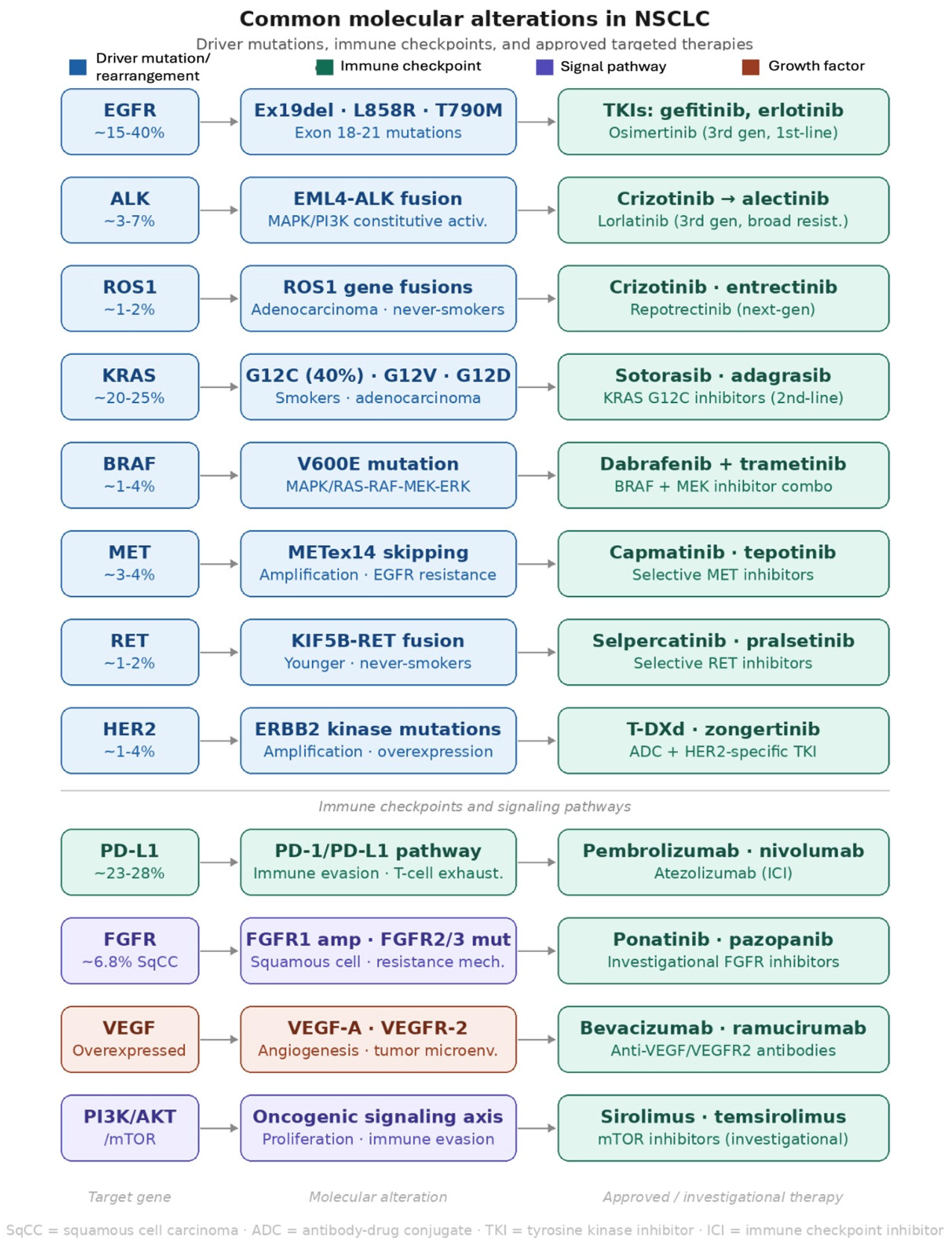
The common molecular alterations in NSCLC (Figure 1) include:

2.1. EGFR

The epidermal growth factor receptor (EGFR) is a transmembrane receptor tyrosine kinase that plays a critical role in regulating cellular proliferation, survival, differentiation, and migration. Dysregulation of EGFR signaling can promote oncogenesis through persistent activation of downstream pathways involved in tumor growth and progression. In the late 1980s, EGFR overexpression was identified in several malignancies and was subsequently recognized as an important oncogenic driver in NSCLC. Activating EGFR mutations represent one of the most common oncogenic alterations in NSCLC, particularly in patients with adenocarcinoma histology [11,12].
The most frequent activating EGFR mutations are deletions in exon 19 (Ex19del) and the exon 21 L858R point mutation. These mutations account for the majority of EGFR-mutated NSCLC cases and are well established predictive biomarkers for a favorable response to EGFR-TKIs [12]. In addition to these classical mutations, a variety of rare EGFR alterations have been described, including point mutations, insertions, deletions, and duplications within exons 18–25. These rare variants are less common and often demonstrate heterogeneous sensitivity to EGFR-targeted therapies. Due to their rarity, clinical evidence guiding optimal treatment strategies for these mutations remains limited [12].
Three generations of EGFR-TKIs have been developed, resulting in substantial improvements in clinical outcomes compared with conventional cytotoxic chemotherapy [11,13]. First-generation EGFR-TKIs, including gefitinib and erlotinib, reversibly inhibit the ATP-binding site of the EGFR tyrosine kinase domain. These agents demonstrated significantly improved progression-free survival and response rates compared with chemotherapy, particularly in tumors harboring exon 19 deletions or the exon 21 L858R mutation [13]. Second-generation EGFR-TKIs, such as afatinib and dacomitinib, were developed as irreversible inhibitors designed to overcome resistance mechanisms associated with first-generation TKIs. However, their clinical utility has been limited by increased toxicity and limited efficacy against tumors harboring the T790M resistance mutation [14,15,16]. Third-generation EGFR-TKIs, most notably osimertinib, were specifically developed to target both sensitizing EGFR mutations and the T790M resistance mutation while sparing wild-type EGFR, thereby reducing treatment-related toxicity. Clinical trials have demonstrated significant improvements in progression-free survival and overall survival with osimertinib compared with earlier-generation TKIs or chemotherapy [17,18]. Currently, third-generation EGFR-TKIs represent the standard first-line therapy for patients with advanced EGFR-mutated NSCLC. Emerging combination strategies, including the use of third-generation EGFR-TKIs with chemotherapy or novel agents such as amivantamab, have demonstrated promising improvements in progression-free survival and are under active investigation [19].

2.2. ALK Rearrangements

ALK rearrangements were first identified in anaplastic large-cell lymphomas and later recognized as an important oncogenic driver in NSCLC, occurring in approximately 3–7% of cases [14,20,21]. In ALK-rearranged NSCLC, fusion proteins such as EML4–ALK lead to constitutive activation of downstream signaling pathways, including MAPK, PI3K–AKT–mTOR, and JAK–STAT, promoting tumor cell proliferation, survival, and progression [21].
ALK tyrosine kinase inhibitors (ALK-TKIs) have significantly improved clinical outcomes compared with chemotherapy, with higher response rates, prolonged progression-free survival (PFS), and better control of central nervous system (CNS) metastases [22]. However, acquired resistance inevitably develops, mainly through secondary ALK mutations, different fusion variants, or activation of bypass signaling pathways [20,23].
Multiple generations of ALK inhibitors have been developed to overcome resistance. First-generation crizotinib showed superior efficacy compared with chemotherapy but is limited by poor CNS penetration and resistance [24]. Second-generation inhibitors (ceritinib, alectinib, brigatinib, ensartinib) offer improved potency and intracranial activity and are widely used as first-line treatments [25,26]. The third-generation inhibitor lorlatinib was designed to overcome a broad range of resistance mutations, including G1202R, which confers resistance to earlier-generation ALK inhibitors [27].

2.3. ROS1 Rearrangements

ROS1 gene fusions represent oncogenic drivers in NSCLC, resulting from chromosomal translocations that generate constitutively active fusion proteins, leading to persistent activation of downstream signaling pathways, including MAPK, PI3K, and JAK/STAT. Activation of these pathways promotes tumor growth, survival, and disease progression. ROS1 rearrangements occur in approximately 1–2% of NSCLC cases and are most commonly observed in patients with adenocarcinoma histology, particularly in younger individuals and never-smokers [14,28]. Studies suggest that ROS1 rearrangements may be more frequently observed in female patients and in those presenting with advanced-stage disease (stage III–IV) [29]. NGS is essential for detecting known and novel ROS1 fusion variants with potential therapeutic implications [30,31].
Crizotinib, a multitargeted TKI targeting MET, ALK, and ROS1, was the first approved targeted therapy for ROS1-rearranged NSCLC [32], achieving objective response rates (ORR) of approximately 72% and a median PFS of 19.2 months in patients with ROS1-positive NSCLC [33]. Newer ROS1 inhibitors have been developed to improve treatment outcomes, particularly with regard to CNS activity. Agents such as ceritinib, entrectinib, and lorlatinib demonstrate improved CNS penetration and have become important components of therapeutic strategies for ROS1-rearranged NSCLC [32]. More recently, next-generation ROS1 inhibitors have been introduced to address resistance mutations. Repotrectinib, a potent ROS1/ALK/TRK inhibitor, retains activity against resistance mutations, including the solvent-front G2032R mutation. Clinical studies have demonstrated promising efficacy, with an ORR of 79% (95% CI, 68–88) and a median PFS of 34.1 months in patients with ROS1 fusion-positive NSCLC [34,35]. Another emerging agent is taletrectinib, a CNS-penetrant ROS1/TRK inhibitor that has demonstrated encouraging clinical activity, with an objective response rate of approximately 54% and a median PFS of 9.6 months in patients with advanced or metastatic ROS1-positive NSCLC [36].

2.4. BRAF Mutations

BRAF mutations, particularly the BRAF V600E mutation, are oncogenic alteration in NSCLC that leads to constitutive activation of the RAS–RAF–MEK–ERK signaling cascade, also known as the MAPK pathway, promoting uncontrolled cellular proliferation, survival, and tumor progression [37,38]. These alterations are most frequently observed in lung adenocarcinoma and has been reported to occur more commonly in female patients. In addition, co-occurring genomic alterations have been described in some cases, including mutations involving other oncogenic drivers such as EGFR, ALK, and ROS1. The presence of such concurrent mutations may influence disease behavior and therapeutic decision-making [39].
Targeted therapies directed against BRAF V600E mutations have been developed for the treatment of advanced NSCLC. The combination of dabrafenib, a BRAF inhibitor, and trametinib, a MEK inhibitor, has demonstrated significant antitumor activity in patients with BRAF V600E-mutated NSCLC. Clinical studies have shown that this dual-targeted approach improves treatment outcomes compared with conventional chemotherapy while maintaining a manageable safety profile in patients with metastatic disease [37,40].

2.5. Kirsten Rat Sarcoma Viral Oncogene Homolog (KRAS)

Mutations in KRAS represent the most common oncogenic driver in NSCLC, accounting for approximately 20–25% of cases. KRAS mutations are predominantly observed in lung adenocarcinoma and are strongly associated with tobacco exposure, occurring in up to 90% of smokers with NSCLC [41]. Among KRAS-mutated tumors, the most frequent subtype is KRAS G12C, which accounts for approximately 40% of KRAS mutations, followed by G12V (19%) and G12D (15%) [42]. Historically, KRAS mutations were considered “undruggable” due to the absence of suitable binding pockets for small-molecule inhibitors. However, recent advances in molecular drug design have enabled the development of targeted therapies specifically directed against KRAS mutations, particularly KRAS G12C, marking a major breakthrough in the treatment of KRAS-mutated NSCLC [43].
Sotorasib and adagrasib have been developed as selective small-molecule inhibitors targeting KRAS G12C mutations. These agents specifically bind to the mutant KRAS protein and prevent its transition to the active guanosine triphosphate (GTP)-bound state, thereby inhibiting downstream oncogenic signaling pathways [44]. Both drugs have been approved and are widely used as second-line treatments for patients with advanced NSCLC harboring KRAS G12C mutations [14], and have demonstrated meaningful clinical activity with these agents. In patients with NSCLC treated with sotorasib, the ORR was 37% (95% CI: 28.6–46.2), with some responses lasting longer than 12 months. The median PFS was 6.8 months (95% CI: 5.1–8.2), and the median overall survival was 12.5 months (95% CI: 10.0–not estimable) [45,46].
Resistance to KRAS inhibitors remains a significant clinical challenge. Mechanisms of resistance may involve genetic alterations affecting nucleotide exchange function, adaptive activation of downstream signaling pathways, or the emergence of additional KRAS mutations, including newly expressed KRAS G12C variants [42]. Furthermore, the presence of co-occurring genomic alterations can influence therapeutic response to KRAS-targeted therapies. For example, mutations in STK11 and ATM frequently co-occur with KRAS mutations such as G12C, G12A, and G12V, while KEAP1 alterations are commonly associated with KRAS G12C and G13X mutations [44].

2.6. Human Epidermal Growth Factor Receptor 2 (HER2) Alterations

Human epidermal growth factor receptor 2 (HER2, also known as ERBB2) is a member of the ERBB family of receptor tyrosine kinases. Genetic alterations involving the ERBB2 gene, located on chromosome 17, occur in approximately 1–4% of NSCLC cases [47]. These alterations may include activating mutations, most commonly within the kinase domain (exons 18–21), as well as gene amplification and protein overexpression [48].
Trastuzumab deruxtecan, an antibody–drug conjugate targeting HER2, has been approved for patients with advanced NSCLC harboring HER2 mutations who have previously received systemic therapy. In addition, newer HER2-specific TKIs, such as zongertinib and BAY2927088, have demonstrated promising clinical activity and are emerging therapeutic options for patients with ERBB2-mutated advanced NSCLC demonstrating ORR of 72% and a disease control rate of 95.5%, along with a favorable safety profile [49,50].

2.7. Mesenchymal–Epithelial Transition (MET) Alterations

Alterations in the mesenchymal–epithelial transition (MET) gene, located on chromosome 7q21–q31, can lead to constitutive activation of the MET receptor tyrosine kinase, promoting cellular proliferation, survival, and tumor metastasis. The most clinically relevant MET alterations include MET exon 14 skipping mutations (METex14) and MET gene amplification [51]. MET exon 14 skipping mutations occur in approximately 3–4% of lung adenocarcinomas and 1–2% of other NSCLC subtypes. These alterations are particularly enriched in pulmonary sarcomatoid carcinoma, where they are detected at a higher frequency [52]. Patients with METex14-mutated NSCLC tend to be older compared with those harboring other oncogenic driver mutations such as EGFR or KRAS, with a reported median age of approximately 72.5 years at diagnosis [53]. In addition to acting as a primary oncogenic driver, MET amplification has also been identified as an important mechanism of acquired resistance to targeted therapies, particularly EGFR TKIs. MET amplification has been detected in approximately 21% of patients who develop resistance to first-generation EGFR inhibitors such as gefitinib or erlotinib [54,55].
Several targeted therapies have demonstrated clinical efficacy in NSCLC patients harboring MET exon 14 skipping mutations. Crizotinib, a multitargeted kinase inhibitor, as well as more selective MET inhibitors such as capmatinib and tepotinib, have shown significant therapeutic activity in this patient population [56]. Clinical trials have demonstrated encouraging outcomes with these agents. Capmatinib achieved an ORR of 68% (95% CI, 48–84) and a median duration of response of 12.6 months in treatment-naive patients with METex14-mutated NSCLC [57]. Similarly, tepotinib demonstrated an ORR of 57.3% (95% CI, 49.4–65.0) with a median duration of response of 46.4 months in patients with METex14-mutated NSCLC in long-term follow-up analyses [58].

2.8. RET Rearrangements

The RET proto-oncogene, located on chromosome 10q11.2, encodes a receptor tyrosine kinase involved in the regulation of cellular growth, differentiation, and survival. RET fusions were first identified as oncogenic drivers in NSCLC in 2011 and occur in approximately 1–2% of NSCLC cases, predominantly in patients with lung adenocarcinoma, younger age, and minimal or no smoking history [59,60]. The most common RET fusion partner identified in NSCLC is KIF5B–RET, while less frequent fusion partners include CCDC6–RET and NCOA4–RET [61].
Selpercatinib and pralsetinib—selective RET inhibitors—have demonstrated substantial antitumor activity with favorable safety profiles in patients with advanced disease [62,63]. In patients with advanced RET fusion-positive NSCLC, selpercatinib showed significant clinical benefit, achieving an ORR of 64% and a median duration of response of 17.5 months [64]. Similarly, pralsetinib has demonstrated promising efficacy, with an ORR of 72% and a median progression-free survival (PFS) of 13.0 months in treatment-naïve patients [65].

2.9. Fibroblast Growth Factor Receptor (FGFR) Alterations

FGFR alterations represent oncogenic drivers in a subset of NSCLC. The FGFR signaling pathway plays an important role in regulating cell proliferation, survival, differentiation, and angiogenesis, thereby contributing to tumor development and progression [66,67]. Activation of the FGFR pathway has also been implicated as a compensatory resistance mechanism during treatment with targeted therapies, including EGFR- or KRAS-directed therapies [68]. FGFR alterations are most commonly observed in lung squamous cell carcinoma, where FGFR mutations occur in approximately 6.8% of cases, whereas they are less frequent in other NSCLC subtypes, with a reported prevalence of approximately 1.3% [66]. Several types of FGFR alterations have been identified in NSCLC, including FGFR1 amplification, FGFR2 and FGFR3 mutations, and FGFR gene fusions. Examples of reported fusion events include FGFR3–TACC3, FGFR2–INA, FGFR4–RAPGEFL1, and FGFR1 fusions [66,69].
Targeted therapies directed against FGFR, e.g., ponatinib, have demonstrated inhibitory effects on tumor growth in NSCLC cell lines overexpressing FGFR1 [70]. In addition, multikinase inhibitors, such as pazopanib, have shown clinical responses in patients with FGFR2-mutated squamous cell carcinoma [71]. However, the clinical effectiveness of FGFR-targeted therapies may be limited by the development of acquired resistance, which can arise from secondary mutations within the FGFR kinase domain. Moreover, FGFR fusions may emerge as mechanisms of resistance to other targeted treatments, including EGFR tyrosine kinase inhibitors. Therefore, comprehensive genomic profiling, including circulating tumor DNA (ctDNA) analysis, is essential for detecting FGFR alterations and guiding personalized treatment strategies in NSCLC [69,72].

2.10. Trophoblast Cell Surface Antigen 2 (TROP-2) Alterations

Trophoblast cell surface antigen 2 (TROP-2) is a transmembrane glycoprotein belonging to the epithelial cell adhesion molecule (EpCAM) family and is highly expressed in several epithelial malignancies, including NSCLC [73]. TROP-2 expression has been reported in approximately 75% of squamous cell carcinomas, 65% of lung adenocarcinomas, and 18% of high-grade neuroendocrine tumors. Furthermore, increased TROP-2 expression in lung adenocarcinoma has been associated with higher cancer-specific mortality, suggesting a potential prognostic role for this biomarker in lung cancer [74].
Targeted therapies against TROP-2 have recently emerged. Sacituzumab govitecan (SG), an antibody–drug conjugate linking an anti-TROP-2 monoclonal antibody to SN-38 (the active metabolite of irinotecan), has demonstrated promising activity in advanced NSCLC, with an ORR of 17% in the intention-to-treat population (19% in evaluable patients), a median duration of response of 6.0 months, and a median PFS of 5.2 months [75].

2.11. Other Molecular Pathways in NSCLC

2.11.1. Programmed Cell Death Protein-1 (PD-1) Receptor and Programmed Cell Death Ligand-1 (PD-L1) Pathway

The programmed cell death protein 1 (PD-1) receptor and its ligands PD-L1 and PD-L2 constitute an important immune checkpoint pathway that plays a key role in tumor immune evasion. PD-1 is a co-inhibitory receptor primarily expressed on activated T-cells, B cells, natural killer (NK) cells, monocytes, and dendritic cells (DCs). Activation of the PD-1/PD-L1 pathway contributes to immune suppression within the tumor microenvironment and facilitates tumor immune escape in NSCLC [76,77]. The interaction between PD-1 and PD-L1/PD-L2 inhibits T-cell activation and proliferation, reduces the cytotoxic function of T lymphocytes, and promotes T-cell exhaustion. These effects impair the host immune response against tumor cells and allow malignant cells to evade immune surveillance. Additionally, regulatory mediators such as GATA-3 and T-bet have been implicated in promoting apoptosis of tumor-infiltrating T-cells, further contributing to an immunosuppressive tumor microenvironment [77].
Therapeutic blockade of the PD-1/PD-L1 pathway is a cornerstone in advanced NSCLC management, restoring antitumor immunity and enhancing T-cell-mediated tumor cell killing. Approved inhibitors, including pembrolizumab, nivolumab, and atezolizumab, have demonstrated improved survival, durable responses, and manageable safety profiles in first- and second-line settings [76,78].

2.11.2. Cytotoxic t-Lymphocyte-Associated Antigen 4 (CTLA-4) Pathway

Cytotoxic T-lymphocyte-associated antigen 4 (CTLA-4) is another important immune checkpoint protein involved in the regulation of immune responses. Similar to PD-1, CTLA-4 functions as a negative regulator of T-cell activation, playing a critical role in maintaining immune homeostasis and self-tolerance. By inhibiting early T-cell activation, CTLA-4 contributes to the suppression of antitumor immune responses [79]. In NSCLC, the role of CTLA-4 expression remains complex and has been associated with both prognostic and predictive significance. Studies have also shown that CTLA-4 expression may differ between primary tumors and metastatic lymph nodes, reflecting phenotypic heterogeneity within the tumor microenvironment [80].
Therapeutic inhibition of CTLA-4 enhances T-cell activation and restores antitumor immunity. While agents such as tremelimumab have been evaluated in advanced NSCLC, CTLA-4 blockade is primarily used in combination with PD-1/PD-L1 inhibitors, where dual checkpoint inhibition has shown improved immune responses, more durable clinical benefit, and acceptable safety profiles [81,82].

2.11.3. The Phosphatidylinositol 3-Kinase (PI3K)/AKT/Mammalian Target of Rapamycin (mTOR) Signaling Pathway

The phosphatidylinositol 3-kinase (PI3K)/AKT/mammalian target of rapamycin (mTOR) signaling pathway plays a critical role in tumorigenesis and disease progression and represents a central oncogenic axis in NSCLC. Activation of this pathway promotes tumor growth through multiple mechanisms, including enhanced cellular proliferation, metabolic reprogramming, inhibition of apoptosis, and increased resistance to anticancer therapies [83,84]. Activation of the PI3K/AKT/mTOR pathway has also been implicated in shaping the tumor immune microenvironment. Dysregulation of this pathway in tumor or immune cells may contribute to the development of an immunosuppressive tumor microenvironment, which facilitates tumor progression and immune evasion. In addition, activation of this signaling cascade has been associated with increased expression of immune checkpoint molecules such as PD-L1, further promoting immune escape in NSCLC [84,85]. Furthermore, activation of the PI3K/AKT/mTOR signaling pathway plays an important role in metabolic regulation, particularly by enhancing glycolytic activity in tumor cells. This metabolic reprogramming contributes to increased tumor growth and progression in NSCLC [86]. Numerous inhibitors targeting PI3K, AKT, and mTOR are currently under development and are being evaluated in preclinical studies and early-phase clinical trials for the treatment of NSCLC [84]. Examples of agents targeting this pathway include perifosine, an alkylphospholipid compound that inhibits AKT membrane translocation and prevents phosphorylation of downstream signaling molecules, thereby disrupting oncogenic signaling pathways. Other agents under clinical investigation include sirolimus, temsirolimus, and ridaforolimus, which target components of the mTOR signaling pathway [84,87].

2.11.4. Vascular Endothelial Growth Factor (VEGF) Pathway

The vascular endothelial growth factor (VEGF) signaling pathway plays a critical role in the progression, metastasis, and recurrence of NSCLC. VEGF mediates the formation of tumor microvasculature through angiogenesis, the process by which new blood vessels are formed to supply oxygen and nutrients to rapidly proliferating tumor cells. This process facilitates tumor growth, invasion, and metastatic dissemination. Many NSCLC tumors exhibit overexpression of VEGF-A, which represents a key driver of tumor-associated angiogenesis [88,89,90]. In addition to its role in angiogenesis, VEGF significantly influences the tumor immune microenvironment. VEGF can inhibit the maturation of dendritic cells, impair antigen-presenting capacity, and promote the recruitment of regulatory T-cells, tumor-associated macrophages, and myeloid-derived suppressor cells, thereby contributing to an immunosuppressive tumor microenvironment that facilitates tumor immune evasion [88]. The VEGF family includes several ligands such as VEGF-A, VEGF-B, VEGF-C, VEGF-D, and placenta growth factor (PlGF). These ligands interact with specific receptors, including VEGFR-1, VEGFR-2, and VEGFR-3, as well as co-receptors such as neuropilin-1 (NRP-1) and neuropilin-2 (NRP-2), to regulate both angiogenesis and lymphangiogenesis [91].
Targeting the VEGF/VEGFR signaling axis has become an important therapeutic strategy in NSCLC. Several agents have been developed, including monoclonal antibodies directed against VEGF or VEGF receptors as well as receptor tyrosine kinase inhibitors. Among these, bevacizumab, a monoclonal antibody targeting VEGF-A, and ramucirumab, a human IgG1 monoclonal antibody targeting VEGFR-2, have demonstrated clinical efficacy when combined with chemotherapy in patients with advanced NSCLC, leading to improved response rates, progression-free survival, and overall survival [88,90,92]. More recently, combination strategies integrating anti-angiogenic therapy with immune checkpoint inhibitors have shown promising results. Anti-angiogenic agents can normalize tumor vasculature and modulate the tumor microenvironment, shifting it from an immunosuppressive to an immune-supportive state, thereby enhancing the efficacy of immunotherapy [93]. Additionally, serum VEGF levels have been investigated as a potential predictive biomarker in NSCLC. However, further research is required to clarify its clinical utility for diagnosis, prognosis, and treatment selection [91].

3. Importance of Mediastinal Staging and Tissue Acquisition

Accurate staging of NSCLC is essential for determining optimal management strategies and for estimating prognosis, including survival outcomes and the risk of disease recurrence. Furthermore, precise staging also plays a critical role in guiding therapeutic decision-making, including the selection of the surgical resection, systemic therapies, radiotherapy, or combined multimodal treatment approaches [94]. The tumor–node–metastasis (TNM) staging system, established by the International Association for the Study of Lung Cancer (IASLC), is the globally accepted standard classification for lung cancer staging [94].
The IASLC released the 9th edition of the TNM classification for lung cancer in January 2025, introducing several revisions aimed at improving prognostic accuracy and supporting increasingly complex treatment strategies NSCLC [95]. In the 8th edition, N categories were defined exclusively according to the anatomical location of metastatic lymph nodes, without considering the number of involved lymph nodes. However, growing evidence has demonstrated that additional factors beyond anatomical location contribute to significant prognostic heterogeneity, particularly within the broad N2 category, highlighting the need for a more refined classification system [96]. While the T category underwent minor anatomical refinements, it remained largely unchanged in its fundamental structure. The most significant modifications involve the nodal and metastatic classifications. Specifically, pathological N2 disease has been subdivided into two categories: N2a and N2b, reflecting differences in nodal disease burden. In addition, the M1c category has been further subdivided into M1c1 and M1c2, providing a more detailed classification of distant metastatic spread [94,95]. These updates emphasize the importance of pathological nodal staging, which remains one of the most important prognostic factors in patients with resectable NSCLC. Furthermore, emerging evidence suggests that N2b disease is associated with a significantly higher risk of mortality compared with N2a disease, supporting the clinical relevance of this more granular nodal classification. Overall, the refinements introduced in the 9th edition of the TNM staging system are expected to improve the accuracy of prognostic assessment, facilitate more precise patient stratification, and enhance clinical decision-making in the management of NSCLC [96].

3.1. Clinical Importance of Comprehensive Mediastinal Lymph Node Staging in Early-Stage NSCLC

Systematic and accurate lymph node staging in early-stage NSCLC planned for curative surgical management is essential to ensure precise disease staging, guide appropriate adjuvant therapy, and achieve complete (R0) resection at the time of surgery [97]. Inadequate resection—whether resulting from incomplete lymph node dissection (e.g., failure to perform systematic nodal dissection or the presence of a positive highest mediastinal lymph node) or from an uncertain resection status—has been associated with significantly worse overall survival compared with complete surgical resection (hazard ratios 1.69 and 3.18, respectively; both p = 0.0001). Median overall survival was 80.1 months in patients with complete resection, compared with 39.9 months and 17.3 months in those with uncertain and incomplete resections, respectively. Corresponding 5-year survival rates were 58.8%, 37.3%, and 15.7%, respectively. These findings underscore the critical importance of accurate mediastinal nodal staging [98].

3.2. Clinical Importance of Comprehensive Mediastinal Lymph Node Staging in Locally Advanced NSCLC

In locally advanced NSCLC, accurate mediastinal nodal staging is essential for appropriate radiotherapy planning. Reliance solely on PET-CT for determining the extent of nodal involvement may lead to inaccuracies in target volume delineation. False-positive lymph nodes on PET-CT may result in unnecessarily enlarged radiation fields and higher delivered radiation doses, thereby increasing the risk of treatment-related toxicity and complications. Conversely, PET-occult nodal metastases may be excluded from the radiation field, which can increase the risk of geographic miss, treatment failure, and disease recurrence [99]. Current evidence suggests that a considerable proportion of patients may harbor nodal disease not detected by PET-CT alone. In particular, patients with larger primary tumors and PET-CT-based clinical N0 or N1 status demonstrate a higher likelihood of occult mediastinal involvement [99]. Studies have reported upstaging to pathological N2 disease in approximately 20% of such patients, identified either through endobronchial ultrasound-guided transbronchial needle aspiration (EBUS-TBNA) or postoperative pathological assessment [100].
These observations are consistent with estimates indicating that 5–29% of patients may have nodal disease located outside the initially planned radiation field when staging is based solely on imaging modalities. This underscores the importance of incorporating invasive mediastinal staging techniques, such as EBUS-guided nodal sampling, to improve staging accuracy and optimize radiotherapy target delineation in patients with locally advanced NSCLC [97,100,101].

4. Role of EBUS-TBNA Samples for Immunohistochemistry and NGS

EBUS-TBNA plays a crucial role in precision oncology by providing cytological and histological material for molecular characterization during lung cancer staging, thereby enabling the identification of patients who may benefit from targeted therapies and personalized immunotherapy [102]. Additionally, the molecular analysis of EBUS-TBNA-derived lymph node specimens may improve nodal staging accuracy through two complementary mechanisms. First, EBUS-TBNA enables simultaneous pathological confirmation of nodal metastasis and comprehensive molecular profiling within a single minimally invasive procedure, thereby integrating anatomical staging with molecular characterization. Second, the detection of tumor-specific oncogenic driver mutations in mediastinal lymph node samples may enhance the sensitivity of nodal staging beyond conventional cytomorphological assessment, particularly in cases of occult or micrometastatic nodal involvement where standard cytological evaluation may be insufficient [103,104].
The adequacy and reliability of EBUS-TBNA for genotyping in NSCLC, as well as its suitability for immunohistochemical analysis, have been widely investigated [105]. In a large multicenter study including 774 patients, the suitability of EBUS-TBNA specimens obtained in routine clinical practice for NSCLC subtyping and molecular analysis was evaluated. Histological subtyping was successfully achieved in 77% of cases, while EGFR mutation analysis was feasible in 90% of the obtained samples. These findings support the role of EBUS-TBNA as a reliable minimally invasive technique for both histological classification and molecular testing in patients with NSCLC [106].
Similarly, a retrospective analysis of 109 patients with NSCLC and mediastinal or hilar lymphadenopathy demonstrated the feasibility of using EBUS-TBNA specimens for the detection of EML4–ALK fusion genes. ALK rearrangements were identified in 6.4% of cases using EBUS-TBNA samples. These alterations were reliably detected by IHC, FISH, and reverse transcription polymerase chain reaction (RT-PCR), demonstrating that small histological core samples obtained via EBUS-TBNA are suitable for comprehensive molecular analysis. ALK-positive tumors were associated with adenocarcinoma histology, younger age, never- or light-smoking status, smaller primary tumor size, mucin production, and wild-type EGFR [107].
The feasibility and reliability of EBUS-TBNA samples for PD-L1 assessment and broad molecular characterization in advanced NSCLC were further evaluated in a prospective study including 42 patients. EBUS-TBNA samples showed high adequacy for comprehensive molecular profiling, with successful genotyping rates of 92.8% using NGS, 95.2% using nCounter analysis, and 100% for PD-L1 testing. Concordance with paired tissue biopsy samples was 100% for NGS and nCounter analyses and substantial for PD-L1 expression (88.9% using a ≥ 1% cutoff), although caution is warranted when interpreting very high PD-L1 expression levels [102].
A systematic review and meta-analysis including 33 studies and 2869 patients further confirmed the high adequacy of EBUS-TBNA samples for molecular testing in NSCLC. The pooled sample adequacy was 94.5% (95% CI, 93.2–96.4%) for EGFR mutation analysis and 94.9% (95% CI, 89.4–98.8%) for ALK rearrangement testing. The prevalence of EGFR mutations was 15.8% (95% CI, 12.1–19.4%), whereas ALK rearrangements were detected in 2.77% of cases (95% CI, 1.0–4.8%). Data regarding ROS1 and PD-L1 alterations were insufficient for meta-analysis [108].

4.1. Factors Influencing the Adequacy and Diagnostic Yield of EBUS-TBNA Samples for Molecular Mutation Analysis

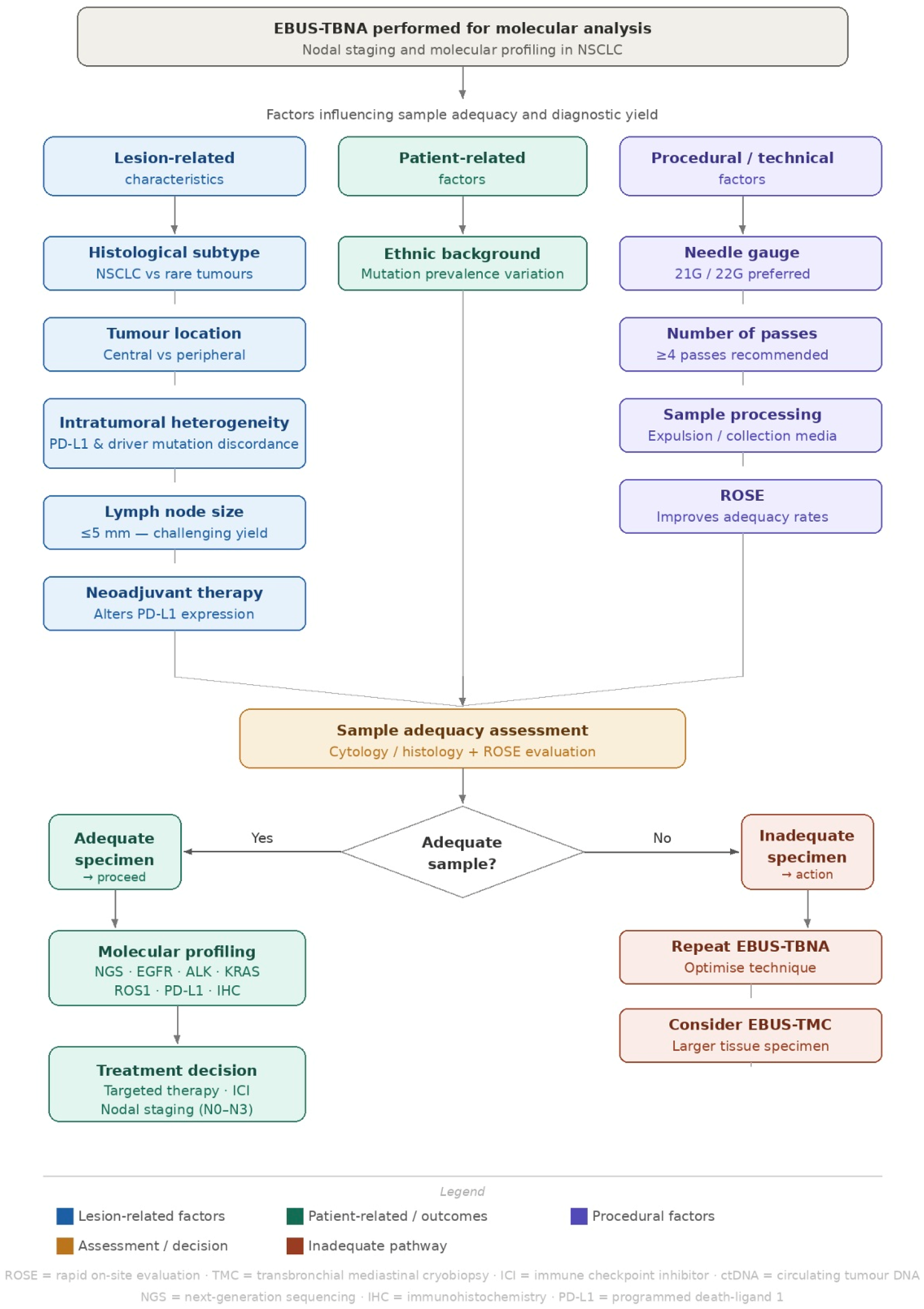
Multiple factors influence the diagnostic accuracy and reliability of molecular analyses performed on samples obtained via EBUS-TBNA (Figure 2). These determinants can be broadly categorized into three principal domains: (a) lesion-related characteristics: these include the histological subtype of the tumor, anatomical tumor location, the presence of intratumoral heterogeneity, the size of metastatic lymph nodes, and prior neoadjuvant therapy, all of which may affect cellular yield and the representativeness of the obtained specimen [105,109,110], (b) patient-related factors: patient characteristics, particularly the ethnic background of the studied population, may influence the prevalence and distribution of specific molecular alterations [108], (c) procedural and technical factors of EBUS-TBNA: technical aspects of the sampling procedure significantly affect specimen adequacy and molecular testing success. Relevant parameters include the needle gauge, the application of suction, the number of needle passes, specimen handling and processing protocols, and the utilization of rapid on-site evaluation (ROSE) to assess sample adequacy during the procedure [111].

4.1.1. Lesion-Related Characteristics

Histological Subtype of Lung Cancer
The histological subtype of lung cancer represents an important factor influencing the accuracy and reliability of molecular analyses performed on samples obtained by EBUS-TBNA [111]. In patients with primary NSCLC, molecular testing for common driver mutations—such as EGFR, KRAS, BRAF, and PIK3CA—can be reliably performed on EBUS-TBNA specimens. Studies have demonstrated a high feasibility of mutation analysis, with an overall mutation detection rate of approximately 91% using fine-needle aspirates analyzed by allele-specific qPCR [112]. In contrast, the diagnostic yield of EBUS-TBNA samples may be limited in rare tumors or uncommon malignancies, where small cytological specimens are often insufficient for comprehensive histopathological evaluation and advanced molecular profiling. In such cases, larger tissue samples are frequently required to establish a definitive diagnosis and to perform extended molecular analyses. Alternative techniques, such as EBUS-guided transbronchial mediastinal cryobiopsy (TMC), may provide larger and more representative tissue specimens, thereby improving diagnostic accuracy in patients with mediastinal lymphadenopathy without an obvious primary lung lesion [112,113].
Location of the Tumor
The location of the tumor may also influence the diagnostic accuracy and reliability of samples obtained by EBUS-TBNA. Specimens acquired from centrally located intrapulmonary tumors have demonstrated diagnostic performance comparable to that of mediastinal lymph node sampling and frequently provide sufficient material for molecular analysis [114]. EBUS-TBNA performed on centrally located tumors achieved an overall diagnostic yield of 86% (88/102 cases). Furthermore, the adequacy of samples for molecular testing was reported in ≥94% of cases [114].
Intratumoral Heterogeneity
PD-L1 expression in NSCLC demonstrates both intertumoral and intratumoral heterogeneity, which may contribute to discordance in PD-L1 classification between small cytological specimens, such as those obtained by EBUS-TBNA, and larger surgically resected tissue samples. This variability may affect the reliability of PD-L1 assessment, particularly when tumor proportion score (TPS) values are close to clinically relevant cut-off thresholds of 1% and 50% [115]. Furthermore, discordant PD-L1 expression between different tumor sites or specimen types is not uncommon in NSCLC, reflecting heterogeneity related to histological subtype, tissue sampling methods, and metastatic sites [116].
Size of Metastatic Lymph Nodes
The size of metastatic lymph nodes may also influence the reliability of molecular analyses performed on EBUS-TBNA-derived specimens, although the impact of lymph node size remains controversial [117]. Larger lymph nodes are generally more likely to harbor metastatic disease and therefore may provide a higher probability of obtaining malignant cells in sufficient quantity for histopathological assessment and molecular profiling [117,118]. Conversely, smaller lymph nodes, particularly those measuring ≤ 5 mm, are less frequently associated with malignancy and may pose technical challenges during sampling, potentially resulting in insufficient material for molecular analysis [119].
However, some studies suggest that lymph node size may not significantly influence diagnostic performance. For example, a prospective study showed that diagnostic accuracy of EBUS-TBNA was not significantly associated with lymph node size or the number of needle passes (p = 0.23 and p = 0.27, respectively), indicating that adequate diagnostic yield can still be achieved even in smaller lymph nodes when appropriate technique is applied [117].
Neoadjuvant Chemotherapy or Immunotherapy
Neoadjuvant therapy, including chemotherapy or immunotherapy, may also influence the expression of PD-L1 in tumor cells. Several studies have suggested that systemic treatment can alter the tumor microenvironment and may lead to changes in PD-L1 expression levels, including potential downregulation of PD-L1 on tumor cells. Consequently, PD-L1 assessment performed on post-treatment samples may not always accurately reflect the baseline PD-L1 status, which could affect the interpretation of results obtained from EBUS-TBNA specimens used for molecular and immunohistochemical analysis [120].

4.1.2. Technical Factors of EBUS-TBNA

Sample adequacy in EBUS-TBNA is influenced by several technical factors, including needle size, the use of suction, the number of needle passes, specimen processing protocols, and the integration of rapid on-site evaluation (ROSE) [111].
Gauge of EBUS-TBNA Needles
Multiple EBUS-TBNA needle gauges (25-, 22-, 21-, and 19-gauge) are currently commercially available. The optimal needle size for obtaining adequate tissue samples for diagnosis and molecular testing has been investigated in numerous studies. The American College of Chest Physicians (ACCP) Clinical Practice Guideline for the acquisition and handling of endobronchial ultrasound-guided transbronchial needle aspiration samples recommends the use of 21- or 22-gauge needles over 19-gauge needles when performing EBUS-TBNA in patients with suspected malignant disease, mainly due to concerns regarding tissue integrity and potential specimen contamination with blood when using larger needles [111]. However, this recommendation is conditional and based on very low certainty of evidence [111].
Several studies have reported no significant difference in sample adequacy or diagnostic yield between 21-G and 22-G needles. In a comparative study demonstrated that although the diagnostic yield was similar between the two needle sizes, samples obtained with the 21-G needle showed better preservation of histological architecture, which may facilitate improved morphological and genetic characterization of NSCLC [103].
The role of the 19-G needle, which may allow retrieval of a larger tissue core, remains controversial. While the larger needle may theoretically improve tissue acquisition for histological and molecular analysis, available evidence is heterogeneous. One limitation of the 19-G needle is increased blood contamination during aspiration, which may complicate ROSE and potentially reduce diagnostic yield in some cases [111]. Several studies have suggested potential advantages of using a larger-gauge needle. In one study, the 19-G needle demonstrated significantly higher smear cellularity compared with the 22-G needle (32.6% vs. 13.0%, p = 0.05) and was associated with improved adequacy rates during ROSE (84.8% vs. 63.0%, p = 0.004) [121]. Similarly, another study reported that specimens obtained with a 19-G needle contained significantly greater amounts of tissue and higher numbers of tumor cells per slide, while maintaining a safety profile comparable to that of the 22-G needle [121,122]. In contrast, several randomized and prospective studies have demonstrated no superiority of the 19-G needle in terms of diagnostic yield or histological core procurement [123,124,125]. Conversely, one study reported that the 19-G needle did not improve diagnostic yield and produced more bloody and less adequate samples compared with the 22-G needle. In their study, sample adequacy was significantly higher with the 22-G needle (73% vs. 46%, p < 0.001), while the 19-G needle produced significantly more bloody samples (59% vs. 19%, p < 0.001). Despite these differences, the overall diagnostic yield remained similar between both needles (95% vs. 93%, p = 0.62) [104].
Regarding molecular testing, the available evidence suggests that samples obtained with 21-G and 22-G needles are generally sufficient for molecular analysis, including EGFR, ALK, and PD-L1 testing. EGFR mutation testing was successfully performed in 79 of 80 cases (98.75%), with EGFR mutations detected in 5 of 80 samples (6.3%), while ALK analysis was successfully performed in all tested samples (21/21) [126]. Similarly, a pilot study demonstrated that the 19-G needle achieved high success rates for molecular testing, with success rates of 90% for PD-L1, 90% for EGFR, and 86% for ALK testing in NSCLC samples due to the higher tumor cell content. However, the success rate for ROS-1 testing was lower (67%) [127].
Overall, current evidence indicates that 21-G and 22-G needles provide reliable diagnostic yield and adequate material for molecular testing, whereas the potential advantages of 19-G needles remain inconsistent across studies and require further investigation [111].
Number of Needle Passes
According to ACCP clinical practice guideline on the acquisition and handling of EBUS-TBNA Samples, at least four needle passes per lymph node are suggested when malignancy is suspected rather than three or fewer passes, although the quality of evidence supporting this recommendation is considered very low. This recommendation aims to ensure adequate tissue acquisition not only for definitive histopathological diagnosis but also for ancillary testing and molecular analysis. Increasing the number of passes per lymph node may improve the likelihood of obtaining sufficient material for molecular testing without an apparent increase in procedure-related complications [111].
Supporting evidence has been reported in several studies. In a cohort of 453 patients with lung cancer, a mean of 3.4 EBUS-TBNA passes per lesion was sufficient to allow EGFR mutation and ALK fusion gene analysis in 80.4% (201/250) of specimens following routine IHC processing. The authors further demonstrated that performing at least three passes per lesion, particularly in larger lymph nodes, significantly increased the probability of successful lung cancer subtyping and molecular testing using EBUS-TBNA samples [128]. Similarly, one study reported that a median of four passes per lesion was required to achieve adequate molecular profiling in 95.3% of cases when EBUS-TBNA was performed in conjunction with ROSE [129].
Specimen Sample Expulsion/Suction and Collection Media
The ACCP clinical practice guideline on the acquisition and handling of EBUS-TBNA samples suggests that either the standard method (e.g., using a stylet or air flush) or alternative techniques such as needle rinsing may be used to expel EBUS-TBNA specimens onto cytopathology slides or directly into liquid collection media (e.g., formalin or alcohol-based solutions). However, the guideline does not recommend one expulsion technique over another, reflecting the limited available evidence [111].
The only aspect that has been formally evaluated in a randomized controlled trial is the use of a stylet during specimen expulsion. In this study, 121 patients with 194 sampled lymph nodes underwent EBUS-TBNA using both with-stylet and without-stylet techniques. The results demonstrated no significant difference in diagnostic yield or specimen quality between the two methods, suggesting that the use of a stylet does not improve diagnostic outcomes [130]. To date, no studies have specifically compared different expulsion techniques (e.g., air flush, stylet expulsion, or needle rinsing) with regard to sample adequacy, diagnostic yield, or reliability for molecular analysis. Most available studies instead focus on comparisons between specimen preparation or collection media (e.g., formalin versus alcohol-based media, direct smears versus liquid-based cytology) [111].
Accordingly, the ACCP guideline does not recommend a specific collection medium (such as formalin, RPMI, saline, phosphate-buffered saline, or alcohol-based preparations). These recommendations remain conditional with very low certainty of evidence, largely due to limited comparative data. Several studies have reported no significant differences in diagnostic yield among different preparation methods or collection media. Furthermore, combining direct cytology smears with cell block preparation has been shown to provide high diagnostic accuracy in EBUS-TBNA samples [111,131,132,133]. Given these limitations in the evidence, the guideline emphasizes the importance of local collaboration between bronchoscopists and cytopathology laboratories to determine the most appropriate specimen expulsion technique, collection medium, and processing method based on local expertise and laboratory requirements [111].
Regarding the suitability of cytological specimens for molecular analysis, studies have demonstrated high reliability. For example, in a study evaluating EGFR mutation testing in EBUS-TBNA cytology samples, paired primary tumor tissue and lymph node cytology specimens from 14 patients with EGFR-mutant lung adenocarcinoma were analyzed. The results showed high concordance between cytological and histological samples, with all but one cytology specimen demonstrating the same mutation profile. These findings support the reliability of cytology smears for real-time PCR-based EGFR mutation testing in NSCLC [134]. Additionally, alcohol-based fixatives have been investigated as an alternative to formalin and paraffin-based fixation methods, which may impair DNA and RNA quality. Several studies have demonstrated that alcohol-based non-crosslinking fixatives provide higher DNA and RNA yields with improved preservation of nucleic acid integrity. Furthermore, these fixatives may enhance the molecular diagnostics by reducing nucleic acid damage and increasing the amount of recoverable genetic material from biopsy specimens [135].
ROSE
The ACCP clinical practice guideline on the acquisition and handling of EBUS-TBNA samples recommends the use of ROSE during EBUS-TBNA when available, as it provides immediate cytopathological feedback and preliminary diagnostic information compared with procedures performed without ROSE [111]. Evidence supporting this recommendation has been demonstrated in several studies. A pooled analysis evaluating the diagnostic yield of EBUS-TBNA with versus without ROSE reported diagnostic yields of 78.0% and 71.4%, respectively, corresponding to an odds ratio of 2.35 (95% CI, 1.47–3.74) in favor of ROSE [136,137,138,139,140].
Regarding the influence of ROSE on molecular genotyping, a prospective randomized trial comparing EBUS-TBNA with and without ROSE demonstrated that complete molecular profiling was achieved in 85.7% of patients (108/126). Although the success rate was higher in the ROSE group than in the EBUS-only group (90.8% vs. 80.3%), the difference did not reach statistical significance (p = 0.09). Notably, the ROSE group had no samples limited to pathologic diagnosis due to minimal tumor burden (0 vs. 6, p = 0.05) and more frequently required only a single biopsy site (58.9% vs. 44.1%, p = 0.01) [141].

4.2. Concordance of EBUS-TBNA with Surgical Specimens for Molecular Profiling

Although EBUS-TBNA is a minimally invasive technique, accumulating evidence demonstrates that specimens obtained with this method are reliable for molecular analyses, including testing for EGFR, ALK, and KRAS mutations. Several studies have shown a high concordance between molecular profiling results obtained from EBUS-TBNA samples and those derived from surgical resection specimens. A prospective study compared the diagnostic accuracy of EBUS-TBNA and mediastinoscopy for mediastinal staging of lung cancer. The two techniques demonstrated excellent agreement (91%; κ = 0.8; 95% CI, 0.7–0.9). Both methods achieved 100% specificity and positive predictive value. The sensitivity, negative predictive value, and overall diagnostic accuracy were 81%, 91%, and 93% for EBUS-TBNA, and 79%, 90%, and 93% for mediastinoscopy, respectively, with no significant difference in pathological N-stage determination (p = 0.78) [142].
Regarding PD-L1 testing, a study evaluated the concordance between PD-L1 expression in small biopsy samples and corresponding surgical specimens. Using a PD-L1 tumor proportion score (TPS) cut-off ≥50%, the study demonstrated a 78% concordance rate with moderate agreement (Cohen’s κ = 0.45) between EBUS-TBNA samples and surgical resection specimens. Although PD-L1 expression in biopsy samples correlated with surgical specimens, the authors noted that the clinical accuracy remains limited, indicating that PD-L1 assessment from small biopsy samples should be interpreted cautiously when guiding treatment decisions [143]. Similar findings were observed 78% concordance with moderate agreement (κ = 0.45) when using a TPS cut-off ≥50% for PD-L1 expression [120].
For driver mutation testing, a study demonstrated that comprehensive molecular profiling can be effectively performed using EBUS-TBNA samples. In their study, EGFR mutations (exons 18–21), KRAS mutations (exons 2–3), and ALK rearrangements were identified in 16.9%, 31.6%, and 3.9% of EBUS-TBNA samples, respectively, compared with 14.8%, 29.0%, and 3.4% in corresponding surgical specimens. Importantly, no statistically significant differences were observed between the two sample types, confirming the suitability of EBUS-TBNA specimens for comprehensive mutational analysis in advanced non-small cell lung cancer [144].

4.3. EBUS-Transbronchial Mediastinal Cryobiopsy (TMC) and Molecular Testing

EBUS-TMC has recently emerged as a promising technique for sampling mediastinal and hilar lymph nodes. Compared with conventional needle aspiration, cryobiopsy generally yields larger specimens with well-preserved tissue architecture and minimal crush artifacts, which facilitates histopathological evaluation and may improve the suitability of samples for molecular analyses [145]. Initial clinical experience suggests that the procedure has a favorable safety profile, with no significant difference in the rate of adverse events compared with standard EBUS-TBNA [145,146]. In clinical practice, EBUS-TMC is frequently used as a complementary technique to EBUS-TBNA, improving diagnostic performance when both methods are combined. In a multicenter, open-label randomized trial, the diagnostic yield increased from 81% with EBUS-TBNA alone to 93% when combined with cryobiopsy [145]. EBUS-TMC appears to be particularly valuable in lymphoproliferative disorders and benign granulomatous diseases, such as sarcoidosis. In one study, the diagnostic rate for sarcoidosis reached 96.7% when EBUS-TBNA was combined with cryobiopsy, compared with 87.5% when EBUS-TBNA was combined with transbronchial forceps biopsy [147]. A pooled analysis of seven studies including 555 patients reported an overall diagnostic yield of 92% for EBUS-TMC compared with 80% for EBUS-TBNA, mostly in patients with lymphoma and benign mediastinal lesions. Additionally, in 97% of EBUS-TMC samples, genetic and immunohistochemical analyses, including PD-L1 testing, were feasible, highlighting the particular value of EBUS-TMC for molecular profiling of mediastinal samples [148]. Another meta-analysis including 538 patients across 10 studies demonstrated a pooled overall diagnostic yield of 89.59% for EBUS-TMC versus 77.13% for EBUS-TBNA, with a statistically significant advantage of EBUS-TMC in lymphoma and benign disorders. The safety profile of EBUS-TMC was also confirmed. Clinically significant bleeding occurred in 1.12% and pneumothorax in 0.74% of patients, with no procedure-related mortality reported [149]. A further meta-analysis including 20 studies demonstrated significantly higher diagnostic efficacy for EBUS-TMC compared with EBUS-TBNA (RD 0.30; 95% CI: 0.17–0.44; p < 0.001). Regarding the complications, there was no significant differences in pneumothorax or bleeding risk between the two techniques [150].
For molecular testing in NSCLC, TMC samples have also shown advantages due to their larger size and higher tumor cellularity [151]. In a study EBUS-TMC demonstrated a significantly higher diagnostic yield compared with EBUS-TBNA (90.4% vs. 67.7%; p < 0.001), including in heterogeneous lesions (92.3% vs. 69.4%; p = 0.011). EBUS-TMC samples also showed higher tumor cellularity (65% vs. 30%; p < 0.001) and improved NGS success rates (85.4% vs. 61.9%; p = 0.035) [152]. Similarly, a study reported a higher diagnostic yield for EBUS-TMC compared with EBUS-TBNA (91.2% vs. 56.2%; p < 0.001) and demonstrated that immunohistochemistry was feasible more frequently with cryobiopsy (88.9%) than with needle aspiration (40.7%; p < 0.001) [153]. The larger tissue fragments obtained by EBUS-TMC (approximately 3.5 ± 0.7 mm) are associated with higher nucleic acid yields, with mean extracted DNA and RNA concentrations of 97.2 ± 22.4 ng/µL and 26.6 ± 4.9 ng/µL, respectively, providing adequate material for both histomorphological assessment and comprehensive molecular testing [154].
Despite these promising results, EBUS-TMC remains a relatively new technique, and large prospective head-to-head studies comparing EBUS-TMC with conventional EBUS-TBNA or EBUS-guided forceps biopsy are still limited. Therefore, additional evidence is required before widespread implementation of EBUS-TMC in routine clinical practice can be recommended [155].

5. Future Directions

5.1. Thin Convex Probe EBUS (TCP-EBUS)

A third generation of thin convex probe EBUS (TCP-EBUS) scope is now available to overcome the limitations of currently commercially available convex probe EBUS (CP-EBUS) bronchoscopes, which have limited ability to explore segmental bronchi, particularly in the upper lobes, mainly due to restricted angulation and their relatively larger diameter [156,157].
The newly developed TCP-EBUS scope (Olympus BF-UC290F) provides improved flexibility with enhanced angulation of up to 160°. It features a smaller diameter with a compact distal tip of only 6.6 mm, and the ultrasound scanning range has been increased by 5°. These improvements allow better access to segmental bronchi and smaller airways, facilitating the evaluation of peripheral lesions and lymph node staging beyond the hilar and lobar lymph nodes—areas that are often difficult to reach using standard EBUS bronchoscopes [156,157].
An initial evaluation of TCP-EBUS in a cadaveric model demonstrated greater accessibility compared with standard convex EBUS in several bronchi, with statistically significant differences (p < 0.05). In addition, puncture success rates for simulated lesions using TCP-EBUS were significantly higher than those achieved with conventional convex EBUS in both segmental bronchial regions (85.0% vs. 60.0%, p < 0.001) and subsegmental bronchial regions (84.4% vs. 38.9%, p < 0.001) [157].
Notably, TCP-EBUS utilizes only a thin 25-gauge needle due to the smaller working channel of the scope. However, several studies have demonstrated that samples obtained using a 25-gauge needle are comparable to those obtained with a 22-gauge needle in terms of diagnostic yield and their suitability for genetic analysis using NGS [158,159]. The adequacy of samples obtained with a 25-gauge needle using TCP-EBUS specifically for molecular analysis has not yet been systematically investigated. The suitability of these samples may also be influenced by the location of the target lesions. In addition, the integration of a 1.1 mm cryoprobe for EBUS-TMC, which can be used through the TCP-EBUS scope, may help overcome potential sampling limitations associated with the smaller needle size. Nevertheless, this approach requires further clinical evaluation.

5.2. Artificial Intelligence (AI) in EBUS

Recent advances in artificial intelligence (AI) and machine learning, particularly deep learning and convolutional neural networks, have significantly impacted medical imaging. The integration of these technologies into the field of interventional pulmonology has improved procedural planning and enabled real-time assessment, including intraprocedural tissue evaluation. This integration has the potential to improve diagnostic yield and enhance the quality of obtained samples for subsequent molecular and genetic analyses [160]. Several studies have investigated the reliability of AI models applied to grayscale EBUS images for differentiating metastatic from benign lymph nodes. The reported diagnostic accuracy of these models varies considerably, ranging from 73% to 97% across different trained algorithms [161,162,163].
However, these findings remain preliminary, as most studies are limited by single-center datasets, relatively small sample sizes, and restricted external validation. Furthermore, the potential utility of AI-trained models and their impact on the reliability and diagnostic accuracy of EBUS-TBNA samples for molecular analysis and NGS have not yet been adequately investigated. Multicenter studies with larger sample sizes are therefore needed to standardize the procedure and to validate the clinical applicability of AI-assisted EBUS in the diagnosis of metastatic lymph nodes, as well as to assess the adequacy of obtained samples for molecular analyses.
Additionally, the implementation of AI algorithms in ROSE is a promising approach to overcome the limitations associated with the routine use of ROSE in the bronchoscopy suite, which is often constrained by the limited availability of pathologists/cytologists. Recent studies have demonstrated that AI systems are effectively capable of analyzing ROSE smears with high accuracy of identification if cancerous cells and may thereby enhance the diagnostic efficiency and adequacy of EBUS-TBNA samples [164,165]. Beyond the recognition of tumor cellularity, recent ML models have increasingly been investigated for their ability to integrate multidimensional data sources, such as whole-transcriptome RNA sequencing and airway epithelial transcriptional profiling, thereby improving diagnostic yield [166]. Furthermore, ML models based on programmed cell death (PCD) signatures have demonstrated promising prognostic potential and may help identify patients at risk of resistance to immunotherapy, thereby contributing to improved patient stratification and personalized treatment strategies for lung adenocarcinoma [167].
However, the currently available evidence supporting the clinical validity of AI-driven models for immunohistopathological sample analysis remains limited and is largely derived from early exploratory studies. Greater data availability, improved integration with established procedural technologies, and further prospective multicenter studies are essential to validate these models and facilitate their implementation in routine clinical practice.

Author Contributions

Conceptualization, A.E. and K.D.; methodology, A.E.; software, A.E.; validation, A.E., N.B. and K.D. formal analysis, A.E.; investigation, A.E.; resources, A.E.; data curation, A.E.; writing—original draft preparation, A.E.; writing—review and editing, A.E., N.B. and K.D.; visualization, A.E., N.B. and K.D.; supervision, K.D.; project administration, A.E.; funding acquisition, A.E. and K.D. All authors have read and agreed to the published version of the manuscript.

Funding

This research received no external funding.

Data Availability Statement

This is a review article; no new datasets were generated or analyzed during the current study.

Conflicts of Interest

The authors declare no competing financial interests.

Abbreviations

The following abbreviations are used in this manuscript:
ACCPAmerican College of Chest Physicians
ADCAntibody–drug conjugate
AIArtificial intelligence
ALKAnaplastic lymphoma kinase
AMPAssociation for molecular pathology
CAPCollege of American Pathologists
CNSCentral nervous system
CP-EBUSConvex probe EBUS
CtDNACirculating tumor DNA
CTLA-4Cytotoxic t-lymphocyte-associated antigen 4
DCDendritic cells
EBUS-TBNAEndobronchial ultrasound-guided transbronchial needle aspiration
EBUS-TMCEBUS-Transbronchial Mediastinal Cryobiopsy
EGFREpidermal growth factor receptor
EpCAMEpithelial cell adhesion molecule
FISHFluorescence in situ hybridization
FGFRFibroblast growth factor receptor
GTPGuanosine triphosphate
HER2Human epidermal growth factor receptor 2
IASLCInternational Association for the study of Lung Cancer
ICIImmune checkpoint inhibitor
IHCImmunohistochemistry
KEAP1Kelch-like ECH-associated protein 1
KRASKirsten rat sarcoma viral oncogene homolog
mTORMammalian target of rapamycin
METMesenchymal–epithelial transition
NKNatural killer
NGSNext-generation sequencing
NSCLCNon-small cell lung cancer
ORRObjective response rates
PCRPolymerase chain reaction
PD-1Programmed cell death protein-1
PD-L1Programmed death-ligand 1
PFSProgression-free survival
PI3KPhosphatidylinositol 3-kinase
PlGFPlacenta growth factor
RT-PCRReverse transcription polymerase chain reaction
ROS1ROS proto-oncogene 1
ROSERapid on-site evaluation
SGSacituzumab Govitecan
SqCCSquamous cell carcinoma
STK11Serine/Threonine Kinase 11
TCP-EBUSThin convex probe EBUS
TKIsTyrosine kinase inhibitors
TNMTumor–node–metastasis
TPSTumor proportion score
TROP-2Trophoblast cell surface antigen 2
VEGFVascular endothelial growth factor

References

  1. Dang, A.-T.H.; Tran, V.-U.; Tran, T.-T.; Pham, H.-A.T.; Le, D.-T.; Nguyen, L.; Nguyen, N.-V.; Nguyen, T.-H.T.; Nguyen, C.V.; Le, H.T.; et al. Actionable mutation profiles of non-small cell lung cancer patients from Vietnamese population. Sci. Rep. 2020, 10, 2707. [Google Scholar] [CrossRef]
  2. Hassan, W.A. Molecular advances in early-stage and locally advanced non-small cell lung carcinoma: Shaping the future of precision oncology-systematic review. Sci. Prog. 2025, 108, 00368504251383055. [Google Scholar] [CrossRef] [PubMed]
  3. McGuire, A.L.; Tam, S.; Melosky, B.; Karim, S.; Knox, J.; Lee-Ying, R.; Laskin, J.; Basappa, N.; Blais, N.; Sangha, R.; et al. The clinically actionable molecular profile of early versus late-stage non-small cell lung cancer, an individual age and sex propensity-matched pair analysis. Curr. Oncol. 2022, 29, 2630–2643. [Google Scholar] [CrossRef]
  4. Lindeman, N.I.; Cagle, P.T.; Aisner, D.L.; Arcila, M.E.; Beasley, M.B.; Bernicker, E.H.; Colasacco, C.; Dacic, S.; Hirsch, F.R.; Kerr, K.; et al. Updated molecular testing guideline for the selection of lung cancer patients for treatment with targeted tyrosine kinase inhibitors: Guideline from the College of American Pathologists, the International Association for the Study of Lung Cancer, and the Association for Molecular Pathology. Arch. Pathol. Lab. Med. 2018, 142, 321–346. [Google Scholar] [CrossRef] [PubMed]
  5. Gregg, J.P.; Li, T.; Yoneda, K.Y. Molecular testing strategies in non-small cell lung cancer: Optimizing the diagnostic journey. Transl. Lung Cancer Res. 2019, 8, 286. [Google Scholar] [CrossRef]
  6. Bruno, R.; Picchi, H.; Bruix, J.; Meloni, F.; Poletti, V.; Ravaglia, C.; Gurioli, C.; Gattia, M.; Fontanini, G.; Lucchi, M.; et al. Early-stage non-small cell lung cancer: Prevalence of actionable alterations in a monocentric consecutive cohort. Cancers 2024, 16, 1410. [Google Scholar] [CrossRef] [PubMed]
  7. Rauf, Y.; Tatineni, V.; Oshea, P.J.; Jia, X.; Peereboom, D.M.; Ahluwalia, M.S. Outcomes of KRAS mutated, EGFR mutated, ALK mutated and wildtype patients in non-small cell lung cancer brain metastases. Wolters Kluwer Health 2021, 39, e21028. [Google Scholar] [CrossRef]
  8. Canale, M.; Petracci, E.; Delmonte, A.; Chiadini, E.; Dazzi, C.; Papi, M.; Capelli, L.; Casanova, C.; De Luigi, N.; Mariotti, M.; et al. The role of TP53 mutations in EGFR-mutated non-small-cell lung cancer: Clinical significance and implications for therapy. Cancers 2022, 14, 1143. [Google Scholar] [CrossRef]
  9. Bai, B.; An, X.; Qu, Q.; Liu, X.; Liu, Y.; Wei, L. The clinical features and prognostic implications of the co-mutated TP53 gene in advanced non-small cell lung cancer. Clin. Transl. Oncol. 2024, 26, 3236–3245. [Google Scholar] [CrossRef]
  10. Odintsov, I.; Sholl, L.M. Prognostic and predictive biomarkers in non-small cell lung carcinoma. Pathology 2024, 56, 192–204. [Google Scholar] [CrossRef]
  11. O’Leary, C.; Gasper, H.; Bhattarai, S.; O’Brien, M.E.; Bhatt, D.L.; Williams, T.M.; Daly, M.E.; Zhong, J.; Decker, R.H. Epidermal growth factor receptor (EGFR)-mutated non-small-cell lung cancer (NSCLC). Pharmaceuticals 2020, 13, 273. [Google Scholar] [CrossRef]
  12. Harrison, P.T.; Vyse, S.; Huang, P.H. Rare epidermal growth factor receptor (EGFR) mutations in non-small cell lung cancer. Semin. Cancer Biol. 2020, 61, 167–179. [Google Scholar] [CrossRef]
  13. Rajendra, A.; Noronha, V.; Joshi, A.; Patil, V.M.; Menon, N.; Prabhash, K. Epidermal growth factor receptor-mutated non-small-cell lung cancer: A primer on contemporary management. Cancer Res. Stat. Treat. 2019, 2, 36–53. [Google Scholar]
  14. Peshin, S.; Sehgal, K.; Patil, T.; Borghaei, H.; Ramalingam, S.S.; Levy, B.P.; Pennell, N.A.; Gerber, D.E.; Carbone, D.P.; Wakelee, H.A.; et al. Advances in Targeted Therapy for Non-Small-Cell Lung Cancer: Current Progress and Future Directions. Int. J. Mol. Sci. 2025, 26, 11517. [Google Scholar] [CrossRef]
  15. Martinez-Marti, A.; Navarro, A.; Felip, E. Epidermal growth factor receptor first generation tyrosine-kinase inhibitors. Transl. Lung Cancer Res. 2019, 8, S235. [Google Scholar] [CrossRef] [PubMed]
  16. Zhang, H. Three generations of epidermal growth factor receptor tyrosine kinase inhibitors developed to revolutionize the therapy of lung cancer. Drug Des. Dev. Ther. 2016, 10, 3867–3872. [Google Scholar] [CrossRef] [PubMed]
  17. Mok, T.S.; Wu, Y.-L.; Ahn, M.-J.; Garassino, M.C.; Kim, H.R.; Ramalingam, S.S.; Shepherd, F.A.; He, Y.; Akamatsu, H.; Theelen, W.S.M.E.; et al. Osimertinib or platinum–pemetrexed in EGFR T790M–positive lung cancer. N. Engl. J. Med. 2017, 376, 629–640. [Google Scholar] [CrossRef]
  18. Ramalingam, S.S.; Vansteenkiste, J.; Planchard, D.; Cho, B.C.; Gray, J.E.; Ohe, Y.; Zhou, C.; Reungwetwattana, T.; Cheng, Y.; Chewaskulyong, B.; et al. Overall survival with osimertinib in untreated, EGFR-mutated advanced NSCLC. N. Engl. J. Med. 2020, 382, 41–50. [Google Scholar] [CrossRef]
  19. Kim, J.; Park, S.; Ku, B.M.; Ahn, M.J. Updates on the treatment of epidermal growth factor receptor-mutant non–small cell lung cancer. Cancer 2025, 131, e35778. [Google Scholar] [CrossRef] [PubMed]
  20. Kauffmann-Guerrero, D.; Kahnert, K.; Huber, R.M. Treatment sequencing for anaplastic lymphoma kinase-rearranged non-small-cell lung cancer. Drugs 2021, 81, 87–100. [Google Scholar] [CrossRef]
  21. Shackelford, R.E.; Ansari, J.M.; Wei, E.X.; Alexander, J.S.; Cotelingam, J. Anaplastic lymphoma kinase rearrangements in non-small-cell lung cancer: Novel applications in diagnostics and treatment. Pharmacogenomics 2017, 18, 1179–1192. [Google Scholar] [CrossRef]
  22. Cameron, L.B.; Babas, A.; Chandran, E.; El Bizri, I.; Goldstein, D.A.; Karim, S.; Patel, J.D.; Shepshelovich, D.; Sonke, G.S.; Tannock, I.; et al. Targeted therapy for advanced anaplastic lymphoma kinase (ALK)-rearranged non-small cell lung cancer. Cochrane Database Syst. Rev. 2022, CD013453. [Google Scholar] [CrossRef]
  23. Katayama, R.; Sakashita, T.; Yanagitani, N.; Ninomiya, H.; Horiike, A.; Friboulet, L.; Gainor, J.F.; Motoi, N.; Dobashi, A.; Tajima, A.; et al. P-glycoprotein mediates ceritinib resistance in anaplastic lymphoma kinase-rearranged non-small cell lung cancer. EBioMedicine 2016, 3, 54–66. [Google Scholar] [CrossRef] [PubMed]
  24. Solomon, B.J.; Mok, T.; Kim, D.-W.; Wu, Y.-L.; Nakagawa, K.; Mekhail, T.; Felip, E.; Cappuzzo, F.; Paolini, J.; Usari, T.; et al. First-line crizotinib versus chemotherapy in ALK-positive lung cancer. N. Engl. J. Med. 2014, 371, 2167–2177. [Google Scholar] [CrossRef]
  25. Peters, S.; Camidge, D.R.; Shaw, A.T.; Gadgeel, S.; Ahn, J.S.; Kim, D.-W.; Ou, S.-H.I.; Pérol, M.; Dziadziuszko, R.; Rosell, R.; et al. Alectinib versus crizotinib in untreated ALK-positive non–small-cell lung cancer. N. Engl. J. Med. 2017, 377, 829–838. [Google Scholar] [CrossRef]
  26. Yang, J.C.-H.; Liu, G.; Lu, S.; Shao, Y.; He, J.; Gao, G.; Fang, M.; Wu, Y.-L.; Nakagawa, K.; Kim, D.-W.; et al. Brigatinib versus alectinib in ALK-positive NSCLC after disease progression on crizotinib: Results of phase 3 ALTA-3 trial. J. Thorac. Oncol. 2023, 18, 1743–1755. [Google Scholar] [CrossRef]
  27. Shaw, A.T.; Felip, E.; Bauer, T.M.; Besse, B.; Navarro, A.; Postel-Vinay, S.; Gainor, J.F.; Johnson, M.; Dietrich, J.; James, L.P.; et al. ALK resistance mutations and efficacy of lorlatinib in advanced anaplastic lymphoma kinase-positive non–small-cell lung cancer. J. Clin. Oncol. 2019, 37, 1370–1379. [Google Scholar] [CrossRef]
  28. Rimkunas, V.M.; Crosby, K.E.; Li, D.; Hu, Y.; Kelly, M.E.; Gu, T.-L.; Mack, J.S.; Silver, M.R.; Zhou, X.; Haack, H. Analysis of receptor tyrosine kinase ROS1-positive tumors in non–small cell lung cancer: Identification of a FIG-ROS1 fusion. Clin. Cancer Res. 2012, 18, 4449–4457. [Google Scholar] [CrossRef]
  29. Zhu, Q.; Zhan, P.; Zhang, X.; Lv, T.; Song, Y. Clinicopathologic characteristics of patients with ROS1 fusion gene in non-small cell lung cancer: A meta-analysis. Transl. Lung Cancer Res. 2015, 4, 300. [Google Scholar] [PubMed]
  30. Shu, Y.; Cheng, C.; Liu, H.; Luo, Y.; Du, J.; Zhao, X.; Chen, J.; Li, Z.; Li, J. Case Report: Response to crizotinib treatment in a patient with advanced non-small cell lung cancer with LDLR-ROS1 fusion. Front. Oncol. 2023, 13, 1169876. [Google Scholar] [CrossRef]
  31. Xu, S.; Li, S.; Guo, Y.; Luo, J.; Ellis, M.J.; Ma, C.X. ROS1-ADGRG6: A case report of a novel ROS1 oncogenic fusion variant in lung adenocarcinoma and the response to crizotinib. BMC Cancer 2019, 19, 769. [Google Scholar] [CrossRef]
  32. Drilon, A.; Siena, S.; Ou, S.-H.I.; Patel, M.; Ahn, M.J.; Lee, J.; Bauer, T.M.; Farago, A.F.; Wheler, J.J.; Liu, S.V.; et al. Entrectinib in ROS1 fusion-positive non-small-cell lung cancer: Integrated analysis of three phase 1–2 trials. Lancet Oncol. 2020, 21, 261–270. [Google Scholar] [CrossRef] [PubMed]
  33. Shaw, A.T.; Ou, S.-H.I.; Bang, Y.-J.; Camidge, D.R.; Solomon, B.J.; Salgia, R.; Riely, G.J.; Varella-Garcia, M.; Shapiro, G.I.; Costa, D.B.; et al. Crizotinib in ROS1-rearranged non–small-cell lung cancer. N. Engl. J. Med. 2014, 371, 1963–1971. [Google Scholar] [CrossRef]
  34. Drilon, A.; Camidge, D.R.; Lin, J.J.; Kim, S.-W.; Solomon, B.J.; Dziadziuszko, R.; Besse, B.; Goto, K.; Zhu, V.W.; de Langen, A.J.; et al. Repotrectinib in ROS1 fusion–positive non–small-cell lung cancer. N. Engl. J. Med. 2024, 390, 118–131. [Google Scholar] [CrossRef]
  35. Keddy, C.; Gajiwala, K.S.; Rong, H.-J.; Murray, B.W. Resistance profile and structural modeling of next-generation ROS1 tyrosine kinase inhibitors. Mol. Cancer Ther. 2022, 21, 336–346. [Google Scholar] [CrossRef] [PubMed]
  36. Pérol, M.; Ou, S.-H.I.; Camidge, D.R.; Yang, J.C.-H.; Crino, L.; Reguart, N.; Felip, E.; de Langen, J.; Cho, B.C.; Carcereny, E.; et al. 1289P Pooled efficacy and safety from 2 pivotal phase II trials of taletrectinib in patients (Pts) with advanced or metastatic ROS1+ non-small cell lung cancer (NSCLC). Ann. Oncol. 2024, 35, S821. [Google Scholar] [CrossRef]
  37. Parisi, C.; Planchard, D. BRAF in non–small cell lung cancer: From molecular mechanisms to clinical practice. Cancer 2025, 131, e35781. [Google Scholar] [CrossRef] [PubMed]
  38. Zhang, H.; Cong, X.; Yin, J.; Chen, C.; Liu, Z. Case report: Dual dabrafenib and trametinib therapy for treating BRAF V600E mutated lung adenocarcinoma with BRCA2 germline mutation post multiline progression. Front. Oncol. 2024, 14, 1387388. [Google Scholar] [CrossRef]
  39. Wang, L.; Zhu, Y.; Gu, Y.; Wei, M.; Sun, Z.; Li, X.; Wang, X.; Zhang, M.; Chen, X. Lung adenocarcinoma with initially co-occurring EGFR and BRAF double mutation: A case report and literature review. Thorac. Cancer 2025, 16, e70031. [Google Scholar] [CrossRef]
  40. Mu, Y.; Xing, P.; Hao, X.; Wang, Y.; Zhu, Y.; Zhao, J.; Wang, J.; Li, J. Clinical characteristics and treatment outcomes of 65 patients with BRAF-mutated non-small cell lung cancer (NSCLC). Am. Soc. Clin. Oncol. 2020, 10, 603. [Google Scholar] [CrossRef]
  41. Addeo, A.; Banna, G.L.; Friedlaender, A. KRAS G12C mutations in NSCLC: From target to resistance. Cancers 2021, 13, 2541. [Google Scholar] [CrossRef] [PubMed]
  42. Reita, D.; Pabst, L.; Pencreach, E.; Guérin, E.; Dano, L.; Rimelen, V.; Voegeli, A.-C.; Vallat, L.; Mascaux, C.; Beau-Faller, M. Direct targeting KRAS mutation in non-small cell lung cancer: Focus on resistance. Cancers 2022, 14, 1321. [Google Scholar] [CrossRef]
  43. Judd, J.; Abdel Karim, N.; Khan, H.; Naqash, A.R.; Baca, Y.; Xiu, J.; Adib, E.; Bhatt, D.L.; Awad, M.M.; Ricciuti, B.; et al. Characterization of KRAS mutation subtypes in non–small cell lung cancer. Mol. Cancer Ther. 2021, 20, 2577–2584. [Google Scholar] [CrossRef]
  44. Ricciuti, B.; Arbour, K.C.; Lin, J.J.; Vajdi, A.; Vokes, N.; Hong, L.; Zhang, J.; Tolstorukov, M.Y.; Li, Y.Y.; Spurr, L.; et al. Comparative analysis and isoform-specific therapeutic vulnerabilities of KRAS mutations in non–small cell lung cancer. Clin. Cancer Res. 2022, 28, 1640–1650. [Google Scholar] [CrossRef]
  45. Skoulidis, F.; Li, B.T.; Dy, G.K.; Price, T.J.; Falchook, G.S.; Wolf, J.; Italiano, A.; Schuler, M.; Borghaei, H.; Barlesi, F.; et al. Sotorasib for lung cancers with KRAS p. G12C mutation. N. Engl. J. Med. 2021, 384, 2371–2381. [Google Scholar] [CrossRef]
  46. Jänne, P.A.; Riely, G.J.; Gadgeel, S.M.; Heist, R.S.; Ladanyi, M.; Patel, J.D.; Villaruz, L.C.; Barve, M.; Doebele, R.C.; Ramalingam, S.S.; et al. Adagrasib in non–small-cell lung cancer harboring a KRASG12C mutation. N. Engl. J. Med. 2022, 387, 120–131. [Google Scholar] [CrossRef]
  47. Riely, G.J.; Wood, D.E.; Ettinger, D.S.; Aisner, D.L.; Akerley, W.; Bauman, J.R.; Bharat, A.; Bruno, D.S.; Chang, J.Y.; Chen, E.Y.; et al. Non–small cell lung cancer, version 4.2024, NCCN clinical practice guidelines in oncology. J. Natl. Compr. Cancer Netw. 2024, 22, 249–274. [Google Scholar] [CrossRef]
  48. Ricciardi, G.R.R.; Russo, A.; Franchina, T.; Ferraro, G.; Santarpia, M.; Picone, A.; Nardi, M.; Picciotto, M.; Adamo, V. NSCLC and HER2: Between lights and shadows. J. Thorac. Oncol. 2014, 9, 1750–1762. [Google Scholar] [CrossRef] [PubMed]
  49. Ekyalongo, R.; Yamaoka, T.; Tsurutani, J. Recent Advances in the Development and Clinical Use of HER2 Inhibitors in Non-Small Cell Lung Cancer. Biomolecules 2025, 15, 1443. [Google Scholar] [CrossRef] [PubMed]
  50. Heymach, J.; Hotta, K.; Bhatt, D.L.; Borghaei, H.; Goto, K.; Janne, P.A.; Kim, D.-W.; Planchard, D.; Popat, S.; Ramalingam, S.S.; et al. Phase Ia/Ib trial of zongertinib (BI 1810631), a HER2-specific tyrosine kinase inhibitor (TKI), in patients (pts) with HER2 aberration-positive solid tumors: Updated Phase Ia data from Beamion LUNG-1. Am. Soc. Clin. Oncol. 2024, 42, 8514. [Google Scholar] [CrossRef]
  51. Feng, H.; Wu, F.; Chen, X.; Zheng, Z.; Yin, S.; Li, C.; Mao, Y.; Hu, C.; Hu, J.; Wang, S.; et al. Expert consensus on the diagnosis and treatment of non-small cell lung cancer with MET alteration. Cancer Biol. Med. 2025, 22, 237–265. [Google Scholar] [CrossRef]
  52. Drusbosky, L.M.; Dawar, R.; Rodriguez, E.; Ikpeazu, C.V. Therapeutic strategies in METex14 skipping mutated non-small cell lung cancer. J. Hematol. Oncol. 2021, 14, 129. [Google Scholar] [CrossRef]
  53. Awad, M.M.; Oxnard, G.R.; Jackman, D.M.; Savukoski, D.O.; Hall, D.; Shivdasani, P.; Heng, J.C.; Dahlberg, S.E.; Jänne, P.A.; Verma, S.; et al. MET exon 14 mutations in non–small-cell lung cancer are associated with advanced age and stage-dependent MET genomic amplification and c-Met overexpression. J. Clin. Oncol. 2016, 34, 721–730. [Google Scholar] [CrossRef]
  54. Coleman, N.; Hong, L.; Zhang, J.; Heymach, J.; Hong, D.; Le, X. Beyond epidermal growth factor receptor: MET amplification as a general resistance driver to targeted therapy in oncogene-driven non-small-cell lung cancer. ESMO Open 2021, 6, 100319. [Google Scholar] [CrossRef]
  55. Angelopoulos, P.A.; McCann, K.E.; Donoghue, M.T.A.; Schram, A.M.; Drilon, A.; Riely, G.J.; Schultz, N.; Zehir, A.; Chakravarty, D.; Offin, M.; et al. Management of MET-driven resistance to osimertinib in EGFR-mutant non-small cell lung cancer. Genes 2025, 16, 772. [Google Scholar] [CrossRef]
  56. Hong, L.; Zhang, J.; Heymach, J.V.; Le, X. Current and future treatment options for MET exon 14 skipping alterations in non-small cell lung cancer. Ther. Adv. Med. Oncol. 2021, 13, 1758835921992976. [Google Scholar] [CrossRef]
  57. Wolf, J.; Seto, T.; Han, J.-Y.; Reguart, N.; Garon, E.B.; Groen, H.J.M.; Tan, D.S.W.; Hida, T.; de Jonge, M.; Orlov, S.V.; et al. Capmatinib in MET exon 14–mutated or MET-amplified non–small-cell lung cancer. N. Engl. J. Med. 2020, 383, 944–957. [Google Scholar] [CrossRef] [PubMed]
  58. Mazieres, J.; Paik, P.K.; Garassino, M.C.; Le, X.; Sakai, H.; Gadgeel, S.M.; Tanaka, H.; Paz-Ares, L.; Cho, B.C.; Hung, J.-J.; et al. Tepotinib treatment in patients with MET exon 14–skipping non–small cell lung cancer: Long-term follow-up of the VISION phase 2 nonrandomized clinical trial. JAMA Oncol. 2023, 9, 1260–1266. [Google Scholar] [CrossRef] [PubMed]
  59. Lipson, D.; Capelletti, M.; Yelensky, R.; Otto, G.; Parker, A.; Jarosz, M.; Curran, J.A.; Balasubramanian, S.; Bloom, T.; Brennan, K.W.; et al. Identification of new ALK and RET gene fusions from colorectal and lung cancer biopsies. Nat. Med. 2012, 18, 382–384. [Google Scholar] [CrossRef] [PubMed]
  60. Owen, D.; Gbolahan, O.; Townsend, M.; Hanna, N.; Gadgeel, S.; Syrigos, K.; Sehdev, A.; Rajagopal, S.; Choudhuri, S.; Borghaei, H.; et al. Actionable structural variant detection via RNA-NGS and DNA-NGS in patients with advanced non–small cell lung cancer. JAMA Netw. Open 2024, 7, e2442970. [Google Scholar] [CrossRef]
  61. Li, A.Y.; McCusker, M.G.; Russo, A.; Scilla, K.A.; Gittens, A.; Arensmeyer, K.; Mehra, R.; Adamo, V.; Rolfo, C. RET fusions in solid tumors. Cancer Treat. Rev. 2019, 81, 101911. [Google Scholar] [CrossRef]
  62. Drilon, A.; Oxnard, G.R.; Tan, D.S.W.; Loong, H.H.F.; Johnson, M.; Gainor, J.; McCoach, C.E.; Gautschi, O.; Besse, B.; Cho, B.C.; et al. Efficacy of selpercatinib in RET fusion–positive non–small-cell lung cancer. N. Engl. J. Med. 2020, 383, 813–824. [Google Scholar] [CrossRef] [PubMed]
  63. Addeo, A.; Friedlaender, A.; Banna, G.L.; Metro, G.; Lamberti, G.; Genova, C.; Coco, S.; Ulivi, P.; Delmonte, A.; Paci, M.; et al. RET aberrant cancers and RET inhibitor therapies: Current state-of-the-art and future perspectives. Pharmacol. Ther. 2023, 242, 108344. [Google Scholar] [CrossRef]
  64. Belluomini, L.; Calvetti, L.; Sposito, M.; Menis, J.; Pasello, G.; Guarneri, V. Selpercatinib in RET-fusion positive metastatic non-small cell lung cancer: Achievements and gray areas. Expert Rev. Anticancer Ther. 2022, 22, 785–794. [Google Scholar] [CrossRef]
  65. Griesinger, F.; Curigliano, G.; Thomas, M.; Subbiah, V.; Tan, D.S.W.; Zhu, V.W.; Lim, S.M.; Schuler, M.H.; Barve, M.; de Braud, F.; et al. Selpercatinib in RET-fusion positive metastatic non-small cell lung cancer including as first-line therapy: Update from the ARROW trial. Ann. Oncol. 2022, 33, 1168–1178. [Google Scholar] [CrossRef] [PubMed]
  66. Zhou, Z.; Wang, Z.; Chen, X.; Zhu, L.; Zhao, Y.; Li, Y.; Sun, Q.; Luo, Y.; Zhang, Z.; He, J.; et al. Targeting FGFR in non-small cell lung cancer: Implications from the landscape of clinically actionable aberrations of FGFR kinases. Cancer Biol. Med. 2021, 18, 490–501. [Google Scholar] [CrossRef] [PubMed]
  67. Chae, Y.K.; Ranganath, K.; Hammerman, P.S.; Vaklavas, C.; Mohindra, N.; Kalyan, A.; Matsangou, M.; Costa, R.; Carneiro, B.; Villaflor, V.M.; et al. Inhibition of the fibroblast growth factor receptor (FGFR) pathway: The current landscape and barriers to clinical application. Oncotarget 2016, 8, 16052. [Google Scholar] [CrossRef]
  68. Terai, H.; Soejima, K.; Yasuda, H.; Nakayama, S.; Hamamoto, J.; Arai, D.; Ishioka, K.; Ohgino, K.; Ikemura, S.; Sato, T.; et al. Activation of the FGF2-FGFR1 autocrine pathway: A novel mechanism of acquired resistance to gefitinib in NSCLC. Mol. Cancer Res. 2013, 11, 759–767. [Google Scholar] [CrossRef]
  69. Zhao, W.; Ou, Q.; Wu, X.; Wang, X.; Shao, Y. Identification of novel and known FGFR gene fusions in Chinese non-small cell lung cancer. Ann. Oncol. 2019, 30, v798–v799. [Google Scholar] [CrossRef]
  70. Ren, M.; Qin, H.; Ren, R.; Tidwell, J.; Bhatt, D.L.; Cowell, J.K. Novel FGFR inhibitor ponatinib suppresses the growth of non-small cell lung cancer cells overexpressing FGFR1. Oncol. Rep. 2013, 29, 2181–2190. [Google Scholar] [CrossRef]
  71. Liao, R.G.; Jung, J.; Tchaicha, J.; Wilkerson, M.D.; Sivachenko, A.; Beauchamp, E.M.; Liu, Q.; Pugh, T.J.; Pedamallu, C.S.; Hayes, D.N.; et al. Inhibitor-sensitive FGFR2 and FGFR3 mutations in lung squamous cell carcinoma. Cancer Res. 2013, 73, 5195–5205. [Google Scholar] [CrossRef]
  72. Severson, P.; Sytnikova, J.; Mohan, A.; Zhang, N.; Donderici, E.Y.; Williams, R.T. ctDNA-based genomic landscape analysis to evaluate molecular brake and gatekeeper mutations in FGFR2 alterations. Am. Soc. Clin. Oncol. 2023, 41, 3049. [Google Scholar] [CrossRef]
  73. Gogtay, M.; Aimalla, N.; Thirugnanasambandam, R.P.; Ganti, A.K. Therapeutic potential of datopotamab deruxtecan in the treatment of advanced non-small cell lung cancer: Evidence to date. OncoTargets Ther. 2025, 18, 575–584. [Google Scholar] [CrossRef]
  74. Inamura, K.; Yokouchi, Y.; Kobayashi, M.; Sakurai, H.; Nomura, K.; Okumura, S.; Ishikawa, Y. Association of tumor TROP2 expression with prognosis varies among lung cancer subtypes. Oncotarget 2017, 8, 28725. [Google Scholar] [CrossRef]
  75. Heist, R.S.; Guarino, M.J.; Masters, G.; Purcell, W.T.; Starodub, A.N.; Horn, L.; Scheff, R.J.; Bardia, A.; Messersmith, W.; Berlin, J.; et al. Therapy of advanced non–small-cell lung cancer with an SN-38-anti-trop-2 drug conjugate, sacituzumab govitecan. J. Clin. Oncol. 2017, 35, 2790–2797. [Google Scholar] [CrossRef]
  76. Li, F.; Liao, B.; Wang, T.; Qi, T.; Wang, Y. Programmed cell death protein 1/programmed cell death protein ligand 1 immunosuppressants in advanced non-small cell lung cancer research progress in treatment. Front. Pharmacol. 2022, 13, 918709. [Google Scholar] [CrossRef] [PubMed]
  77. Jain, E.; Swaminathan, R.; Singh, P.; Doval, D.C.; Mehta, A.; Sharma, M.; Mehrotra, R. PD-L1 expression and its clinicopathologic and genomic correlation in the non-small cell lung carcinoma patients: An Indian perspective. Pathol. Res. Pract. 2021, 228, 153497. [Google Scholar] [CrossRef] [PubMed]
  78. Hsu, P.-C.; Yang, C.-T.; Jablons, D.M.; You, L. The role of yes-associated protein (YAP) in regulating programmed death-ligand 1 (PD-L1) in thoracic cancer. Biomedicines 2018, 6, 114. [Google Scholar] [CrossRef] [PubMed]
  79. Tanvetyanon, T.; Gray, J.E.; Antonia, S.J. PD-1 checkpoint blockade alone or combined PD-1 and CTLA-4 blockade as immunotherapy for lung cancer? Expert Opin. Biol. Ther. 2017, 17, 305–312. [Google Scholar] [CrossRef]
  80. De Mello, R.A.B.; Veloso, A.F.; Esposito, C.C.; Aguiar, P.; Gronchi, F. Immunotherapy in patients with advanced non-small cell lung cancer lacking driver mutations and future perspectives. Cancers 2021, 14, 122. [Google Scholar] [CrossRef]
  81. Lee, J.B.; Kim, H.R.; Ha, S.-J. Immune checkpoint inhibitors in 10 years: Contribution of basic research and clinical application in cancer immunotherapy. Immune Netw. 2022, 22, e2. [Google Scholar] [CrossRef]
  82. Shen, Y.; Chen, J.; Li, X.-P. Research advances in immune checkpoint drugs for non-small cell lung cancer. J. Drug Target. 2023, 31, 700–713. [Google Scholar] [CrossRef]
  83. Batra, U.; Nathany, S.; Sharma, M.; Jain, P.; Mehta, A.; Bansal, A. A novel EML4–NTRK3 fusion in lung adenocarcinoma with dramatic response to entrectinib. J. Cancer Res. Ther. 2023, 19, 2045–2047. [Google Scholar] [CrossRef]
  84. Alharbi, K.S.; Almalki, W.H.; Imam, S.S.; Alrobaian, M.; Gilani, S.J.; Singh, Y.; Alzahrani, I.M.; Al-Abbasi, F.A.; Alzarea, S.I.; Kazmi, I. PI3K/Akt/mTOR pathways inhibitors with potential prospects in non-small-cell lung cancer. J. Environ. Pathol. Toxicol. Oncol. 2022, 41, 85–102. [Google Scholar] [CrossRef] [PubMed]
  85. Cho, H.-G.; Kim, J.; Lee, S.-H.; Kim, Y.; Park, J.-H.; Park, J.; Song, J.; Kim, J.-E.; Kim, H.; Kim, Y.-J.; et al. Comparison of PI3K/AKT/mTOR pathway profiles amongst three immune phenotypes classified by artificial intelligence-powered H&E analyzer in non-small cell lung cancer. J. Immunother. Cancer 2021, 9, A966. [Google Scholar]
  86. Wang, S.; Zeng, H.; Xie, Y.; Tang, Y.; Liu, Q.; Luo, X.; Zhao, L.; Zheng, W.; Fan, H.; Zhang, Y.; et al. PTPRH promotes the progression of non-small cell lung cancer via glycolysis mediated by the PI3K/AKT/mTOR signaling pathway. J. Transl. Med. 2023, 21, 819. [Google Scholar] [CrossRef] [PubMed]
  87. Tan, A.C. Targeting the PI3K/Akt/mTOR pathway in non-small cell lung cancer (NSCLC). Thorac. Cancer 2020, 11, 511–518. [Google Scholar] [CrossRef]
  88. Zhang, Y.-W.; Su, Y.; Volpert, O.V.; Woude, G.F.V. Hepatocyte growth factor/scatter factor mediates angiogenesis through positive VEGF and negative thrombospondin 1 regulation. Proc. Natl. Acad. Sci. USA 2003, 100, 12718–12723. [Google Scholar] [CrossRef]
  89. Offersen, B.V.; Pfeiffer, P.; Hamilton-Dutoit, S.; Overgaard, J. Patterns of angiogenesis in nonsmall-cell lung carcinoma. Cancer 2001, 91, 1500–1509. [Google Scholar] [CrossRef]
  90. Eguchi, R.; Wakabayashi, I. HDGF enhances VEGF-dependent angiogenesis and FGF-2 is a VEGF-independent angiogenic factor in non-small cell lung cancer. Oncol. Rep. 2020, 44, 14–28. [Google Scholar] [CrossRef]
  91. Kokkotou, E.; Charpidou, A.; Syrigos, N. Predictive value of serum VEGF levels in non-small cell lung cancer: A review. Oncol. Res. 2025, 33, 2657. [Google Scholar] [CrossRef]
  92. Zhao, Y.; Cao, J.; Melamed, A.; Worley, M.; Gockley, A.; Jones, D.; Nia, H.T.; Zhang, Y.; Stylianopoulos, T.; Kumar, A.S.; et al. VEGF/VEGFR-targeted therapy and immunotherapy in non-small cell lung cancer: Targeting the tumor microenvironment. Int. J. Biol. Sci. 2022, 18, 3845. [Google Scholar] [CrossRef]
  93. Ren, S.; Xiong, X.; You, H.; Shen, J.; Zhou, P. The combination of immune checkpoint blockade and angiogenesis inhibitors in the treatment of advanced non-small cell lung cancer. Front. Immunol. 2021, 12, 689132. [Google Scholar] [CrossRef]
  94. Son, J.; Lee, J.; Jeon, J. Validation of IASLC 9th edition TNM classification for lung cancer: Focus on N descriptor. BMC Cancer 2024, 24, 1460. [Google Scholar] [CrossRef]
  95. von Laffert, M.; Kuon, J.; Reinmuth, N.; Reck, M.; Kriegsmann, K.; Kriegsmann, M.; Horner, A.; Tufman, A.; Kauffmann-Guerrero, D.; Scheel, A.H.; et al. Guide to the application of the 9th TNM classification for lung cancer: Statement/position paper of the Thoracic Pathology Working Group. Pathologie 2025, 46, 395–399. [Google Scholar] [CrossRef]
  96. Demirdöğen, E.; Terzi, O.E.; Aydın Güçlü, Ö.; Ursavaş, A.; Karadağ, M. Differences between the 8th and 9th editions of the TNM staging system in predicting mortality in non-small cell lung cancer patients staged with EBUS. Diagnostics 2025, 15, 1570. [Google Scholar] [CrossRef] [PubMed]
  97. Steinfort, D.P.; Lim, A.; Antippa, P.; Conron, M.; Kok, P.S.; Wright, G.M.; Jennings, B.; Smallwood, D.; Jennings, G.; Slavin, M.; et al. Systematic endoscopic staging of mediastinum to guide radiotherapy planning in patients with locally advanced non-small-cell lung cancer (SEISMIC): An international, multicentre, single-arm, clinical trial. Lancet Respir. Med. 2024, 12, 467–475. [Google Scholar] [CrossRef]
  98. Gagliasso, M.; Migliaretti, G.; Ardissone, F. Assessing the prognostic impact of the International Association for the Study of Lung Cancer proposed definitions of complete, uncertain, and incomplete resection in non-small cell lung cancer surgery. Lung Cancer 2017, 111, 124–130. [Google Scholar] [CrossRef]
  99. Nestle, U.; De Ruysscher, D.; Ricardi, U.; Geets, X.; Belderbos, J.; Pöttgen, C.; Dziadziuszko, R.; Peeters, S.; Lievens, Y.; Hurkmans, C.; et al. ESTRO ACROP guidelines for target volume definition in the treatment of locally advanced non-small cell lung cancer. Radiother. Oncol. 2018, 127, 1–5. [Google Scholar] [CrossRef] [PubMed]
  100. Vial, M.R.; O’Connell, O.J.; Grosu, H.B.; Eapen, G.A.; Hernandez, M.; Liang, J.; Gonzalez, A.V.; Casal, R.F.; Ost, D.E.; Jimenez, C.A.; et al. Diagnostic performance of endobronchial ultrasound-guided mediastinal lymph node sampling in early stage non-small cell lung cancer: A prospective study. Respirology 2018, 23, 76–81. [Google Scholar] [CrossRef] [PubMed]
  101. Peeters, S.T.; Dooms, C.; Van Baardwijk, A.; Dingemans, A.M.; De Ruysscher, D.; Vansteenkiste, J.; Lambrecht, M.; Thomas, M.; Lievens, Y.; Everaerts, W.; et al. Selective mediastinal node irradiation in non-small cell lung cancer in the IMRT/VMAT era: How to use E(B)US-NA information in addition to PET–CT for delineation? Radiother. Oncol. 2016, 120, 273–278. [Google Scholar] [CrossRef] [PubMed]
  102. Martin-Deleon, R.; Teixido, C.; Reguart, N.; Vollmer, I.; Marti-Pages, C.; Viladot, M.; Garcia-Pelaez, B.; Domenech, M.; Molins, L.; Feu-Collell, N.; et al. EBUS-TBNA cytological samples for comprehensive molecular testing in non–small cell lung cancer. Cancers 2021, 13, 2084. [Google Scholar] [CrossRef]
  103. Nakajima, T.; Yasufuku, K.; Suzuki, M.; Hiroshima, K.; Kubo, R.; Mohammed, S.; Shibuya, K.; Yoshino, I. Comparison of 21-gauge and 22-gauge aspiration needle during endobronchial ultrasound-guided transbronchial needle aspiration. Respirology 2011, 16, 90–94. [Google Scholar] [CrossRef]
  104. Chaddha, U.; Ronaghi, R.; Elatre, W.; Chang, C.-F.; Mahdavi, R. Comparison of sample adequacy and diagnostic yield of 19-and 22-G EBUS-TBNA needles. J. Bronchol. Interv. Pulmonol. 2018, 25, 264–268. [Google Scholar] [CrossRef]
  105. Sakairi, Y.; Nakajima, T.; Yoshino, I. Role of endobronchial ultrasound-guided transbronchial needle aspiration in lung cancer management. Expert Rev. Respir. Med. 2019, 13, 863–870. [Google Scholar] [CrossRef]
  106. Navani, N.; Brown, J.M.; Nankivell, M.; Woolhouse, I.; Harrison, R.N.; Jeebun, V.; Munavvar, M.; Ng, B.J.; Rassl, D.M.; Gobindram, A.; et al. Suitability of endobronchial ultrasound-guided transbronchial needle aspiration specimens for subtyping and genotyping of non–small cell lung cancer: A multicenter study of 774 patients. Am. J. Respir. Crit. Care Med. 2012, 185, 1316–1322. [Google Scholar] [CrossRef] [PubMed]
  107. Sakairi, Y.; Nakajima, T.; Yasufuku, K.; Ikebe, D.; Kageyama, H.; Fujiwara, T.; Yoshida, S.; Suzuki, M.; Hiroshima, K.; Nakatani, Y.; et al. EML4-ALK fusion gene assessment using metastatic lymph node samples obtained by endobronchial ultrasound-guided transbronchial needle aspiration. Clin. Cancer Res. 2010, 16, 4938–4945. [Google Scholar] [CrossRef] [PubMed]
  108. Labarca, G.; Folch, E.; Jantz, M.; Mehta, H.J.; Majid, A.; Fernandez-Bussy, S. Adequacy of samples obtained by endobronchial ultrasound with transbronchial needle aspiration for molecular analysis in patients with non–small cell lung cancer. Systematic review and meta-analysis. Ann. Am. Thorac. Soc. 2018, 15, 1205–1216. [Google Scholar] [CrossRef]
  109. Guisier, F.; Salaün, M.; Lachkar, S.; Thiberville, L.; Fournier, C.; Dominique, S.; Genevois, A.; Piton, N.; Bota, S. Molecular analysis of peripheral non-squamous non-small cell lung cancer sampled by radial EBUS. Respirology 2016, 21, 718–726. [Google Scholar] [CrossRef]
  110. Muriana, P.; Rossetti, F. The role of EBUS-TBNA in lung cancer restaging and mutation analysis. Mediastinum 2020, 4, 23. [Google Scholar] [CrossRef]
  111. Gilbert, C.R.; Hogarth, D.K.; Smith, G.; Flandes, J.; Channick, C.; Ortiz-Comino, R.M.; Lau, K.K.; Lamb, C.R.; Fernandez-Bussy, S.; Yarmus, L.B.; et al. Acquisition and handling of endobronchial ultrasound transbronchial needle samples: An American College of Chest Physicians clinical practice guideline. Chest 2025, 167, 899–909. [Google Scholar] [CrossRef]
  112. van Eijk, R.; Licht, J.; Smit, M.; Morreau, H.; Huijsmans, A.; Foekens, J.A.; Timmermans, A.M.; Berns, E.M.; Kluin, P.; Linden, H.; et al. Rapid KRAS, EGFR, BRAF and PIK3CA mutation analysis of fine needle aspirates from non-small-cell lung cancer using allele-specific qPCR. PLoS ONE 2011, 6, e17791. [Google Scholar] [CrossRef] [PubMed]
  113. Todisco, F.; Pierandrei, M.; Savignano, F.; Ambrogi, E.; Attanasio, M.; Cardaci, V.; Colella, S.; Ennas, F.; Ferrandino, I.; Fusaro, L.; et al. Transbronchial mediastinal cryobiopsy guided by endobronchial ultrasound in addition to endobronchial ultrasound-guided transbronchial needle aspiration in the diagnosis of ilo-mediastinal lymphadenopathy without obvious primary lung neoplastic lesion: A prospective multicenter study. J. Clin. Med. 2025, 14, 7407. [Google Scholar]
  114. Rai, H.; Nambiar, A.; Guleria, R.; Jain, D. Endobronchial ultrasound-guided sampling of centrally located intrapulmonary tumors provides suitable material for diagnostic and molecular testing. J. Bronchol. Interv. Pulmonol. 2023, 30, 163–168. [Google Scholar] [CrossRef]
  115. Wang, G.; Dong, X.; Shi, B.; Zhang, H.; Li, K.; Yue, J. PD-L1 testing on the EBUS-FNA cytology specimens of non-small cell lung cancer. Lung Cancer 2019, 136, 1–5. [Google Scholar] [CrossRef]
  116. Shen, X.; Zhao, B.; Ou, Q.; Shao, Y.W.; Jiang, J.; Guo, W.; Li, X.; Shen, W.; Xu, X.; Wu, X.; et al. PD-L1 expression in non-small cell lung cancer: Heterogeneity by pathologic types, tissue sampling and metastasis. J. Thorac. Dis. 2021, 13, 4360. [Google Scholar] [CrossRef]
  117. Ye, T.; Hu, H.; Luo, X.; Chen, H. The role of endobronchial ultrasound guided transbronchial needle aspiration (EBUS-TBNA) for qualitative diagnosis of mediastinal and hilar lymphadenopathy: A prospective analysis. BMC Cancer 2011, 11, 100. [Google Scholar] [CrossRef]
  118. Özgül, M.A.; Çetinkaya, E.; Tutar, N.; Özgül, G.; Onaran, H.; Bilaçeroglu, S. Endobronchial ultrasound-guided transbronchial needle aspiration for the diagnosis of intrathoracic lymphadenopathy in patients with extrathoracic malignancy: A study in a tuberculosis-endemic country. J. Cancer Res. Ther. 2013, 9, 416–421. [Google Scholar] [PubMed]
  119. Kennedy, M.P.; Jimenez, C.A.; Bruzzi, J.F.; Mhatre, A.D.; Lei, X.; Giles, F.J.; Faiz, S.A.; Mehran, R.J.; Roth, J.A.; Shepherd, B.A.; et al. Factors influencing the diagnostic yield of endobronchial ultrasound-guided transbronchial needle aspiration. J. Bronchol. Interv. Pulmonol. 2010, 17, 202–208. [Google Scholar] [CrossRef] [PubMed]
  120. Gompelmann, D.; Herth, F.J.F.; Eberhardt, R.; Leiner, T.; Gaspar, M.; Warth, A.; Schnabel, P.A.; Schöttker, B.; Kreuter, M.; Schneider, M.A.; et al. Correlation of PD-L1 expression on tumour cells between diagnostic biopsies and surgical specimens of lung cancer in real life with respect to biopsy techniques and neoadjuvant treatment. J. Cancer Res. Clin. Oncol. 2023, 149, 1747–1754. [Google Scholar] [CrossRef]
  121. Elmufdi, F.S.; Peterson, M.K.; Niccum, D.; Asche, S.; Ham, K. Evaluating yield of 19 versus 21 G EBUS-TBNA needles: A prospective study. J. Bronchol. Interv. Pulmonol. 2021, 28, 29–33. [Google Scholar] [CrossRef]
  122. Wolters, C.; Darwiche, K.; Franzen, D.; Eberhardt, R.; Herth, F.J.F.; Hetzel, J.; Schuhmann, M.; Siemsen, M.; Leiner, T.; Schmitt, J.; et al. A prospective, randomized trial for the comparison of 19-G and 22-G endobronchial ultrasound-guided transbronchial aspiration needles; introducing a novel end point of sample weight corrected for blood content. Clin. Lung Cancer 2019, 20, e265–e273. [Google Scholar] [CrossRef] [PubMed]
  123. Dooms, C.; Vander Borght, S.; Yserbyt, J.; Belmans, A.; Coolen, J.; Nackaerts, K.; De Wever, W.; Thomas, M.; Decaluwé, H.; De Leyn, P.; et al. A randomized clinical trial of flex 19G needles versus 22G needles for endobronchial ultrasonography in suspected lung cancer. Respiration 2018, 96, 275–282. [Google Scholar] [CrossRef]
  124. Manley, C.J.; Bhattacharyya, T.; Rivera, M.P.; Henderson, C.; Wantoch, M.; Wang, A.; Hanna, A.; Ost, D.E.; Tremblay, A.; Silvestri, G.A.; et al. Prospective randomized trial to compare the safety, diagnostic yield and utility of 22-gauge and 19-gauge endobronchial ultrasound transbronchial needle aspirates and processing technique by cytology and histopathology. J. Am. Soc. Cytopathol. 2022, 11, 114–121. [Google Scholar] [CrossRef]
  125. Pickering, E.M.; Holden, V.K.; Heath, J.E.; Verceles, A.C.; Kalchiem-Dekel, O.; Sachdeva, A. Tissue acquisition during EBUS-TBNA: Comparison of cell blocks obtained from a 19G versus 21G needle. J. Bronchol. Interv. Pulmonol. 2019, 26, 237–244. [Google Scholar] [CrossRef]
  126. Jeyabalan, A.; Bhatt, N.; Plummeridge, M.J.; Medford, A.R. Adequacy of endobronchial ultrasound-guided transbronchial needle aspiration samples processed as histopathological samples for genetic mutation analysis in lung adenocarcinoma. Mol. Clin. Oncol. 2016, 4, 119–125. [Google Scholar] [CrossRef] [PubMed][Green Version]
  127. Wahidi, M.M.; Rahmanian, M.; Huang, H.; Shofer, S.; Condra, T.A.; Sheikh, A.; Kain, T.; McCulloch, L.; Lerner, A.D. Pilot study of the performance of 19-G needle in endobronchial ultrasound-guided transbronchial aspiration for the diagnosis and testing of molecular markers in lung cancer. J. Bronchol. Interv. Pulmonol. 2021, 28, 209–214. [Google Scholar] [CrossRef]
  128. Zhang, Y.; Xu, C.-H.; Wang, Q.; Qian, Q.; Yuan, Y.; Wang, W.; Liu, Y.; Huang, J.; Ye, M.; Xie, W.; et al. Determining factors of endobronchial ultrasound-guided transbronchial needle aspiration specimens for lung cancer subtyping and molecular testing. Endosc. Ultrasound 2019, 8, 404–411. [Google Scholar] [CrossRef] [PubMed]
  129. Yarmus, L.; Akulian, J.; Gilber, C.; Illei, P.; Shah, P.; Merlo, C.; Orens, J.; Feller-Kopman, D. Optimizing endobronchial ultrasound for molecular analysis. How many passes are needed? Ann. Am. Thorac. Soc. 2013, 10, 636–643. [Google Scholar] [CrossRef]
  130. Scholten, E.L.; Semaan, R.; Zeiger, M.A.; Mathur, A.; Feller-Kopman, D.; Yarmus, L. Stylet use does not improve diagnostic outcomes in endobronchial ultrasonographic transbronchial needle aspiration: A randomized clinical trial. Chest 2017, 151, 636–642. [Google Scholar] [CrossRef]
  131. Lourido-Cebreiro, T.; Saavedra-Santamaría, M.; Quero-Martinez, A.; Villares-Alvarez, E.M.; Represas-Represas, C.; Botana-Rial, M.; Fernandez-Villar, A. The contribution of cell blocks in the diagnosis of mediastinal masses and hilar adenopathy samples from echobronchoscopy. Arch. Bronconeumol. 2014, 50, 267–271. [Google Scholar] [CrossRef] [PubMed]
  132. Rahman, K.M.; Mohapatra, P.R.; Panigrahi, M.K.; Purkait, S.; Bhuniya, S. Comparison of endobronchial ultrasound-guided transbronchial needle aspiration cytology versus cell blocks in adults with undiagnosed mediastinal lymphadenopathy. Lung India 2021, 38, 425–430. [Google Scholar] [CrossRef]
  133. Gauchotte, G.; Vignaud, J.M.; Scheid, P.; Grosjean, J.; Bressenot, A.; Montagne, K.; Bonnet, C.; Gallet, P.; Oliver, A.; Labrousse, F.; et al. A combination of smears and cell block preparations provides high diagnostic accuracy for endobronchial ultrasound-guided transbronchial needle aspiration. Virchows Arch. 2012, 461, 505–512. [Google Scholar] [CrossRef]
  134. Powrózek, T.; Krawczyk, P.; Pankowski, J.; Milanowski, J. Cytology smears as diagnostic material for EGFR gene testing in non-small cell lung cancer. SAGE Publ. 2015, 101, e151–e153. [Google Scholar] [CrossRef]
  135. Moelans, C.B.; ter Hoeve, N.; van Ginkel, J.W.; ten Kate, F.J.; van Diest, P.J. Formaldehyde substitute fixatives: Analysis of macroscopy, morphologic analysis, and immunohistochemical analysis. Am. J. Clin. Pathol. 2011, 136, 548–556. [Google Scholar] [CrossRef]
  136. Cardoso, A.; Neves, I.; Magalhães, A.; Sucena, M.; Barroca, H.; Fernandes, G. The value of rapid on-site evaluation during EBUS-TBNA. Rev. Port. Pneumol. 2015, 21, 253–258. [Google Scholar] [CrossRef]
  137. Griffin, A.C.; Schwartz, L.E.; Baloch, Z.W. Utility of on-site evaluation of endobronchial ultrasound-guided transbronchial needle aspiration specimens. Cytojournal 2011, 8, 20. [Google Scholar] [CrossRef]
  138. Guo, H.; Xu, Y.; Ding, Y.; Ding, M.; Wang, J.; Zhang, W.; Zhao, L.; Ye, L.; Li, J.; Hu, J. Rapid on-site evaluation during endobronchial ultrasound-guided transbronchial needle aspiration for the diagnosis of hilar and mediastinal lymphadenopathy in patients with lung cancer. Cancer Lett. 2016, 371, 182–186. [Google Scholar] [CrossRef] [PubMed]
  139. Liang, L.; Li, X.; Lu, H.; Li, Q.; Xu, J.; Zhang, Y.; Wang, Z.; Wu, L.; Yao, Y.; Ying, K. Value of transbronchial needle aspiration combined with a rapid on-site evaluation of cytology in the diagnosis of pulmonary lesions. Front. Med. 2022, 9, 922239. [Google Scholar] [CrossRef] [PubMed]
  140. Oki, M.; Saka, H.; Kitagawa, C.; Kogure, Y.; Murata, N.; Adachi, T.; Ando, M. Rapid on-site cytologic evaluation during endobronchial ultrasound-guided transbronchial needle aspiration for diagnosing lung cancer: A randomized study. Respiration 2013, 85, 486–492. [Google Scholar] [CrossRef]
  141. Trisolini, R.; Cancellieri, A.; Tinelli, C.; De Silvestri, A.; Scavalli, C.; Balbi, M.; Comel, A.; Maddau, C.; Patelli, M. Randomized trial of endobronchial ultrasound-guided transbronchial needle aspiration with and without rapid on-site evaluation for lung cancer genotyping. Chest 2015, 148, 1430–1437. [Google Scholar] [CrossRef]
  142. Yasufuku, K.; Pierre, A.; Darling, G.; de Perrot, M.; Waddell, T.; Johnston, M.; da Cunha Santos, G.; Geddie, W.; Boerner, S.; Le, L.W.; et al. A prospective controlled trial of endobronchial ultrasound-guided transbronchial needle aspiration compared with mediastinoscopy for mediastinal lymph node staging of lung cancer. J. Thorac. Cardiovasc. Surg. 2011, 142, 1393–1400. [Google Scholar] [CrossRef]
  143. Tsunoda, A.; Nakamura, A.; Motoi, N.; Kodama, T.; Nakamura, H.; Yoneda, K.; Yamamoto, K.; Saiki, M.; Kikuchi, T.; Tochigi, N.; et al. A prospective observational study to assess PD-L1 expression in small biopsy samples for non-small-cell lung cancer. BMC Cancer 2019, 19, 546. [Google Scholar] [CrossRef]
  144. Casadio, C.; Guarize, J.; Donghi, S.; Di Tonno, C.; Fumagalli, C.; Morenghi, E.; Dell’Orto, P.; Testori, A.; Leo, F.; Spaggiari, L.; et al. Molecular testing for targeted therapy in advanced non–small cell lung cancer: Suitability of endobronchial ultrasound transbronchial needle aspiration. Am. J. Clin. Pathol. 2015, 144, 629–634. [Google Scholar] [CrossRef]
  145. Zhang, J.; Guo, J.-R.; Huang, Z.-S.; Cheng, Y.; Li, X.-P.; Fang, W.; Yang, G.; Shi, X.; Liu, H.; Hu, J.; et al. Transbronchial mediastinal cryobiopsy in the diagnosis of mediastinal lesions: A randomised trial. Eur. Respir. J. 2021, 58, 2100055. [Google Scholar] [CrossRef] [PubMed]
  146. Ariza-Prota, M.; Pando-Sandoval, A.; García-Clemente, M.; Crespo, A.; Martínez, C.; García-Rio, F.; Cases, E.; Enríquez-Rodríguez, C.J.; Matilla González, J.M.; Suárez-Antelo, J.; et al. Endobronchial ultrasound-guided transbronchial mediastinal cryobiopsy in the diagnosis of mediastinal lesions: Safety, feasibility and diagnostic yield–experience in 50 cases. ERJ Open Res. 2023, 9, 00448-2022. [Google Scholar] [CrossRef] [PubMed]
  147. Yang, H.; Kong, D.; Zhang, X.; Li, X.; Zhang, Q.; Zhou, R. Safety and efficacy of endobronchial ultrasound-guided transbronchial biopsy of intrathoracic lymphadenopathy. Front. Med. 2025, 12, 1736768. [Google Scholar] [CrossRef] [PubMed]
  148. Botana-Rial, M.; Núñez-Delgado, M.; Leiro-Fernández, V.; Álvarez-Kindelán, A.; Tilve-Gómez, A.; Fernández-Villar, A. Is the diagnostic yield of mediastinal lymph node cryobiopsy (cryoEBUS) better for diagnosing mediastinal node involvement compared to endobronchial ultrasound-guided transbronchial needle aspiration (EBUS-TBNA)? A systematic review. Respir. Med. 2023, 218, 107389. [Google Scholar] [CrossRef]
  149. Zhang, Z.; Li, S.; Bao, Y. Endobronchial ultrasound-guided transbronchial mediastinal cryobiopsy versus endobronchial ultrasound-guided transbronchial needle aspiration for mediastinal disorders: A meta-analysis. Respiration 2024, 103, 359–367. [Google Scholar] [CrossRef]
  150. Gherman, C.D.; Mocan, T.; Mocan, L.; Lebovici, A.; Cismaru, G.; Bota, M.; Mitre, R. Comparative efficacy of transbronchial needle aspiration and cryobiopsies in thoracic disorders: A systematic review and meta-analysis. Life 2026, 16, 768. [Google Scholar] [CrossRef]
  151. Genova, C.; Dellepiane, C.; Carrega, P.; Queirolo, P.; Spagnolo, F.; Moretti, S.; Filaci, G.; Coco, S.; Alama, A.; Boccardo, S.; et al. Potential application of cryobiopsy for histo-molecular characterization of mediastinal lymph nodes in patients with thoracic malignancies: A case presentation series and implications for future developments. BMC Pulm. Med. 2022, 22, 5. [Google Scholar] [CrossRef]
  152. Soo, C.I.; Hassan, T.; Soo, C.I.; Tan, G.L.; Too, C.L.; Lee, P.; Kow, K.S.; Tengku Ahmad, T.A.T.; Lee, Y.C.G.; Tee, A. Performance of endobronchial ultrasound-guided cryobiopsy in diagnosing thoracic disorders and its role in next-generation sequencing for non-small-cell lung cancer. Pulm. Med. 2025, 2025, 3522554. [Google Scholar] [CrossRef] [PubMed]
  153. Mangold, M.S.; Bhattacharyya, T.; Müller, C.; Gu, Z.; Tremblay, A.; Koegelenberg, C.F.N.; Yarmus, L.; Dooms, C.; Gasparini, S.; Bolliger, C.T.; et al. Ultrasound-guided transbronchial cryobiopsy of mediastinal and hilar lesions: A multicenter pragmatic cohort study with real-world evidence. BMJ Open Respir. Res. 2024, 11, e002617. [Google Scholar] [CrossRef]
  154. Velasco-Albendea, F.J.; Lucena-Jiménez, M.C.; Laso-Morales, M.J.; Pajares-Ruiz, V.; Hernandez-Vazquez, J.; Sánchez-Gutierrez, J.J.; Bonilla-Estévez, A.; Núñez-Delgado, M.; Diaz-Garcia, M.; Garcia-Rosado, D.; et al. The contribution of mediastinal transbronchial nodal cryobiopsy to morpho-histological and molecular diagnosis. Diagnostics 2023, 13, 3476. [Google Scholar] [CrossRef] [PubMed]
  155. Chalhoub, M.; Joseph, B.; Acharya, S. A review of endobronchial-ultrasound-guided transbronchial intranodal forceps biopsy and cryobiopsy. Diagnostics 2024, 14, 965. [Google Scholar] [CrossRef]
  156. Ishiwata, T.; Gregor, A.; Jain, S.; El-Baz, A.; Yoshino, I.; Waddell, T.K.; Yasufuku, K. Preclinical evaluation of thin convex probe endobronchial ultrasound-guided transbronchial needle aspiration for intrapulmonary lesions. Transl. Lung Cancer Res. 2022, 11, 1292. [Google Scholar] [CrossRef]
  157. Takashima, Y.; Furuya, N.; Minami, Y.; Otsuka, K.; Matsumoto, Y.; Hagiwara, E.; Ogura, T.; Araki, T.; Okamoto, N.; Nakanishi, M.; et al. Evaluating the efficacy of thin convex-probe endobronchial ultrasound bronchoscope in cadaveric models. J. Bronchol. Interv. Pulmonol. 2025, 32, e01015. [Google Scholar] [CrossRef]
  158. Stoy, S.P.; Slebos, D.J.; Herth, F.J.; Shah, P.L.; Bonta, P.I.; Dooms, C.; Koperberg, W.; Hartman, J.E.; Welling, J.B.; Bade, B.; et al. Feasibility of endobronchial ultrasound-guided transbronchial needle aspiration cytology specimens for next generation sequencing in non–small-cell lung cancer. Clin. Lung Cancer 2018, 19, 230–238. [Google Scholar] [CrossRef] [PubMed]
  159. Uchimura, K.; Morimatsu, H.; Urakami, K.; Ono, N.; Yokomichi, N.; Ito, Y.; Suzuki, M.; Udagawa, H.; Sato, T.; Inomata, M.; et al. The impact of core tissues on successful next-generation sequencing analysis of specimens obtained through endobronchial ultrasound-guided transbronchial needle aspiration. Cancers 2021, 13, 5879. [Google Scholar] [CrossRef]
  160. Ishiwata, T.; Yasufuku, K. Artificial intelligence in interventional pulmonology. Curr. Opin. Pulm. Med. 2024, 30, 92–98. [Google Scholar] [CrossRef]
  161. Churchill, I.F.; Churpek, M.M.; Bharat, A.; Odell, D.D.; DeCamp, M.M.; Liptay, M.J.; Warren, W.H.; Fhied, C.; Borgia, J.A.; Feldman, T.; et al. An artificial intelligence algorithm to predict nodal metastasis in lung cancer. Ann. Thorac. Surg. 2022, 114, 248–256. [Google Scholar] [CrossRef] [PubMed]
  162. Ito, Y.; Ishiwata, T.; Gregor, A.; Waddell, T.K.; Yasufuku, K. Prediction of nodal metastasis in lung cancer using deep learning of endobronchial ultrasound images. Cancers 2022, 14, 3334. [Google Scholar] [CrossRef]
  163. Ishiwata, T.; Gregor, A.; Ito, Y.; Hasan, S.M.; Jain, S.; El-Baz, A.; Waddell, T.K.; Yasufuku, K. Deep learning-based prediction of nodal metastasis in lung cancer using endobronchial ultrasound. JTCVS Tech. 2024, 28, 151–161. [Google Scholar] [CrossRef]
  164. Asfahan, S.; Elhence, P.; Dutt, N.; Jalandra, R.N.; Chauhan, N.K. Digital-rapid on-site examination in endobronchial ultrasound-guided transbronchial needle aspiration (DEBUT): A proof of concept study for the application of artificial intelligence in the bronchoscopy suite. Eur. Respir. J. 2021, 58, 2100915. [Google Scholar] [CrossRef]
  165. Koratala, A.; Bhattacharya, D.; Kazani, S.; Majid, A.; Folch, E.; Bhadra, K. Artificial intelligence in rapid on-site evaluation of bronchoscopy samples. In Proceedings of the American Thoracic Society 2023 International Conference, Washington, DC, USA, 19 May–24 May 2023; American Thoracic Society: Oxford, UK, 2023; p. A4467. [Google Scholar]
  166. Tomlinson, G.S.; Booth, H.; Dhoot, J.; Elks, P.; Pollara, G.; Sridhar, S.; Lowe, D.; Gillmore, R.; Breen, R.; Balakrishnan, I.; et al. Transcriptional profiling of endobronchial ultrasound-guided lymph node samples aids diagnosis of mediastinal lymphadenopathy. Chest 2016, 149, 535–544. [Google Scholar] [CrossRef] [PubMed]
  167. Wang, S.; Wang, R.; Hu, D.; Zhang, C.; Cao, P.; Huang, J. Machine learning reveals diverse cell death patterns in lung adenocarcinoma prognosis and therapy. npj Precis. Oncol. 2024, 8, 49. [Google Scholar] [CrossRef] [PubMed]
Figure 1. Common molecular alterations in non-small cell lung cancer (NSCLC). Overview of key oncogenic driver mutations, immune checkpoint pathways, and signaling pathway alterations with their approximate prevalence and approved or investigational targeted therapies. Blue boxes indicate driver mutations and rearrangements (EGFR, ALK, ROS1, KRAS, BRAF, MET, RET, HER2); green boxes indicate immune checkpoint pathways (PD-L1); purple boxes indicate signaling pathways (FGFR, PI3K/AKT/mTOR); and coral boxes indicate growth factor pathways (VEGF). Therapy boxes (teal) show currently approved agents or investigational compounds under active clinical evaluation. ADC, antibody–drug conjugate; ICI, immune checkpoint inhibitor; SqCC, squamous cell carcinoma; TKI, tyrosine kinase inhibitor.
Cancers 18 01797 g001
Figure 2. Algorithm illustrating factors influencing the adequacy and diagnostic yield of EBUS-TBNA samples for molecular mutation analysis in NSCLC. EBUS-TMC: EBUS-guided transbronchial mediastinal cryobiopsy; ICI: immune checkpoint inhibitor; IHC: immunohistochemistry; NGS: next-generation sequencing; NSCLC: non-small cell lung cancer; PD-L1: programmed death-ligand 1; ROSE: rapid on-site evaluation.
Cancers 18 01797 g002
Disclaimer/Publisher’s Note: The statements, opinions and data contained in all publications are solely those of the individual author(s) and contributor(s) and not of MDPI and/or the editor(s). MDPI and/or the editor(s) disclaim responsibility for any injury to people or property resulting from any ideas, methods, instructions or products referred to in the content.