Surgical Approach to Liver Metastasis from Gastroenteropancreatic Neuroendocrine Tumors in the Era of Precision Oncology †
by
 , , , , , and
Jorgelina Coppa
1,* ,
,
Simone Oldani
2,
Sara Pusceddu
2,
Monica Paoletti
1,
Marco Bongini
1,
Federica Cavalcoli
3,
Tommaso Cascella
4,
Rodolfo Lanocita
4,
Giovanna Sabella
5,
Massimo Milione
5, 
Giovanni Argiroffi
6,
Marco Maccauro
6 and
Vincenzo Mazzaferro
1 1
Hepatology and Hepato-Pancreatic-Biliary Surgery and Liver Transplantation, Fondazione IRCCS Istituto Nazionale Tumori, ENETS Center of Excellence, 20133 Milan, Italy
2
Department of Medical Oncology, Fondazione IRCCS Istituto Nazionale Tumori, ENETS Center of Excellence, 20133 Milan, Italy
3
Gastroenterology and Digestive Endoscopy Unit, Fondazione IRCCS Istituto Nazionale Tumori, ENETS Center of Excellence, 20133 Milan, Italy
4
Department of Radiology, Fondazione IRCCS Istituto Nazionale Tumori, ENETS Center of Excellence, 20133 Milan, Italy
5
First Pathology Unit, Department of Pathology and Laboratory Medicine, Fondazione IRCCS Istituto Nazionale Tumori, ENETS Center of Excellence, 20133 Milan, Italy
6
Nuclear Medicine Department, Fondazione IRCCS Istituto Nazionale Tumori, ENETS Center of Excellence, 20133 Milan, Italy
*
Author to whom correspondence should be addressed.
†
A Narrative Review with Focus on the controversial and evolving role of liver transplantation.
Cancers 2026, 18(11), 1745; https://doi.org/10.3390/cancers18111745
Submission received: 30 March 2026
/
Revised: 20 May 2026
/
Accepted: 21 May 2026
/
Published: 27 May 2026
(This article belongs to the Special Issue Treatment Options and Risk Factors for Pancreatic Neuroendocrine Neoplasms)
Simple Summary
Neuroendocrine tumors are rare cancers that often spread to the liver, significantly affecting patient survival and quality of life. Managing liver metastases is challenging because treatment options vary widely and must be tailored to each patient. This review aims to clarify the role of surgery within the broader treatment landscape, including tumor removal, tumor reduction, and liver transplantation in selected cases. It also highlights how newer medical therapies can be combined with surgical strategies to improve outcomes. By summarizing current evidence and treatment approaches, this work seeks to support clinicians in making more informed decisions and to identify areas where further research is needed. Ultimately, improving patient selection and treatment strategies may lead to better long-term survival and quality of life for patients with these complex tumors.
Abstract
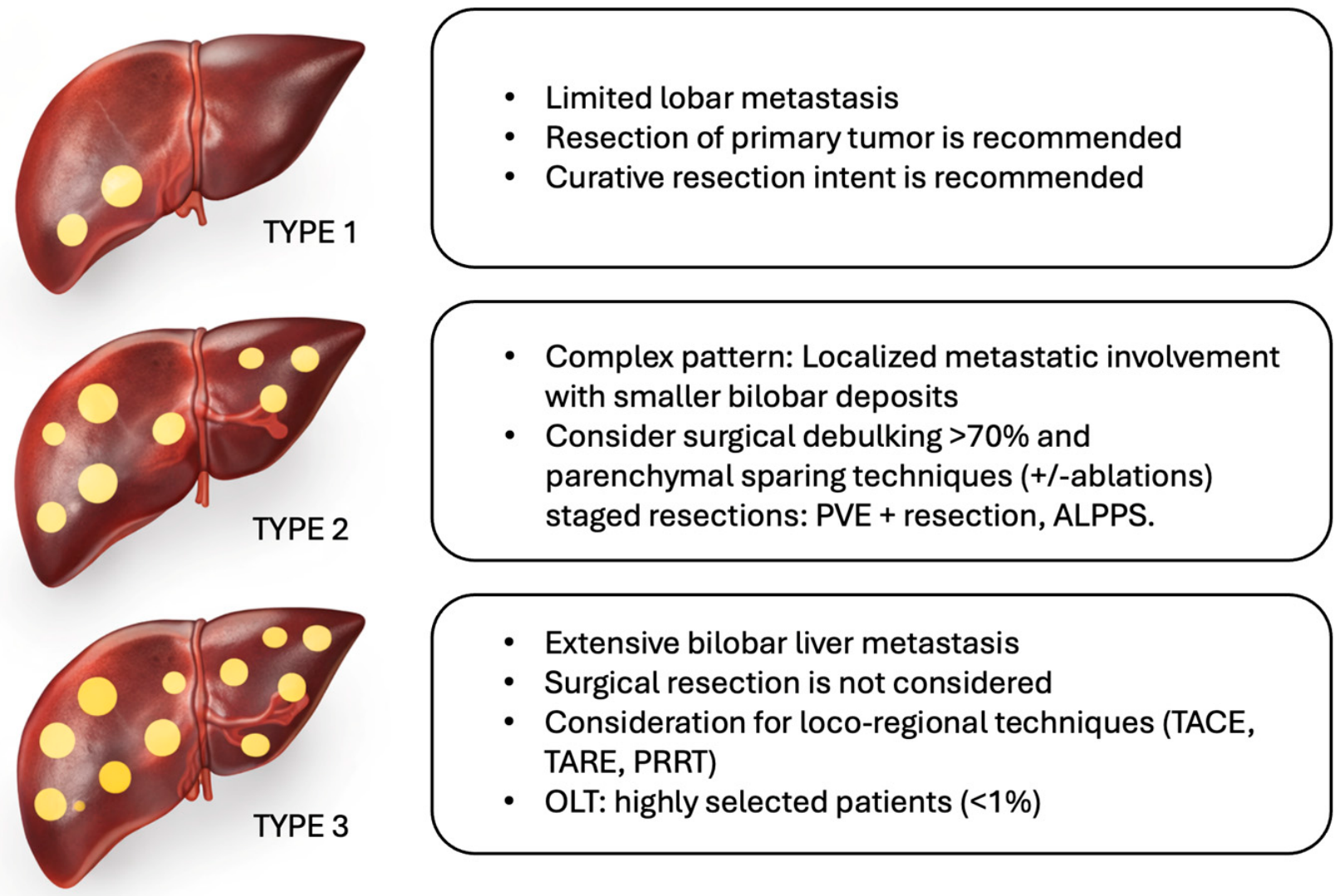
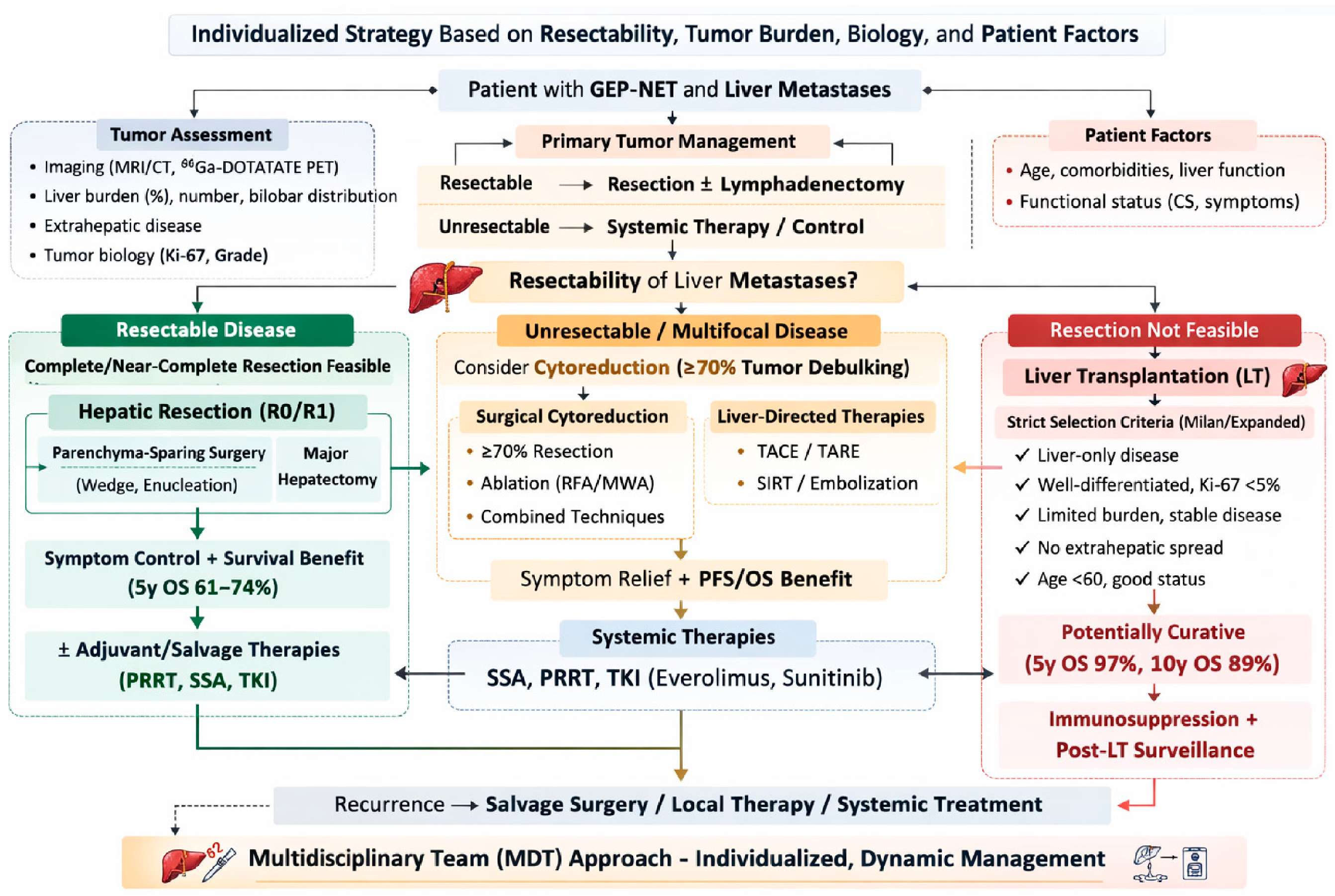
Neuroendocrine tumors (NETs) are a heterogeneous group of neoplasms with increasing incidence, particularly within the gastroenteropancreatic (GEP) system. The liver represents the most common site of metastasis, and neuroendocrine liver metastases (NELMs) significantly impact prognosis, symptom burden, and therapeutic decision-making. Surgical management remains a cornerstone in the treatment of NELMs and encompasses a spectrum of strategies, including curative liver resection, cytoreductive surgery, and, in selected cases, liver transplantation (LT). Hepatic resection, although potentially curative when technically feasible, is applicable only to a highly selected subset of patients, and its benefits in terms of long-term survival and symptom control remain limited by recurrence rates and patient-related factors. Cytoreductive surgery has emerged as a valuable alternative in patients with unresectable disease, with increasing evidence supporting a ≥70% debulking threshold as sufficient to achieve meaningful clinical benefit. This approach may improve survival and quality of life, notably in symptomatic patients, and can be combined with parenchymal-sparing techniques and locoregional therapies. Liver transplantation represents a radical but potentially curative strategy for highly selected patients with liver-only disease, favorable tumor biology, and stable disease. Outcomes are strongly dependent on strict selection criteria, and appropriate patient selection remains critical. The incorporation of systemic treatments, such as somatostatin analogues, targeted therapies, and peptide receptor radionuclide therapy (PRRT), has broadened the available therapeutic options and contributed to redefining current treatment strategies. Overall, the management of NELMs requires a multidisciplinary, individualized approach guided by tumor biology, disease distribution, and patient-specific factors, with the goal of optimizing survival outcomes and preserving quality of life.