Advances and Challenges in KRAS Mutation Detection and Clinical Implications

 , , , , , ,
  and
and
Simple Summary
Abstract
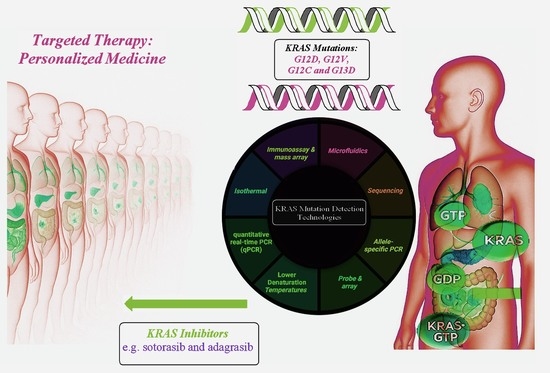
1. Personalized Cancer Treatment: The Role of Mutation Screening
2. RAS Family of Small GTPases
3. RAS Family Signaling Pathways
4. RASopathies
5. KRAS: A Historical Timeline
6. KRAS Inhibitors and KRAS-Targeted Therapies
7. The Importance of KRAS Mutation Detection
8. Hot Spots for KRAS Mutations
9. Detection Methods of KRAS Mutations
10. Technical and Clinical Comparison of KRAS Mutation Detection Techniques
11. Future Perspectives
12. Conclusions
Author Contributions
Funding
Conflicts of Interest
Abbreviations
| Signaling molecules and oncogenes: | |
| AKT | Protein Kinase B |
| APC | Adenomatous Polyposis Coli |
| BRAF | B-Raf Proto-Oncogene |
| EGFR | Epidermal Growth Factor Receptor |
| GEFs | Guanine Nucleotide Exchange Factors |
| GAP | GTPase-Activating Protein |
| GDP | Guanosine Diphosphate |
| GTP | Guanosine Triphosphate |
| GTPase | Guanosine Triphosphatase |
| HGF | Hepatocyte Growth Factor |
| HRAS | Harvey Rat Sarcoma Viral Oncogene Homolog |
| KRAS | Kirsten Rat Sarcoma Viral Oncogene Homolog |
| NRAS | Neuroblastoma RAS Viral Oncogene Homolog |
| MAPK | Mitogen-Activated Protein Kinase |
| PI3K | Phosphoinositide 3-Kinase |
| PIK3CA | Phosphatidylinositol-4,5-Bisphosphate 3-Kinase Catalytic Subunit Alpha |
| SHP2 | Src Homology Region-2 Containing Protein Tyrosine Phosphatase |
| SOS1 | Son of Sevenless-1 |
| Mutations and amino acid substitution codes: | |
| CAAX | Cysteine–Aliphatic–Any Amino Acid motif |
| L858R | Leucine-to-Arginine substitution at EGFR codon 858 |
| T790M | Threonine-to-Methionine substitution at EGFR codon 790 |
| Diagnostic biomarkers: | |
| CA19-9 | Cancer Antigen 19-9 |
| cfDNA | Cell-Free DNA |
| ctDNA | Circulating Tumor DNA |
| FFPE | Formalin-Fixed Paraffin-Embedded |
| FFPET | Formalin-Fixed Paraffin-Embedded Tissue |
| FNA | Fine-Needle Aspiration |
| IVD | In Vitro Diagnostic |
| PCR-based and isothermal amplification methods: | |
| AS-ARMS PCR | Allele-Specific Amplification Refractory Mutation System PCR |
| AS-PCR | Allele-Specific PCR |
| AS-LAMP | Allele-Specific or Asymmetric Loop-Mediated Isothermal Amplification |
| AS-SSCP | Allele-Specific Single-Strand Conformational Polymorphism |
| CAST-PCR | Competitive Allele-Specific TaqMan PCR |
| ddPCR | Droplet Digital PCR |
| dPCR | Digital PCR |
| EAB-qPCR | Enhanced Asymmetric Blocked qPCR |
| HRMA | High-Resolution Melting Analysis |
| LB | Loop-Back Primer |
| LAMP | Loop-Mediated Isothermal Amplification |
| PCqPCR | Peptide Nucleic Acid Clamp Real-Time PCR |
| PCR | Polymerase Chain Reaction |
| qPCR | Quantitative PCR |
| RFLP | Restriction Fragment Length Polymorphism |
| RPA | Recombinase Polymerase Amplification |
| SMAP-2 | Smart Amplification Process v2 |
| SSCP | Single-Strand Conformational Polymorphism |
| TaqMelt® | High-Resolution Taq-Based Melt Assay |
| Tc | Critical Denaturation Temperature |
| Tm | Melting Temperature |
| Next-generation and high-throughput platforms: | |
| NGS | Next-Generation Sequencing |
| MALDI-TOF | Matrix-Assisted Laser Desorption/Ionization Time-of-Flight |
| MassARRAY | Mass Spectrometry-Based Genotyping System |
| LOC | Lab-On-Chip |
| MEMS | Microelectromechanical Systems |
| MILLIPLEX | Multiplex Assay Technology |
| SMR | Silicon Microring Resonator |
| xMAP | Multi-Analyte Profiling |
| Synthetic probes and clamps: | |
| BODIPY | Boron-Dipyrromethene |
| FAM | Fluorescein Amidite |
| PNA | Peptide Nucleic Acid |
| XNA | Xeno-Nucleic Acid |
| QClamp® | XNA-Based Mutation Test |
| Clinical assays, kits, or commercial platforms: | |
| AMG-510 | Sotorasib |
| MRTX849 | Adagrasib |
| cobas® | Roche qPCR Mutation Test |
| PSS | Plasma-SeqSensei™ |
| iPLEX® HS | High-Sensitivity iPLEX Panel |
| OncoBEAM® | Digital PCR-Based BEAMing Assay |
| Disease names and clinical terms: | |
| CRC | Colorectal Cancer |
| mCRC | Metastatic Colorectal Cancer |
| NSCLC | Non-Small Cell Lung Cancer |
| CFC | Cardiofaciocutaneous Syndrome |
| NS | Noonan Syndrome |
| NF1 | Neurofibromatosis Type 1 |
| Other technical terms: | |
| Ct | Cycle Threshold |
| CV% | Coefficient of Variation Percentage |
| DNA | Deoxyribonucleic Acid |
| RNA | Ribonucleic Acid |
| ECL | Electrochemiluminescence |
| FDA | Food and Drug Administration |
| RUO | Research Use Only |
References
- Wang, Y.; Chen, Z. Mutation Detection and Molecular Targeted Tumor Therapies. STEMedicine 2020, 1, e11. [Google Scholar] [CrossRef] [Scilit]
- Shen, P.; Zhong, W. Adjuvant Egfr Tki Therapy for Resectable Non-Small Cell Lung Cancer: New Era for Personalized Medicine. J. Thorac. Dis. 2018, 10, 1364–1369. [Google Scholar] [CrossRef] [Scilit]
- Sadee, W.; Wang, D.; Hartmann, K.; Toland, A.E. Pharmacogenomics: Driving Personalized Medicine. Pharmacol. Rev. 2023, 75, 789–814. [Google Scholar] [CrossRef] [Scilit]
- Salih, S.; Elliyanti, A.; Alkatheeri, A.; AlYafei, F.; Almarri, B.; Khan, H. The Role of Molecular Imaging in Personalized Medicine. J. Pers. Med. 2023, 13, 369. [Google Scholar] [CrossRef] [Scilit]
- Lopes-Junior, L.C.; Veronez, L.C. Personalized Care for Patients with Cancer in the Precision-Medicine Era. Int. J. Env. Res. Public Health 2023, 20, 3023. [Google Scholar] [CrossRef] [Scilit] [PubMed]
- Lazo, J.S.; Sharlow, E.R. Drugging Undruggable Molecular Cancer Targets. Annu. Rev. Pharmacol. Toxicol. 2016, 56, 23–40. [Google Scholar] [CrossRef] [Scilit] [PubMed]
- Waters, A.M.; Der, C.J. KRAS: The Critical Driver and Therapeutic Target for Pancreatic Cancer. Cold Spring Harb. Perspect. Med. 2018, 8, a031435. [Google Scholar] [CrossRef] [Scilit]
- Bos, J.L. The Ras Gene Family and Human Carcinogenesis. Mutat. Res. 1988, 195, 255–271. [Google Scholar] [CrossRef] [Scilit]
- Kodaz, H.; Kostek, O.; Hacioglu, M.B.; Erdogan, B.; Kodaz, C.E.; Hacibekiroglu, I.; Turkmen, E.; Uzunoglu, S.; Cicin, I. Frequency of RAS Mutations (Kras, Nras, Hras) in Human Solid Cancer. Breast Cancer 2017, 7, 1–7. [Google Scholar] [CrossRef] [Scilit]
- Parker, J.A.; Mattos, C. The K-Ras, N-Ras, and H-Ras Isoforms: Unique Conformational Preferences and Implications for Targeting Oncogenic Mutants. Cold Spring Harb. Perspect. Med. 2018, 8, a031427. [Google Scholar] [CrossRef] [Scilit] [PubMed]
- Taniguchi, H.; Yamazaki, K.; Yoshino, T.; Muro, K.; Yatabe, Y.; Watanabe, T.; Ebi, H.; Ochiai, A.; Baba, E.; Tsuchihara, K.; et al. Japanese Society of Medical Oncology Clinical Guidelines: RAS (KRAS/NRAS) Mutation Testing in Colorectal Cancer Patients. Cancer Sci. 2015, 106, 324–327. [Google Scholar] [CrossRef] [Scilit]
- Johnson, C.W.; Reid, D.; Parker, J.A.; Salter, S.; Knihtila, R.; Kuzmic, P.; Mattos, C. The Small GTPases K-Ras, N-Ras, and H-Ras Have Distinct Biochemical Properties Determined by Allosteric Effects. J. Biol. Chem. 2017, 292, 12981–12993. [Google Scholar] [CrossRef] [Scilit] [PubMed]
- Parikh, C.; Subrahmanyam, R.; Ren, R. Oncogenic Nras, Kras, and Hras Exhibit Different Leukemogenic Potentials in Mice. Cancer Res. 2007, 67, 7139–7146. [Google Scholar] [CrossRef] [Scilit] [PubMed]
- Nakhaeizadeh, H.; Amin, E.; Nakhaei-Rad, S.; Dvorsky, R.; Ahmadian, M.R. The Ras-Effector Interface: Isoform-Specific Differences in the Effector Binding Regions. PLoS ONE 2016, 11, e0167145. [Google Scholar] [CrossRef] [Scilit]
- Santarpia, L.; Lippman, S.M.; El-Naggar, A.K. Targeting the MAPK–RAS–RAF Signaling Pathway in Cancer Therapy. Expert. Opin. Ther. Targets 2012, 16, 103–119. [Google Scholar] [CrossRef] [Scilit]
- Mansoor, A.; Kamran, H.; Akhter, A.; Seno, R.; Torlakovic, E.E.; Roshan, T.M.; Shabani-Rad, M.-T.; Elyamany, G.; Minoo, P.; Stewart, D. Identification of Potential Therapeutic Targets for Plasmablastic Lymphoma Through Gene Expression Analysis: Insights into RAS and Wnt Signaling Pathways. Mod. Pathol. 2023, 36, 100198. [Google Scholar] [CrossRef] [Scilit]
- Nakhaei-Rad, S.; Haghighi, F.; Nouri, P.; Rezaei Adariani, S.; Lissy, J.; Kazemein Jasemi, N.S.; Dvorsky, R.; Ahmadian, M.R. Structural Fingerprints, Interactions, and Signaling Networks of RAS Family Proteins Beyond RAS Isoforms. Crit. Rev. Biochem. Mol. Biol. 2018, 53, 130–156. [Google Scholar] [CrossRef] [Scilit] [PubMed]
- Tartaglia, M.; Aoki, Y.; Gelb, B.D. The Molecular Genetics of Rasopathies: An Update on Novel Disease Genes and New Disorders. Am. J. Med. Genet. C Semin. Med. Genet. 2022, 190, 425–439. [Google Scholar] [CrossRef] [Scilit]
- Riller, Q.; Rieux-Laucat, F. Rasopathies: From Germline Mutations to Somatic and Multigenic Diseases. Biomed. J. 2021, 44, 422–432. [Google Scholar] [CrossRef] [Scilit]
- Rauen, K.A. The Rasopathies. Annu. Rev. Genom. Hum. Genet. 2013, 14, 355–369. [Google Scholar] [CrossRef] [Scilit]
- Jett, K.; Friedman, J.M. Clinical and Genetic Aspects of Neurofibromatosis 1. Genet. Med. 2010, 12, 1–11. [Google Scholar] [CrossRef] [Scilit]
- Williams, V.C.; Lucas, J.; Babcock, M.A.; Gutmann, D.H.; Korf, B.; Maria, B.L. Neurofibromatosis Type 1 Revisited. Pediatrics 2009, 123, 124–133. [Google Scholar] [CrossRef] [Scilit]
- Motta, M.; Sagi-Dain, L.; Krumbach, O.H.F.; Hahn, A.; Peleg, A.; German, A.; Lissewski, C.; Coppola, S.; Pantaleoni, F.; Kocherscheid, L.; et al. Activating MRAS Mutations Cause Noonan Syndrome Associated with Hypertrophic Cardiomyopathy. Hum. Mol. Genet. 2019, 29, 1772–1783. [Google Scholar] [CrossRef] [Scilit] [PubMed]
- Nava, C.; Hanna, N.; Michot, C.; Pereira, S.; Pouvreau, N.; Niihori, T.; Aoki, Y.; Matsubara, Y.; Arveiler, B.; Lacombe, D.; et al. Cardio-Facio-Cutaneous and Noonan Syndromes due to Mutations in the Ras/Mapk Signalling Pathway: Genotype-Phenotype Relationships and Overlap with Costello Syndrome. J. Med. Genet. 2007, 44, 763–771. [Google Scholar] [CrossRef] [Scilit] [PubMed]
- Goodwin, A.F.; Oberoi, S.; Landan, M.; Charles, C.; Groth, J.; Martinez, A.; Fairley, C.; Weiss, L.A.; Tidyman, W.E.; Klein, O.D.; et al. Craniofacial and Dental Development in Cardio-Facio-Cutaneous Syndrome: The importance of Ras Signaling Homeostasis. Clin. Genet. 2013, 83, 539–544. [Google Scholar] [CrossRef] [Scilit]
- Goodwin, A.F.; Tidyman, W.E.; Jheon, A.H.; Sharir, A.; Zheng, X.; Charles, C.; Fagin, J.A.; McMahon, M.; Diekwisch, T.G.; Ganss, B.; et al. Abnormal Ras Signaling in Costello Syndrome (CS) Negatively Regulates Enamel Formation. Hum. Mol. Genet. 2014, 23, 682–692. [Google Scholar] [CrossRef] [Scilit]
- Nauth, T.; Bazgir, F.; Voß, H.; Brandenstein, L.I.; Mosaddeghzadeh, N.; Rickassel, V.; Deden, S.; Gorzelanny, C.; Schlüter, H.; Ahmadian, M.R. Cutaneous Manifestations in Costello Syndrome: HRAS p. Gly12Ser Affects RIN1-Mediated Integrin Trafficking in Immortalized Epidermal Keratinocytes. Hum. Mol. Genet. 2023, 32, 304–318. [Google Scholar] [CrossRef] [Scilit]
- Denayer, E.; Chmara, M.; Brems, H.; Kievit, A.M.; Van Bever, Y.; Van den Ouweland, A.M.; Van Minkelen, R.; de Goede-Bolder, A.; Oostenbrink, R.; Lakeman, P. Legius Syndrome in Fourteen Families. Hum. Mutat. 2011, 32, E1985–E1998. [Google Scholar] [CrossRef] [Scilit] [PubMed]
- Tsuchida, N.; Murugan, A.K.; Grieco, M. Kirsten Ras* Oncogene: Significance of Its Discovery in Human Cancer Research. Oncotarget 2016, 7, 46717–46733. [Google Scholar] [CrossRef] [Scilit]
- Cox, A.D.; Der, C.J. Ras History: The Saga Continues. Small GTPases 2010, 1, 2–27. [Google Scholar] [CrossRef] [Scilit]
- Timar, J.; Kashofer, K. Molecular Epidemiology and Diagnostics of KRAS Mutations in Human Cancer. Cancer Metastasis Rev. 2020, 39, 1029–1038. [Google Scholar] [CrossRef] [Scilit] [PubMed]
- Zhu, G.; Pei, L.; Xia, H.; Tang, Q.; Bi, F. Role of Oncogenic Kras in the Prognosis, Diagnosis and Treatment of Colorectal Cancer. Mol. Cancer 2021, 20, 143. [Google Scholar] [CrossRef] [Scilit]
- Delpu, Y.; Hanoun, N.; Lulka, H.; Sicard, F.; Selves, J.; Buscail, L.; Torrisani, J.; Cordelier, P. Genetic and Epigenetic Alterations in Pancreatic Carcinogenesis. Curr. Genom. 2011, 12, 15. [Google Scholar] [CrossRef] [Scilit] [PubMed]
- Di Magliano, M.P.; Logsdon, C.D. Roles for Kras in Pancreatic Tumor Development and Progression. Gastroenterology 2013, 144, 1220–1229. [Google Scholar] [CrossRef] [Scilit] [PubMed]
- Prior, I.A.; Hood, F.E.; Hartley, J.L. The Frequency of Ras Mutations in Cancer. Cancer Res. 2020, 80, 2969–2974. [Google Scholar] [CrossRef] [Scilit]
- Pylayeva-Gupta, Y.; Grabocka, E.; Bar-Sagi, D. Ras Oncogenes: Weaving a Tumorigenic Web. Nat. Rev. Cancer 2011, 11, 761–774. [Google Scholar] [CrossRef] [Scilit]
- Di Fiore, F.; Blanchard, F.; Charbonnier, F.; Le Pessot, F.; Lamy, A.; Galais, M.; Bastit, L.; Killian, A.; Sesboüé, R.; Tuech, J. Clinical Relevance of Kras Mutation Detection in Metastatic Colorectal Cancer Treated by Cetuximab Plus Chemotherapy. Br. J. Cancer 2007, 96, 1166–1169. [Google Scholar] [CrossRef] [Scilit]
- Huang, L.; Guo, Z.; Wang, F.; Fu, L. KRAS Mutation: From Undruggable to Druggable in Cancer. Signal Transduct. Target. Ther. 2021, 6, 386. [Google Scholar] [CrossRef] [Scilit]
- Bar-Sagi, D.; Knelson, E.H.; Sequist, L.V. A Bright Future for Kras Inhibitors. Nat. Cancer 2020, 1, 25–27. [Google Scholar] [CrossRef] [Scilit]
- Han, C.W.; Jeong, M.S.; Jang, S.B. Understand Kras and the Quest for Anti-Cancer Drugs. Cells 2021, 10, 842. [Google Scholar] [CrossRef] [Scilit]
- Saliani, M.; Jalal, R.; Ahmadian, M.R. From Basic Researches to New Achievements in Therapeutic Strategies of Kras-Driven Cancers. Cancer Biol. Med. 2019, 16, 435. [Google Scholar] [CrossRef] [Scilit]
- Kim, H.J.; Lee, H.N.; Jeong, M.S.; Jang, S.B. Oncogenic Kras: Signaling and Drug Resistance. Cancers 2021, 13, 5599. [Google Scholar] [CrossRef] [Scilit]
- Liu, P.; Wang, Y.; Li, X. Targeting the Untargetable KRAS in Cancer Therapy. Acta Pharm. Sin. B 2019, 9, 871–879. [Google Scholar] [CrossRef] [Scilit]
- Vatansever, S.; Erman, B.; Gümüş, Z.H. Oncogenic G12D Mutation Alters Local Conformations and Dynamics of K-Ras. Sci. Rep. 2019, 9, 11730. [Google Scholar] [CrossRef] [Scilit] [PubMed]
- Jančík, S.; Drábek, J.; Radzioch, D.; Hajdúch, M. Clinical Relevance of Kras in Human Cancers. J. Biomed. Biotechnol. 2010, 2010, 150960. [Google Scholar] [CrossRef] [Scilit]
- Punekar, S.R.; Velcheti, V.; Neel, B.G.; Wong, K.-K. The Current State of the Art and Future Trends in RAS-Targeted Cancer Therapies. Nat. Rev. Clin. Oncol. 2022, 19, 637–655. [Google Scholar] [CrossRef] [Scilit] [PubMed]
- Palma, G.; Khurshid, F.; Lu, K.; Woodward, B.; Husain, H. Selective Kras G12C Inhibitors in Non-Small cell LUNG Cancer: Chemistry, Concurrent Pathway Alterations, and Clinical Outcomes. NPJ Precis. Oncol. 2021, 5, 98. [Google Scholar] [CrossRef] [Scilit] [PubMed]
- Skoulidis, F.; Li, B.T.; Dy, G.K.; Price, T.J.; Falchook, G.S.; Wolf, J.; Italiano, A.; Schuler, M.; Borghaei, H.; Barlesi, F. Sotorasib for Lung Cancers with KRAS p. G12C Mutation. N. Engl. J. Med. 2021, 384, 2371–2381. [Google Scholar] [CrossRef] [Scilit]
- Ou, S.I.; Janne, P.A.; Leal, T.A.; Rybkin, I.I.; Sabari, J.K.; Barve, M.A.; Bazhenova, L.; Johnson, M.L.; Velastegui, K.L.; Cilliers, C.; et al. First-in-Human Phase I/IB Dose-Finding Study of Adagrasib (MRTX849) in Patients With Advanced Kras(G12C) Solid Tumors (KRYSTAL-1). J. Clin. Oncol. 2022, 40, 2530–2538. [Google Scholar] [CrossRef] [Scilit]
- Issahaku, A.R.; Salifu, E.Y.; Soliman, M.E.S. Inside the Cracked Kernel: Establishing the Molecular Basis of AMG510 and MRTX849 in Destabilising KRASG12C Mutant Switch I and II in Cancer Treatment. J. Biomol. Struct. Dyn. 2022, 41, 4890–4902. [Google Scholar] [CrossRef] [Scilit]
- Chen, C.Y.; Lu, Z.; Scattolin, T.; Chen, C.; Gan, Y.; McLaughlin, M. Synthesis of Adagrasib (MRTX849), a Covalent Kras(G12C) Inhibitor Drug for the Treatment of Cancer. Org. Lett. 2023, 25, 944–949. [Google Scholar] [CrossRef] [Scilit]
- Wang, J.; Martin-Romano, P.; Cassier, P.; Johnson, M.; Haura, E.; Lenox, L.; Guo, Y.; Bandyopadhyay, N.; Russell, M.; Shearin, E.; et al. Phase I Study of JNJ-74699157 in Patients with Advanced Solid Tumors Harboring the Kras G12C Mutation. Oncologist 2022, 27, e536–e553. [Google Scholar] [CrossRef] [Scilit] [PubMed]
- Hofmann, M.H.; Gmachl, M.; Ramharter, J.; Savarese, F.; Gerlach, D.; Marszalek, J.R.; Sanderson, M.P.; Kessler, D.; Trapani, F.; Arnhof, H.; et al. BI-3406, a Potent and Selective SOS1-Kras Interaction Inhibitor, Is Effective in Kras-Driven Cancers Through Combined MEK Inhibition. Cancer Discov. 2021, 11, 142–157. [Google Scholar] [CrossRef] [Scilit]
- Zheng, W.; Yang, Z.; Song, P.; Sun, Y.; Liu, P.; Yue, L.; Lv, K.; Wang, X.; Shen, Y.; Si, J.; et al. SHP2 Inhibition Mitigates Adaptive Resistance to Mek Inhibitors in Kras-Mutant Gastric Cancer Through the Suppression of Ksr1 Activity. Cancer Lett. 2023, 555, 216029. [Google Scholar] [CrossRef] [Scilit]
- Novotny, C.J.; Hamilton, G.L.; McCormick, F.; Shokat, K.M. Farnesyltransferase-Mediated Delivery of a Covalent Inhibitor Overcomes Alternative Prenylation to Mislocalize K-Ras. ACS Chem. Biol. 2017, 12, 1956–1962. [Google Scholar] [CrossRef] [Scilit]
- Harrison, C. Lyrica Survives Patent Challenge. Nat. Rev. Drug. Discov. 2014, 13, 250. [Google Scholar] [CrossRef] [Scilit]
- Mukhopadhyay, S.; Huang, H.Y.; Lin, Z.; Ranieri, M.; Li, S.; Sahu, S.; Liu, Y.; Ban, Y.; Guidry, K.; Hu, H.; et al. Genome-Wide CRISPR Screens Identify Multiple Synthetic Lethal Targets That Enhance Krasg12c Inhibitor Efficacy. Cancer Res. 2023, 83, 4095–4111. [Google Scholar] [CrossRef] [Scilit]
- Dilly, J.; Hoffman, M.T.; Abbassi, L.; Li, Z.; Paradiso, F.; Parent, B.D.; Hennessey, C.J.; Jordan, A.C.; Morgado, M.; Dasgupta, S.; et al. Mechanisms of Resistance to Oncogenic Kras Inhibition in Pancreatic Cancer. Cancer Discov. 2024, 14, 2135–2161. [Google Scholar] [CrossRef] [Scilit] [PubMed]
- Ji, X.; Li, Y.; Kong, X.; Chen, D.; Lu, J. Discovery of Prodrug of MRTX1133 as an Oral Therapy for Cancers with KRAS(G12D) Mutation. ACS Omega 2023, 8, 7211–7221. [Google Scholar] [CrossRef] [Scilit] [PubMed]
- Spira, A.I.; Starodub, A.N.; Arbour, K.C.; Sommerhalder, D.; Wolpin, B.M.; Barve, M.; Garrido-Laguna, I.; Punekar, S.; Pelster, M.; Kar, S.; et al. Abstract PR010: Preliminary Safety and Pharmacokinetic Profiles of RMC-6236, a First-in-Class, Ras-Selective, Tri-Complex RASMULTI(ON) Inhibitor in Patients with KRAS Mutant Solid Tumors on the Phase 1 Trial RMC-6236-001. Mol. Cancer Ther. 2023, 22 (Suppl. S12), PR010. [Google Scholar] [CrossRef] [Scilit]
- Bröker, J.; Waterson, A.G.; Hodges, T.R.; Abbott, J.R.; Arnold, A.; Böttcher, J.; Braun, N.; Cui, J.; Fuchs, J.E.; Gerstberger, T.; et al. Discovery of BI-2493, a Pan-Kras Inhibitor Showing In Vivo Efficacy. J. Med. Chem. 2025, 68, 15649–15668. [Google Scholar] [CrossRef] [Scilit] [PubMed]
- Yang, Q.; To, K.K.W.; Hu, G.; Fu, K.; Yang, C.; Zhu, S.; Pan, C.; Wang, F.; Luo, K.; Fu, L. BI-2865, a pan-KRAS inhibitor, reverses the P-glycoprotein Induced Multidrug Resistance In Vitro and In Vivo. Cell Commun. Signal. 2024, 22, 325. [Google Scholar] [CrossRef] [Scilit]
- Dinu, D.; Dobre, M.; Panaitescu, E.; Bîrlă, R.; Iosif, C.; Hoara, P.; Caragui, A.; Boeriu, M.; Constantinoiu, S.; Ardeleanu, C. Prognostic Significance of Kras Gene Mutations in Colorectal Cancer-Preliminary Study. J. Med. Life 2014, 7, 581. [Google Scholar]
- Shimozaki, K.; Shinozaki, E.; Yamamoto, N.; Imamura, Y.; Osumi, H.; Nakayama, I.; Wakatsuki, T.; Ooki, A.; Takahari, D.; Ogura, M.; et al. Kras Mutation as a Predictor of Insufficient Trastuzumab Efficacy and Poor Prognosis in Her2-Positive Advanced Gastric Cancer. J. Cancer Res. Clin. Oncol. 2023, 149, 1273–1283. [Google Scholar] [CrossRef] [Scilit]
- Renaud, S.; Guerrera, F.; Seitlinger, J.; Costardi, L.; Schaeffer, M.; Romain, B.; Mossetti, C.; Claire-Voegeli, A.; Filosso, P.L.; Legrain, M.; et al. Kras Exon 2 Codon 13 Mutation is Associated with a Better Prognosis than Codon 12 Mutation Following Lung Metastasectomy in Colorectal Cancer. Oncotarget 2017, 8, 2514–2524. [Google Scholar] [CrossRef] [Scilit]
- Lohinai, Z.; Klikovits, T.; Moldvay, J.; Ostoros, G.; Raso, E.; Timar, J.; Fabian, K.; Kovalszky, I.; Kenessey, I.; Aigner, C.; et al. Kras-Mutation Incidence and Prognostic Value are Metastatic Site-Specific in Lung Adenocarcinoma: Poor Prognosis in Patients with Kras Mutation and Bone Metastasis. Sci. Rep. 2017, 7, 39721. [Google Scholar] [CrossRef] [Scilit]
- Thein, K.Z.; Biter, A.B.; Hong, D.S. Therapeutics Targeting Mutant Kras. Annu. Rev. Med. 2021, 72, 349–364. [Google Scholar] [CrossRef] [Scilit] [PubMed]
- Yang, D.; Lai, X.; Xu, F.; Li, Y.; Jiang, W.; Ma, D. Prognosis and Clinical Characteristics of Colorectal Cancer Patients with Kras Gene Mutation: A 5-year Follow-Up Study. Int. J. Clin. Exp. Pathol. 2019, 12, 409. [Google Scholar] [PubMed]
- McCormick, F. Targeting KRAS directly. Annu. Rev. Cancer Biol. 2018, 2, 81–90. [Google Scholar] [CrossRef] [Scilit]
- Perkins, G.; Pilati, C.; Blons, H.; Laurent-Puig, P. Beyond Kras Status and Response to Anti-Egfr Therapy in Metastatic Colorectal cancer. Pharmacogenomics 2014, 15, 1043–1052. [Google Scholar] [CrossRef] [Scilit] [PubMed]
- Chen, K.; Zhang, Y.; Qian, L.; Wang, P. Emerging Strategies to Target RAS Signaling in Human Cancer Therapy. J. Hematol. Oncol. 2021, 14, 116. [Google Scholar] [CrossRef] [Scilit] [PubMed]
- Patel, N.; Petrinic, T.; Silva, M.; Soonawalla, Z.; Reddy, S.; Gordon-Weeks, A. The Diagnostic Accuracy of Mutant Kras Detection from Pancreatic Secretions for the Diagnosis of Pancreatic Cancer: A Meta-Analysis. Cancers 2020, 12, 2353. [Google Scholar] [CrossRef] [Scilit]
- Stolze, B.; Reinhart, S.; Bulllinger, L.; Fröhling, S.; Scholl, C. Comparative Analysis of Kras codon 12, 13, 18, 61 and 117 Mutations Using Human MCF10A Isogenic Cell Lines. Sci. Rep. 2015, 5, 8535. [Google Scholar] [CrossRef] [Scilit]
- Tong, J.H.; Lung, R.W.; Sin, F.M.; Law, P.P.; Kang, W.; Chan, A.W.; Ma, B.B.; Mak, T.W.; Ng, S.S.; To, K.F. Characterization of Rare Transforming Kras Mutations in Sporadic Colorectal Cancer. Cancer Biol. Ther. 2014, 15, 768–776. [Google Scholar] [CrossRef] [Scilit]
- Mondal, K.; Posa, M.K.; Shenoy, R.P.; Roychoudhury, S. Kras Mutation Subtypes and Their Association with Other Driver Mutations in Oncogenic Pathways. Cells 2024, 13, 1221. [Google Scholar] [CrossRef] [Scilit] [PubMed]
- Anderson, S.M. Laboratory Methods for Kras Mutation Analysis. Expert. Rev. Mol. Diagn. 2011, 11, 635–642. [Google Scholar] [CrossRef] [Scilit]
- Tomasik, B.; Garbicz, F.; Braun, M.; Bieńkowski, M.; Jassem, J. Heterogeneity in Precision Oncology. Camb. Prism. Precis. Med. 2024, 2, e2. [Google Scholar] [CrossRef] [Scilit]
- Weyn, C.; Van Raemdonck, S.; Dendooven, R.; Maes, V.; Zwaenepoel, K.; Lambin, S.; Pauwels, P. Clinical Performance Evaluation of a Sensitive, Rapid Low-Throughput Test for Kras Mutation Analysis Using Formalin-Fixed, Paraffin-Embedded Tissue Samples. BMC Cancer 2017, 17, 139. [Google Scholar] [CrossRef] [Scilit] [PubMed]
- Bournet, B.; Buscail, C.; Muscari, F.; Cordelier, P.; Buscail, L. Targeting Kras for Diagnosis, Prognosis, and Treatment of Pancreatic Cancer: Hopes and Realities. Eur. J. Cancer 2016, 54, 75–83. [Google Scholar] [CrossRef] [Scilit] [PubMed]
- Earl, J.; Garcia-Nieto, S.; Martinez-Avila, J.C.; Montans, J.; Sanjuanbenito, A.; Rodríguez-Garrote, M.; Lisa, E.; Mendía, E.; Lobo, E.; Malats, N. Circulating Tumor Cells (Ctc) and kras Mutant Circulating Free Dna (cfdna) Detection in Peripheral Blood as Biomarkers in Patients Diagnosed with Exocrine Pancreatic Cancer. BMC Cancer 2015, 15, 797. [Google Scholar] [CrossRef] [Scilit]
- Fuccio, L.; Hassan, C.; Laterza, L.; Correale, L.; Pagano, N.; Bocus, P.; Fabbri, C.; Maimone, A.; Cennamo, V.; Repici, A. The role of K-ras Gene Mutation Analysis in EUS-Guided Fna Cytology Specimens for The Differential Diagnosis of Pancreatic Solid Masses: A Meta-Analysis of Prospective Studies. Gastrointest. Endosc. 2013, 78, 596–608. [Google Scholar] [CrossRef] [Scilit] [PubMed]
- Bournet, B.; Selves, J.; Grand, D.; Danjoux, M.; Hanoun, N.; Cordelier, P.; Buscail, L. Endoscopic Ultrasound–Guided Fine-Needle Aspiration Biopsy Coupled With a Kras Mutation Assay Using Allelic Discrimination Improves the Diagnosis of Pancreatic Cancer. J. Clin. Gastroenterol. 2015, 49, 50–56. [Google Scholar] [CrossRef] [Scilit]
- Pellisé, M.; Castells, A.; Ginès, A.; Solé, M.; Mora, J.; CastellvÍ-Bel, S.; Rodríguez-Moranta, F.; Fernàndez-Esparrach, G.; Llach, J.; Bordas, J. Clinical Usefulness of Kras Mutational Analysis in the Diagnosis of Pancreatic Adenocarcinoma by Means of Endosonography-Guided Fine-Needle Aspiration Biopsy. Aliment. Pharmacol. Ther. 2003, 17, 1299–1307. [Google Scholar] [CrossRef] [Scilit]
- Trisolini, E.; Armellini, E.; Paganotti, A.; Veggiani, C.; Bozzola, C.; Frattini, M.; Pizio, C.; Mancuso, G.; Andorno, S.; Boldorini, R. Kras Mutation Testing on all Non-Malignant Diagnosis of Pancreatic Endoscopic Ultrasound-Guided Fine-Needle Aspiration Biopsies Improves Diagnostic Accuracy. Pathology 2017, 49, 379–386. [Google Scholar] [CrossRef] [Scilit]
- García-Pardo, M.; Makarem, M.; Li, J.J.N.; Kelly, D.; Leighl, N.B. Integrating Circulating-Free DNA (cfDNA) Analysis Into Clinical Practice: Opportunities and Challenges. Br. J. Cancer 2022, 127, 592–602. [Google Scholar] [CrossRef] [Scilit]
- Yan, Y.Y.; Guo, Q.R.; Wang, F.H.; Adhikari, R.; Zhu, Z.Y.; Zhang, H.Y.; Zhou, W.M.; Yu, H.; Li, J.Q.; Zhang, J.Y. Cell-Free DNA: Hope and Potential Application in Cancer. Front. Cell Dev. Biol. 2021, 9, 639233. [Google Scholar] [CrossRef] [Scilit]
- Thierry, A.R.; Mouliere, F.; El Messaoudi, S.; Mollevi, C.; Lopez-Crapez, E.; Rolet, F.; Gillet, B.; Gongora, C.; Dechelotte, P.; Robert, B.; et al. Clinical Validation of the Detection of Kras and Braf Mutations from Circulating Tumor DNA. Nat. Med. 2014, 20, 430–435. [Google Scholar] [CrossRef] [Scilit] [PubMed]
- Norcic, G. Liquid Biopsy in Colorectal Cancer-Current Status and Potential Clinical Applications. Micromachines 2018, 9, 300. [Google Scholar] [CrossRef] [Scilit]
- Stranneheim, H.; Lundeberg, J. Stepping Stones in DNA Sequencing. Biotechnol. J. 2012, 7, 1063–1073. [Google Scholar] [CrossRef] [Scilit]
- Franklin, W.A.; Haney, J.; Sugita, M.; Bemis, L.; Jimeno, A.; Messersmith, W.A. Kras Mutation: Comparison of Testing Methods and Tissue Sampling Techniques in Colon Cancer. J. Mol. Diagn. 2010, 12, 43–50. [Google Scholar] [CrossRef] [Scilit]
- Straiton, J.; Free, T.; Sawyer, A.; Martin, J. From Sanger Sequencing to Genome Databases and Beyond. BioTechniques 2019, 66, 60–63. [Google Scholar] [CrossRef] [Scilit]
- Sokolenko, A.P.; Imyanitov, E.N. Molecular Diagnostics in Clinical Oncology. Front. Mol. Biosci. 2018, 5, 76. [Google Scholar] [CrossRef] [Scilit]
- Warth, A.; Penzel, R.; Brandt, R.; Sers, C.; Fischer, J.R.; Thomas, M.; Herth, F.J.; Dietel, M.; Schirmacher, P.; Bläker, H. Optimized Algorithm for Sanger Sequencing-Based Egfr Mutation Analyses in NSCLC biopsies. Virchows Arch. 2012, 460, 407–414. [Google Scholar] [CrossRef] [Scilit] [PubMed]
- Davidson, C.J.; Zeringer, E.; Champion, K.J.; Gauthier, M.-P.; Wang, F.; Boonyaratanakornkit, J.; Jones, J.R.; Schreiber, E. Improving the Limit of Detection for Sanger Sequencing: A Comparison of Methodologies for Kras Variant Detection. Biotechniques 2012, 53, 182–188. [Google Scholar] [CrossRef] [Scilit]
- Harrington, C.T.; Lin, E.I.; Olson, M.T.; Eshleman, J.R. Fundamentals of Pyrosequencing. Arch. Pathol. Lab. Med. 2013, 137, 1296–1303. [Google Scholar] [CrossRef] [Scilit] [PubMed]
- Lin, Y.-S.; Liu, F.-G.R.; Wang, T.-Y.; Pan, C.-T.; Chang, W.-T.; Li, W.-H. A Simple Method Using Pyrosequencing TM to Identify de Novo SNPs in Pooled DNA Samples. Nucleic Acids Res. 2011, 39, e28. [Google Scholar] [CrossRef] [Scilit]
- Fakruddin, M.; Chowdhury, A. Pyrosequencing an Alternative to Traditional Sanger Sequencing. Am. J. Biochem. Biotechnol. 2012, 8, 14–20. [Google Scholar] [CrossRef] [Scilit]
- de Macedo, M.P.; de Melo, F.M.; Lisboa, B.C.; Andrade, L.D.; de Souza Begnami, M.D.; Junior, S.A.; Ribeiro, H.S.; Soares, F.A.; Carraro, D.M.; da Cunha, I.W. kras Gene Mutation in a Series of Unselected Colorectal Carcinoma Patients with Prognostic Morphological Correlations: A Pyrosequencing Method Improved by Nested PCR. Exp. Mol. Pathol. 2015, 98, 563–567. [Google Scholar] [CrossRef] [Scilit]
- Ta, T.V.; Nguyen, Q.N.; Chu, H.H.; Truong, V.L.; Vuong, L.D. Ras/Raf Mutations and their Associations with Epigenetic Alterations for Distinct Pathways in Vietnamese Colorectal Cancer. Pathol. Res. Pr. 2020, 216, 152898. [Google Scholar] [CrossRef] [Scilit]
- Mack, E.; Stabla, K.; Riera-Knorrenschild, J.; Moll, R.; Neubauer, A.; Brendel, C. A Rational two-step approach to Kras Mutation Testing in Colorectal Cancer Using High Resolution Melting Analysis and Pyrosequencing. BMC Cancer 2016, 16, 585. [Google Scholar] [CrossRef] [Scilit] [PubMed]
- Kodaz, H.; Tastekin, E.; Erdogan, B.; Hacibekiroglu, I.; Tozkir, H.; Gurkan, H.; Turkmen, E.; Demirkan, B.; Uzunoglu, S.; Cicin, I. kras Mutation in Small Cell Lung Carcinoma and Extrapulmonary Small Cell Cancer. Balk. Med. J. 2016, 33, 407–410. [Google Scholar] [CrossRef] [Scilit]
- Sundström, M.; Edlund, K.; Lindell, M.; Glimelius, B.; Birgisson, H.; Micke, P.; Botling, J. KRAS Analysis in Colorectal Carcinoma: Analytical Aspects of Pyrosequencing and Allele-Specific PCR in Clinical Practice. BMC Cancer 2010, 10, 660. [Google Scholar] [CrossRef] [Scilit]
- Ari, Ş.; Arikan, M. Next-Generation Sequencing: Advantages, Disadvantages, and Future. In Plant Omics Trends Applications; Springer: Berlin, Germany, 2016; pp. 109–135. [Google Scholar]
- Jones, S.; Zhang, X.; Parsons, D.W.; Lin, J.C.-H.; Leary, R.J.; Angenendt, P.; Mankoo, P.; Carter, H.; Kamiyama, H.; Jimeno, A. Core Signaling Pathways in Human Pancreatic Cancers Revealed by Global Genomic Analyses. Science 2008, 321, 1801–1806. [Google Scholar] [CrossRef] [Scilit]
- Lin, M.T.; Mosier, S.L.; Thiess, M.; Beierl, K.F.; Debeljak, M.; Tseng, L.H.; Chen, G.; Yegnasubramanian, S.; Ho, H.; Cope, L.; et al. Clinical validation of KRAS, BRAF, and EGFR mutation detection using next-generation sequencing. Am. J. Clin. Pathol. 2014, 141, 856–866. [Google Scholar] [CrossRef] [Scilit]
- Praxis® Extendedraspanel Reference Guide; Illumina: San Diego, CA, USA, 2017.
- Pekker, I.; Pollak, J.; Potts, K.; Chan, P.; Tsai, C.-H.; Liao, A.; Garrison, C.; Brown, T.; Stull, P.; Bianchi-Frias, D.; et al. Resolution ctDx First Plasma Assay as a Companion Diagnostic for Adagrasib and its Application to Longitudinal Monitoring. J. Clin. Oncol. 2022, 40, 3057. [Google Scholar] [CrossRef] [Scilit]
- Malapelle, U.; Vigliar, E.; Sgariglia, R.; Bellevicine, C.; Colarossi, L.; Vitale, D.; Pallante, P.; Troncone, G. Ion Torrent Next-Generation Sequencing for Routine Identification of Clinically Relevant Mutations in Colorectal Cancer Patients. J. Clin. Pathol. 2015, 68, 64–68. [Google Scholar] [CrossRef] [Scilit] [PubMed]
- Barthelemy, D.; Lescuyer, G.; Geiguer, F.; Grolleau, E.; Gauthier, A.; Balandier, J.; Raffin, M.; Bardel, C.; Bouyssounouse, B.; Rodriguez-Lafrasse, C. Paired Comparison of Routine Molecular Screening of Patient Samples with Advanced Non-Small Cell Lung Cancer in Circulating Cell-Free DNA Using Three Targeted Assays. Cancers 2023, 15, 1574. [Google Scholar] [CrossRef] [Scilit]
- Kim, D.; Hong, Y.S.; Kim, J.E.; Kim, K.P.; Lee, J.L.; Chun, S.M.; Kim, J.; Jang, S.J.; Kim, T.W. Use of a High-Throughput Genotyping Platform (OncoMap) for RAS Mutational Analysis to Predict Cetuximab Efficacy in Patients with Metastatic Colorectal Cancer. Cancer Res. Treat. 2017, 49, 37–43. [Google Scholar] [CrossRef] [Scilit]
- Biswas, S.; Afrose, S.; Mita, M.A.; Hasan, M.R.; Shimu, M.S.S.; Zaman, S.; Saleh, M.A. Next-Generation Sequencing: An Advanced Diagnostic Tool for Detection of Pancreatic Disease/Disorder. JGH Open 2024, 8, e70061. [Google Scholar] [CrossRef] [Scilit] [PubMed]
- Zekri, J.; Baghdadi, M.A.; Alardati, H.; Khallaf, H.; Kabanja, J.H. Evaluation of the Idylla Kras and Nras Mutation Test in Colorectal Cancer Tissue. Exp. Mol. Pathol. 2019, 110, 104270. [Google Scholar] [CrossRef] [Scilit]
- Wei, Q.; Eltoum, I.A.; Mackinnon, A.C.; Harada, S. Performance of Idylla KRAS Assay on Extracted DNA and De-Stained Cytology Smears: Can. We Rescue Small Sample? Ann. Diagn. Pathol. 2022, 60, 152023. [Google Scholar] [CrossRef] [Scilit] [PubMed]
- Vivancos, A.; Aranda, E.; Benavides, M.; Elez, E.; Gomez-Espana, M.A.; Toledano, M.; Alvarez, M.; Parrado, M.R.C.; Garcia-Barberan, V.; Diaz-Rubio, E. Comparison of the Clinical Sensitivity of the Idylla Platform and the Oncobeam Ras Crc Assay for Kras Mutation Detection in Liquid Biopsy Samples. Sci. Rep. 2019, 9, 8976. [Google Scholar] [CrossRef] [Scilit]
- Vessies, D.C.L.; Greuter, M.J.E.; van Rooijen, K.L.; Linders, T.C.; Lanfermeijer, M.; Ramkisoensing, K.L.; Meijer, G.A.; Koopman, M.; Coupe, V.M.H.; Vink, G.R.; et al. Performance of Four Platforms for Kras Mutation Detection in Plasma Cell-Free DNA: ddPCR, Idylla, COBAS z480 and BEAMing. Sci. Rep. 2020, 10, 8122. [Google Scholar] [CrossRef] [Scilit] [PubMed]
- Van Haele, M.; Vander Borght, S.; Ceulemans, A.; Wieers, M.; Metsu, S.; Sagaert, X.; Weynand, B. Rapid Clinical Mutational Testing of Kras, Braf and Egfr: A Prospective Comparative Analysis of the Idylla Technique with High-Throughput Next-Generation Sequencing. J. Clin. Pathol. 2020, 73, 35–41. [Google Scholar] [CrossRef] [Scilit]
- Mousavi, N.; Truelsen, S.L.B.; Bernth-Andersen, S.; Koch, A.; Heegaard, S. Mutation of Kras in Colorectal Adenocarcinoma in Greenland. J. Pathol. Microbiol. Immunol. 2022, 130, 493–497. [Google Scholar] [CrossRef] [Scilit]
- Holm, M.; Andersson, E.; Osterlund, E.; Ovissi, A.; Soveri, L.M.; Anttonen, A.K.; Kytola, S.; Aittomaki, K.; Osterlund, P.; Ristimaki, A. Detection of Kras Mutations in Liquid Biopsies from Metastatic Colorectal Cancer Patients Using Droplet Digital PCR, Idylla, and Next Generation Sequencing. PLoS ONE 2020, 15, e0239819. [Google Scholar] [CrossRef] [Scilit]
- Gragnano, G.; Nacchio, M.; Sgariglia, R.; Conticelli, F.; Iaccarino, A.; De Luca, C.; Troncone, G.; Malapelle, U. Performance Evaluation of a Fully Closed Real-Time PCR Platform for the Detection of Kras p.G12C Mutations in Liquid Biopsy of Patients With Non-Small Cell Lung Cancer. J. Clin. Pathol. 2022, 75, 350–353. [Google Scholar] [CrossRef] [Scilit] [PubMed]
- Franczak, C.; Witz, A.; Geoffroy, K.; Demange, J.; Rouyer, M.; Husson, M.; Massard, V.; Gavoille, C.; Lambert, A.; Gilson, P.; et al. Evaluation of KRAS, NRAS and BRAF Mutations Detection in Plasma Using an Automated System for Patients with Metastatic Colorectal Cancer. PLoS ONE 2020, 15, e0227294. [Google Scholar] [CrossRef] [Scilit]
- Therascreen® KRAS RGQ PCR Kit Instructions for Use; 140; QIAGEN GmbH: Hilden, Germany, 2023.
- Cavallini, A.; Valentini, A.M.; Lippolis, C.; Campanella, D.; Guerra, V.; Caruso, M.L. KRAS Genotyping as Biomarker in Colorectal Cancer: A Comparison of Three Commercial Kits on Histologic Material. Anticancer. Res. 2010, 30, 5251–5256. [Google Scholar]
- Onouchi, S.; Matsushita, H.; Moriya, Y.; Akasu, T.; Fujita, S.; Yamamoto, S.; Hasegawa, H.; Kitagawa, Y.; Matsumura, Y. New Method for Colorectal Cancer Diagnosis Based on SSCP Analysis of DNA from Exfoliated Colonocytes in Naturally Evacuated Feces. Anticancer. Res. 2008, 28, 145–150. [Google Scholar]
- Barbano, R.; Pasculli, B.; Coco, M.; Fontana, A.; Copetti, M.; Rendina, M.; Valori, V.M.; Graziano, P.; Maiello, E.; Fazio, V.M.; et al. Competitive Allele-Specific TaqMan PCR (Cast-PCR) is a Sensitive, Specific and Fast Method for BRAF V600 Mutation Detection in Melanoma Patients. Sci. Rep. 2015, 5, 18592. [Google Scholar] [CrossRef] [Scilit]
- Accurate and Sensitive Mutation Detection and Quantitation Using TaqMan Mutation Detection. Assays for Disease Research; Thermo Fischer Scientific: Waltham, MA, USA, 2016.
- Bignon, J.D.; Bidwell, J.L. Combined use of RFLP and PCR-ASO typing for HLA-DR-Dw and DQw Typing. Int. J. Immunogenet. 1991, 18, 125–138, Erratum in Eur. J. Immunogenet. 1991, 18, 193–194. [Google Scholar] [CrossRef] [Scilit]
- Angulo, B.; García-García, E.; Martínez, R.; Suárez-Gauthier, A.; Conde, E.; Hidalgo, M.; López-Ríos, F. A Commercial real-time PCR Kit Provides Greater Sensitivity than Direct Sequencing to Detect Kras Mutations: A Morphology-Based Approach in Colorectal Carcinoma. J. Mol. Diagn. 2010, 12, 292–299. [Google Scholar] [CrossRef] [Scilit]
- Wojas-Krawczyk, K.; Kalinka-Warzocha, E.; Reszka, K.; Nicos, M.; Szumilo, J.; Mandziuk, S.; Szczepaniak, K.; Kupnicka, D.; Lewandowski, R.; Milanowski, J.; et al. Analysis of Kras, Nras, Braf, and Pik3ca Mutations Could Predict Metastases in Colorectal Cancer: A Preliminary Study. Adv. Clin. Exp. Med. 2019, 28, 67–73. [Google Scholar] [CrossRef] [Scilit] [PubMed]
- Huggett, J.F.; Cowen, S.; Foy, C.A. Considerations for Digital PCR as an Accurate Molecular Diagnostic Tool. Clin. Chem. 2015, 61, 79–88. [Google Scholar] [CrossRef] [Scilit] [PubMed]
- Jun, E.; Koo, B.; Kim, E.J.; Hwang, D.W.; Lee, J.H.; Song, K.B.; Lee, W.; Park, Y.; Hong, S.; Shin, Y. Analysis of Kras Mutation Subtype in Tissue DNA and Cell-Free DNA Using Droplet Digital PCR and the Function of Cell-Free DNA as a Recurrence Predictive Marker in Pancreatic Cancer. Biomedicines 2021, 9, 1599. [Google Scholar] [CrossRef] [Scilit] [PubMed]
- Sacher, A.G.; Paweletz, C.; Dahlberg, S.E.; Alden, R.S.; O’Connell, A.; Feeney, N.; Mach, S.L.; Jänne, P.A.; Oxnard, G.R. Prospective Validation of Rapid Plasma Genotyping for the Detection of EGFR and KRAS Mutations in Advanced Lung Cancer. JAMA Oncol. 2016, 2, 1014–1022. [Google Scholar] [CrossRef] [Scilit]
- Yu, Q.; Jiang, H.; Su, X.; Jiang, Z.; Liang, X.; Zhang, C.; Shang, W.; Zhang, Y.; Chen, H.; Yang, Z.; et al. Development of Multiplex Drop-Off Digital PCR Assays for Hotspot Mutation Detection of Kras, Nras, Braf and Pik3ca in the Plasma of Colorectal Cancer Patients. J. Mol. Diagn. 2023, 25, 388–402. [Google Scholar] [CrossRef] [Scilit] [PubMed]
- Tanaka, J.; Nakagawa, T.; Harada, K.; Morizane, C.; Tanaka, H.; Shiba, S.; Ohba, A.; Hijioka, S.; Takai, E.; Yachida, S. Efficient and Accurate Kras Genotyping Using Digital Pcr Combined with Melting Curve Analysis for ctDNA From Pancreatic Cancer Patients. Sci. Rep. 2023, 13, 3039. [Google Scholar] [CrossRef] [Scilit]
- Kwon, M.J.; Lee, S.E.; Kang, S.Y.; Choi, Y.-L. Frequency of KRAS, BRAF, and PIK3CA Mutations in Advanced Colorectal Cancers: Comparison of Peptide Nucleic Acid-Mediated PCR Clamping and Direct Sequencing in Formalin-Fixed, Paraffin-Embedded Tissue. Pathol. Res. Pr. 2011, 207, 762–768. [Google Scholar] [CrossRef] [Scilit] [PubMed]
- Zuo, Z.; Chen, S.S.; Chandra, P.K.; Galbincea, J.M.; Soape, M.; Doan, S.; Barkoh, B.A.; Koeppen, H.; Medeiros, L.J.; Luthra, R. Application of COLD-PCR for Improved Detection of Kras Mutations in Clinical Samples. Mod. Pathol. 2009, 22, 1023–1031. [Google Scholar] [CrossRef] [Scilit] [PubMed]
- Zuo, Z.; Jabbar, K.J. COLD-PCR: Applications and Advantages. In Clinical Applications of PCR; Springer: Berlin/Heidelberg, Germany, 2016; pp. 17–25. [Google Scholar]
- Liang, H.; Chen, G.-J.; Yu, Y.; Xiong, L.-K. Co-amplification at Lower Denaturation Temperature-PCR: Methodology and Applications. Yi Chuan 2018, 40, 227–236. [Google Scholar]
- Schmidt, M. Xenobiology: A New Form of Life as the Ultimate Biosafety Tool. BioEssays 2010, 32, 322–331. [Google Scholar] [CrossRef] [Scilit]
- Sun, Q.; Pastor, L.; Du, J.; Powell, M.J.; Zhang, A.; Bodmer, W.; Wu, J.; Zheng, S.; Sha, M.Y. A novel Xenonucleic Acid-Mediated Molecular Clamping Technology for Early Colorectal Cancer Screening. PLoS ONE 2021, 16, e0244332. [Google Scholar] [CrossRef] [Scilit]
- Chen, S.; Wang, Y.; Wang, K.; Zhang, L.; Zhang, X. Circulating Tumor DNA-Based Early Detection of Precancerous Colorectal Lesions Using QClamp XNA-mediated real-time PCR. Pharmazie 2021, 76, 606–610. [Google Scholar] [CrossRef] [Scilit]
- Demidov, V.V. PNA and LNA Throw Light On DNA. Trends Biotechnol. 2003, 21, 4–7. [Google Scholar] [CrossRef] [Scilit]
- Deguo, W.; Guicheng, H.; Fugui, W.; Yonggang, L.; Daxi, R. Drawback of Loop-Mediated Isothermal Amplification. Afr. J. Food Sci. 2008, 2, 83–86. [Google Scholar]
- Kumasaka, A.; Matsumoto, N.; Mukae, S.; Kitano, T.; Noguchi, H.; Ohki, H.; Komiyama, K.; Ando, T. Rapid and Specific Screening Assay for KRAS Oncogene Mutation by a Novel Gene Amplification Method. Anticancer. Res. 2016, 36, 1571–1579. [Google Scholar]
- Itonaga, M.; Matsuzaki, I.; Warigaya, K.; Tamura, T.; Shimizu, Y.; Fujimoto, M.; Kojima, F.; Ichinose, M.; Murata, S.-i. Novel Methodology for Rapid Detection of KRAS Mutation Using PNA-LNA Mediated Loop-Mediated Isothermal Amplification. PLoS ONE 2016, 11, e0151654. [Google Scholar] [CrossRef] [Scilit] [PubMed]
- Egholm, M.; Buchardt, O.; Christensen, L.; Behrens, C.; Freier, S.M.; Driver, D.A.; Berg, R.H.; Kim, S.K.; Norden, B.; Nielsen, P.E. PNA Hybridizes to Complementary Oligonucleotides Obeying the Watson–Crick Hydrogen-Bonding Rules. Nature 1993, 365, 566–568. [Google Scholar] [CrossRef] [Scilit]
- Jeong, D.; Jeong, Y.; Lee, J.; Baek, M.J.; Kim, Y.; Lee, J.H.; Cho, H.D.; Oh, M.H.; Kim, C.J. Rapid and Sensitive Detection of Kras Mutation by Peptide Nucleic Acid-Based Real-Time PCR Clamping: A Comparison with Direct Sequencing Between Fresh Tissue and Formalin-Fixed and Paraffin Embedded Tissue of Colorectal Cancer. Korean J. Pathol. 2011, 45, 151–159. [Google Scholar] [CrossRef] [Scilit]
- Lazaro, A.; Tortajada-Genaro, L.A.; Maquieira, A. Enhanced Asymmetric Blocked qPCR Method for Affordable Detection of Point Mutations in KRAS Oncogene. Anal. Bioanal. Chem. 2021, 413, 2961–2969. [Google Scholar] [CrossRef] [Scilit]
- Li, Z.Z.; Bai, L.; Wang, F.; Zhang, Z.C.; Wang, F.; Zeng, Z.L.; Zeng, J.B.; Zhang, D.S.; Wang, F.H.; Wang, Z.Q.; et al. Comparison of Kras Mutation Status Between Primary Tumor and Metastasis in Chinese Colorectal Cancer Patients. Med. Oncol. 2016, 33, 71. [Google Scholar] [CrossRef] [Scilit] [PubMed]
- Cejalvo, J.M.; Perez-Fidalgo, J.A.; Ribas, G.; Burgues, O.; Mongort, C.; Alonso, E.; Ibarrola-Villava, M.; Bermejo, B.; Martinez, M.T.; Cervantes, A.; et al. Clinical Implications of Routine Genomic Mutation Sequencing in PIK3CA/AKT1 and Kras/Nras/Braf in Metastatic Breast Cancer. Breast Cancer Res. Treat. 2016, 160, 69–77. [Google Scholar] [CrossRef] [Scilit] [PubMed]
- Wu, S.G.; Liao, W.Y.; Su, K.Y.; Yu, S.L.; Huang, Y.L.; Yu, C.J.; Chih-Hsin Yang, J.; Shih, J.Y. Prognostic Characteristics and Immunotherapy Response of Patients With Nonsquamous NSCLC With Kras Mutation in East Asian Populations: A Single-Center Cohort Study in Taiwan. JTO Clin. Res. Rep. 2021, 2, 100140. [Google Scholar] [CrossRef] [Scilit]
- Sutton, B.C.; Birse, R.T.; Maggert, K.; Ray, T.; Hobbs, J.; Ezenekwe, A.; Kazmierczak, J.; Mosko, M.; Kish, J.; Bullock, A.; et al. Assessment of Common Somatic Mutations of Egfr, Kras, Braf, Nras in Pulmonary Non-Small Cell Carcinoma Using iPLEX(R) HS, a New Highly Sensitive Assay for the MassARRAY(R) System. PLoS ONE 2017, 12, e0183715. [Google Scholar] [CrossRef] [Scilit]
- Birgisson, H.; Edlund, K.; Wallin, U.; Pahlman, L.; Kultima, H.G.; Mayrhofer, M.; Micke, P.; Isaksson, A.; Botling, J.; Glimelius, B.; et al. Microsatellite Instability and Mutations in BRAF and KRAS are Significant Predictors of Disseminated Disease in Colon Cancer. BMC Cancer 2015, 15, 125. [Google Scholar] [CrossRef] [Scilit] [PubMed]
- Dunbar, S.A. Applications of Luminex® xMAP™ Technology for Rapid, High-Throughput Multiplexed Nucleic Acid Detection. Clin. Chim. Acta 2006, 363, 71–82. [Google Scholar] [CrossRef] [Scilit]
- Baner, J.; Nilsson, M.; Isaksson, A.; Mendel-Hartvig, M.; Antson, D.O.; Landegren, U. More Keys to Padlock Probes: Mechanisms for High-Throughput nucleic Acid Analysis. Curr. Opin. Biotechnol. 2001, 12, 11–15. [Google Scholar] [CrossRef] [Scilit]
- Zhang, Y.; Wang, L.; Luo, F.; Qiu, B.; Guo, L.; Weng, Z.; Lin, Z.; Chen, G. An Electrochemiluminescence Biosensor for Kras Mutations Based on Locked Nucleic Acid Functionalized DNA Walkers and Hyperbranched Rolling Circle Amplification. Chem. Commun. 2017, 53, 2910–2913. [Google Scholar] [CrossRef] [Scilit] [PubMed]
- Jancik, S.; Drabek, J.; Berkovcova, J.; Xu, Y.Z.; Stankova, M.; Klein, J.; Kolek, V.; Skarda, J.; Tichy, T.; Grygarkova, I. A comparison of Direct Sequencing, Pyrosequencing, High resolution melting analysis, TheraScreen DxS, and the K-ras StripAssay for Detecting Kras Mutations in non small cell lung carcinomas. J. Exp. Clin. Cancer Res. 2012, 31, 79. [Google Scholar] [CrossRef] [Scilit]
- Jayanthi, V.; Das, A.B.; Saxena, U. Recent Advances in Biosensor Development for the Detection of Cancer Biomarkers. Biosens. Bioelectron. 2017, 91, 15–23. [Google Scholar] [CrossRef] [Scilit] [PubMed]
- Huang, M.-Y.; Liu, H.-C.; Yen, L.-C.; Chang, J.-Y.; Huang, J.-J.; Wang, J.-Y.; Hsiao, C.-P.; Lin, S.-R. Detection of Activated Kras from Cancer Patient Peripheral Blood Using a Weighted Enzymatic Chip Array. J. Transl. Med. 2014, 12, 147. [Google Scholar] [CrossRef] [Scilit]
- Guarnaccia, M.; Iemmolo, R.; San Biagio, F.; Alessi, E.; Cavallaro, S. Genotyping of Kras Mutational Status by the in-Check Lab-on-Chip Platform. Sensors 2018, 18, 131. [Google Scholar] [CrossRef] [Scilit]
- Rosario, I.; Maria, G.; Salvatore, P.; Sebastiano, C.; Sabrina, C. Lab-on-Disk Platform for Kras Mutation Testing. In Proceedings of the Fourth National Conference on Sensors, Catania, Italy, 21–23 February 2018; Springer: Berlin/Heidelberg, Germany, 2019; Volume 4, pp. 437–444. [Google Scholar]
- Mirlohi, M.S.; Pishbin, E.; Dezhkam, R.; Kiani, M.J.; Shamloo, A.; Salami, S. Innovative PNA-LB mediated allele-specific LAMP for KRAS mutation profiling on a compact lab-on-a-disc device. Talanta 2024, 276, 126224. [Google Scholar] [CrossRef] [Scilit]
- Lu, P.; Su, X.; Leong, S.; Xiu, X.; Song, P.; Peng, J.; Si, Y. Analysis of Colorectal Cancer Gene Mutations and Application of Long Blocker Displacement Amplification Technology for High-Throughput Mutation Detection. Biosensors 2025, 15, 308. [Google Scholar] [CrossRef] [Scilit]
- Addamo-De Nard, B.; Geissmann, M.; Akhoundova, D.; Pistoni, C.; Brezina, T.; Zoche, M.; Weber, A.; Hussung, S.; Fritsch, R. A Novel KRAS Exon 2 Drop-Off Digital PCR Assay for Mutation Detection in Cell-Free DNA of Cancer Patients. Diagn. Pathol. 2025, 20, 62. [Google Scholar] [CrossRef] [Scilit]
- Etrouth, S.; Tirlangi, P.K.; Gupta, N.; Satti, S.R.; Dasari, C.P.; Veturi, S.; Kumar, S.; Rughwani, H.; Singh, A.P.; Gupta, A. Clinical Profile and Outcome of Patients with Pancreatic Necrosis Infected with Carbapenem Resistant Infections (PanCRI): A Prospective Observational Study. Pancreatology 2023, 23, 751–754. [Google Scholar] [CrossRef] [Scilit]
- Wittwer, C.T. High-Resolution DNA Melting Analysis: Advancements and limitations. Hum. Mutat. 2009, 30, 857–859. [Google Scholar] [CrossRef] [Scilit] [PubMed]
- Foncillas, J.G.; Zazo, S.; Carames, C.; Serrano, G.; Leon, A.; Campos, A.; Martin-Valades, J.; Cañadas, C.; Hernandez-Guerrero, T.; Rojo, F. Prognostic Role of Kras Mutations Detected by High-Sensitivity Taqmelt PCR Assay in Metastatic Colorectal Cancer. Ann. Oncol. 2012, 23, ix187. [Google Scholar] [CrossRef] [Scilit]
- Harlé, A.; Busser, B.; Rouyer, M.; Harter, V.; Genin, P.; Leroux, A.; Merlin, J.-L. Comparison of COBAS 4800 Kras, TaqMan PCR and High Resolution Melting PCR Assays for the detection of Kras Somatic Mutations in Formalin-Fixed Paraffin Embedded Colorectal Carcinomas. Virchows Arch. 2013, 462, 329–335. [Google Scholar] [CrossRef] [Scilit]
- Lee, S.C.; Cao, J.; Adhikary, K.; Corona, L.; Lee, N.; Li, J.; May, T.; Wu, Y.; Brophy, V. The Analytic Performance of a TaqMelt PCR Assay for the Detection of Kras Mutations in Formalin-Fixed Paraffin-Embedded Tissue (FFPET) Samples of Non-Small Cell Lung Cancer (NSCLC). Cancer Res. 2013, 73, 2399. [Google Scholar] [CrossRef] [Scilit]
- Zazo, S.; Caldes, T.; González, N.P.; Madoz, J.; Satre, J.; Manso, R.; Ferrandez, D.; Ramos, T.; Garcia-Foncillas, J.; Diaz-Rubio, E. Differences in Kras and Braf Mutation Prevalence in Metastatic Colorectal Carcinoma Using High-Sensitivity Taqmelt vs Arms-Scorpion Pcr Assays. Ann. Oncol. 2012, 23, ix183–ix184. [Google Scholar] [CrossRef] [Scilit]
- Miranda, R.R.; Silva, T.D.; Forones, N.M. High-Resolution Melting for detecting KRAS Mutations in Colorectal Cancer. Biomed. Rep. 2019, 11, 269–273. [Google Scholar] [CrossRef] [Scilit]
- Yu, S.; Cheng, Y.; Tang, C.-C.; Liu, Y.-P. Diagnostic Accuracy of High-Resolution Melting Curve Analysis for Discrimination of Oncology-Associated EGFR Mutations: A Systematic Review and Meta-Analysis. J. Int. Med. Res. 2025, 53, 03000605241311133. [Google Scholar] [CrossRef] [Scilit]
- Islam, M.S.; Aktar, S.; Moetamedirad, N.; Xie, N.; Lu, C.T.; Gopalan, V.; Lam, A.K.; Shiddiky, M.J. A Novel Platform for Mutation Detection in Colorectal Cancer Using a PNA-LNA Molecular Switch. Biosens. Bioelectron. 2025, 267, 116813. [Google Scholar] [CrossRef] [Scilit] [PubMed]
- Araki, T.; Shimizu, K.; Nakamura, K.; Nakamura, T.; Mitani, Y.; Obayashi, K.; Fujita, Y.; Kakegawa, S.; Miyamae, Y.; Kaira, K. Usefulness of peptide nucleic acid (PNA)-clamp smart amplification process version 2 (SmartAmp2) for Clinical Diagnosis of KRAS Codon12 Mutations in Lung Adenocarcinoma: Comparison of PNA-Clamp SmartAmp2 and PCR-Related Methods. J. Mol. Diagn. 2010, 12, 118–124. [Google Scholar] [CrossRef] [Scilit] [PubMed]
- Miyamae, Y.; Shimizu, K.; Mitani, Y.; Araki, T.; Kawai, Y.; Baba, M.; Kakegawa, S.; Sugano, M.; Kaira, K.; Lezhava, A.; et al. Mutation Detection of Epidermal Growth Factor Receptor and Kras Genes Using The Smart Amplification Process Version 2 from Formalin-Fixed, Paraffin-Embedded Lung Cancer Tissue. J. Mol. Diagn. 2010, 12, 257–264. [Google Scholar] [CrossRef] [Scilit]
- Tatsumi, K.; Mitani, Y.; Watanabe, J.; Takakura, H.; Hoshi, K.; Kawai, Y.; Kikuchi, T.; Kogo, Y.; Oguchi-Katayama, A.; Tomaru, Y. Rapid Screening Assay for Kras Mutations by the Modified Smart Amplification Process. J. Mol. Diagn. 2008, 10, 520–526. [Google Scholar] [CrossRef] [Scilit]
- Mitani, Y.; Lezhava, A.; Kawai, Y.; Kikuchi, T.; Oguchi-Katayama, A.; Kogo, Y.; Itoh, M.; Miyagi, T.; Takakura, H.; Hoshi, K.; et al. Rapid SNP Diagnostics Using Asymmetric Isothermal Amplification and a New Mismatch-Suppression Technology. Nat. Methods 2007, 4, 257–262. [Google Scholar] [CrossRef] [Scilit]
- Lee, H.J.; Koo, B.; Jang, Y.O.; Liu, H.; Dao, T.N.T.; Lim, S.-B.; Shin, Y. Hot-Spot-Specific Probe (HSSP) for Rapid and Accurate Detection of KRAS Mutations in Colorectal Cancer. Biosensors 2022, 12, 597. [Google Scholar] [CrossRef] [Scilit]
- Wang, Q.l.; Zhou, C.l.; Yin, Y.f.; Xiao, L.; Wang, Y.; Li, K. An Enzymatic on/off Switch-Mediated Assay for KRAS hotspot Point Mutation Detection of Circulating Tumor DNA. J. Clin. Lab. Anal. 2020, 34, e23305. [Google Scholar] [CrossRef] [Scilit] [PubMed]
- Sen, M.; Ozdemir, O.; Turan, M.; Arici, S.; Yildiz, F.; Koksal, B.; Goze, F. Epigenetic Inactivation of Tumor Suppressor SFRP2 and Point Mutation in KRAS Proto-Oncogene in Fistula-Associated Mucinous Type Anal Adenocarcinoma: Report of Two Cases. Intern. Med. 2010, 49, 1637–1640. [Google Scholar] [CrossRef] [Scilit]
- Jakovljevic, K.; Malisic, E.; Cavic, M.; Krivokuca, A.; Dobricic, J.; Jankovic, R. Kras and Braf Mutations in Serbian Patients with Colorectal Cancer. J. BUON 2012, 17, 575–580. [Google Scholar]
- Kurata, S.; Kanagawa, T.; Yamada, K.; Torimura, M.; Yokomaku, T.; Kamagata, Y.; Kurane, R. Fluorescent Quenching-Based Quantitative Detection of Specific DNA/RNA Using a BODIPY((R)) FL-Labeled Probe or Primer. Nucleic Acids Res. 2001, 29, E34. [Google Scholar] [CrossRef] [Scilit]
- Herreros-Villanueva, M.; Chen, C.-C.; Yuan, S.-S.F.; Liu, T.-C.; Er, T.-K. KRAS mutations: Analytical considerations. Clin. Chim. Acta 2014, 431, 211–220. [Google Scholar] [CrossRef] [Scilit] [PubMed]
- Sherwood, J.L.; Brown, H.; Rettino, A.; Schreieck, A.; Clark, G.; Claes, B.; Agrawal, B.; Chaston, R.; Kong, B.S.; Choppa, P. Key Differences between 13 KRAS Mutation Detection Technologies and their Relevance for Clinical Practice. ESMO Open 2017, 2, e000235. [Google Scholar] [CrossRef] [Scilit] [PubMed]
- Ibrahem, S.; Seth, R.; O’Sullivan, B.; Fadhil, W.; Taniere, P.; Ilyas, M. Comparative Analysis of Pyrosequencing and QMC-PCR in Conjunction with high Resolution Melting for Kras/Braf Mutation Detection. Int. J. Exp. Pathol. 2010, 91, 500–505. [Google Scholar] [CrossRef] [Scilit] [PubMed]
- Gao, J.; Li, Y.Y.; Sun, P.N.; Shen, L. Comparative Analysis of Dideoxy Sequencing, the Kras Stripassay and Pyrosequencing for Detection of Kras Mutation. World J. Gastroenterol. 2010, 16, 4858–4864. [Google Scholar] [CrossRef] [Scilit]
- Bolton, L.; Reiman, A.; Lucas, K.; Timms, J.; Cree, I.A. Kras Mutation Analysis by PCR: A Comparison of Two Methods. PLoS ONE 2015, 10, e0115672. [Google Scholar] [CrossRef] [Scilit]
- Suzuki, S.-I.; Matsusaka, S.; Hirai, M.; Shibata, H.; Takagi, K.; Mizunuma, N.; Hatake, K. A Novel Approach to Detect KRAS/BRAF Mutation for Colon Cancer: Highly Sensitive Simultaneous Detection of Mutations and Simple Pre-Treatment Without DNA Extraction. Int. J. Oncol. 2015, 47, 97–105. [Google Scholar] [CrossRef] [Scilit] [PubMed]
- Matsunaga, M.; Kaneta, T.; Miwa, K.; Ichikawa, W.; Fujita, K.I.; Nagashima, F.; Furuse, J.; Kage, M.; Akagi, Y.; Sasaki, Y. A Comparison of Four Methods for Detecting Kras Mutations in Formalin-Fixed Specimens From Metastatic Colorectal Cancer Patients. Oncol. Lett. 2016, 12, 150–156. [Google Scholar] [CrossRef] [Scilit]
- Szeto, S.; Kytölä, S.; Erkan, E.P.; Ahtiainen, M.; Mecklin, J.P.; Kuopio, T.; Sallinen, V.; Lepistö, A.; Koskenvuo, L.; Renkonen-Sinisalo, L. Performance Comparison of Droplet Digital PCR and Next-Generation Sequencing for Circulating Tumor DNA Detection in Non-Metastatic Rectal Cancer. Cancer Med. 2025, 14, e70943. [Google Scholar] [CrossRef] [Scilit]
- Murakami, S.; Shinada, K.; Otsutsumi, Y.; Komine, F.; Yuan, Y.; Nakamura, J.; Katakura, S.; Kondo, T.; Kato, T.; Yokose, T. Comparison Between Next-Generation Sequencing and Multiplex Polymerase Chain Reaction Assays for Nonsmall-Cell Lung Cancer Molecular Diagnosis. Cancer Med. 2024, 13, e7162. [Google Scholar] [CrossRef] [Scilit]
- Chretien, A.S.; Harle, A.; Meyer-Lefebvre, M.; Rouyer, M.; Husson, M.; Ramacci, C.; Harter, V.; Genin, P.; Leroux, A.; Merlin, J.L. Optimization of Routine Kras Mutation PCR-Based Testing Procedure for Rational Individualized First-line-Targeted Therapy Selection in Metastatic Colorectal Cancer. Cancer Med. 2013, 2, 11–20. [Google Scholar] [CrossRef] [Scilit]
- Lee, S.E.; Lee, S.Y.; Park, H.K.; Oh, S.Y.; Kim, H.J.; Lee, K.Y.; Kim, W.S. Detection of EGFR and KRAS Mutation by Pyrosequencing Analysis in Cytologic Samples of Non-Small Cell Lung Cancer. J. Korean Med. Sci. 2016, 31, 1224–1230. [Google Scholar] [CrossRef] [Scilit]
- Jin, C.E.; Yeom, S.-S.; Koo, B.; Lee, T.Y.; Lee, J.H.; Shin, Y.; Lim, S.-B. Rapid and Accurate Detection of Kras Mutations in Colorectal Cancers Using the Isothermal-Based Optical Sensor for Companion Diagnostics. Oncotarget 2017, 8, 83860. [Google Scholar] [CrossRef] [Scilit]
- Tanaka, J.; Nakagawa, T.; Shiratori, A.; Shimazaki, Y.; Uematsu, C.; Kamahori, M.; Yokoi, T.; Harada, K.; Kohara, Y. Kras Genotyping by Digital PCR Combined with Melting Curve Analysis. Sci. Rep. 2019, 9, 2626. [Google Scholar] [CrossRef] [Scilit]
- Fu, Y.; Duan, X.; Huang, J.; Huang, L.; Zhang, L.; Cheng, W.; Ding, S.; Min, X. Detection of KRAS Mutation via Ligation-Initiated LAMP Reaction. Sci. Rep. 2019, 9, 5955. [Google Scholar] [CrossRef] [Scilit] [PubMed]
- Mansour, Y.; Boubaddi, M.; Odion, T.; Marty, M.; Belleannée, G.; Berger, A.; Subtil, C.; Laurent, C.; Dabernat, S.; Amintas, S. Droplet digital Polymerase Chain Reaction Detection of Kras Mutations in Pancreatic Fna Samples: Technical and Practical Aspects for Routine Clinical Implementation. Cancer Cytopathol. 2024, 132, 274–284. [Google Scholar] [CrossRef] [Scilit] [PubMed]
- Shimane, G.; Nakano, Y.; Matsuda, S.; Kitago, M.; Masugi, Y.; Nakamura, K.; Nakamura, Y.; Yagi, H.; Abe, Y.; Hasegawa, Y. Molecular Diagnosis for Detecting Kras Mutation in Peritoneal Washing Fluid of Pancreatic Ductal Adenocarcinoma. Sci. Rep. 2024, 14, 21732. [Google Scholar] [CrossRef] [Scilit] [PubMed]
- Ye, P.; Cai, P.; Xie, J.; Zhang, J. Reliability of Digital Pcr in Detecting Kras Mutation in Colorectal Cancer Using Plasma Sample: A Systematic Review and Meta-Analysis. Medicine 2020, 99, e21171. [Google Scholar] [CrossRef] [Scilit]
- Chen, K.; Qu, Y.; Han, Y.; Li, Y.; Gao, H.; Zheng, D. Performance of Machine Learning in Diagnosing KRAS (Kirsten Rat Sarcoma) Mutations in Colorectal Cancer: Systematic Review and Meta-Analysis. J. Med. Internet Res. 2025, 27, e73528. [Google Scholar] [CrossRef] [Scilit]



| Disorder | Main Causative Genes | Key Clinical Features | References |
|---|---|---|---|
| Neurofibromatosis type 1 (NF1) | NF1 | Cafأ-au-lait spots, neurofibromas, learning issues | [21,22] |
| Noonan syndrome (NS) | PTPN11, SOS1, RAF1, KRAS, MRAS, RIT1 | Short stature, heart defects, distinctive facies | [23] |
| Cardiofaciocutaneous (CFC) | BRAF, MEK1, MEK2, KRAS | Facial anomalies, intellectual disability, ectodermal defects | [24,25] |
| Costello syndrome | HRAS | Growth delay, cardiomyopathy, tumor predisposition | [26,27] |
| Legius syndrome | SPRED1 | Cafأ-au-lait spots, mild learning issues | [28] |
| Other rare forms | PTPN11/RAF1 (NSML), RASA1/EPHB4 (CM-AVM) | Variable features depending on syndrome | [20] |
| Target | Drug | Mechanism/Class | Clinical Status | References |
|---|---|---|---|---|
| KRAS (direct) | Sotorasib | KRAS G12C covalent inhibitor | FDA approved (NSCLC) | [46,48] |
| Adagrasib | KRAS G12C covalent inhibitor | FDA approved (NSCLC) | [47,50] | |
| ARS-3248 | KRAS G12C inhibitor | Phase I | [51] | |
| MRTX1133 | KRAS G12D selective inhibitor | Preclinical/early clinical | [59] | |
| RMC-6236 | Pan-KRAS multi-mutant inhibitor | Phase I/II | [60] | |
| BI-2493/BI-2865 | Pan-KRAS inhibitor targeting multiple KRAS variants | Preclinical | [61,62] | |
| SOS1 | BI-3406 | SOS1–KRAS interaction inhibitor | Phase I | [52,53] |
| SHP2 | RMC-4630 | SHP2 allosteric inhibitor | Phase I/II | [53] |
| TNO155 | SHP2 inhibitor | Phase I | [54] | |
| Farnesyltransferase | Tipifarnib | FTI (membrane localization) | Phase II/III | [55,56] |
| Other emerging strategies | siRNA, degraders, vaccines | Indirect KRAS pathway targeting | Preclinical/early clinical | [46] |
| Method/Technology | KRAS Codons/Exons Covered | Typical Sample Types | Sensitivity (LoD, %) | Turnaround Time | Main Cancer Applications | Clinical Applications | Key Strengths | Key Limitations | Regulatory/Commercial Kits | Validation Data | References |
|---|---|---|---|---|---|---|---|---|---|---|---|
| Sanger Sequencing | Exons 2–4 (12, 13, 61, 146) | FFPE, biopsy, cytology | 10–20 | 1–2 d | CRC, PDAC, NSCLC (historical) | Mutation confirmation, diagnostic classification | Detects novel/rare variants; gold standard | Low sensitivity; poor for cfDNA | Mostly RUO; pathology labs | ~95% specificity; poor at <15% VAF | [78,89,90,91,92,93,94] |
| Pyrosequencing | Exons 2–3 (hotspots) | FFPE, cytology, plasma cfDNA | 2–5 | <1 d | CRC, NSCLC, PDAC | Routine hotspot profiling; cfDNA screening | Quantitative, rapid | Panel-limited; affected by homopolymers | QIAGEN PyroMark (CE-IVD) | 90–95% sensitivity; >95% concordance with NGS | [95,96,97,98,99,100,101,102] |
| NGS | Exons 2–4; rare/novel variants | FFPE, plasma cfDNA | 0.2–5 (≤0.1 ultra-deep) | 3–7 d | CRC, PDAC, NSCLC, biliary, endometrial | Comprehensive profiling; detection of co-mutations; trial enrollment | Broad coverage; detects rare variants | High cost; longer TAT | Praxis Extended RAS Panel (FDA), FoundationOne® CDx | ≥95% concordance; detects variants missed by PCR | [103,104,105,106,107,108,109,110,111] |
| Allele-Specific PCR (ARMS/CAST/Scorpion) | Codons 12, 13, 59, 61, 117, 146 | FFPE, plasma | 0.1–1 | <1 d | CRC, NSCLC | FDA-approved companion diagnostics for anti-EGFR therapy | High sensitivity; rapid; regulatory approved | Only detects known variants | Qiagen therascreen® (FDA), EntroGen ARMS | FDA-CDx approved for cetuximab/panitumumab | [112,113,114,115,116,117,118,119,120,121,122,123,124,125,126,127,128] |
| Digital PCR (ddPCR, cdPCR) | Hotspots; customizable | cfDNA, FFPE, plasma | 0.01–0.1 | 4–6 h | CRC, PDAC (MRD), NSCLC (G12C) | cfDNA MRD monitoring; resistance tracking | Ultra-sensitive; quantitative | Expensive equipment; targeted panels only | Bio-Rad ddPCR kits (RUO); OncoBEAM® (CE-IVD) | ≥99% specificity; >95% concordance with tissue | [129,130,131,132,133,163,164] |
| High-Resolution Melt Analysis (HRMA) | Exons 2–3, 4 | FFPE, plasma, biopsy | 3–10 | <4 h | CRC, PDAC | Rapid triage, screening | Fast; cost-effective | Needs confirmatory assay; moderate sensitivity | cobas® KRAS TaqMelt (Roche, CE-IVD) | 85–90% concordance with sequencing | [165,166,167,168,169,170,171] |
| COLD-PCR | Codons 12, 13 | Plasma, FFPE | 0.1–1 | ~6 h | CRC | Enrichment of rare alleles for downstream sequencing | Improves sensitivity; recovers low-frequency mutations | Workflow complex; RUO | No IVD kits | Detects <1% VAF in CRC cfDNA | [134,135,136,137] |
| LAMP/PNA/XNA Clamp | Codons 12, 13 (custom) | FFPE, plasma, cytology | 0.1–2 | <2 h | CRC, NSCLC (experimental) | Rapid hotspot detection, POC | Isothermal, fast, portable | Few validated kits; risk of false positives | PNAClamp™ KRAS (CE-IVD, Korea) | 80–90% concordance vs. PCR | [138,139,140,141,142,143,144,145,146,147,172] |
| MassARRAY (MALDI-TOF) | Up to 40 codons | FFPE, plasma | 1–5 | 1–2 d | CRC, PDAC, NSCLC | Multiplex hotspot profiling | High throughput, quantitative | Expensive equipment; central labs | Agena iPLEX® HS Colon Panel (CE-IVD/RUO) | >95% specificity; high concordance with sequencing | [148,149,150,151] |
| DNA Microarray/xMAP | Dozens of codons | FFPE, plasma | ~1 | 1–2 d | CRC, NSCLC | High-throughput multiplex mutation screening | Multiplex; automation | Lower sensitivity vs. PCR/NGS | Randox RAS Array (IVD), Luminex xMAP RUO | 85–90% sensitivity; moderate concordance | [148,152,153] |
| SMAP-2 (Smart Amplification v2) | Codons 12, 13 | Plasma, FFPE | ~1 | 30–60 min | CRC (experimental) | Rapid hotspot detection | Isothermal; no thermocycler | Limited validation; RUO | Experimental | ≥90% sensitivity; small panels | [173,174,175,176] |
| Padlock Probes and RCA | Codons 12, 13, 61 | Plasma cfDNA, RNA, FFPE | ≤1 | 6–8 h | CRC, NSCLC (experimental) | Single-molecule detection | Very high sensitivity | Complex workflow; RUO | None; academic | Detects sub-1% VAF in CRC cfDNA | [122,145,146,147,156,177,178,179,180,181] |
| ISAD (Isothermal Solid-Phase Amplification/Detection) | Codons 12, 13 | Plasma, CRC tissue | ~1 | <30 min | CRC | Rapid label-free hotspot detection | Ultra-fast (<30 min) | Limited to few hotspots; experimental | Prototype chips only | >90% sensitivity in CRC | [154,155,156,157] |
| Lab-on-Chip/Microfluidics | Customizable | Plasma, cfDNA, FNA | ≤1 | 1–2 h | CRC, PDAC (liquid biopsy) | POC, integrated testing | Automated; scalable | RUO; not widely validated | Hybcell (RUO), In-Check™ | ~92% concordance vs. ddPCR | [158,159,160,161] |
| LBDA (Long Block Displacement Amplification) | 81 hotspots | FFPE, synthetic DNA | 0.08 VAF | <3 h | CRC (validation); PDAC/NSCLC (potential) | High-throughput KRAS hotspot panel | Ultra-sensitive; low cost | New; limited validation | Experimental | 88% sens., 100% spec. vs. NGS | [162] |
| Manufacturer (Diagnostic Name) | Indication-Sample Type | Drug Trade Name (Generic) NDA/BLA | Biomarker(s) | Biomarker(s) (Details) | PMA/510(k)/513(f)(2)/HDE (Approval/Clearance/Grant Date) |
|---|---|---|---|---|---|
| Agilent Resolution ctDx FIRST assay (Resolution Bioscience, Inc.) | Non-Small Cell Lung Cancer (NSCLC)-Plasma | Krazati (adagrasib) NDA 216340 | KRAS | KRAS G12C | P210040 (12 December 2022) |
| cobas KRAS Mutation Test (Roche Molecular Systems, Inc.) | Colorectal Cancer-Tissue | Erbitux (cetuximab) BLA 125084 | Mutations in codons 12 and 13 of the KRAS gene | P140023 (7 May 2015) | |
| cobas KRAS Mutation Test (Roche Molecular Systems, Inc.) | Colorectal Cancer-Tissue | Vectibix (panitumumab) BLA 125147 | KRAS | Mutations in codons 12 and 13 of the KRAS gene | P140023 (7 May 2015) |
| FoundationOne CDx (Foundation Medicine, Inc.) | Colorectal Cancer-Tissue | Erbitux (cetuximab) BLA 125084 | KRAS | KRAS wild type (absence of mutations in codons 12 and 13) | P170019 (30 November 2017) |
| FoundationOne CDx (Foundation Medicine, Inc.) | Colorectal Cancer-Tissue | Vectibix (panitumumab) BLA 125147 | KRAS | KRAS wild-type (absence of mutations in exons 2, 3, and 4) and NRAS wild-type (absence of mutations in exons 2, 3, and 4) | P170019 (30 November 2017) |
| Guardant360 CDx (Guardant Health, Inc.) | Non-Small Cell Lung Cancer (NSCLC)-Plasma | Lumakras (sotorasib) NDA 214665 | KRAS and NRAS | G12C | P200010/S002 (28 May 2021) |
| ONCO/Reveal Dx Lung & Colon Cancer Assay (O/RDx-LCCA) (Pillar Biosciences, Inc.) | Colorectal Cancer-Tissue | Erbitux (cetuximab) BLA 125084 | KRAS | KRAS wild type (absence of mutations in codons 12 and 13) | P200011 (30 July 2021) |
| ONCO/Reveal Dx Lung & Colon Cancer Assay (O/RDx-LCCA) (Pillar Biosciences, Inc.) | Colorectal Cancer-Tissue | Vectibix (panitumumab) BLA 125147 | KRAS | KRAS wild type (absence of mutations in codons 12 and 13) | P200011 (30 July 2021) |
| Praxis Extended RAS Panel (Illumina, Inc.) | Colorectal Cancer-Tissue | Vectibix (panitumumab) BLA 125147 | KRAS | KRAS wild-type (absence of mutations in exons 2, 3, and 4) and NRAS wild-type (absence of mutations in exons 2, 3, and 4) | P160038 (29 June 2017) |
| therascreen KRAS RGQ PCR Kit (Qiagen Manchester, Ltd.) | Colorectal Cancer-Tissue | Vectibix (panitumumab) BLA 125147 | KRAS and NRAS | G12A, G12D, G12R, G12C, G12S, G12V, G13D | P110027 (23 May 2014) |
| therascreen KRAS RGQ PCR Kit (Qiagen Manchester, Ltd.) | Non-Small Cell Lung Cancer (NSCLC)-Tissue | Lumakras (sotorasib) NDA 214665 | KRAS | G12C | P110027/S012 (28 May 2021) |
| therascreen KRAS RGQ PCR Kit (Qiagen Manchester, Ltd.) | Colorectal Cancer-Tissue | Erbitux (cetuximab) BLA 125084 | KRAS | G12A, G12D, G12R, G12C, G12S, G12V, G13D | P110030 (6 July 2012) |
| therascreen KRAS RGQ PCR Kit (Qiagen Manchester, Ltd.) | Colorectal Cancer-Tissue | Erbitux (cetuximab) BLA 125084 | KRAS | KRAS wild type (absence of mutations in codons 12 and 13) | P110027/S013 (2 December 2022) |
| therascreen KRAS RGQ PCR Kit (Qiagen Manchester, Ltd.) | Non-Small Cell Lung Cancer (NSCLC)-Tissue | Krazati (adagrasib) NDA 216340 | KRAS | KRAS G12C | P110027/S013 (2 December 2022) |
Disclaimer/Publisher’s Note: The statements, opinions and data contained in all publications are solely those of the individual author(s) and contributor(s) and not of MDPI and/or the editor(s). MDPI and/or the editor(s) disclaim responsibility for any injury to people or property resulting from any ideas, methods, instructions or products referred to in the content. |
© 2025 by the authors. Licensee MDPI, Basel, Switzerland. This article is an open access article distributed under the terms and conditions of the Creative Commons Attribution (CC BY) license.
Share and Cite
Mirlohi, M.S.; Yousefi, T.; Razaviyan, J.; Nomiri, S.; Pishbin, E.; Shabani-Rad, M.-T.; Ahmadian, M.R.; Salami, S. Advances and Challenges in KRAS Mutation Detection and Clinical Implications. Cancers 2026, 18, 31. https://doi.org/10.3390/cancers18010031
Mirlohi MS, Yousefi T, Razaviyan J, Nomiri S, Pishbin E, Shabani-Rad M-T, Ahmadian MR, Salami S. Advances and Challenges in KRAS Mutation Detection and Clinical Implications. Cancers. 2026; 18(1):31. https://doi.org/10.3390/cancers18010031
Chicago/Turabian StyleMirlohi, Maryam Sadat, Tooba Yousefi, Javad Razaviyan, Samira Nomiri, Esmail Pishbin, Meer-Taher Shabani-Rad, Mohammad Reza Ahmadian, and Siamak Salami. 2026. "Advances and Challenges in KRAS Mutation Detection and Clinical Implications" Cancers 18, no. 1: 31. https://doi.org/10.3390/cancers18010031
APA StyleMirlohi, M. S., Yousefi, T., Razaviyan, J., Nomiri, S., Pishbin, E., Shabani-Rad, M.-T., Ahmadian, M. R., & Salami, S. (2026). Advances and Challenges in KRAS Mutation Detection and Clinical Implications. Cancers, 18(1), 31. https://doi.org/10.3390/cancers18010031