Outcome After Laparoscopic Compared to Open Interval Debulking Surgery for Advanced Stage Ovarian Cancer: A Systematic Review and Meta-Analysis
 , , and
Simple Summary
Abstract
1. Introduction
2. Materials and Methods
2.1. Search Strategy
2.2. Study Selection Criteria
2.3. Definition of Outcomes
2.4. Data Extraction and Statistical Analysis
2.5. Subgroup and Sensitivity Analysis
2.6. Heterogeneity and Risk of Bias Assessment
2.7. Assessment of Evidence Certainty
3. Results
3.1. Study Characteristics
3.2. Resection Rate
3.3. Survival Data
3.4. Secondary Outcomes

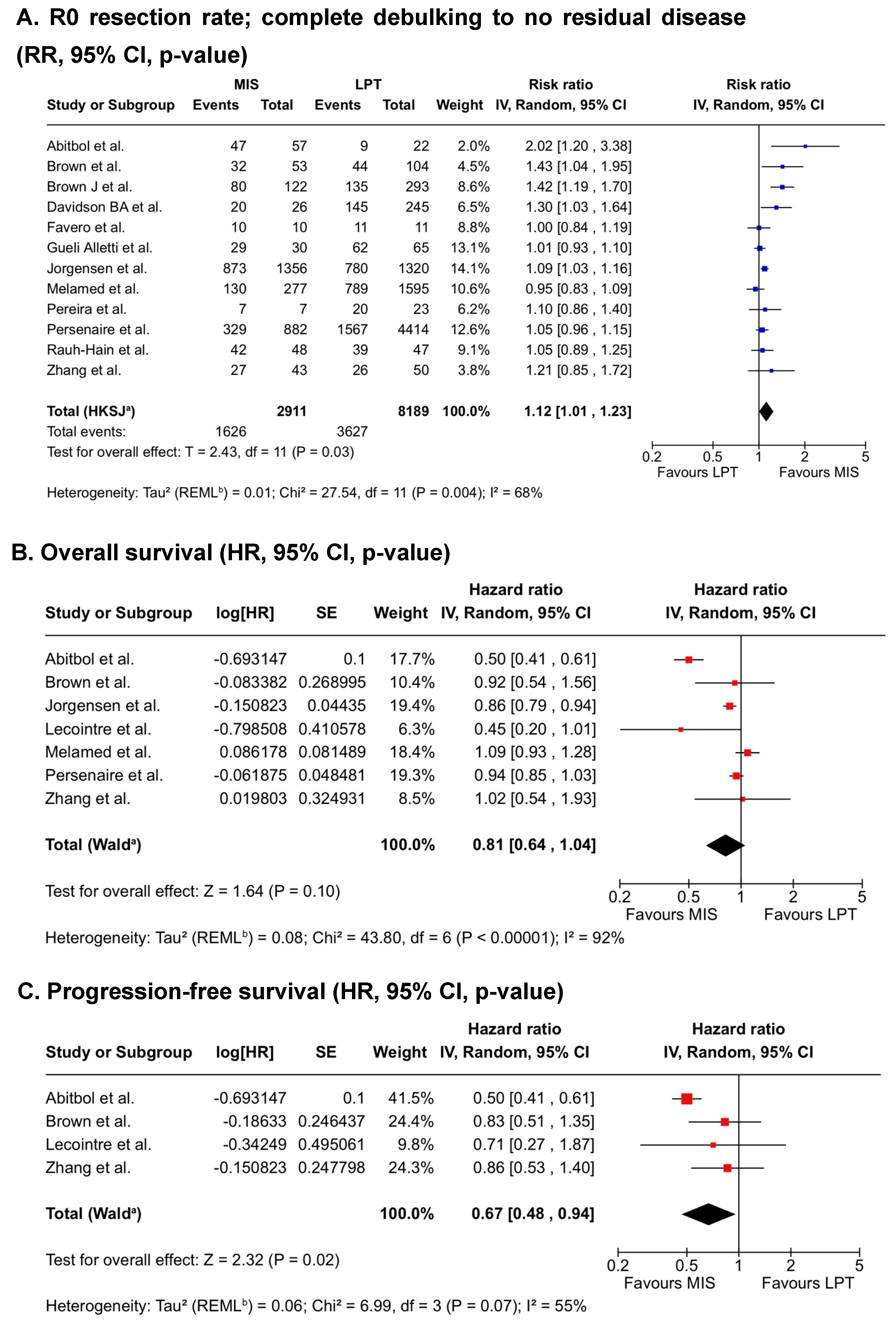
| Author | Year | R0-Resection | p-Value | Overall Survival, Months | p-Value | HR | Progression-Free Survival, Months | p-Value | HR | |||
|---|---|---|---|---|---|---|---|---|---|---|---|---|
| LPT, n (%) | MIS, n (%) | LPT | MIS | LPT | MIS | |||||||
| Abitbol [23] | 2019 | 9 (40.91) | 47 (82.46) | NR | Median: 37.9 ± 9.8 | Median: 47.2 ± 9.8 | 0.02 | 0.5 ± 0.1 | Median: 11.9 ± 1.2 | Median: 20.6 ± 2.4 | 0.002 | 0.5 ± 0.1 |
| Brown [24] | 2019 | 44 (42.31) | 32 (60.38) | 0.02 | Median: 35 | Median: 37 | 0.74 | 0.92 (95%CI 0.54–1.55) | Median: 29 | Median: 27 | 0.45 | 0.83 (95%CI 0.51–1.34) |
| Brown J [25] | 2021 | 135 (46) | 80 (66) | <0.001 | Median: 36.7 | Median: 40.9 | 0.5 | NR | Median: 15.1 | Median: 18.2 | 0.051 | NR |
| Davidson [26] | 2018 | 145 (59.18) | 20 (76.92) | NR | NR | NR | NR | NR | NR | NR | NR | NR |
| Favero [27] | 2015 | 11 (100) | 10 (100) | NR | NR | NR | NR | NR | Mean: 20.5 ± 3.7 | Mean: 13.3 ± 2.2 | 0.29 | NR |
| Gueli Alletti [28] | 2016 | 62 (95.4) | 29 (96.67) | NR | NR | NR | NR | NR | Median: 12 | Median: 18 | 0.027 | NR |
| Jorgensen [29] | 2023 | 780 (59.17) | 873 (64.38) | 0.01 | Median: 41 (95%CI 38.7–43.5) | Median: 46.7 (95%CI 44.7–48.6) | <0.01 | 0.86 (95%CI 0.79–0.94) | NR | NR | NR | NR |
| Lecointre [30] | 2022 | NR | NR | NR | 26.3 (95%CI 21.7–31.7) | Median: 23.1 (95%CI 15.7–29.7) | 0.17 | 0.45 (95%CI 0.19–0.95) | Median: 12 | Median: 14.8 | 0.057 | 0.71 (95%CI 0.27–1.88) |
| Melamed [31] | 2017 | 789 (49.47) | 130 (46.93) | 0.29 | Median: 26.3 (95%CI 21.7–31.7) | Median: 33.8 (95%CI 31.9–40.6) | NR | 1.09 (95%CI 0.93–1.28) | NR | NR | NR | NR |
| Pereira [32] | 2022 | 20 (86.96) | 7 (100) | 0.31 | Median: 37.6 (95%CI 36.1–39.6) | NR | NR | NR | NR | NR | NR | NR |
| Persenaire [33] | 2022 | 1567 (35.5) | 329 (37.3) | 0.59 | Median: 35.1 | Median: 36.6 | 0.22 | 0.94 (95%CI 0.86–1.04) | NR | NR | NR | NR |
| Pomel [34] | 2021 | NR | 31 (96.9) | NR | NR | NR | NR | NR | NR | NR | NR | NR |
| Rauh-Hain [22] | 2024 | 39 (83) | 42 (88) | NR | NR | NR | NR | NR | NR | NR | NR | NR |
| Zhang [35] | 2021 | 26 (52) | 27 (62.79) | 0.4 | Mean: 38.2 | Mean: 35.6 | 0.7 | 1.02 (95%CI 0.54–1.93) | Mean: 15.4 | Mean: 16.7 | 0.7 | 0.86 (95%CI 0.53–1.40) |
3.5. Risk of Bias and Sensitivity Analysis
4. Discussion
4.1. Summary of Main Results
4.2. Results in the Context of the Published Literature
4.3. Surgical Resection Status
4.4. Patient Survival
4.5. Intraoperative Course
4.6. Postoperative Complications and Length of Stay
4.7. Current Evidence
4.8. Strengths and Weaknesses
4.9. Implications for Practice and Future Research
5. Conclusions
Supplementary Materials
Author Contributions
Funding
Institutional Review Board Statement
Informed Consent Statement
Data Availability Statement
Acknowledgments
Conflicts of Interest
Abbreviations
| R0 | Resection to no visible residual disease |
| R0/R1 | Optimal cytoreduction to <1 cm tumour (debate ongoing on definition of optimal) |
| CC0 | Completeness of cytoreduction Score 0, no visible tumour remaining |
| CC1 | Completeness of cytoreduction Score 1, small nodules <2.5 mm remaining |
| RCT | Randomized controlled trial |
| RR | Risk ratio |
| HR | Hazard ratio |
| CI | Confidence Interval |
| MIS | Minimally invasive surgery |
| LPT | Laparotomy |
| HKSJ | Hartung-Knapp-Sidik-Jonkman method |
| Wald | Wald-type method |
| n | Number of patients |
| NR | Not reported |
| SD | Standard deviation |
| SE | Standard Error |
| SMD | Standardized mean difference |
| REML | Tau2 calculated by Restricted Maximum-Likelihood method |
| mL | Millilitre |
References
- Siegel, R.L.; Miller, K.D.; Fuchs, H.E.; Jemal, A. Cancer statistics, 2022. CA Cancer J. Clin. 2022, 72, 7–33. [Google Scholar] [CrossRef]
- Cancer WHOIAfRo. Ovary Fact Sheet, GLOBOCAN 2022: Global Cancer Observatory: Cancer Today; IARC: Lyon, France, 2024; Available online: https://gco.iarc.who.int/media/globocan/factsheets/cancers/25-ovary-fact-sheet.pdf (accessed on 18 November 2025).
- World Health Organization. Ovary Fact Sheet; International Agency for Research on Cancer: Lyon, France, 2024. [Google Scholar]
- Bryant, A.; Hiu, S.; Kunonga, P.T.; Gajjar, K.; Craig, D.; Vale, L.; Winter-Roach, B.A.; Elattar, A.; Naik, R. Impact of residual disease as a prognostic factor for survival in women with advanced epithelial ovarian cancer after primary surgery. Cochrane Database Syst. Rev. 2022, 2022, CD015048. [Google Scholar] [CrossRef]
- Chi, D.S.; Eisenhauer, E.L.; Lang, J.; Huh, J.; Haddad, L.; Abu-Rustum, N.R.; Sonoda, Y.; Levine, D.A.; Hensley, M.; Barakat, R.R. What is the optimal goal of primary cytoreductive surgery for bulky stage IIIC epithelial ovarian carcinoma (EOC)? Gynecol. Oncol. 2006, 103, 559–564. [Google Scholar] [CrossRef]
- Garsed, D.W.; Pandey, A.; Fereday, S.; Kennedy, C.J.; Takahashi, K.; Alsop, K.; Hamilton, P.T.; Hendley, J.; Chiew, Y.-E.; Traficante, N.; et al. The genomic and immune landscape of long-term survivors of high-grade serous ovarian cancer. Nat. Genet. 2022, 54, 1853–1864. [Google Scholar] [CrossRef] [PubMed]
- Saner, F.A.M.; Takahashi, K.; Budden, T.; Pandey, A.; Ariyaratne, D.; Zwimpfer, T.A.; Meagher, N.S.; Fereday, S.; Twomey, L.; Pishas, K.I.; et al. Concurrent RB1 Loss and BRCA Deficiency Predicts Enhanced Immunologic Response and Long-term Survival in Tubo-ovarian High-grade Serous Carcinoma. Clin. Cancer Res. 2024, 30, 3481–3498. [Google Scholar] [CrossRef] [PubMed]
- Baum, J.; Braicu, E.I.; Hunsicker, O.; Vergote, I.; Concin, N.; Van Nieuwenhuysen, E.; Feldheiser, A.; Achimas-Cadariu, P.; Darb-Esfahani, S.; Berger, A.; et al. Impact of clinical factors and surgical outcome on long-term survival in high-grade serous ovarian cancer: A multicenter analysis. Int. J. Gynecol. Cancer 2021, 31, 713–720. [Google Scholar] [CrossRef] [PubMed]
- Vergote, I.; Tropé, C.G.; Amant, F.; Kristensen, G.B.; Ehlen, T.; Johnson, N.; Verheijen, R.H.M.; Van Der Burg, M.E.L.; Lacave, A.J.; Panici, P.B.; et al. Neoadjuvant Chemotherapy or Primary Surgery in Stage IIIC or IV Ovarian Cancer. N. Engl. J. Med. 2010, 363, 943–953. [Google Scholar] [CrossRef]
- Kehoe, S.; Hook, J.; Nankivell, M.; Jayson, G.C.; Kitchener, H.; Lopes, T.; Luesley, D.; Perren, T.; Bannoo, S.; Mascarenhas, M.; et al. Primary chemotherapy versus primary surgery for newly diagnosed advanced ovarian cancer (CHORUS): An open-label, randomised, controlled, non-inferiority trial. Lancet 2015, 386, 249–257. [Google Scholar] [CrossRef]
- Fagotti, A.; Ferrandina, M.G.; Vizzielli, G.; Pasciuto, T.; Fanfani, F.; Gallotta, V.; Margariti, P.A.; Chiantera, V.; Costantini, B.; Gueli Alletti, S.; et al. Randomized trial of primary debulking surgery versus neoadjuvant chemotherapy for advanced epithelial ovarian cancer (SCORPION-NCT01461850). Int. J. Gynecol. Cancer 2020, 30, 1657–1664. [Google Scholar] [CrossRef]
- Knisely, A.; Gamble, C.R.; Clair, C.M.S.; Hou, J.Y.; Khoury-Collado, F.; Gockley, A.A.; Wright, J.D.; Melamed, A. The Role of Minimally Invasive Surgery in the Care of Women with Ovarian Cancer: A Systematic Review and Meta-analysis. J. Minim. Invasive Gynecol. 2021, 28, 537–543. [Google Scholar] [CrossRef]
- Gueli Alletti, S.; Bottoni, C.; Fanfani, F.; Gallotta, V.; Chiantera, V.; Costantini, B.; Cosentino, F.; Ercoli, A.; Scambia, G.; Fagotti, A. Minimally invasive interval debulking surgery in ovarian neoplasm (MISSION trial–NCT02324595): A feasibility study. Am. J. Obstet. Gynecol. 2016, 214, 503.e1–503.e6. [Google Scholar] [CrossRef] [PubMed]
- Tang, Q.; Liu, W.; Jiang, D.; Tang, J.; Zhou, Q.; Zhang, J. Perioperative and Survival Outcomes of Robotic-Assisted Surgery, Comparison with Laparoscopy and Laparotomy, for Ovarian Cancer: A Network Meta-Analysis. J. Oncol. 2022, 2022, 1–15. [Google Scholar] [CrossRef] [PubMed]
- Ackroyd, S.A.; Thomas, S.; Angel, C.; Moore, R.; Meacham, P.J.; DuBeshter, B. Interval robotic cytoreduction following neoadjuvant chemotherapy in advanced ovarian cancer. J. Robot. Surg. 2018, 12, 245–250. [Google Scholar] [CrossRef]
- Carbajal-Mamani, S.L.; Schweer, D.; Markham, M.J.; Esnakula, A.K.; Grajo, J.R.; Castagno, J.C.; Cardenas-Goicoechea, J. Robotic-assisted interval cytoreductive surgery in ovarian cancer: A feasibility study. Obstet. Gynecol. Sci. 2020, 63, 150–157. [Google Scholar] [CrossRef] [PubMed]
- Corrado, G.; Mancini, E.; Cutillo, G.; Baiocco, E.; Vici, P.; Sergi, D.; Patrizi, L.; Saltari, M.; Baffa, A.; Vizza, E. Laparoscopic Debulking Surgery in the Management of Advanced Ovarian Cancer After Neoadjuvant Chemotherapy. Int. J. Gynecol. Cancer 2015, 25, 1253–1257. [Google Scholar] [CrossRef]
- Fagotti, A.; Gueli Alletti, S.; Corrado, G.; Cola, E.; Vizza, E.; Vieira, M.; Andrade, C.E.; Tsunoda, A.; Favero, G.; Zapardiel, I.; et al. The INTERNATIONAL MISSION study: Minimally invasive surgery in ovarian neoplasms after neoadjuvant chemotherapy. Int. J. Gynecol. Cancer 2019, 29, 5–9. [Google Scholar] [CrossRef]
- Matsuo, K.; Huang, Y.; Matsuzaki, S.; Klar, M.; Roman, L.D.; Sood, A.K.; Wright, J.D. Minimally Invasive Surgery and Risk of Capsule Rupture for Women With Early-Stage Ovarian Cancer. JAMA Oncol. 2020, 6, 1110. [Google Scholar] [CrossRef]
- Saner, F.A.-C.M.; Ruggeri, G.; Siegenthaler, F.; Wampfler, J.; Imboden, S.; Mueller, M.D. Change of Fagotti score is associated with outcome after neoadjuvant chemotherapy for ovarian cancer. Int. J. Gynecol. Cancer 2023, 33, 1595–1601. [Google Scholar] [CrossRef]
- Van De Vrie, R.; Rutten, M.J.; Asseler, J.D.; Leeflang, M.M.; Kenter, G.G.; Mol, B.W.J.; Buist, M. Laparoscopy for diagnosing resectability of disease in women with advanced ovarian cancer. Cochrane Database Syst. Rev. 2019, 2019, CD009786. [Google Scholar] [CrossRef]
- Rauh-Hain, J.A.; Melamed, A.; Pareja, R.; May, T.; Sinno, A.; McNally, L.; Horowitz, N.S.; De Iaco, P.; Michener, C.M.; Van Lonkhuijzen, L.; et al. Laparoscopic Cytoreduction After Neoadjuvant Chemotherapy in High-Grade Epithelial Ovarian Cancer: A LANCE Randomized Clinical Trial. JAMA Netw. Open 2024, 7, e2446325. [Google Scholar] [CrossRef]
- Abitbol, J.; Gotlieb, W.; Zeng, Z.; Ramanakumar, A.; Kessous, R.; Kogan, L.; Pare-Miron, V.; Rombaldi, M.; Salvador, S.; Kucukyazici, B.; et al. Incorporating robotic surgery into the management of ovarian cancer after neoadjuvant chemotherapy. Int. J. Gynecol. Cancer 2019, 29, 1341–1347. [Google Scholar] [CrossRef]
- Brown, J.; Drury, L.; Crane, E.K.; Anderson, W.E.; Tait, D.L.; Higgins, R.V.; Naumann, R.W. When Less Is More: Minimally Invasive Surgery Compared with Laparotomy for Interval Debulking After Neoadjuvant Chemotherapy in Women with Advanced Ovarian Cancer. J. Minim. Invasive Gynecol. 2019, 26, 902–909. [Google Scholar] [CrossRef]
- Brown, J.; Barr, A.; Zhang, Y.; Davidson, B.; Secord, A.A.; Drury, L.; Crane, E.; Tait, D.; Naumann, R.W.; McNally, L. A multi-institutional study of minimally invasive surgery compared to laparotomy for interval debulking after neoadjuvant chemotherapy in women with advanced ovarian cancer. Gynecol. Oncol. 2021, 162, S20. [Google Scholar] [CrossRef]
- Davidson, B.A.; Broadwater, G.; Crim, A.; Boccacio, R.; Bixel, K.; Backes, F.; Previs, R.A.; Salinaro, J.; Salani, R.; Moore, K.; et al. Surgical complexity score and role of laparoscopy in women with advanced ovarian cancer treated with neoadjuvant chemotherapy. Gynecol. Oncol. 2019, 152, 554–559. [Google Scholar] [CrossRef]
- Favero, G.; Macerox, N.; Pfiffer, T.; Kohler, C.; da Costa Miranda, V.; Estevez Diz Mdel, P.; Fukushima, J.T.; Baracat, E.C.; Carvalho, J.P. Oncologic Concerns regarding Laparoscopic Cytoreductive Surgery in Patients with Advanced Ovarian Cancer Submitted to Neoadjuvant Chemotherapy. Oncology 2015, 89, 159–166. [Google Scholar] [CrossRef]
- Gueli Alletti, S.; Petrillo, M.; Vizzielli, G.; Bottoni, C.; Nardelli, F.; Costantini, B.; Quagliozzi, L.; Gallotta, V.; Scambia, G.; Fagotti, A. Minimally invasive versus standard laparotomic interval debulking surgery in ovarian neoplasm: A single-institution retrospective case-control study. Gynecol. Oncol. 2016, 143, 516–520. [Google Scholar] [CrossRef]
- Jorgensen, K.; Melamed, A.; Wu, C.F.; Nitecki, R.; Pareja, R.; Fagotti, A.; Schorge, J.O.; Ramirez, P.T.; Rauh-Hain, J.A. Minimally invasive interval debulking surgery for advanced ovarian cancer after neoadjuvant chemotherapy. Gynecol. Oncol. 2023, 172, 130–137. [Google Scholar] [CrossRef] [PubMed]
- Lecointre, L.; Pellerin, M.; Venkatasamy, A.; Fabacher, T.; Eberst, L.; Gantzer, J.; Jochum, F.; Faller, E.; Boisrame, T.; Querleu, D.; et al. Complete Laparoscopic Interval Debulking Surgery for Advanced Ovarian Cancer Achieves Similar Survival Outcomes to Open Approach: A Propensity-Matched Study. J. Investig. Surg. 2022, 35, 1394–1401. [Google Scholar] [CrossRef] [PubMed]
- Melamed, A.; Nitecki, R.; Boruta, D.M., 2nd; Del Carmen, M.G.; Clark, R.M.; Growdon, W.B.; Goodman, A.; Schorge, J.O.; Rauh-Hain, J.A. Laparoscopy Compared With Laparotomy for Debulking Ovarian Cancer After Neoadjuvant Chemotherapy. Obstet. Gynecol. 2017, 129, 861–869. [Google Scholar] [CrossRef]
- Pereira, A.; Magrina, J.F.; Magtibay, P.M.; Neto, J.S.; Siufi, D.F.S.; Chang, Y.H.; Perez-Medina, T. Does MIS Play a Role in the Treatment of Advanced Ovarian Cancer? Cancers 2022, 14, 3579. [Google Scholar] [CrossRef] [PubMed]
- Persenaire, C.; Pyrzak, A.; Barber, E.L. Survival and Surgical Approach among Women with Advanced Ovarian Cancer Treated with Neoadjuvant Chemotherapy. J. Minim. Invasive Gynecol. 2022, 29, 375–384. [Google Scholar] [CrossRef]
- Pomel, C.; Akladios, C.; Lambaudie, E.; Rouzier, R.; Ferron, G.; Lecuru, F.; Classe, J.M.; Fourchotte, V.; Paillocher, N.; Wattiez, A.; et al. Laparoscopic management of advanced epithelial ovarian cancer after neoadjuvant chemotherapy: A phase II prospective multicenter non-randomized trial (the CILOVE study). Int. J. Gynecol. Cancer 2021, 31, 1572–1578. [Google Scholar] [CrossRef]
- Zhang, Y.; Grant, M.S.; Zhang, X.; Paraghamian, S.E.; Tan, X.; Clark, L.H. Comparing Laparotomy with Robot-assisted Interval Debulking Surgery for Patients with Advanced Epithelial Ovarian Cancer Receiving Neoadjuvant Chemotherapy. J. Minim. Invasive Gynecol. 2021, 28, 1237–1243. [Google Scholar] [CrossRef]
- Dindo, D.; Demartines, N.; Clavien, P.-A. Classification of surgical complications: A new proposal with evaluation in a cohort of 6336 patients and results of a survey. Ann. Surg. 2004, 240, 205–213. [Google Scholar] [CrossRef]
- Yokoi, A.; Machida, H.; Shimada, M.; Matsuo, K.; Shigeta, S.; Furukawa, S.; Nishikawa, N.; Nomura, H.; Hori, K.; Tokunaga, H.; et al. Efficacy and safety of minimally invasive surgery versus open laparotomy for epithelial ovarian cancer: A systematic review and meta-analysis. Gynecol. Oncol. 2024, 190, 42–52. [Google Scholar] [CrossRef] [PubMed]
- Zeng, S.; Yu, Y.; Cui, Y.; Liu, B.; Jin, X.; Li, Z.; Liu, L. Efficacy and Safety of Minimally Invasive Surgery Versus Open Laparotomy for Interval Debulking Surgery of Advanced Ovarian Cancer After Neoadjuvant Chemotherapy: A Systematic Review and A Meta-Analysis. Front. Oncol. 2022, 12, 900256. [Google Scholar] [CrossRef]
- Achen, G.; Koual, M.; Bentivegna, E.; Fournier, L.; Nguyen Xuan, H.T.; Delanoy, N.; Bats, A.S.; Azais, H. Epithelial ovarian cancers and minimally invasive cytoreductive surgery after neoadjuvant chemotherapy: A systematic review. Gynecol. Obstet. Fertil. Senol. 2021, 49, 736–743. [Google Scholar] [CrossRef] [PubMed]
- Marchand, G.; Masoud, A.T.; Abdelsattar, A.; King, A.; Ulibarri, H.; Parise, J.; Arroyo, A.; Coriell, C.; Goetz, S.; Moir, C.; et al. Meta-analysis of laparoscopic radical hysterectomy, excluding robotic assisted versus open radical hysterectomy for early stage cervical cancer. Sci. Rep. 2023, 13, 273. [Google Scholar] [CrossRef] [PubMed]
- Mahmoud, Y.; Thiagarajan, V.; Jihad, Y.; Ranganatha, A.; Khalid, F.; Essani, B. Comparing the Outcomes of Laparoscopic Versus Open Surgery for Colorectal Cancer: A Systematic Review and Meta-Analysis. Cureus 2025, 17, e90687. [Google Scholar] [CrossRef]


| Author | Year | Study Design | Duration of Study | FIGO Stage | Patients | Type of Intervention | Laparoconversion, n (%) | ||
|---|---|---|---|---|---|---|---|---|---|
| Total | LPT | MIS | Robotic | ||||||
| n | n (%) | n (%) | n (%) | ||||||
| Abitbol [23] | 2019 | Retrospective | 2008–2014 | III–IV | 79 | 22 (27.85) | 57 (72.15) | 57 (100) | 6 (10.53) |
| Brown [24] | 2019 | Retrospective | 2006–2017 | III–IV | 157 | 104 (66.24) | 53 (33.76) | - | 9 (17) |
| Brown J [25] | 2021 | Retrospective | 2008–2018 | III-IV | 415 | 293 (70.6) | 122 (29.4) | 78 (63.93) | 38 (31.15) |
| Davidson [26] | 2018 | Retro-prospective | 2000–2017 | III-IV | 272 | 245 (90.07) | 27 (9.93) | - | 24 (47.06) |
| Favero [27] | 2015 | Prospective | 2011–2014 | IIIC–IVA | 21 | 11 (52.38) | 10 (47.62) | - | 0 (0) |
| Gueli Alletti [28] | 2016 | Retrospective | 2013–2014 | III–IV | 95 | 65 (68.42) | 30 (31.58) | - | NR |
| Jorgensen [29] | 2023 | Retrospective | 2013–2018 | IIIC-IV | 4042 | 2021 (50) | 2021 (50) | 864 (42.75) | 208 (10.29) |
| Lecointre [30] | 2022 | Retrospective | 2009–2019 | III-IV | 77 | 40 (51.95) | 37 (48.05) | - | 1 (2.7) |
| Melamed [31] | 2017 | Retrospective | 2010–2012 | IIIC–IV | 3071 | 2621 (85.35) | 450 (14.65) | 122 (27.11) | 72 (16) |
| Pereira [32] | 2022 | Retrospective | 2012–2013 | IIIC-IV | 30 | 23 (76.67) | 7 (23.33) | - | 0 (0) |
| Persenaire [33] | 2022 | Retrospective | 2010–2016 | IIIC-IV | 8085 | 6713 (83) | 1372 (17) | - | 183 (2.3) |
| Pomel [34] | 2021 | Prospective | 2013–2016 | IIIC-IV | 41 | 9 (21.95) | 32 (78.05) | - | 3 (9.38) |
| Rauh-Hain [22] | 2024 | RCT | 2020–2023 | IIIC-IV | 100 | 51 (51) | 49 (49) | - | 6 (12.5) |
| Zhang [35] | 2021 | Retrospective | 2011–2018 | III–IV | 93 | 50 (53.76) | 43 (46.24) | 43 (100) | 5 (11.63) |
Disclaimer/Publisher’s Note: The statements, opinions and data contained in all publications are solely those of the individual author(s) and contributor(s) and not of MDPI and/or the editor(s). MDPI and/or the editor(s) disclaim responsibility for any injury to people or property resulting from any ideas, methods, instructions or products referred to in the content. |
© 2025 by the authors. Licensee MDPI, Basel, Switzerland. This article is an open access article distributed under the terms and conditions of the Creative Commons Attribution (CC BY) license (https://creativecommons.org/licenses/by/4.0/).
Share and Cite
von Holzen, J.; Siegenthaler, F.; Locher, N.; Baumgartner, C.; Imboden, S.; Mueller, M.D.; Saner, F.A.M. Outcome After Laparoscopic Compared to Open Interval Debulking Surgery for Advanced Stage Ovarian Cancer: A Systematic Review and Meta-Analysis. Cancers 2025, 17, 3858. https://doi.org/10.3390/cancers17233858
von Holzen J, Siegenthaler F, Locher N, Baumgartner C, Imboden S, Mueller MD, Saner FAM. Outcome After Laparoscopic Compared to Open Interval Debulking Surgery for Advanced Stage Ovarian Cancer: A Systematic Review and Meta-Analysis. Cancers. 2025; 17(23):3858. https://doi.org/10.3390/cancers17233858
Chicago/Turabian Stylevon Holzen, Jana, Franziska Siegenthaler, Noah Locher, Christine Baumgartner, Sara Imboden, Michael David Mueller, and Flurina Annacarina Maria Saner. 2025. "Outcome After Laparoscopic Compared to Open Interval Debulking Surgery for Advanced Stage Ovarian Cancer: A Systematic Review and Meta-Analysis" Cancers 17, no. 23: 3858. https://doi.org/10.3390/cancers17233858
APA Stylevon Holzen, J., Siegenthaler, F., Locher, N., Baumgartner, C., Imboden, S., Mueller, M. D., & Saner, F. A. M. (2025). Outcome After Laparoscopic Compared to Open Interval Debulking Surgery for Advanced Stage Ovarian Cancer: A Systematic Review and Meta-Analysis. Cancers, 17(23), 3858. https://doi.org/10.3390/cancers17233858