Nevus-Associated and De Novo Melanoma: A Cross-Sectional Study on Prognostic Differences

 ,
,  ,
,  , ,
, ,
Simple Summary
Abstract
1. Introduction
2. Materials and Methods
3. Results
4. Discussion
5. Conclusions
Author Contributions
Funding
Institutional Review Board Statement
Informed Consent Statement
Data Availability Statement
Acknowledgments
Conflicts of Interest
Abbreviations
| NAM | Nevus-Associated Melanoma |
| DNM | De Novo Melanoma |
| SLN | Sentinel Lymph Node |
| CI | Confidence Interval |
References
- Sun, Y.; Shen, Y.; Liu, Q.; Zhang, H.; Jia, L.; Chai, Y.; Jiang, H.; Wu, M.; Li, Y. Global trends in melanoma burden: A comprehensive analysis from the Global Burden of Disease Study, 1990–2021. J. Am. Acad. Dermatol. 2025, 92, 100–107. [Google Scholar] [CrossRef]
- Kandolf, L.; Ascierto, P.A.; Bastholt, L.; Gavrilova, I.; Haanen, J.; Hauschild, A.; Herceg, D.; Hoeller, C.; Jalovcic Suljevic, A.; Kessels, J.I.; et al. An update on access to novel treatment for metastatic melanoma in Europe—A 2024 survey of the European melanoma registry and the European association of dermato-oncology. Eur. J. Cancer 2025, 216, 115124. [Google Scholar] [CrossRef] [PubMed]
- Schadendorf, D.; Fisher, D.E.; Garbe, C.; Gershenwald, J.E.; Grob, J.J.; Halpern, A.; Herlyn, M.; Marchetti, M.A.; McArthur, G.; Ribas, A.; et al. Melanoma. Nat. Rev. Dis. Primers 2015, 1, 15003. [Google Scholar] [CrossRef] [PubMed]
- Arnold, M.; Singh, D.; Laversanne, M.; Vignat, J.; Vaccarella, S.; Meheus, F.; Cust, A.E.; de Vries, E.; Whiteman, D.C.; Bray, F. Global Burden of Cutaneous Melanoma in 2020 and Projections to 2040. JAMA Dermatol. 2022, 158, 495–503. [Google Scholar] [CrossRef] [PubMed] [PubMed Central]
- Bosch-Amate, X.; Podlipnik, S.; Loughlin, C.; Carrera, C.; Barreiro-Capurro, A.; García-Herrera, A.; Alós, L.; Malvehy, J.; Puig, S. Clinicopathological, Genetic and Survival Advantages of Naevus-associated Melanomas: A Cohort Study. Acta Derm.-Venereol. 2021, 101, adv00425. [Google Scholar] [CrossRef] [PubMed]
- Shitara, D.; Nascimento, M.; Ishioka, P.; Carrera, C.; Alós, L.; Malvehy, J.; Puig, S. Dermoscopy of Naevus-associated Melanomas. Acta Derm.-Venereol. 2015, 95, 671–675. [Google Scholar] [CrossRef]
- Pampena, R.; Manfreda, V.; Kyrgidis, A.; Lai, M.; Borsari, S.; Benati, E.; Lombardi, M.; Bianchi, L.; Zalaudek, I.; Moscarella, E.; et al. Digital dermoscopic changes during follow-up of de-novo and nevus-associated melanoma: A cohort study. Int. J. Dermatol. 2020, 59, 813–821. [Google Scholar] [CrossRef]
- Zalaudek, I.; Conforti, C.; Guarneri, F.; Vezzoni, R.; Deinlein, T.; Hofmann-Wellenhof, R.; Longo, C.; Moscarella, E.; Kittler, H.; Argenziano, G.; et al. Clinical and dermoscopic characteristics of congenital and noncongenital nevus-associated melanomas. J. Am. Acad. Dermatol. 2020, 83, 1080–1087. [Google Scholar] [CrossRef]
- Stark, M.S.; Tell-Martí, G.; da Silva, V.M.; Martinez-Barrios, E.; Calbet-Llopart, N.; Vicente, A.; Sturm, R.A.; Soyer, H.P.; Puig, S.; Malvehy, J.; et al. The Distinctive Genomic Landscape of Giant Congenital Melanocytic Nevi. J. Investig. Dermatol. 2021, 141, 692–695.e2. [Google Scholar] [CrossRef]
- Shreberk-Hassidim, R.; Ostrowski, S.M.; Fisher, D.E. The Complex Interplay between Nevi and Melanoma: Risk Factors and Precursors. Int. J. Mol. Sci. 2023, 24, 3541. [Google Scholar] [CrossRef]
- Longo, C.; Piana, S.; Marghoob, A.; Cavicchini, S.; Rubegni, P.; Cota, C.; Ferrara, G.; Cesinaro, A.; Baade, A.; Bencini, P.; et al. Morphological features of naevoid melanoma: Results of a multicentre study of the International Dermoscopy Society. Br. J. Dermatol. 2014, 172, 961–967. [Google Scholar] [CrossRef]
- Dessinioti, C.; Geller, A.C.; Stratigos, A.J. A review of nevus-associated melanoma: What is the evidence? J. Eur. Acad. Dermatol. Venereol. 2022, 36, 1927–1936. [Google Scholar] [CrossRef] [PubMed]
- Lobos-Guede, N.; Hartmann, D.; Darlic, V.; Carrera, C.; Alos, L.; Puig, S. New Dermoscopy Pattern in Nevus-Associated Melanomas. Pigment. Cell Melanoma Res. 2025, 38, e70015. [Google Scholar] [CrossRef] [PubMed]
- Elder, D.; Barnhill, R.L.; Bastian, B.C.; Cree, I.A.; Massi, D.; Scolyer, R.A. Melanocytic Tumour Classification and the Pathway Concept of Melanoma Pathogenesis. In WHO Classification of Skin Tumours, 4th ed.; Elder, D.E., Massi, D., Scolyer, R.A., Willemze, R., Eds.; International Agency for Research on Cancer (IARC): Lyon, France, 2018; Volume 11, pp. 66–71. [Google Scholar]
- Vezzoni, R.; Conforti, C.; Vichi, S.; Giuffrida, R.; Retrosi, C.; Magaton-Rizzi, G.; Di Meo, N.; Pizzichetta, M.A.; Zalaudek, I. Is There More Than One Road to Nevus-Associated Melanoma? Dermatol. Pract. Concept. 2020, 10, e2020028. [Google Scholar] [CrossRef] [PubMed]
- Dessinioti, C.; Befon, A.; Plaka, M.; Niforou, A.; Kypreou, K.; Nicolaidou, E.; Lingria, A.; Stratigos, A. A retrospective study of nevus-associated melanoma in situ. Dermatology 2025, 241, 356–360. [Google Scholar] [CrossRef]
- Gosman, L.M.; Țăpoi, D.A.; Costache, M. Cutaneous Melanoma: A Review of Multifactorial Pathogenesis, Immunohistochemistry, and Emerging Biomarkers for Early Detection and Management. Int. J. Mol. Sci. 2023, 24, 15881. [Google Scholar] [CrossRef]
- Mack, T. The pathogenesis of melanoma induced by ultraviolet radiation. N. Engl. J. Med. 1999, 341, 766. [Google Scholar] [CrossRef] [PubMed]
- Navarrete-Dechent, C.; Jaimes, N.; Marchetti, M. Unveiling melanomagenesis through the dermatoscope. J. Eur. Acad. Dermatol. Venereol. 2021, 35, 1038–1039. [Google Scholar] [CrossRef]
- Bellinato, F.; Moar, A.; Rosina, P.; Gisondi, P.; Girolomoni, G. Comparative dermoscopy assessment of nevus-associated versus de novo in situ melanoma. Eur. J. Dermatol. 2023, 33, 121–125. [Google Scholar] [CrossRef]
- Pampena, R.; Kyrgidis, A.; Lallas, A.; Moscarella, E.; Argenziano, G.; Longo, C. A meta-analysis of nevus-associated melanoma: Preva-lence and practical implications. J. Am. Acad. Dermatol. 2017, 77, 938–945.e4. [Google Scholar] [CrossRef]
- Lai, M.; Piana, S.; Pellacani, G.; Longo, C.; Pampena, R. Prevalence and clinical-pathological features of nevus-associated versus de novo melanoma: A retrospective cross-sectional study of 2806 cases. Dermatol. Pract. Concept. 2022, 12, e2022094. [Google Scholar] [CrossRef] [PubMed] [PubMed Central]
- Rapanotti, M.C.; Cenci, T.; Scioli, M.G.; Cugini, E.; Anzillotti, S.; Savino, L.; Coletta, D.; Di Raimondo, C.; Campione, E.; Roselli, M.; et al. Circulating Tumor Cells: Origin, Role, Current Applications, and Future Perspectives for Personalized Medicine. Biomedicines 2024, 12, 2137. [Google Scholar] [CrossRef]
- Dika, E.; Veronesi, G.; Altimari, A.; Riefolo, M.; Ravaioli, G.M.; Piraccini, B.M.; Lambertini, M.; Campione, E.; Gruppioni, E.; Fiorentino, M.; et al. BRAF, KIT, and NRAS Mutations of Acral Melanoma in White Patients. Am. J. Clin. Pathol. 2020, 153, 664–671. [Google Scholar] [CrossRef]
- WHO Classification of Tumours Editorial Board. Skin Tumours, 5th ed.; WHO Classification of Tumours Series; International Agency for Research on Cancer: Lyon, France, 2023; Volume 12. [Google Scholar]
- Shain, A.H.; Joseph, N.M.; Yu, R.; Benhamida, J.; Liu, S.; Prow, T.; Ruben, B.; North, J.; Pincus, L.; Yeh, I.; et al. Genomic and Transcriptomic Analysis Reveals Incremental Disruption of Key Signaling Pathways during Melanoma Evolution. Cancer Cell. 2018, 34, 45–55.e4. [Google Scholar] [CrossRef] [PubMed]
- Shain, A.H.; Bastian, B.C. From melanocytes to melanomas. Nat. Rev. Cancer 2016, 16, 345–358. [Google Scholar] [CrossRef] [PubMed]
- Shitara, D.; Tell-Martí, G.; Badenas, C.; Enokihara, M.; Alós, L.; Larque, A.; Michalany, N.; Puig-Butille, J.; Carrera, C.; Malvehy, J.; et al. Mutational status of naevus-associated melanomas. Br. J. Dermatol. 2015, 173, 671–680. [Google Scholar] [CrossRef] [PubMed]
- Ricci, C.; Dika, E.; Ambrosi, F.; Lambertini, M.; Veronesi, G.; Barbara, C. Cutaneous Melanomas: A Single Center Experience on the Usage of Immunohistochemistry Applied for the Diagnosis. Int. J. Mol. Sci. 2022, 23, 5911. [Google Scholar] [CrossRef]
- Dika, E.; Fanti, P.A.; Fiorentino, M.; Capizzi, E.; Neri, I.; Piraccini, B.M.; Ravaioli, G.M.; Misciali, C.; Passarini, B.; Patrizi, A. Spitzoid tumors in children and adults. Melanoma Res. 2015, 25, 295–301. [Google Scholar] [CrossRef]
- Dika, E.; Riefolo, M.; Porcellini, E.; Broseghini, E.; Ribero, S.; Senetta, R.; Osella-Abate, S.; Scarfì, F.; Lambertini, M.; Veronesi, G.; et al. Defining the Prognostic Role of MicroRNAs in Cutaneous Melanoma. J. Investig. Dermatol. 2020, 140, 2260–2267. [Google Scholar] [CrossRef]
- Sini, M.; Manca, A.; Cossu, A.; Budroni, M.; Botti, G.; Ascierto, P.; Cremona, F.; Muggiano, A.; D’atri, S.; Casula, M.; et al. Molecular alterations at chromosome 9p21 in melanocytic naevi and melanoma. Br. J. Dermatol. 2007, 158, 243–250. [Google Scholar] [CrossRef]
- Shitara, D.; Tell-Martí, G.; Badenas, C.; Enokihara, M.; Alós, L.; Larque, A.; Michalany, N.; Puig-Butille, J.; Carrera, C.; Malvehy, J.; et al. Discrepant mutational status between naevi and melanomas in naevus-associated melanomas: About mutation-specific immunohistochemistry: Reply from the authors. Br. J. Dermatol. 2016, 175, 435. [Google Scholar] [CrossRef]
- Durante, G.; Veronesi, G.; Misciali, C.; Riefolo, M.; Lambertini, M.; Tartari, F.; Ricci, C.; Ferracin, M.; Dika, E. Dysplastic nevi and melanoma: MicroRNAs tell a divergent story. Pathol.-Res. Pract. 2022, 235, 153942. [Google Scholar] [CrossRef]
- Rapanotti, M.C.; Cugini, E.; Campione, E.; Di Raimondo, C.; Costanza, G.; Rossi, P.; Ferlosio, A.; Bernardini, S.; Orlandi, A.; De Luca, A.; et al. Epithelial-to-Mesenchymal Transition Gene Signature in Circulating Melanoma Cells: Biological and Clinical Relevance. Int. J. Mol. Sci. 2023, 24, 11792. [Google Scholar] [CrossRef] [PubMed]
- Durante, G.; Broseghini, E.; Comito, F.; Naddeo, M.; Milani, M.; Salamon, I.; Campione, E.; Dika, E.; Ferracin, M. Circulating microRNA biomarkers in melanoma and non-melanoma skin cancer. Expert Rev. Mol. Diagn. 2022, 22, 305–318. [Google Scholar] [CrossRef] [PubMed]
- Scarfì, F.; Patrizi, A.; Veronesi, G.; Lambertini, M.; Tartari, F.; Mussi, M.; Melotti, B.; Dika, E. The role of topical imiquimod in melanoma cutaneous metastases: A critical review of the literature. Dermatol. Ther. 2020, 33, e14165. [Google Scholar] [CrossRef] [PubMed]
- Zhai, H.; Dika, E.; Goldovsky, M.; Maibach, H.I. Tape-stripping method in man: Comparison of evaporimetric methods. Ski. Res. Technol. 2007, 13, 207–210. [Google Scholar] [CrossRef]
- Cosio, T.; Di Prete, M.; Di Raimondo, C.; Garofalo, V.; Lozzi, F.; Lanna, C.; Dika, E.; Orlandi, A.; Rapanotti, M.C.; Bianchi, L.; et al. Patidegib in Dermatology: A Current Review. Int. J. Mol. Sci. 2021, 22, 10725. [Google Scholar] [CrossRef]
- Durante, G.; Comito, F.; Lambertini, M.; Broseghini, E.; Dika, E.; Ferracin, M. Non-coding RNA dysregulation in skin cancers. Essays Biochem. 2021, 65, 641–655. [Google Scholar] [CrossRef]
- Di Raimondo, C.; Fico, A.; Cicala, M.; Caro, R.D.C.; Di Domenico, P.; Lozzi, F.; Paganini, C.; Rossi, P.; Rapanotti, C.; Galluzzo, M.; et al. Peripheral blood inflammation indexes correlate with advanced stages in cutaneous melanoma: A single-center retrospective study. Melanoma Res. 2025, 35, 361–365. [Google Scholar] [CrossRef]
- Dika, E.; Lambertini, M.; Pellegrini, C.; Veronesi, G.; Melotti, B.; Riefolo, M.; Sperandi, F.; Patrizi, A.; Ricci, C.; Mussi, M.; et al. Cutaneous and Mucosal Melanomas of Uncommon Sites: Where Do We Stand Now? J. Clin. Med. 2021, 10, 478. [Google Scholar] [CrossRef]
- Ricci, C.; Dika, E.; Lambertini, M.; Ambrosi, F.; Chiarucci, F.; Chillotti, S.; Fiorentino, M.; Fabbri, E.; Tassone, D.; Veronesi, G.; et al. The EORTC protocol for sentinel lymph node biopsy (SLNB) reveals a high number of nodal nevi and a strong association with nevus-associated melanoma. Pathol.-Res. Pract. 2022, 233, 153805. [Google Scholar] [CrossRef]
- Dika, E.; Magnaterra, E. Acral melanoma: Molecular subtyping as a gateway to precision medicine. J. Eur. Acad. Dermatol. Venereol. 2025, 39, 1216–1217. [Google Scholar] [CrossRef]
- Amaral, T.; Ottaviano, M.; Arance, A.; Blank, C.; Chiarion-Sileni, V.; Donia, M.; Dummer, R.; Garbe, C.; Gershenwald, J.E.; Gogas, H.; et al. Cutaneous melanoma: ESMO Clinical Practice Guideline for diagnosis, treatment and follow-up. Ann Oncol. 2025, 36, 10–30. [Google Scholar] [CrossRef] [PubMed]
- Stiegel, E.; Xiong, D.; Ya, J.; Funchain, P.; Isakov, R.; Gastman, B.; Vij, A. Prognostic value of sentinel lymph node biopsy according to Breslow thickness for cutaneous melanoma. J. Am. Acad. Dermatol. 2018, 78, 942–948. [Google Scholar] [CrossRef] [PubMed]
- Mandalà, M.; Imberti, G.L.; Piazzalunga, D.; Belfiglio, M.; Labianca, R.; Barberis, M.; Marchesi, L.; Poletti, P.; Bonomi, L.; Novellino, L.; et al. Clinical and histopathological risk factors to predict sentinel lymph node positivity, disease-free and overall survival in clinical stages I-II AJCC skin melanoma: Outcome analysis from a single-institution prospectively collected database. Eur. J. Cancer 2009, 45, 2537–2545. [Google Scholar] [CrossRef] [PubMed]
- Mandalà, M.; Galli, F.; Cattaneo, L.; Merelli, B.; Rulli, E.; Ribero, S.; Quaglino, P.; De Giorgi, V.; Pigozzo, J.; Sileni, V.C.; et al. Mitotic rate correlates with sentinel lymph node status and outcome in cutaneous melanoma greater than 1 millimeter in thickness: A multi-institutional study of 1524 cases. J. Am. Acad. Dermatol. 2017, 76, 264–273.e2. [Google Scholar] [CrossRef]
- Quaglino, P.; Ribero, S.; Osella-Abate, S.; Macrì, L.; Grassi, M.; Caliendo, V.; Asioli, S.; Sapino, A.; Macripò, G.; Savoia, P.; et al. Clinico-pathologic features of primary melanoma and sentinel lymph node predictive for non-sentinel lymph node involvement and overall survival in melanoma patients: A single centre observational cohort study. Surg. Oncol. 2011, 20, 259–264. [Google Scholar] [CrossRef]
- Tejera-Vaquerizo, A.; Pérez-Cabello, G.; Marínez-Leborans, L.; Gallego, E.; Oliver-Martínez, V.; Martín-Cuevas, P.; Arias-Santiago, S.; Aneiros-Fernández, J.; Herrera-Acosta, E.; Traves, V.; et al. Is mitotic rate still useful in the management of patients with thin melanoma? J. Eur. Acad. Dermatol. Venereol. 2017, 31, 2025–2029. [Google Scholar] [CrossRef]
- Tejera-Vaquerizo, A.; Ribero, S.; Puig, S.; Boada, A.; Paradela, S.; Moreno-Ramírez, D.; Cañueto, J.; de Unamuno, B.; Brinca, A.; Descalzo-Gallego, M.A.; et al. Survival analysis and sentinel lymph node status in thin cutaneous melanoma: A multicenter observational study. Cancer Med. 2019, 8, 4235–4244. [Google Scholar] [CrossRef]
- Conic, R.R.Z.; Ko, J.; Damiani, G.; Funchain, P.; Knackstedt, T.; Vij, A.; Vidimos, A.; Gastman, B.R. Predictors of sentinel lymph node positivity in thin melanoma using the National Cancer Database. J. Am. Acad. Dermatol. 2019, 80, 441–447. [Google Scholar] [CrossRef] [PubMed]
- Long, G.V.; Hauschild, A.; Santinami, M.; Atkinson, V.; Mandalà, M.; Chiarion-Sileni, V.; Larkin, J.; Nyakas, M.; Dutriaux, C.; Haydon, A.; et al. Adjuvant Dabrafenib plus Trametinib in Stage III BRAF-Mutated Melanoma. N. Engl. J. Med. 2017, 377, 1813–1823. [Google Scholar] [CrossRef] [PubMed]
- Dummer, R.; Hauschild, A.; Santinami, M.; Atkinson, V.; Mandalà, M.; Kirkwood, J.M.; Chiarion Sileni, V.; Larkin, J.; Nyakas, M.; Dutriaux, C.; et al. Five-Year Analysis of Adjuvant Dabrafenib plus Trametinib in Stage III Melanoma. N. Engl. J. Med. 2020, 383, 1139–1148. [Google Scholar] [CrossRef] [PubMed]
- Karakousis, G. Adjuvant therapy for melanoma: How to choose? Lancet Oncol. 2020, 21, 319–320. [Google Scholar] [CrossRef] [PubMed]
- Sussman, T.A.; Ott, P.A. Adjuvant immunotherapy for melanoma patients: Progress and opportunities. ESMO Open 2024, 9, 102962. [Google Scholar] [CrossRef] [PubMed]
- Zhang, Y.; Wu, J.; Cai, X.; Jiang, K.; Zhang, W.; Zhou, H.; Li, Z.; Lan, S.; Liu, J.; Liu, F.; et al. Nevus-associated acral melanoma has lower risk of recurrence and mortality than de novo acral melanoma: A multicenter, retrospective analysis of 482 patients. J. Am. Acad. Dermatol. 2025, 92, 538–545. [Google Scholar] [CrossRef] [PubMed]
- Riaz, N.; Huibers, A.; Leong, S.P.; Kashani-Sabet, M.; White, R.L., Jr.; Vetto, J.T.; Schneebaum, S.; O’Donoghue, C.; Howard, H.; Avisar, E.; et al. Prognostic Value of Nevus-Associated Melanoma in Patients with Melanoma. Ann. Surg. Oncol. 2025, 32, 3189–3197. [Google Scholar] [CrossRef] [PubMed] [PubMed Central]
- Lin, W.M.; Luo, S.; Muzikansky, A.; Lobo, A.Z.; Tanabe, K.K.; Sober, A.J.; Cosimi, A.B.; Tsao, H.; Duncan, L.M. Outcome of patients with de novo versus nevus-associated melanoma. J. Am. Acad. Dermatol. 2015, 72, 54–58. [Google Scholar] [CrossRef] [PubMed]
- Cymerman, R.M.; Shao, Y.; Wang, K.; Zhang, Y.; Murzaku, E.C.; Penn, L.A.; Osman, I.; Polsky, D. De Novo vs Nevus-Associated Melanomas: Differences in Associations With Prognostic Indicators and Survival. JNCI J. Natl. Cancer Inst. 2016, 108, djw121. [Google Scholar] [CrossRef]
- Saida, T. Histogenesis of cutaneous malignant melanoma: The vast majority do not develop from melanocytic nevus but arise de novo as melanoma in situ. J. Dermatol. 2019, 46, 80–94. [Google Scholar] [CrossRef]
- Tas, F.; Erturk, K. De Novo and Nevus-Associated Melanomas: Different Histopathologic Characteristics but Similar Survival Rates. Pathol. Oncol. Res. 2020, 26, 2483–2487. [Google Scholar] [CrossRef]
- Caccavale, S.; Calabrese, G.; Mattiello, E.; Broganelli, P.; Ramondetta, A.; Pieretti, G.; Alfano, R.; Argenziano, G. Cutaneous Melanoma Arising in Congenital Melanocytic Nevus: A Retrospective Observational Study. Dermatology 2020, 237, 473–478. [Google Scholar] [CrossRef]
- Pampena, R.; Lai, M.; Piana, S.; Lallas, A.; Pellacani, G.; Longo, C. Nevus-associated melanoma: Facts and controversies. Ital. J. Dermatol. Venereol. 2020, 155, 65–75. [Google Scholar] [CrossRef]



| Variable | NAM | DNM |
|---|---|---|
| Mean age (years) | 52.0 | 54.0 |
| Female (%) | 42.0 | 48.0 |
| Male (%) | 58.0 | 52.0 |
| Trunk (%) | 65.6 | 51.7 |
| Lower limbs (%) | 14.4 | 22.6 |
| Upper limbs (%) | 13.3 | 16.7 |
| Head and neck (%) | 4.4 | 7.3 |
| Acral (%) | 2.2 | 1.7 |
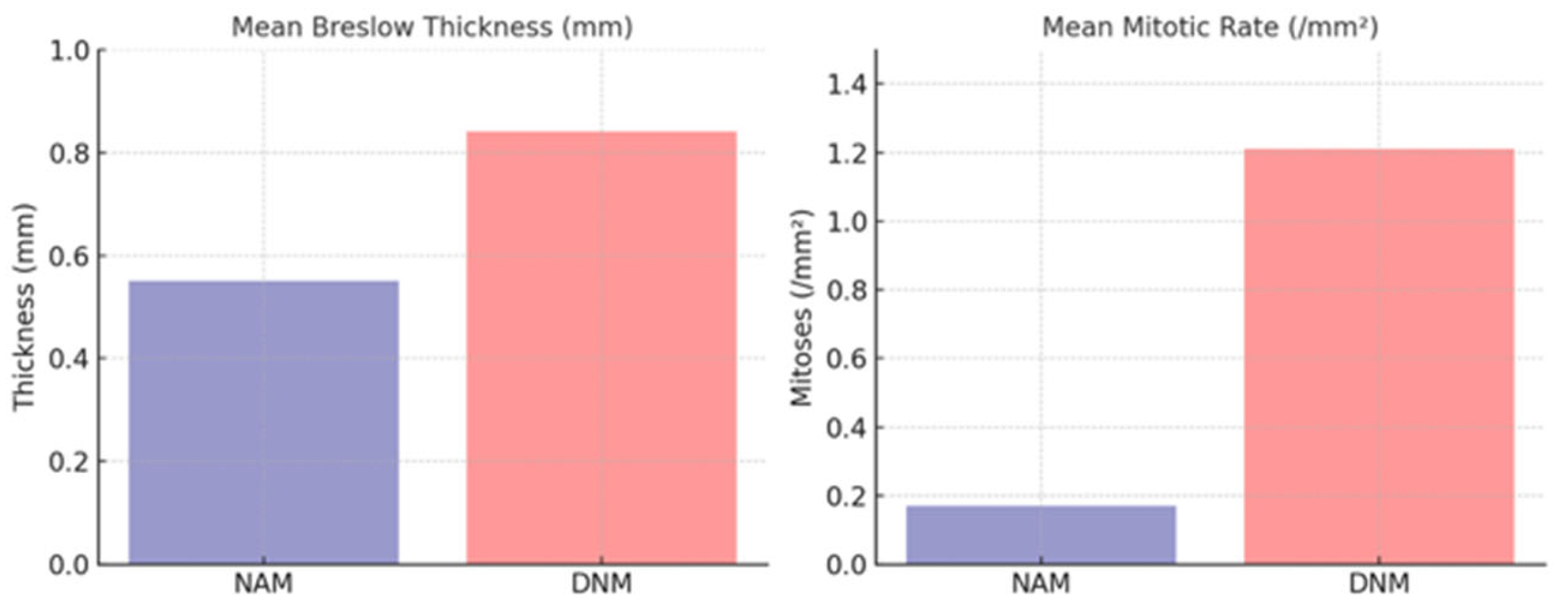
| Mean Breslow (mm) | 0.55 | 0.84 |
| Mean mitoses (/mm2) | 0.17 | 1.21 |
| Ulceration (%) | 2.2 | 9.4 |
| SLN positivity (%) | 1.1 | 6.3 |
| Distant metastases (%) | 0.0 | 6.6 |
| Melanoma-specific mortality (%) | 0.0 | 0.69 |
| Patient Features | p-Value | Odds Ratio (95% CI) |
|---|---|---|
| Gender | 0.935 | 0.96 (0.36–2.54) |
| Age | 0.542 | 1.10 (0.98–1.05) |
| Breslow thickness | 0.037 | 1.008 (1.00–1.20) |
| Mitoses | 0.009 | 0.38 (0.19–0.79) |
| Positive sentinel lymph node | 0.671 | 0.60 (0.06–6.50) |
| Ulceration | 0.728 | 1.42 (0.20–10.10) |
| Distant Metastasis | 0.998 | 0.00 (0–0) |
| Mortality | 1.0 | 0.20 (0–0) |
Disclaimer/Publisher’s Note: The statements, opinions and data contained in all publications are solely those of the individual author(s) and contributor(s) and not of MDPI and/or the editor(s). MDPI and/or the editor(s) disclaim responsibility for any injury to people or property resulting from any ideas, methods, instructions or products referred to in the content. |
© 2025 by the authors. Licensee MDPI, Basel, Switzerland. This article is an open access article distributed under the terms and conditions of the Creative Commons Attribution (CC BY) license (https://creativecommons.org/licenses/by/4.0/).
Share and Cite
Dika, E.; Venturi, F.; Scotti, B.; Gualandi, A.; Baraldi, C.; Vaccari, S.; Posenato, S.; Zengarini, C.; Alessandrini, A.; Veneziano, L.; et al. Nevus-Associated and De Novo Melanoma: A Cross-Sectional Study on Prognostic Differences. Cancers 2025, 17, 3859. https://doi.org/10.3390/cancers17233859
Dika E, Venturi F, Scotti B, Gualandi A, Baraldi C, Vaccari S, Posenato S, Zengarini C, Alessandrini A, Veneziano L, et al. Nevus-Associated and De Novo Melanoma: A Cross-Sectional Study on Prognostic Differences. Cancers. 2025; 17(23):3859. https://doi.org/10.3390/cancers17233859
Chicago/Turabian StyleDika, Emi, Federico Venturi, Biagio Scotti, Alberto Gualandi, Carlotta Baraldi, Sabina Vaccari, Sebastiano Posenato, Corrado Zengarini, Aurora Alessandrini, Leonardo Veneziano, and et al. 2025. "Nevus-Associated and De Novo Melanoma: A Cross-Sectional Study on Prognostic Differences" Cancers 17, no. 23: 3859. https://doi.org/10.3390/cancers17233859
APA StyleDika, E., Venturi, F., Scotti, B., Gualandi, A., Baraldi, C., Vaccari, S., Posenato, S., Zengarini, C., Alessandrini, A., Veneziano, L., Ardigò, M., & Magnaterra, E. (2025). Nevus-Associated and De Novo Melanoma: A Cross-Sectional Study on Prognostic Differences. Cancers, 17(23), 3859. https://doi.org/10.3390/cancers17233859