Discrepancies Between the Tennessee Nomogram and Oncotype DX: Implications for the Korean Breast Cancer Population—The BRAIN Study
by
 , , and
Suk Jun Lee
1,† ,
,
Joo Heung Kim
2,†,
Jee Hyun Ahn
3,
So Hyeon Gwon
4,
Ilkyun Lee
1,
Seho Park
3,* and
Nak-Hoon Son
4,* 1
Department of Surgery, Catholic Kwandong University College of Medicine, International St. Mary’s Hospital, Incheon 22711, Republic of Korea
2
Department of Surgery, Yongin Severance Hospital, Yonsei University College of Medicine, Yongin 16995, Republic of Korea
3
Division of Breast Surgery, Department of Surgery, Yonsei University College of Medicine, Seoul 03722, Republic of Korea
4
Department of Statistics, Keimyung University, Daegu 42601, Republic of Korea
*
Authors to whom correspondence should be addressed.
†
These authors contributed equally to this work.
Cancers 2025, 17(18), 3083; https://doi.org/10.3390/cancers17183083
Submission received: 4 August 2025
/
Revised: 8 September 2025
/
Accepted: 17 September 2025
/
Published: 21 September 2025
/
Corrected: 30 December 2025
(This article belongs to the Section Clinical Research in Cancer)
Simple Summary
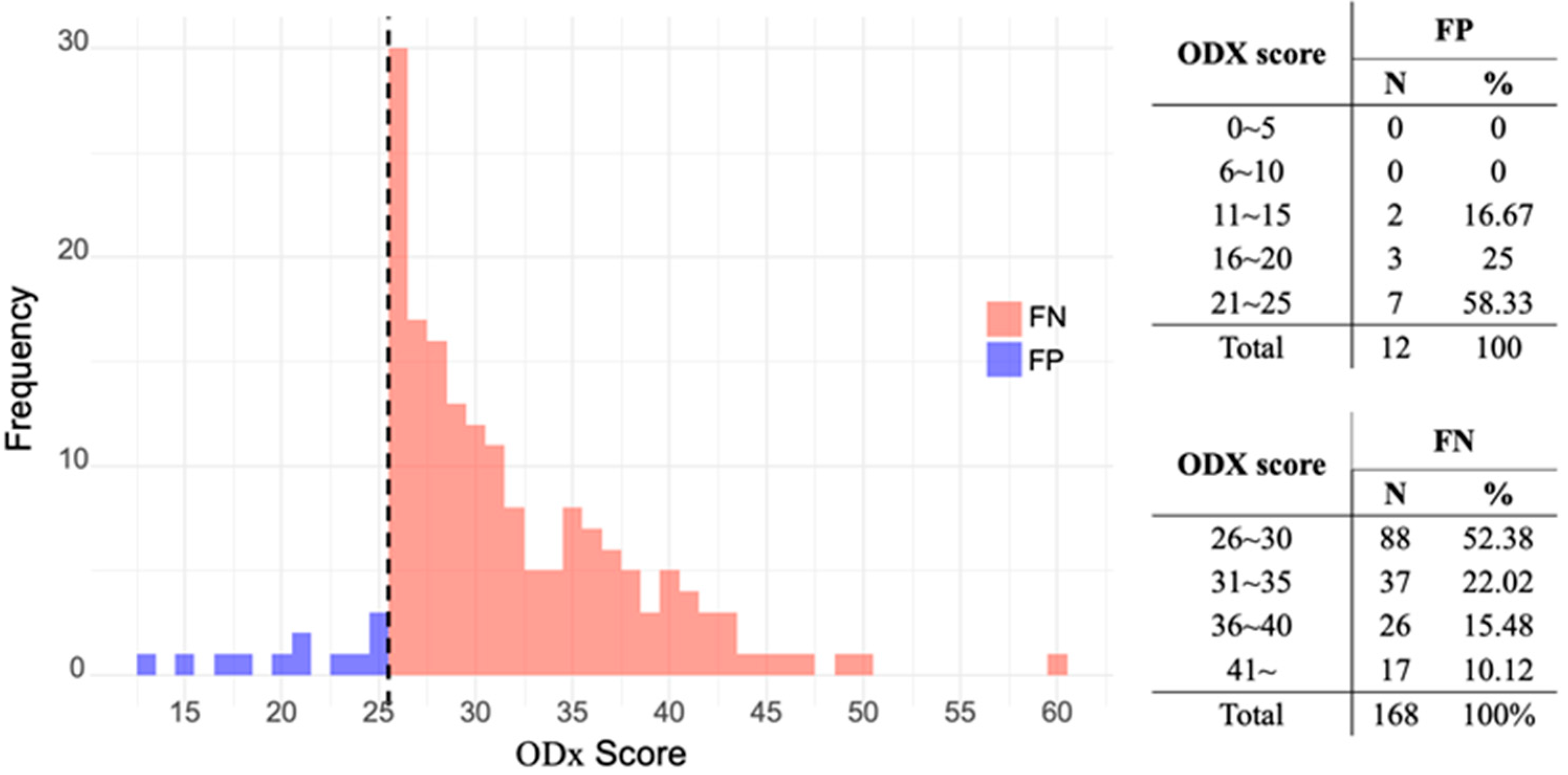
Breast cancer treatment decisions often rely on the Oncotype DX (ODX) test, which predicts the risk of cancer recurrence and the potential benefit of chemotherapy. However, this genetic test is expensive and not available to all patients worldwide. The Tennessee nomogram is a simpler, clinicopathology-based tool designed to approximate ODX results. We examined whether this nomogram could accurately predict ODX risk scores in Korean patients with early-stage, hormone receptor-positive, HER2-negative breast cancer. In our study of 1298 patients, the nomogram accurately predicted low-risk results for most individuals but underestimated risk in some patients with aggressive tumor features, such as high tumor grade, lack of progesterone receptor expression, and high Ki-67 levels. These patients were often assigned a low-risk score by the nomogram despite having high ODX scores, particularly in the borderline-high range (25–30). Our findings suggest that while the Tennessee nomogram may help guide treatment decisions when genetic testing is unavailable, clinicians should exercise caution when tumors exhibit aggressive characteristics and consider performing ODX testing to ensure optimal therapy selection.
Abstract
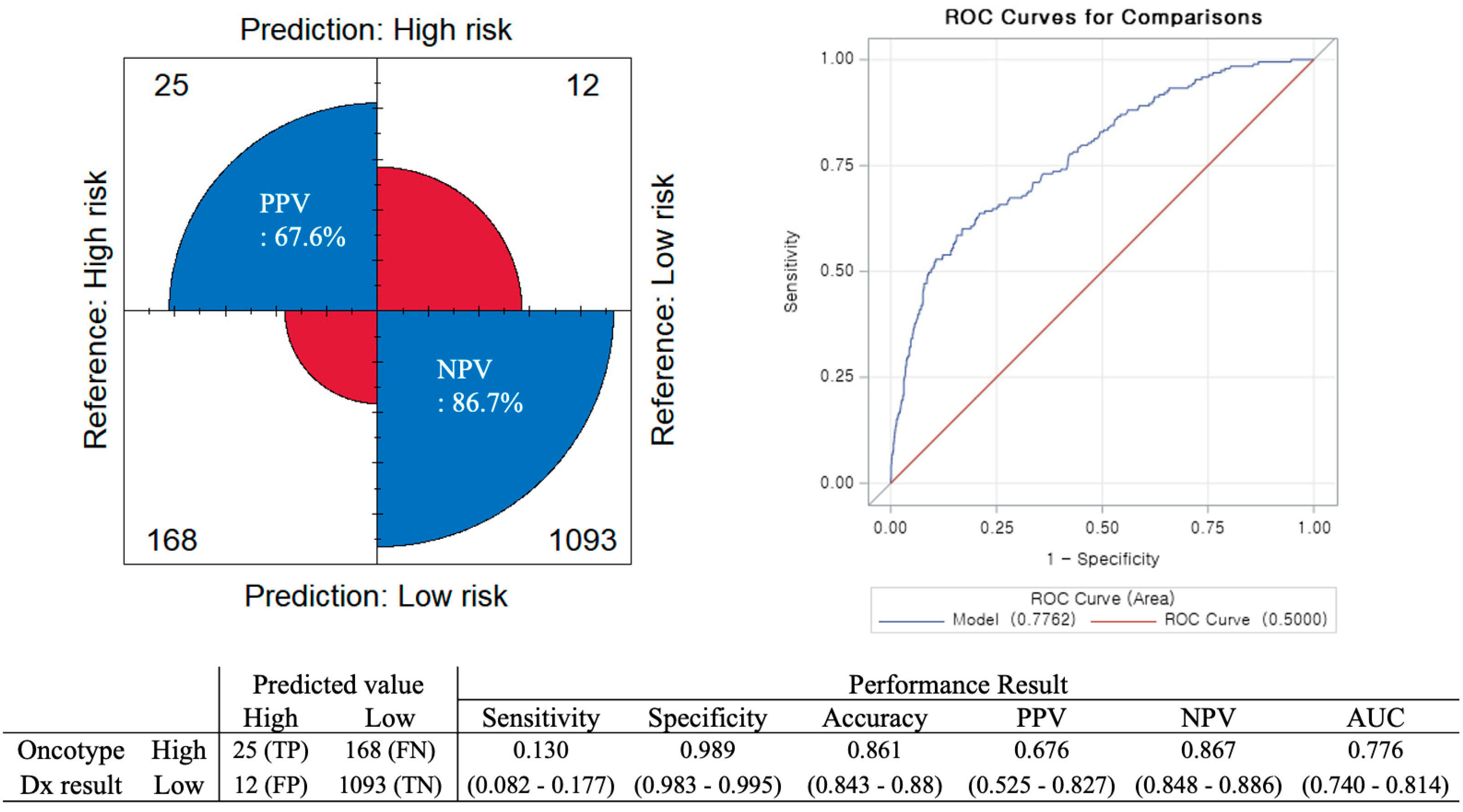
Background: Oncotype DX (ODX) is widely used to estimate recurrence risk and guide adjuvant therapy in hormone receptor-positive (HR+), HER2-negative early-stage breast cancer. However, limited accessibility and high costs have prompted the use of alternative clinical models, such as the Tennessee nomogram. This study aimed to validate the predictive performance of the Tennessee nomogram in a Korean breast cancer cohort and identify factors contributing to discrepancies between nomogram predictions and ODX results. Methods: We retrospectively analyzed data on1298 patients with HR+/HER2−, node-negative invasive breast cancer who underwent ODX testing between May 2013 and August 2023. Predictive probabilities were calculated using the Tennessee nomogram and compared with actual ODX recurrence scores. Sensitivity, specificity, accuracy, positive predictive value (PPV), negative predictive value (NPV), and area under the curve (AUC) were determined. Discordant cases were examined for clinicopathologic characteristics contributing to prediction errors. Results: The nomogram demonstrated an overall accuracy of 86.1% (sensitivity 0.130, specificity 0.989, AUC 0.776). Discordant results were observed in 13.9% of cases, primarily in patients with a high histologic grade, PR negativity, and elevated Ki-67 index. Most false negatives clustered within the ODX score range of 25–30, suggesting underestimation of risk in borderline-high cases. Conclusions: The Tennessee nomogram may be a useful surrogate when ODX testing is unavailable, but caution is warranted in patients with aggressive tumor biology. In such cases, ODX testing should be prioritized to guide adjuvant therapy decisions.
Keywords:
breast cancer; Korean population; Oncotype Dx; Tennessee nomogram; validation; discordance