High RAS Allele Frequency Signals Increased Risk of TERT Promoter Mutations in Thyroid Tumors

 , ,
, , 
 ,
,
Simple Summary
Abstract
1. Introduction
2. Materials and Methods
2.1. Patient Samples
2.2. Data Collection
2.3. Statistical Analysis
3. Results
4. Discussion
5. Conclusions
Author Contributions
Funding
Institutional Review Board Statement
Informed Consent Statement
Data Availability Statement
Acknowledgments
Conflicts of Interest
Abbreviations
| AF | Allele Frequency |
| CNA | Copy Number Alteration |
| CI | Confidence Interval |
| FTC | Follicular Thyroid Carcinoma |
| GEP | Gene Expression Profiling |
| NIFTP | Non-Invasive Follicular Thyroid Neoplasm with Papillary-like Nuclear Features |
| PTC | Papillary Thyroid Carcinoma |
| RAS | Rat Sarcoma Virus Oncogene Family |
| SD | Standard Deviation |
| TERT | Telomerase Reverse Transcriptase |
References
- Zhao, Q.; Chen, M.; Fu, L.; Yang, Y.; Zhan, Y. Assessing and Projecting the Global Burden of Thyroid Cancer, 1990–2030: Analysis of the Global Burden of Disease Study. J. Glob. Health 2024, 14, 04090. [Google Scholar] [CrossRef]
- National Cancer Institute. Surveillance, Epidemiology, and End Results Program. In Cancer of the Thyroid: Cancer Stat Facts Bethesda (MD); National Cancer Institute: Bethesda, MD, USA, 2025. Available online: https://seer.cancer.gov/statfacts/html/thyro.html (accessed on 3 July 2024).
- Nikiforov, Y.E.; Ohori, N.P.; Hodak, S.P.; Carty, S.E.; Lebeau, S.O.; Ferris, R.L.; Yip, L.; Seethala, R.R.; Tublin, M.E.; Stang, M.T.; et al. Impact of Mutational Testing on the Diagnosis and Management of Patients with Cytologically Indeterminate Thyroid Nodules: A Prospective Analysis of 1056 FNA Samples. J. Clin. Endocrinol. Metab. 2011, 96, 3390–3397. [Google Scholar] [CrossRef] [PubMed]
- Merdad, M. A contemporary look at thyroid nodule management. Saudi Med. J. 2020, 41, 123–127. [Google Scholar] [CrossRef]
- Nikiforov, Y.E. Molecular analysis of thyroid tumors. Mod. Pathol. 2011, 24, S34–S43. [Google Scholar] [CrossRef]
- Prete, A.; de Souza, P.B.; Censi, S.; Muzza, M.; Nucci, N.; Sponziello, M. Update on Fundamental Mechanisms of Thyroid Cancer. Front. Endocrinol. 2020, 11, 102. [Google Scholar] [CrossRef]
- Liu, C.; Chen, T.; Liu, Z. Associations between BRAFV600E and prognostic factors and poor outcomes in papillary thyroid carcinoma: A meta-analysis. World J. Surg. Oncol. 2016, 14, 241. [Google Scholar] [CrossRef]
- Liu, C.; Liu, Z.; Chen, T.; Zeng, W.; Guo, Y.; Huang, T. TERT promoter Mutation and Its Association with Clinicopathological Features and Prognosis of Papillary Thyroid Cancer: A Meta-analysis. Sci. Rep. 2016, 6, 36990. [Google Scholar] [CrossRef]
- Liu, R.; Xing, M. TERT promoter mutations in thyroid cancer. Endocr.-Relat. Cancer 2016, 23, R143–R155. [Google Scholar] [CrossRef] [PubMed]
- Murugan, A.K.; Grieco, M.; Tsuchida, N. RAS Mutations in Human Cancers: Roles in Precision Medicine. Semin. Cancer Biol. 2019, 59, 23–35. [Google Scholar] [CrossRef] [PubMed]
- Howell, G.M.; Hodak, S.P.; Yip, L. RAS Mutations in Thyroid Cancer. Oncologist 2013, 18, 926–932. [Google Scholar] [CrossRef]
- Hudson, T.J.; Pusztaszeri, M.P.; Hier, M.P.; Forest, V.-I.; Yang, J.-W.; Payne, R.J. Does the likelihood of malignancy in thyroid nodules with RAS mutations increase in direct proportion with the allele frequency percentage? J. Otolaryngol.—Head Neck Surg. 2023, 52, 12. [Google Scholar] [CrossRef]
- Nikiforov, Y.E.; Baloch, Z.W. Clinical validation of the ThyroSeq v3 genomic classifier in thyroid nodules with indeterminate FNA cytology. Cancer Cytopathol. 2019, 127, 225–230. [Google Scholar] [CrossRef]
- Bielo, L.B.; Trapani, D.; Repetto, M.; Crimini, E.; Valenza, C.; Belli, C.; Criscitiello, C.; Marra, A.; Subbiah, V.; Curigliano, G. Variant allele frequency: A decision-making tool in precision oncology? Trends Cancer 2023, 9, 1058–1068. [Google Scholar] [CrossRef]
- Pairawan, S.; Hess, K.R.; Janku, F.; Sanchez, N.S.; Shaw, K.R.M.; Eng, C.; Damodaran, S.; Javle, M.; Kaseb, A.O.; Hong, D.S.; et al. Cell-free Circulating Tumor DNA Variant Allele Frequency Associates with Survival in Metastatic Cancer. Clin. Cancer Res. 2019, 26, 1924–1931. [Google Scholar] [CrossRef]
- Huang, J.; Wang, J.; Xv, J.; Wang, J.; Wang, G.; Zhao, Y. Genetic Alterations and Allele Frequency of BRAF V600E and TERT Mutation in Papillary Thyroid Carcinoma with Intermediate-to-High Recurrence Risk: A Retrospective Study. Clin. Exp. Med. 2024, 24, 76. [Google Scholar] [CrossRef] [PubMed]
- Abdulhaleem, M.; Bandargal, S.; Pusztaszeri, M.P.; Rajab, M.; Greenspoon, H.; Krasner, J.R.; Da Silva, S.D.; Forest, V.-I.; Payne, R.J. The Impact of BRAF V600E Mutation Allele Frequency on the Histopathological Characteristics of Thyroid Cancer. Cancers 2023, 16, 113. [Google Scholar] [CrossRef] [PubMed]
- Nikiforova, M.N.; Mercurio, S.; Wald, A.I.; Barbi de Moura, M.; Callenberg, K.; Santana-Santos, L.; Gooding, W.E.; Yip, L.; Ferris, R.L.; Nikiforov, Y.E. Analytical Performance of the ThyroSeq v3 Genomic Classifier for Cancer Diagnosis in Thyroid Nodules. Cancer 2018, 124, 1682–1690. [Google Scholar] [CrossRef] [PubMed]
- Song, Y.S.; Park, Y.J. Genomic Characterization of Differentiated Thyroid Carcinoma. Endocrinol. Metab. 2019, 34, 1–10. [Google Scholar] [CrossRef]
- Kim, H.; Park, G.; Kim, M.K.; Oh, Y.L.; Kim, T.H.; Shin, J.H.; Hahn, S.Y. Prognostic significance of clinicopathological and ultrasonographic features in anaplastic thyroid carcinoma beyond TERT promoter mutation. Sci. Rep. 2025, 15, 11736. [Google Scholar] [CrossRef]
- Colombo, C.; Muzza, M.; Proverbio, M.C.; Tosi, D.; Soranna, D.; Pesenti, C.; Rossi, S.; Cirello, V.; De Leo, S.; Fusco, N.; et al. Impact of Mutation Density and Heterogeneity on Papillary Thyroid Cancer Clinical Features and Remission Probability. Thyroid 2019, 29, 237–251. [Google Scholar] [CrossRef]
- Wang, Z.; Tang, P.; Hua, S.; Gao, J.; Zhang, B.; Wan, H.; Wu, Q.; Zhang, J.; Chen, G. Genetic and Clinicopathologic Characteristics of Papillary Thyroid Carcinoma in the Chinese Population: High BRAF Mutation Allele Frequency, Multiple Driver Gene Mutations, and RET Fusion May Indicate More Advanced TN Stage. OncoTargets Ther. 2022, 15, 147–157. [Google Scholar] [CrossRef]
- Goffredo, P.; Cheung, K.; Roman, S.A.; Sosa, J.A. Can Minimally Invasive Follicular Thyroid Cancer be Approached as a Benign Lesion? Ann. Surg. Oncol. 2012, 20, 767–772. [Google Scholar] [CrossRef]
- Lo, C.-Y.; Chan, W.-F.; Lam, K.-Y.; Wan, K.-Y. Follicular Thyroid Carcinoma. Ann. Surg. 2005, 242, 708–715. [Google Scholar] [CrossRef]
- Harahap, A.S.; Roren, R.S.; Imtiyaz, S. A Comprehensive Review and Insights into the New Entity of Differentiated High-Grade Thyroid Carcinoma. Curr. Oncol. 2024, 31, 3311–3328. [Google Scholar] [CrossRef] [PubMed]
- de Berker, A.O.; Rutledge, R.B.; Mathys, C.; Marshall, L.; Cross, G.F.; Dolan, R.J.; Bestmann, S. Computations of uncertainty mediate acute stress responses in humans. Nat. Commun. 2016, 7, 10996. [Google Scholar] [CrossRef] [PubMed]
- Folkman, S.; Lazarus, R.S.; Gruen, R.J.; DeLongis, A. Appraisal, coping, health status, and psychological symptoms. J. Pers. Soc. Psychol. 1986, 50, 571–579. [Google Scholar] [CrossRef] [PubMed]
- Insilla, A.C.; Proietti, A.; Borrelli, N.; Macerola, E.; Niccoli, C.; Vitti, P.; Miccoli, P.; Basolo, F. TERT promoter mutations and their correlation with BRAF and RAS mutations in a consecutive cohort of 145 thyroid cancer cases. Oncol. Lett. 2018, 15, 2763–2770. [Google Scholar] [CrossRef]
- Tan, G.; Jin, B.; Qian, X.; Wang, Y.; Zhang, G.; Agyekum, E.A.; Wang, F.; Shi, L.; Zhang, Y.; Mao, Z.; et al. TERT promoter mutations contribute to adverse clinical outcomes and poor prognosis in radioiodine refractory differentiated thyroid cancer. Sci. Rep. 2024, 14, 23719. [Google Scholar] [CrossRef]
- Patel, N.M.; Jo, H.; Eberhard, D.A.; Yin, X.; Hayward, M.C.; Stein, M.K.; Hayes, D.N.; Grilley-Olson, J.E. Improved Tumor Purity Metrics in Next-Generation Sequencing for Clinical Practice: The Integrated Interpretation of Neoplastic Cellularity and Sequencing Results (IINCaSe) Approach. Appl. Immunohistochem. Mol. Morphol. 2019, 27, 764–772. [Google Scholar] [CrossRef]
- Sisoudiya, S.D.; Tukachinsky, H.; Keller-Evans, R.B.; Schrock, A.B.; Sokol, E.S.; Huang, R.S.P.; Gjoerup, O.; Pishvaian, M.J.; Frampton, G.M.; Sivakumar, S.; et al. Tissue-based genomic profiling of 300,000 tumors highlights the detection of variants with low allele fraction. Nat. Cancer 2025, 1, 648–660. [Google Scholar] [CrossRef]


| Variant | RAS + TERT Co-Mutation (%) (n = 7) | RAS Mutation Only (%) (n = 104) | p-Value |
|---|---|---|---|
| Age (years) | |||
| mean ± SD * (CI) | 56.4 ± 9.4 (95% CI: 47.8–65.1) | 49.8 ± 13.2 (95% CI: 47.2–52.4) | 0.118 |
| Sex | |||
| Female | 5 (71.4) | 86 (82.7) | 0.607 |
| Male | 2 (28.6) | 18 (17.3) | |
| Nodule size (cm) | |||
| mean ± SD * (CI) | 3.7 ± 1.1 (95% CI: 2.6–4.7) | 2.4 ± 1.1 (95% CI: 2.2–2.6) | 0.005 |
| Variant | RAS + TERT Co-Mutation (%) (n = 7) | RAS Mutation Only (%) (n = 104) | p-Value |
|---|---|---|---|
| Bethesda Category | 0.065 | ||
| Bethesda III | 2 (28.6) | 55 (52.9) | |
| Bethesda IV | 5 (71.4) | 31 (29.8) | |
| Bethesda V | 0 (0) | 18 (17.3) | |
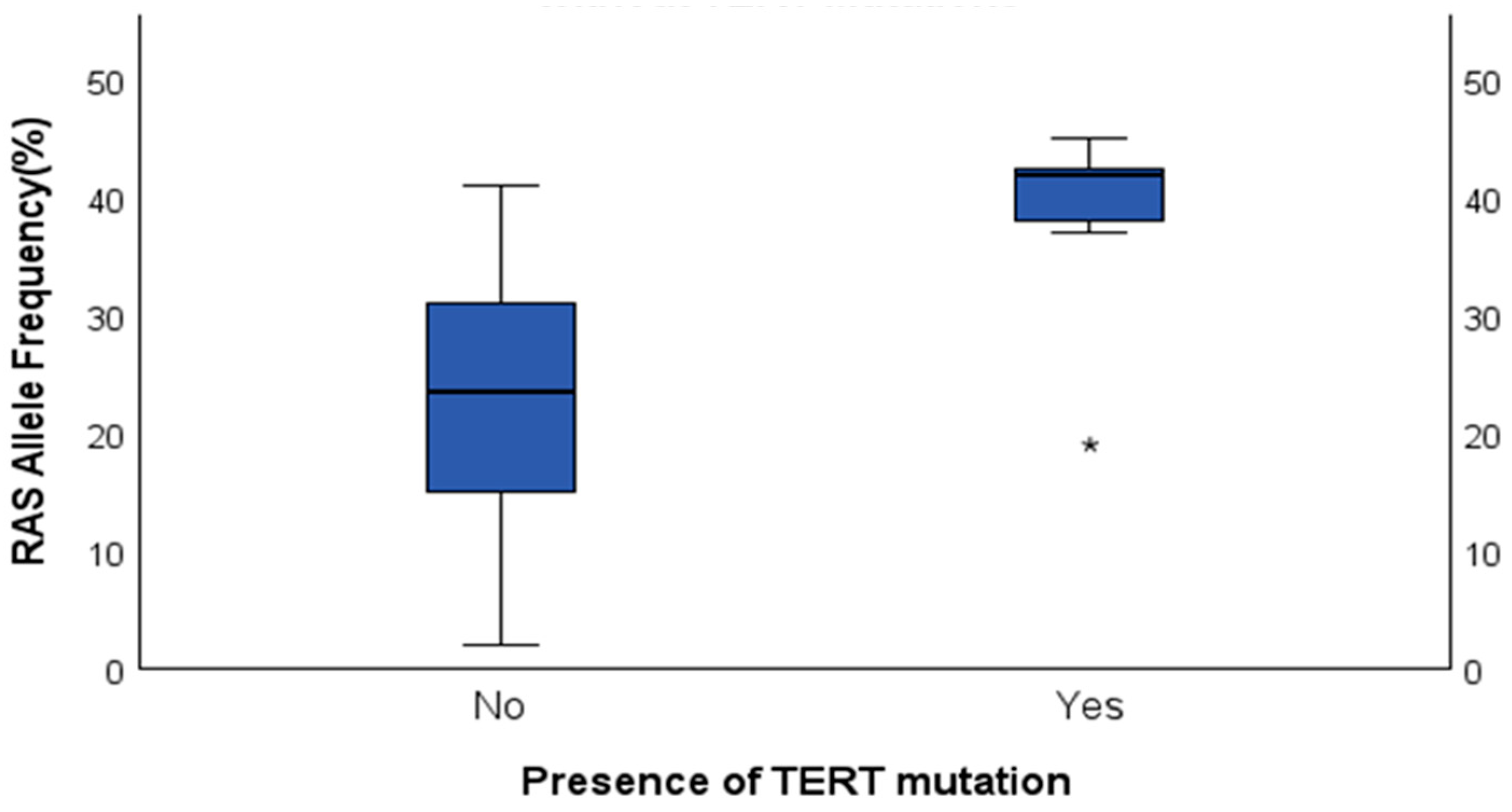
| AF (%) of RAS Mean ± SD | 38.1 ± 8.8 | 22.1 ± 10.6 | 0.002 |
| Pathology | 0.591 | ||
| Benign | 0 (0) | 15 (14.4) | |
| Malignant/NIFTP * | 7 (100.0) | 89 (85.6) |
| Molecular Alterations | RAS + TERT Co-Mutation (%) (n = 7) | RAS Mutation Only (%) (n = 104) | p-Value |
|---|---|---|---|
| GEP(%) | 0.002 | ||
| Yes | 7 (100.0) | 39 (37.5) | |
| No | 0 (0) | 65 (62.5) | |
| CNA(%) | 0.643 | ||
| Yes | 2 (28.6) | 22 (21.2) | |
| No | 5 (71.4) | 82 (78.8) |
| Groups | Average RAS AF (%) | Standard Deviation (SD) | n | p-Value (ANOVA) |
|---|---|---|---|---|
| TERT and GEP comparison | <0.001 | |||
| TERT+/GEP+ | 38.1 | 8.8 | 7 | |
| TERT+/GEP− | - | - | 0 | |
| TERT−/GEP+ | 24.3 | 9.2 | 39 | |
| TERT−/GEP− | 20.7 | 11.1 | 65 | |
| TERT and CNA comparison | <0.001 | |||
| TERT+/CNA+ | 43.5 | 2.1 | 2 | |
| TERT+/CNA− | 36.0 | 9.8 | 5 | |
| TERT−/CNA+ | 30.1 | 6.9 | 22 | |
| TERT−/CNA− | 19.9 | 10.4 | 82 | |
| Pathology and TERT | <0.001 | |||
| TERT+/Benign | - | - | 0 | |
| TERT+/Malignant | 38.1 | 8.8 | 7 | |
| TERT−/Benign | 16.3 | 10.5 | 15 | |
| TERT−/Malignant | 23.0 | 10.3 | 89 | |
| Isoform pattern of RAS | 0.018 | |||
| HRAS | 21.4 | 10.9 | 25 | |
| NRAS | 25.0 | 10.4 | 71 | |
| KRAS | 16.6 | 12.6 | 15 |
| Type of Thyroid Cancer | Average RAS AF (%) of Patients | Standard Deviation (SD) | n | p-Values |
|---|---|---|---|---|
| Follicular thyroid carcinoma (FTC) | 30.8 | 12.3 | 5 | 0.104 |
| Papillary Thyroid Carcinoma (PTC) | 22.5 | 10.9 | 105 |
| Groups | Average RAS AF (%) of Patients with RAS + TERT Co-Mutation | Average RAS AF (%) of Patients with RAS Mutation Only | Standard Deviation (SD) | n | p-Values |
|---|---|---|---|---|---|
| Subtype of FTC | |||||
| Widely invasive FTC | 42.0 | - | N/A | 1 | N/A * |
| Minimally invasive FTC | 28.0 | 28.0 | 12.3 | 4 | |
| Subtypes of PTC/NIFTP | |||||
| NIFTP | - | 23.0 | 9.2 | 19 | |
| FVPTC | - | 24.1 | 10.0 | 44 | |
| Invasive FVPTC | - | 22.3 | 11.5 | 12 | |
| Differentiated high-grade FVPTC | 42.0 | - | N/A | 1 | |
| Oncocytic | 45.0 | 11.3 | 18.2 | 4 | |
| Classical | - | 35.0 | N/A | 1 | |
| Solid/Trabecular | - | 25.5 | 21.9 | 2 | |
| Macrofollicular | - | 19.0 | 14.1 | 3 | |
| Well-differentiated thyroid carcinoma (not otherwise specified) | - | 16.0 | N/A | 1 | N/A * |
| Papillary microcarcinoma | - | 10.0 | N/A | 1 | |
| PTC in adenomatoid nodule | - | 25.0 | N/A | 1 | |
| Benign pathology | |||||
| Follicular nodular disease | - | 12.3 | 11.2 | 6 | N/A * |
| Follicular adenoma | - | 17.8 | 9.9 | 6 | |
| Oncocytic adenoma | - | 21.0 | 11.4 | 3 |
Disclaimer/Publisher’s Note: The statements, opinions and data contained in all publications are solely those of the individual author(s) and contributor(s) and not of MDPI and/or the editor(s). MDPI and/or the editor(s) disclaim responsibility for any injury to people or property resulting from any ideas, methods, instructions or products referred to in the content. |
© 2025 by the authors. Licensee MDPI, Basel, Switzerland. This article is an open access article distributed under the terms and conditions of the Creative Commons Attribution (CC BY) license (https://creativecommons.org/licenses/by/4.0/).
Share and Cite
Lefebvre, C.; Greenspoon, H.; Payne, K.E.; Steinberg, E.; Tewfik, F.; Savoia, G.; da Silva, S.D.; Pusztaszeri, M.; Forest, V.-I.; Payne, R.J. High RAS Allele Frequency Signals Increased Risk of TERT Promoter Mutations in Thyroid Tumors. Cancers 2025, 17, 2851. https://doi.org/10.3390/cancers17172851
Lefebvre C, Greenspoon H, Payne KE, Steinberg E, Tewfik F, Savoia G, da Silva SD, Pusztaszeri M, Forest V-I, Payne RJ. High RAS Allele Frequency Signals Increased Risk of TERT Promoter Mutations in Thyroid Tumors. Cancers. 2025; 17(17):2851. https://doi.org/10.3390/cancers17172851
Chicago/Turabian StyleLefebvre, Coralie, Hannah Greenspoon, Kayla E. Payne, Emily Steinberg, Felicia Tewfik, Gianluca Savoia, Sabrina Daniela da Silva, Marc Pusztaszeri, Véronique-Isabelle Forest, and Richard J. Payne. 2025. "High RAS Allele Frequency Signals Increased Risk of TERT Promoter Mutations in Thyroid Tumors" Cancers 17, no. 17: 2851. https://doi.org/10.3390/cancers17172851
APA StyleLefebvre, C., Greenspoon, H., Payne, K. E., Steinberg, E., Tewfik, F., Savoia, G., da Silva, S. D., Pusztaszeri, M., Forest, V.-I., & Payne, R. J. (2025). High RAS Allele Frequency Signals Increased Risk of TERT Promoter Mutations in Thyroid Tumors. Cancers, 17(17), 2851. https://doi.org/10.3390/cancers17172851