Deep Learning for Melanoma Detection: A Deep Learning Approach to Differentiating Malignant Melanoma from Benign Melanocytic Nevi
by
 , , , , , , and
Magdalini Kreouzi
1, 
Nikolaos Theodorakis
2,3,4,5 ,
,
Georgios Feretzakis
5 ,
,
Evgenia Paxinou
5,
Aikaterini Sakagianni
6,
Dimitris Kalles
5 ,
,
Athanasios Anastasiou
7,
Vassilios S. Verykios
5,* and
Maria Nikolaou
3 1
Department of Internal Medicine & 65+ Clinic, Amalia Fleming General Hospital, 14, 25th Martiou Str., 15127 Melissia, Greece
2
NT-CardioMetabolics, Clinic for Metabolism and Athletic Performance, 47 Tirteou Str., 17564 Palaio Faliro, Greece
3
65+ Outpatient Clinic, Amalia Fleming General Hospital, 14, 25th Martiou Str., 15127 Melissia, Greece
4
School of Medicine, National and Kapodistrian University of Athens, 75 Mikras Asias, 11527 Athens, Greece
5
School of Science and Technology, Hellenic Open University, 18 Aristotelous Str., 26335 Patras, Greece
6
Intensive Care Unit, Sismanogelio General Hospital, 37 Sismanogleiou Str., 15126 Marousi, Greece
7
Biomedical Engineering Laboratory, National Technical University of Athens, 15773 Athens, Greece
*
Author to whom correspondence should be addressed.
Cancers 2025, 17(1), 28; https://doi.org/10.3390/cancers17010028
Submission received: 29 November 2024
/
Revised: 21 December 2024
/
Accepted: 23 December 2024
/
Published: 25 December 2024
(This article belongs to the Special Issue Application of Biostatistics in Cancer Research)
Simple Summary
Melanoma is a dangerous type of skin cancer that can grow quickly and spread to other parts of the body, making early detection and diagnosis essential for saving lives. However, it can be difficult to tell the difference between melanoma and harmless skin spots, even for experts. This study explores how advanced computer technologies called convolutional neural networks (CNNs) can help detect melanoma more accurately. These systems analyze skin images and identify patterns that indicate whether a spot is likely to be cancerous. We compared four different types of CNN to find the best balance between accuracy and efficiency. Our findings show that some models are not only highly accurate but also fast and lightweight, making them suitable for use in clinics or even on mobile devices. This research highlights the potential of artificial intelligence to assist doctors and improve early melanoma detection, ultimately saving more lives.
Abstract
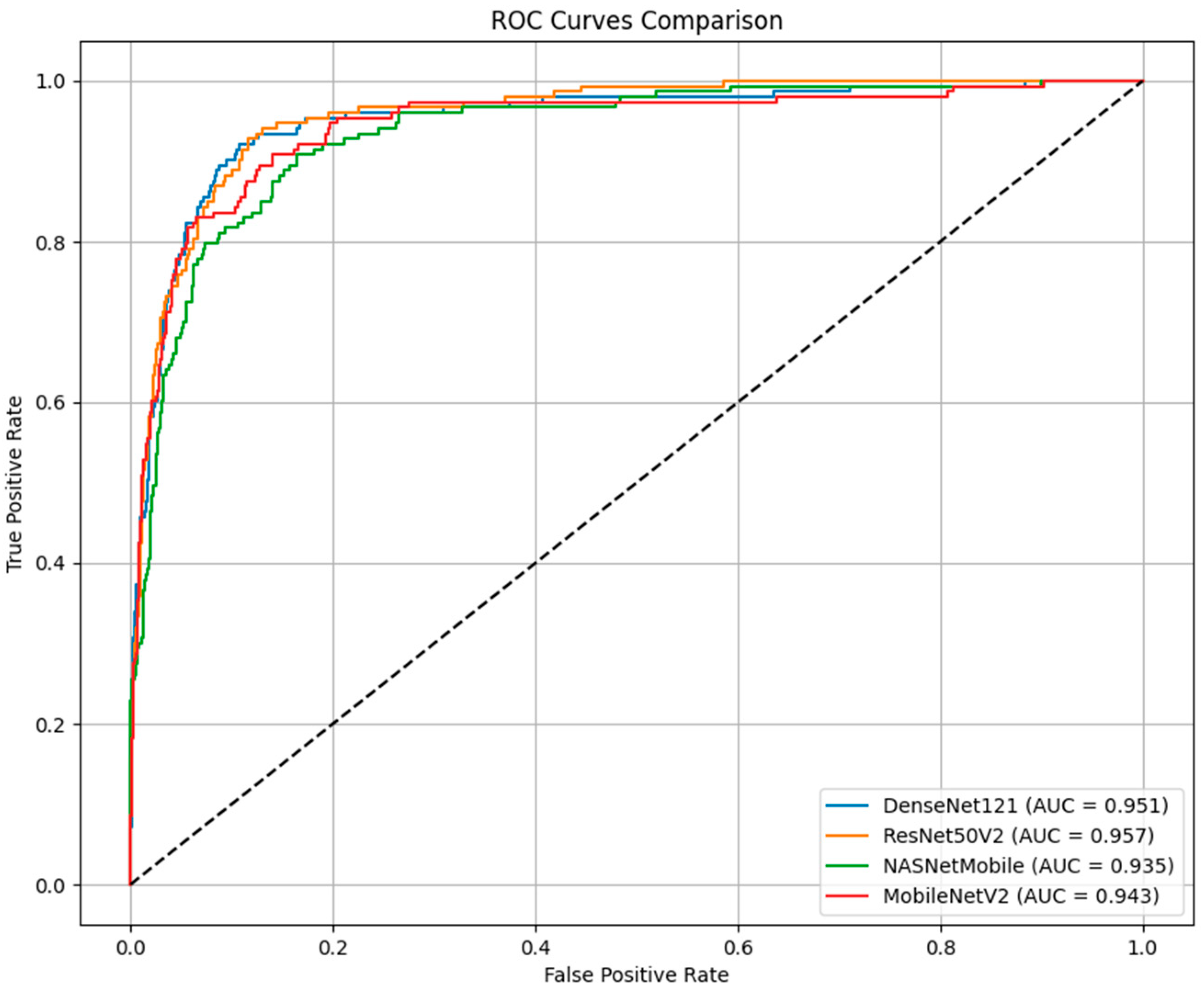
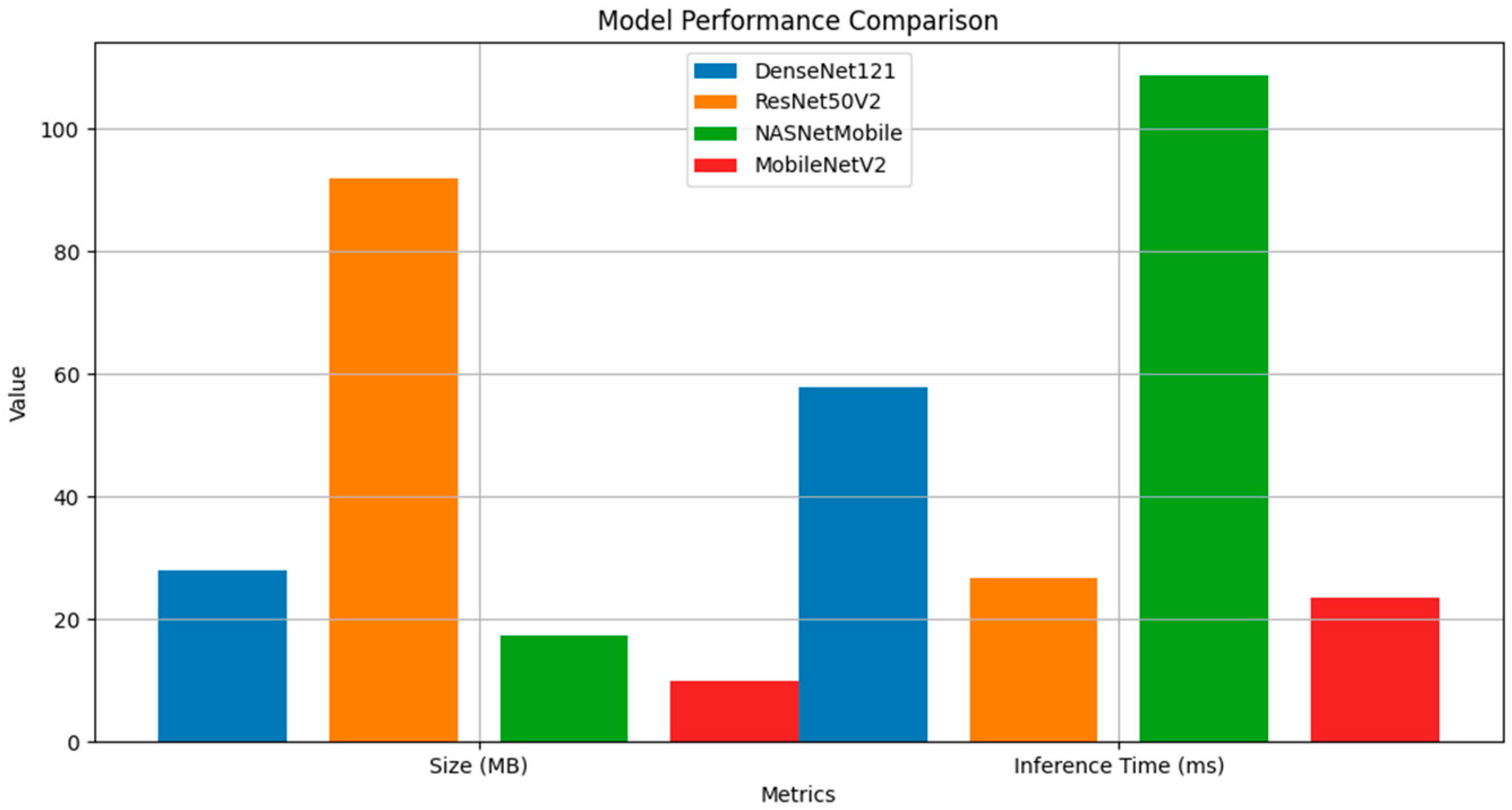
Background/Objectives: Melanoma, an aggressive form of skin cancer, accounts for a significant proportion of skin-cancer-related deaths worldwide. Early and accurate differentiation between melanoma and benign melanocytic nevi is critical for improving survival rates but remains challenging because of diagnostic variability. Convolutional neural networks (CNNs) have shown promise in automating melanoma detection with accuracy comparable to expert dermatologists. This study evaluates and compares the performance of four CNN architectures—DenseNet121, ResNet50V2, NASNetMobile, and MobileNetV2—for the binary classification of dermoscopic images. Methods: A dataset of 8825 dermoscopic images from DermNet was standardized and divided into training (80%), validation (10%), and testing (10%) subsets. Image augmentation techniques were applied to enhance model generalizability. The CNN architectures were pre-trained on ImageNet and customized for binary classification. Models were trained using the Adam optimizer and evaluated based on accuracy, area under the receiver operating characteristic curve (AUC-ROC), inference time, and model size. The statistical significance of the differences was assessed using McNemar’s test. Results: DenseNet121 achieved the highest accuracy (92.30%) and an AUC of 0.951, while ResNet50V2 recorded the highest AUC (0.957). MobileNetV2 combined efficiency with competitive performance, achieving a 92.19% accuracy, the smallest model size (9.89 MB), and the fastest inference time (23.46 ms). NASNetMobile, despite its compact size, had a slower inference time (108.67 ms), and slightly lower accuracy (90.94%). Performance differences among the models were statistically significant (p < 0.0001). Conclusions: DenseNet121 demonstrated a superior diagnostic performance, while MobileNetV2 provided the most efficient solution for deployment in resource-constrained settings. The CNNs show substantial potential for improving melanoma detection in clinical and mobile applications.