Real-World Outcome of Treatment with Single-Agent Ibrutinib in Italian Patients with Chronic Lymphocytic Leukemia: Final Results of the EVIdeNCE Study
by
 , , , , , , , , , , , , , add
Show full author list
, , , , , , , , , , , , , add
Show full author list
Francesca Romana Mauro
1 ,
,
Potito Rosario Scalzulli
2,
Lydia Scarfò
3,4,
Carla Minoia
5,
Roberta Murru
6,
Paolo Sportoletti
7,
Ferdinando Frigeri
8,
Francesco Albano
9 ,
,
Nicola Di Renzo
10,
Alessandro Sanna
11,
Luca Laurenti
12,
Massimo Massaia
13,14,
Ramona Cassin
15,
Marta Coscia
14,16 ,
,
Caterina Patti
17,
Elsa Pennese
18,
Agostino Tafuri
19, 
Annalisa Chiarenza
20,
Piero Galieni
21,
Omar Perbellini
22,
Carmine Selleri
23,
Catello Califano
24,
Felicetto Ferrara
25,
Antonio Cuneo
26 ,
,
Marco Murineddu
27,
Gaetano Palumbo
28,
Ilaria Scortechini
29,
Alessandra Tedeschi
30,
Livio Trentin
31,
Marzia Varettoni
32,
Fabrizio Pane
33,
Anna Marina Liberati
34,
Francesco Merli
35,
Lucia Morello
36,
Gerardo Musuraca
37,
Monica Tani
38,
Adalberto Ibatici
39,
Giulia Regazzoni
40,
Michele Di Candia
40,
Maria Palma
40,*,
Danilo Arienti
40 and
Stefano Molica
41,42 add
Show full author list
add
Show full author list
1
Ematologia, Sapienza Università di Roma, 00185 Roma, Italy
2
Ospedale “Casa Sollievo della Sofferenza”, 71013 San Giovanni Rotondo, Italy
3
Università Vita-Salute San Raffaele, 20132 Milano, Italy
4
IRCCS Ospedale San Raffaele, 20132 Milano, Italy
5
Hematology Unit, IRCCS Istituto Tumori “Giovanni Paolo II”, 70124 Bari, Italy
6
Hematology and Stem Cell Transplantation Unit, Ospedale Oncologico A. Businco, ARNAS G. Brotzu, 09134 Cagliari, Italy
7
Sezione di Ematologia, Università degli Studi di Perugia, 06123 Perugia, Italy
8
AORN “Sant’Anna e San Sebastiano”, 81100 Caserta, Italy
9
Hematology and Stem Cell Transplantation Unit, Department of Precision and Regenerative Medicine and Ionian Area (DiMePRe-J), University of Bari “Aldo Moro”, 70121 Bari, Italy
10
UOC Ematologia e Trapianto di Cellule Staminali-PO “Vito Fazzi” ASL Lecce, 73100 Lecce, Italy
11
AOU Careggi, 50121 Firenze, Italy
12
Policlinico A. Gemelli, 00168 Roma, Italy
13
SC Ematologia-AO S. Croce e Carle, 12100 Cuneo, Italy
14
Dipartimento di Biotecnologie Molecolari e Scienze per la Salute, Università degli Studi di Torino, 10124 Torino, Italy
15
Fondazione IRCCS Cà Granda Ospedale Maggiore Policlinico of Milan, 20122 Milano, Italy
16
SC Ematologia U, AOU Città della Salute e della Scienza di Torino, 10126 Torino, Italy
17
UOC Oncoematologia, Ospedali Riuniti Villa Sofia-Cervello, 90146 Palermo, Italy
18
UOC Ematologia Clinica, ASL Pescara, 65124 Pescara, Italy
19
Ematologia, AOU Sant’Andrea, Sapienza Università di Roma, 00185 Roma, Italy
20
UOC Ematologia, AOU Policlinico G.Rodolico-San Marco, 95123 Catania, Italy
21
UOC Ematologia e Terapia Cellulare, Ospedale Mazzoni, 63100 Ascoli Piceno, Italy
22
UOC Ematologia, Azienda ULSS 8 Berica, 36100 Vicenza, Italy
23
Hematology and Bone Marrow Transplant Center, Department of Medicine and Surgery, University of Salerno, 84081 Salerno, Italy
24
UOC Ematologia, PO Andrea Tortora-Pagani, 84016 Pagani, Italy
25
AORN Antonio Cardarelli, 80131 Napoli, Italy
26
Department of Medical Science, Università degli Studi di Ferrara, 44121 Ferrara, Italy
27
Ematologia, Ospedale San Francesco ASL Nuoro, 08100 Nuoro, Italy
28
SC Ematologia, AOU Policlinico Foggia, 71122 Foggia, Italy
29
Azienda Ospedaliero Universitaria delle Marche, 60126 Ancona, Italy
30
Divisione di Ematologia, ASST GOM Niguarda, 20162 Milano, Italy
31
Dipartimento di Medicina, UOC Ematologia, Università di Padova, 35122 Padova, Italy
32
Divisione di Ematologia, Fondazione IRCCS Policlinico San Matteo, 27100 Pavia, Italy
33
Division of Hematology, Department of Clinical Medicine and Surgery, Università di Napoli Federico II, 80131 Napoli, Italy
34
AO Santa Maria, Università degli Studi Di Perugia, 05100 Terni, Italy
35
Ematologia AUSL-IRCCS Reggio Emilia, 42123 Reggio Emilia, Italy
36
IRCCS Humanitas Research Hospital-Humanitas Cancer Center, 20089 Rozzano, Italy
37
IRCCS Istituto Romagnolo per lo Studio dei Tumori (IRST) “Dino Amadori”, 47014 Meldola, Italy
38
Haematology Unit, Ospedale S. Maria delle Croci, 48121 Ravenna, Italy
39
IRCCS Ospedale Policlinico San Martino, 16132 Genova, Italy
40
Johnson & Johnson Innovative Medicine, 20126 Milano, Italy
41
Dipartimento Onco-Ematologico, Azienda Ospedaliera Pugliese-Ciaccio, 88100 Catanzaro, Italy
42
Queens Centre for Oncology and Haematology, Castle Hill Hospital, Hull University NHS Trust, Hull HU16 5JQ, UK
*
Author to whom correspondence should be addressed.
Cancers 2024, 16(6), 1228; https://doi.org/10.3390/cancers16061228
Submission received: 21 January 2024
/
Revised: 7 March 2024
/
Accepted: 15 March 2024
/
Published: 20 March 2024
(This article belongs to the Special Issue Advances in Chronic Lymphocytic Leukemia Microenvironment: The Disruption of the Supportive Leukemic/Accessory Cells Interactions to Improve Therapy Response)
Simple Summary
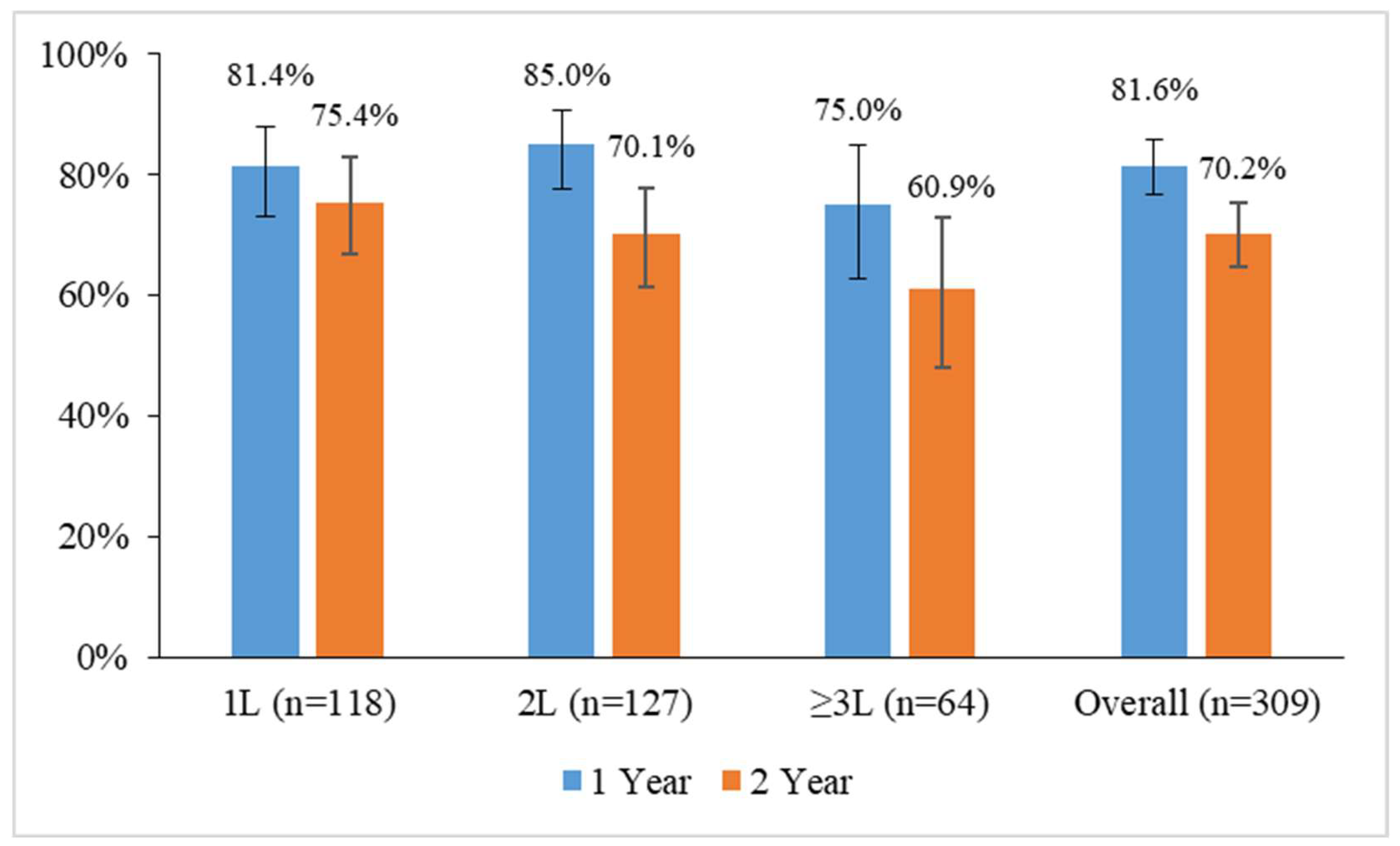
In clinical trials, ibrutinib was found to be effective and well-tolerated in patients with chronic lymphocytic leukemia (CLL). To confirm these findings, data on unselected patients treated in clinical practice are necessary. The aim of our observational, prospective Italian cohort study was to describe the real-world persistence rate, patterns of use, and clinical outcomes in patients with CLL treated with single-agent ibrutinib across various treatment lines. We found that, despite the high burden of patient comorbidities and unfavorable genetic features, the majority of patients (217/309, 70%), especially those treated in first line (75%), continued ibrutinib treatment for ≥2 years. The most common reasons for treatment discontinuation were adverse events, primarily infections. We reported positive clinical and survival outcomes, especially in the first-line cohort, and a safety profile consistent with clinical trial data. Our data suggest that ibrutinib is a valuable option for both treatment-naïve and previously treated patients with CLL.
Abstract
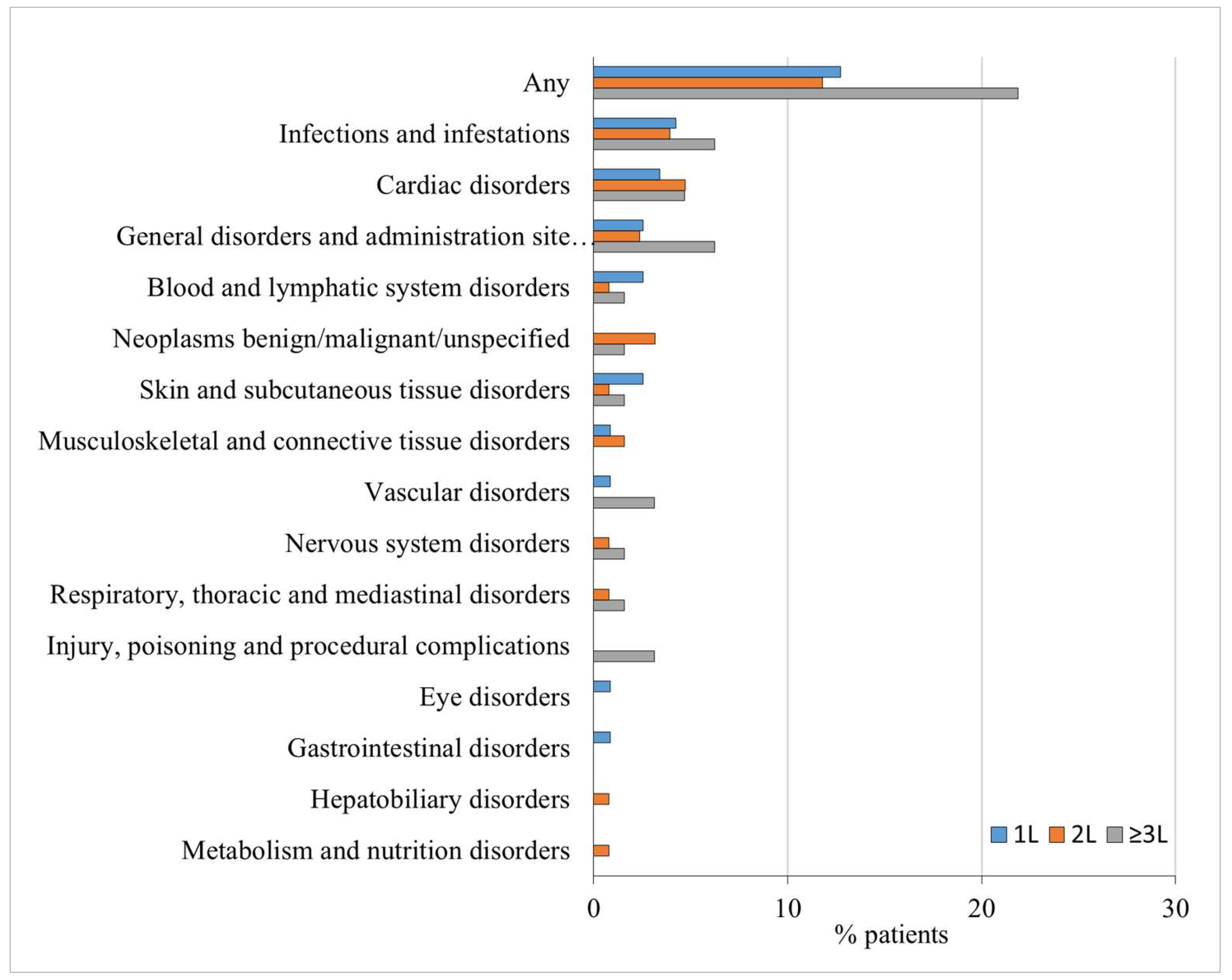
Real-world data in clinical practice are needed to confirm the efficacy and safety that ibrutinib has demonstrated in clinical trials of patients with chronic lymphocytic leukemia (CLL). We described the real-world persistence rate, patterns of use, and clinical outcomes in 309 patients with CLL receiving single-agent ibrutinib in first line (1L, n = 118), 2L (n = 127) and ≥3L (n = 64) in the prospective, real-world, Italian EVIdeNCE study. After a median follow-up of 23.9 months, 29.8% of patients discontinued ibrutinib (1L: 24.6%, 2L: 29.9%, ≥3L: 39.1%), mainly owing to adverse events (AEs)/toxicity (14.2%). The most common AEs leading to discontinuation were infections (1L, ≥3L) and cardiac events (2L). The 2-year retention rate was 70.2% in the whole cohort (1L: 75.4%, 2L: 70.1%, ≥3L: 60.9%). The 2-year PFS and OS were, respectively, 85.4% and 91.7% in 1L, 80.0% and 86.2% in 2L, and 70.1% and 80.0% in ≥3L. Cardiovascular conditions did not impact patients’ clinical outcomes. The most common AEs were infections (30.7%), bleeding (12.9%), fatigue (10.0%), and neutropenia (9.7%), while grade 3–4 atrial fibrillation occurred in 3.9% of patients. No new safety signals were detected. These results strongly support ibrutinib as a valuable treatment option for CLL.