Detection of Germline Mutations in a Cohort of 250 Relatives of Mutation Carriers in Multigene Panel: Impact of Pathogenic Variants in Other Genes beyond BRCA1/2
by
 ,
,
Sara Di Rado
1,†,
Roberta Giansante
1,2,†,
Michela Cicirelli
1,2,
Lucrezia Pilenzi
1,
Anastasia Dell’Elice
1,*,
Federico Anaclerio
1,
Martina Rimoldi
3,
Antonino Grassadonia
1,4,
Simona Grossi
5,
Nicole Canale
5,
Patrizia Ballerini
1,
Liborio Stuppia
1 and
Ivana Antonucci
1 1
Center for Advanced Studies and Technology (CAST), “G. D’Annunzio” University of Chieti-Pescara, 66100 Chieti, Italy
2
Department of Medical Genetics, “G. D’Annunzio” University of Chieti-Pescara, 66100 Chieti, Italy
3
SD Genetica Medica, IRCCS Fondazione Ca’Granda Ospedale Maggiore Policlinico, 20122 Milano, Italy
4
Department of Innovative Technologies in Medicine and Dentistry, “G. D’Annunzio” University of Chieti-Pescara, 66100 Chieti, Italy
5
U.O.C. Chirurgia Generale ad Indirizzo Senologico, Eusoma Breast Center ASL2 Abruzzo, 66026 Ortona, Italy
*
Author to whom correspondence should be addressed.
†
These authors have contributed equally to this work.
Cancers 2023, 15(24), 5730; https://doi.org/10.3390/cancers15245730
Submission received: 13 October 2023
/
Revised: 20 November 2023
/
Accepted: 4 December 2023
/
Published: 6 December 2023
(This article belongs to the Section Cancer Causes, Screening and Diagnosis)
Simple Summary
During the last few decades, the basis for a genetic predisposition for several cancer syndromes has been clarified, and the highly penetrant/high-risk genes mutated in familial cases are currently subjected to genetic diagnostic screening programs. Mutation testing in these genes has a major impact on genetic counseling, defines the prognosis of carriers, identifies the most appropriate and personalized prophylactic measures, and increases the chance of survival. We aim to underline the effectiveness of the multigene panel in increasing the detection rate of germline mutations in cancer patients and consequently improve the healthy carriers’ identification.
Abstract
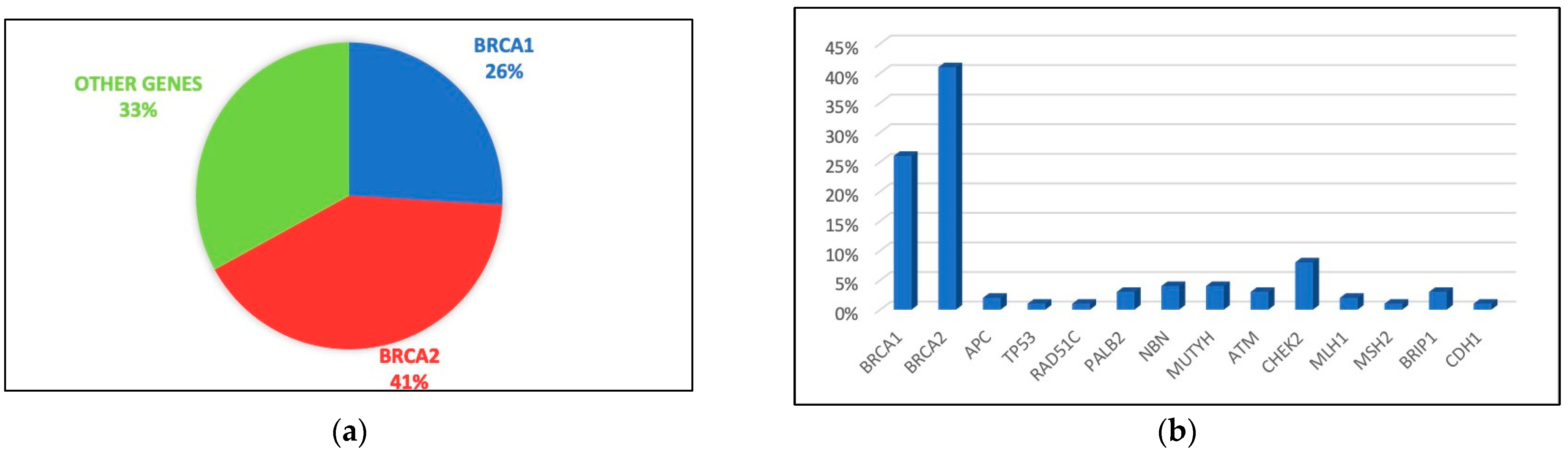
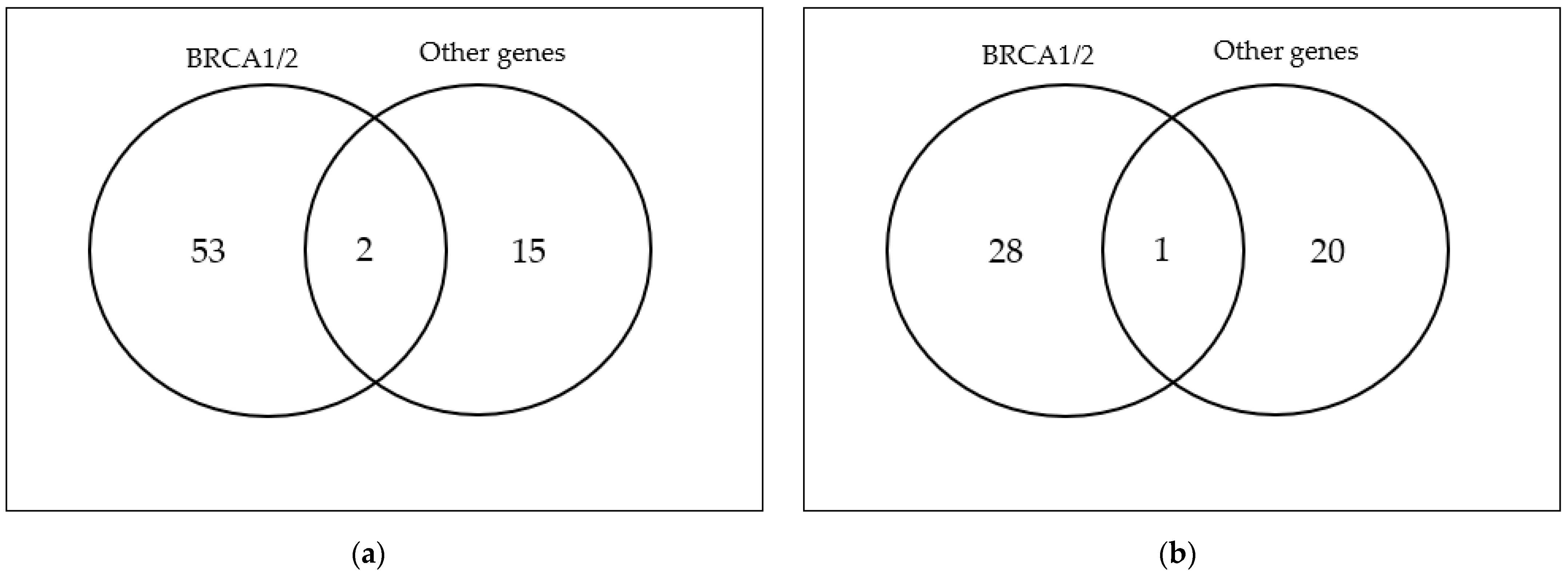
Background: Several hereditary–familial syndromes associated with various types of tumors have been identified to date, evidencing that hereditary cancers caused by germline mutations account for 5–10% of all tumors. Advances in genetic technology and the implementation of Next-Generation Sequencing (NGS) have accelerated the discovery of several susceptibility cancer genes, allowing for the detection of cancer-predisposing mutations in a larger number of cases. The aim of this study is to highlight how the application of an NGS-multigene panel to a group of oncological patients subsequently leads to improvement in the identification of carriers of healthy pathogenic variants/likely pathogenic variants (PVs/LPVs) and prevention of the disease in these cases. Methods: Starting from a total of 110 cancer patients carrying PVs/LPVs in genes involved in cancer susceptibility detected via a customized NGS panel of 27 cancer-associated genes, we enrolled 250 healthy collateral family members from January 2020 to July 2022. The specific PVs/LPVs identified in each proband were tested in healthy collateral family members via Sanger sequencing. Results: A total of 131 out of the 250 cases (52%) were not carriers of the mutation detected in the affected relative, while 119 were carriers. Of these, 81/250 patients carried PVs/LPVs on BRCA1/2 (33%), 35/250 harbored PVs/LPVs on other genes beyond BRCA1 and BRCA2 (14%), and 3/250 (1%) were PVs/LPVs carriers both on BRCA1/2 and on another susceptibility gene. Conclusion: Our results show that the analysis of BRCA1/2 genes would have only resulted in a missed diagnosis in a number of cases and in the lack of prevention of the disease in a considerable percentage of healthy carriers with a genetic mutation (14%).