Automated Cellular-Level Dual Global Fusion of Whole-Slide Imaging for Lung Adenocarcinoma Prognosis
by
 , , , , , , , , , add
Show full author list
, , , , , , , , , add
Show full author list
Songhui Diao
1,2,3 ,
,
Pingjun Chen
3 ,
,
Eman Showkatian
3,
Rukhmini Bandyopadhyay
3,
Frank R. Rojas
4,
Bo Zhu
5,
Lingzhi Hong
3,5,
Muhammad Aminu
3,
Maliazurina B. Saad
3,
Morteza Salehjahromi
3,
Amgad Muneer
3 ,
,
Sheeba J. Sujit
3,
Carmen Behrens
5,
Don L. Gibbons
5,
John V. Heymach
5,
Neda Kalhor
6,
Ignacio I. Wistuba
4,
Luisa M. Solis Soto
4,
Jianjun Zhang
5,7,
Wenjian Qin
1,* and
Jia Wu
3,5,* add
Show full author list
add
Show full author list
1
Shenzhen Institute of Advanced Technology, Chinese Academy of Sciences, Shenzhen 518055, China
2
Shenzhen College of Advanced Technology, University of Chinese Academy of Sciences, Shenzhen 518055, China
3
Department of Imaging Physics, Division of Diagnostic Imaging, The University of Texas MD Anderson Cancer Center, Houston, TX 77030, USA
4
Department of Translational Molecular Pathology, The University of Texas MD Anderson Cancer Center, Houston, TX 77030, USA
5
Department of Thoracic/Head and Neck Medical Oncology, The University of Texas MD Anderson Cancer Center, Houston, TX 77030, USA
6
Department of Pathology, The University of Texas MD Anderson Cancer Center, Houston, TX 77030, USA
7
Department of Genomic Medicine, The University of Texas MD Anderson Cancer Center, Houston, TX 77030, USA
*
Authors to whom correspondence should be addressed.
Cancers 2023, 15(19), 4824; https://doi.org/10.3390/cancers15194824
Submission received: 8 September 2023
/
Revised: 24 September 2023
/
Accepted: 27 September 2023
/
Published: 1 October 2023
(This article belongs to the Special Issue Advances in Oncological Imaging)
Simple Summary
Lung cancer is the leading cause of cancer death in the United States and worldwide. Currently, deep learning–based methods show significant advances and potential in pathology and can guide lung cancer diagnosis and prognosis prediction. In this study, we present a fully automated cellular-level survival prediction pipeline that uses histopathologic images of lung adenocarcinoma to predict survival risk based on dual global feature fusion. The results show meaningful, convincing, and comprehensible survival prediction ability and manifest the potential of our proposed pipeline for application to other malignancies.
Abstract
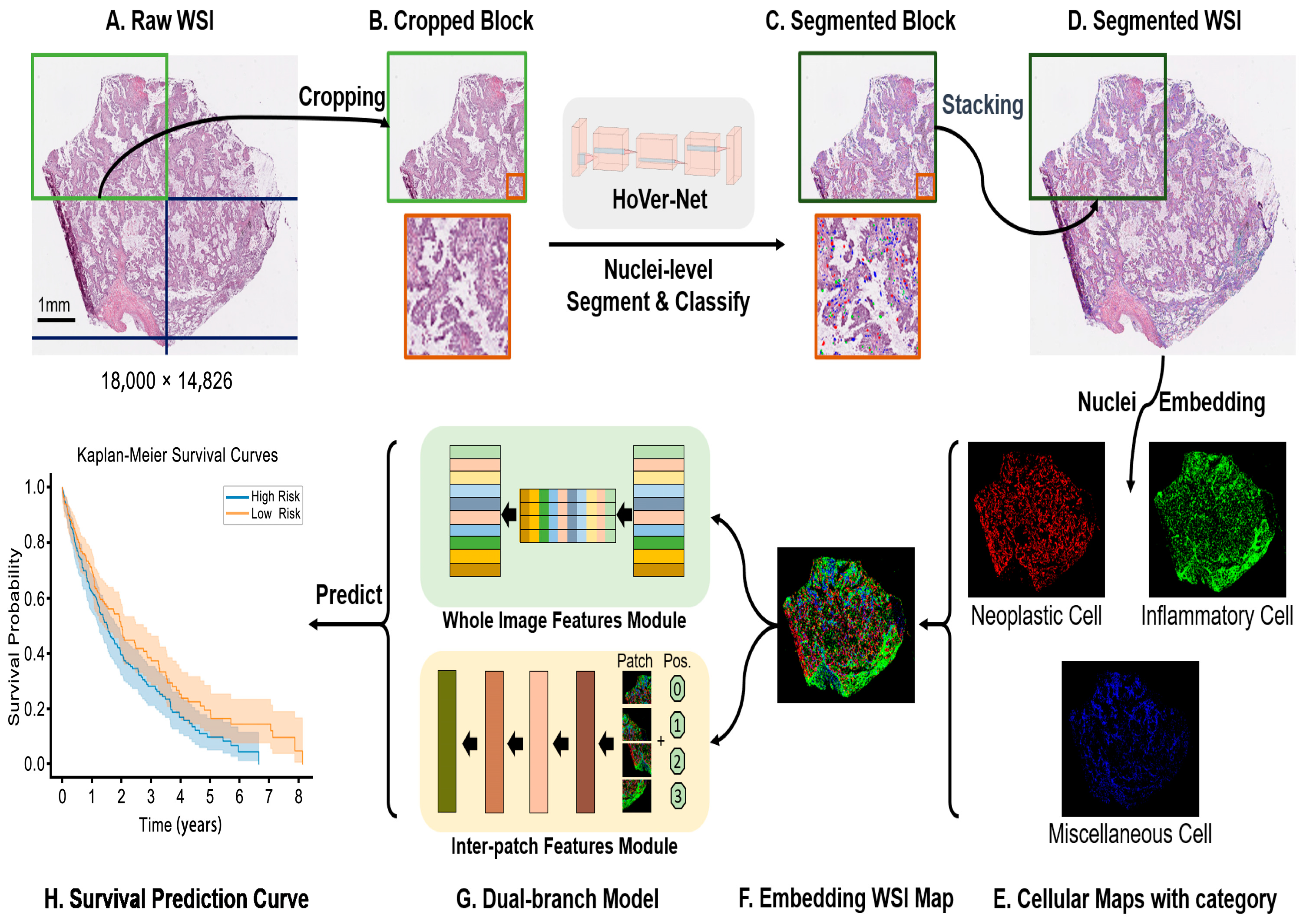
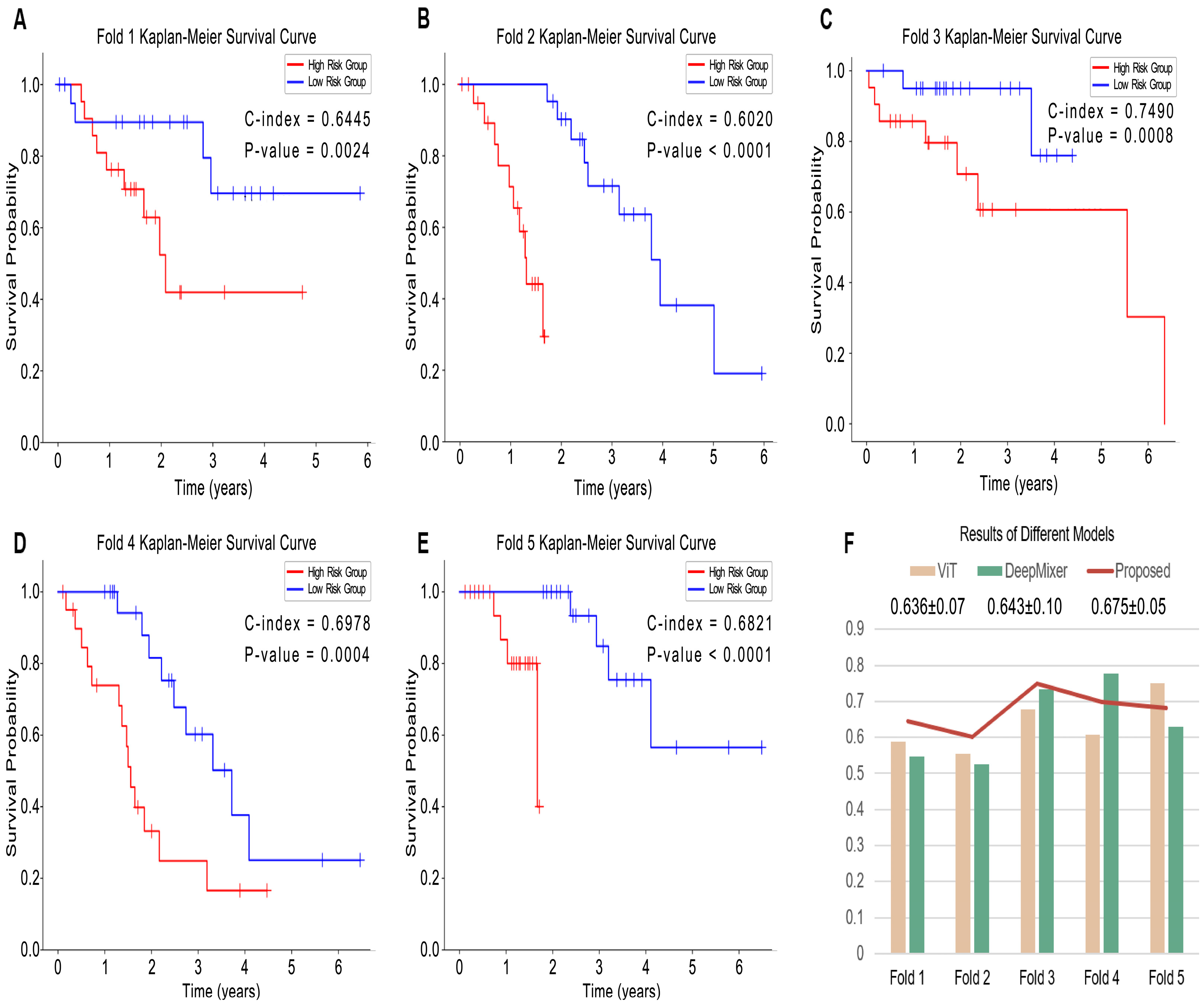
Histopathologic whole-slide images (WSI) are generally considered the gold standard for cancer diagnosis and prognosis. Survival prediction based on WSI has recently attracted substantial attention. Nevertheless, it remains a central challenge owing to the inherent difficulties of predicting patient prognosis and effectively extracting informative survival-specific representations from WSI with highly compounded gigapixels. In this study, we present a fully automated cellular-level dual global fusion pipeline for survival prediction. Specifically, the proposed method first describes the composition of different cell populations on WSI. Then, it generates dimension-reduced WSI-embedded maps, allowing for efficient investigation of the tumor microenvironment. In addition, we introduce a novel dual global fusion network to incorporate global and inter-patch features of cell distribution, which enables the sufficient fusion of different types and locations of cells. We further validate the proposed pipeline using The Cancer Genome Atlas lung adenocarcinoma dataset. Our model achieves a C-index of 0.675 (±0.05) in the five-fold cross-validation setting and surpasses comparable methods. Further, we extensively analyze embedded map features and survival probabilities. These experimental results manifest the potential of our proposed pipeline for applications using WSI in lung adenocarcinoma and other malignancies.