How ITD Insertion Sites Orchestrate the Biology and Disease of FLT3-ITD-Mutated Acute Myeloid Leukemia

1
Department of Hematology and Oncology, Medical Center, Otto-von-Guericke University, 39120 Magdeburg, Germany
2
Gesundheitscampus Immunology, Inflammation and Infectiology (GC-I3), Medical Center, Otto-von-Guericke University, 39120 Magdeburg, Germany
3
Institute for Molecular and Clinical Immunology, Medical Faculty, Otto-von-Guericke University, 39120 Magdeburg, Germany
4
Center of Health and Medical Prevention (CHaMP), Otto-von-Guericke University, 39106 Magdeburg, Germany
*
Author to whom correspondence should be addressed.
Cancers 2023, 15(11), 2991; https://doi.org/10.3390/cancers15112991
Submission received: 25 April 2023
/
Revised: 25 May 2023
/
Accepted: 26 May 2023
/
Published: 30 May 2023
(This article belongs to the Special Issue Recent Advances in the Understanding of Myelodysplastic Syndrome and Acute Myeloid Leukemia)
Simple Summary
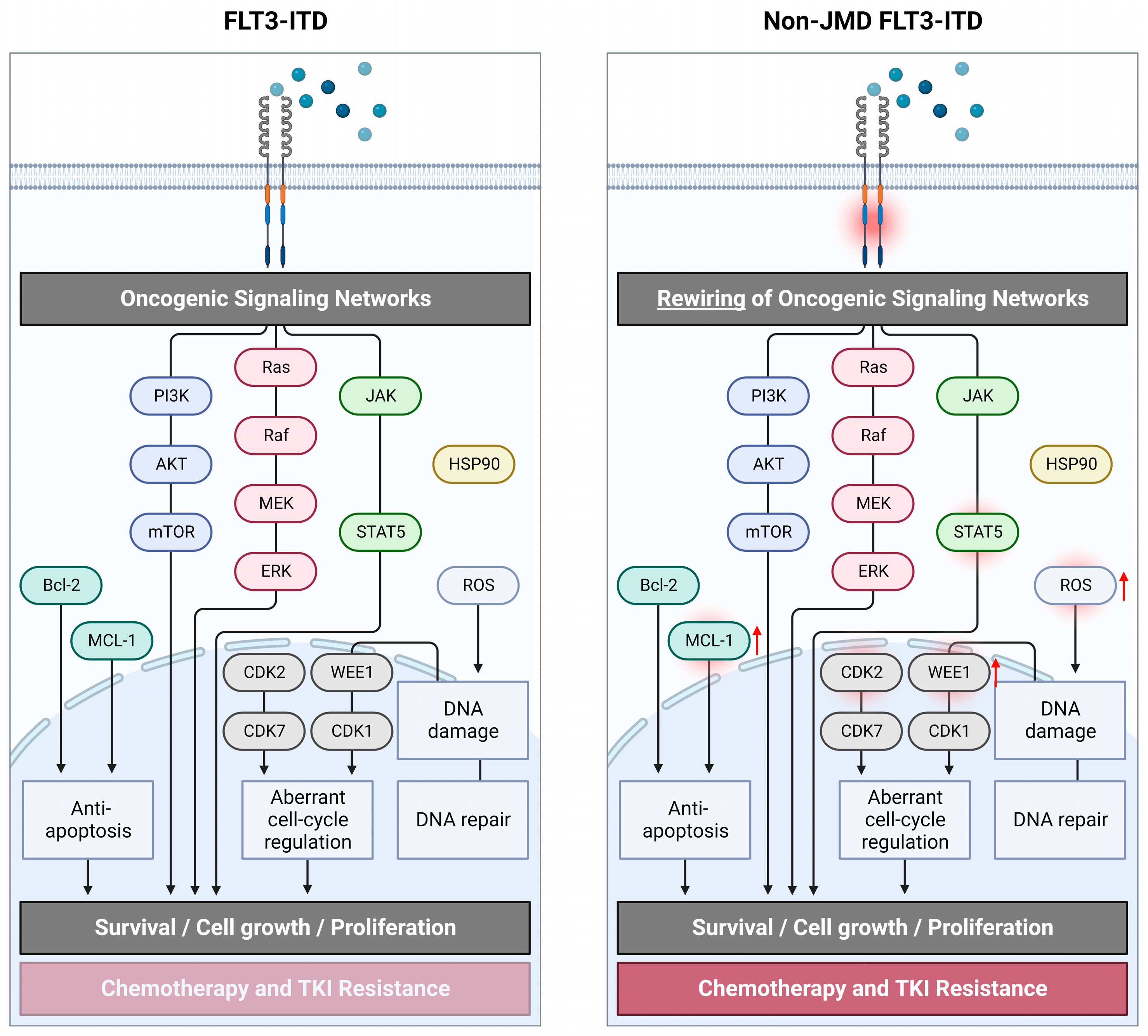
FLT3 gene mutations are among the most common genetic aberrations detected in AML and occur with a frequency of approximately 30%, mainly as internal tandem duplications (FLT3-ITD). As a novel finding, it has been reported that the specific insertion sites (IS) of FLT3-ITD exhibit marked heterogeneity in both biological and clinical features. Thus, the so-called non-juxtamembrane domain (non-JMD) FLT3-ITD insertions have been shown to be associated with worse clinical outcomes and resistance to both chemotherapy and tyrosine kinase inhibition. This present review summarizes our current knowledge of the biological and clinical impact of FLT3-ITD inserting at the non-JMD level. Recent evidence suggests that conformational changes depending on FLT3-ITD localization affect downstream signaling networks and the oncogenic potential. We propose that refined risk stratification guidelines integrating the negative prognostic impact of non-JMD FLT3-ITD are warranted. Overcoming therapy resistance in non-JMD-inserting FLT3-ITD-mutated AML may lead to promising treatment approaches.
Abstract
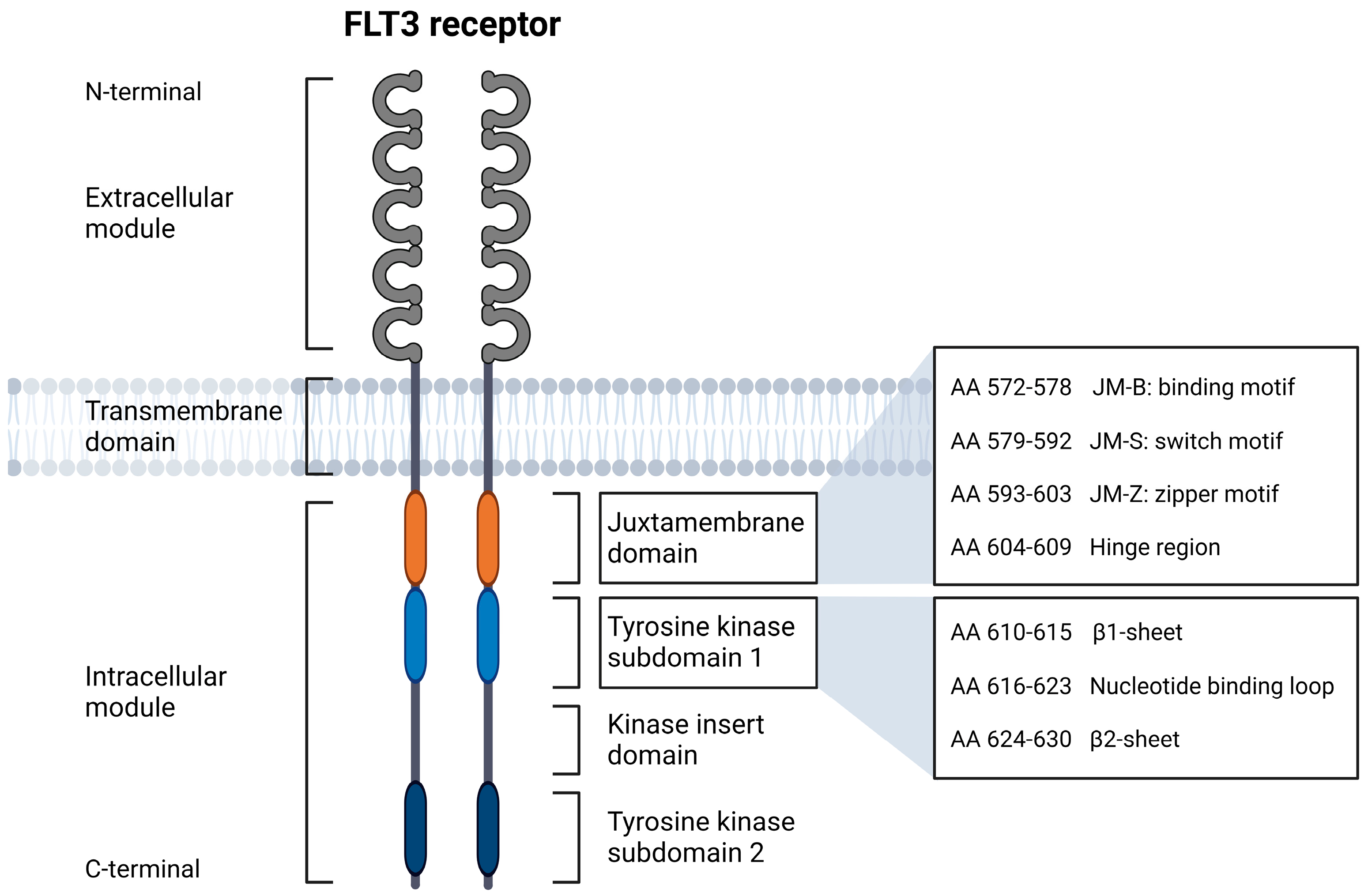
Mutations of the FLT3 gene are among the most common genetic aberrations detected in AML and occur mainly as internal tandem duplications (FLT3-ITD). However, the specific sites of FLT3-ITD insertion within FLT3 show marked heterogeneity regarding both biological and clinical features. In contrast to the common assumption that ITD insertion sites (IS) are restricted to the juxtamembrane domain (JMD) of FLT3, 30% of FLT3-ITD mutations insert at the non-JMD level, thereby integrating into various segments of the tyrosine kinase subdomain 1 (TKD1). ITDs inserted within TKD1 have been shown to be associated with inferior complete remission rates as well as shorter relapse-free and overall survival. Furthermore, resistance to chemotherapy and tyrosine kinase inhibition (TKI) is linked to non-JMD IS. Although FLT3-ITD mutations in general are already recognized as a negative prognostic marker in currently used risk stratification guidelines, the even worse prognostic impact of non-JMD-inserting FLT3-ITD has not yet been particularly considered. Recently, the molecular and biological assessment of TKI resistance highlighted the pivotal role of activated WEE1 kinase in non-JMD-inserting ITDs. Overcoming therapy resistance in non-JMD FLT3-ITD-mutated AML may lead to more effective genotype- and patient-specific treatment approaches.