Treatment of Malignant Adnexal Tumors of the Skin: A 12-Year Perspective
by
 , , , , and
Marcin Kleibert
1,2,† ,
,
Iga Płachta
1,2,†,
Anna M. Czarnecka
1,* ,
,
Mateusz J. Spałek
1 ,
,
Anna Szumera-Ciećkiewicz
3,4 and
Piotr Rutkowski
1
1
Department of Soft Tissue/Bone Sarcoma and Melanoma, Maria Sklodowska-Curie National Research, Institute of Oncology, 02-781 Warsaw, Poland
2
Faculty of Medicine, Medical University of Warsaw, 02-091 Warsaw, Poland
3
Department of Pathology and Laboratory Diagnostics, Maria Sklodowska-Curie National Research Institute of Oncology, 02-781 Warsaw, Poland
4
Department of Diagnostic Hematology, Institute of Hematology and Transfusion Medicine, 00-791 Warsaw, Poland
*
Author to whom correspondence should be addressed.
†
These authors contributed equally to this work.
Cancers 2022, 14(4), 998; https://doi.org/10.3390/cancers14040998
Submission received: 7 January 2022
/
Revised: 11 February 2022
/
Accepted: 14 February 2022
/
Published: 16 February 2022
(This article belongs to the Special Issue Rare Skin Cancers: Recent Advances in Classification and Management)
Simple Summary
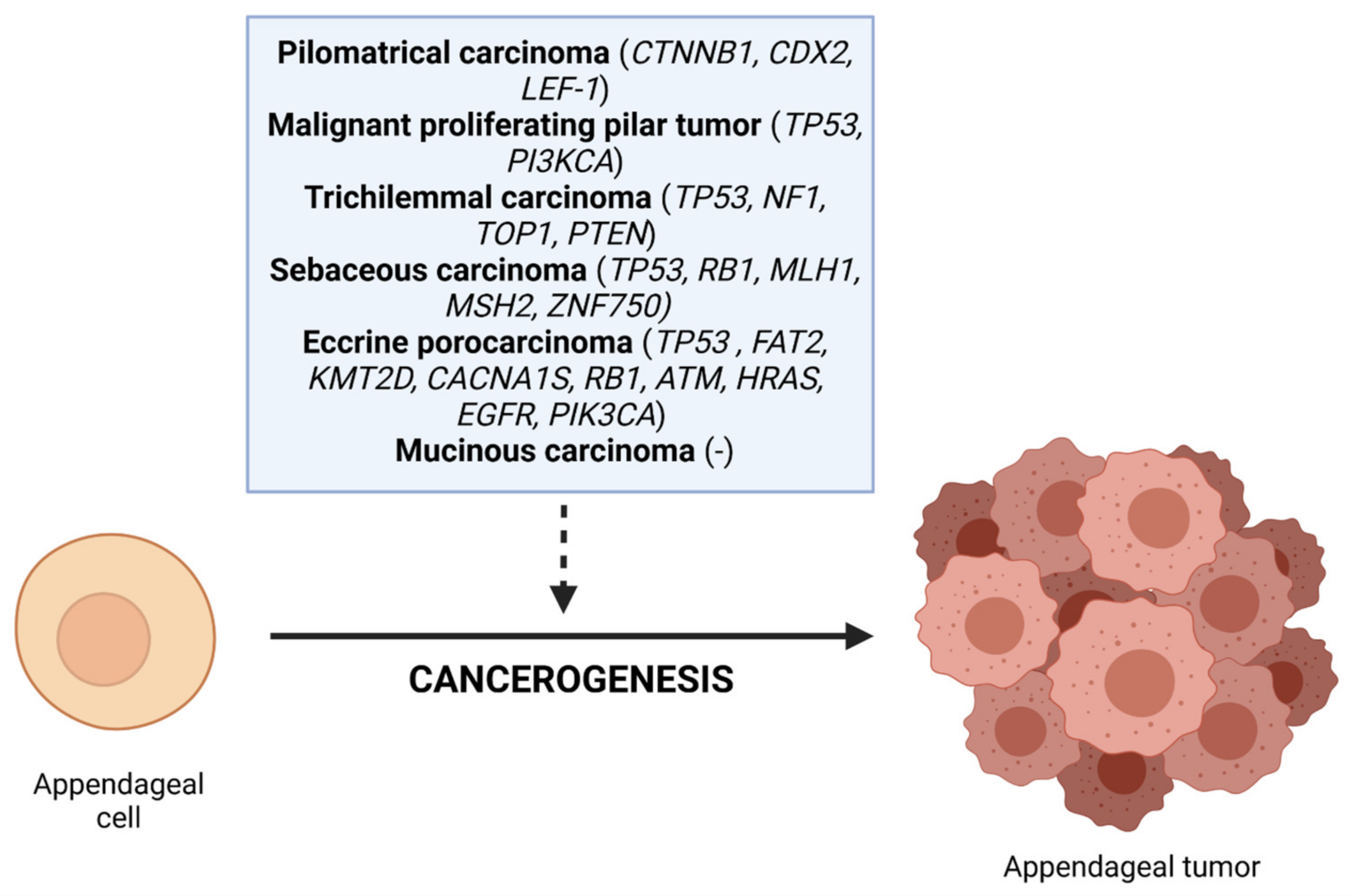
Surgical resection is the standard of care for malignant adnexal cancers of the skin. The efficacy of radiotherapy and targeted therapies is still undetermined in both adjuvant and palliative settings. In routine clinical practice, genetic abnormalities are rarely assessed, although numerous mutations have been described, e.g., in TP53 (tumor protein p53), FAT2 (FAT atypical cadherin 2), KMT2D (lysine methyltransferase 2D), CACNA1S (calcium voltage-gated channel subunit alpha1 S), and PTEN (phosphatase and tensin homolog). These cancers occur mainly in the middle-aged, and are locally aggressive, but when metastasized result in poor prognosis. The aim of this study is to analyze treatment efficacy in patients treated at a reference center since 2009. The role of multidisciplinary treatment is also discussed.
Abstract
Malignant adnexal cancers of the skin—extremely rare neoplasms—are mostly reported as non-symptomatic, slow-growing nodules. These carcinomas occur mainly in the middle-aged (50–60 years of age); they are mostly localized on the upper part of the body and are locally aggressive, infiltrate surrounding tissue, and metastasize to regional lymph nodes. The patients’ outcomes depend on multiple prognostic factors, including the size of the primary tumor and its mitotic count. Surgical resection of the primary tumor with or without regional lymph nodes is the treatment method of choice; however, due to aggressive tumor behavior, perioperative treatment may be considered. The role and efficacy of radiotherapy in the treatment of skin adnexal malignancies are not yet fully defined. Some authors suggest that adjuvant radiotherapy may be considered in locally advanced and regional disease. The aim of this study was to evaluate treatment outcomes and assess the efficacy of combined therapy in patients with adnexal malignancies. Our analysis covered all cases of cutaneous adnexal tumor patients diagnosed and provided with multidisciplinary treatment with surgery and radiotherapy since the beginning of 2009.