Circulating Tumor Cells in Breast Cancer Patients: A Balancing Act between Stemness, EMT Features and DNA Damage Responses
by
 and
and
Benedikt Heitmeir
, 
Miriam Deniz
,
Wolfgang Janni
,
Brigitte Rack
,
Fabienne Schochter
† and
Lisa Wiesmüller
*,†
Department of Obstetrics and Gynecology, Ulm University, 89075 Ulm, Germany
*
Author to whom correspondence should be addressed.
†
These authors contributed equally to this work.
Cancers 2022, 14(4), 997; https://doi.org/10.3390/cancers14040997
Submission received: 27 January 2022
/
Revised: 11 February 2022
/
Accepted: 13 February 2022
/
Published: 16 February 2022
(This article belongs to the Special Issue DNA Damage Response Targeting: Challenges and Opportunities)
Simple Summary
Circulating tumor cells dissociate from the primary tumor, enter the bloodstream and travel to distant sites where they seed metastases. To endow these tumor cells with the features necessary for this journey, they must undergo dramatic shape changes, acquire migratory potential, alter their metabolism, and quickly adapt to insults in each new environment. To permit such phenotypic changes in multiple directions, they often acquire a more primitive state reminiscent of stem cells in the embryo. These changes are coupled with altered capacities and qualities to remove DNA lesions such as those induced by a metabolic shift or an immune cell attack. Defects in DNA repair cause mutations, leading to hereditary breast cancer and accelerating progression. Enhanced DNA repair causes resistance to chemotherapeutic treatment. Therefore, it is of utmost interest to understand the choreography of these functions in circulating tumor cells at the molecular level, because they represent targets to fight chemoresistant metastases.
Abstract
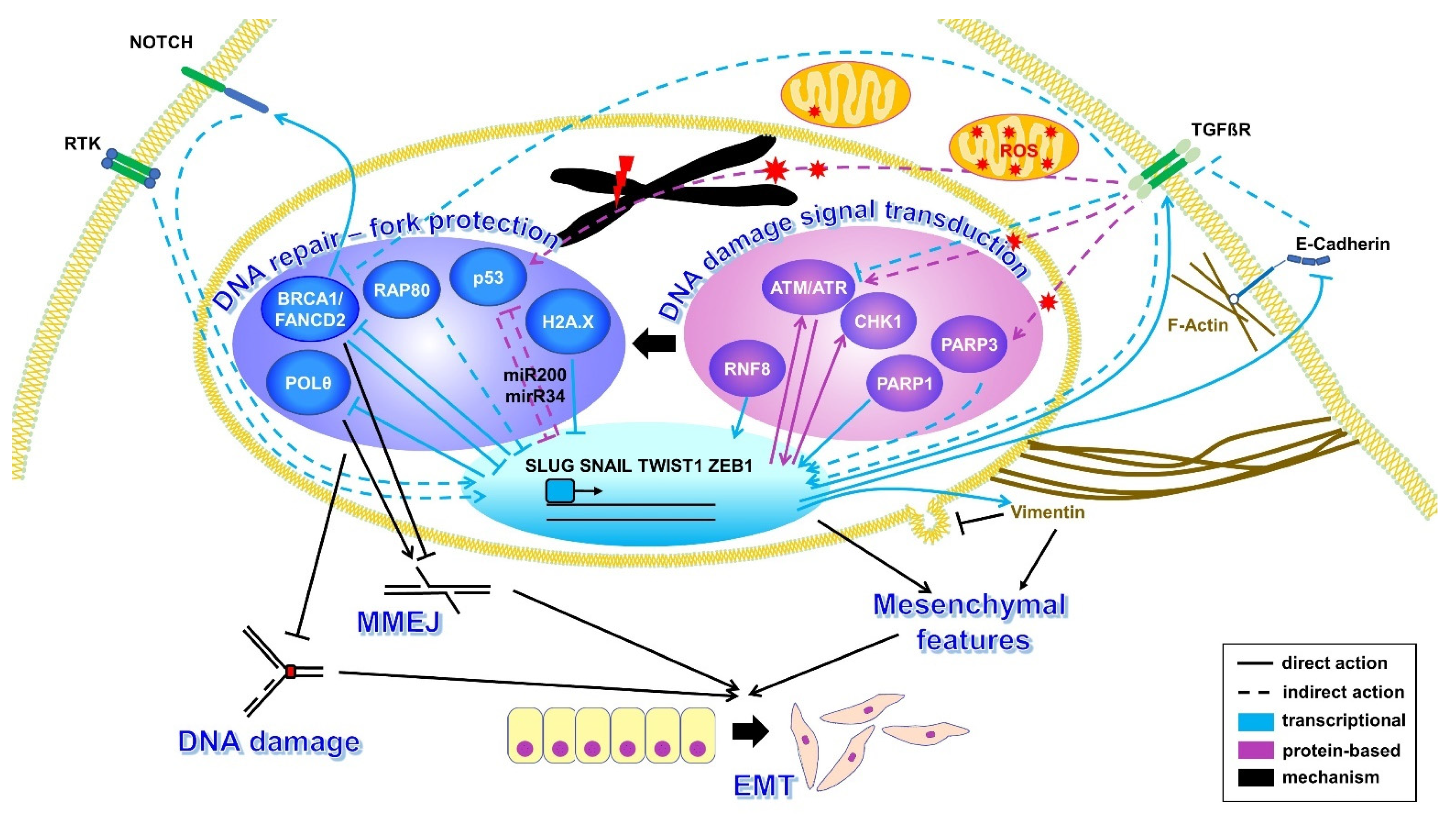
Circulating tumor cells (CTCs) traverse vessels to travel from the primary tumor to distant organs where they adhere, transmigrate, and seed metastases. To cope with these challenges, CTCs have reached maximal flexibility to change their differentiation status, morphology, migratory capacity, and their responses to genotoxic stress caused by metabolic changes, hormones, the inflammatory environment, or cytostatic treatment. A significant percentage of breast cancer cells are defective in homologous recombination repair and other mechanisms that protect the integrity of the replication fork. To prevent cell death caused by broken forks, alternative, mutagenic repair, and bypass pathways are engaged but these increase genomic instability. CTCs, arising from such breast tumors, are endowed with an even larger toolbox of escape mechanisms that can be switched on and off at different stages during their journey according to the stress stimulus. Accumulating evidence suggests that DNA damage responses, DNA repair, and replication are integral parts of a regulatory network orchestrating the plasticity of stemness features and transitions between epithelial and mesenchymal states in CTCs. This review summarizes the published information on these regulatory circuits of relevance for the design of biomarkers reflecting CTC functions in real-time to monitor therapeutic responses and detect evolving chemoresistance mechanisms.