


Simple Summary
Physical activity is linked to longer survival among non-metastasized colorectal cancer patients. It is unclear if physical activity is also beneficial for survival among patients with metastatic colorectal cancer. We researched this question in our study of 293 patients with metastatic colorectal cancer. We found that participants who reported higher levels of physical activity at diagnosis lived longer compared to patients who reported low activity levels. Furthermore, adherence to the physical activity guidelines for cancer survivors was related to prolonged survival. Our findings suggest that patients with metastatic colorectal cancer also benefit from being physically active. Future studies are needed to investigate whether improving exercise levels after diagnosis of metastasis is also beneficial and what kind of exercise interventions are most optimal for possibly improving survival time of patients with metastatic colorectal cancer.
Abstract
Regular physical activity (PA) is associated with improved overall survival (OS) in stage I–III colorectal cancer (CRC) patients. This association is less defined in patients with metastatic CRC (mCRC). We therefore conducted a study in mCRC patients participating in the Prospective Dutch Colorectal Cancer cohort. PA was assessed with the validated SQUASH questionnaire, filled-in within a maximum of 60 days after diagnosis of mCRC. PA was quantified by calculating Metabolic Equivalent Task (MET) hours per week. American College of Sports and Medicine (ACSM) PA guideline adherence, tertiles of moderate to vigorous PA (MVPA), and sport and leisure time MVPA (MVPA-SL) were assessed as well. Vital status was obtained from the municipal population registry. Cox proportional-hazards models were used to study the association between PA determinants and all-cause mortality adjusted for prognostic patient and treatment-related factors. In total, 293 mCRC patients (mean age 62.9 ± 10.6 years, 67% male) were included in the analysis. Compared to low levels, moderate and high levels of MET-hours were significantly associated with longer OS (fully adjusted hazard ratios: 0.491, (95% CI 0.299–0.807, p value = 0.005) and 0.485 (95% CI 0.303–0.778, p value = 0.003), respectively), as were high levels of MVPA (0.476 (95% CI 0.278–0.816, p value = 0.007)) and MVPA-SL (0.389 (95% CI 0.224–0.677, p value < 0.001)), and adherence to ACSM PA guidelines compared to non-adherence (0.629 (95% CI 0.412–0.961, p value = 0.032)). The present study provides evidence that higher PA levels at diagnosis of mCRC are associated with longer OS.
1. Introduction
A physically active lifestyle is broadly considered to be related to a decreased risk of developing colorectal cancer (CRC), with evidence being especially strong for colon cancer [1,2,3,4,5]. After a cancer diagnosis, several studies show beneficial associations between high levels of physical activity (PA) and reduced mortality in stage I–III CRC patients as well [6,7,8,9,10,11].
Evidence for an association between PA and survival among metastatic colorectal cancer (mCRC) patients, however, is sparse, and the described associations are less uniform. Three studies provided secondary subgroup analyses, including small numbers of mCRC patients with conflicting results [12,13,14].
One large prospective study of patients with mCRC, embedded in a randomized phase III trial, reported a longer progression-free survival (PFS) and lower risk of treatment-related toxicities with higher total physical activity levels. More non-vigorous activity was associated with longer PFS and overall survival (OS), vigorous activity and walking were not [15]. However, as also noted by the authors, selective enrollment in a trial context may affect the generalizability of these results, creating uncertainty as to what extent the results can be extrapolated to the general patient population.
Expanding current knowledge about the association between PA and OS is relevant, as it may help patients to make informed choices regarding their (change of) lifestyle, which is an important question facing a significant proportion of patients [16]. Furthermore, if there is indeed an association between PA and OS in patients with mCRC, this could inform future exercise intervention studies investigating the potential to prolong survival. Previous studies already showed feasibility and safety of exercise interventions in advanced cancer patients in general [17] and the mCRC population specifically [18].
In this study, we aim to provide further evidence of the association between prediagnostic PA and OS among patients with mCRC who participate in a large, prospective cohort study.
2. Materials and Methods
2.1. Study Sample
Data were obtained from patients participating in the Prospective Dutch Colorectal Cancer (PLCRC) cohort. PLCRC is a prospective multidisciplinary nationwide observational cohort in the Netherlands for which all patients over eighteen years of age with a histologically proven or strong clinical suspicion of CRC are eligible for inclusion. Currently, sixty-one of the sixty-nine Dutch hospitals participate in this initiative. As an informed consent option, patients are asked to consent to receiving repeated questionnaires on health-related topics. A detailed description of the cohort design is published elsewhere [19]. For the current analysis, all patients who completed a questionnaire within sixty days of diagnosis of first metastasis were included. Clinical data on tumor characteristics and treatment information were obtained from the Netherlands Cancer Registry (NCR). Date of first metastasis was defined as date of histological confirmation or date of first imaging of metastasis if no histological proof was obtained. Standardized differences were calculated to quantify the magnitude of differences in patient characteristics between our study population and the general Dutch population of mCRC patients, and between our study population and all mCRC PLCRC participants (i.e., including patients that did not consent to filling out questionnaires). Values greater than 0.20 indicate a large imbalance, while values between 0.10 and 0.20 indicate a small imbalance, and standardized differences less than 0.10 indicate a negligible imbalance [20].
2.2. Assessment of Mortality
The primary endpoint of this study is overall survival (OS). Vital status was obtained from an annual data linkage with the municipal population registry on 1 February 2021. Overall survival was defined as the interval from diagnosis of metastatic disease to all-cause death, or the date of the last follow-up was used for censoring (1 February 2021).
2.3. Assessment of Physical Activity
PA information was obtained using the validated Dutch short questionnaire to assess health-enhancing physical activity (SQUASH) [21]. The general purpose of the SQUASH is to assess the amount and intensity of habitual PA during an average week in the past months. Questions are divided in four activity domains: commuting activities, sports and leisure time activities, household activities, and activities at work and school.
The total amount of time spent weekly on each activity and each activity domain was calculated. All activities were given a Metabolic Equivalent of Task (MET) score, based on the updated Ainsworth compendium of physical activities [22], and categorized as light-intensity (<3.0 METs), moderate-intensity (3.0–5.9 METs), and vigorous-intensity (≥6.0 METs).
MET-hours were calculated by multiplying the time spent on activities with their assigned MET values. Weekly time spent on moderate-to-vigorous-intensity physical activity (MVPA) was calculated, which contained all activities with ≥3.0 METs. A subset was also made, containing only sport and leisure time MVPA (MVPA-SL). Lastly, Dutch PA guideline adherence was assessed, which correspond to the American College of Sports and Medicine (ACSM) guidelines for cancer survivors, i.e., resistance training at least twice a week, and a minimum of 150 min aerobic exercise per week [23,24].
2.4. Assessment of other Study Parameters
Age, sex, primary tumor location, metastatic sites, synchronicity of metastasis, surgery of primary tumor, metastasectomy and systemic treatment information were obtained from the NCR. Synchronous metastasis was defined as having stage IV cancer at first diagnosis. Exposure to systemic treatment types was defined as having received at least one dose of a treatment modality. Total days on systemic treatment was calculated as the cumulative sum of intervals receiving systemic therapy. If no end date was registered, date of censoring was used as end date. Body mass index (BMI) was calculated using the standard kg/m2 calculation, based on self-reported height and weight within sixty days of diagnosis of first metastasis.
2.5. Statistical Analyses
Cox proportional hazards models were used to analyze associations between PA and OS. PA was assessed using continuous data and tertiles for weekly MET-hours, MVPA, and MVPA-SL (henceforth: tertile 1 = low; tertile 2 = moderate; and tertile 3 = high level of PA), with low being the reference category. Guideline adherence was assessed as a categorical variable (yes, no), with ‘no’ being the reference category. The proportional hazards assumption was tested for PA variables, both visually and by using scaled Schoenfeld residuals.
Two multivariable cox models were applied. The first model (henceforth: adjusted model) was adjusted for characteristics at diagnosis: age (continuous), sex (female, male), BMI (continuous), primary tumor location (left, right, rectum, other), metastatic sites (1, >1), liver-only metastasis (yes or no) and metastasis pattern (synchronous vs. metachronous). The second model (henceforth: fully adjusted model) was adjusted for the same variables, and contained additional adjustment for treatment-related factors: surgery of primary tumor (yes—before diagnosis of 1st metastasis, yes—after diagnosis of 1st metastasis, or no) and metastasectomy (yes or no). Sensitivity analyses were performed to reduce the probability of reverse causation by repeating our Cox models without patients who died within six months after diagnosis of 1st metastasis. All data were analyzed using SPSS version 26 [25] and R version 4.0.3. [26]. Survival analyses were performed with the R survival package, version 3.2–13 [27] and survival plots were created with the R survminer package, version 0.4.9 [28]. All statistical tests were two-sided with an alpha level of 0.050.
3. Results
3.1. Patient Characteristics
In total, 306 patients completed a SQUASH questionnaire within sixty days of diagnosis of first metastasis. Thirteen participants were excluded from further analysis due to incomplete questionnaires, i.e., more than two of the four domains were missing, leading to a final study population of n = 293.
Table 1 shows baseline and treatment characteristics by tertiles of weekly MET-hours, and for the total study population. The majority of patients were male (67.2%) and mean age was 62.9 years (standard deviation (SD) 10.6). Table A1 shows standardized differences between our study population and both the general Dutch mCRC population and the entire PLCRC mCRC population. Compared to the general population, our study population showed a large difference in age (63 vs. 68 years), sex (67% vs. 57% male), and primary tumor localization (39% vs. 28% rectum). Compared to the entire PLCRC mCRC population, our study population showed a small difference in sex (67% vs. 61% male) and negligible differences in age (63 vs. 62 years) and primary tumor localization (39% vs. 39% rectum) [29]. When comparing tertiles, patients with high PA levels (tertile 3) were younger, less likely to have right-sided tumors, and were more likely to have synchronous metastases and to receive a metastasectomy. No clear differences in systemic treatment exposure were seen, but the median total days on treatment was evidently lower in patients with low PA levels (tertile 1, median of 169 days vs. a median of 223 and 215 in tertiles 2 and 3).
Table 1.
Patient characteristics by tertiles of MET-hours per week, and for the total study sample.
3.2. Associations of Physical Activity with OS
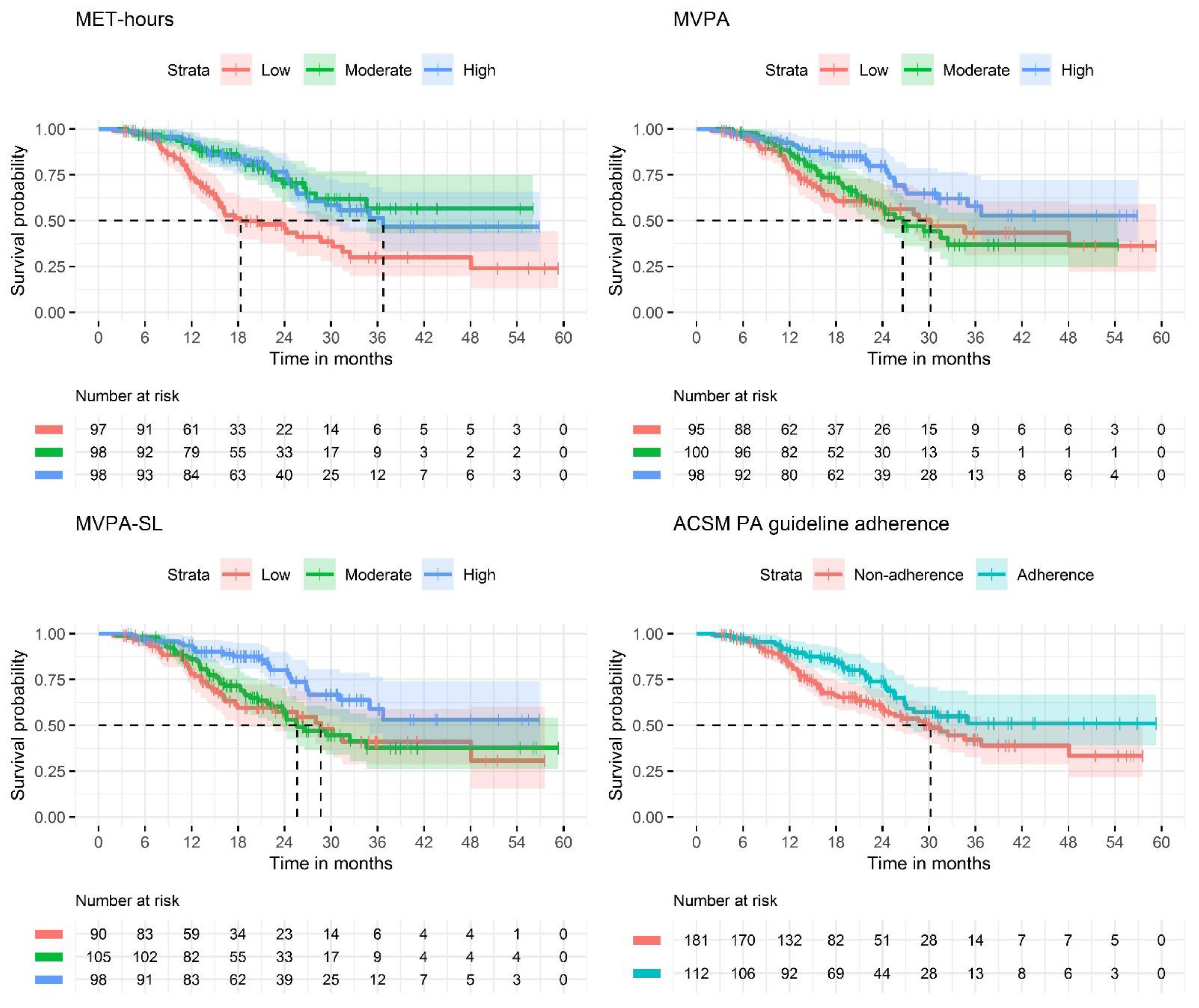
Figure 1 shows Kaplan–Meier curves of OS by tertiles of MET-hours, MVPA and MVPA-SL, and by ACSM PA guideline adherence. A total of 106 deaths occurred during a median follow-up time of 18.8 months. Based on the Schoenfeld test, proportionality assumption was met for MET-hours (p value = 0.202), MVPA (p value = 0.164), MVPA-SL (p value = 0.294), and guideline adherence (p value = 0.257).
Figure 1.
Kaplan–Meier survival curves, stratified by the following physical activity determinants: tertiles of Metabolic equivalent of task (MET) hours; tertiles of moderate and vigorous physical activity (MVPA); tertiles of sport and leisure time moderate and vigorous physical activity (MVPA-SL); and American College of Sports and Medicine (ACSM) physical activity (PA) guideline adherence. Dotted lines represent median survival time when reached.
Table 2 shows Hazard Ratios (HRs) of the four assessed PA determinants for the univariate and for both multivariable adjusted Cox proportional hazard models.
Table 2.
Hazard ratios for overall survival according to continuous data and tertiles of physical activity categories and according to ACSM PA guideline adherence.
3.2.1. Metabolic Equivalent Task Hours
An increase in weekly MET-hours was consistently significantly associated with improved survival across all models (univariate HR 0.994 (95% CI 0.990–0.997, p value < 0.001); adjusted HR 0.995 (95% CI 0.991–0.998, p value = 0.001); and fully adjusted HR 0.995 (95% CI 0.991–0.998, p value < 0.001)). Median (IQR) MET-hours per week was 33.1 (10.0, 47.4) for the group with low levels, 89.9 (79.4, 104) for the group with moderate levels, and 166 (140, 199) for the group with high levels. Both moderate and high MET-hour levels were consistently significantly associated with improved survival compared to low levels across all models. Compared to low levels of MET-hour/week, the fully adjusted HR for moderate levels of MET-hours per week was 0.491 (95% CI 0.299–0.807, p value = 0.005), and the adjusted HR was 0.448 (95% CI 0.271–0.741, p value = 0.002). For high levels of MET-hours per week compared to low levels, the fully adjusted HR was 0.485 (95% CI 0.303–0.778, p value < 0.001), and the adjusted HR was 0.491 (95% CI 0.306–0.790, p value <0.001).
3.2.2. Moderate and Vigorous Physical Activity
An increase in weekly hours spent on MVPA was consistently significantly associated with improved survival across all models (univariate HR 0.976 (95% CI 0.958–0.994, p value = 0.010); adjusted HR 0.975 (95% CI 0.957–0.994, p value = 0.010); fully adjusted HR 0.973 (95% CI 0.955–0.992, p value = 0.006)). Median (IQR) hours per week spent on MVPA was 0.5 (0.0, 2.4) for the group with low levels, 7.5 (5.1, 10.3) for the group with moderate levels, and 21.6 (16.1, 31.4) for the group with high levels. High levels of MVPA were significantly associated with longer survival compared to low levels (fully adjusted HR 0.476 (95% CI 0.278–0.816, p value = 0.007) and adjusted HR 0.491 (95% CI 0.288–0.836, p value = 0.088)). Moderate levels of MVPA were not significantly associated with longer OS compared to low levels (fully adjusted HR 0.889 (95% CI 0.556–1.423, p value = 0.625), adjusted HR 0.916 (95% CI 0.575–1.459, p value = 0.711)).
3.2.3. Sport and Leisure Time Moderate and Vigorous Physical Activity
An increase in weekly hours spent on MVPA-SL was consistently significantly associated with improved survival across all models (univariate HR 0.965 (95% CI 0.938–0.993, p value = 0.015); adjusted HR 0.955 (95% CI 0.926–0.986, p value = 0.004); and fully adjusted HR 0.957 (95% CI 0.927–0.988, p value = 0.007)). Median (IQR) hours per week spent on MVPA-SL was 0.0 (0.0, 0.3) for the group with low levels, 4.2 (2.5, 5.5) in the group with moderate levels, and 14.0 (10.5, 18.5) in the group with high levels. High levels of MVPA-SL were significantly associated with improved survival compared to low levels (fully adjusted HR 0.389 (95% CI 0.224–0.677, p value < 0.001) and adjusted HR 0.384 (95% CI 0.223–0.661, p value < 0.001)). Moderate levels of MVPA-SL were not associated with a significant difference in OS compared to low levels (fully adjusted HR 0.737 (95% CI 0.462–1.175, p value = 0.200) and adjusted HR 0.769 (95% CI 0.480–1.230, p value = 0.273)).
3.2.4. ACSM Physical Activity Guideline Adherence
Thirty-eight percent (112/293) of participants adhered to ACSM PA guidelines. Guideline adherence was significantly associated with improved survival in the univariate model (HR 0.628, 95% CI = 0.417-0.945, p value = 0.026) and in the fully adjusted model (HR 0.629, 95% CI = 0.412–0.961, p value = 0.032), but not in the adjusted model (HR 0.666, 95% CI = 0.439–1.009, p value = 0.055).
3.2.5. Sensitivity Analyses
Table A2 shows HRs of the four assessed PA determinants with exclusion of participants that died within six months (n = 8). This yielded comparable results for all models with MET-hours, MVPA, and MVPA-SL as determinants. The adjusted model with ACSM PA guideline adherence showed a significant association 0.628 (95% CI 0.407–0.969, p value = 0.036), compared to a non-significant association in the primary analysis.
4. Discussion
In this prospective observational cohort of mCRC patients, we found that higher weekly total PA (MET-hours), MVPA, and MVPA-SL at diagnosis of first metastasis was significantly associated with prolonged survival time compared to low levels. When comparing tertiles, significant associations were seen for high levels of MVPA and MVPA-SL, and high and moderate levels of total PA (MET-hours per week). Significant associations with increased survival time were also seen for ACSM PA guideline adherence compared to non-adherence. Greatest risk reductions were seen for high levels of MVPA-SL compared to low levels.
To date, the evidence for the relationship between PA and survival in mCRC patients is limited. A previous study by Guercio et al. showed an association between greater non-vigorous activity and improved survival in this patient group, but not of total physical activity [15]. Several other studies have reported data from subgroup analyses of patients with stage IV CRC. One study showed that walking was related to longer OS in mCRC patients [12], whereas two other studies found no associations with survival [13,14]. However, the latter two studies were limited by low numbers. In our study including almost 300 patients with mCRC, we observed clear associations between multiple types of PA and survival.
Furthermore, we investigated PA by means of tertiles, instead of dichotomizing PA levels as in the majority of studies. It could be the case that the cut-off for the most active group in other studies simply was not high enough. This is illustrated by the fact that moderate PA levels show little to no difference in survival time compared to low levels of PA for both MVPA and MVPA-SL in our analyses. In this light however, it is important to note that comparing PA associations of different studies poses challenges due to heterogeneity in assessment of physical activity [21,30,31]. These differences are reflected in reported median weekly MET-hours ranging from 10 to 100/week for different questionnaires [8,32,33]. Besides these differences in assessment, interpretation of results for specific activities/activity types poses the additional challenge that distribution of activity types is known to be different per country [34].
Several underlying biological mechanisms might be involved in beneficial associations between PA and survival, including hyperinsulinemia, inflammation, and obesity [35,36]. Reduction in treatment-related toxicities is also described in physically active patients, which could contribute to increased survival time [37]. This might also have occurred in our study, based on the differences in median total time on treatment between the group with low levels of MET-hours, and the groups with moderate and high levels of MET-hours. Future analyses using repeated measures of PA and more detailed analysis of (changes in) systemic treatment will provide additional and valuable insight into associations with survival time when maintaining or increasing PA levels after mCRC diagnosis. These analyses will also inform future randomized controlled trials investigating the effects of physical activity on mCRC outcomes.
Strengths of our study include the large nation-wide design and population-based study sample, reflecting a more heterogeneous mCRC population as compared to trial-based study samples. The design of the PLCRC cohort made it possible to compare our study sample to all mCRC participants, showing no notable differences in age or tumor characteristics. Detailed and highly complete demographic and clinical baseline variables allowed us to adjust for known prognostic factors. Information on systemic therapy made it possible to compare exposure to treatment modalities, showing comparable percentages for MET-hour tertiles, whereas data on surgical treatment (including metastasectomies) allowed us to account for beneficial effects on survival during follow-up. However, the association between PA and longer survival was virtually unchanged after adjustment for cancer treatment.
This study has some notable limitations to consider as well. First, as this is an observational study with a single measure of PA, the association between PA and OS is at risk for reverse causation. We cannot rule out that a low level of PA is an indicator of worse disease, although we adjusted the analyses for prognostic factors. Additionally, analyses with exclusion of participants who died within six months did not alter our results. Still, residual confounding cannot be ruled out. Furthermore, although mean age from our study sample is higher compared to phase-III clinical trials in mCRC, participants are, on average, 5 years younger than the general mCRC population [29,38], thereby possibly still limiting generalizability of our results. Additionally, our follow-up time was limited with a median follow-up time of 18.8 months. In regard to assessment of our determinant of interest, it should be noted that self-report of PA is inherently vulnerable to misclassification. Subsequently, although the SQUASH questionnaire asks respondents to think about a normal week in the past few months, reporting of baseline activity within sixty days of diagnosis of first metastasis could have been influenced by variance in cancer disease presentation. Nevertheless, the SQUASH questionnaire is a widely used and validated tool to measure habitual PA [21].
5. Conclusions
Higher levels of physical activity at mCRC diagnosis are significantly associated with improved survival. Associations were most pronounced with high levels of moderate to vigorous sport and leisure time physical activity. Future observational studies with repeated PA assessments and randomized studies should assess whether increasing PA levels after mCRC diagnosis reduces mortality risk, and investigate optimal exercise interventions and guidance for mCRC patients.
Author Contributions
Conceptualization, K.C.S., J.W.G.D., M.K., and A.M.M.; Data curation, G.L.O.B., E.J.T.B., M.B., P.P.L.O.C., H.v.C., M.A.D., J.W.T.D., J.M.v.D.-d.J., A.W.H., H.H.H., M.P.H., R.H., I.H.J.T.d.H., J.N.M.I., J.J.B.J., J.L.M.K., M.L., L.J.M.M., P.N., K.C.M.J.P., N.A.J.B.P., H.J.F.M.P., P.Q.v.U.-M., R.C.R., A.H.W.S., A.S.v.d.V., R.W.M.S., M.P.S.S., D.W.S., D.J.A.S., H.B.A.C.S., M.T., F.T., M.L.R.T.-A.-T., L.V.-v.I., A.M.T.v.d.V., W.J.V., T.v.V., J.A.W., J.H.W.d.W., and M.K.; Formal analysis, K.C.S.; Methodology, K.C.S., J.W.G.D., M.K., and A.M.M.; Supervision, J.W.G.D., M.K., and A.M.M.; Visualization, K.C.S.; Writing—original draft, K.C.S. and J.W.G.D.; and Writing—review and editing, K.C.S., J.W.G.D., G.L.O.B., E.J.T.B., M.B., P.P.L.O.C., H.v.C., M.A.D., J.W.T.D., J.M.v.D.-d.J., A.W.H., H.H.H., M.P.H., R.H., I.H.J.T.d.H., J.N.M.I., J.J.B.J., J.L.M.K., M.L., L.J.M.M., P.N., K.C.M.J.P., N.A.J.B.P., H.J.F.M.P., P.Q.v.U.-M., R.C.R., A.H.W.S., A.S.v.d.V., R.W.M.S., M.P.S.S., D.W.S., D.J.A.S., H.B.A.C.S., M.T., F.T., L.V.-v.I., A.M.T.v.d.V., W.J.V., T.v.V., J.A.W., J.H.W.d.W., M.K., and A.M.M. All authors have read and agreed to the published version of the manuscript.
Funding
This research was supported by Regio Deal Foodvalley (grant nr 162135). The Prospective Dutch Colorectal Cancer (PLCRC) cohort is an initiative of the Dutch Colorectal Cancer Group (DCCG). PLCRC is supported by the Dutch Cancer Society; Stand Up to Cancer; ZonMw; Health Holland; Maag Lever Darm Stichting; Lilly (unrestricted grant); Merck (unrestricted grant); Bristol-Myers Squibb (unrestricted grant); Bayer (unrestricted grant); and Servier (unrestricted grant).
Institutional Review Board Statement
The current work was performed using data from the Prospective Dutch Colorectal Cancer (PLCRC) cohort. The PLCRC is an ongoing cohort study conducted according to the guidelines of the Declaration of Helsinki, and approved by the Medical Research Ethics Committee (MREC) of the University Medical Center Utrecht (protocol code 12-510, date of approval: 18 June 2014).
Informed Consent Statement
Written informed consent was obtained from all subjects involved in the current analysis.
Data Availability Statement
The data that support the findings of our study originate from the Prospective Dutch Colorectal Cancer (PLCRC) cohort, and clinical data were provided by the NCR. Restrictions apply to the availability of these data, which were used under license for our study. Data can be made available upon request. Access to cohort resources for future collaborative research projects may be requested through the Scientific Committee [https://plcrc.nl/for-international-visitors (accessed on: 12 January 2022)] that reviews all research projects for approval.
Acknowledgments
We thank M.A.G. (Marloes) Elferink, who provided advice on data preparation and processing. We thank all patients and staff of each of the participating hospitals. The Further members of the PLCRC study group: F.H.B., Department of Surgery, Franciscus Gasthuis & Vlietland Hospital, Schiedam, The Netherlands; R.B., Department of Medical Oncology, Saxenburgh Hospital, Hardenberg, The Netherlands; F.L.G.E., Department of Medical Oncology, Zuyderland Hospital, Heerlen, The Netherlands; S.A.F.F., Department of Surgery, Laurentius hospital, Roermond, The Netherlands; J.W.d.G., Department of Medical Oncology, Isala Hospital, Zwolle, The Netherlands; J.W.J., Department of Surgery, Admiraal de Ruyter Hospital, Goes, The Netherlands; A.U.G.v.L., Department of Gastroenterology and Hepatology, OLVG Hospital, Amsterdam, The Netherlands; M.R.M., Department of Radiotherapy, VU Medical Center, Amsterdam, The Netherlands; L.J.M.M., Department of Medical Oncology, Medisch Spectrum Twente, Enschede, The Netherlands; N.A.J.B.P., Department of Medical Oncology, Sint Jans Hospital, Weert, The Netherlands; M.B.P., Department of Medical Oncology, Medical Center Leeuwarden, Leeuwarden, The Netherlands; J.S., Department of Surgery, Amphia Hospital, Breda, The Netherlands; L.S., Department of Medical Oncology, Maxima Medical Center, Eindhoven, The Netherlands; L.E.A.S., Department of Medical Oncology, Alrijne Hospital, Leiderdorp, The Netherlands; K.T., Department of Surgery, Deventer Hospital, Deventer, The Netherlands; R.P.V., Department of Gastroenterology and Hepatology, Martini Hospital, Groningen, The Netherlands; M.V., Department of Surgery, Ijsselland Hospital, Capelle aan den IJssel, The Netherlands; A.I.d.V., Department of Medical Oncology, Van Weel-Bethesda Hospital, Dirksland, The Netherlands; and D.D.E.Z., Department of Surgery, Elisabeth-TweeSteden Hospital, Tilburg, The Netherlands.
Conflicts of Interest
M.K. reports institutional financial interests with Amgen, Bayer, BMS, Merck-Serono, Nordic Pharma, Roche, Servier, Sirtex, and Sanofi-Aventis. M.K. reports the following non-financial interests: an advisory role for ZON-MW, membership of the scientific board of the Dutch Cancer Society (KWF), chairmanship of the Dutch Colorectal Cancer Group (DCCG), and principal investigator (PI) of the Prospective Dutch Colorectal Cancer (PLCRC) cohort. All other authors declare no conflicts of interest.
Appendix A
Table A1.
Characteristics of the study population, compared to the Dutch population with stage IV CRC and compared to all PLCRC participants with stage IV CRC.
Table A1.
Characteristics of the study population, compared to the Dutch population with stage IV CRC and compared to all PLCRC participants with stage IV CRC.
| Characteristics | Study Sample (n = 293) | Dutch Population with mCRC between 2013-’17 (n = 15,341) | PLCRC PARTICIPANTS with mCRC between 2013-Aug’19 (n = 918) | Standardized Difference a Study Population vs. Dutch Population | Standardized Difference a Study Population vs. PLCRC Participants |
|---|---|---|---|---|---|
| Age in years, mean (SD) | 62.9 (10.6) | 68.4 (11.8) | 62.2 (11.0) | 0.491 | 0.065 |
| Sex | 0.222 | 0.115 | |||
| Male, n (%) | 197 (67.2) | 8669 (56.5) | 567 (61.2) | ||
| Female, n (%) | 96 (32.8) | 6672 (43.5) | 351 (38.2) | ||
| Primary tumor localization | 0.249 | 0.020 | |||
| Rectum, n (%) | 115 (39.2) | 4234 (27.6) | 354 (38.6) | ||
| Colon, n (%) | 178 (60.8) | 11,107 (72.4) | 564 (61.4) |
a Standardized differences (d) are differences in means or proportions divided by the standard error; d > 0.20 indicate a large difference, d 0.10–0.20 indicate a small difference, and d < 0.10 indicate a negligible difference.
Table A2.
Hazard ratios for overall survival according to continuous data and tertiles of physical activity categories and according to ACSM PA guideline adherence with exclusion of participants that died within six months (n = 8).
Table A2.
Hazard ratios for overall survival according to continuous data and tertiles of physical activity categories and according to ACSM PA guideline adherence with exclusion of participants that died within six months (n = 8).
| Determinant (Median Hours/Week) | Events/ Total | Univariate Model | Adjusted Model a | Fully Adjusted Model b | |||
|---|---|---|---|---|---|---|---|
| HR (95% CI) | p Value | HR (95% CI) | p Value | HR (95% CI) | p Value | ||
| MET | |||||||
| Continuous | 98/285 | 0.993 (0.990–0.997) | <0.001 | 0.994 (0.990–0.997) | <0.001 | 0.994 (0.990–0.997) | <0.001 |
| Low (33.3) | 48/95 | Ref. | Ref. | Ref. | Ref. | Ref. | Ref. |
| Moderate (90.3) | 22/95 | 0.348 (0.210–0.578) | <0.001 | 0.370 (0.218–0.628) | <0.001 | 0.413 (0.245–0.696) | <0.001 |
| High (166) | 28/95 | 0.388 (0.243–0.619) | <0.001 | 0.419 (0.256–0.686) | 0.001 | 0.419 (0.257–0.682) | <0.001 |
| MVPA | |||||||
| Continuous | 98/285 | 0.973 (0.954–0.993) | 0.007 | 0.972 (0.952–0.992) | 0.005 | 0.969 (0.950–0.989) | 0.003 |
| Low (0.6) | 35/92 | Ref. | Ref. | Ref. | Ref. | Ref. | Ref. |
| Moderate (7.5) | 40/98 | 0.988 (0.626–1.560) | 0.960 | 0.894 (0.551–1.449) | 0.649 | 0.867 (0.532–1.412) | 0.566 |
| High (21.5) | 23/95 | 0.476 (0.281–0.806) | 0.006 | 0.434 (0.248–0.759) | 0.003 | 0.416 (0.236–0.733) | 0.002 |
| MVPA-SL | |||||||
| Continuous | 98/285 | 0.963 (0.934–0.992) | 0.014 | 0.951 (0.920–0.983) | 0.003 | 0.952 (0.920–0.985) | 0.005 |
| Low (0.3) | 34/87 | Ref. | Ref. | Ref. | Ref. | Ref. | Ref. |
| Moderate (4.0) | 43/103 | 0.937 (0.597–1.469) | 0.776 | 0.720 (0.441–1.176) | 0.189 | 0.704 (0.433–1.144) | 0.156 |
| High (14.0) | 21/95 | 0.416 (0.241–0.717) | 0.002 | 0.332 (0.187–0.589) | <0.001 | 0.333 (0.185–0.599) | <0.001 |
| ACSM PA Guideline | |||||||
| Non-adherence | 67/176 | Ref. | Ref. | Ref. | Ref. | Ref. | Ref. |
| Adherence | 31/109 | 0.606 (0.396–0.928) | 0.021 | 0.628 (0.407–0.969) | 0.036 | 0.582 (0.374–0.906) | 0.016 |
Abbreviations: HR, hazard ratio; CI confidence interval; MET, Metabolic equivalent task; MVPA, moderate and vigorous physical activity; MVPA-SL sport and leisure time moderate and vigorous activity; ACSM, American College of Sports and Medicine; and PA, physical activity. a Cox proportional hazard model, adjusted for baseline characteristics: age (continuous), sex (female, male), BMI (continuous), primary tumor location (left, right, rectum, other), metastatic sites (1, >1), liver-only metastasis (yes or no), synchronicity of metastasis (yes or no) b Cox model, adjusted for baseline characteristics in model 1, and additional adjustment for treatment-related factors, including surgery on primary tumor (no, yes (before diagnosis of 1st metastasis), or yes (after diagnosis of 1st metastasis)) and metastasectomy (yes or no). Seventeen participants had missing data for body mass index and were excluded from adjusted analysis.
References
- World Cancer Research Fund/American Institute for Cancer Research. Diet, Nutrition, Physical Activity and Colorectal Cancer: A Global Perspective. Continuous Update Project Expert Report 2018. pp. 1–62. Available online: https://www.wcrf.org/wp-content/uploads/2021/02/Colorectal-cancer-report.pdf (accessed on 12 January 2022).
- Perera, P.S.; Thompson, R.L.; Wiseman, M.J. Recent Evidence for Colorectal Cancer Prevention Through Healthy Food, Nutrition, and Physical Activity: Implications for Recommendations. Curr. Nutr. Rep. 2012, 1, 44–54. [Google Scholar] [CrossRef]
- Johnson, C.M.; Wei, C.; Ensor, J.E.; Smolenski, D.J.; Amos, C.I.; Levin, B.; Berry, D.A. Meta-analyses of colorectal cancer risk factors. Cancer Causes Control 2013, 24, 1207–1222. [Google Scholar] [CrossRef]
- Ma, Y.; Yang, Y.; Wang, F.; Zhang, P.; Shi, C.; Zou, Y.; Qin, H. Obesity and Risk of Colorectal Cancer: A Systematic Review of Prospective Studies. PLoS ONE 2013, 8, e53916. [Google Scholar] [CrossRef] [PubMed] [Green Version]
- Robsahm, T.E.; Aagnes, B.; Hjartåker, A.; Langseth, H.; Bray, F.I.; Larsen, I.K. Body mass index, physical activity, and colorectal cancer by anatomical subsites: A systematic review and meta-analysis of cohort studies. Eur. J. Cancer Prev. 2013, 22, 492–505. [Google Scholar] [CrossRef] [PubMed]
- Je, Y.; Jeon, J.Y.; Giovannucci, E.L.; Meyerhardt, J.A. Association between physical activity and mortality in colorectal cancer: A meta-analysis of prospective cohort studies. Int. J. Cancer 2013, 133, 1905–1913. [Google Scholar] [CrossRef] [PubMed]
- Guetz, G.D.; Uzzan, B.; Bouillet, T.; Nicolas, P.; Chouahnia, K.; Zelek, L.; Morere, J.-F. Impact of Physical Activity on Cancer-Specific and Overall Survival of Patients with Colorectal Cancer. Gastroenterol. Res. Pract. 2013, 2013, 340851. [Google Scholar]
- Meyerhardt, J.A.; Giovannucci, E.L.; Holmes, M.D.; Chan, A.T.; Chan, J.A.; Colditz, G.; Fuchs, C.S. Physical Activity and Survival After Colorectal Cancer Diagnosis. J. Clin. Oncol. 2006, 24, 3527–3534. [Google Scholar] [CrossRef] [PubMed]
- Jeon, J.; Sato, K.; Niedzwiecki, D.; Ye, X.; Saltz, L.B.; Mayer, R.J.; Mowat, R.B.; Whittom, R.; Hantel, A.; Benson, A.; et al. Impact of physical activity after cancer diagnosis on survival in patients with recurrent colon cancer: Findings from CALGB 89803/alliance. Clin. Colorectal Cancer 2013, 12, 233–238. [Google Scholar] [CrossRef] [Green Version]
- Lee, M.; Lee, Y.; Jang, D.; Shin, A. Physical activity after colorectal cancer diagnosis and mortality in a nationwide retrospective cohort study. Cancers 2021, 13, 4804. [Google Scholar] [CrossRef]
- Schmid, D.; Leitzmann, M.F. Association between physical activity and mortality among breast cancer and colorectal cancer survivors: A systematic review and meta-analysis. Ann. Oncol. 2014, 25, 1293–1311. [Google Scholar] [CrossRef]
- Walter, V.; Jansen, L.; Knebel, P.; Chang-Claude, J.; Hoffmeister, M.; Brenner, H. Physical activity and survival of colorectal cancer patients: Population-based study from Germany. Int. J. Cancer 2017, 140, 1985–1997. [Google Scholar] [CrossRef] [PubMed] [Green Version]
- Boyle, T.; Fritschi, L.; Platell, C.; Heyworth, J. Lifestyle factors associated with survival after colorectal cancer diagnosis. Br. J. Cancer 2013, 109, 814–822. [Google Scholar] [CrossRef] [Green Version]
- Haydon, A.M.M.; MacInnis, R.J.; English, D.R.; Giles, G.G. Effect of physical activity and body size on survival after diagnosis with colorectal cancer. Gut 2006, 55, 62–67. [Google Scholar] [CrossRef] [PubMed] [Green Version]
- Guercio, B.J.; Zhang, S.; Ou, F.; Venook, A.P.; Niedzwiecki, D.; Lenz, H.; Innocenti, F.; O’Neil, B.H.; Shaw, J.E.; Polite, B.N.; et al. Associations of physical activity with survival and progression in metastatic colorectal cancer: Results from Cancer and Leukemia Group B (Alliance)/SWOG 80405. J. Clin. Oncol. 2019, 37, 2620–2631. [Google Scholar] [CrossRef] [PubMed]
- Doyle, C.; Kushi, L.; Byers, T.; Courneya, K.S.; Demark-Wahnefried, W.; Grant, B.; McTiernan, A.; Rock, C.L.; Thompson, C.; Gansler, T.; et al. Nutrition and Physical Activity During and After Cancer Treatment: An American Cancer Society Guide for Informed Choices. CA Cancer J. Clin. 2006, 56, 323–353. [Google Scholar] [CrossRef] [PubMed] [Green Version]
- Heywood, R.; McCarthy, A.L.; Skinner, T. Safety and feasibility of exercise interventions in patients with advanced cancer: A systematic review. Support. Care Cancer 2017, 25, 3031–3050. [Google Scholar] [CrossRef] [PubMed]
- Cheville, A.L.; Kollasch, J.; Vandenberg, J.; Shen, T.; Grothey, A.; Gamble, G.; Basford, J.R. A Home-Based Exercise Program to Improve Function, Fatigue, and Sleep Quality in Patients With Stage IV Lung and Colorectal Cancer: A Randomized Controlled Trial. J. Pain Symptom Manag. 2012, 45, 811–821. [Google Scholar] [CrossRef]
- Burbach, J.P.M.; Kurk, S.A.; Braak, R.R.J.C.V.D.; Dik, V.K.; May, A.M.; Meijer, G.A.; Punt, C.J.A.; Vink, G.R.; Los, M.; Hoogerbrugge, N.; et al. Prospective Dutch colorectal cancer cohort: An infrastructure for long-term observational, prognostic, predictive and (randomized) intervention research. Acta Oncol. 2016, 55, 1273–1280. [Google Scholar] [CrossRef] [Green Version]
- Austin, P.C. Using the standardized difference to compare the prevalence of a binary variable between two groups in observational research. Commun. Stat. Simul. Comput. 2009, 38, 1228–1234. [Google Scholar] [CrossRef]
- Wendel-Vos, G.C.W.; Schuit, A.J.; Saris, W.H.M.; Kromhout, D. Reproducibility and relative validity of the short questionnaire to assess health-enhancing physical activity. J. Clin. Epidemiol. 2003, 56, 1163–1169. [Google Scholar] [CrossRef] [Green Version]
- Ainsworth, B.E.; Haskell, W.L.; Herrmann, S.D.; Meckes, N.; Bassett, D.R., Jr.; Tudor-Locke, C.; Greer, J.L.; Vezina, J.; Whitt-Glover, M.C.; Leon, A.S. 2011 compendium of physical activities: A second update of codes and MET values. Med. Sci. Sports Exerc. 2011, 43, 1575–1581. [Google Scholar] [CrossRef] [PubMed] [Green Version]
- Weggemans, R.M.; Backx, F.J.G.; Borghouts, L.; Chinapaw, M.; Hopman, M.T.E.; Koster, A.; Kremers, S.; Van Loon, L.J.C.; May, A.; Mosterd, A.; et al. The 2017 Dutch Physical Activity Guidelines. Int. J. Behav. Nutr. Phys. Act. 2018, 15, 58. [Google Scholar] [CrossRef] [PubMed]
- Campbell, K.L.; Winters-Stone, K.M.; Wiskemann, J.; May, A.M.; Schwartz, A.L.; Courneya, K.S.; Zucker, D.S.; Matthews, C.E.; Ligibel, J.A.; Gerber, L.H.; et al. Exercise Guidelines for Cancer Survivors: Consensus Statement from International Multidisciplinary Roundtable. Med. Sci. Sports Exerc. 2019, 51, 2375–2390. [Google Scholar] [CrossRef] [Green Version]
- IBM Corp. Released. IBM SPSS Statistics for Windows. Version 26.0. IBM Corp.: Armonk, NY, USA, 2019. Available online: https://www.ibm.com/support/pages/downloading-ibm-spss-statistics-26 (accessed on 12 January 2022).
- R Core Team. R: A Language and Environment for Statistical Computing. 2020. Available online: https://www.r-project.org/ (accessed on 12 January 2022).
- Therneau, T.M. A Package for Survival Analysis in R. 2021. Available online: https://cran.r-project.org/web/packages/survival/vignettes/survival.pdf (accessed on 12 January 2022).
- Kassambara, A.; Kosinski, M.; Biecek, P. Survminer: Drawing Survival Curves Using ‘ggplot2’. 2021. Available online: https://cran.r-project.org/web/packages/survminer/survminer.pdf (accessed on 12 January 2022).
- Derksen, J.W.G.; The PLCRC Study Group; Vink, G.R.; Elferink, M.A.G.; Roodhart, J.M.L.; Verkooijen, H.M.; van Grevenstein, W.M.U.; Siersema, P.D.; May, A.M.; Koopman, M. The Prospective Dutch Colorectal Cancer (PLCRC) cohort: Real-world data facilitating research and clinical care. Sci. Rep. 2021, 11, 3923. [Google Scholar] [CrossRef]
- Wolf, A.; MHunter, D.J.; Colditz, G.A.; Manson, J.A.; Stampfer, M.J.; Corsano, K.A.; Rosner, B.; Kriska, A.; Willett, W.C. Reproducibility and Validity of a Self-Administered Physical Activity Questionnaire. Int. J. Epidemiol. 1994, 23, 991–999. [Google Scholar] [CrossRef] [PubMed]
- Cust, A.E.; Smith, B.J.; Chau, J.; van der Ploeg, H.P.; Friedenreich, C.M.; Armstrong, B.K.; Bauman, A. Validity and repeatability of the EPIC physical activity questionnaire: A validation study using accelerometers as an objective measure. Int. J. Behav. Nutr. Phys. Act. 2008, 5, 33. [Google Scholar] [CrossRef] [Green Version]
- Hardikar, S.; Newcomb, P.A.; Campbell, P.T.; Win, A.; Lindor, N.M.; Buchanan, D.; Makar, K.W.; Jenkins, M.; Potter, J.; Phipps, A.I. Prediagnostic physical activity and colorectal cancer survival: Overall and stratified by tumor characteristics. Cancer Epidemiol. Biomark. Prev. 2015, 24, 1130–1137. [Google Scholar] [CrossRef] [Green Version]
- Ratjen, I.; Schafmayer, C.; di Giuseppe, R.; Waniek, S.; Plachta-Danielzik, S.; Koch, M.; Burmeister, G.; Nöthlings, U.; Hampe, J.; Schlesinger, S.; et al. Postdiagnostic physical activity, sleep duration, and TV watching and all-cause mortality among long-term colorectal cancer survivors: A prospective cohort study. BMC Cancer 2017, 17, 701. [Google Scholar]
- Haftenberger, M.; Schuit, A.J.; Tormo, M.J.; Boeing, H.; Wareham, N.; Bueno-de-Mesquita, H.B.; Kumle, M.; Hjartåker, A.; Chirlaque, M.D.; Ardanaz, E.; et al. Physical activity of subjects aged 50–64 years involved in the European Prospective Investigation into Cancer and Nutrition (EPIC). Public Health Nutr. 2002, 5, 1163–1177. [Google Scholar] [CrossRef]
- Ballard-Barbash, R.; Friedenreich, C.; Courneya, K.S.; Siddiqi, S.M.; McTiernan, A.; Alfano, C.M. Physical activity, biomarkers, and disease outcomes in cancer survivors: A systematic review. J. Natl. Cancer Inst. 2012, 104, 815–840. [Google Scholar] [CrossRef] [Green Version]
- Davies, N.J.; Batehup, L.; Thomas, R. The role of diet and physical activity in breast, colorectal, and prostate cancer survivorship: A review of the literature. Br. J. Cancer 2011, 105, S52–S72. [Google Scholar] [CrossRef] [PubMed] [Green Version]
- Van Waart, H.; Stuiver, M.M.; Van Harten, W.H.; Geleijn, E.; Kieffer, J.; Buffart, L.M.; De Maaker-Berkhof, M.; Boven, E.; Schrama, J.; Geenen, M.M. Effect of low-intensity physical activity and moderate- to high-intensity physical exercise during adjuvant chemotherapy on physical fitness, fatigue, and chemotherapy completion rates: Results of the PACES randomized clinical trial. J. Clin. Oncol. 2015, 33, 1918–1927. [Google Scholar] [CrossRef] [PubMed] [Green Version]
- Renfro, L.A.; Loupakis, F.; Adams, R.; Seymour, M.T.; Heinemann, V.; Schmoll, H.-J.; Douillard, J.-Y.; I Hurwitz, H.; Fuchs, C.S.; Diaz-Rubio, E.; et al. Body mass index is prognostic in metastatic colorectal cancer: Pooled analysis of patients from first-line clinical trials in the ARCAD database. J. Clin. Oncol. 2016, 34, 144–150. [Google Scholar] [CrossRef] [PubMed]
Publisher’s Note: MDPI stays neutral with regard to jurisdictional claims in published maps and institutional affiliations. |
© 2022 by the authors. Licensee MDPI, Basel, Switzerland. This article is an open access article distributed under the terms and conditions of the Creative Commons Attribution (CC BY) license (https://creativecommons.org/licenses/by/4.0/).


