Heterochromatin Protein 1: A Multiplayer in Cancer Progression
by
 ,
,
Yu Hyun Jeon
1,†, 
Go Woon Kim
1,†,
So Yeon Kim
1,
Sang Ah Yi
2,
Jung Yoo
1,
Ji Yoon Kim
1,
Sang Wu Lee
1 and
So Hee Kwon
1,*
1
College of Pharmacy, Yonsei Institute of Pharmaceutical Sciences, Yonsei University, Incheon 21983, Korea
2
School of Pharmacy, Sungkyunkwan University, Suwon 16419, Korea
*
Author to whom correspondence should be addressed.
†
These authors contributed equally to this paper.
Cancers 2022, 14(3), 763; https://doi.org/10.3390/cancers14030763
Submission received: 5 January 2022
/
Revised: 28 January 2022
/
Accepted: 29 January 2022
/
Published: 1 February 2022
(This article belongs to the Special Issue Epigenetic Landscape in Cancer: From Biomarker Identification to Drug Discovery)
Simple Summary
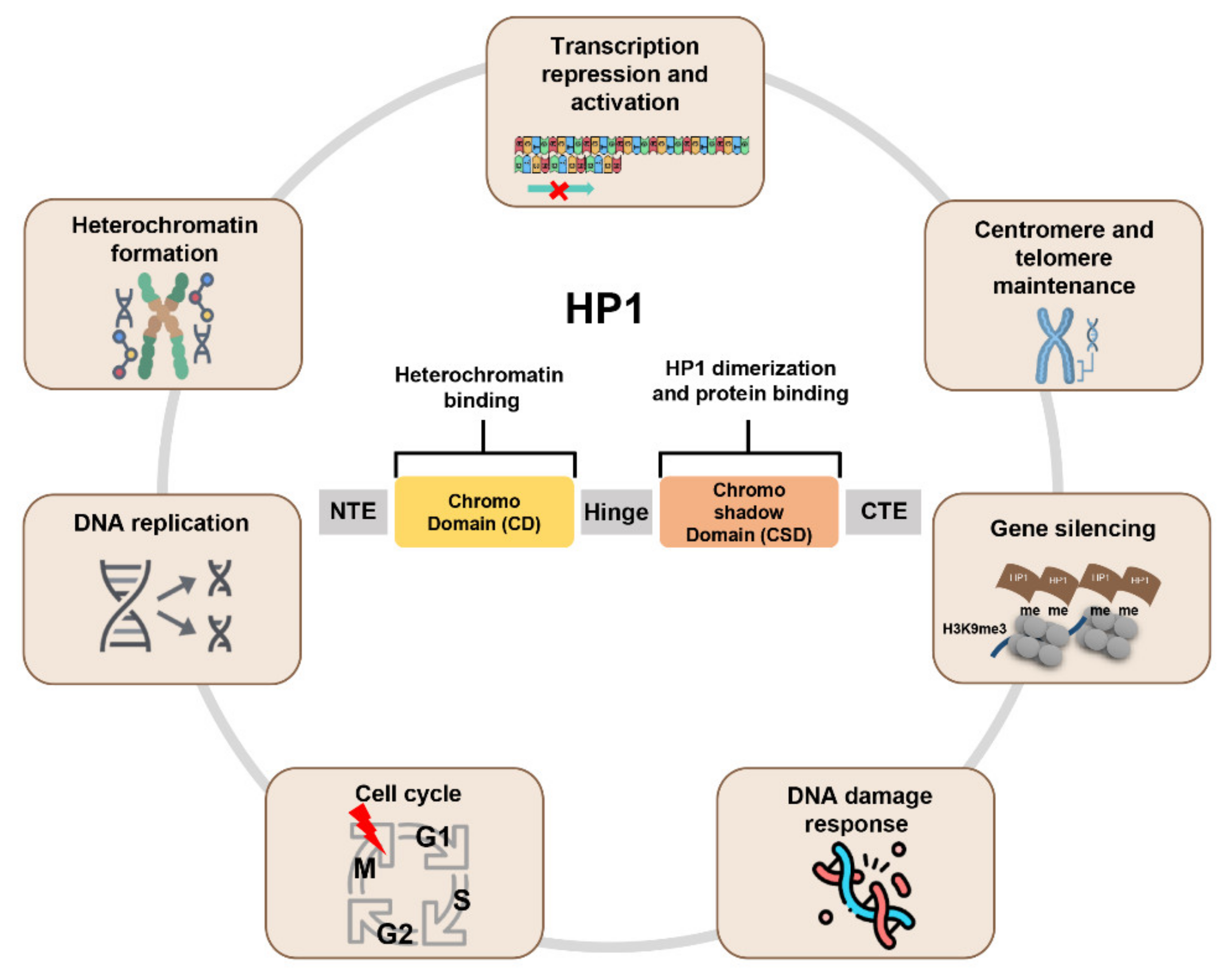
Heterochromatin protein 1 is a histone code reader protein that recognizes histone H3 lysine 9 methylation. It acts as a transcriptional corepressor by forming heterochromatin. Since its discovery, the crucial roles of heterochromatin protein 1 in tumorigenesis have been constantly reported. Indeed, numerous studies report on the altered expression level of heterochromatin protein 1 in various cancers. The changed expression pattern of heterochromatin protein 1 is associated with tumorigenesis as it regulates diverse mechanisms such as heterochromatin formation, transcriptional regulation, DNA repair, cell cycle, and telomere maintenance. Despite the studies suggesting its role in tumorigenesis, the precise tumorigenic mechanism of heterochromatin protein 1 in each cancer type is still not established. In the present review, we summarize the studies conducted on the relationship between heterochromatin protein 1 and cancer. Also, we highlight the possibility of utilizing heterochromatin protein 1 as a prognostic marker and a therapeutic target of cancer.
Abstract
Dysregulation of epigenetic mechanisms as well as genomic mutations contribute to the initiation and progression of cancer. In addition to histone code writers, including histone lysine methyltransferase (KMT), and histone code erasers, including histone lysine demethylase (KDM), histone code reader proteins such as HP1 are associated with abnormal chromatin regulation in human diseases. Heterochromatin protein 1 (HP1) recognizes histone H3 lysine 9 methylation and broadly affects chromatin biology, such as heterochromatin formation and maintenance, transcriptional regulation, DNA repair, chromatin remodeling, and chromosomal segregation. Molecular functions of HP1 proteins have been extensively studied, although their exact roles in diseases require further study. Here, we comprehensively review the studies that have revealed the altered expression of HP1 and its functions in tumorigenesis. In particular, the distinctive effects of each HP1 subtype, namely HP1α, HP1β, and HP1γ, have been thoroughly explored in various cancer types. We also highlight how HP1 can serve as a potential biomarker for cancer prognosis and therapeutic target for cancer patients.
Keywords:
HP1; cancer; DDR; epigenetic reader; chromatin dynamics