The Effect of Older Age and Frailty on the Time to Diagnosis of Cancer: A Connected Bradford Electronic Health Records Study
by
 , , , , , and
Charlotte Summerfield
1,* ,
,
Lesley Smith
2 ,
,
Oliver Todd
3,4,
Cristina Renzi
5,6,
Georgios Lyratzopoulos
5,
Richard D. Neal
7 and
Daniel Jones
1 1
Academic Unit of Primary Care, University of Leeds, Leeds LS2 9JT, UK
2
Clinical and Population Science Department, School of Medicine, University of Leeds, Leeds LS2 9JT, UK
3
Academic Unit for Ageing and Stroke Research, University of Leeds, Leeds LS2 9JT, UK
4
Bradford Institute for Health Research, Bradford Teaching Hospitals NHS Trust, Bradford BD9 6RJ, UK
5
Epidemiology of Cancer Healthcare Outcomes (ECHO) Research Group, Research Department of Behavioural Science and Health, University College London, London WC1E 6BT, UK
6
Faculty of Medicine, University Vita-Salute San Raffaele, Milan, Via Olgettina 58, 20132 Milan, Italy
7
Department of Health and Community Sciences, Faculty of Health and Life Sciences, University of Exeter, Exeter EX4 4PY, UK
*
Author to whom correspondence should be addressed.
Cancers 2022, 14(22), 5666; https://doi.org/10.3390/cancers14225666
Submission received: 25 October 2022
/
Revised: 12 November 2022
/
Accepted: 16 November 2022
/
Published: 18 November 2022
(This article belongs to the Special Issue Cancer Detection in Primary Care)
Simple Summary
Over 60% of cancer diagnoses in the United Kingdom (UK) are in patients aged 65 and over. It can be more complicated to identify and diagnose cancer in older people due to frailty. Frailty means that people are more vulnerable and often take longer to recover from health problems. Delays in diagnosis and treatment of cancer can lead to poorer patient outcomes. Using a database of patients from the Bradford district, we identified a group of patients who presented to their GP with signs suggestive of cancer, and who went on to be diagnosed with cancer, and calculated their degree of frailty using the electronic frailty index (eFI). We found that 1 in 5 of these patients were identified as frail and that frailty was associated with a significantly longer time to cancer diagnosis. We recommend further research takes place to explore reasons behind this delay in diagnosis.
Abstract
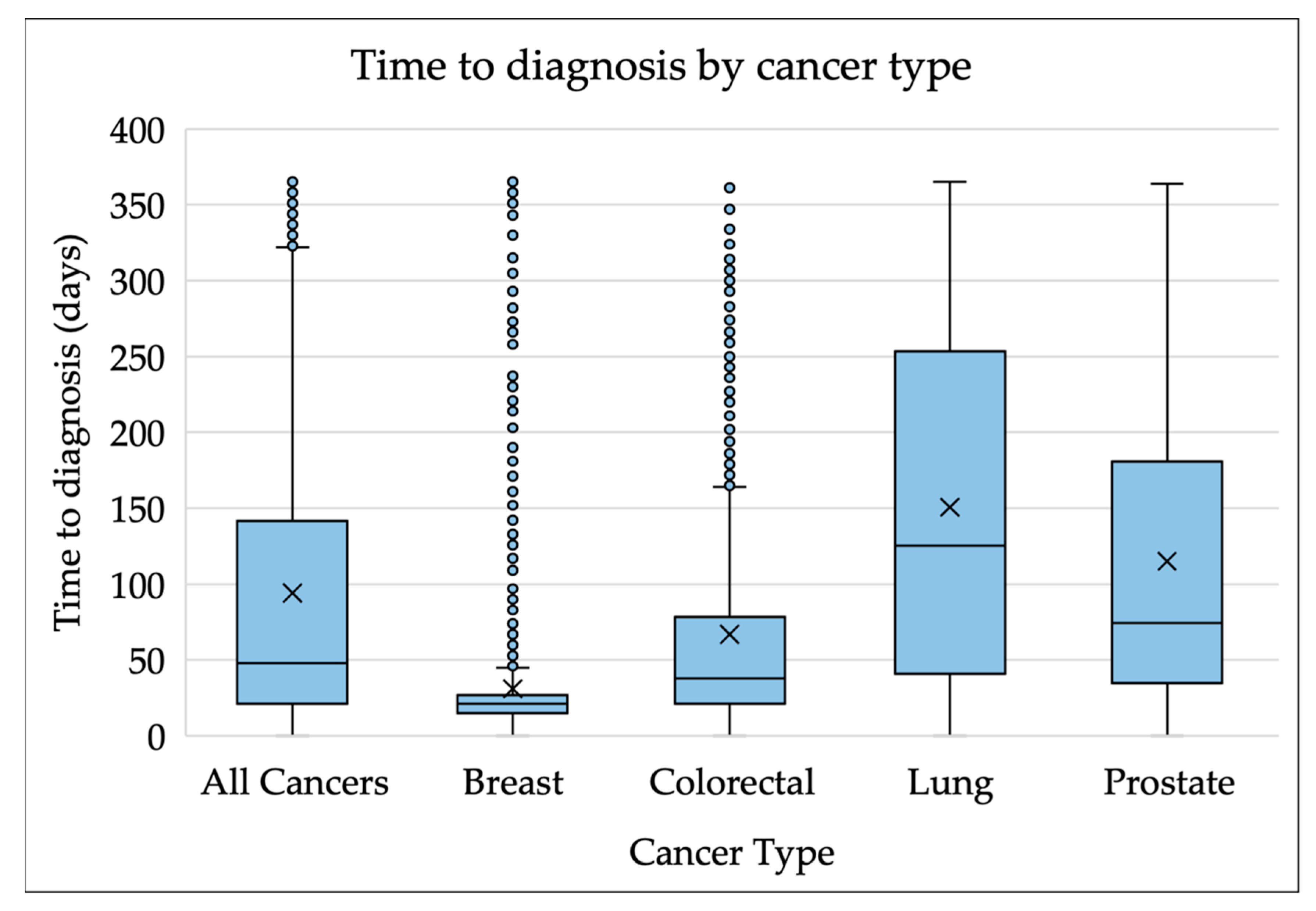
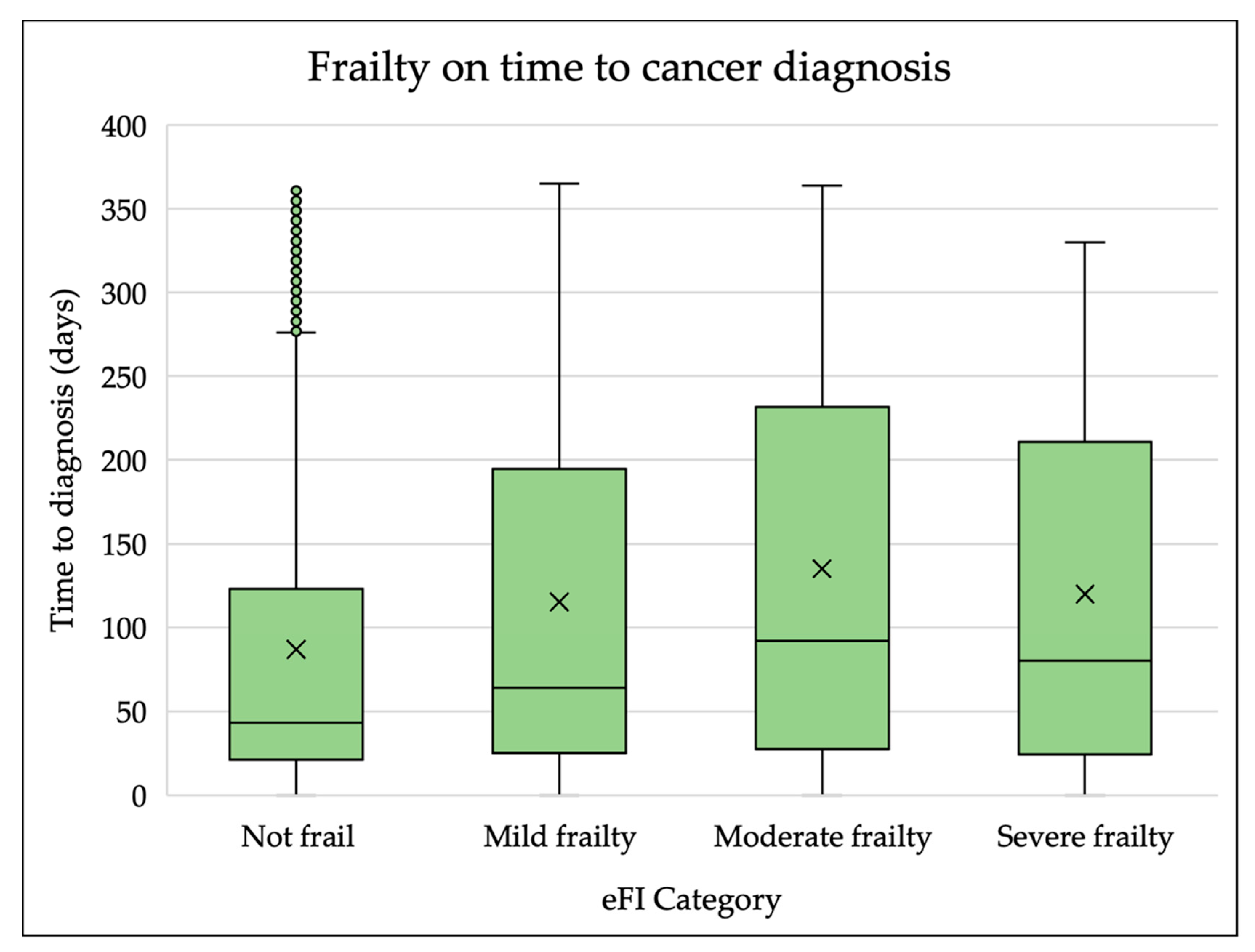
Over 60% of cancer diagnoses in the UK are in patients aged 65 and over. Cancer diagnosis and treatment in older adults is complicated by the presence of frailty, which is associated with lower survival rates and poorer quality of life. This population-based cohort study used a longitudinal database to calculate the time between presentation to primary care with a symptom suspicious of cancer and a confirmed cancer diagnosis for 7460 patients in the Bradford District. Individual frailty scores were calculated using the electronic frailty index (eFI) and categorised by severity. The median time from symptomatic presentation to cancer diagnosis for all patients was 48 days (IQR 21–142). 23% of the cohort had some degree of frailty. After adjustment for potential confounders, mild frailty added 7 days (95% CI 3–11), moderate frailty 23 days (95% CI 4–42) and severe frailty 11 days (95% CI −27–48) to the median time to diagnosis compared to not frail patients. Our findings support use of the eFI in primary care to identify and address patient, healthcare and system factors that may contribute to diagnostic delay. We recommend further research to explore patient and clinician factors when investigating cancer in frail patients.
Keywords:
cancer; diagnosis; primary care; frailty; older age