Sequential Hypofractionated versus Concurrent Twice-Daily Radiotherapy for Limited-Stage Small-Cell Lung Cancer: A Propensity Score-Matched Analysis
by
 ,
,
Wei Zhou
1,†, 
Pang Wang
2,†,
Xinyu Ti
3,
Yutian Yin
1,
Shigao Huang
1,
Zhi Yang
1,
Jie Li
1,
Guangjin Chai
1,
Bo Lyu
1,
Zhaohui Li
1,
Yan Zhou
1,
Feng Xiao
1,
Lin Xu
1,
Mei Shi
1,* and
Lina Zhao
1,* 1
Department of Radiation Oncology, Xijing Hospital, Air Force Medical University, Xi’an 710032, China
2
Out-Patient Department, Xijing Hospital, Air Force Medical University, Xi’an 710032, China
3
Department of Pulmonary Diseases and Critical Care Medicine, Xijing Hospital, Air Force Medical University, Xi’an 710032, China
*
Authors to whom correspondence should be addressed.
†
These authors contributed equally to this work.
Cancers 2022, 14(16), 3920; https://doi.org/10.3390/cancers14163920
Submission received: 3 July 2022
/
Revised: 9 August 2022
/
Accepted: 10 August 2022
/
Published: 13 August 2022
(This article belongs to the Special Issue Personalized Radiation Therapy for Oncology)
Simple Summary
Although twice-daily concurrent chemoradiotherapy for limited-stage small-cell lung cancer (LS-SCLC) is still the standard treatment, this regimen is inconvenient and not universally adopted across different institutions. Therefore, the optimal radiation dose and fractions are still under investigation. A once-daily hypofractionated schedule may be suitable for LS-SCLC patients, and more and more hypofractionated schedule studies are being performed. However, few studies have investigated the efficacy and toxicities of sequential chemotherapy and hypofractionated radiotherapy compared with the concurrent twice-daily schedule. Our evaluation of sequential hypofractionated and twice-daily concurrent chemoradiotherapy schedules before and after propensity score-matched analysis (PSM) for LS-SCLC revealed a comparable survival and less toxicity. The sequential hypofractionated schedule may be used as an alternative to concurrent twice-daily regimens.
Abstract
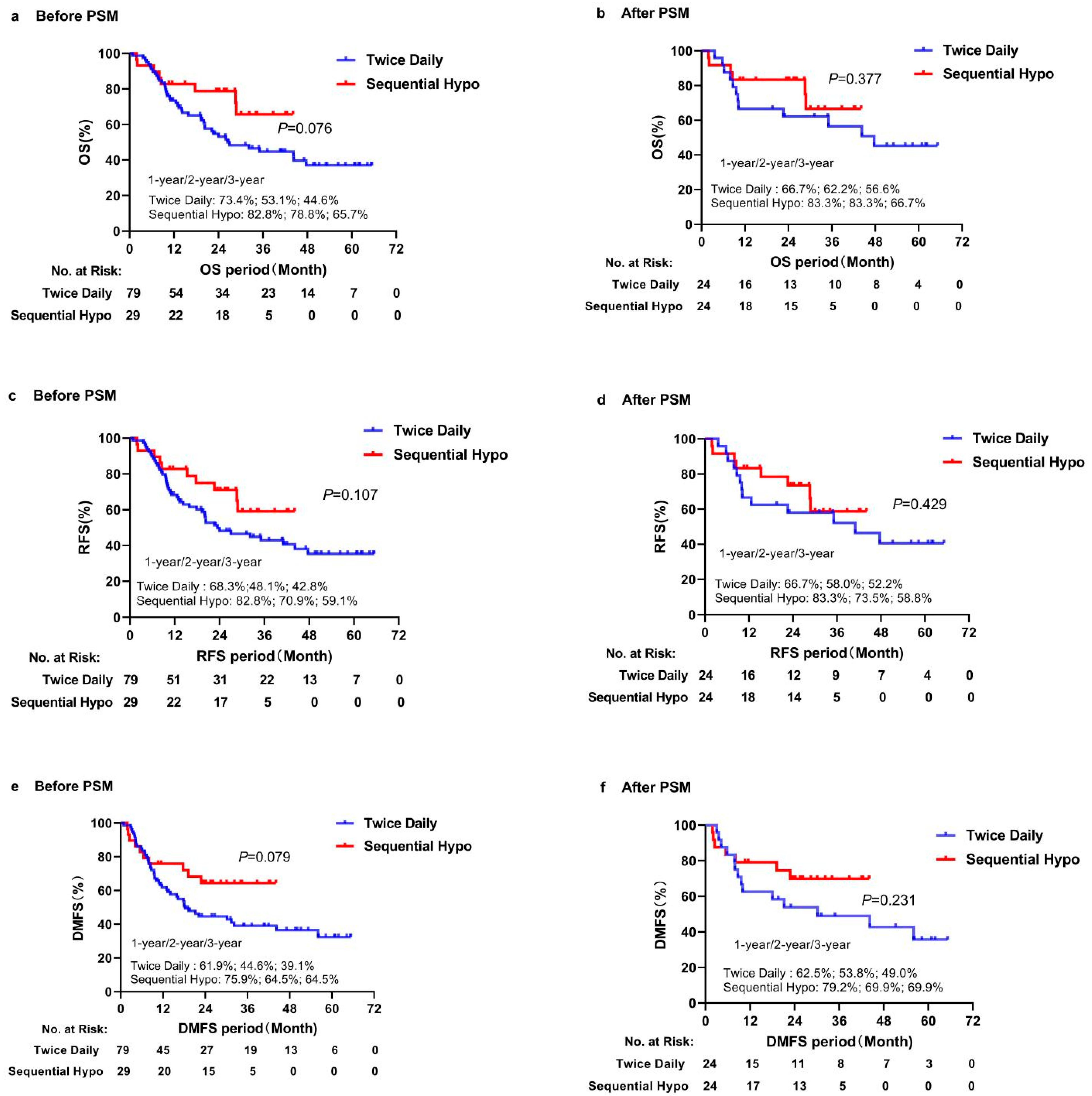
Background: As there are no randomized trials comparing twice-daily with sequential hypofractionated (sequential hypo) radiotherapy regimens for limited-stage small-cell lung cancer (LS-SCLC). This study aimed to compare these two regimens for LS-SCLC by propensity score-matched analysis (PSM). Methods: We retrospectively analyzed 108 LS-SCLC patients between January 2015 and July 2019. All patients received concurrent twice-daily or sequential hypo radiotherapy. The survival, failure patterns, and toxicities were evaluated before and after PSM. Results: Before PSM, multivariate analysis showed that patients treated with sequential hypo had a significantly better overall survival (OS) and distant metastasis-free survival (DMFS) (HR = 0.353, p = 0.009; HR = 0.483, p = 0.039, respectively). Total radiotherapy time ≥ 24 days and stage III (HR = 2.454, p = 0.004; HR = 2.310, p = 0.004, respectively) were poor prognostic indicators for OS. Patients with a total radiotherapy time ≥ 24 days and N2–3 were more likely to recur than others (HR = 1.774, p = 0.048; HR = 2.369, p = 0.047, respectively). N2–3 (HR = 3.032, p = 0.011) was a poor prognostic indicator for DMFS. After PSM, being aged ≥65 years was associated with poorer OS, relapse-free survival (RFS) and DMFS (p < 0.05). A total radiotherapy time of ≥24 days was a poor prognostic indicator for OS and RFS (HR = 2.671, p = 0.046; HR = 2.370, p = 0.054, respectively). Although there was no significant difference, the patients in the sequential hypo group had a trend towards a better OS. The failure pattern between the two groups showed no difference. More patients had grade 1–2 esophagitis in the twice-daily group (p = 0.001). Conclusions: After propensity matching, no difference was shown in survival and failure. The sequential hypo schedule was associated with comparable survival and less toxicity and may be used as an alternative to concurrent twice-daily regimens.