Anthracyclines Strike Back: Rediscovering Non-Pegylated Liposomal Doxorubicin in Current Therapeutic Scenarios of Breast Cancer
by
 , , , , , , , , , , , , , , , and add
Show full author list
, , , , , , , , , , , , , , , and add
Show full author list
Francesco Schettini
1,2 ,
,
Mario Giuliano
3, 
Matteo Lambertini
4,5 ,
,
Rupert Bartsch
6, 
David James Pinato
7,8 ,
,
Concetta Elisa Onesti
9,
Nadia Harbeck
10,
Diana Lüftner
11,
Sylvie Rottey
12,
Peter A. van Dam
13 ,
,
Khalil Zaman
14,
Giorgio Mustacchi
15,
Joseph Gligorov
16,
Ahmad Awada
17,
Mario Campone
18,
Hans Wildiers
19,
Alessandra Gennari
8,
Vivianne C. G. Tjan-Heijnen
20,
Javier Cortes
21,22 ,
,
Mariavittoria Locci
23, 
Ida Paris
24 ,
,
Lucia Del Mastro
4,5 ,
,
Sabino De Placido
3,
Miguel Martín
25,
Guy Jerusalem
26,
Sergio Venturini
27,
Giuseppe Curigliano
28 and
Daniele Generali
29,30,* add
Show full author list
add
Show full author list
1
Translational Genomics and Targeted Therapies in Solid Tumors Research Group, 08036 Barcelona, Spain
2
Department of Medical Oncology, Hospital Clinic of Barcelona, 08036 Barcelona, Spain
3
Department of Clinical Medicine and Surgery, University of Naples Federico II, 80131 Naples, Italy
4
Department of Internal Medicine and Medical Specialties (DiMI), School of Medicine, University of Genova, 16132 Genova, Italy
5
Department of Medical Oncology, U.O.C Clinica di Oncologia Medica, IRCCS Ospedale Policlinico San Martino, 16132 Genova, Italy
6
Division of Oncology, Department of Medicine 1, Medical University of Vienna, 1090 Vienna, Austria
7
Division of Cancer, Department of Surgery and Cancer, Imperial College London, London SW7 2AZ, UK
8
Department of Translational Medicine, Università del Piemonte Orientale “A. Avogadro”, 28100 Novara, Italy
9
Clinical and Oncological Research Department, IRCCS Regina Elena National Cancer Institute, 00144 Rome, Italy
10
Breast Center, Department OB&GYN and CCCLMU, LMU University Hospital, 81377 Munich, Germany
11
Department of Hematology, Oncology and Tumor Immunology, Charité—Universitätsmedizin Berlin, 10117 Berlin, Germany
12
Department of Medical Oncology, UZ Gent, 9000 Gent, Belgium
13
Oncology Department, University Hospital Antwerp (UZA), 2650 Edegem, Belgium
14
Oncology Department, Lausanne University Hospital CHUV, 1011 Lausanne, Switzerland
15
Division of Medical Oncology, University of Trieste, 34127 Trieste, Italy
16
Department of Medical Oncology, Tenon Hospital, Institut Universitaire de Cancérologie AP-HP, Sorbonne University, 75004 Paris, France
17
Department of Medical Oncology, Institut Jules Bordet, Université Libre de Bruxelles, 1000 Bruxelles, Belgium
18
Division of Medical Oncology, Institut de Cancérologie de l’Ouest-Pays de la Loire, 44800 Saint-Herblain, France
19
Department of General Medical Oncology, University Hospital Leuven, 3000 Leuven, Belgium
20
Division of Medical Oncology, Maastricht University Medical Center (MUMC), 6229 Maastricht, The Netherlands
21
Oncology Department, IOB Institute of Oncology, Quiron Group, 08023 Madrid, Spain
22
Vall d’Hebron Institute of Oncology (VHIO), Centro Cellex, 08035 Carrer de Natzaret, Spain
23
Department of Neuroscience, Reproductive Medicine, Odontostomatology, University of Naples Federico II, 80131 Naples, Italy
24
Department of Woman and Child Health and Public Health, Woman Health Area, Fondazione Policlinico Universitario A, Gemelli IRCCS, 00168 Rome, Italy
25
Departamento de Medicina, Instituto de Investigación Sanitaria Gregorio Marañón Universidad Complutense, 28007 Madrid, Spain
26
Division of Medical Oncology, CHU Sart Tilman Liège and University of Liège, 4000 Liège, Belgium
27
Management Department, University of Turin, 10124 Torino, Italy
28
Istituto Europeo di Oncologia, IRCCS ed Università di Milano, 20141 Milano, Italy
29
Department of Medicine, Surgery and Health Sciences, University of Trieste, 34127 Trieste, Italy
30
Multidisciplinary Unit of Breast Pathology and Translational Research, Cremona Hospital, Viale Concordia 1, 26100 Cremona, Italy
*
Author to whom correspondence should be addressed.
Cancers 2021, 13(17), 4421; https://doi.org/10.3390/cancers13174421
Submission received: 28 June 2021
/
Revised: 27 August 2021
/
Accepted: 31 August 2021
/
Published: 1 September 2021
(This article belongs to the Special Issue Metastatic Breast Cancers)
Simple Summary
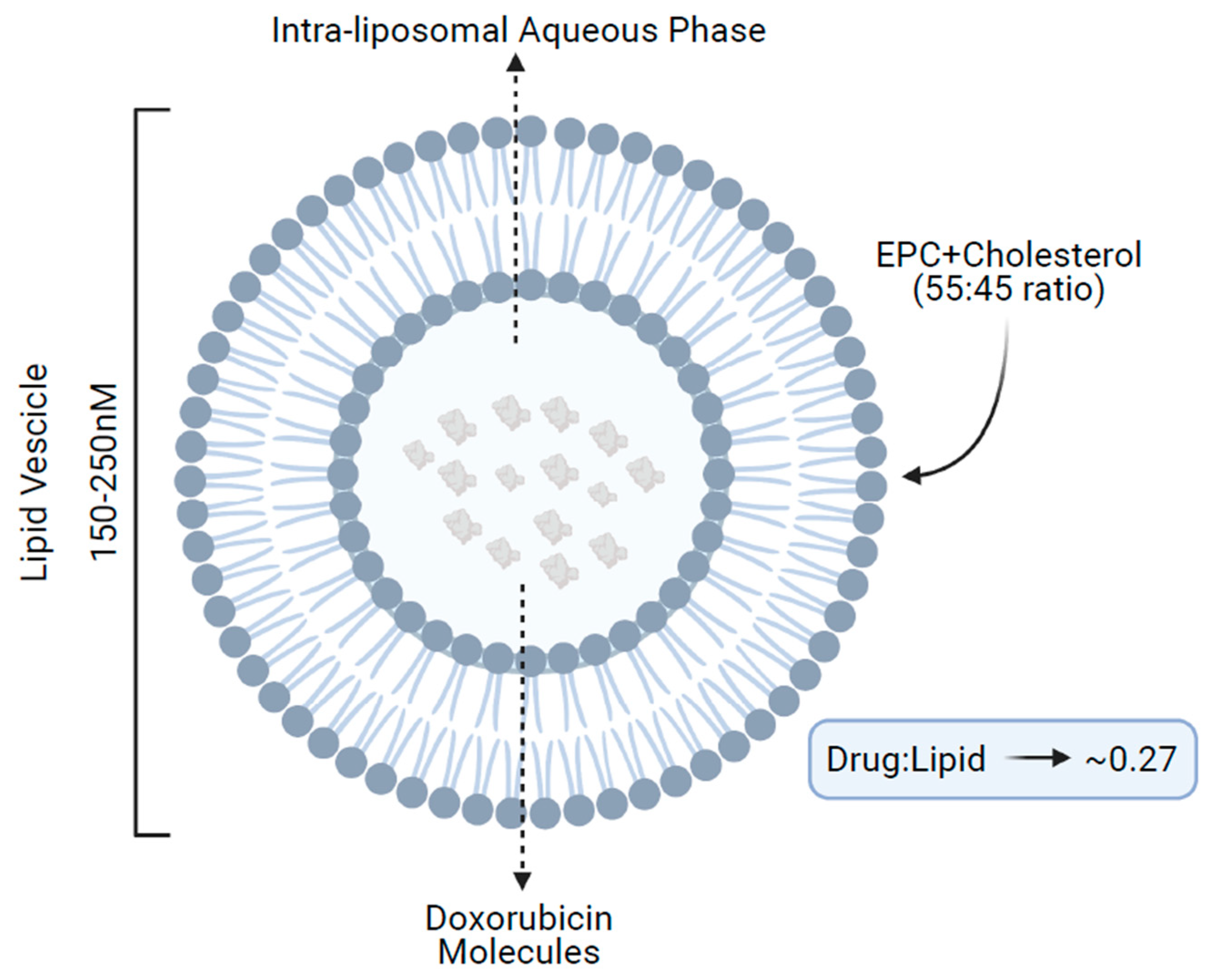
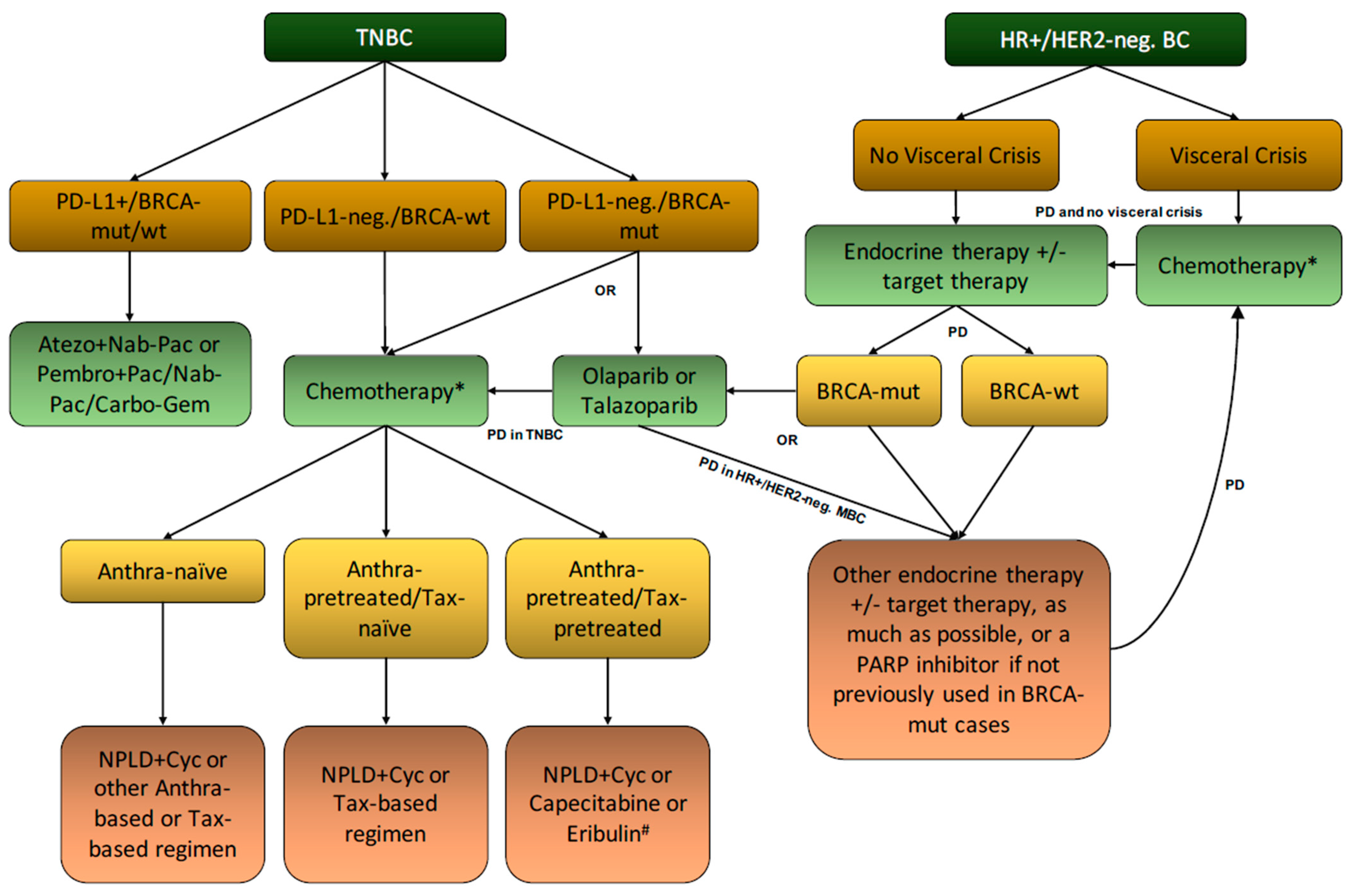
Anthracyclines are among the most active chemotherapies in breast cancer (BC). However, they can cause structural and cumulative dose-related cardiac damage; hence, they require careful administration after preliminary functional cardiac assessment and subsequent monitoring, along with a limitation in the cumulative dose delivered. Non-pegylated liposomal doxorubicin (NPLD) has been precisely developed to optimize the doxorubicin toxicity profile, while retaining its therapeutic efficacy, thanks to a reduced diffusion in normal tissues with preserved drug penetrance into cancer sites. This has allowed administration of NPLD beyond a conventional doxorubicin maximum cumulative dose, as well as in patients with cardiac comorbilities or anthracycline pretreatment. At present, NPLD is approved in Europe and Canada in combination with cyclophosphamide as the first line of metastatic HER2-negative BC. However, given the increasing complexity of the therapeutic scenario in this setting, we have carefully revised the most updated literature on the topic and dissected the potential role of NPLD in the evolving therapeutic algorithms.
Abstract
Anthracyclines are among the most active chemotherapies (CT) in breast cancer (BC). However, cardiotoxicity is a risk and peculiar side effect that has been limiting their use in clinical practice, especially after the introduction of taxanes. Non-pegylated liposomal doxorubicin (NPLD) has been developed to optimize the toxicity profile induced by anthracyclines, while maintaining its unquestionable therapeutic index, thanks to its delivering characteristics that increase its diffusion in tumor tissues and reduce it in normal tissues. This feature allows NPLD to be safely administered beyond the standard doxorubicin maximum cumulative dose of 450–480 mg/m2. Following three pivotal first-line phase III trials in HER2-negative metastatic BC (MBC), this drug was finally approved in combination with cyclophosphamide in this specific setting. Given the increasing complexity of the therapeutic scenario of HER2-negative MBC, we have carefully revised the most updated literature on the topic and dissected the potential role of NPLD in the evolving therapeutic algorithms.