The PATHFINDER Study: Assessment of the Implementation of an Investigational Multi-Cancer Early Detection Test into Clinical Practice
by
 , ,
, ,
Lincoln D. Nadauld
1,*, 
Charles H. McDonnell III
2,
Tomasz M. Beer
3,
Minetta C. Liu
4,
Eric A. Klein
5,
Andrew Hudnut
2,
Richard A. Whittington
6,
Bruce Taylor
6,
Geoffrey R. Oxnard
7,
Jafi Lipson
8,
Margarita Lopatin
9,
Rita Shaknovich
9,
Karen C. Chung
9,
Eric T. Fung
9,
Deborah Schrag
7 and
Catherine R. Marinac
7 1
Hematology/Oncology, Intermountain Healthcare, St. George, UT 84790, USA
2
Sutter Health, Sacramento, CA 95816, USA
3
Hematology/Medical Oncology, Oregon Health & Science University Knight Cancer Institute, Portland, OR 97239, USA
4
Departments of Oncology and Laboratory Medicine & Pathology, Mayo Clinic, Rochester, MN 55905, USA
5
Glickman Urological and Kidney Institute, Cleveland Clinic, Cleveland, OH 44195, USA
6
Department of Internal Medicine, Intermountain Healthcare, Salt Lake City, UT 84111, USA
7
Department of Medical Oncology, Division of Population Sciences, Dana-Farber Cancer Institute, Boston, MA 02215, USA
8
Radiology Department, Stanford Hospital and Clinics, Stanford, CA 94305, USA
9
GRAIL, Inc., Menlo Park, CA 94025, USA
*
Author to whom correspondence should be addressed.
Cancers 2021, 13(14), 3501; https://doi.org/10.3390/cancers13143501
Submission received: 9 April 2021
/
Revised: 6 July 2021
/
Accepted: 8 July 2021
/
Published: 13 July 2021
(This article belongs to the Section Cancer Causes, Screening and Diagnosis)
Simple Summary
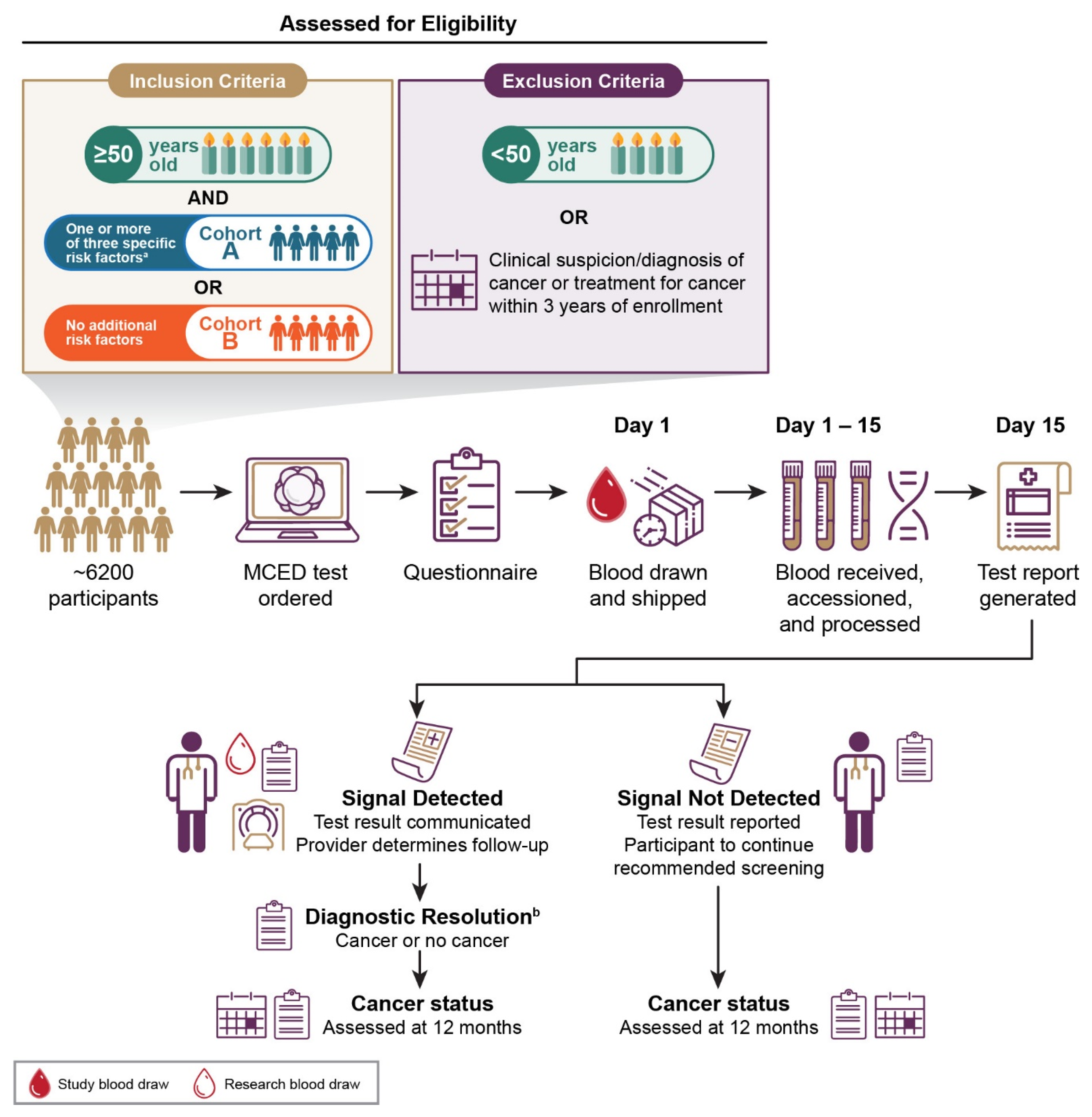
PATHFINDER is an interventional study that will examine how well a multi-cancer early detection test can be integrated into clinical practice. This test looks at DNA methylation patterns in patient blood samples to detect cancer and also predict cancer origin. The PATHFINDER study will include ~6200 study participants from 31 sites in the United States. The study will return tests results to participants and their health care providers and will evaluate how test results affect the clinical pathway to confirm or rule out a cancer diagnosis. Results of this study could help determine how a blood-based multi-cancer early detection test will fit into clinical practice.
Abstract
To examine the extent of the evaluation required to achieve diagnostic resolution and the test performance characteristics of a targeted methylation cell-free DNA (cfDNA)-based multi-cancer early detection (MCED) test, ~6200 participants ≥50 years with (cohort A) or without (cohort B) ≥1 of 3 additional specific cancer risk factors will be enrolled in PATHFINDER (NCT04241796), a prospective, longitudinal, interventional, multi-center study. Plasma cfDNA from blood samples will be analyzed to detect abnormally methylated DNA associated with cancer (i.e., cancer “signal”) and a cancer signal origin (i.e., tissue of origin). Participants with a “signal detected” will undergo further diagnostic evaluation per guiding physician discretion; those with a “signal not detected” will be advised to continue guideline-recommended screening. The primary objective will be to assess the number and types of subsequent diagnostic tests needed for diagnostic resolution. Based on microsimulations (using estimates of cancer incidence and dwell times) of the typical risk profiles of anticipated participants, the median (95% CI) number of participants with a “signal detected” result is expected to be 106 (87–128). Subsequent diagnostic evaluation is expected to detect 52 (39–67) cancers. The positive predictive value of the MCED test is expected to be 49% (39–58%). PATHFINDER will evaluate the integration of a cfDNA-based MCED test into existing clinical cancer diagnostic pathways. The study design of PATHFINDER is described here.