Old Player-New Tricks: Non Angiogenic Effects of the VEGF/VEGFR Pathway in Cancer
by
 , , , ,
Panagiotis Ntellas
1,2, 
Leonidas Mavroeidis
1,2,
Stefania Gkoura
1,2,
Ioanna Gazouli
1,2,
Anna-Lea Amylidi
1,2,
Alexandra Papadaki
1,2,
George Zarkavelis
1,2,
Davide Mauri
1,2,
Georgia Karpathiou
3,
Evangelos Kolettas
4,5, 
Anna Batistatou
6 and
George Pentheroudakis
1,2,* 1
Department of Medical Oncology, University Hospital of Ioannina, 45500 Ioannina, Greece
2
Society for Study of Clonal Heterogeneity of Neoplasia (EMEKEN), 45445 Ioannina, Greece
3
Department of Pathology, University Hospital of St-Etienne, 42055 Saint Etienne, France
4
Laboratory of Biology, School of Medicine, Faculty of Health Sciences, University of Ioannina, 45110 Ioannina, Greece
5
Biomedical Research Division, Institute of Molecular Biology & Biotechnology, Foundation for Research & Technology, 45115 Ioannina, Greece
6
Department of Pathology, University Hospital of Ioannina, 45500 Ioannina, Greece
*
Author to whom correspondence should be addressed.
Cancers 2020, 12(11), 3145; https://doi.org/10.3390/cancers12113145
Submission received: 28 September 2020
/
Revised: 21 October 2020
/
Accepted: 23 October 2020
/
Published: 27 October 2020
(This article belongs to the Special Issue Angiogenesis in Cancers)
Simple Summary
Although VEGF-A is well characterized as the principal player of cancer angiogenesis, new data on the interplay with other components of the tumor microenvironment emerge. Here we review the effect of VEGF-A on cancer cells and immune cells as well as investigative and established combinational therapies of anti-angiogenic agents with immune checkpoint inhibitors. We thus elaborate the scientific rationale behind the development of these novel combinational approaches.
Abstract
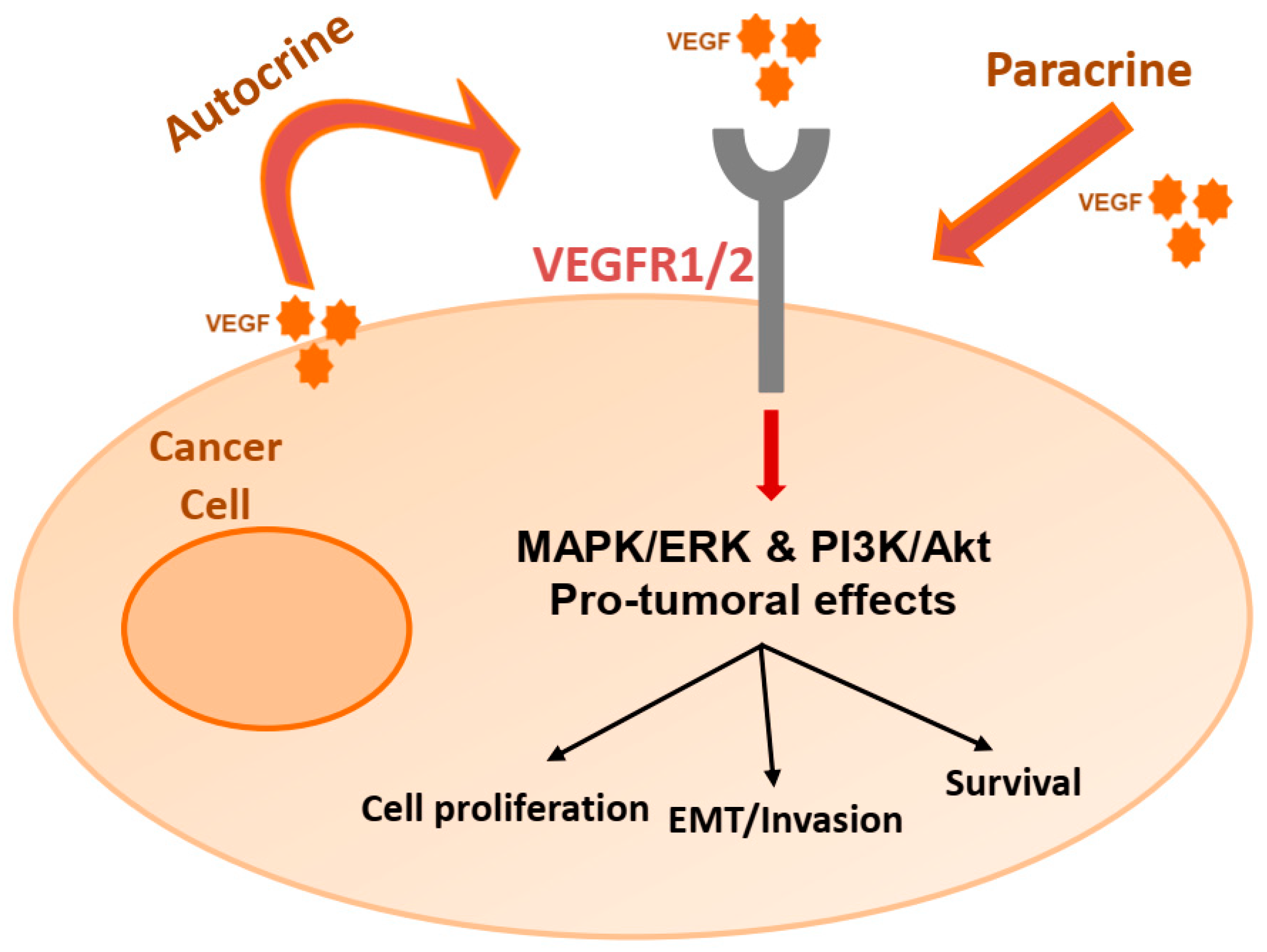
Angiogenesis has long been considered to facilitate and sustain cancer growth, making the introduction of anti-angiogenic agents that disrupt the vascular endothelial growth factor/receptor (VEGF/VEGFR) pathway an important milestone at the beginning of the 21st century. Originally research on VEGF signaling focused on its survival and mitogenic effects towards endothelial cells, with moderate so far success of anti-angiogenic therapy. However, VEGF can have multiple effects on additional cell types including immune and tumor cells, by directly influencing and promoting tumor cell survival, proliferation and invasion and contributing to an immunosuppressive microenvironment. In this review, we summarize the effects of the VEGF/VEGFR pathway on non-endothelial cells and the resulting implications of anti-angiogenic agents that include direct inhibition of tumor cell growth and immunostimulatory functions. Finally, we present how previously unappreciated studies on VEGF biology, that have demonstrated immunomodulatory properties and tumor regression by disrupting the VEGF/VEGFR pathway, now provide the scientific basis for new combinational treatments of immunotherapy with anti-angiogenic agents.