Review

Targeted Therapy of Uveal Melanoma: Recent Failures and New Perspectives

IRCCS Ospedale Policlinico San Martino, 16132 Genoa, Italy
*
Author to whom correspondence should be addressed.
Cancers 2019, 11(6), 846; https://doi.org/10.3390/cancers11060846

Submission received: 13 May 2019 / Revised: 10 June 2019 / Accepted: 11 June 2019 / Published: 18 June 2019
(This article belongs to the Special Issue Uveal Melanoma)

Abstract

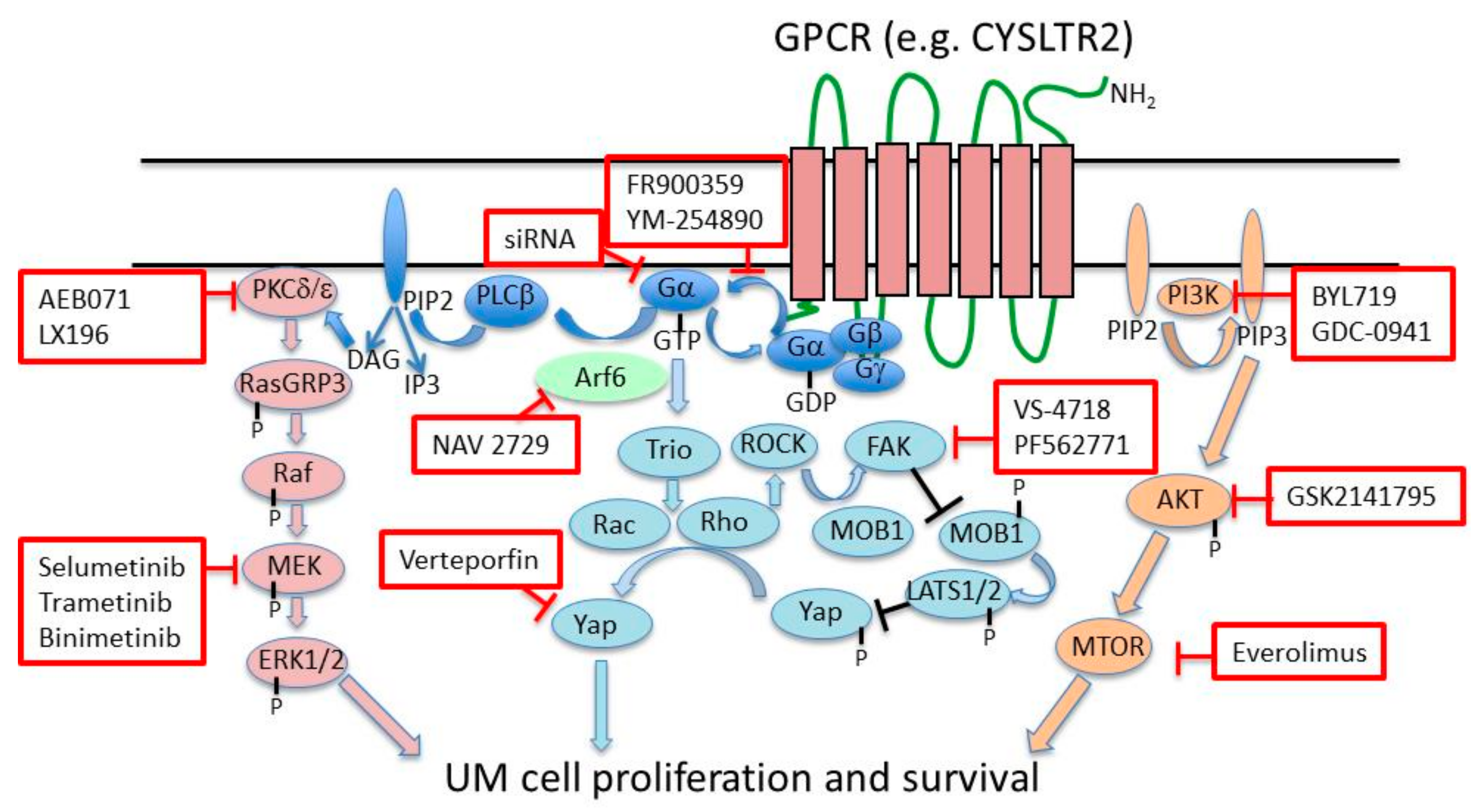
Among Uveal Melanoma (UM) driver mutations, those involving GNAQ or GNA11 genes are the most frequent, while a minor fraction of tumors bears mutations in the PLCB4 or CYSLTR2 genes. Direct inhibition of constitutively active oncoproteins deriving from these mutations is still in its infancy in UM, whereas BRAFV600E-targeted therapy has obtained relevant results in cutaneous melanoma. However, UM driver mutations converge on common downstream signaling pathways such as PKC/MAPK, PI3K/AKT, and YAP/TAZ, which are presently considered as actionable targets. In addition, BAP1 loss, which characterizes UM metastatic progression, affects chromatin structure via histone H2A deubiquitylation that may be counteracted by histone deacetylase inhibitors. Encouraging results of preclinical studies targeting signaling molecules such as MAPK and PKC were unfortunately not confirmed in early clinical studies. Indeed, a general survey of all clinical trials applying new targeted and immune therapy to UM displayed disappointing results. This paper summarizes the most recent studies of UM-targeted therapies, analyzing the possible origins of failures. We also focus on hyperexpressed molecules involved in UM aggressiveness as potential new targets for therapy.
Keywords: uveal melanoma; driver mutations; signaling pathways; targeted therapies uveal melanoma; driver mutations; signaling pathways; targeted therapies