Article

An Efficient Numerical Homogenization Method for Multi-Scale Modeling of 2.5D Package Warpage and Thermal Analysis


1
Science and Technology on Electronic Test and Measurement Laboratory, North University of China, Taiyuan 030051, China
2
State Key Laboratory of Extreme Environment Optoelectronic Dynamic Measurement Technology and Instrument, North University of China, Taiyuan 030051, China
3
Beijing Institute of Aerospace Microsystem and Information Technology, Beijing 100094, China
4
College of Information and Control Engineering, Xi’an University of Architecture and Technology, Xi’an 710055, China
5
State Key Laboratory of Electromechanical Integrated Manufacturing of High-Performance Electronic Equipments, Xidian University, Xi’an 710071, China
*
Authors to whom correspondence should be addressed.
Micromachines 2026, 17(7), 853; https://doi.org/10.3390/mi17070853
Submission received: 4 June 2026 / Revised: 14 July 2026 / Accepted: 15 July 2026 / Published: 17 July 2026

Abstract

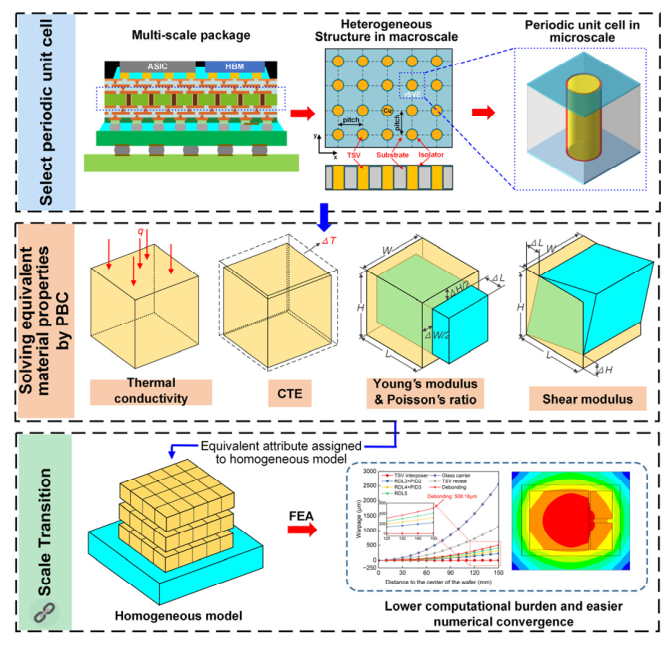
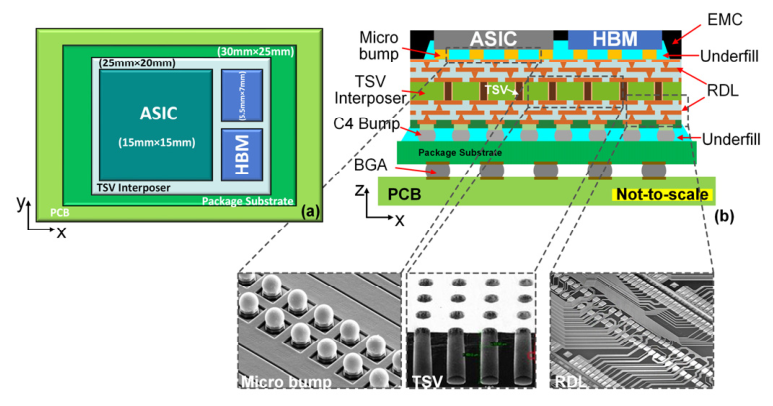
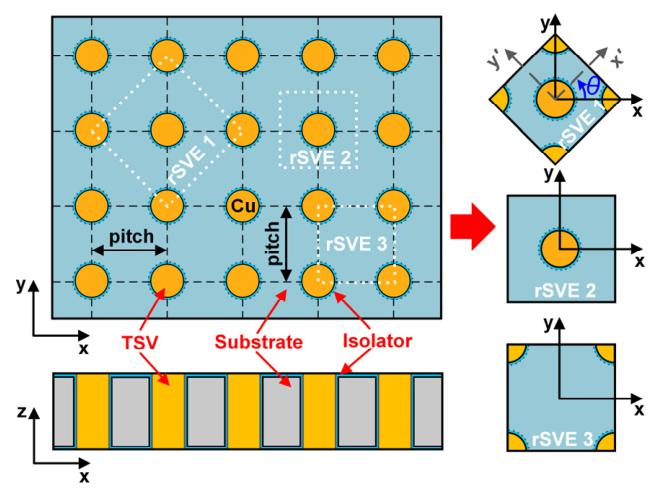
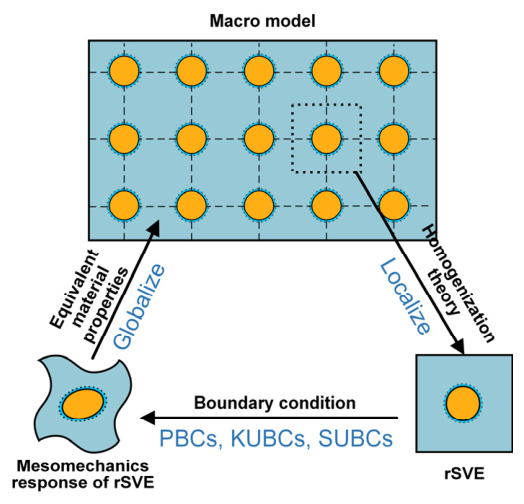
To achieve high interconnect density in 2.5D packages, various microscale structures such as through-silicon vias (TSVs), microbumps, and redistribution layers (RDLs) are employed. These features typically exist at the micron scale, whereas other package components span millimeter to centimeter scales, resulting in a wide range of physical dimensions within the package. Although finite element analysis (FEA) has proven effective for evaluating the mechanical and thermal characteristics of 2.5D packages, the inherent multi-scale nature poses significant computational challenges and numerical convergence issues, severely hindering the design and analysis of increasingly dense packages. To address this problem, this paper proposes an efficient numerical homogenization method for the mechanical and thermal analysis of 2.5D packages. The method employs periodic boundary conditions (PBCs) based on the concept of referential statistical volume elements (rSVEs). In this approach, typical microstructures—including TSVs, microbumps, and RDL traces together with the surrounding matrix material—are treated as a homogeneous medium, and the equivalent material properties of the multi-scale structures are evaluated. These properties include the stiffness matrices (from which the equivalent Young’s modulus, shear modulus, and Poisson’s ratio can be derived), coefficients of thermal expansion, and thermal conductivity. Validation results demonstrate that the proposed method ensures continuity of displacement, stress, strain, and heat flux across opposite surface pairs of the rSVEs. Compared with experimental measurements and other existing homogenization techniques, the method accurately determines the equivalent material properties of complex multi-scale structures without being restricted to specific geometries, while significantly improving computational efficiency. Finally, the proposed numerical homogenization method is successfully applied to wafer warpage analysis during the manufacturing process and to thermal analysis under operating conditions. The results indicate that the method achieves high computational efficiency while maintaining accuracy in both mechanical and thermal analyses of 2.5D packages, thereby laying a solid foundation for the development of next-generation 2.5D package structures.
Keywords: numerical homogenization; multi-scale analysis; 2.5D packaging; periodic boundary condition; warpage analysis; thermal analysis numerical homogenization; multi-scale analysis; 2.5D packaging; periodic boundary condition; warpage analysis; thermal analysis