Article

Design and Simulation of a High-Performance GaN Vertical Merged P-i-N/Schottky (MPS) Diode with Multi-Drift-Layer and Field-Plate Termination

ICT & Robotics Engineering, Semiconductor Convergence Engineering, AISPC Laboratory and IITC, Hankyong National University, 327 Jungang-ro, Anseong-si 17579, Gyenggi-do, Republic of Korea
*
Author to whom correspondence should be addressed.
Micromachines 2026, 17(6), 722; https://doi.org/10.3390/mi17060722 (registering DOI)
Submission received: 14 May 2026 / Revised: 11 June 2026 / Accepted: 12 June 2026 / Published: 14 June 2026
(This article belongs to the Topic Wide Bandgap Semiconductor Electronics and Devices)

Abstract

This paper presents the design, structural optimization, and two-dimensional (2D) technology computer-aided design (TCAD) simulation of a gallium nitride (GaN) vertical Merged P-i-N/Schottky (MPS) diode incorporating a multi-drift-layer doping profile, composite SiO2/Si3N4 passivation, and field-plate (FP) termination. The proposed device is constructed on an n+-GaN substrate with a three-sub-layer n-type drift region and a p-GaN/p+-GaN anode region. Systematic TCAD simulations are performed to investigate the dependences of key performance metrics—including knee voltage (Vknee), specific on-resistance (Ron), breakdown voltage (BV), reverse leakage current (Jleak), and Baliga’s figure of merit (BFOM)—on the Schottky metal work function, multi-drift-layer doping concentration, drift-layer thickness, Schottky-to-PN contact length ratio (γw), operating temperature, and reverse recovery switching transients. Results demonstrate that the MPS architecture effectively decouples forward conduction loss from reverse blocking capability, overcoming the conventional RonBV trade-off. The optimal doping profile (nmm = 2 × 10¹⁵, nm = 2 × 10¹⁵, n = 1 × 1016 cm−3) achieves a BFOM of ~31.97 GW·cm−2 with BV ≈ 5.98 kV and Ron ≈ 1.12 mΩ·cm2. Joint doping–thickness optimization further identifies a graded doping profile (nmm = 2 × 10¹⁵, nm = 5 × 10¹⁵, n = 1 × 1016 cm−3) combined with layer thicknesses (Tnmm, Tnm, Tn) = (4.49, 5, 20) μm as the overall optimum, achieving BFOM = 55.36 GW·cm−2 (BV = 6.61 kV, Ron = 0.79 mΩ·cm2)—a +73% improvement, governed by the punch-through/field-stop design principle. The optimal contact ratio of γw = 1.33 yields a BFOM of 38.71 GW·cm−2. Temperature analysis confirms a positive BV temperature coefficient due to drift-region-limited avalanche breakdown, and the BFOM improves monotonically from 33.31 to 37.82 GW·cm−2 between 200 K and 450 K. Mixed-mode switching simulations show that increasing γw substantially reduces reverse recovery charge (Qrr), demonstrating the strong potential of the proposed MPS diode for high-voltage, high-frequency, and high-temperature power electronic applications.

1. Introduction

Wide-bandgap (WBG) semiconductor materials have attracted intense research interest for next-generation power electronic applications due to their superior physical properties compared with conventional silicon (Si) [1,2]. Among WBG semiconductors, gallium nitride (GaN) stands out owing to its wide bandgap (~3.4 eV), high critical electric field (~3.3 MV/cm), high electron mobility, and high thermal conductivity [3,4]. These properties place GaN well above Si and on par with or superior to silicon carbide (SiC) in terms of Baliga’s figure of merit (BFOM), making it an attractive material platform for power rectifiers and switches operating at high voltage, high current, and elevated temperatures [5,6].
Vertical GaN power diodes are particularly attractive for high-power applications because the vertical current path allows the drift region to independently sustain the blocking voltage, enabling higher breakdown voltage (BV) and current density than lateral device architectures [7,8]. Among vertical GaN rectifiers, Schottky barrier diodes (SBDs) offer low knee voltage (Vknee) and fast unipolar switching, but suffer from high reverse leakage current (Jleak) and limited BV due to electric-field crowding at the metal–semiconductor interface [9,10]. In contrast, GaN P-i-N (PiN) diodes achieve excellent reverse blocking capability with near-ideal avalanche behavior, but exhibit a significantly higher Vknee and large on-resistance (Ron) at low current densities due to the bipolar turn-on voltage [11,12].
The Merged P-i-N/Schottky (MPS) diode architecture—also referred to as a Junction Barrier Schottky (JBS) diode in some literature—was originally developed for SiC and has more recently been investigated for GaN [13,14]. The MPS structure integrates Schottky and ohmic contacts at the anode, such that forward current flows primarily through the low-resistance Schottky path, while embedded p-GaN regions shield the Schottky interface from high electric fields under reverse bias [15,16]. This dual-path configuration enables simultaneous achievement of low Vknee, reduced Ron, and high BV, effectively relaxing the fundamental RonBV trade-off inherent to conventional unipolar and bipolar devices [17,18].
Field-plate (FP) termination has been widely adopted in GaN power devices to redistribute the electric field at device edges, suppressing premature edge breakdown and improving BV [19,20]. Composite dielectric passivation layers, such as SiO2/Si3N4 stacks, further reduce surface leakage and trap-related degradation, contributing to improved long-term device reliability [21,22]. In addition, engineering the drift-layer doping profile through a multi-layer approach—rather than a uniform single layer—allows simultaneous optimization of forward conduction and reverse blocking by tailoring the electric field distribution within the drift region [23].
Despite the growing body of experimental and simulation literature on GaN SBDs, PiN diodes, and MPS structures, a comprehensive and systematic design optimization of a vertical GaN MPS diode combining all three elements—multi-drift-layer profile, composite passivation, and FP termination—remains limited. Specifically, the independent and combined influences of the Schottky barrier height (via metal work function), multi-drift-layer doping profile, Schottky-to-PN contact length ratio (γw), temperature, and switching dynamics on the comprehensive set of performance metrics have not been systematically quantified within a unified device framework [24,25].
In this work, we present a detailed 2D TCAD design and simulation study of a GaN vertical MPS diode incorporating a three-sub-layer n-type drift region, composite SiO2/Si3N4 passivation, and anode field-plate termination using the TCAD simulator [26,27]. We systematically investigate the effects of: (1) Schottky metal work function; (2) multi-drift-layer doping concentration; (3) Schottky-to-PN contact length ratio; (4) operating temperature; and (5) reverse recovery switching transients; and (6) drift-layer thickness, including the joint doping-thickness optimum. The results provide a clear design guideline for realizing high-voltage, low-loss GaN MPS diodes suitable for next-generation power electronics.

2. Device Structure and Simulation Methodology

2.1. Proposed MPS Diode Structure

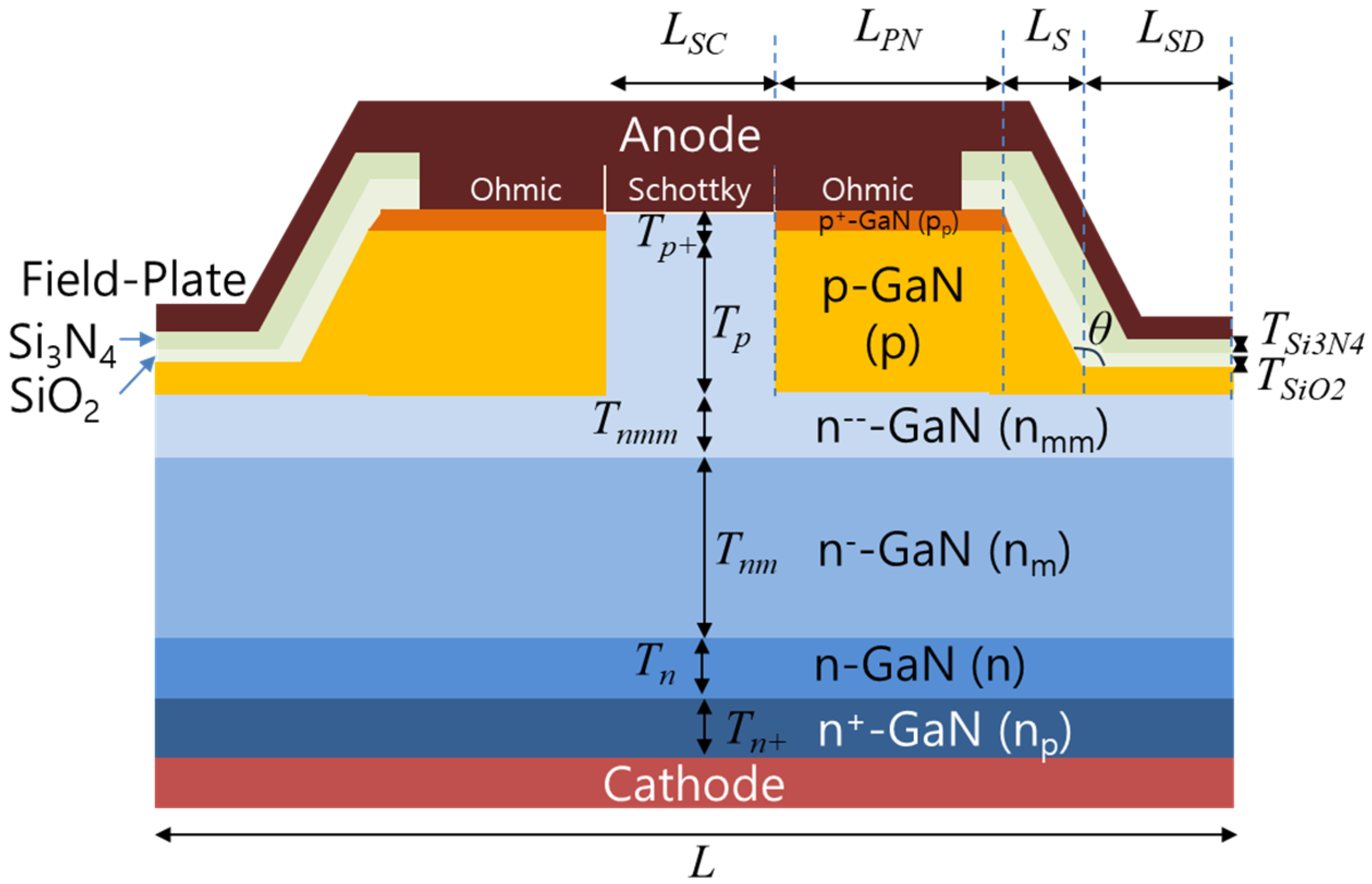
Figure 1 illustrates the cross-sectional schematic of the proposed GaN vertical MPS diode. The device is built on an n+-GaN substrate serving as the cathode, upon which a multi-layered n-type drift region is epitaxially grown. The drift region consists of three sub-layers from bottom to top: n-GaN (Tn = 5 μm), n-GaN (Tnm = 20 μm), and n− −-GaN (Tnmm = 4.49 μm). Above the drift region, a p-GaN layer (Tp = 0.5 μm, variable) is formed, capped with a thin p+-GaN contact layer (Tp+ = 0.01 μm) at the mesa-etched anode regions.
The anode electrode contacts both ohmic (p+-GaN) and Schottky regions, realizing the MPS configuration. The Schottky contact of length LSC = 1.5 μm is located at the center of the anode cell, flanked by p-GaN regions of length LPN = 2.1 μm on each side. A spacing LS = 0.15 μm separates the Schottky contact from the p-GaN mesa sidewall. The composite passivation layer—consisting of SiO2 (TSiO2 = 0.1 μm) deposited first, followed by Si3N4 (TSi3N4 = 0.1 μm)—covers the mesa sidewalls and the field-plate dielectric region. The field plate extends horizontally over the passivation layer for a length LSD = 1.25 μm beyond the anode metal edge.
The complete structural parameters are summarized in Table 1. The combination of the MPS architecture, multi-drift-layer doping, composite passivation, and field-plate termination is designed to simultaneously achieve for reduced Vknee, minimized Ron, elevated BV through electric field redistribution, and suppressed leakage current.

2.2. Simulation Methodology

All simulations were performed using the 2D TCAD Synopsys Sentaurus-Device simulator [26]. The key physical models employed include: (1) Fermi-Dirac carrier statistics; (2) concentration-dependent Shockley–Read–Hall (SRH) recombination [28]; (3) band-to-band tunneling (BTBT) for reverse-bias leakage at the Schottky junction via the non-local tunneling model; (4) Selberherr impact ionization model with non-local electric field treatment for avalanche breakdown analysis [29]; and (5) carrier mobility described by the Masetti doping-dependent model [30] combined with Caughey–Thomas-type high-field velocity saturation [27]. In addition, incomplete ionization of the dopants and a bulk deep-level trap density of 1.25 × 1015 cm−3 (EC − 0.7 eV), representative of native point defects in epitaxial GaN, are included in all simulations, so that the influence of point defects on the electrostatics, leakage, and breakdown is explicitly captured. It should be noted that, in actual GaN epitaxial growth, the mobility at low doping levels (<1 × 1017 cm−3) is influenced not only by impurity scattering but, more importantly, by compensating point defects such as carbon-related deep acceptors and gallium-vacancy complexes [31,32,33,34]: increasing the doping concentration at low doping levels compensates the point defects and enhances carrier screening, so that the measured mobility can actually increase with doping, with a maximum typically near 1016–1017 cm−3. Because the doping-dependent mobility model does not account for this compensation effect, the simulated mobilities of the lightly doped layers represent an idealized, uncompensated upper bound; the impact of this idealization is discussed in Section 3.2.
The Schottky barrier height (ϕB) is set according to the specified metal WF: ϕB = WFχGaN, where χGaN = 4.1 eV is the GaN electron affinity [35]. Three WF values—4.5, 5.0, and 5.2 eV—are investigated, corresponding to ϕB of approximately 0.4, 0.9, and 1.1 eV, respectively. For the forward current-voltage (I-V) simulations, the anode voltage is swept from 0 to 10 V. For reverse I-V simulations, the anode voltage is swept negatively until device breakdown. Current density J [A/cm2] is computed from the 2D TCAD current I [A/μm] (per unit z-width) normalized to the simulated device length of 5 μm: J = I/(5 × 10−8) [A/cm2].
The specific Ron is evaluated at two bias points: Ron1 (differential resistance dV/dI at V = 2.5 V) and Ron2 (differential resistance dV/dI at V = 8 V), both converted to [mΩ·cm2], Vknee is defined as the anode voltage at which the forward current density reaches 200 A/cm2. Jleak is reported as J [A/cm2] at a reverse anode voltage of −10 V for device-level comparison. BV is uniformly defined throughout this work as the reverse anode voltage at which the reverse current density reaches J = 2 A/cm2. This identical criterion is applied to all devices (SBDs with different work functions, the PN diode, and all MPS diode configurations), and the corresponding horizontal reference line is shown in all reverse I-V figures. BFOM is computed as BFOM = BV2/Ron [5,6].

3. Results and Discussion

3.1. Work Function Dependence

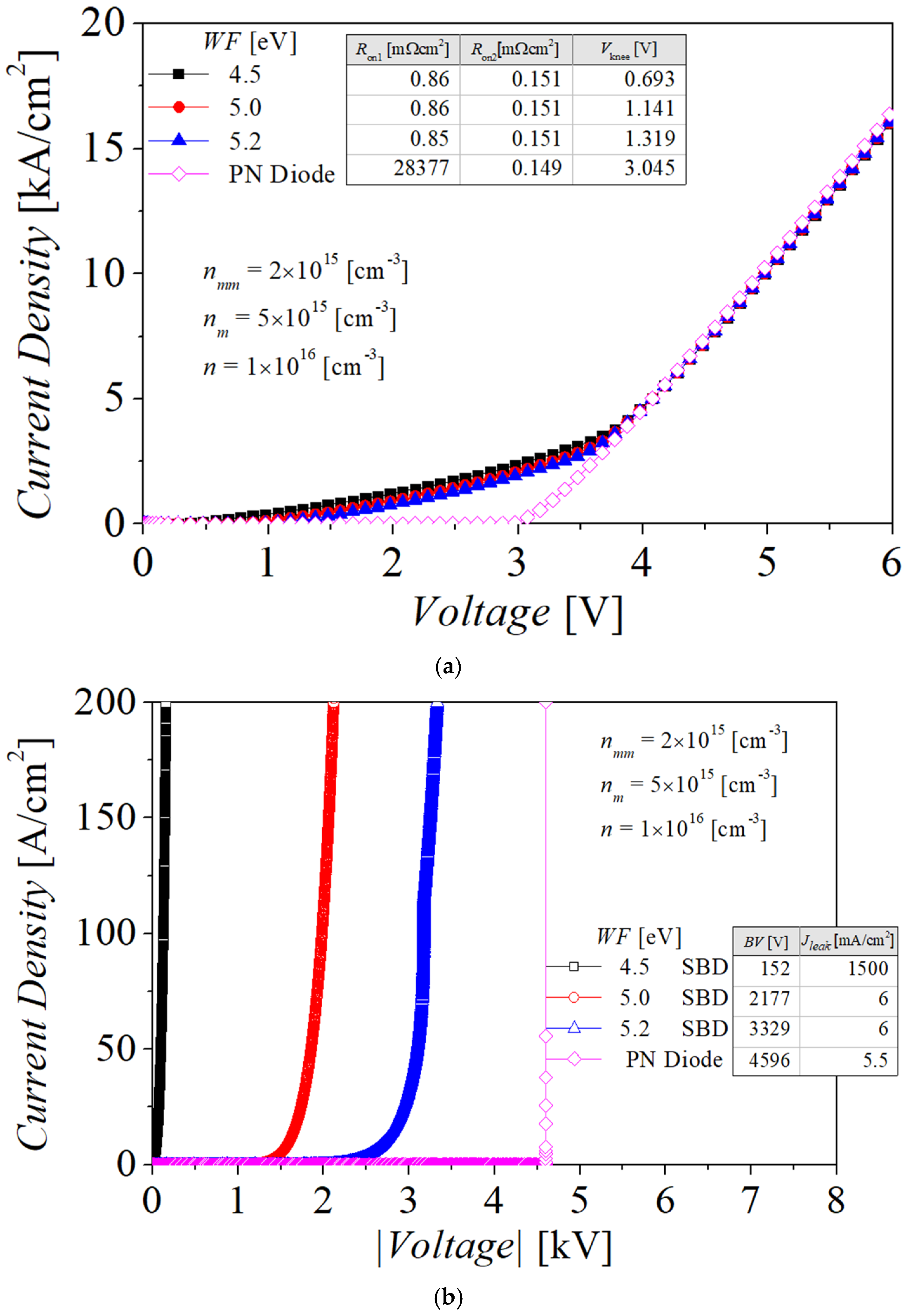
Figure 2 compares the forward and reverse I-V characteristics of three Schottky diodes with different metal work functions (WF = 4.5, 5.0, and 5.2 eV) and a conventional PN diode. Table 2 summarizes the forward and reverse performance metrics extracted from Figure 2. All devices were simulated using an identical multi-drift-layer doping profile of nmm = 2 × 10¹⁵, nm = 5 × 10¹⁵, and n = 1 × 1016 cm−3, ensuring that the observed performance differences arise primarily from the contact type and carrier transport mechanism rather than from variations in the drift region. Filled squares, filled circles, filled triangles, and open diamonds denote the I-V characteristics of Schottky diodes with WFs of 4.5, 5.0, and 5.2 eV, and the PN diode, respectively.
Table 2. Forward and reverse performance metrics as a function of metal work function.
WF [eV]TypeRon1 [mΩ·cm2]Ron2 [mΩ·cm2]Vknee [V]BV [V]
4.5SBD0.860.1510.693152
5.0SBD0.860.1511.1412177
5.2SBD0.850.1511.3193329
PN Diode28,3770.1493.0454596
As shown in Figure 2a, the forward I-V characteristics of the Schottky diodes are strongly dependent on the metal work function. A lower work function reduces ϕB, resulting in a smaller Vknee at low forward bias [35,36]. In contrast, the PN diode exhibits a significantly higher Vknee and a much larger Ron1, reflecting the inherent voltage drop associated with bipolar junction turn-on. Notably, as indicated in Table 2, Ron1 and Ron2 remain nearly constant for all Schottky diodes, regardless of the work function, demonstrating that the high-current on-state resistance is dominated by the drift-layer resistance rather than by the Schottky contact.
Figure 2b highlights the reverse I-V characteristics and breakdown behavior. The PN diode shows excellent reverse blocking capability with low leakage current, which is characteristic of a junction-controlled device. In contrast, conventional Schottky diodes typically suffer from limited BV due to strong electric-field crowding at the metal–semiconductor interface [10,19]. However, in the present devices, all Schottky diodes achieve BVs in the kilovolt range, comparable to that of the PN diode. This improvement is attributed to the multi-drift-layer structure, which effectively redistributes the electric field into the bulk drift region, thereby shifting the breakdown mechanism from being Schottky-contact-limited to drift-region-limited [23]. Moreover, increasing the metal work function further enhances BV and suppresses Jleak by increasing ϕB [35].
These results clearly illustrate the intrinsic trade-off between Ron and BV in power devices. The PN diode achieves high BV at the expense of a large Ron, particularly in the low- to moderate-current regime, whereas a Schottky diode offers low Ron but is traditionally limited in BV [17,18]. The MPS diode structure effectively overcomes this limitation by combining a Schottky conduction path with a drift-layer-supported blocking mechanism. As a result, the MPS diode maintains a low Vknee and reduced Ron, characteristic of unipolar Schottky conduction, while simultaneously achieving a high BV comparable to that of a PN diode. This decoupling of forward conduction loss from reverse blocking capability relaxes the conventional RonBV trade-off and underscores the necessity of the MPS structure for high-voltage, low-loss power device applications [15,16].
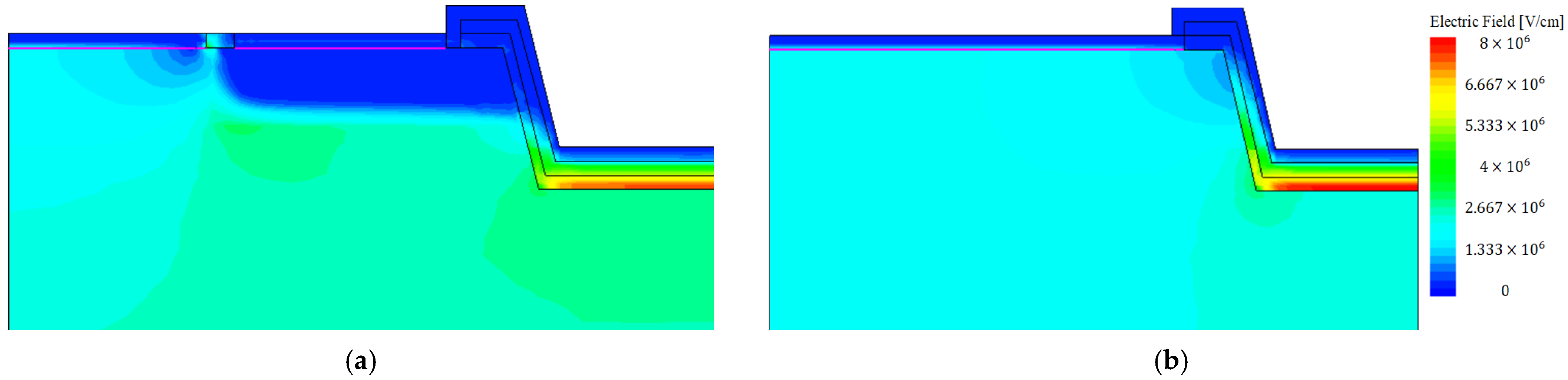
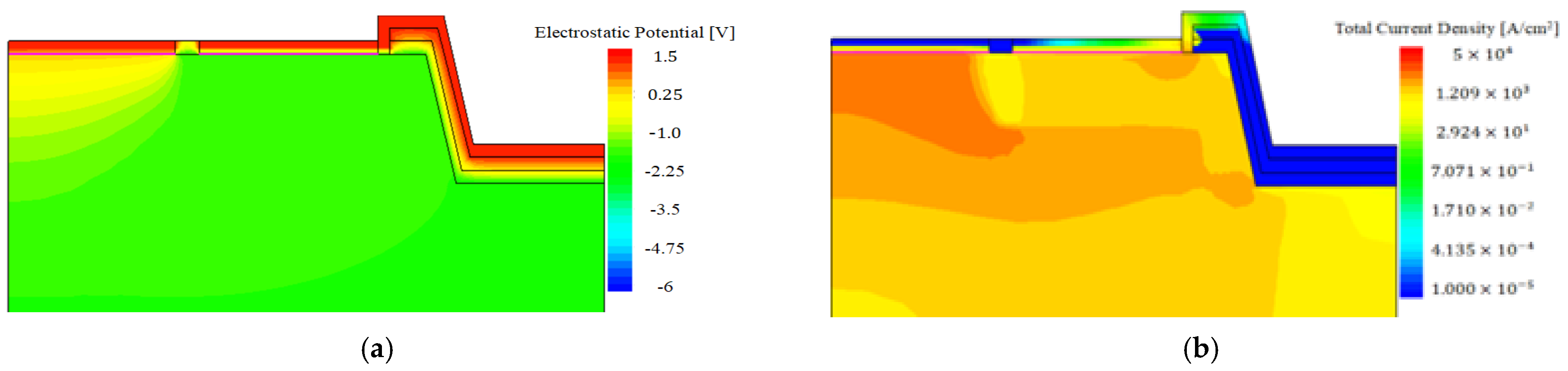
To physically substantiate the carrier-transport and field-redistribution mechanisms of the proposed MPS architecture, Figure 3 and Figure 4 present the internal distributions of key physical quantities. Figure 3a,b show the electrostatic potential and the total current density under forward bias (V = +3 V). The potential map confirms that the forward bias is correctly localized at the Schottky junction, while the current-density map demonstrates parallel dual-path conduction: high current density flows from the anode through both the central Schottky contact and the lateral p+-GaN ohmic contacts, directly visualizing the dual-path conduction mechanism of the MPS architecture. Figure 4a,b compare the reverse-bias (V = −5 kV) electric-field distributions of the proposed MPS diode and the conventional Schottky diode (i.e., the same drift structure but without the embedded p-GaN regions), respectively. In the MPS diode [Figure 4a], the embedded p-GaN regions effectively shield the Schottky/GaN interface and redistribute the high-field region into the n− −-GaN layer beneath the p-GaN junctions, whereas in the conventional Schottky diode [Figure 4b] the high field is concentrated directly at the Schottky/GaN interface across the entire anode area—the well-known origin of premature Schottky-contact-limited breakdown. This field-redistribution mechanism is the direct physical origin of the elevated BV reported in Table 2, Table 3 and Table 4.

3.2. Multi-Drift-Layer Doping Concentration Dependence in the Proposed MPS Diode

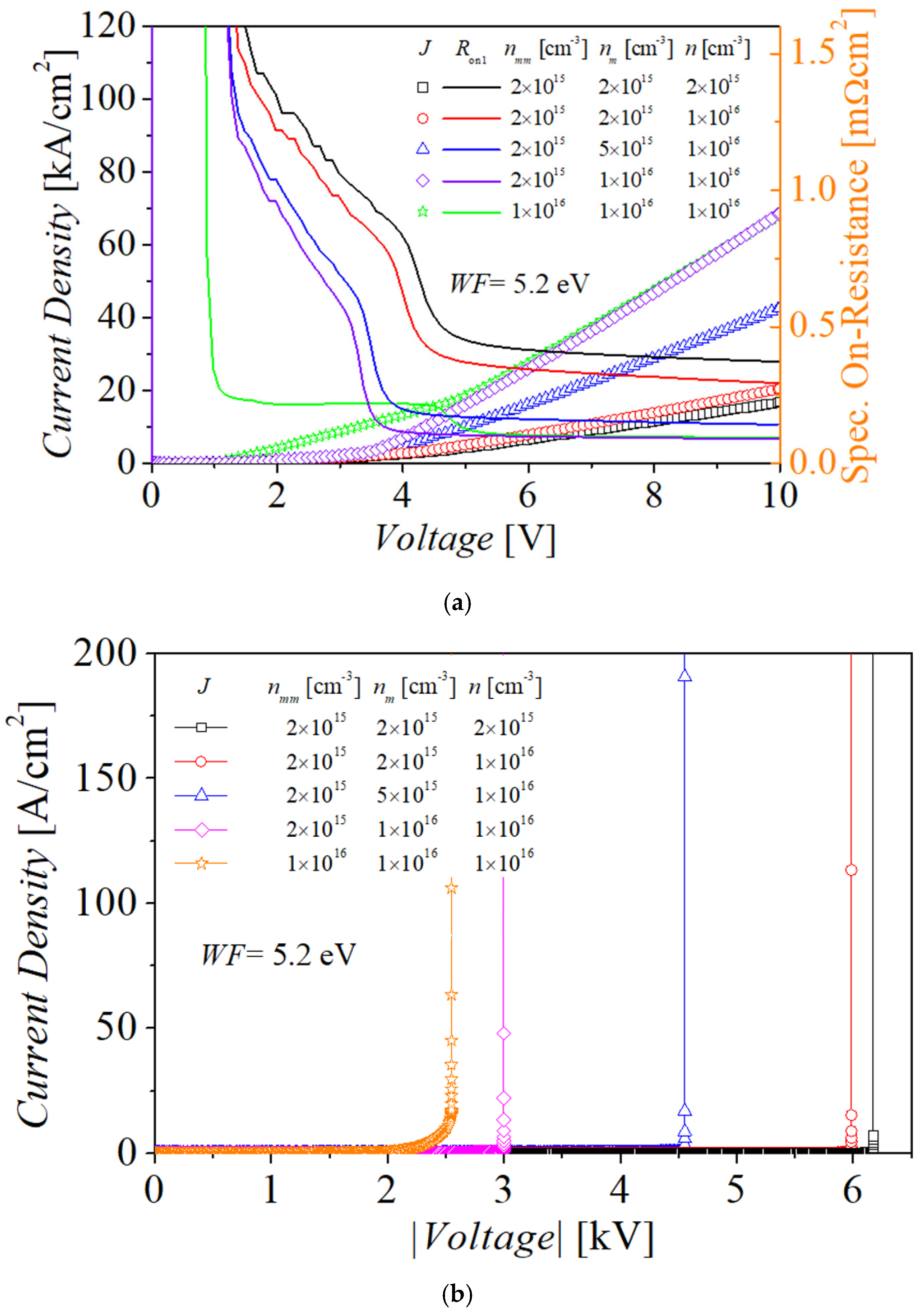
Figure 5 compares the forward and reverse I-V characteristics of MPS diodes employing four different multi-drift-layer doping profiles, all evaluated at a fixed WF of 5.2 eV. From these characteristics, the key performance metrics—including Vknee, Ron, BV, Jleak, and BFOM—are extracted and summarized in Table 3. Because all devices share the same MPS architecture and Schottky contact, the observed variations can be directly attributed to differences in the drift-layer doping configuration.
As shown in Figure 5a, the forward I-V characteristics exhibit systematic changes with the doping profile. Increasing the drift-layer doping concentration reduces both Vknee and Ron by lowering the series resistance in the current path [23]. This trend is clearly reflected in Table 3, where Ron decreases monotonically with higher drift-layer doping. However, excessively high doping levels significantly increase reverse leakage and degrade the blocking capability.
The reverse I-V characteristics in Figure 5b reveal the complementary effect of the drift-layer doping on BV. Lightly doped profiles achieve higher BV due to reduced electric-field peak intensity within the drift region, while more heavily doped structures suffer from premature breakdown [5,17]. This behavior highlights the fundamental RonBV trade-off governed by drift-layer design.
Table 3. BFOM performance comparison across multi-drift-layer doping configurations in the MPS diode (WF = 5.2 eV).
nmm [cm−3]nm [cm−3]n [cm−3]Vknee [V]Ron1 [mΩ·cm2]BV [V]Jleak [mA/cm2]BFOM [GW/cm2]
1 × 10141 × 10141 × 10144.41123.3066730.161.91
1 × 10151 × 10151 × 10151.8752.41565510.4117.77
2 × 10152 × 10152 × 10151.3651.2061700.5531.72
2 × 10152 × 10151 × 10161.3521.1259840.5531.97
2 × 10155 × 10151 × 10161.3190.8645600.5524.18
2 × 10151 × 10161 × 10161.3070.7729940.5511.64
1 × 10161 × 10161 × 10161.0060.2225451.1029.44
Among the four profiles examined, the doping configuration with nmm = 2 × 10¹⁵, nm = 2 × 10¹⁵, and n = 1 × 1016 cm−3, exhibits the most balanced performance. This structure achieves a moderate Vknee of approximately 1.35 V, a low Ron of about 1.12 mΩ·cm2, and a high BV of approximately 6 kV. As a result, it delivers the highest BFOM, approximately 31.97 GW·cm−2, among all investigated cases.
In contrast, more lightly doped configurations improve BV but suffer from a substantial increase in Ron, whereas more heavily doped profiles reduce Ron at the expense of severely degraded BV. These results confirm that the optimal performance of an MPS diode cannot be achieved through uniform or extreme drift-layer doping, but instead requires a carefully engineered multi-drift-layer profile [23].
Overall, this optimization study demonstrates that the MPS diode effectively relaxes the conventional RonBV trade-off by decoupling forward conduction and reverse blocking mechanisms. The Schottky contact ensures low turn-on voltage and reduced conduction loss, while the optimized multi-drift-layer structure sustains high breakdown voltage through electric-field redistribution. Consequently, the identified optimal doping profile provides a clear design guideline for realizing high-voltage, low-loss MPS diodes suitable for next-generation power electronic applications. Among the investigated doping profiles, the structure with nmm = 2 × 10¹⁵, nm = 2 × 10¹⁵, and n = 1 × 1016 cm−3 achieves the highest BFOM and represents the best trade-off between Ron and BV. Accordingly, all subsequent analyses in Section 3.3 and beyond were carried out using this optimized doping profile with a fixed WF = 5.2 eV to ensure a consistent evaluation of device performance.
It is noteworthy that the uniformly high-doped profile (nmm = nm = n = 1 × 1016 cm−3) achieves a BFOM of 29.44 GW/cm2, which is only 8% below the optimal graded profile (31.97 GW/cm2) despite a 2.4× lower BV. This apparent paradox is a consequence of the quadratic-vs-inverse-quadratic dependence of BFOM on BV and Ron: as the drift doping is increased uniformly from 2 × 10¹⁵ to 1 × 1016 cm−3, Ron1 decreases by a factor of ~5.5× (from 1.20 to 0.22 mΩ·cm2), which almost exactly compensates for the ~5.9× reduction in BV2 (from 61702 to 25452). The net BFOM is therefore reduced by less than 10%. However, the absolute BV of 2545 V is below the practical requirement for the medium-voltage (≥3.3 kV class) power-electronic applications targeted by this work, so the uniformly high-doped configuration is not preferred despite its competitive BFOM. This observation highlights a general limitation of using BFOM alone as a design metric: an additional constraint on the absolute BV is required for high-voltage device design.
To further explore the low-doping regime, we extended the uniform-doping sweep in Table 3 to include 1 × 10¹⁴ and 1 × 1015 cm−3. The results show that BV is essentially saturated across the entire low-doping range—BV = 6673 → 6551 → 6170 V for doping = 1 × 10¹⁴ → 1 × 10¹⁵ → 2 × 1015 cm−3 (only ~8% variation across a 20× change in doping). This saturation indicates that the device is already fully punched-through at 2 × 1015 cm−3, with the depletion region filling the entire drift stack. Meanwhile, Ron1 degrades by ~19× (from 1.20 to 23.30 mΩ·cm2) and Vknee rises from 1.365 to 4.411 V due to series-resistance domination of the current-density definition point. As a result, BFOM collapses from 31.72 to 1.91 GW/cm2—a 16× degradation. We conclude that 2 × 1015 cm−3 represents a practical lower bound for the lightly-doped layer in the present drift geometry; operation below this value is not beneficial unless the drift stack is also substantially thickened to raise the punch-through-limited BV ceiling.
In actual epitaxial material, compensation by point defects further reduces both the carrier concentration and the mobility in the 1014–1015 cm−3 range [31,32,33,34], so the Ron values in Table 3 for these cases are best-case estimates and the practical lower bound of 2 × 1015 cm−3 is, if anything, conservative. The overall conclusions are robust to this idealization, since BV is insensitive to mobility and the optimum design conducts mainly through the heavily doped n layer (1 × 1016 cm−3), where compensation is weak and the mobility model is most reliable.
Importantly, the doping ranking established in this section is conditional on the default drift-layer thicknesses. The complete picture—including the joint doping–thickness optimum, which uncovers a configuration superior to the doping-only optimum reported above—is established in the new Section 3.6.

3.3. Schottky-to-PN Contact Length Ratio Dependence of the Proposed MPS Diode

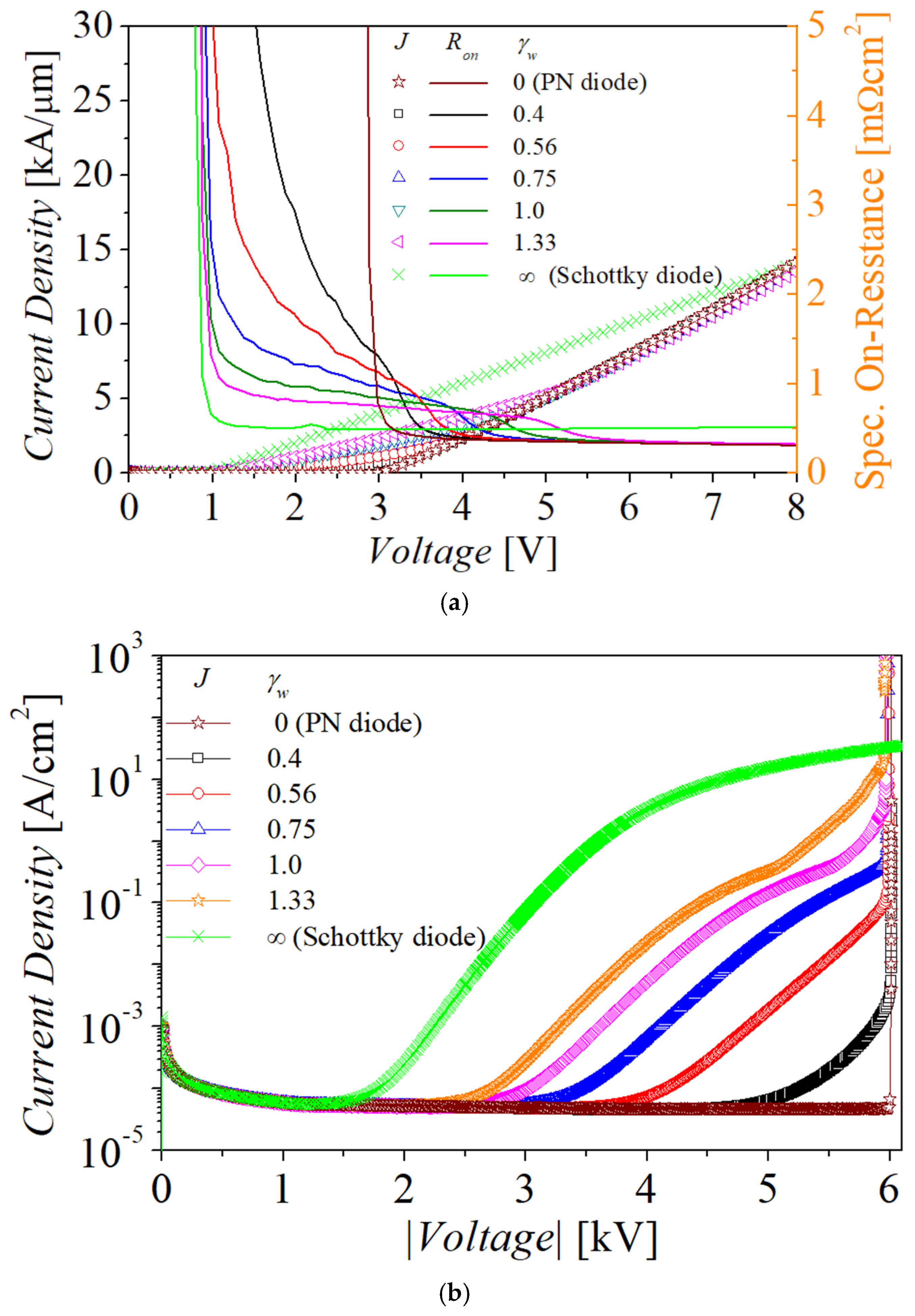
Figure 6 and Table 4 summarize the forward and reverse I-V characteristics of the MPS diodes as a function of the Schottky-to-PN contact length ratio, defined as γw = LSC/LPN, together with the extracted performance metrics including Vknee, Ron, BV, Jleak, and BFOM. To provide clear reference points, two limiting cases are also included: a conventional PN diode corresponding to γw = 0 and a pure Schottky diode corresponding to γw → ∞. For all devices, the total anode contact length is fixed as LA = LSC + LPN, and an identical multi-drift-layer doping profile with a fixed WF of 5.2 eV is employed. This configuration allows a direct and systematic investigation of the impact of lateral contact ratio on the MPS diode performance.
Table 4. Performance metrics extracted from Figure 6 as a function of γ w .
γw (=LSC/LPN)Ron1 [mΩ·cm2]Vknee [V]BV [V]Jleak [mA/cm2]BFOM [GW/cm2]
0 (PN diode)0.31 *3.06060110.55240.88 *
0.4 (=1.0/2.5)1.912.06860080.5518.90
0.56 (=1.25/2.25)1.401.58859890.5525.62
0.75 (=1.5/2.0)1.121.35259840.5531.94
1.0 (=1.75/1.75)0.921.23258900.5537.71
1.33 (=2.0/1.5)0.791.16955300.5538.71
∞ (Schottky diode)0.491.04438130.6029.67
* On-resistance at V = 8 V (Ron2).
Figure 6a shows the forward I-V characteristics of the proposed MPS diodes for different values of γw. The PN diode (γw = 0) exhibits a high Vknee and a steep rise in on-resistance at low forward bias, reflecting the inherent conduction loss associated with bipolar junction turn-on [11]. As γw increases and a Schottky conduction path is introduced, both Vknee and Ron decrease monotonically. This trend is clearly quantified in Table 4. As γw increases from 0.40 to 1.33, Vknee decreases from 3.06 V to 1.17 V, while Ron is reduced from 3.06 to 0.79 mΩ·cm2. In the limiting case of the pure Schottky diode (γw → ∞), the lowest Ron of 0.49 mΩ·cm2 is achieved, confirming the superior forward conduction capability of unipolar Schottky transport [9,14]. These results demonstrate that increasing γw effectively transitions the dominant conduction mechanism from bipolar PN conduction to unipolar Schottky conduction, leading to progressively reduced forward losses.
The reverse I-V characteristics shown in Figure 6b reveal a fundamentally different trend. The PN diode exhibits excellent reverse blocking capability with a BV of approximately 6.0 kV and negligible Jleak. Introducing a Schottky contact through the MPS structure preserves this high BV across a wide range of γw, indicating that the reverse blocking mechanism remains drift-region-limited [15,16]. For all MPS diodes with finite γw, the BV remains close to 6 kV, despite substantial changes in the Schottky contact fraction. Moreover, Jleak prior to breakdown is nearly identical for all γw values, demonstrating that the embedded PN regions effectively shield the Schottky interface from electric-field crowding under reverse bias [13,14]. In contrast, the pure Schottky diode (γw → ∞) exhibits a significantly reduced BV of approximately 3.8 kV and a higher leakage current, reflecting Schottky-contact-limited breakdown. Importantly, the reverse current in the MPS diodes begins to increase gradually above approximately 2 kV, well before the final breakdown. This increase originates from high-field effects in the lightly doped drift region, where the expanding depletion region enhances electric fields and activates field-assisted Shockley–Read–Hall generation [28] and impact-ionization-assisted pre-avalanche carrier multiplication [29]. The insensitivity of this behavior to γw confirms that it is governed by the drift region rather than by Schottky-related leakage mechanisms.
The interplay between forward conduction loss and reverse blocking capability is reflected in the BFOM, summarized in Table 4. The PN diode achieves a BV but suffers from a large Ron, resulting in limited BFOM despite excellent leakage suppression. Conversely, the pure Schottky diode offers very low Ron but a severely degraded BV, leading to a reduced BFOM. The proposed MPS diode bridges these two extremes. As γw increases from 0.40 to 1.33, the BFOM increases monotonically from 18.9 to 38.7 GW·cm−2, driven primarily by the strong reduction in Ron while maintaining a BV comparable to that of the PN diode. This result demonstrates that the MPS architecture effectively decouples forward conduction optimization from reverse blocking capability, thereby relaxing the conventional RonBV trade-off.
From a design perspective, the results identify γw as a powerful tuning parameter for MPS diodes. While increasing γ w continuously improves forward conduction, excessively large values approaching the pure Schottky limit compromise BV and leakage performance. Within the investigated range, the highest BFOM is achieved at γw = 1.33, which represents an optimal balance between Schottky-dominated conduction and effective PN-assisted electric-field management.
Overall, this study demonstrates that the proposed MPS diode provides a continuous and controllable transition between PN and Schottky diode behaviors. By optimizing the γw, the MPS structure combines the low forward loss of Schottky diodes with the high breakdown robustness of PN diodes, making it a compelling solution for high-voltage, low-loss power electronics.
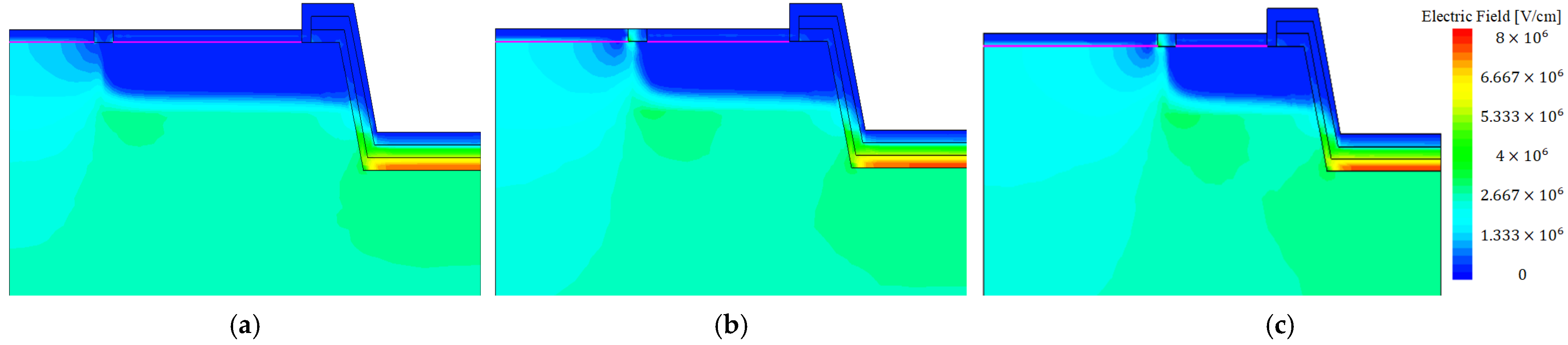
To further visualize the γw-dependent field-shielding mechanism, Figure 7 shows the 2D electric-field distributions of the proposed MPS diode for three γw values (0.4, 0.75, and 1.33) under a reverse anode bias of V = −5 kV. As γw increases (i.e., the Schottky region widens while the p-GaN region narrows), the field-redistribution pattern visibly evolves: the high-field region migrates from being well-confined under the p-GaN to extending laterally toward the mesa edge. This visual evolution provides a direct physical explanation for the mild BV reduction (6008 → 5530 V) observed in Table 4 as γw increases.
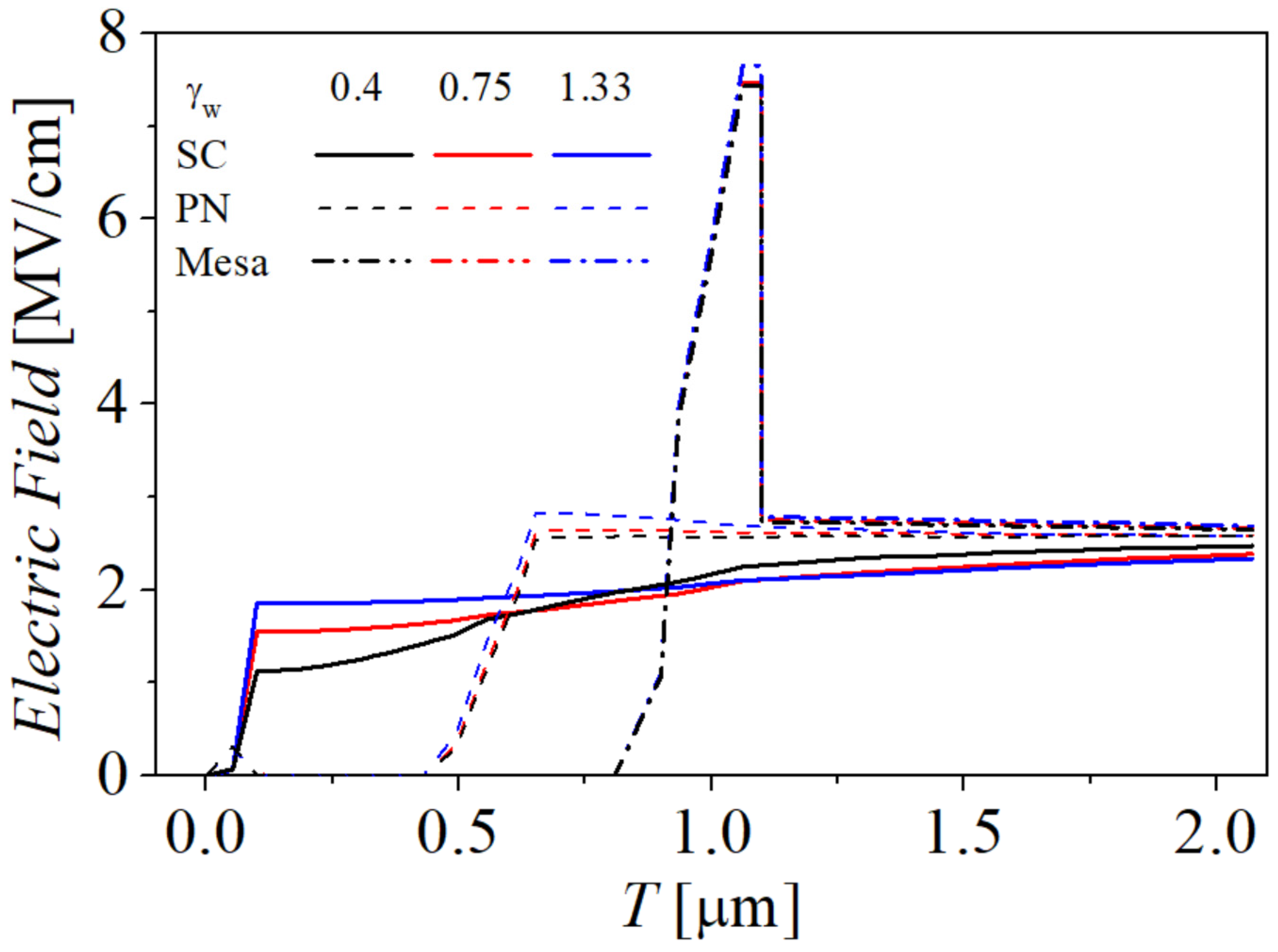
Figure 8 provides a quantitative comparison of the vertical electric-field profiles along three representative cut-lines—through the Schottky center (SC, solid lines), through the p-GaN center (PN, dashed lines), and at the mesa edge (Mesa, dash-dotted lines)—for the same three γw values. Three key observations emerge: (i) the field at the Schottky center remains well below 2 MV/cm for all γw values, quantitatively confirming the effective p-GaN shielding of the Schottky interface; (ii) the field at the p-GaN center is moderate (~2.5–3 MV/cm); and (iii) the field at the mesa edge rises sharply when γw increases from 0.4 to 0.75 (from ~2.5 to ~7 MV/cm), with a smaller further increase at γw = 1.33. This identifies the mesa edge as the dominant BV-limiting location at high γw and explains the BV trend in Table 4 quantitatively.

3.4. Temperature Dependence of the Proposed MPS Diode

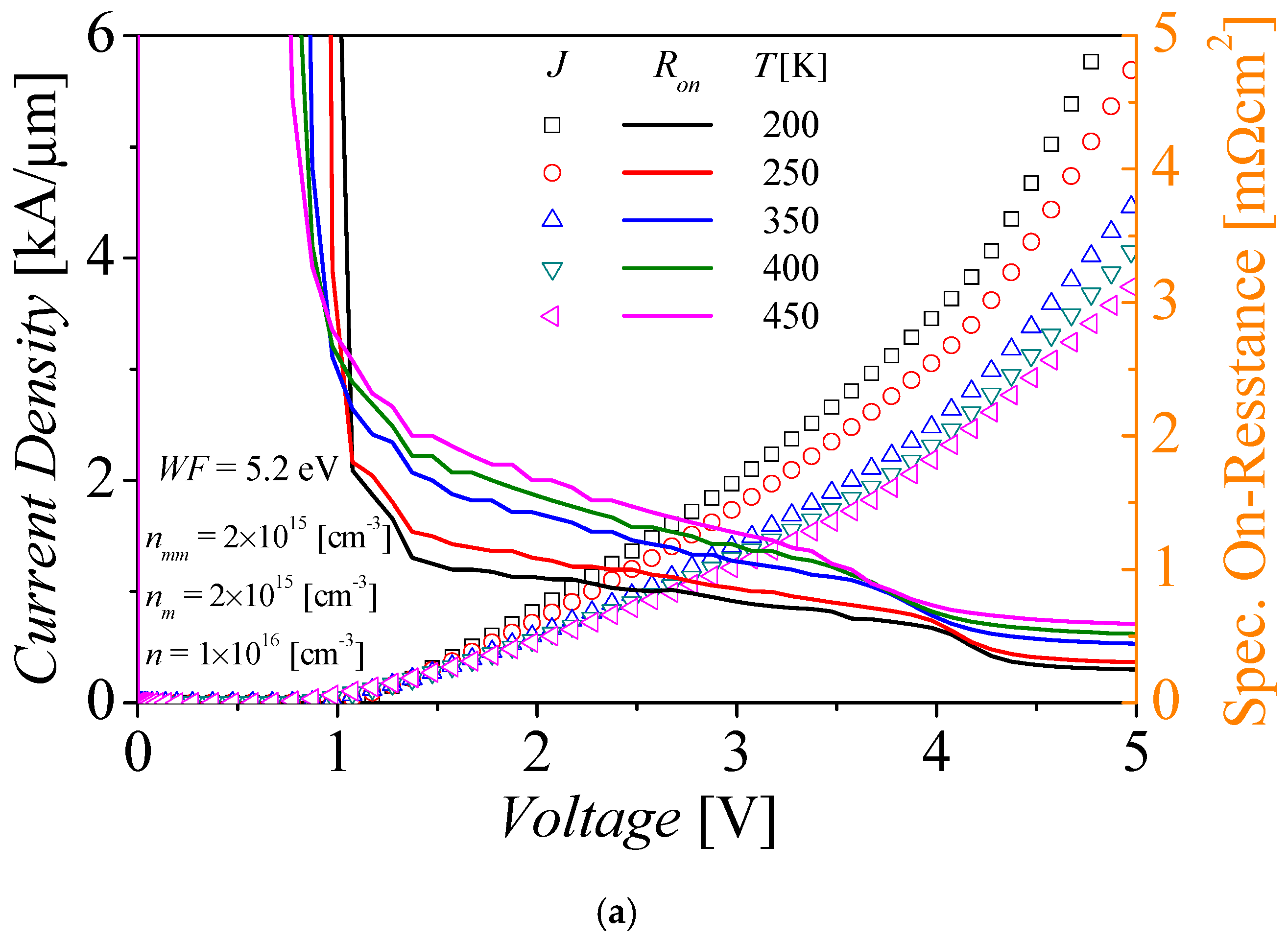
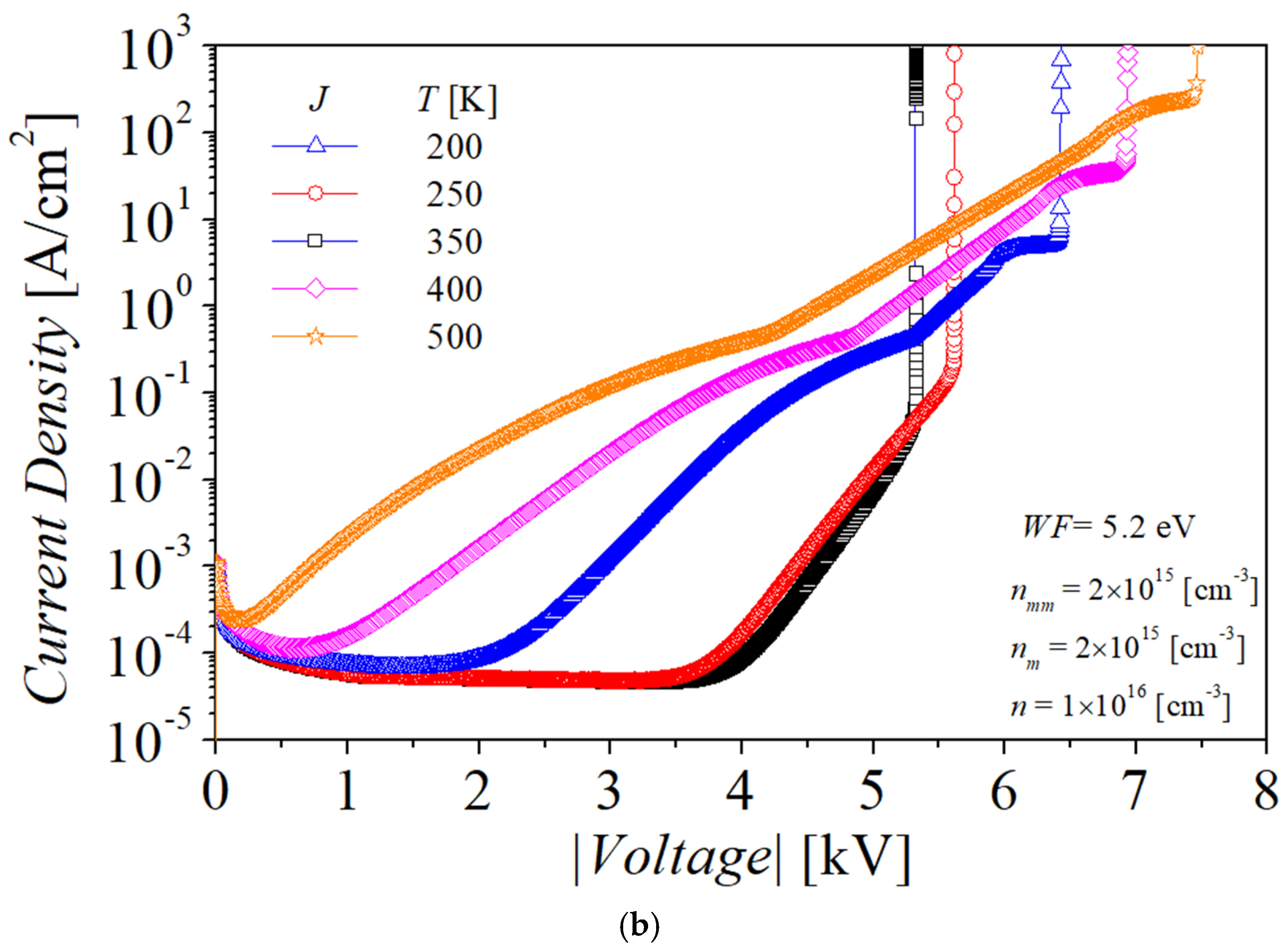
Figure 9 shows the temperature dependence of the forward and reverse I-V characteristics of the MPS diode, measured over a temperature range from 200 K to 450 K. The corresponding extracted performance metrics, including Vknee, Ron, BV, Jleak, and BFOM, are summarized in Table 5. All devices employ an identical MPS structure with a fixed WF of 5.2 eV and the same optimized multi-drift-layer doping profile and Schottky contact length, ensuring that the observed variations arise solely from temperature effects.
As shown in Figure 9a, the forward I-V characteristics exhibit a systematic temperature dependence. With increasing temperature, the Vknee slightly decreases, reflecting the temperature-induced reduction of the effective ϕB and the enhanced thermionic emission at the metal–semiconductor interface [35,36]. At the same time, the extracted Ron increases monotonically with temperature, as summarized in Table 5. This increase in Ron is primarily attributed to reduced electron mobility in the GaN drift region due to enhanced phonon scattering at elevated temperatures [27,37]. Nevertheless, even at 450 K, the increase in Ron remains moderate, indicating that the unipolar Schottky conduction path in the MPS structure mitigates excessive conduction loss compared with purely bipolar devices.
Figure 9b presents the reverse I-V characteristics as a function of temperature. Unlike conventional Schottky diodes, which often suffer from premature breakdown and strong temperature sensitivity due to Schottky-contact-limited electric-field crowding [10], the MPS diode maintains robust reverse blocking capability across the entire temperature range. Notably, the BV exhibits a clear positive temperature dependence, increasing from approximately 5.32 kV at 200 K to about 7.43 kV at 450 K, as listed in Table 5. This positive temperature coefficient of BV indicates that breakdown in the MPS diode is dominated by avalanche multiplication in the drift region rather than by Schottky-contact-limited mechanisms [38,39]. As temperature increases, enhanced phonon scattering reduces the impact ionization coefficient, thereby requiring a higher electric field to initiate avalanche breakdown [40]. The effectiveness of the embedded PN regions in shielding the Schottky contact is further evidenced by the nearly constant reverse leakage current density prior to breakdown, which remains below 10−3 A/cm2 over the investigated temperature range. In addition, a gradual increase in reverse current is observed at high reverse voltages below breakdown, particularly above approximately 2 kV. This behavior originates from field-enhanced generation and pre-avalanche carrier multiplication within the extended depletion region of the drift layers and represents intrinsic high-field behavior rather than premature breakdown or Schottky-induced leakage [28,29].
The combined temperature dependence of Ron and BV is directly reflected in the evolution of BFOM. As shown in Table 5, despite the gradual increase in Ron with temperature, the BFOM improves monotonically from approximately 33.3 GW·cm−2 at 200 K to 37.8 GW·cm−2 at 450 K. This enhancement is primarily driven by the strong positive temperature coefficient of BV, which more than compensates for the increase in Ron. This behavior demonstrates a key advantage of the MPS diode architecture. While conventional power devices often suffer from a worsened RonBV trade-off at elevated temperatures, the proposed MPS diode effectively decouples forward conduction degradation from reverse blocking capability. The Schottky contact ensures low turn-on voltage and efficient carrier transport, whereas the PN-assisted drift-region-limited breakdown mechanism provides enhanced BV and thermal stability.
Overall, these results confirm that the proposed MPS diode exhibits robust electrical performance and improved BFOM over a wide temperature range, underscoring its suitability for high-voltage, high-temperature power electronic applications.

3.5. Switching Transient Analysis and Dynamic Performance

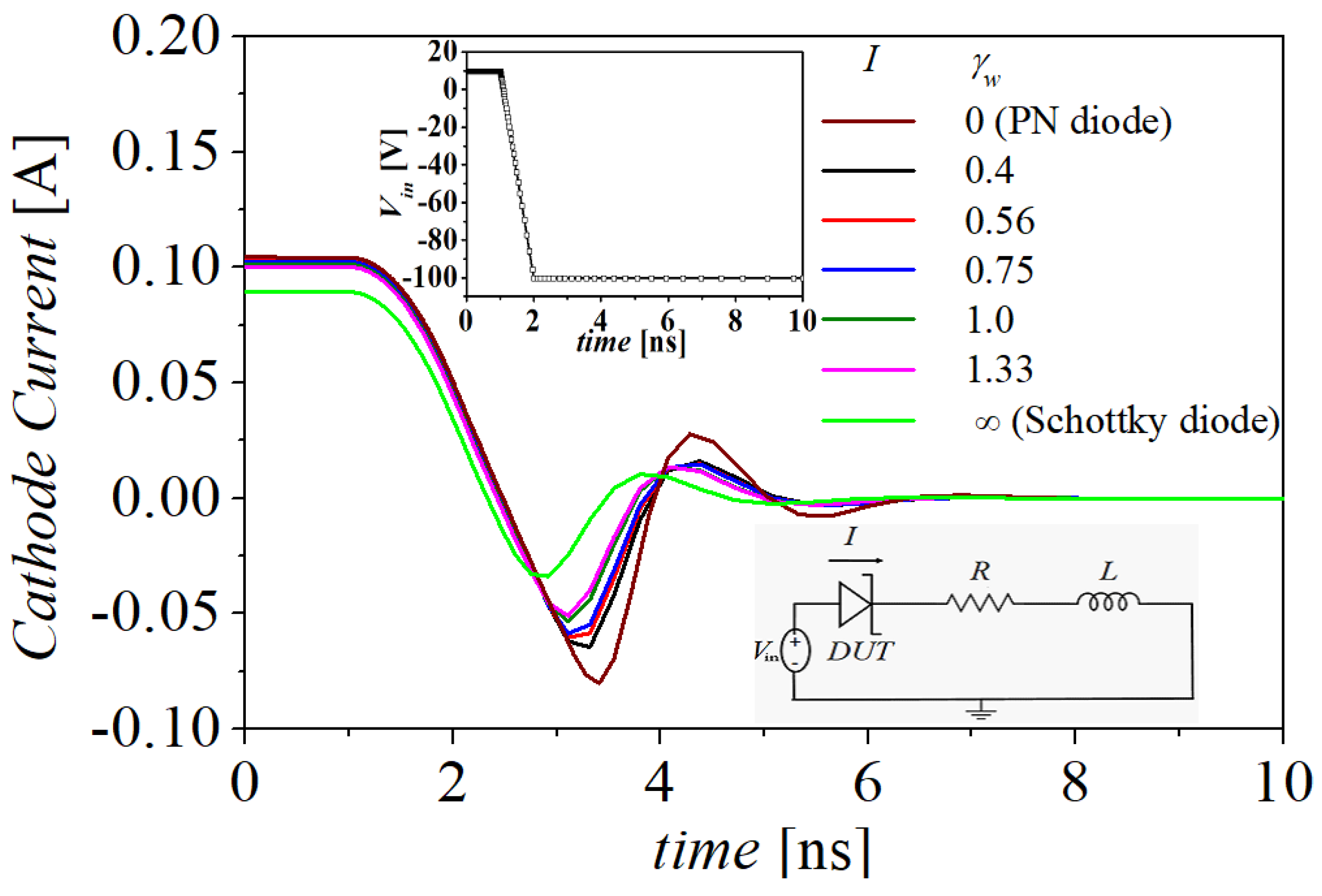
Figure 10 shows the reverse recovery switching characteristics of the proposed MPS diodes as a function of γw, together with reference results for a conventional PN diode (γw = 0) and a pure Schottky diode (γw → ∞). The transient responses were obtained using mixed-mode TCAD simulations [26] that coupled a two-dimensional diode structure with an external RL circuit, as illustrated in the right inset of Figure 10, where L = 1 μH and R = 1 mΩ. The applied pulse input voltage Vin is shown in the left inset. As shown in Figure 6, the PN diode exhibits a large reverse recovery current peak (Irr(peak)) and a pronounced recovery tail, which originate from the extraction of stored minority carriers during turn-off [41,42]. This behavior results in a relatively high Irr,peak of 80.15 mA and a large reverse recovery charge Qrr of 65.80 pC, as summarized in Table 6. The reverse recovery time trr is also relatively long, reaching 1.462 ns, which is detrimental for high-frequency switching operation. In contrast, the pure Schottky diode shows a substantially reduced reverse recovery current and a much shorter recovery interval, reflecting the absence of stored charge and the predominance of capacitive effects [43]. As a result, Irr,peak, trr, and Qrr are reduced to 33.84 mA, 1.140 ns, and 21.71 pC, respectively. However, this improvement in dynamic performance is accompanied by a severe degradation in BV, which decreases to 3.81 kV, highlighting the intrinsic trade-off between switching speed and blocking capability in conventional Schottky diodes.
The proposed MPS diodes exhibit an intermediate and controllable reverse recovery behavior between these two extremes. As γw increases, a systematic reduction in reverse recovery parameters is observed. Specifically, when γw increases from 0.4 to 1.33, Irr,peak decreases from 64.44 mA to 50.90 mA, while the reverse recovery time trr is reduced from 1.467 ns to 1.321 ns. Correspondingly, Qrr decreases from 52.08 pC to 36.86 pC, representing a reduction of approximately 29% compared with the PN diode case. This improvement is attributed to the enhanced contribution of the Schottky conduction path, which suppresses minority-carrier injection, while the embedded PN regions continue to provide effective electric-field shielding under reverse bias [14,15].
Notably, the MPS diode with γw = 1.0 and 1.33 achieves a favorable balance between dynamic and blocking performance. For γw = 1.33, the device maintains a high BV of 5.53 kV while exhibiting a significantly reduced Qrr of 36.86 pC and a shortened trr of 1.321 ns. Compared with the PN diode, this corresponds to a marked reduction in reverse recovery loss without sacrificing high-voltage robustness. These characteristics are particularly advantageous for high-frequency power systems, where Qrr and trr directly impact switching loss, current overshoot, and electromagnetic interference [43,44].
Overall, the results in Figure 10 and Table 6 clearly demonstrate that the Schottky-to-PN contact length ratio is a critical design parameter governing the reverse recovery dynamics of the MPS diode. By appropriately selecting γw, the proposed MPS structure effectively alleviates the conventional trade-off between fast switching and high breakdown voltage, enabling improved dynamic performance while preserving PN-like blocking capability. This balance underscores the suitability of the proposed MPS diodes for high-voltage, high-frequency power electronic applications.

3.6. Drift-Layer Thickness Optimization and Joint Doping-Thickness Optimum

While Section 3.2 established the optimal doping concentrations under fixed default drift-layer thicknesses, the layer thicknesses themselves represent an additional degree of design freedom that we had not yet exploited. To complete the design optimization, this new section systematically varies the three drift-layer thicknesses (Tnmm, Tnm, Tn) for the two leading doping profiles from Section 3.2—the uniform profile (nmm = nm = 2 × 10¹⁵, n = 1 × 1016 cm−3) and the graded profile (nmm = 2 × 10¹⁵, nm = 5 × 10¹⁵, n = 1 × 1016 cm−3)—at the fixed optimum WF = 5.2 eV. The simulation set is organized into two complementary groups: Group A (Tnmm fixed at 4.49 μm; Tnm and Tn traded off at constant Tnm + Tn = 25 μm) and Group B (Tn fixed at 5 μm; Tnmm and Tnm traded off at constant Tnmm + Tnm = 24.49 μm).
For the uniform doping profile, as shown in Table 7, three key findings emerge. (1) The optimum is at (Tnmm, Tnm, Tn) = (4.49, 5, 20) μm, achieving BFOM = 51.05 GW/cm2 (BV = 6626 V, Ron1 = 0.86 mΩ·cm2)—a substantial improvement over the default configuration (T_nm = 20, Tn = 5: BFOM = 31.97 GW/cm2). Remarkably, this new configuration simultaneously improves both metrics: BV increases by +11% and Ron1 decreases by −23%. (2) Tn is the dominant thickness parameter. The monotonic trend in Group A (BFOM = 31.97 → 42.37 → 46.37 → 51.05 GW/cm2 as Tn increases from 5 to 20 μm) clearly identifies Tn as the dominant knob. (3) Tnmm and Tnm are electrically interchangeable when nmm = nm. The Group B rows in Table 7 (4.49/20/5, 8.49/16/5, 14.49/10/5) yield identical Vknee, Ron1, BV, and BFOM, because nmm = nm makes the n− − and n layers electrically indistinguishable; only their combined thickness (Tnmm + Tnm) matters.
For the graded doping profile, as shown in Table 8, the same thickness pattern (large Tn and small Tnm) achieves an even better result: BFOM = 55.36 GW/cm2 (BV = 6613 V, Ron1 = 0.79 mΩ·cm2) at (Tnmm, Tnm, Tn) = (4.49, 5, 20) μm. This is the overall optimum of this work—+73% improvement over the doping-only optimum reported in Section 3.2 (31.97 GW/cm2). The improvement comes mainly from the lower Ron (0.79 vs. 0.86 mΩ·cm2), enabled by the more conductive n layer (5 × 10¹⁵ vs. 2 × 1015 cm−3).
Moreover, Table 8 reveals two important physical distinctions from the uniform-doping case. First, Tnmm and Tnm are no longer interchangeable—the Group B rows of Table 8 (4.49/20/5, 8.49/16/5, 14.49/10/5) yield strongly different BFOM (24.18 → 26.51 → 44.47 GW/cm2), because nmmnm makes the two layers electrically distinguishable. Second, increasing Tnmm (the lightly-doped layer adjacent to the p-GaN junction) substantially raises BV (4560 → 6635 V in Group B), because the depletion peak-field zone has more lightly-doped material available before reaching the higher-doped n layer.
Physical interpretation—punch-through/field-stop principle. The performance gain at large Tn can be understood as follows. The lightly-doped (n− − + n) region acts as the primary blocking region, while the more heavily doped n region (5× higher doping) acts as a quasi-field-stop layer. In the default configuration (Tn = 5 μm), the light region (24.49 μm thick) supports most of the reverse voltage with a strongly triangular electric-field profile, and the thin n layer plays only a minor role. In the new optimum (Tn = 20 μm, light region = 9.49 μm), the depletion punches through the thin light region at lower reverse voltage and then extends into the n layer. The wider n layer thus contributes a large additional voltage-supporting region (raising BV), while simultaneously providing a lower-resistivity bulk current path (reducing Ron). This is precisely the punch-through/field-stop principle that has been successfully exploited in IGBTs and SiC power diodes for decades [45,46], and we have now established it as the governing design principle for the proposed GaN MPS diode.
A major paper-level finding—doping-thickness coupling. In the original Section 3.2, the doping was optimized at the fixed default thicknesses; under that constraint, the uniform profile (2, 2, 10) × 1015 was found to be best (BFOM = 31.97), and the graded profile (2, 5, 10) × 1015 appeared suboptimal (BFOM = 24.18). However, the present joint study shows that those ranking reverses when the thickness is also optimized: the graded profile becomes the overall best (BFOM = 55.36), exceeding the uniform-profile thickness-optimum (BFOM = 51.05). The original Section 3.2 conclusion is therefore conditional on the default thickness, and the true optimum requires joint doping-thickness optimization. To our knowledge, this coupled doping-thickness design space has not been previously reported for GaN MPS diodes.
In summary, the overall optimum of the proposed MPS diode is: doping (nmm, nm, n) = (2 × 10¹⁵, 5 × 10¹⁵, 1 × 10¹⁶) cm−3; thickness (Tnmm, Tnm, Tn) = (4.49, 5, 20) μm; performance BV = 6.61 kV, Ron1 = 0.79 mΩ·cm2, BFOM = 55.36 GW·cm−2. This optimum is also fully consistent with the lower-bound finding of Section 3.2 that nmm = 2 × 1015 cm−3 represents a practical lower limit for the lightly-doped layer.

4. Conclusions

In this work, a GaN vertical MPS diode incorporating a three-sub-layer n-type drift region, composite SiO2/Si3N4 passivation, and anode field-plate termination has been designed and comprehensively analyzed through 2D TCAD simulations. The following conclusions can be drawn:
(1)
Work function dependence: The Schottky metal work function governs the trade-off between Vknee and BV. While a lower work function (WF = 4.5 eV) achieves the smallest Vknee of 0.693 V, the breakdown voltage is severely limited (152 V) due to a low ϕB. A higher work function (WF = 5.2 eV) simultaneously elevates BV to over 3.3 kV and suppresses reverse leakage current, making it the preferred choice for high-voltage MPS diodes.
(2)
Multi-drift-layer optimization: At fixed default thicknesses, the optimum doping (nmm = 2 × 10¹⁵, nm = 2 × 10¹⁵, n = 1 × 1016 cm−3) achieves BFOM = 31.97 GW·cm−2. Extending the low-doping sweep down to 1 × 1014 cm−3 confirms that 2 × 1015 cm−3 is a practical lower bound: BV saturates while Ron increases ~19× and BFOM collapses 16× as doping decreases. The joint doping–thickness optimization in Section 3.6 identifies a new overall optimum: graded doping (nmm = 2 × 10¹⁵, nm = 5 × 10¹⁵, n = 1 × 1016 cm−3) combined with thicknesses (Tnmm, Tnm, Tn) = (4.49, 5, 20) μm, achieving BFOM = 55.36 GW·cm−2 (BV = 6.61 kV, Ron = 0.79 mΩ·cm2)—a +73% improvement. This is governed by the punch-through/field-stop design principle and demonstrates that doping and thickness must be co-optimized rather than optimized sequentially.
(3)
Schottky contact length ratio: Increasing γw from 0.40 to 1.33 monotonically reduces Vknee and Ron while maintaining BV ≈ 6 kV, resulting in a BFOM improvement from 18.90 to 38.71 GW·cm−2. The value γw = 1.33 is identified as the optimal design point, providing the highest BFOM without sacrificing the PN-assisted reverse blocking capability.
(4)
Temperature stability: The MPS diode exhibits robust performance over a wide temperature range (200–450 K). The BV increases with temperature due to the positive temperature coefficient of avalanche breakdown, and the BFOM improves monotonically from 33.31 to 37.82 GW·cm−2, confirming thermal stability superior to conventional Schottky diodes.
(5)
Switching performance: Mixed-mode TCAD simulations demonstrate that increasing γw reduces Qrr by approximately 29% relative to the PN diode reference, while maintaining PN-like BV. The proposed MPS structure at γw = 1.33 achieves an excellent balance between fast switching (Qrr = 36.86 pC, trr = 1.321 ns) and high blocking capability (BV = 5.53 kV).
(6)
Internal distribution analysis: 2D contour plots of the electrostatic potential, current density, and reverse-bias electric field (Figure 3, Figure 4, Figure 7 and Figure 8) directly visualize the dual-path forward conduction and the p-GaN field-shielding mechanism. The cut-line profiles in Figure 8 identify the mesa edge as the dominant BV-limiting location at high γw.
Overall, the proposed GaN vertical MPS diode with multi-drift-layer and field-plate termination effectively decouples forward conduction loss from reverse blocking capability, substantially relaxing the conventional RonBV trade-off. The identified design guidelines provide a practical roadmap for realizing high-voltage, high-efficiency GaN power rectifiers for next-generation power electronic systems. These improvements are expected to enhance the high-frequency figure of merit, highlighting the advantage of the proposed MPS diode in switching applications.

Author Contributions

Conceptualization, Y.S.Y.; methodology, S.Y. and Y.S.Y.; investigation, S.Y., J.H.O., and Y.S.Y.; data curation, Y.S.Y.; writing—original draft preparation, Y.S.Y.; writing—review and editing, J.H.O. and Y.S.Y.; supervision, Y.S.Y.; project administration, Y.S.Y. All authors have read and agreed to the published version of the manuscript.

Funding

This research received no external funding.

Institutional Review Board Statement

Not applicable.

Informed Consent Statement

Not applicable.

Data Availability Statement

The original contributions presented in this study are included in the article. Further inquiries can be directed to the corresponding author.

Acknowledgments

This work was supported by IDEC (EDA tool: Synopsys Sentaurus Device V-2024.03).

Conflicts of Interest

The authors declare no conflict of interest.

References

  1. Baliga, B.J. Semiconductors for high-voltage, vertical channel field-effect transistors. J. Appl. Phys. 1982, 53, 1759–1764. [Google Scholar] [CrossRef]
  2. Millán, J.; Godignon, P.; Perpiñà, X.; Pérez-Tomás, A.; Rebollo, J. A survey of wide bandgap power semiconductor devices. IEEE Trans. Power Electron. 2013, 29, 2155–2163. [Google Scholar] [CrossRef]
  3. Amano, H.; Baines, Y.; Beam, E.; Borga, M.; Bouchet, T.; Chalker, P.R.; Charles, M.; Chen, K.J.; Chowdhury, N.; Chu, R.; et al. The 2018 GaN power electronics roadmap. J. Phys. D Appl. Phys. 2018, 51, 163001. [Google Scholar] [CrossRef]
  4. Roccaforte, F.; Greco, G.; Fiorenza, P.; Iucolano, F. An overview of normally-off GaN-based high electron mobility transistors. Materials 2019, 12, 1599. [Google Scholar] [CrossRef] [PubMed]
  5. Baliga, B.J. Power semiconductor device figure of merit for high-frequency applications. IEEE Electron Device Lett. 2002, 10, 455–457. [Google Scholar] [CrossRef]
  6. Nela, L.; Xiao, M.; Zhang, Y.; Matioli, E. A perspective on multi-channel technology for the next-generation of GaN power devices. Appl. Phys. Lett. 2022, 120, 190501. [Google Scholar] [CrossRef]
  7. Kizilyalli, I.C.; Edwards, A.P.; Nie, H.; Disney, D.; Bour, D. High voltage vertical GaN p-n diodes with avalanche capability. IEEE Trans. Electron Devices 2013, 60, 3067–3070. [Google Scholar] [CrossRef]
  8. Nomoto, K.; Song, B.; Hu, Z.; Zhu, M.; Qi, M.; Kaneda, N.; Mishima, T.; Nakamura, T.; Jena, D.; Xing, H.G. 1.7-kV and 0.55-mΩ·cm2 GaN p-n diodes on bulk GaN substrates with avalanche capability. IEEE Electron Device Lett. 2015, 37, 161–164. [Google Scholar] [CrossRef]
  9. Zhang, Y.; Sun, M.; Piedra, D.; Hu, J.; Liu, Z.; Lin, Y.; Gao, X.; Shepard, K.; Palacios, T. 1200 V GaN vertical fin power field-effect transistors. In Proceedings of the IEEE International Electron Devices Meeting (IEDM) 2017, San Francisco, CA, USA, 2–6 December 2017; pp. 9.2.1–9.2.4. [Google Scholar] [CrossRef]
  10. Dang, G.T.; Zhang, A.P.; Ren, F.; Cao, X.A.; Pearton, S.J.; Cho, H.; Han, J.; Chyi, J.-I.; Lee, C.-M.; Chuo, C.-C.; et al. High voltage GaN schottky rectifiers. IEEE Trans. Electron Devices 2000, 47, 692–696. [Google Scholar] [CrossRef]
  11. Pu, T.; Younis, U.; Chiu, H.C.; Xu, K.; Kuo, H.C.; Liu, X. Review of recent progress on vertical GaN-based PN diodes. Nanoscale Res. Lett. 2021, 16, 101. [Google Scholar] [CrossRef]
  12. Hu, Z.; Nomoto, K.; Song, B.; Zhu, M.; Qi, M.; Pan, M.; Gao, X.; Protasenko, V.; Jena, D.; Xing, H.G. Near unity ideality factor and Shockley-Read-Hall lifetime in GaN-on-GaN p-n diodes with avalanche breakdown. Appl. Phys. Lett. 2015, 107, 243501. [Google Scholar] [CrossRef]
  13. Zhang, Y.; Lu, X.; Zou, X. Device design assessment of GaN merged PiN Schottky diodes. Electronics 2019, 8, 1550. [Google Scholar] [CrossRef]
  14. Hayashida, T.; Nanjo, T.; Furukawa, A.; Yamamuka, M. Vertical GaN merged PiN Schottky diode with a breakdown voltage of 2 kV. Appl. Phys. Express 2017, 10, 061003. [Google Scholar] [CrossRef]
  15. Sung, W.; Baliga, B.J. Monolithically integrated 4H-SiC MOSFET and JBS diode (JBSFET) for improved body diode performance. IEEE Electron Device Lett. 2016, 37, 1605–1608. [Google Scholar] [CrossRef]
  16. Ryu, S.-H.; Agarwal, A.; Richmond, J.; Palmour, J.; Saks, N.; Williams, J. 10 A, 2.4 kV Power DiMOSFETs in 4H-SiC. IEEE Electron Device Lett. 2002, 23, 321–323. [Google Scholar] [CrossRef]
  17. Baliga, B.J. Fundamentals of Power Semiconductor Devices; Springer: New York, NY, USA, 2008; pp. 42–125. [Google Scholar]
  18. Renz, A.B.; Shah, V.A.; Vavasour, O.J.; Baker, G.W.C.; Bonyadi, Y.; Sharma, Y.; Pathirana, V.; Trajkovic, T.; Mawby, P.; Antoniou, M.; et al. The optimization of 3.3 kV 4H-SiC JBS diodes. IEEE Trans. Electron Devices 2021, 69, 298–303. [Google Scholar] [CrossRef]
  19. Lei, Y.; Shi, H.; Lu, H.; Chen, D.; Zhang, R.; Zheng, Y. Field plate engineering for GaN-based Schottky barrier diodes. J. Semicond. 2013, 34, 054007. [Google Scholar] [CrossRef]
  20. Ma, J.; Zanuz, D.C.; Matioli, E. Field plate design for low leakage current in lateral GaN power Schottky diodes: Role of the pinch-off voltage. IEEE Electron Device Lett. 2017, 38, 1298–1301. [Google Scholar] [CrossRef]
  21. Liu, Z.H.; Ng, G.I.; Zhou, H.; Arulkumaran, S.; Maung, Y.K.T. Reduced surface leakage current and trapping effects in AlGaN/GaN high electron mobility transistors on silicon with SiN/Al2O3 passivation. Appl. Phys. Lett. 2011, 98, 113506. [Google Scholar] [CrossRef]
  22. Derluyn, J.; Boeykens, S.; Cheng, K.; Vandersmissen, R.; Das, J.; Ruythooren, W.; Degroote, S.; Leys, M.R.; Germain, M.; Borghs, G. Improvement of AlGaN/GaN high electron mobility transistor structures by in situ deposition of a Si3N4 surface layer. J. Appl. Phys. 2005, 98, 054501. [Google Scholar] [CrossRef]
  23. Yang, Z.; Wang, G.; Wang, Y.; Mao, P.; Ye, B. Design and TCAD Simulation of GaN P-i-N Diode with Multi-Drift-Layer and Field-Plate Termination Structures. Micromachines 2025, 16, 839. [Google Scholar] [CrossRef]
  24. Li, G.; Ren, Y.; Lin, W.; Wang, Q.; He, L.; Li, L. Quasi-vertical GaN merged PN Schottky diode by using p-NiO/n-GaN heterojunction. Vacuum 2023, 211, 111954. [Google Scholar] [CrossRef]
  25. Baliga, B.J. The future of power semiconductor device technology. Proc. IEEE 2001, 89, 822–832. [Google Scholar] [CrossRef]
  26. Synopsys. Sentaurus Device User Guide (V-2024.03); Synopsys Inc.: Mountain View, CA, USA, 2023. [Google Scholar]
  27. Caughey, D.M.; Thomas, R.E. Carrier mobilities in silicon empirically related to doping and field. Proc. IEEE 1967, 55, 2192–2193. [Google Scholar] [CrossRef]
  28. Shockley, W.; Read, W.T. Statistics of the recombinations of holes and electrons. Phys. Rev. 1952, 87, 835. [Google Scholar] [CrossRef]
  29. Selberherr, S. Analysis and Simulation of Semiconductor Devices; Springer: Vienna, Austria, 1984; pp. 104–140. [Google Scholar]
  30. Masetti, G.; Severi, M.; Solmi, S. Modeling of carrier mobility against carrier concentration in arsenic-, phosphorus-, and boron-doped silicon. IEEE Trans. Electron Devices 1983, 30, 764–769. [Google Scholar] [CrossRef]
  31. Ng, H.M.; Doppalapudi, D.; Moustakas, T.D.; Weimann, N.G.; Eastman, L.F. The role of dislocation scattering in n-type GaN films. Appl. Phys. Lett. 1998, 73, 821–823. [Google Scholar] [CrossRef]
  32. Look, D.C.; Sizelove, J.R. Predicted maximum mobility in bulk GaN. Appl. Phys. Lett. 2001, 79, 1133–1135. [Google Scholar] [CrossRef]
  33. Kyle, E.C.H.; Kaun, S.W.; Burke, P.G.; Wu, F.; Wu, Y.-R.; Speck, J.S. High-electron-mobility GaN grown on free-standing GaN templates by ammonia-based molecular beam epitaxy. J. Appl. Phys. 2014, 115, 193702. [Google Scholar] [CrossRef]
  34. Lyons, J.L.; Janotti, A.; Van de Walle, C.G. Carbon impurities and the yellow luminescence in GaN. Appl. Phys. Lett. 2010, 97, 152108. [Google Scholar] [CrossRef]
  35. Sze, S.M.; Ng, K.K. Physics of Semiconductor Devices, 3rd ed.; Wiley-Interscience: Hoboken, NJ, USA, 2007; pp. 134–196. [Google Scholar]
  36. Norde, H.; de Sousa Pires, J.; d’Heurle, F.; Pesavento, F.; Petersson, S.; Tove, P.A. The Schottky-barrier height of the contacts between some rare-earth metals (and silicides) and p-type silicon. Appl. Phys. Lett. 1981, 38, 865–866. [Google Scholar] [CrossRef]
  37. Pearton, S.J.; Zolper, J.C.; Shul, R.J.; Ren, F. GaN: Processing, defects, and devices. J. Appl. Phys. 1999, 86, 1–78. [Google Scholar] [CrossRef]
  38. Kizilyalli, I.C.; Edwards, A.P.; Aktas, O.; Prunty, T.; Bour, D. Vertical power p-n diodes based on bulk GaN. IEEE Trans. Electron Devices 2014, 62, 414–422. [Google Scholar] [CrossRef]
  39. Cao, Y.; Chu, R.; Li, R.; Chen, M.; Chang, R.; McDonald, B. High-voltage vertical GaN Schottky diode enabled by low-carbon metal-organic chemical vapor deposition growth. Appl. Phys. Lett. 2016, 108, 062103. [Google Scholar] [CrossRef]
  40. Dyakonova, N.; Dickens, A.; Shur, M.S.; Gaska, R.; Yang, J.W. Temperature dependence of impact ionization in AlGaN-GaN heterostructure field effect transistors. Appl. Phys. Lett. 1998, 72, 2562–2564. [Google Scholar] [CrossRef]
  41. Trivedi, M.; Shenai, K. Performance evaluation of high-power wide band-gap semiconductor rectifiers. J. Appl. Phys. 1999, 85, 6889–6897. [Google Scholar] [CrossRef]
  42. Huang, A.Q.; Zhang, B. Comparing SiC switching power devices: MOSFET, NPN transistor and GTO thyristor. Solid-State Electron. 2000, 44, 325–340. [Google Scholar] [CrossRef]
  43. Zhang, Y.; Dadgar, A.; Palacios, T. Gallium nitride vertical power devices on foreign substrates: A review and outlook. J. Phys. D Appl. Phys. 2018, 51, 273001. [Google Scholar] [CrossRef]
  44. Jones, E.A.; Wang, F.; Costinett, D. Review of commercial GaN power devices and GaN-based converter design challenges. IEEE J. Emerg. Sel. Top. Power Electron. 2016, 4, 707–719. [Google Scholar] [CrossRef]
  45. Laska, T.; Munzer, M.; Pfirsch, F.; Schaeffer, C.; Schmidt, T. The Field Stop IGBT (FS IGBT). A new power device concept with a great improvement potential. In Proceedings of the 12th International Symposium on Power Semiconductor Devices & ICs, Toulouse, France, 22–25 May 2000; pp. 355–358. [Google Scholar] [CrossRef]
  46. Niwa, H.; Suda, J.; Kimoto, T. 21.7 kV 4H-SiC PiN Diode with a Space-Modulated Junction Termination Extension. Appl. Phys. Express 2012, 5, 064001. [Google Scholar] [CrossRef]
Figure 1. Cross-sectional schematic of the proposed gallium nitride (GaN) vertical merged P-i-N/Schottky (MPS) diode.
Micromachines 17 00722 g001
Figure 2. (a) Forward and (b) reverse I-V characteristics of the three Schottky diodes for metal work functions of WF = 4.5, 5.0, and 5.2 eV, and a PN diode for comparison for comparison. All devices are simulated with an identical multi-drift-layer doping profile (nmm = 2 × 10¹⁵, nm = 5 × 10¹⁵, and n = 1 × 1016 cm−3).
Micromachines 17 00722 g002
Figure 3. (a) Electrostatic potential distribution and (b) total current density distribution of the proposed MPS diode with the optimized multi-drift-layer doping profile (nmm = 2 × 10¹⁵, nm = 2 × 10¹⁵, and n = 1 × 1016 cm−3) and a fixed WF of 5.2 eV, under a forward anode bias of V = +3 V.
Micromachines 17 00722 g003
Figure 4. Electric-field distributions of (a) the proposed MPS diode and (b) the conventional Schottky diode (without the embedded p-GaN regions) for the same multi-drift-layer doping profile (nmm = 2 × 10¹⁵, nm = 2 × 10¹⁵, and n = 1 × 1016 cm−3) and a fixed WF of 5.2 eV, under a reverse anode bias of V = −5 kV.
Micromachines 17 00722 g004
Figure 5. (a) Forward and (b) reverse I-V characteristics of the MPS diodes at a fixed WF of 5.2 eV, employing four different multi-drift-layer doping profiles.
Micromachines 17 00722 g005
Figure 6. (a) Forward and (b) reverse I-V characteristics of the MPS diodes at a fixed WF of 5.2 eV and an optimized multi-drift-layer doping profile, employing seven different Schottky-to-PN contact length ratio γws.
Micromachines 17 00722 g006
Figure 7. Electric-field distributions of the proposed MPS diode for three Schottky-to-PN contact length ratios: (a) γw = 0.4, (b) γw = 0.75, and (c) γw = 1.33, with a fixed WF of 5.2 eV and the optimized multi-drift-layer doping profile, under a reverse anode bias of V = −5 kV.
Micromachines 17 00722 g007
Figure 8. Vertical electric-field profiles of the proposed MPS diode taken along three cut-lines: through the Schottky center (L = 0.5 μm, denoted SC), through the p-GaN center (L = 2.5 μm, denoted PN), and at the mesa edge (L = 4.5 μm, denoted Mesa) for three values of γw (0.4, 0.75, and 1.33). A fixed WF of 5.2 eV and the optimized multi-drift-layer doping profile are used, under a reverse anode bias of V = −5 kV.
Micromachines 17 00722 g008
Figure 9. (a) Forward and (b) reverse I-V characteristics of the MPS diodes at a fixed WF of 5.2 eV and an identical multi-drift-layer doping profile, employing five different temperatures.
Micromachines 17 00722 g009aMicromachines 17 00722 g009b
Figure 10. Reverse recovery switching characteristics of MPS diodes, employing seven different γws. The right inset shows the testing circuit with L = 1 μH, R = 1 mΩ for the reverse recovery characteristics of MPS diodes at the pulse input voltage (Vin) shown in the left inset.
Micromachines 17 00722 g010
Table 1. Structural parameters of the proposed GaN MPS diode.
ParameterValue (Default)UnitDescription
Tp+0.01μmp+-GaN layer thickness
Tp0.5μmp-GaN layer thickness
TnmmVariable (4.49)μmn− −-GaN layer thickness
TnmVariable (20)μmn-GaN layer thickness
TnVariable (5)μmn-GaN layer thickness
Tn+2μmn+-GaN substrate thickness
TSi3N40.1μmSi3N4 passivation thickness
TSiO20.1μmSiO2 passivation thickness
LSCVariable (1.5)μmSchottky contact length
LPNVariable (2.0)μmp-GaN region length
LS0.25μmSpacing length
LSD1.25μmField-plate extension
Table 5. Performance metrics extracted from Figure 9 as a function of temperature.
T [K]Ron1 [mΩ·cm2]Ron2 [mΩ·cm2]Vknee [V]BV [V]Jleak [mA/cm2]BFOM [GW/cm2]
2000.850.1871.35153210.5433.31
2500.990.2471.35156160.5531.86
3001.120.3171.35159840.5531.97
3501.230.3881.35164410.5633.72
4001.350.4611.34469450.5935.73
4501.480.5341.32874810.6937.82
Table 6. Performance metrics extracted from Figure 10 as a function of γw.
γw (=LSC/LPN)Ron1 [mΩ·cm2]BV [kV]|Irr(peak)| [mA]trr [ns]Qrr [pC]
0 (PN diode)0.31 *601180.151.46265.80
0.4 (=1.0/2.5)1.91600864.441.46752.08
0.56 (=1.25/2.25)1.40598960.241.42449.22
0.75 (=1.5/2.0)1.12598458.561.40547.09
1.0 (=1.75/1.75)0.92589053.481.33138.40
1.33 (=2.0/1.5)0.79553050.901.32136.86
∞ (Schottky diode)0.49381333.841.14021.71
* On-resistance at V = 8 V (Ron2).
Table 7. BFOM performance comparison across thickness of multi-drift-layer doping configurations in the MPS diode (WF = 5.2 eV, nmm = 2 × 10¹⁵, nm = 2 × 10¹⁵, and n = 1 × 1016 cm−3).
Tnmm [µm]Tnm [µm]Tnm [µm]Vknee [V]Ron1 [mΩ·cm2]BV [V]Jleak [mA/cm2]BFOM [GW/cm2]
2.492271.3521.1259790.5531.92
4.495201.3190.8666260.5551.05
4.4910151.3280.9566370.5546.37
4.4915101.3411.0366060.5542.37
4.492051.3521.1259840.5531.97
8.491651.3521.1259840.5531.97
14.491051.3521.1259840.5531.97
Table 8. BFOM performance comparison across thickness of multi-drift-layer doping configurations in the MPS diode (WF = 5.2 eV, nmm = 2 × 10¹⁵, nm = 5 × 10¹⁵, and n = 1 × 1016 cm−3).
Tnmm [µm]Tnm [µm]Tnm [µm]Vknee [V]Ron1 [mΩ·cm2]BV [V]Jleak [mA/cm2]BFOM [GW/cm2]
2.492271.3140.8365910.5552.34
4.495201.3100.7966130.5555.36
4.4910151.3130.8166340.5554.33
4.4915101.3160.8466220.5552.20
4.492051.3190.8645600.5524.18
8.491651.3240.9149120.5526.51
14.491051.3350.9966350.5544.47
Disclaimer/Publisher’s Note: The statements, opinions and data contained in all publications are solely those of the individual author(s) and contributor(s) and not of MDPI and/or the editor(s). MDPI and/or the editor(s) disclaim responsibility for any injury to people or property resulting from any ideas, methods, instructions or products referred to in the content.