An Investigation into the Footing Profile Suppression in (110) Si Anisotropic Etching

 ,
,
Abstract
1. Introduction
2. Experimental and Simulation Methods
2.1. Experimental Setup and Procedures
2.2. Numerical Simulation
3. Results and Discussions
3.1. Orientation-Dependent Etching Rate Modeling
3.2. Simulation-Based Mechanism Analysis
3.3. Experimental Validation and Process Window Evaluation
4. Conclusions
- A modified Arrhenius kinetic model, incorporating dual concentration terms (hydroxide and free water), was established to quantify the etching rates of {110}, {100}, and {111} planes. The extracted parameters revealed that the slow-etching {111} plane possesses a notably higher activation energy () compared to the {110} plane (0.5721 eV). This intrinsic thermodynamic disparity serves as the fundamental driver for the severe kinetic anisotropy.
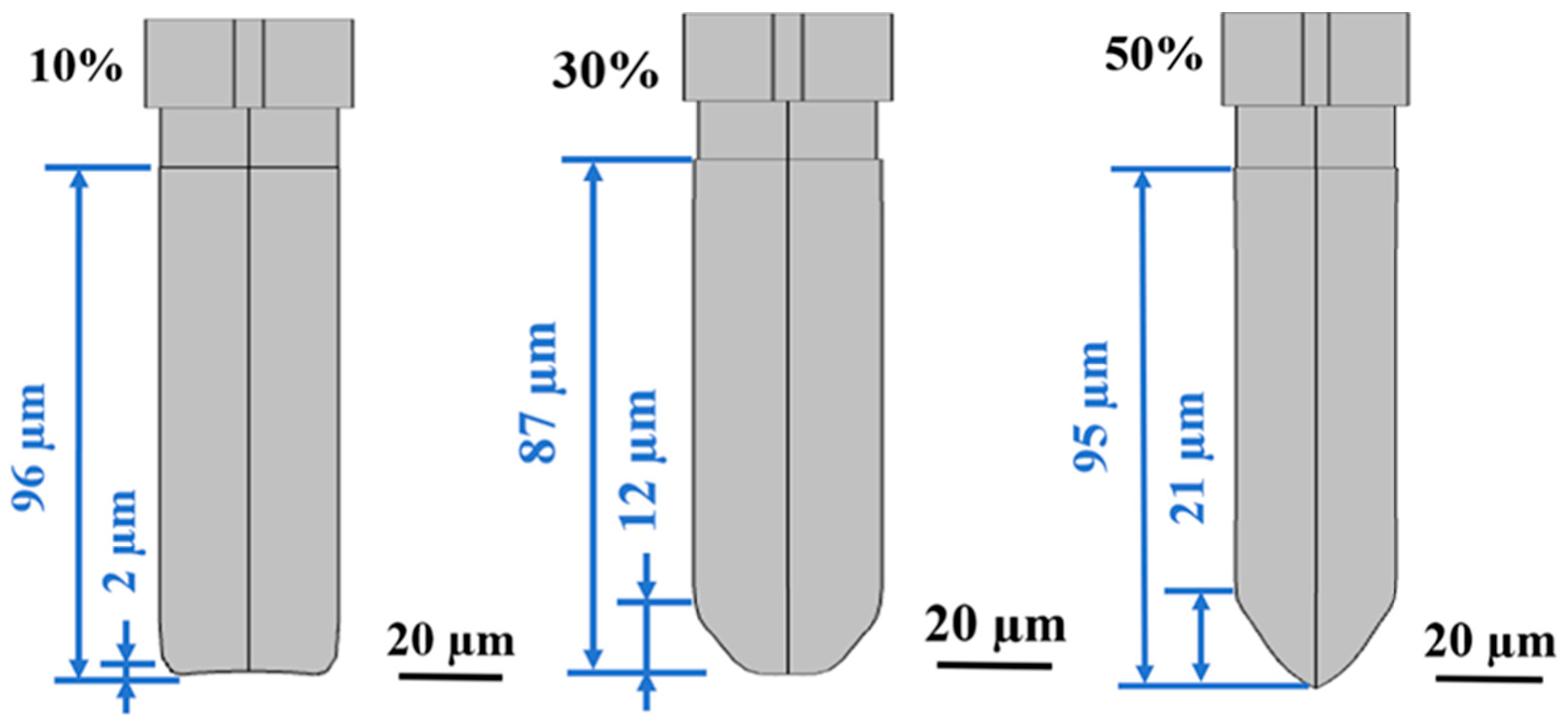
- The V-shaped footing defect is demonstrated to be a deterministic geometric manifestation governed by the kinetic competition ratio (γ). A Critical Flat-Bottom Depth () was theoretically derived as a quantitative threshold for sidewall intersection. The 3D ALE-based multiphysics model, coupled with calibrated kinetics, was found to be consistent with the theoretical predictions in terms of the overall morphology evolution.
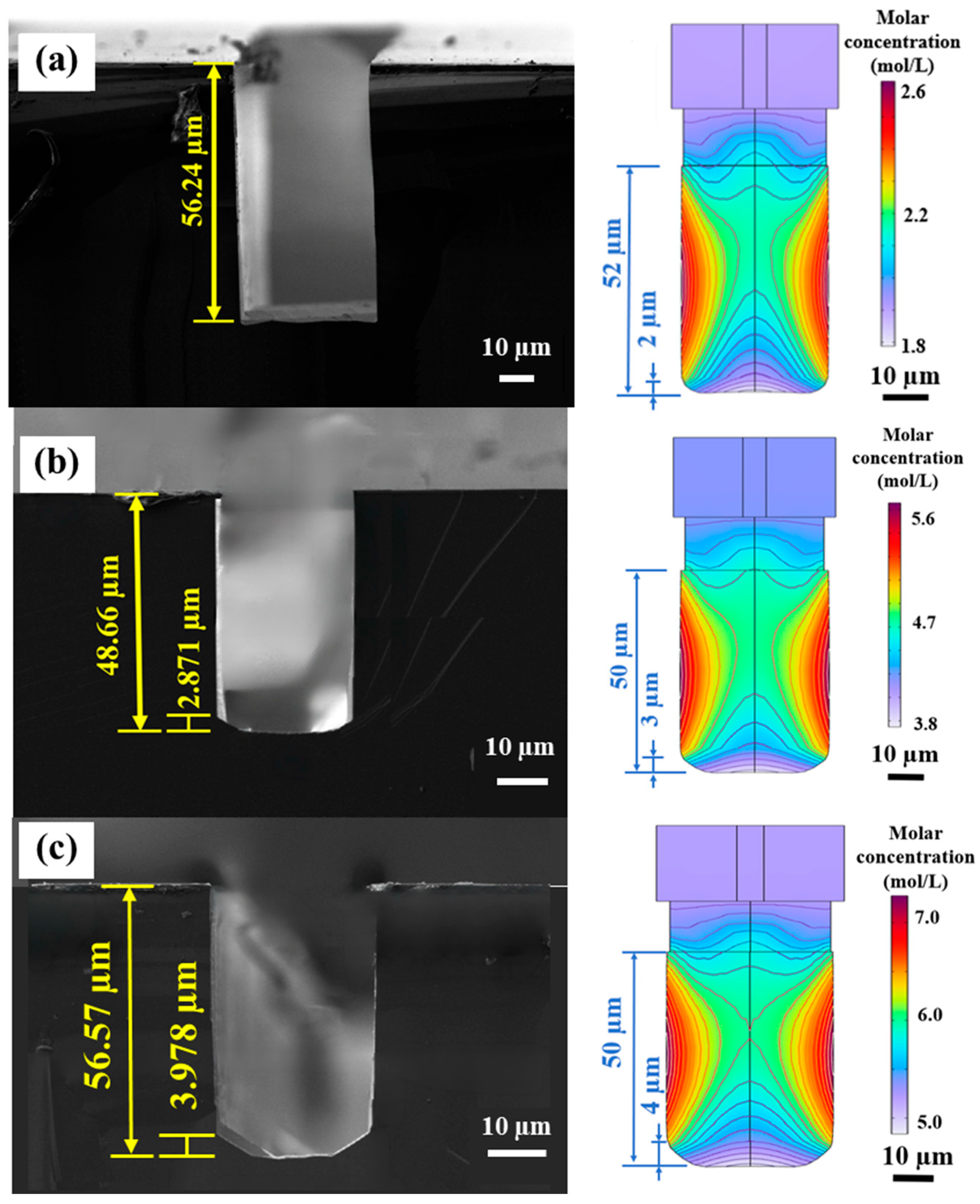
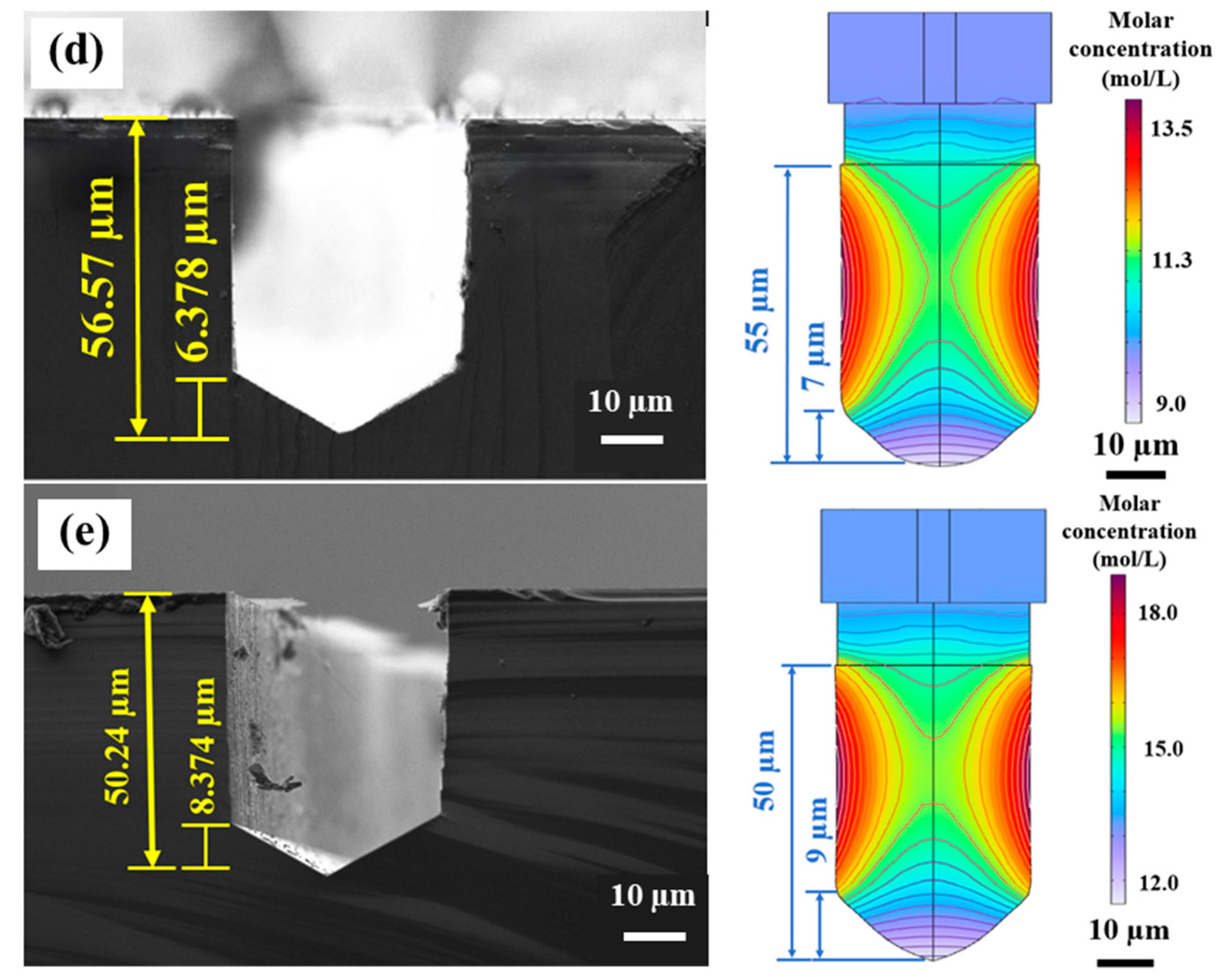
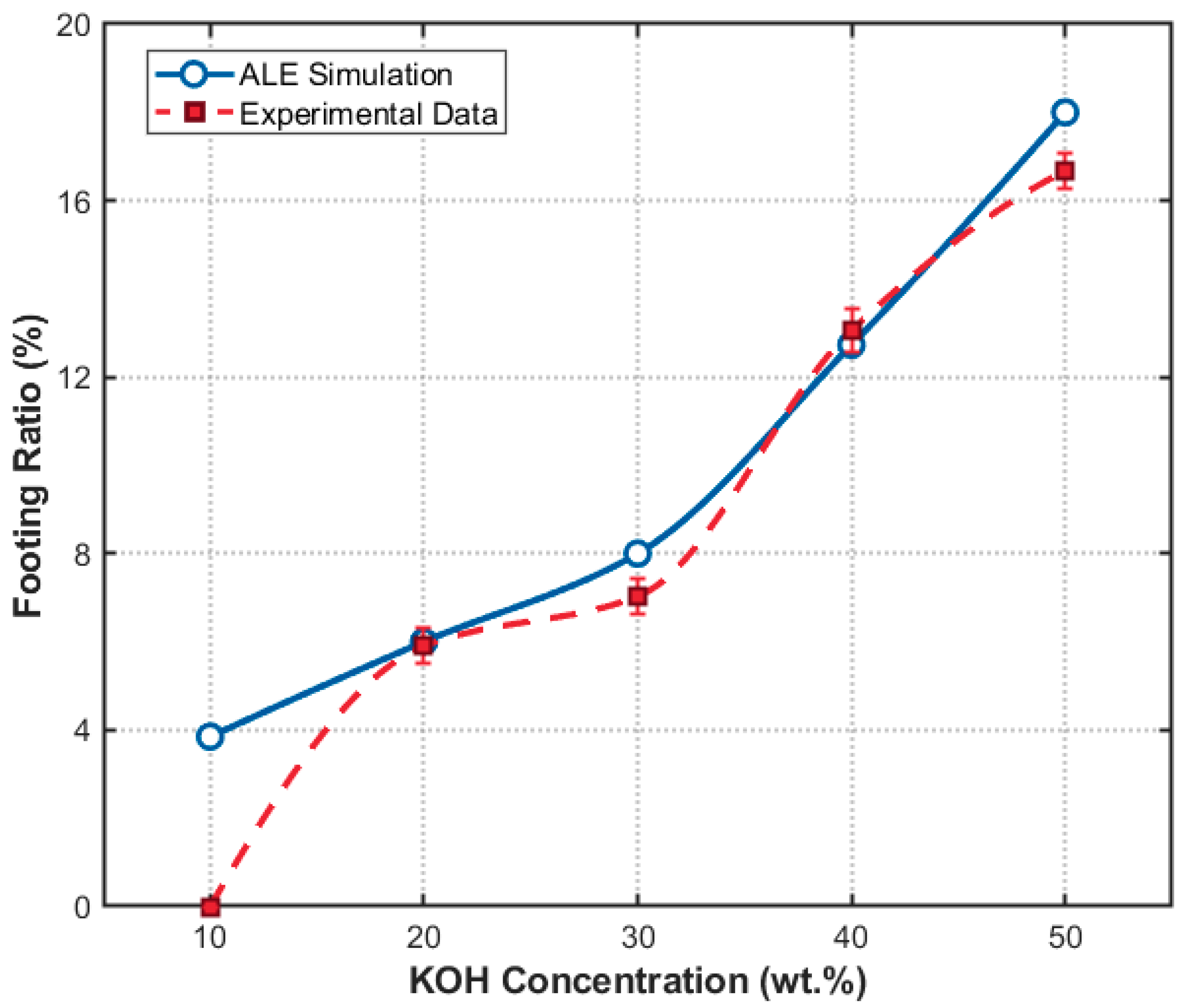
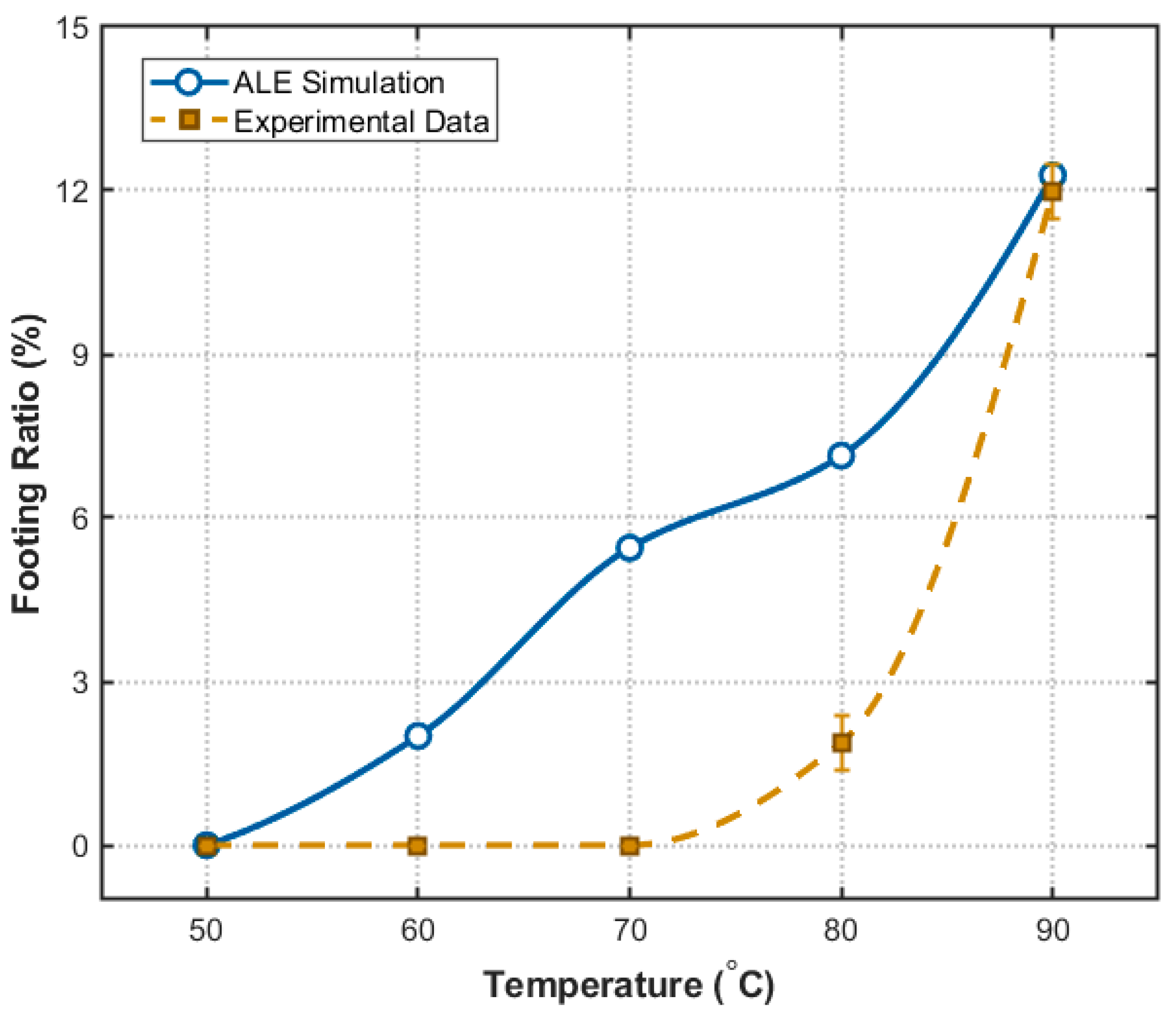
- Systematic experiments showed that the experimental results generally followed the same trend as the simulations within the investigated parameter range. The footing ratio was found to increase monotonically with KOH concentration and temperature, confirming the trend predicted by the -based theoretical framework.
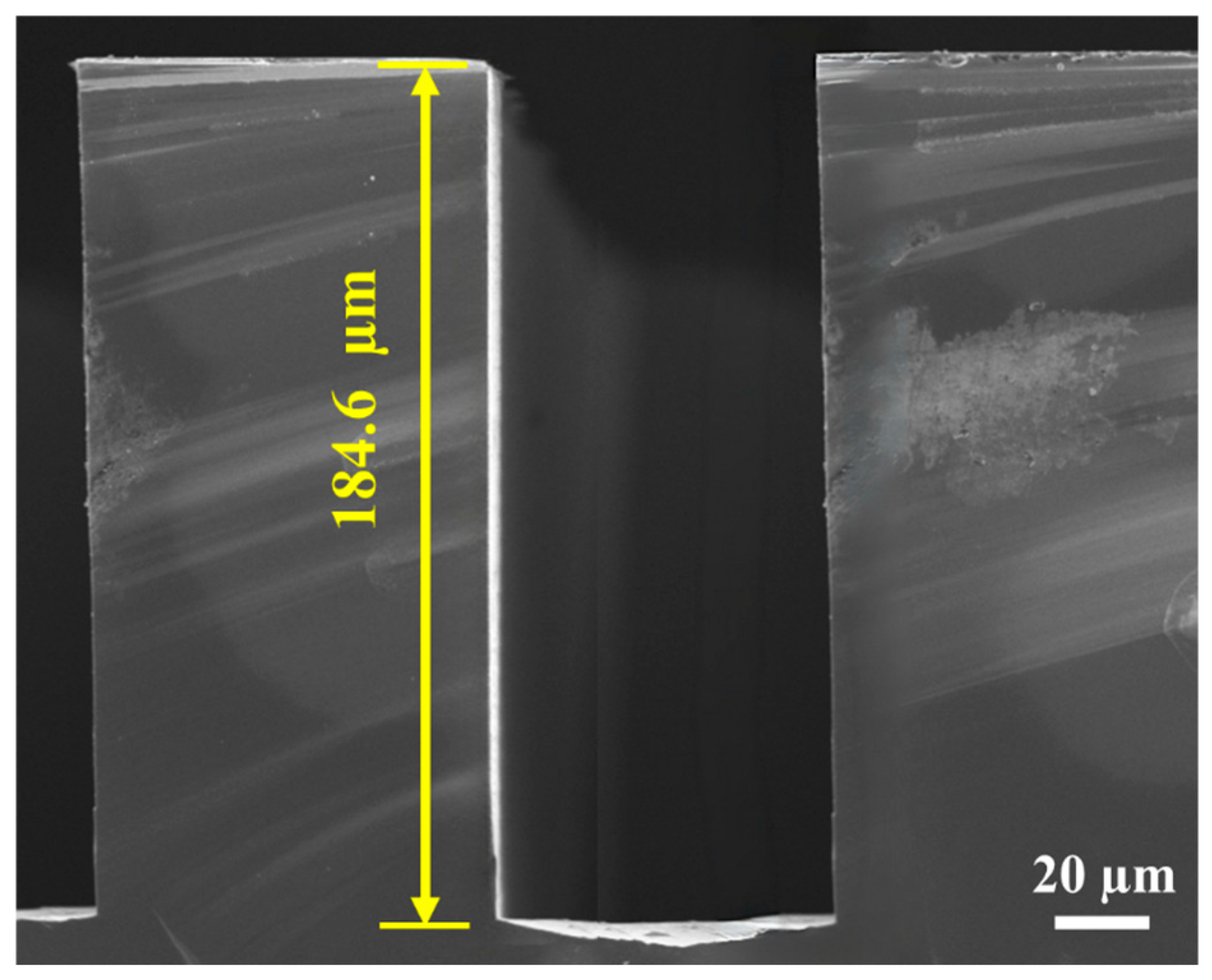
- A dual-parameter kinetic regulation strategy was identified, with 10 wt.% KOH at 70 °C providing the most favorable process window within the investigated conditions. Under these conditions, ultra-deep and complex microstructures (depth reaching 184.6 µm) were successfully fabricated with almost no observable footing defect. This strategy provides a practical process reference for high-fidelity MEMS fabrication.
Author Contributions
Funding
Institutional Review Board Statement
Informed Consent Statement
Data Availability Statement
Acknowledgments
Conflicts of Interest
References
- Takahata, K. Advances in Micro/Nano Electromechanical Systems and Fabrication Technologies; BoD–Books on Demand: Hamburg, Germany, 2013. [Google Scholar]
- Welburn, L.; Javadi, A.M.M.; Nguyen, L.; Desai, S. Prospects and Trends in Biomedical Microelectromechanical Systems (MEMS) Devices: A Review. Biomolecules 2025, 15, 898. [Google Scholar] [CrossRef] [PubMed]
- Varadan, V.K.; Vinoy, K.J.; Gopalakrishnan, S. Smart Material Systems and MEMS: Design and Development Methodologies; John Wiley & Sons: Hoboken, NJ, USA, 2006. [Google Scholar]
- Bean, K.E. Anisotropic etching of silicon. IEEE Trans. Electron Devices 2005, 25, 1185–1193. [Google Scholar] [CrossRef]
- Madou, M.J. Fundamentals of Microfabrication: The Science of Miniaturization; CRC Press: Boca Raton, FL, USA, 2018. [Google Scholar]
- Chen, H.; Zhu, C.; Lin, G.; Lin, Y. Deep silicon etching technology and applications: A review. J. Micromech. Microeng. 2025, 35, 083001. [Google Scholar] [CrossRef]
- Tanaka, H.; Takeda, M.; Sato, K. Si (100) and (110) etching properties in 5, 15, 30 and 48 wt% KOH aqueous solution containing Triton-X-100. Microsyst. Technol. 2017, 23, 5343–5350. [Google Scholar] [CrossRef]
- Yu, X.; Ye, Y.; Zhu, P.; Wu, L.; Shen, R.; Zhu, C.-G. Wet Anisotropic Etching Characteristics of Si {111} in KOH-Based Solution. ACS Omega 2025, 10, 2940–2948. [Google Scholar] [CrossRef]
- Nijdam, A.; Gardeniers, J.; Gui, C.; Elwenspoek, M. Etching pits and dislocations in Si {111}. Sens. Actuators A Phys. 2000, 86, 238–247. [Google Scholar] [CrossRef]
- Hubbard, T.J. MEMS Design: The Geometry of Silicon Micromachining; California Institute of Technology: Pasadena, CA, USA, 1994. [Google Scholar]
- Smiljanić, M.M.; Lazić, Ž.; Jović, V.; Radjenović, B.; Radmilović-Radjenović, M. Etching of Uncompensated Convex Corners with Sides along <n10> in 25 wt% TMAH at 80 °C. Micromachines 2020, 11, 253. [Google Scholar] [CrossRef]
- Ashraf, M.W.; Tayyaba, S.; Afzulpurkar, N. Micro electromechanical systems (MEMS) based microfluidic devices for biomedical applications. Int. J. Mol. Sci. 2011, 12, 3648–3704. [Google Scholar] [CrossRef]
- Lee, D.; Yu, K.; Krishnamoorthy, U.; Solgaard, O. Vertical mirror fabrication combining KOH etch and DRIE of (110) silicon. J. Microelectromech. Syst. 2008, 18, 217–227. [Google Scholar] [CrossRef]
- Liu, L.; Kuryatkov, V.V.; Nikishin, S.A.; Harris, H.R.; Holtz, M. Wet etching silicon nanofins with (111)-oriented sidewalls. J. Vac. Sci. Technol. B 2013, 31, 021801. [Google Scholar] [CrossRef]
- Kramkowska, I.Z.M. Etch rates and morphology of silicon (hkl) surfaces etched in KOH and KOH saturated with isopropanol solutions. Sens. Actuators A Phys. 2004, 115, 549–556. [Google Scholar]
- Henderson, A.H.H.T. Ultra-deep anisotropic etching of (110) silicon. J. Micromech. Microeng. 1999, 9, 51. [Google Scholar] [CrossRef]
- Sato, P.P.K. A comprehensive review on convex and concave corners in silicon bulk micromachining based on anisotropic wet chemical etching. Micro Nano Syst. Lett. 2015, 3, 6. [Google Scholar] [CrossRef]
- Rola, K.P. Anisotropic etching of silicon in KOH+ Triton X-100 for 45 micromirror applications. Microsyst. Technol. 2017, 23, 1463–1473. [Google Scholar] [CrossRef]
- Rola, K.P.; Zubel, I. Application of triton X-100 surfactant for silicon anisotropic etching in KOH-based solutions. Mater. Sci. -Pol. 2013, 31, 525–530. [Google Scholar] [CrossRef]
- Cho, W.-J.; Chin, W.-K.; Kuo, C.-T. Effects of alcoholic moderators on anisotropic etching of silicon in aqueous potassium hydroxide solutions. Sens. Actuators A Phys. 2004, 116, 357–368. [Google Scholar] [CrossRef]
- Shah, I.; Koekkoek, A.; Van Enckevort, W.; Vlieg, E. Influence of additives on alkaline etching of silicon (111). Cryst. Growth Des. 2009, 9, 4315–4323. [Google Scholar] [CrossRef]
- Zubel, K.P.R.I. Triton surfactant as an additive to KOH silicon etchant. J. Microelectromech. Syst. 2013, 22, 1373–1382. [Google Scholar] [CrossRef]
- Pal, P.; Swarnalatha, V.; Rao, A.V.N.; Pandey, A.K.; Tanaka, H.; Sato, K. High speed silicon wet anisotropic etching for applications in bulk micromachining: A review. Micro Nano Syst. Lett. 2021, 9, 4. [Google Scholar] [CrossRef]
- Yang, C.-R.; Chen, P.-Y.; Yang, C.-H.; Chiou, Y.-C.; Lee, R.-T. Effects of various ion-typed surfactants on silicon anisotropic etching properties in KOH and TMAH solutions. Sens. Actuators A Phys. 2005, 119, 271–281. [Google Scholar] [CrossRef]
- Purohit, S.; Swarnalatha, V.; Pandey, A.K.; Sharma, R.; Pal, P. Wet bulk micromachining characteristics of Si {110} in NaOH-based solution. J. Micromechanics Microengineering 2022, 32, 124001. [Google Scholar] [CrossRef]
- Montoliu, C.; Ferrando, N.; Gosalvez, M.; Cerdá, J.; Colom, R. Level set implementation for the simulation of anisotropic etching: Application to complex MEMS micromachining. J. Micromech. Microeng. 2013, 23, 075017. [Google Scholar] [CrossRef]
- Tseng, F.-G.; Chang, K.-C. A Precision Alignment Method to <100> Direction on (110) Silicon Wafer. In Proceedings of the ASME International Mechanical Engineering Congress and Exposition, New York, NY, USA, 11–16 November 2001; American Society of Mechanical Engineers: New York, NY, USA, 2001; Volume 35555, pp. 403–406. [Google Scholar]
- Yang, C.-R.; Chen, P.-Y.; Chiou, Y.-C.; Lee, R.-T. Effects of mechanical agitation and surfactant additive on silicon anisotropic etching in alkaline KOH solution. Sens. Actuators A Phys. 2005, 119, 263–270. [Google Scholar] [CrossRef]
- Jiao, Q.; Tan, X.; Zhu, J.; Feng, S.; Gao, J. Effects of ultrasonic agitation and surfactant additive on surface roughness of Si (1 1 1) crystal plane in alkaline KOH solution. Ultrason. Sonochem. 2016, 31, 222–226. [Google Scholar] [CrossRef]
- Sato, K.; Shikida, M.; Yamashiro, T.; Tsunekawa, M.; Ito, S. Roughening of single-crystal silicon surface etched by KOH water solution. Sens. Actuators A Phys. 1999, 73, 122–130. [Google Scholar] [CrossRef]
- Sato, K.; Shikida, M.; Matsushima, Y.; Yamashiro, T.; Asaumi, K.; Iriye, Y.; Yamamoto, M. Characterization of orientation-dependent etching properties of single-crystal silicon: Effects of KOH concentration. Sens. Actuators A Phys. 1998, 64, 87–93. [Google Scholar] [CrossRef]
- Seidel, H.; Csepregi, L.; Heuberger, A.; Baumgärtel, H. Anisotropic etching of crystalline silicon in alkaline solutions: I. Orientation dependence and behavior of passivation layers. J. Electrochem. Soc. 1990, 137, 3612. [Google Scholar] [CrossRef]
- Gosálvez, M.A. Atomistic Modelling of Anisotropic Etching of Crystalline Silicon; Helsinki University of Technology: Espoo, Finland, 2003. [Google Scholar]
- Gosálvez, M.A.; Pal, P.; Sato, K. Reconstructing the 3D etch rate distribution of silicon in anisotropic etchants using data from vicinal {1 0 0}, {1 1 0} and {1 1 1} surfaces. J. Micromech. Microeng. 2011, 21, 105018. [Google Scholar] [CrossRef]
- Shah, I.; Van der Wolf, B.; Van Enckevort, W.; Vlieg, E. Wet chemical etching of silicon {111}: Autocatalysis in pit formation. J. Electrochem. Soc. 2008, 155, J79. [Google Scholar] [CrossRef]
- Shah, I.A.; van der Wolf, B.M.; van Enckevort, W.J.; Vlieg, E. Wet chemical etching of silicon {1 1 1}: Etch pit analysis by the Lichtfigur method. J. Cryst. Growth 2009, 311, 1371–1377. [Google Scholar] [CrossRef]



| Parameters | Inlet (m/s) | Outlet (Pa) | (wt.%) | Simulation Time (min) | |
|---|---|---|---|---|---|
| Values | 0.01 | 0 | 10, 20, 30, 40, 50 | 50, 60, 70, 80, 90 | 30 |
| Orientation | Pre-Exponential Factor, ln(A) | Reaction Order , n | Solvation Order (), m | Activation Energy (, eV) | Coefficient of Determination |
|---|---|---|---|---|---|
| {110} | 3.137 ± 0.082 | 1.018 ± 0.031 | 3.047 ± 0.095 | 0.5721 ± 0.012 | 0.9948 |
| {100} | 2.125 ± 0.094 | 1.035 ± 0.035 | 3.192 ± 0.102 | 0.5753 ± 0.014 | 0.9939 |
| {111} | 9.836 ± 0.150 | 0.512 ± 0.028 | 1.328 ± 0.067 | 0.6263 ± 0.018 | 0.9914 |
| KOH Conc. | 10% | 20% | 30% | 40% | 50% |
|---|---|---|---|---|---|
| Trench depth (µm) | 56.24 | 48.66 | 56.57 | 48.85 | 50.24 |
| Footing height (µm) | 0.000 | 2.871 | 3.978 | 6.378 | 8.374 |
| Footing ratio (%) | 0.000 | 5.900 | 7.032 | 13.06 | 16.67 |
| Sim. Footing ratio (%) | 3.846 | 6.000 | 8.000 | 12.73 | 18.00 |
| Temperature | 50 °C | 60 °C | 70 °C | 80 °C | 90 °C |
|---|---|---|---|---|---|
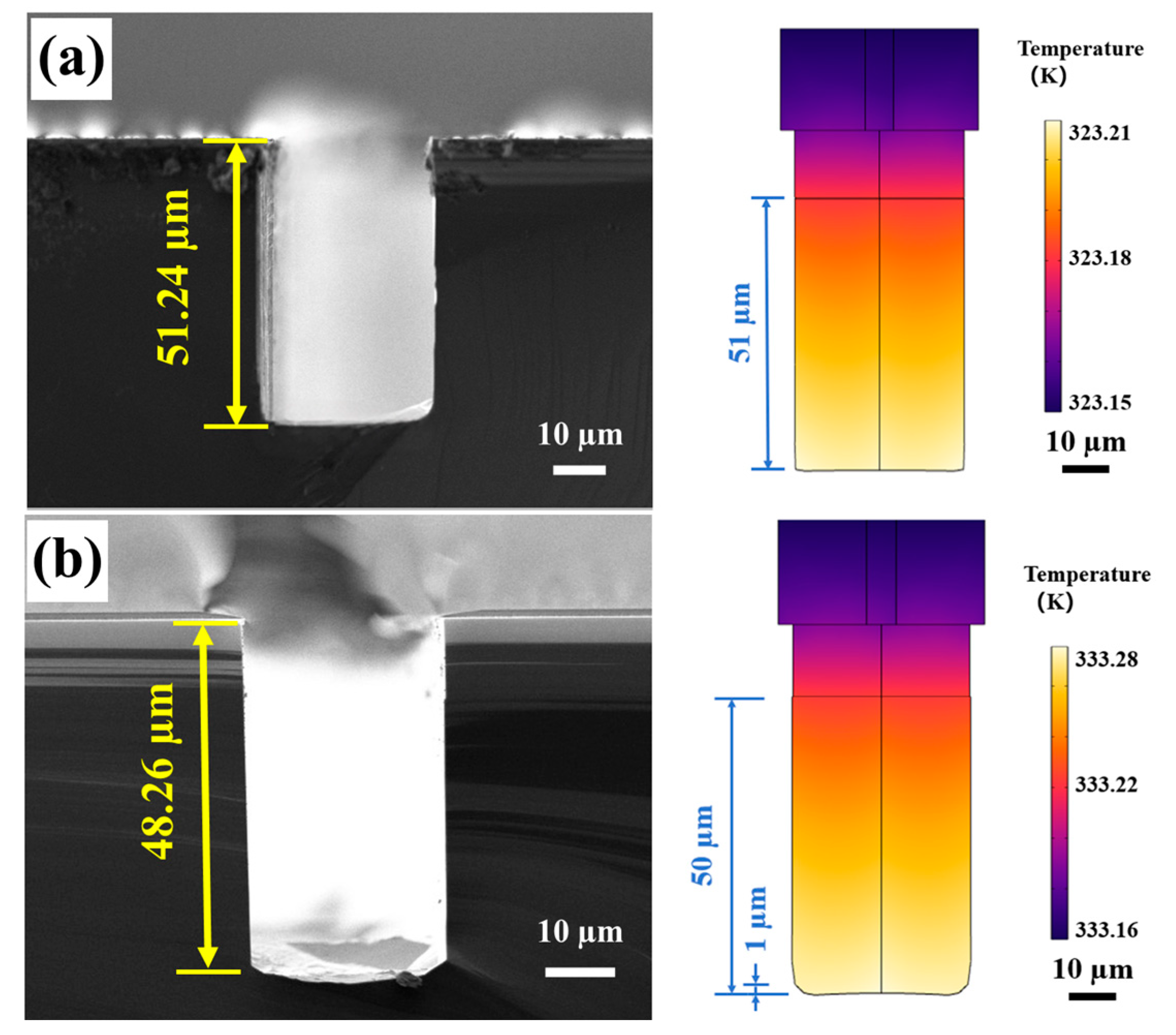
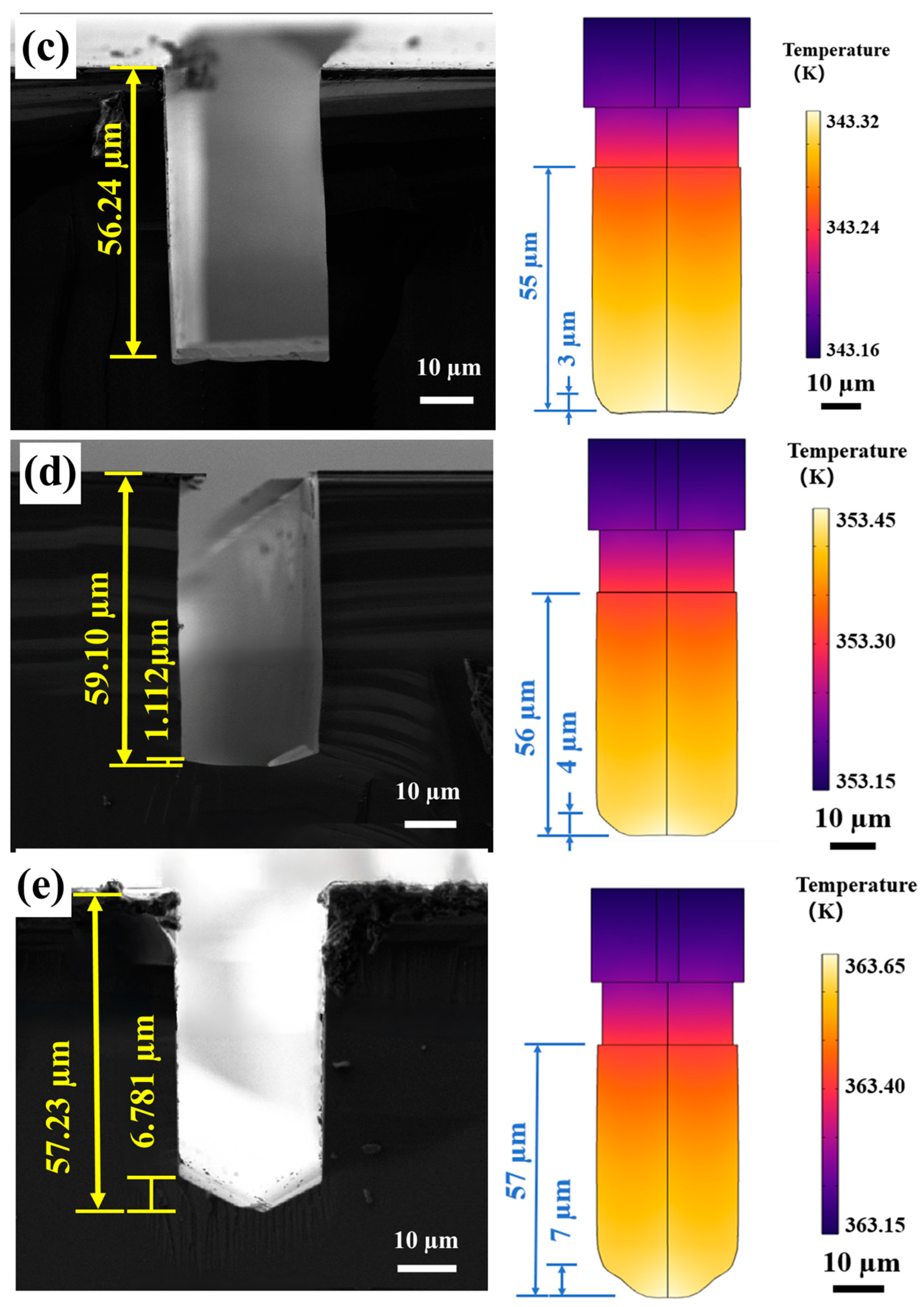
| Trench depth (µm) | 51.24 | 48.26 | 56.24 | 59.10 | 57.23 |
| Footing height (µm) | 0.000 | 0.000 | 0.000 | 1.112 | 6.871 |
| Footing ratio (%) | 0.000 | 0.000 | 0.000 | 1.882 | 11.85 |
| Sim. Footing ratio (%) | 0.000 | 2.000 | 5.45 | 7.143 | 12.28 |
Disclaimer/Publisher’s Note: The statements, opinions and data contained in all publications are solely those of the individual author(s) and contributor(s) and not of MDPI and/or the editor(s). MDPI and/or the editor(s) disclaim responsibility for any injury to people or property resulting from any ideas, methods, instructions or products referred to in the content. |
© 2026 by the authors. Licensee MDPI, Basel, Switzerland. This article is an open access article distributed under the terms and conditions of the Creative Commons Attribution (CC BY) license.
Share and Cite
Wang, Z.; Xie, G.; Xu, G.; Li, G.; Zhou, W.; Fu, D.; Kong, L.; Chen, Z.; Liu, S. An Investigation into the Footing Profile Suppression in (110) Si Anisotropic Etching. Micromachines 2026, 17, 518. https://doi.org/10.3390/mi17050518
Wang Z, Xie G, Xu G, Li G, Zhou W, Fu D, Kong L, Chen Z, Liu S. An Investigation into the Footing Profile Suppression in (110) Si Anisotropic Etching. Micromachines. 2026; 17(5):518. https://doi.org/10.3390/mi17050518
Chicago/Turabian StyleWang, Zhishen, Guoliang Xie, Gaowei Xu, Genzi Li, Weihu Zhou, Dongzhi Fu, Lingde Kong, Zhiwen Chen, and Sheng Liu. 2026. "An Investigation into the Footing Profile Suppression in (110) Si Anisotropic Etching" Micromachines 17, no. 5: 518. https://doi.org/10.3390/mi17050518
APA StyleWang, Z., Xie, G., Xu, G., Li, G., Zhou, W., Fu, D., Kong, L., Chen, Z., & Liu, S. (2026). An Investigation into the Footing Profile Suppression in (110) Si Anisotropic Etching. Micromachines, 17(5), 518. https://doi.org/10.3390/mi17050518