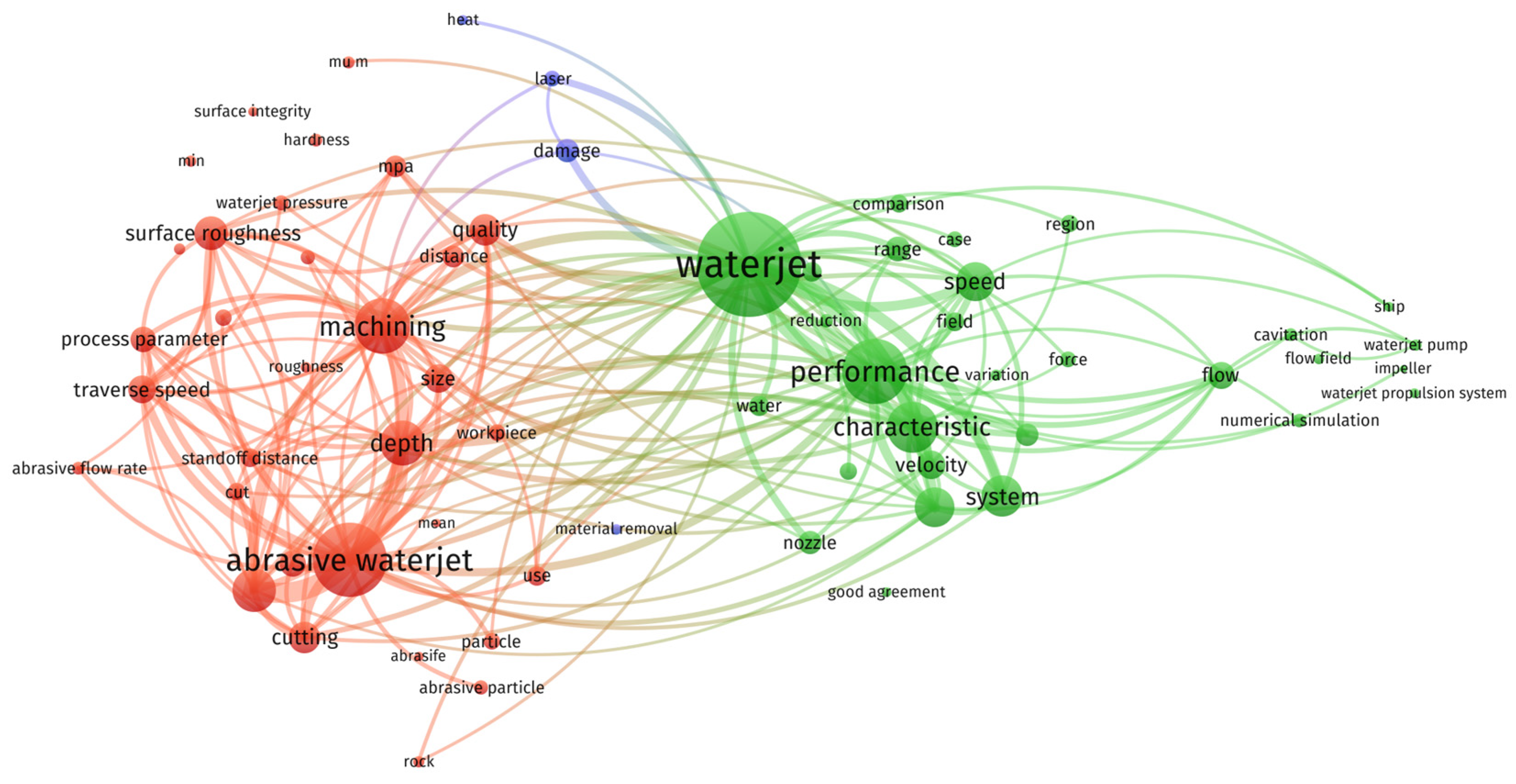
Towards Ultra-Precision Manufacturing: Advancements and Future Trends in Energy Field-Assisted Jet Machining

Abstract
1. Introduction

2. Challenges and Mechanisms of Multi-Energy Field-Assisted Jet Machining Technology
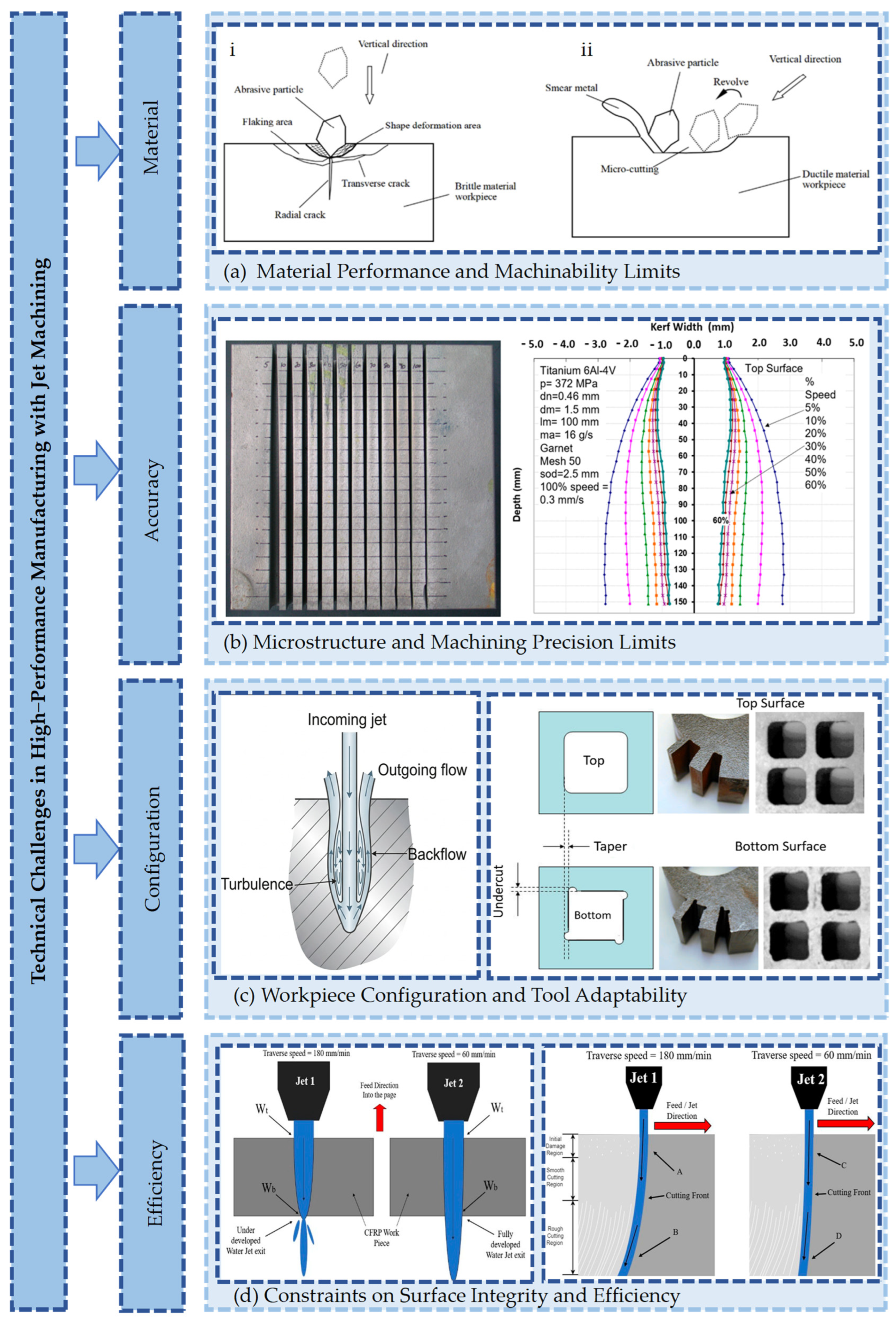
2.1. Technical Challenges in High-Performance Manufacturing with Jet Machining
2.1.1. Limitations in Material Performance and Machinability
2.1.2. Limitations in Workpiece Microstructure and Machining Precision
2.1.3. Limitations in Workpiece Configuration and Tool Adaptability
2.1.4. Limitations in Surface Integrity and Machining Efficiency
2.2. Synergistic Reinforcement Mechanisms of Mechanical and Specialized Energy Fields
2.2.1. Laser-Mechanical Synergistic Reinforcement
2.2.2. Acoustic-Mechanical Synergistic Reinforcement
2.2.3. Magnetic-Mechanical Synergistic Reinforcement
3. Laser-Assisted Jet Machining Technology
3.1. Process Principle

3.2. Typical Applications
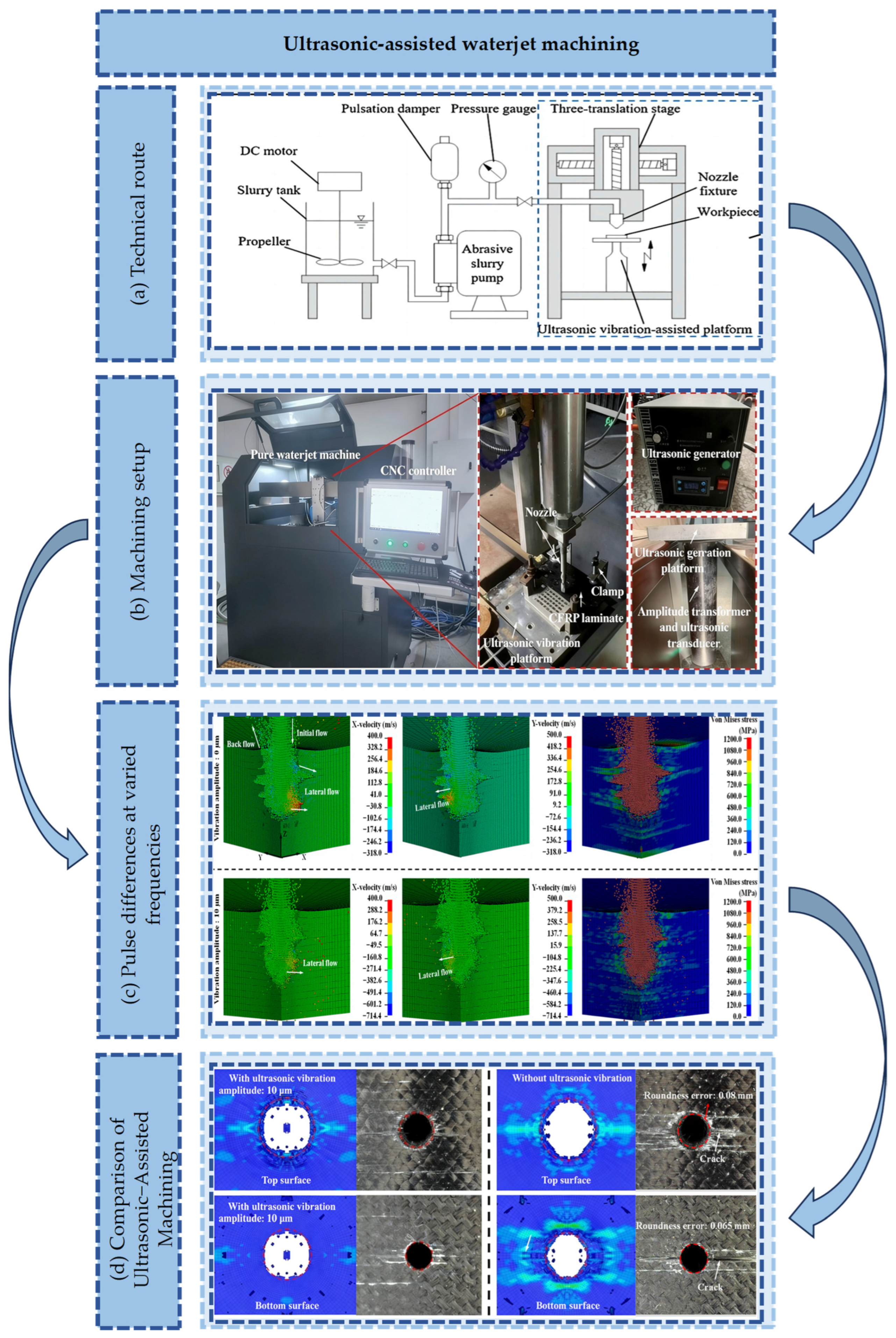
4. Ultrasonic-Assisted Jet Machining Technology
4.1. Process Principle
4.2. Typical Applications
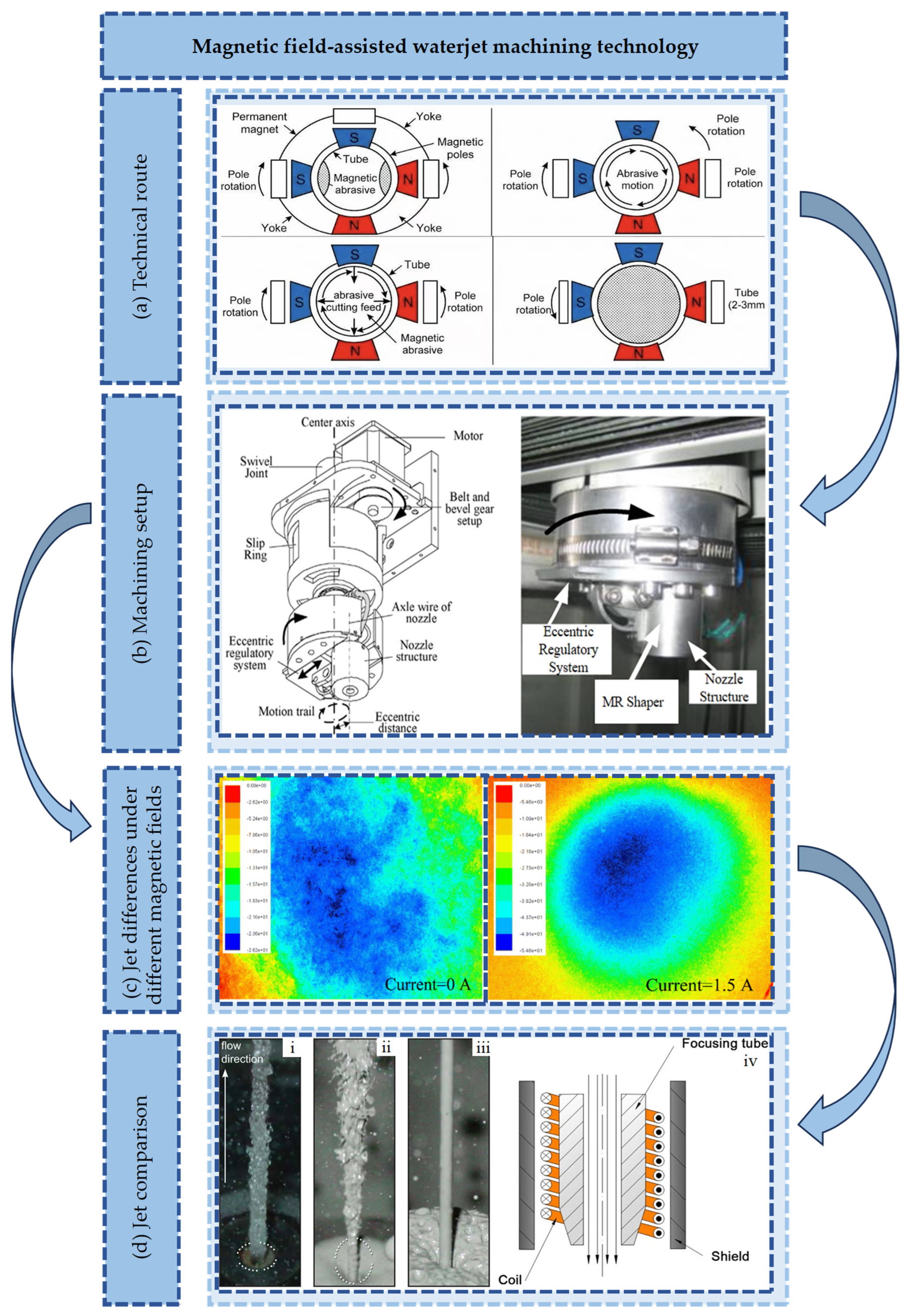
5. Magnetic Field-Assisted Jet Machining Technology
5.1. Process Principle
5.2. Typical Applications
6. Conclusions and Outlook
6.1. Conclusions
6.2. Outlook
- (1)
- Mechanisms of Multi-Physics Non-linear Coupling and Cross-Scale Modeling. Future research prioritizes the non-linear synergistic mechanisms between heterogeneous energy fields. Cross-scale modeling frameworks bridging Molecular Dynamics (MD) and Computational Fluid Dynamics (CFD) capture atomic-level material removal behaviors within complex thermo-mechanical-acoustic-magnetic environments. A key focus lies in high-fidelity simulations of cavitation bubble collapse dynamics under magnetic constraints and the resulting micro-jet impact intensity. Furthermore, the energy matching windows for sequential coupling—such as “nanosecond laser thermal softening followed by magnetorheological jet polishing”—are quantitatively defined to optimize energy efficiency and surface integrity.
- (2)
- AI-Driven Process Architectures and Digital Twin Systems. To address the stochastic nature of jet-material interactions, research shifts towards data-driven process intelligence. This involves integrating Deep Reinforcement Learning (DRL) with multi-modal sensing—such as Acoustic Emission (AE) and high-speed shadowgraphy—to establish real-time feedback loops. Digital Twin models enable the prediction of material damage response and the closed-loop modulation of laser power, ultrasonic frequency, and jet pressure. This approach is instrumental for achieving consistent machining quality in heterogeneous materials like Ceramic Matrix Composites (CMCs) and Gallium Nitride (GaN).
- (3)
- Integration of High-Reliability Equipment with In-Situ Metrology. The engineering focus involves developing compact, coaxial integrated nozzle systems for stable operation under extreme conditions. Technical developments address the water-resistant coupling of high-power laser paths and the fatigue mitigation of ultrasonic transducers under high-pressure water-hammer effects. Next-generation equipment embeds in-situ optical sensors (e.g., white-light interferometry or confocal microscopy) to allow for “machining-while-measuring.” This integration minimizes repositioning errors and maintains the structural integrity of core components throughout extended high-frequency service.
- (4)
- Expansion into “Shape-Performance Integrated” Manufacturing for Extreme Applications. The research paradigm shifts from basic geometric shaping toward “Geometry-Property Synergistic” manufacturing. In the semiconductor sector, applications include sub-nanometer thinning and dicing of 4H-SiC and diamond substrates to achieve zero subsurface damage (SSD) and atomic-scale flatness. Within aerospace engineering, the technology enables the fabrication of complex cooling holes and bionic drag-reduction textures on turbine blades, while facilitating the tailoring of surface residual stress fields to improve fatigue life. This technology is positioned as a strategic platform for the high-integrity manufacturing of critical components operating under extreme thermal and mechanical loads.
Author Contributions
Funding
Data Availability Statement
Acknowledgments
Conflicts of Interest
References
- Wang, Y.-F.; Yang, Z.-G. Finite element model of erosive wear on ductile and brittle materials. Wear 2008, 265, 871–878. [Google Scholar] [CrossRef] [Scilit]
- Balamurugan, K.; Uthayakumar, M.; Gowthaman, S.; Pandurangan, R. A study on the compressive residual stress due to waterjet cavitation peening. Eng. Fail. Anal. 2018, 92, 268–277. [Google Scholar] [CrossRef] [Scilit]
- Boud, F.; Loo, L.F.; Kinnell, P.K. The Impact of Plain Waterjet Machining on the Surface Integrity of Aluminium 7475. Procedia CIRP 2014, 13, 382–386. [Google Scholar] [CrossRef] [Scilit]
- Du, M.; Zhang, K.; Liu, Y.; Feng, L.; Fan, C. Experimental and simulation study on the influence factors of abrasive water jet machining ductile materials. Energy Rep. 2022, 8, 11840–11857. [Google Scholar] [CrossRef] [Scilit]
- Llanto, J.M.; Tolouei-Rad, M.; Vafadar, A.; Aamir, M. Recent Progress Trend on Abrasive Waterjet Cutting of Metallic Materials: A Review. Appl. Sci. 2021, 11, 3344. [Google Scholar] [CrossRef] [Scilit]
- Ghasemian Fard, M.; Nag, A.; Petrů, J.; Hloch, S. Towards sustainable precision: A review of water jet meso and micromachining. Results Eng. 2025, 27, 106447. [Google Scholar] [CrossRef] [Scilit]
- Ghobeity, A.; Krajac, T.; Burzynski, T.; Papini, M.; Spelt, J.K. Surface evolution models in abrasive jet micromachining. Wear 2008, 264, 185–198. [Google Scholar] [CrossRef] [Scilit]
- Cui, J.; Liu, W.; Tang, J.; Zhang, Z.; Lu, Y.; Yan, X.; Chen, K.; Zhang, J. Abrasive breakage characteristics and prediction in abrasive water jets within nozzle internals. Powder Technol. 2025, 458, 120971. [Google Scholar] [CrossRef] [Scilit]
- Kong, L.; Wang, Y.; Lei, X.; Feng, C.; Wang, Z. Integral modeling of abrasive waterjet micro-machining process. Wear 2021, 482–483, 203987. [Google Scholar] [CrossRef] [Scilit]
- Zhang, Z.; Cheung, C.F.; Ho, L.T.; Wang, C. Mechanistic insights and modeling of tool mark removal in fluid jet polishing for ultra-precision machining. Wear 2025, 578–579, 206146. [Google Scholar] [CrossRef] [Scilit]
- Natarajan, Y.; Murugesan, P.K.; Mohan, M.; Liyakath Ali Khan, S.A. Abrasive Water Jet Machining process: A state of art of review. J. Manuf. Process. 2020, 49, 271–322. [Google Scholar] [CrossRef] [Scilit]
- Liu, J.; Du, S.; Xue, Y. Study on the breaking process and damage characteristics of abrasive water jet impacting concrete based on acoustic emission. Constr. Build. Mater. 2020, 262, 120085. [Google Scholar] [CrossRef] [Scilit]
- Liu, X.; Liang, Z.; Wen, G.; Yuan, X. Waterjet machining and research developments: A review. Int. J. Adv. Manuf. Technol. 2019, 102, 1257–1335. [Google Scholar] [CrossRef] [Scilit]
- Shibin, R.; Anandakrishnan, V.; Sathish, S.; Mallemala Sujana, V. Investigation on the abrasive water jet machinability of AA2014 using SiC as abrasive. Mater. Today Proc. 2020, 21, 519–522. [Google Scholar] [CrossRef] [Scilit]
- Zhang, Z.; Wang, R.; Wang, C.; Zhang, H.; Liang, X. Enhancing the grinding performance of RB-SiC ceramic using abrasive water jet dressed diamond grinding wheels. Tribol. Int. 2024, 194, 109477. [Google Scholar] [CrossRef] [Scilit]
- Feng, S.; Huang, C.; Wang, J.; Zhu, H.; Yao, P.; Liu, Z. An analytical model for the prediction of temperature distribution and evolution in hybrid laser-waterjet micro-machining. Precis. Eng. 2017, 47, 33–45. [Google Scholar] [CrossRef] [Scilit]
- Li, Y.; Ding, Y.; Cheng, B.; Cao, J.; Yang, L. Numerical and Experimental Research on the Laser-Water Jet Scribing of Silicon. Appl. Sci. 2022, 12, 4057. [Google Scholar] [CrossRef] [Scilit]
- Bao, J.; Long, Y.; Tong, Y.; Yang, X.; Zhang, B.; Zhou, Z. Experiment and simulation study of laser dicing silicon with water-jet. Appl. Surf. Sci. 2016, 387, 491–496. [Google Scholar] [CrossRef] [Scilit]
- Siva Prasad, K.; Chaitanya, G. Influence of abrasive water jet machining process parameters on accuracy of hole dimensions in glass fiber reinforced polymer composites. Mater. Today Proc. 2024, 98, 135–142. [Google Scholar] [CrossRef] [Scilit]
- Ma, Y.; Yu, B.; Zhang, X.; Cai, J.; Li, D.; Wu, Y.; Chen, Y. Processing quality of the hybrid of laser and gas-waterjet for CFRP hole cutting: An experimental study on the effects of gas and waterjet parameters. Opt. Laser Technol. 2025, 189, 113028. [Google Scholar] [CrossRef] [Scilit]
- Tripathi, R.; Hloch, S.; Chattopadhyaya, S.; Klichová, D.; Ščučka, J.; Das, A.K. Application of the pulsating and continous water jet for granite erosion. Int. J. Rock Mech. Min. Sci. 2020, 126, 104209. [Google Scholar] [CrossRef] [Scilit]
- Wang, H.; Yuan, R.; Zhang, X.; Zai, P.; Deng, J. Research Progress in Abrasive Water Jet Processing Technology. Micromachines 2023, 14, 1526. [Google Scholar] [CrossRef] [Scilit]
- Pal, V.K.; Choudhury, S.K. Surface Characterization and Machining of Blind Pockets on Ti6Al4V by Abrasive Water Jet Machining. Procedia Mater. Sci. 2014, 5, 1584–1592. [Google Scholar] [CrossRef] [Scilit]
- Song, D.; Du, H.; Lin, J.; Zhou, X.; Wang, R. A Review on Magnetorheological Jet Polishing Technique for Microstructured Functional Surfaces. Lubricants 2022, 10, 237. [Google Scholar] [CrossRef] [Scilit]
- Farayibi, P.K.; Murray, J.W.; Huang, L.; Boud, F.; Kinnell, P.K.; Clare, A.T. Erosion resistance of laser clad Ti-6Al-4V/WC composite for waterjet tooling. J. Mater. Process. Technol. 2014, 214, 710–721. [Google Scholar] [CrossRef] [Scilit]
- Ravindran, S.; Anbuchezhiyan, G.; Vignesh, M.; Mubarak, N.M. Exploring the impact of abrasive water jet machining parameters on hole quality characteristics in Al2017A/hBN/ZrO2 hybrid composites. J. Mater. Res. Technol. 2025, 38, 6011–6024. [Google Scholar] [CrossRef] [Scilit]
- You, K.; Yan, G.; Luo, X.; Gilchrist, M.D.; Fang, F. Advances in laser assisted machining of hard and brittle materials. J. Manuf. Process. 2020, 58, 677–692. [Google Scholar] [CrossRef] [Scilit]
- Folkes, J. Waterjet—An innovative tool for manufacturing. J. Mater. Process. Technol. 2009, 209, 6181–6189. [Google Scholar] [CrossRef] [Scilit]
- Tripathi, D.R.; Vachhani, K.H.; Kumari, S.; Dinbandhu; Abhishek, K. Experimental investigation on material removal rate during abrasive water jet machining of GFRP composites. Mater. Today Proc. 2020, 26, 1389–1392. [Google Scholar] [CrossRef] [Scilit]
- Zhang, Z.; Zhang, S.; Liang, X.; Liu, J.; Lu, L.; Hao, G.; Chen, L. Predictive approach of grinding-induced residual stress integrating thermo-mechanical coupling analysis. Int. J. Mech. Sci. 2026, 317, 111493. [Google Scholar] [CrossRef] [Scilit]
- Liu, C.; Zhuang, Z.; Chen, J.; Yip, W.S.; To, S. Atomic-scale investigation of Pt composition on deformation mechanism of AuPt alloy during nano-scratching process. Surf. Interfaces 2023, 40, 103126. [Google Scholar] [CrossRef] [Scilit]
- Arumugam, A.; Pramanik, A.; Dixit, A.R.; Basak, A.K. Abrasive Water Jet Machining (AWJM) of Titanium Alloy—A Review. Designs 2026, 10, 13. [Google Scholar] [CrossRef] [Scilit]
- Wang, Y.; Zhang, X.; Zi, P. Morphological damage to tungsten eroded by abrasive water jet. Nucl. Mater. Energy 2023, 37, 101526. [Google Scholar] [CrossRef] [Scilit]
- Hashish, M. Abrasive Waterjet Machining. Materials 2024, 17, 3273. [Google Scholar] [CrossRef] [Scilit]
- Lv, Z.; Hou, R.; Wang, T.; Huang, C.; Zhu, H. Research on cavitation involved in ultrasonic-assisted abrasive waterjet machining. Int. J. Adv. Manuf. Technol. 2018, 101, 1879–1886. [Google Scholar] [CrossRef] [Scilit]
- Mogul, Y.I.; Mogul, I.; Quadros, J.D.; Mohin, M.; Aabid, A.; Baig, M.; Malik, M.A. Prediction of cutting depth in abrasive water jet machining of Ti-6AL-4V alloy using back propagation neural networks. Results Eng. 2025, 25, 104520. [Google Scholar] [CrossRef] [Scilit]
- Čuha, D.; Hatala, M. Effect of a modified impact angle of an ultrasonically generated pulsating water jet on aluminum alloy erosion using upward and downward stair trajectory. Wear 2022, 500–501, 204369. [Google Scholar] [CrossRef] [Scilit]
- Jegaraj, J.J.R.; Babu, N.R. A strategy for efficient and quality cutting of materials with abrasive waterjets considering the variation in orifice and focusing nozzle diameter. Int. J. Mach. Tools Manuf. 2005, 45, 1443–1450. [Google Scholar] [CrossRef] [Scilit]
- Rowe, A.; Pramanik, A.; Basak, A.K.; Prakash, C.; Subramaniam, S.; Dixit, A.R.; Radhika, N. Effects of Abrasive Waterjet Machining on the Quality of the Surface Generated on a Carbon Fibre Reinforced Polymer Composite. Machines 2023, 11, 749. [Google Scholar] [CrossRef] [Scilit]
- Hlaváč, L.M. Investigation of the abrasive water jet trajectory curvature inside the kerf. J. Mater. Process. Technol. 2009, 209, 4154–4161. [Google Scholar] [CrossRef] [Scilit]
- Zhu, H.; Wang, J.; Yao, P.; Huang, C. Heat transfer and material ablation in hybrid laser-waterjet microgrooving of single crystalline germanium. Int. J. Mach. Tools Manuf. 2017, 116, 25–39. [Google Scholar] [CrossRef] [Scilit]
- He, W.; Liu, C.; Xu, G.; Zhang, J.; Xiao, J.; Chen, X.; Xu, J. Effect of temperature on ductile-to-brittle transition in diamond cutting of silicon. Int. J. Adv. Manuf. Technol. 2021, 116, 3447–3462. [Google Scholar] [CrossRef] [Scilit]
- Chen, X.; Li, X.; Wu, C.; Ma, Y.; Zhang, Y.; Huang, L.; Liu, W. Optimization of Processing Parameters for Water-Jet-Assisted Laser Etching of Polycrystalline Silicon. Appl. Sci. 2019, 9, 1882. [Google Scholar] [CrossRef] [Scilit]
- Yin, W.; Yu, Z.; Xing, G.; Yang, F.; Dong, Z. Study on the Microstructure Evolution and Ablation Mechanism of SiCp/Al Composites Processed by a Water-Jet Guided Laser. Materials 2025, 18, 2749. [Google Scholar] [CrossRef] [Scilit]
- Siahpour, P.; Omar, S.M.T.; Griffin, D.; Amegadzie, M.Y.; Tieu, A.; Donaldson, I.W.; Plucknett, K.P. Evaluating surface mechanical properties and wear resistance of Ti–6Al–4V alloy subjected to ultrasonic pulsed waterjet peening. Wear 2024, 550–551, 205400. [Google Scholar] [CrossRef] [Scilit]
- Ding, X.; Kang, Y.; Li, D.; Wang, X.; Zeng, D. Experimental Investigation on Surface Quality Processed by Self-Excited Oscillation Pulsed Waterjet Peening. Materials 2017, 10, 989. [Google Scholar] [CrossRef] [Scilit]
- Pratap, A.; Zhu, W.; Yuka, M.; Beaucamp, A. Ultrasonic assisted abrasive nano-blasting. CIRP Ann. 2025, 74, 459–463. [Google Scholar] [CrossRef] [Scilit]
- Ramakrishnan, S. Investigating the effects of abrasive water jet machining parameters on surface integrity, chemical state in machining of Ti-6Al-4V. Mater. Today Commun. 2022, 31, 103480. [Google Scholar] [CrossRef] [Scilit]
- Akkurt, A.; Kulekci, M.K.; Seker, U.; Ercan, F. Effect of feed rate on surface roughness in abrasive waterjet cutting applications. J. Mater. Process. Technol. 2004, 147, 389–396. [Google Scholar] [CrossRef] [Scilit]
- Selvam, R.; Arunkumar, N.; Karunamoorthy, L. An investigation on machining characteristics in abrasive water jet machining of hybrid laminated composites with SiC nano particles. Mater. Today Proc. 2021, 39, 1701–1709. [Google Scholar] [CrossRef] [Scilit]
- Palleda, M. A study of taper angles and material removal rates of drilled holes in the abrasive water jet machining process. J. Mater. Process. Technol. 2007, 189, 292–295. [Google Scholar] [CrossRef] [Scilit]
- Lv, Z.; Hou, R.; Tian, Y.; Huang, C.; Zhu, H. Investigation on flow field of ultrasonic-assisted abrasive waterjet using CFD with discrete phase model. Int. J. Adv. Manuf. Technol. 2018, 96, 963–972. [Google Scholar] [CrossRef] [Scilit]
- Li, M.; Huang, M.; Chen, Y.; Gong, P.; Yang, X. Effects of processing parameters on kerf characteristics and surface integrity following abrasive waterjet slotting of Ti6Al4V/CFRP stacks. J. Manuf. Process. 2019, 42, 82–95. [Google Scholar] [CrossRef] [Scilit]
- Ge, J.; Lin, Y.; Qi, H.; Li, Y.; Li, X.; Li, C.; Li, Z.; Xu, K. The impact of ultrasonic-induced jet morphology on polishing efficiency. Int. J. Mech. Sci. 2024, 284, 109764. [Google Scholar] [CrossRef] [Scilit]
- Cheng, Z.; Sun, C.; Duan, M.; Zhang, Z.; Liang, K.; Wang, W.; Zhang, X. Research on surface magnetorheological polishing technology for optical grade components. Precis. Eng. 2026, 97, 249–267. [Google Scholar] [CrossRef] [Scilit]
- Feng, S.; Huang, C.; Wang, J.; Zhu, H. Material removal of single crystal 4H-SiC wafers in hybrid laser-waterjet micromachining process. Mater. Sci. Semicond. Process. 2018, 82, 112–125. [Google Scholar] [CrossRef] [Scilit]
- Meng, S.; Zhao, Y.; Zhao, D.; Zhao, C.; Tang, Y.; Li, Z.; Yu, H.; Liu, G.; Cao, C.; Meng, J. Experimental Study on Carbon Fiber-Reinforced Polymer Groove Machining by High-Power Water-Jet-Guided Laser. Micromachines 2023, 14, 1721. [Google Scholar] [CrossRef] [Scilit] [PubMed]
- Nadolny, K.; Romanowski, M.; Sutowski, P. Assessing the technological quality of abrasive water jet and laser cutting processes by geometrical errors and a multiplicative indicator. Measurement 2023, 217, 113060. [Google Scholar] [CrossRef] [Scilit]
- Tangwarodomnukun, V.; Likhitangsuwat, P.; Tevinpibanphan, O.; Dumkum, C. Laser ablation of titanium alloy under a thin and flowing water layer. Int. J. Mach. Tools Manuf. 2015, 89, 14–28. [Google Scholar] [CrossRef] [Scilit]
- Karthik, K.; Smith Sundarsingh, D.; Harivignesh, M.; Gopi Karthick, R.; Praveen, M. Optimization of machining parameters in abrasive water jet cutting of stainless steel 304. Mater. Today Proc. 2021, 46, 1384–1389. [Google Scholar] [CrossRef] [Scilit]
- Wang, L.; Huang, C.; Wang, J.; Zhu, H.; Liang, X. An experimental investigation on laser assisted waterjet micro-milling of silicon nitride ceramics. Ceram. Int. 2018, 44, 5636–5645. [Google Scholar] [CrossRef] [Scilit]
- Feng, S.; Huang, C.; Wang, J.; Jia, Z. Surface quality evaluation of single crystal 4H-SiC wafer machined by hybrid laser-waterjet: Comparing with laser machining. Mater. Sci. Semicond. Process. 2019, 93, 238–251. [Google Scholar] [CrossRef] [Scilit]
- Nair, A.; Adam Khan, M.; Sivakumar, M.; Selvaganesh, R.M.; Sushanth, J.; Sachin, M. Geometric characteristics analysis of hole making through abrasive water jet drilling. Mater. Today Proc. 2021, 39, 338–347. [Google Scholar] [CrossRef] [Scilit]
- Liu, L.; Yao, P.; Chu, D.; Xu, X.; Qu, S.; Huang, C. Laser-assisted water jet machining of high quality micro-trap structures on stainless steel surfaces. Chin. Opt. 2024, 17, 1476–1488. [Google Scholar] [CrossRef] [Scilit]
- Zhang, S.; Chen, X.; Zhang, W.; Li, L. Current status and development trend of laser processing of ceramic matrix composites. J. Mater. Process. Technol. 2025, 342, 118940. [Google Scholar] [CrossRef] [Scilit]
- Deshmukh, S.P.; Shrivastava, R.; Thakar, C.M. Machining of composite materials through advance machining process. Mater. Today Proc. 2022, 52, 1078–1081. [Google Scholar] [CrossRef] [Scilit]
- Tangwarodomnukun, V.; Wang, J.; Huang, C.Z.; Zhu, H.T. An investigation of hybrid laser–waterjet ablation of silicon substrates. Int. J. Mach. Tools Manuf. 2012, 56, 39–49. [Google Scholar] [CrossRef] [Scilit]
- Chen, F.L.; Siores, E. The effect of cutting jet variation on surface striation formation in abrasive water jet cutting. J. Mater. Process. Technol. 2003, 135, 1–5. [Google Scholar] [CrossRef] [Scilit]
- Park, S.; Kainuma, S.; Yang, M.; Kim, A.; Ikeda, T.; Toyota, Y.; Arakawa, T. Advancements in abrasive water-jet treatment for efficient surface cleaning and comprehensive corrosion removal in steel structures. J. Build. Eng. 2024, 84, 108623. [Google Scholar] [CrossRef] [Scilit]
- Guo, D.; Xiang, J.; Dun, T.; Wang, J.; Zheng, L.; Wang, C. An investigation of the hybrid laser-waterjet non-crystallization micromachining process for Zr-based amorphous alloys. Opt. Lasers Eng. 2025, 186, 108840. [Google Scholar] [CrossRef] [Scilit]
- Cheng, B.; Ding, Y.; Li, Y.; Li, J.; Xu, J.; Li, Q.; Yang, L. Coaxial helical gas assisted laser water jet machining of SiC/SiC ceramic matrix composites. J. Mater. Process. Technol. 2021, 293, 117067. [Google Scholar] [CrossRef] [Scilit]
- Zhu, H.; Mao, D.; Lu, X.; Zhang, Z.; Xu, K.; Liu, Y.; Wang, J.; Saetang, V. Synergistic post-processing of micro-through-slot sidewalls in Si wafers via hybrid laser-electrochemical-abrasive method: Mechanism investigation and process simulation. J. Manuf. Process. 2025, 149, 486–501. [Google Scholar] [CrossRef] [Scilit]
- Yu, M.; Zhang, C.; Li, D.; Wang, F.; Sun, P.; Cui, J.; Du, L. Mechanism of surface hardness enhancement of aluminum alloy 2024-T3 by laser-induced plasma electrolyte jet machining. Surf. Coat. Technol. 2025, 507, 132141. [Google Scholar] [CrossRef] [Scilit]
- Rabani, A.; Madariaga, J.; Bouvier, C.; Axinte, D. An approach for using iterative learning for controlling the jet penetration depth in abrasive waterjet milling. J. Manuf. Process. 2016, 22, 99–107. [Google Scholar] [CrossRef] [Scilit]
- Shi, W.; Li, J.; Yuan, M.; Li, Q.; Liu, Y.; Lin, Y. Experimental study on the influence mechanism of micro-abrasive air jet machining on the surface quality of Ti-6Al-4V titanium alloy formed by selective laser melting. Mater. Today Commun. 2022, 33, 104429. [Google Scholar] [CrossRef] [Scilit]
- Liao, Y.; Liu, X.; Zhao, C.; Wang, B.; Zheng, L.; Hao, X.; Yao, L.; Wang, D. Ultrasonic-Vibration-Assisted Waterjet Drilling of [0/45/−45/90]2s Carbon-Fiber-Reinforced Polymer Laminates. Micromachines 2023, 14, 2209. [Google Scholar] [CrossRef] [Scilit]
- Nag, A.; Hloch, S.; Čuha, D.; Dixit, A.R.; Tozan, H.; Petrů, J.; Hromasová, M.; Müller, M. Acoustic chamber length performance analysis in ultrasonic pulsating water jet erosion of ductile material. J. Manuf. Process. 2019, 47, 347–356. [Google Scholar] [CrossRef] [Scilit]
- Zhang, P.; Yue, X.; Sun, Y.; Zhou, H.; Wang, Y. Ultrasonic peening-water jet combined surface modification mechanism and surface integrity study of 7075 aluminum alloy. J. Alloys Compd. 2025, 1010, 177706. [Google Scholar] [CrossRef] [Scilit]
- Srivastava, M.; Hloch, S.; Tripathi, R.; Kozak, D.; Chattopadhyaya, S.; Dixit, A.R.; Foldyna, J.; Hvizdos, P.; Fides, M.; Adamcik, P. Ultrasonically generated pulsed water jet peening of austenitic stainless-steel surfaces. J. Manuf. Process. 2018, 32, 455–468. [Google Scholar] [CrossRef] [Scilit]
- Hou, R.; Wang, T.; Lv, Z.; Liu, Y.; Lusquiños, F. Experimental Study of the Ultrasonic Vibration-Assisted Abrasive Waterjet Micromachining the Quartz Glass. Adv. Mater. Sci. Eng. 2018, 2018, 8904234. [Google Scholar] [CrossRef] [Scilit]
- Srivastava, M.; Hloch, S.; Krejci, L.; Chattopadhyaya, S.; Dixit, A.R.; Foldyna, J. Residual stress and surface properties of stainless steel welded joints induced by ultrasonic pulsed water jet peening. Measurement 2018, 127, 453–462. [Google Scholar] [CrossRef] [Scilit]
- Zhang, P.; Yue, X.; Jiang, X.; Wang, Y. Predictive model of residual stress and microstructural evolution in 7075 aluminum alloy modified by ultrasonic impact and water jet combined surface treatment. J. Alloys Compd. 2025, 1036, 181552. [Google Scholar] [CrossRef] [Scilit]
- Ijiri, M.; Shimonishi, D.; Nakagawa, D.; Yoshimura, T. Effect of water jet peening using ultrasonic waves on pure Al and Al–Cu alloy surfaces. Int. J. Lightweight Mater. Manuf. 2018, 1, 246–251. [Google Scholar] [CrossRef] [Scilit]
- Stolárik, G.; Svobodová, J.; Klichová, D.; Nag, A.; Hloch, S. Titanium surface roughening with ultrasonic pulsating water jet. J. Manuf. Process. 2023, 90, 341–356. [Google Scholar] [CrossRef] [Scilit]
- Qi, H.; Wen, D.; Lu, C.; Li, G. Numerical and experimental study on ultrasonic vibration-assisted micro-channelling of glasses using an abrasive slurry jet. Int. J. Mech. Sci. 2016, 110, 94–107. [Google Scholar] [CrossRef] [Scilit]
- Qi, H.; Qin, S.; Cheng, Z.; Teng, Q.; Hong, T.; Xie, Y. Towards understanding performance enhancing mechanism of micro-holes on K9 glasses using ultrasonic vibration-assisted abrasive slurry jet. J. Manuf. Process. 2021, 64, 585–593. [Google Scholar] [CrossRef] [Scilit]
- Pahuja, R.; Ramulu, M. Surface quality monitoring in abrasive water jet machining of Ti6Al4V–CFRP stacks through wavelet packet analysis of acoustic emission signals. Int. J. Adv. Manuf. Technol. 2019, 104, 4091–4104. [Google Scholar] [CrossRef] [Scilit]
- Wang, H.; Huang, C.; Shi, Z.; Huang, S.; Li, Y.; Wang, Z.; Xu, L.; Qu, M.; Xu, Z.; Zhang, D.; et al. Surface integrity improvement of the 316L stainless steel manufactured by selective laser melting using a pre-mixed abrasive water jet method. Mater. Today Commun. 2025, 46, 112666. [Google Scholar] [CrossRef] [Scilit]
- Melentiev, R.; Fang, F. Recent advances and challenges of abrasive jet machining. CIRP J. Manuf. Sci. Technol. 2018, 22, 1–20. [Google Scholar] [CrossRef] [Scilit]
- Patel, K.J. Quantitative evaluation of abrasive contamination in ductile material during abrasive water jet machining and minimising with a nozzle head oscillation technique. Int. J. Mach. Tools Manuf. 2004, 44, 1125–1132. [Google Scholar] [CrossRef]
- Peržel, V.; Hreha, P.; Hloch, S.; Tozan, H.; Valíček, J. Vibration emission as a potential source of information for abrasive waterjet quality process control. Int. J. Adv. Manuf. Technol. 2011, 61, 285–294. [Google Scholar] [CrossRef] [Scilit]
- Liu, D.; Nguyen, T.; Wang, J.; Huang, C. Mechanisms of enhancing the machining performance in micro abrasive waterjet drilling of hard and brittle materials by vibration assistance. Int. J. Mach. Tools Manuf. 2020, 151, 103528. [Google Scholar] [CrossRef] [Scilit]
- Xiong, J.; Cai, J.; Kang, Y.; Wang, X.; Lai, Q.; Li, D. Generation of effective pulsed waterjets by ultrasonic nozzle used for energy exploration. Energy 2024, 294, 130868. [Google Scholar] [CrossRef] [Scilit]
- Zhai, Q.; Zhai, W.; Gao, B.; Shi, Y.; Cheng, X. Synthesis and characterization of nanocomposite Fe3O4/SiO2 core–shell abrasives for high-efficiency ultrasound-assisted magneto-rheological polishing of sapphire. Ceram. Int. 2021, 47, 31681–31690. [Google Scholar] [CrossRef] [Scilit]
- Zhao, F.; Zhang, Z.; Yang, J.; Yu, J.; Feng, J.; Zhou, H.; Shi, C.; Meng, F. Advanced nonlinear rheology magnetorheological finishing: A review. Chin. J. Aeronaut. 2024, 37, 54–92. [Google Scholar] [CrossRef] [Scilit]
- Chen, X.; Zhu, Z.; Zhu, L.; Zhu, Z. Low-cost and precise magnetorheological fabrication of miniature glass optics. Precis. Eng. 2025, 92, 179–190. [Google Scholar] [CrossRef] [Scilit]
- Kim, W.-B.; Nam, E.; Min, B.-K.; Choi, D.-S.; Je, T.-J.; Jeon, E.-C. Material removal of glass by magnetorheological fluid jet. Int. J. Precis. Eng. Manuf. 2015, 16, 629–637. [Google Scholar] [CrossRef] [Scilit]
- Ke, J.-H.; Tsai, F.-C.; Hung, J.-C.; Yan, B.-H. Characteristics Study of Flexible Magnetic Abrasive in Abrasive Jet Machining. Procedia CIRP 2012, 1, 679–680. [Google Scholar] [CrossRef] [Scilit]
- Wang, T.; Cheng, H.-B.; Dong, Z.-C.; Tam, H.-Y. Removal character of vertical jet polishing with eccentric rotation motion using magnetorheological fluid. J. Mater. Process. Technol. 2013, 213, 1532–1537. [Google Scholar] [CrossRef] [Scilit]
- Song, D.; Wang, W.; Lin, J.; Qiu, L.; Cui, H.; Zhou, X. Numerical and experimental study of material removal characteristics for magnetorheological micro-jet polishing. Precis. Eng. 2025, 93, 497–514. [Google Scholar] [CrossRef] [Scilit]
- Tricard, M.; Kordonski, W.I.; Shorey, A.B.; Evans, C. Magnetorheological Jet Finishing of Conformal, Freeform and Steep Concave Optics. CIRP Ann. 2006, 55, 309–312. [Google Scholar] [CrossRef] [Scilit]
- Yamaguchi, H.; Hashimoto, F.; da Silva, E.; Cheung, C.F. Advances in magnetic field-assisted finishing. CIRP Ann. 2025, 74, 921–944. [Google Scholar] [CrossRef] [Scilit]
- Amir, M.; Mishra, V.; Sharma, R.; Iqbal, F.; Ali, S.W.; Kumar, S.; Khan, G.S. Development of magnetic nanoparticle based nanoabrasives for magnetorheological finishing process and all their variants. Ceram. Int. 2023, 49, 6254–6261. [Google Scholar] [CrossRef] [Scilit]
- Liu, J.; Cao, Y. Experimental study on the surface tension of magnetized water. Int. Commun. Heat Mass Transf. 2021, 121, 105091. [Google Scholar] [CrossRef] [Scilit]
- Gupta, M.K.; Dinakar, D.; Chhabra, I.M.; Jha, S.; Madireddy, B.S. Experimental investigation and machine parameter optimization for nano finishing of fused silica using magnetorheological finishing process. Optik 2021, 226, 165908. [Google Scholar] [CrossRef] [Scilit]
- Ahmed, A.; Qureshi, A.J.; Fleck, B.A.; Waghmare, P.R. Effects of magnetic field on the spreading dynamics of an impinging ferrofluid droplet. J. Colloid Interface Sci. 2018, 532, 309–320. [Google Scholar] [CrossRef] [Scilit]
- Kale, A.; Singh, S.; Sateesh, N.; Subbiah, R. A review on abrasive water jet machining process and its process parameters. Mater. Today Proc. 2020, 26, 1032–1036. [Google Scholar] [CrossRef] [Scilit]
- Sami Abushanab, W.; Moustafa, E.B.; Harish, M.; Shanmugan, S.; Elsheikh, A.H. Experimental investigation on surface characteristics of Ti6Al4V alloy during abrasive water jet machining process. Alex. Eng. J. 2022, 61, 7529–7539. [Google Scholar] [CrossRef] [Scilit]





| Materials | Research Topics | Hybrid Processes | Main Findings | Key Open Issues | References |
|---|---|---|---|---|---|
| Silicon Nitride | Laser-assisted waterjet micro-milling | Laser-waterjet | Enables nearly damage-free micro-milling by laser softening and waterjet cooling. | Inconsistent groove depth due to waterjet turbulence; unclear removal mechanism. | [61] |
| Zr-based Amorphous Alloy | Non-crystallization micromachining | Laser-waterjet | Achieves crystallization-free micromachining; waterjet prevents oxidation and crystallization. | Risk of local crystallization at high energy; trade-off between efficiency and quality. | [70] |
| SiC | Coaxial gas-assisted laser waterjet machining | Laser-waterjet-Gas | Gas stabilizes the waterjet, enabling high-aspect-ratio, damage-free cutting. | Low efficiency; incomplete water removal in deep grooves; interfacial effects unknown. | [71] |
| Silicon | Laser waterjet dicing | Laser-waterjet | Reduces thermal damage; waterjet efficiently removes molten material. | Mechanism of melt ejection; control of laser self-focusing. | [18] |
| Silicon Wafer | Synergistic sidewall post-processing | Laser-Abrasive | Combined method reduces sidewall roughness via laser-enhanced conductivity and cavitation. | Optimization of multi-parameter synergy for higher efficiency and precision. | [72] |
| Single-crystal Silicon | Hybrid laser-waterj et ablation | Laser-waterjet | Enables material removal below melting point, minimizing thermal damage. | Unclear laser-waterjet coupling mechanism; need for broader material application. | [67] |
| Al alloy 2024-T3 | Laser-induced plasma electrolyte jet machining | Laser Plasma-Electrolyte Jet | Synergy of laser and electrolyte jet significantly increases surface hardness via grain refinement. | Unclear plasma-jet coupling mechanism; need to extend to other metals. | [73] |
| Ti-6Al-4V | Laser ablation under flowing water layer | waterjet-Underwater Laser | Produces narrow, deep grooves with minimal heat-affected zone under a thin water layer. | Need to optimize water flow to avoid laser blocking; extend to other materials. | [59] |
| Materials | Research Topics | Hybrid Processes | Main Findings | Key Open Issues | References |
|---|---|---|---|---|---|
| AA6060 | Acoustic Chamber Length on Erosion | Ultrasonic Pulsed waterjet | A hyperbolic relationship was observed between erosion depth, chamber length and standoff distance. | Synergistic parameter selection is needed for specific processing objectives. | [77] |
| AA7075-T6 | Surface Integrity | Ultrasonic Impact-Special Pulsed waterjet | Surface roughness, microhardness and residual compressive stress were improved; single process failed to optimize all properties. | Synergistic multi-technology surface modification requires development. | [78] |
| AISI 304 | Surface Treatment Hardening | Ultrasonically Generated Pulsed waterjet | Tensile residual stress was converted to compressive, and treated zone hardness was increased. | Potential as a novel surface treatment was demonstrated. | [79] |
| Quartz Glass | Material Removal Surface Quality | Ultrasonic Vibration-Assisted waterjet | Ultrasonic vibration improved material removal rate and erosion depth; pressure and amplitude were key factors. | Mechanism of sub-surface damage suppression under high-frequency impact. | [80] |
| AISI 304 Welded Joint | Stress, Hardness, Roughness & Microstructure | Ultrasonic Pulsed waterjet Peening | Residual stress and roughness increased; subsurface hardness improved, and plastic deformation was confirmed. | Suitable for welded structures needing improved fatigue and corrosion resistance. | [81] |
| AA7075 | Residual Stress Prediction Microstructure | Ultrasonic Impact-waterjet | A validated residual stress prediction model was established. | Model generalization for complex geometries beyond standard planar coupons. | [82] |
| Pure Al, Al-Cu Alloy | Stress, Strength Corrosion Resistance | SFN-MFC | Central erosion of pure Al was suppressed; roughness reduced, and oxide film formed on Al-Cu alloy. | Quantitative correlation between micro-texture parameters and long-term osteoblast adhesion. | [83] |
| Ti-6Al-4V | Surface Morphology for Osseointegration | Ultrasonic Pulsed waterjet (20/40 kHz) | Surface topography was superior to traditional techniques for bio-interaction. | Suitable as a low-temperature surface treatment for implant performance improvement. | [84] |
| Glass | Microchannel Machining | Ultrasonic Vibration-Assisted Abrasive waterjet | Material removal rate and channel size improved; wall inclination reduced, bottom quality unchanged. | Suitable for efficient micro-machining with guaranteed surface quality. | [85] |
| K9 Glass | Micro-Hole Machining Morphology | Ultrasonic Vibration-Assisted Abrasive waterjet | Material removal rate and bottom morphology improved; W-shaped bottom was eliminated. | Mechanism applicable for improving ultrasonic abrasive waterjet polishing uniformity. | [86] |
| Materials | Research Topics | Hybrid Processes | Main Findings | Key Open Issues | References |
|---|---|---|---|---|---|
| Flexible Magnetic Abrasive (Elastomer-containing) | Flexible Magnetic Abrasive Jet Machining Properties | Magnetic Field-Assisted Jet | Magnetic field constrained jet direction, improved machining uniformity and surface roughness through sliding friction. | Complex geometry machining performance requires verification. | [98] |
| Magnetorheological Polishing Fluid, K9 Glass | Eccentric Rotational Vertical Jet Removal | Magnetic Field-Assisted Jet | Ideal Gaussian-like removal function was achieved at 0.8× characteristic length eccentricity. | Eccentric model applicability and path planning for complex surfaces need research. | [99] |
| Magnetorheological Microjet Fluid, 5052 Al Alloy | Material Removal: Simulation Process Optimization | Magnetic Field-Assisted Jet | A reliable CFD model was optimized to reduce Ra from 355 nm to 253 nm. | Model generalization for diverse materials/fluids needs further study. | [100] |
| Magnetorheological Jet Polishing Fluid | Complex Optical Element Deterministic Polishing | Magnetic Field-Assisted Jet | Nanoscale precision was achieved, with insensitivity to nozzle-workpiece distance. | Large/high-steepness free-form surface polishing efficiency needs improvement. | [101] |
| Magnetic Abrasive (Magnetic/Abrasive Grains) | Magnetic-Assisted Precision Machining Progress Review | Multi-Auxiliary Energy Combined Machining | Magnetic-assisted machining reaches hard-to-process areas but faces accuracy challenges. | Intelligent adaptive systems for complex parts are lacking. | [102] |
| SPION Magnetic Nanoabrasive, BK-7 Glass | Intelligent Recyclable Nanoabrasive Development | Nano Magnetic-Abrasive Integration | High-magnetization recyclable nanoabrasive reduced Ra from 411 nm to 22.3 nm. | Abrasive long-term recycling, magnetic loss and economy need study. | [103] |
| Comparison Criteria | Conventional WJ/AWJ | Laser-Assisted Jet Machining (LAJM) | Ultrasonic-Assisted Jet Machining (UAJM) | Magnetic-Assisted Jet Machining (MAJM/MJP) |
|---|---|---|---|---|
| Energy Field Mechanism | Mechanical kinetic impact | Photothermal preheating + Mechanical erosion | Acoustic cavitation + Periodic pulsation | Magnetic confinement + Gradient focusing |
| Key Physical Effects | Brittle fracture/Micro-cutting | Thermal softening & shear strength reduction | Micro-jets from cavitation & enhanced particle momentum | Magnetorheological effect & trajectory orientation |
| Material Removal Rate (MRR) | • ≤2 mm3/s (General) [5] • 345.8 mm3/min (Ti-6Al-4V) [5] • 150 mm3/min (Ni-composite) [6] | • A significant increase occurs at critical resolved shear stress < 5 MPa (1650 K) [27] | • Up to +82% (Ceramics) [35] • ~+20% (CFRP drilling) [76] | • 53.051 mm3/min (K9 glass) [6] • 1.974 μm/h (Sapphire, UAMP) [94] |
| Surface Roughness (Ra) | • 1–5 μm [6] • 0.537 μm (Optimized, Ti6Al4V) [108] | • Greatly reduced (smoother surface finish) [27] | • 0.75 μm → 0.32 μm (CFRP hole) [86] | • 4.86 nm (K9 glass) [24] • ~0.442 nm (Sapphire) [94] • 355 → 253 nm (Sa, Al alloy) [100] |
| Technical Capabilities & Advantages | • No HAZ [5] • Thickness: ≤ 304.8 mm [5] | • Effective for difficult-to-cut hard-brittle materials | • Stable machining of deep holes and narrow grooves | • Minimal damage to non-machining zones • High focusing |
| Technical Limitations | Trade-off between efficiency and precision | Potential secondary thermal damage | Complex transducer integration; Impedance matching issues | Limited to magnetic abrasives; Constraint in magnetic field design |
| Main Applications | General metals, composites | Ceramics, quartz glass, high-strength alloys | Precision hole drilling, microfluidic chips | Ultra-precision polishing, high-aspect-ratio microstructures |
Disclaimer/Publisher’s Note: The statements, opinions and data contained in all publications are solely those of the individual author(s) and contributor(s) and not of MDPI and/or the editor(s). MDPI and/or the editor(s) disclaim responsibility for any injury to people or property resulting from any ideas, methods, instructions or products referred to in the content. |
© 2026 by the authors. Licensee MDPI, Basel, Switzerland. This article is an open access article distributed under the terms and conditions of the Creative Commons Attribution (CC BY) license.
Share and Cite
He, Y.; Chen, T.; Man, X.; Su, T. Towards Ultra-Precision Manufacturing: Advancements and Future Trends in Energy Field-Assisted Jet Machining. Micromachines 2026, 17, 415. https://doi.org/10.3390/mi17040415
He Y, Chen T, Man X, Su T. Towards Ultra-Precision Manufacturing: Advancements and Future Trends in Energy Field-Assisted Jet Machining. Micromachines. 2026; 17(4):415. https://doi.org/10.3390/mi17040415
Chicago/Turabian StyleHe, Yongzhen, Ting’an Chen, Xinhua Man, and Tonglu Su. 2026. "Towards Ultra-Precision Manufacturing: Advancements and Future Trends in Energy Field-Assisted Jet Machining" Micromachines 17, no. 4: 415. https://doi.org/10.3390/mi17040415
APA StyleHe, Y., Chen, T., Man, X., & Su, T. (2026). Towards Ultra-Precision Manufacturing: Advancements and Future Trends in Energy Field-Assisted Jet Machining. Micromachines, 17(4), 415. https://doi.org/10.3390/mi17040415