Machining of Fe-Based Amorphous Alloy Ribbons with Sub-50 Femtosecond Laser Pulses

 , , , and
Abstract
1. Introduction
2. Materials and Methods
3. Results
3.1. Percussion Drilling
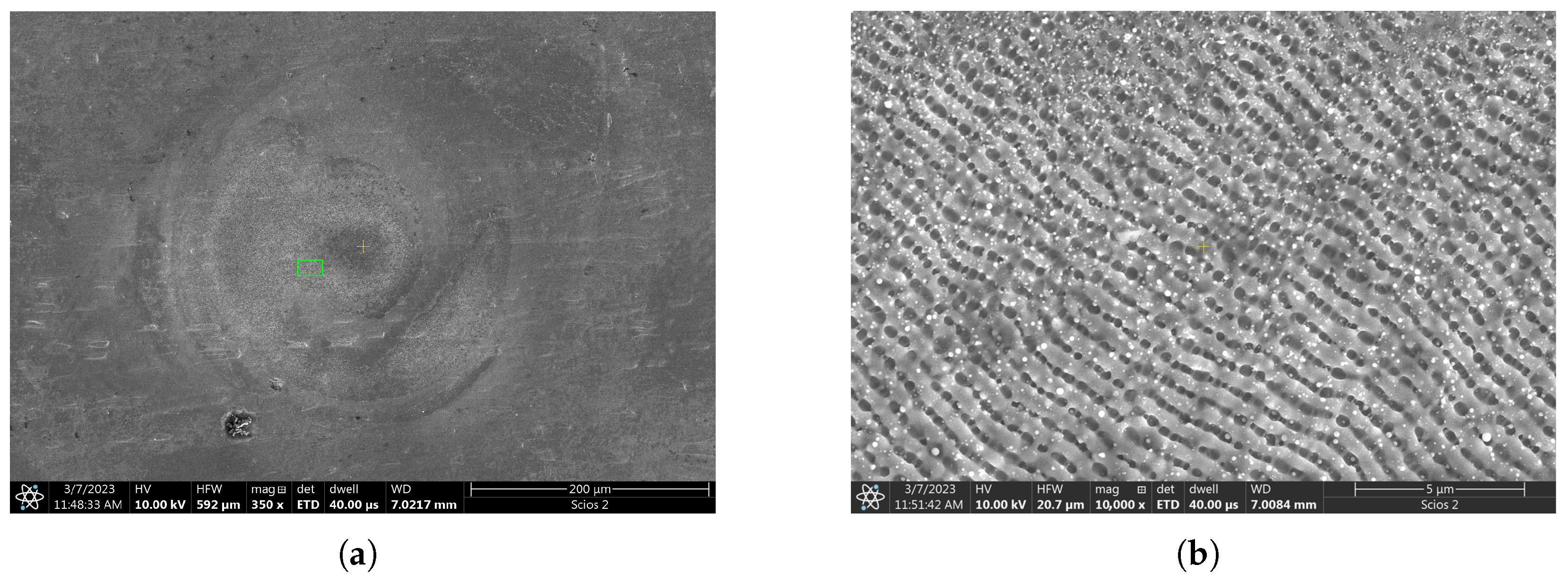
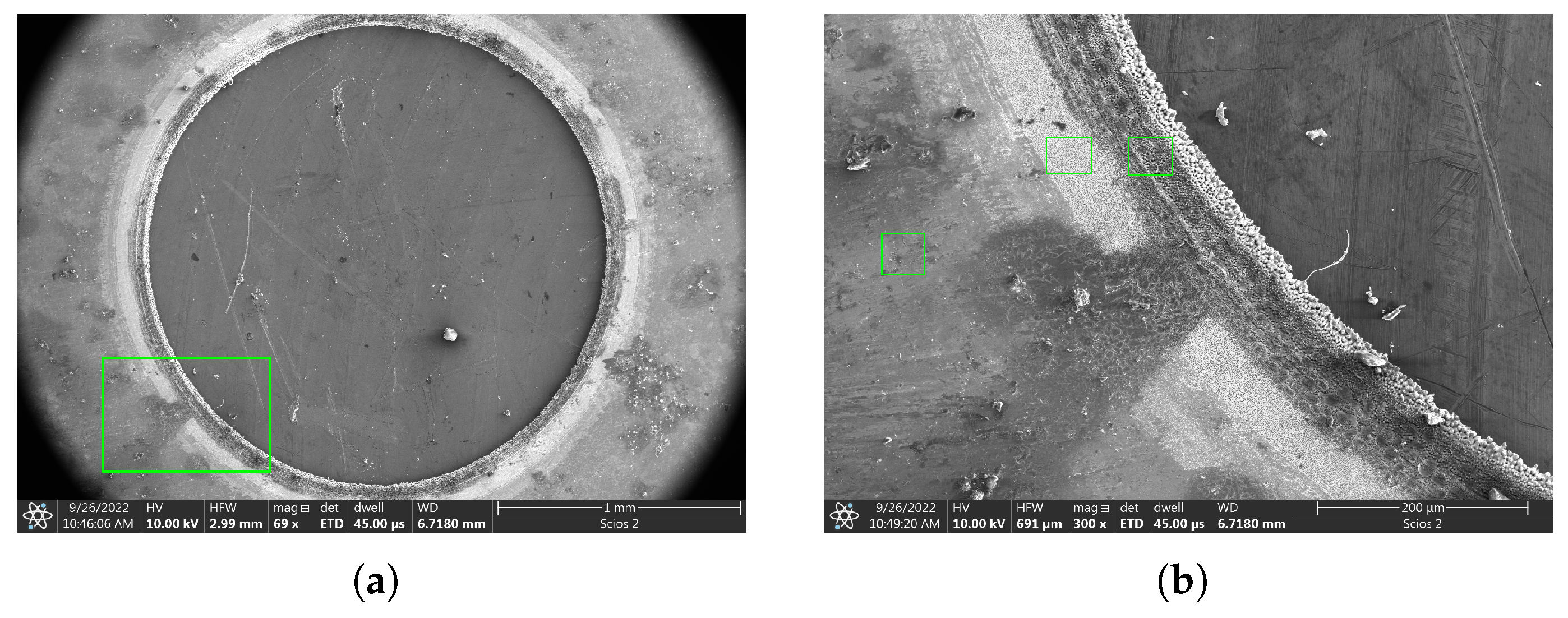
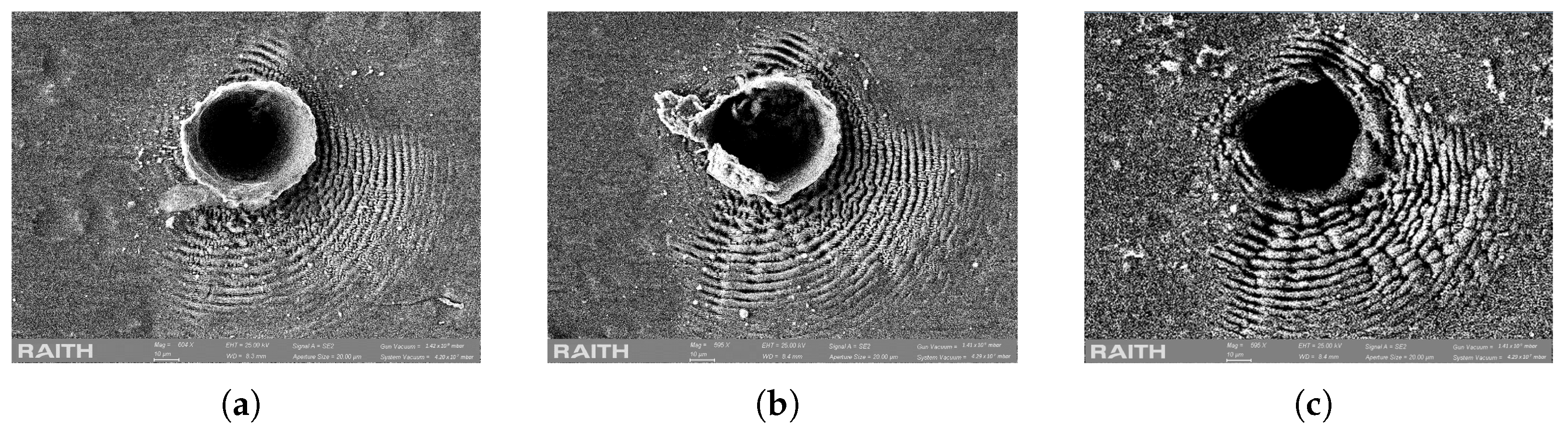
- The central area has a smooth surface and roughly extends to about 25 m. It corresponds in magnitude to the focal spot diameter (14.5 m at 1/e2 peak intensity). This central area can only be identified at such relatively low fluences, since at large energies and/or higher number of pulses more severe morphological changes take place and this region becomes totally evaporated.
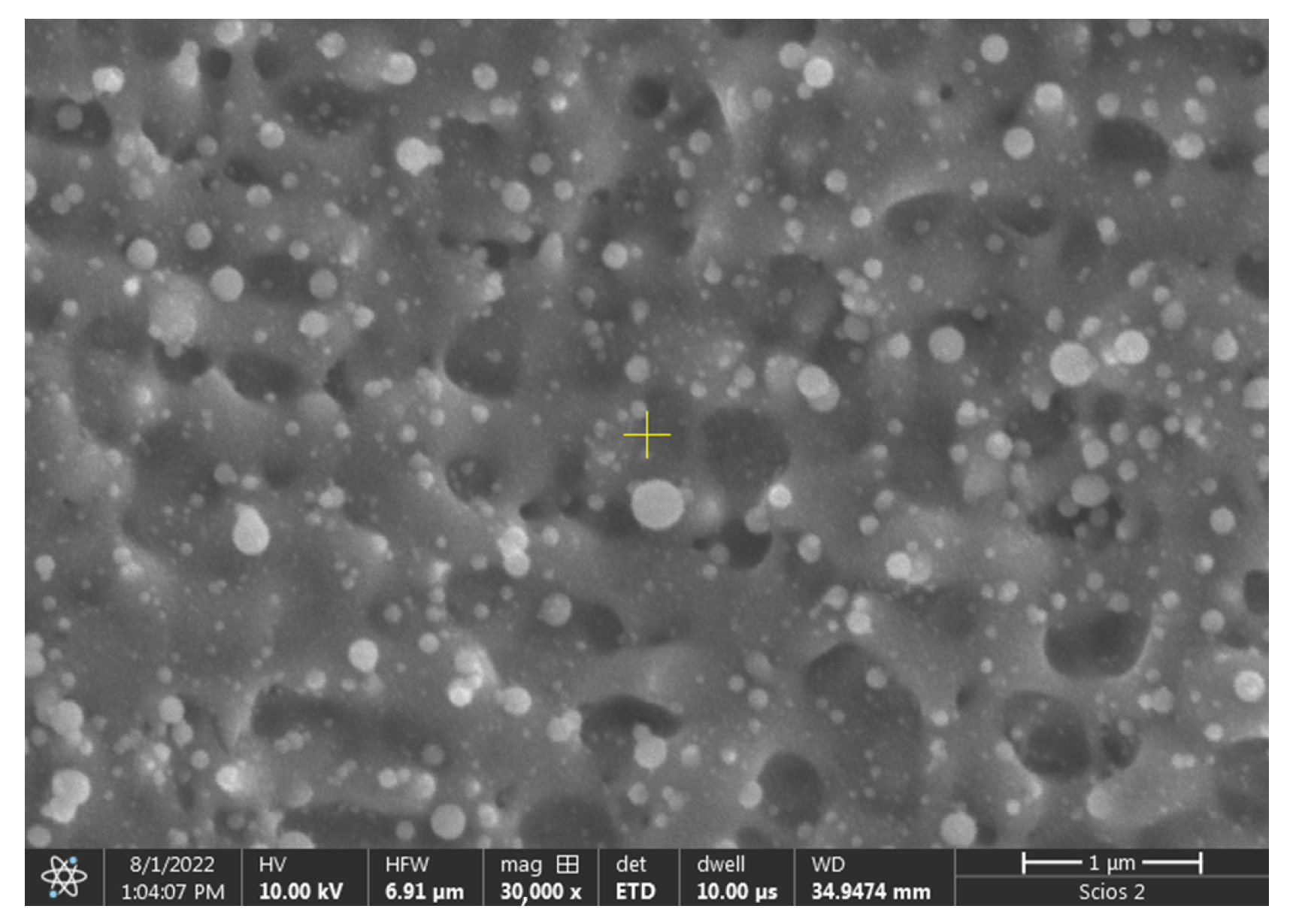
- We can identify a rough, rim-shaped region around the central spot. The shape is less circular, and its diameter spans in the range of 180–250 m. It has a distinctive feature of a highly modulated coarse surface. At higher magnifications, a periodic ripple structure can be uncovered. The ablation crater tends to partially overspread this region as well at high energies.
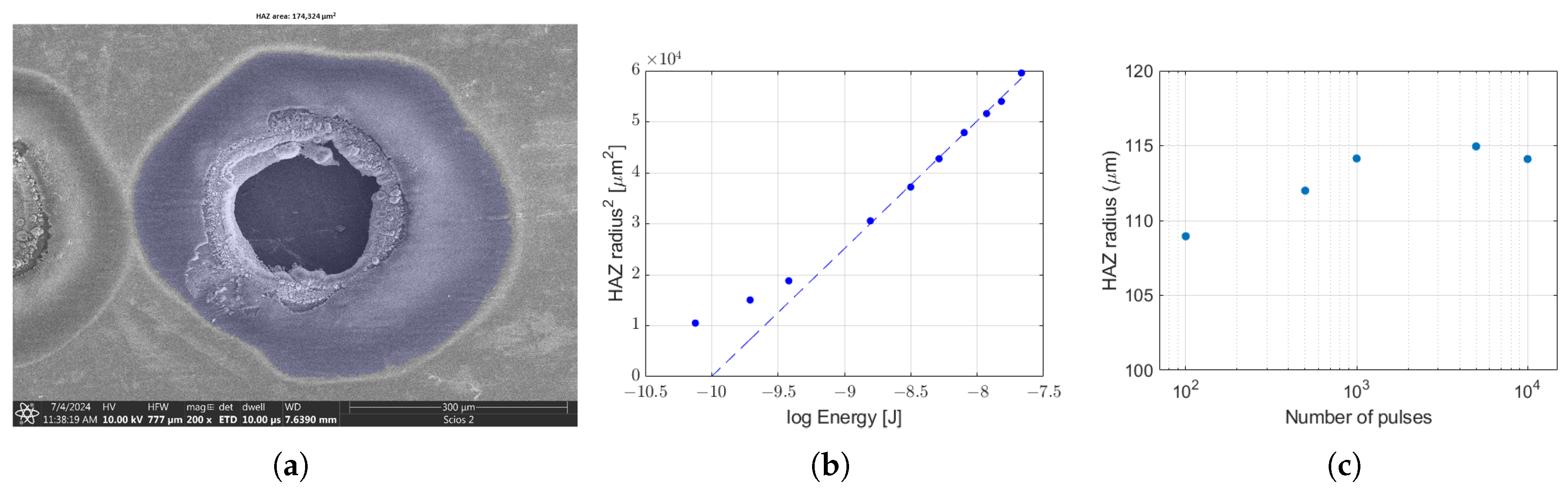
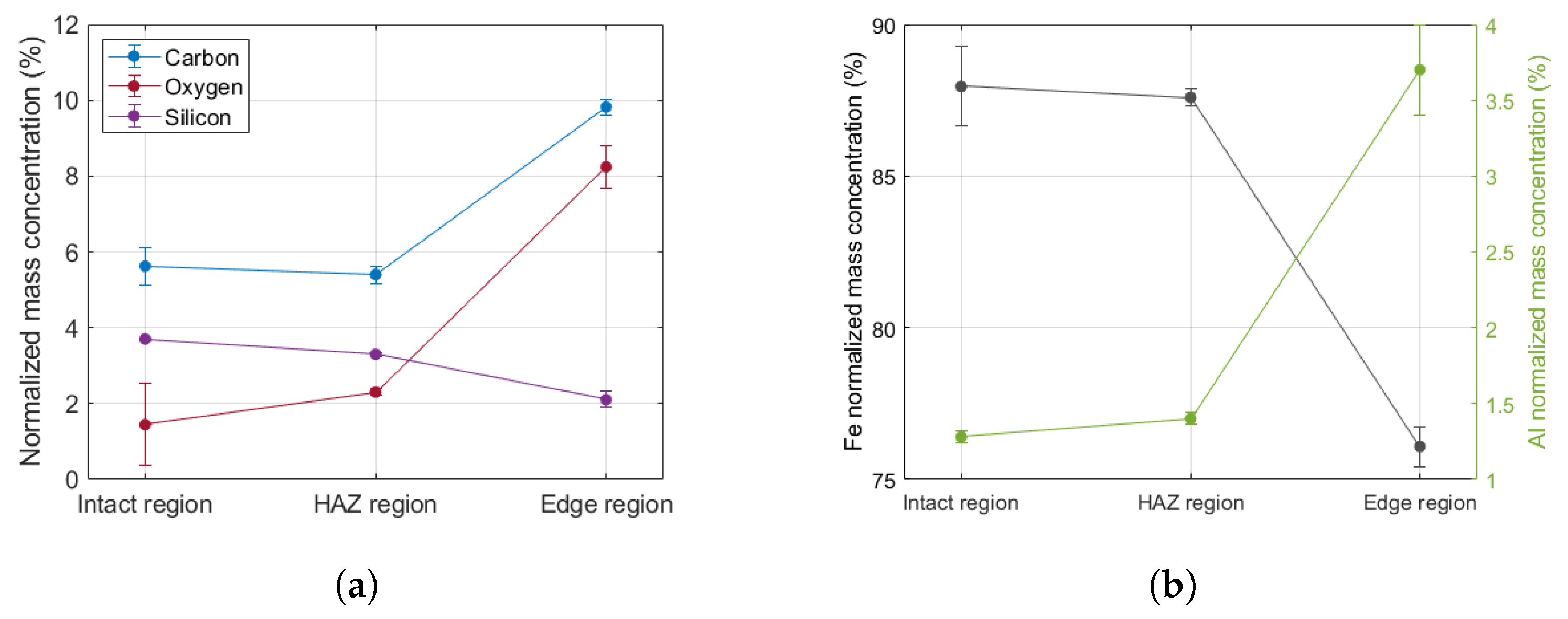
- There is also a smooth circular outer region that surrounds the coarse area. This is more apparent at higher fluences, seen as a reflectivity change in the SEM image. It has no visible surface structure, only a characteristic bright outer contour line Later in the text, it will be referred to it as the heat affected zone (HAZ) and an explanation will be given on the origin of this name.
3.2. Cutting
3.3. Comparison with Crystalline Metals
4. Discussion
5. Conclusions
Author Contributions
Funding
Institutional Review Board Statement
Informed Consent Statement
Data Availability Statement
Acknowledgments
Conflicts of Interest
Abbreviations
| LIPSS | Laser-induced periodic surface structures |
| EDX | Energy-dispersive X-ray spectroscopy |
| HAZ | Heat affected zone |
| SEM | Scanning electron microscope |
References
- Huo, Z.; Zhang, G.; Han, J.; Wang, J.; Ma, S.; Wang, H. A Review of the Preparation, Machining Performance, and Application of Fe-Based Amorphous Alloys. Processes 2022, 10, 1203. [Google Scholar] [CrossRef]
- Feng, Z.; Geng, H.; Zhuang, Y.; Li, P. Progress, Applications, and Challenges of Amorphous Alloys: A Critical Review. Inorganics 2024, 12, 232. [Google Scholar] [CrossRef]
- Wang, J.; Cao, W.; Wang, L.; Zhu, S.; Guan, S.; Huang, L.; Li, R.; Zhang, T. Fe–Al–P–C–B bulk metallic glass with good mechanical and soft magnetic properties. J. Alloys Compd. 2015, 637, 5–9. [Google Scholar] [CrossRef]
- Tatevosyan, A.; Tatevosyan, A.; Zaharova, N. The Study of the Electrical Steel and Amorphous Ferromagnets Magnetic Properties. Procedia Eng. 2016, 152, 727–734. [Google Scholar] [CrossRef]
- Johnson, W.L. Bulk amorphous metal—An emerging engineering material. JOM 2002, 54, 40–43. [Google Scholar] [CrossRef]
- Miracle, D.B. A Physical Model for Metallic Glass Structures: An Introduction and Update. JOM 2012, 64, 846–855. [Google Scholar] [CrossRef]
- Fang, Z.; Nagato, K.; Liu, S.; Sugita, N.; Nakao, M. Investigation into surface integrity and magnetic property of FeSiB metallic glass in two-dimensional cutting. J. Manuf. Process. 2021, 64, 1098–1104. [Google Scholar] [CrossRef]
- Bäuerle, D. Laser Processing and Chemistry; Springer: Berlin/Heidelberg, Germany, 2011. [Google Scholar] [CrossRef]
- Gu, D. Laser Additive Manufacturing of High-Performance Materials; Springer: Berlin Heidelberg, Germany, 2015. [Google Scholar] [CrossRef]
- Glass, J.M.; Groger, H.P.; Churchill, R.J.; Norin, E.M. Laser cutting of amorphous alloy ribbon and POWERCORE® consolidated metal strip. J. Mater. Eng. 1990, 12, 59–68. [Google Scholar] [CrossRef]
- Bán, K.; Nagy, M.; Fogarassy, Z.; Szabó, A. Comparison of Direct and Indirect Structural Analysis of HAZ after Laser Cutting in Amorphous Alloys. Acta Phys. Pol. A 2020, 137, 861–863. [Google Scholar] [CrossRef]
- Szabo, A.; Lovas, A. The impact of composition dependent and process-related properties in the laser cutting of metallic glassy tapes. Prod. Eng. Arch. 2019, 23, 41–46. [Google Scholar] [CrossRef]
- Quintana, I.; Dobrev, T.; Aranzabe, A.; Lalev, G. Laser micromachining of metallic glasses: Investigation of the material response to machining with micro-second and pico-second lasers. In Laser Applications in Microelectronic and Optoelectronic Manufacturing XV; Niino, H., Meunier, M., Gu, B., Hennig, G., Eds.; SPIE: Bellingham, WA, USA, 2010; Volume 7584, p. 75840Y. [Google Scholar] [CrossRef]
- Phillips, K.C.; Gandhi, H.H.; Mazur, E.; Sundaram, S.K. Ultrafast laser processing of materials: A review. Adv. Opt. Photonics 2015, 7, 684. [Google Scholar] [CrossRef]
- Malinauskas, M.; Žukauskas, A.; Hasegawa, S.; Hayasaki, Y.; Mizeikis, V.; Buividas, R.; Juodkazis, S. Ultrafast laser processing of materials: From science to industry. Light. Sci. Appl. 2016, 5, e16133. [Google Scholar] [CrossRef] [PubMed]
- Lin, Z.; Hong, M. Femtosecond Laser Precision Engineering: From Micron, Submicron, to Nanoscale. Ultrafast Sci. 2021, 2021, 9783514. [Google Scholar] [CrossRef]
- Leitz, K.H.; Redlingshöfer, B.; Reg, Y.; Otto, A.; Schmidt, M. Metal Ablation with Short and Ultrashort Laser Pulses. Phys. Procedia 2011, 12, 230–238. [Google Scholar] [CrossRef]
- Shaheen, M.E.; Gagnon, J.E.; Fryer, B.J. Laser ablation of iron: A comparison between femtosecond and picosecond laser pulses. J. Appl. Phys. 2013, 114, 083110. [Google Scholar] [CrossRef]
- Wu, C.; Zhigilei, L.V. Microscopic mechanisms of laser spallation and ablation of metal targets from large-scale molecular dynamics simulations. Appl. Phys. A 2013, 114, 11–32. [Google Scholar] [CrossRef]
- Förster, D.J.; Jäggi, B.; Michalowski, A.; Neuenschwander, B. Review on Experimental and Theoretical Investigations of Ultra-Short Pulsed Laser Ablation of Metals with Burst Pulses. Materials 2021, 14, 3331. [Google Scholar] [CrossRef] [PubMed]
- Cheng, J.; Liu, C.S.; Shang, S.; Liu, D.; Perrie, W.; Dearden, G.; Watkins, K. A review of ultrafast laser materials micromachining. Opt. Laser Technol. 2013, 46, 88–102. [Google Scholar] [CrossRef]
- Jia, W.; Peng, Z.; Wang, Z.; Ni, X.; Wang, C.Y. The effect of femtosecond laser micromachining on the surface characteristics and subsurface microstructure of amorphous FeCuNbSiB alloy. Appl. Surf. Sci. 2006, 253, 1299–1303. [Google Scholar] [CrossRef]
- Wang, X.; Lu, P.; Dai, N.; Li, Y.; Liao, C.; Chang, Y.; Yang, G.; Zheng, Q. Morphology and oxidation of Zr-based amorphous alloy ablated by femtosecond laser pulses. Appl. Phys. A 2007, 89, 547–552. [Google Scholar] [CrossRef]
- Dold, C.; Kachel, M.; Wortmann, D.; Wessels, V.; Dohrn, A.; Bruinink, A.; Pude, F.; Loeffler, J.F.; Poprawe, R.; Wegener, K. Surface structuring of zirconium-based bulk metallic glasses using ultrashort laser pulses. In Laser Applications in Microelectronic and Optoelectronic Manufacturing (LAMOM) XIX; Nakata, Y., Xu, X., Roth, S., Neuenschwander, B., Eds.; SPIE: Bellingham, WA, USA, 2014; Volume 8967, p. 89670V. [Google Scholar] [CrossRef]
- Gaál, P.; Gilinger, T.; Nagyillés, B.; Nagymihály, R.; Seres, I.; Kovács, Á.; Füle, M.; Karnok, M.; Balázs, P.; Novák, T.; et al. A Versatile 100 Hz Laser System with Few-Cycle and TeraWatt Pulses for Applications. Appl. Sci. 2024, 14, 10649. [Google Scholar] [CrossRef]
- ISO 21254-1:2025; Lasers and Laser-Related Equipment—Test Methods for Laser-Induced Damage Threshold. Part 1: Definitions and General Principles. International Organization for Standardization: Geneva, Switzerland, 2025.
- Schwarz, S.; Rung, S.; Esen, C.; Hellmann, R. Surface Plasmon Polariton Triggered Generation of 1D-Low Spatial Frequency LIPSS on Fused Silica. Appl. Sci. 2018, 8, 1624. [Google Scholar] [CrossRef]
- Song, S.; Lu, Q.; Zhang, P.; Yan, H.; Shi, H.; Yu, Z.; Sun, T.; Luo, Z.; Tian, Y. A critical review on the simulation of ultra-short pulse laser-metal interactions based on a two-temperature model (TTM). Opt. Laser Technol. 2023, 159, 109001. [Google Scholar] [CrossRef]
- Gräf, S.; Kunz, C.; Engel, S.; Derrien, T.J.Y.; Müller, F.A. Femtosecond Laser-Induced Periodic Surface Structures on Fused Silica: The Impact of the Initial Substrate Temperature. Materials 2018, 11, 1340. [Google Scholar] [CrossRef]
- Xu, S.Z.; Dou, H.Q.; Sun, K.; Ye, Y.Y.; Li, Z.; Wang, H.J.; Liao, W.; Liu, H.; Miao, X.X.; Yuan, X.D.; et al. Scan speed and fluence effects in femtosecond laser induced micro/nano-structures on the surface of fused silica. J. Non-Cryst. Solids 2018, 492, 56–62. [Google Scholar] [CrossRef]
- Gurevich, E.L.; Levy, Y.; Bulgakova, N.M. Three-Step Description of Single-Pulse Formation of Laser-Induced Periodic Surface Structures on Metals. Nanomaterials 2020, 10, 1836. [Google Scholar] [CrossRef] [PubMed]
- Yang, J.; Zhao, Y.; Zhu, X. Transition between nonthermal and thermal ablation of metallic targets under the strike of high-fluence ultrashort laser pulses. Appl. Phys. Lett. 2006, 88, 094101. [Google Scholar] [CrossRef]
- Shin, S.; Park, J.K.; Kim, D.H. Suppression of spallation induced nanoparticles by high repetition rate femtosecond laser pulses: Realization of precise laser material processing with high throughput. Opt. Express 2021, 29, 20545. [Google Scholar] [CrossRef]
- Raciukaitis, G. Use of High Repetition Rate and High Power Lasers in Microfabrication: How to Keep the Efficiency High? J. Laser Micro/Nanoeng. 2009, 4, 186–191. [Google Scholar] [CrossRef]
- Fourmaux, S.; Kieffer, J. Laser induced damage threshold and incubation effects of high-power laser system optics. Quantum Electron. 2021, 51, 751–758. [Google Scholar] [CrossRef]
- Radaj, D. Heat Effects of Welding; Springer: Berlin/Heidelberg, Germany, 1992. [Google Scholar] [CrossRef]
- Schille, J.; Schneider, L.; Loeschner, U. Process optimization in high-average-power ultrashort pulse laser microfabrication: How laser process parameters influence efficiency, throughput and quality. Appl. Phys. A 2015, 120, 847–855. [Google Scholar] [CrossRef]
- Li, X.; Guan, Y. Theoretical fundamentals of short pulse laser–metal interaction: A review. Nanotechnol. Precis. Eng. 2020, 3, 105–125. [Google Scholar] [CrossRef]
- Neuenschwander, B.; Jaeggi, B.; Schmid, M.; Hennig, G. Surface Structuring with Ultra-short Laser Pulses: Basics, Limitations and Needs for High Throughput. Phys. Procedia 2014, 56, 1047–1058. [Google Scholar] [CrossRef]




Disclaimer/Publisher’s Note: The statements, opinions and data contained in all publications are solely those of the individual author(s) and contributor(s) and not of MDPI and/or the editor(s). MDPI and/or the editor(s) disclaim responsibility for any injury to people or property resulting from any ideas, methods, instructions or products referred to in the content. |
© 2026 by the authors. Licensee MDPI, Basel, Switzerland. This article is an open access article distributed under the terms and conditions of the Creative Commons Attribution (CC BY) license.
Share and Cite
Somoskoi, T.; Füle, M.; Gaal, P.; Karnok, M.; Kovacs, G.; Toth, L.; Budai, J.; Hanyecz, V.; Zsoldos, I.; Osvay, K. Machining of Fe-Based Amorphous Alloy Ribbons with Sub-50 Femtosecond Laser Pulses. Micromachines 2026, 17, 214. https://doi.org/10.3390/mi17020214
Somoskoi T, Füle M, Gaal P, Karnok M, Kovacs G, Toth L, Budai J, Hanyecz V, Zsoldos I, Osvay K. Machining of Fe-Based Amorphous Alloy Ribbons with Sub-50 Femtosecond Laser Pulses. Micromachines. 2026; 17(2):214. https://doi.org/10.3390/mi17020214
Chicago/Turabian StyleSomoskoi, Tamas, Miklós Füle, Peter Gaal, Mate Karnok, Gergely Kovacs, Lazar Toth, Judit Budai, Veronika Hanyecz, Ibolya Zsoldos, and Karoly Osvay. 2026. "Machining of Fe-Based Amorphous Alloy Ribbons with Sub-50 Femtosecond Laser Pulses" Micromachines 17, no. 2: 214. https://doi.org/10.3390/mi17020214
APA StyleSomoskoi, T., Füle, M., Gaal, P., Karnok, M., Kovacs, G., Toth, L., Budai, J., Hanyecz, V., Zsoldos, I., & Osvay, K. (2026). Machining of Fe-Based Amorphous Alloy Ribbons with Sub-50 Femtosecond Laser Pulses. Micromachines, 17(2), 214. https://doi.org/10.3390/mi17020214