Article

An Adaptive Control Strategy for DC/DC Converters Using Command-Filtered Backstepping and Disturbance Rejection


School of Engineering and Technology, Vinh University, Nghe An 43100, Vietnam
*
Author to whom correspondence should be addressed.
Micromachines 2025, 16(12), 1412; https://doi.org/10.3390/mi16121412
Submission received: 9 November 2025 / Revised: 7 December 2025 / Accepted: 12 December 2025 / Published: 15 December 2025

Abstract

Ensuring the stability and accuracy of the output voltage in DC/DC buck converters (DBCs) is critical for reliable operation. This paper investigates an observer-based adaptive command-filtered controller designed for DBC systems subject to lumped disturbances. First, a mathematical model of the system is developed on the basis of switching modes. Then, a simplified extended state observer (SESO) is elaborated to mitigate the effects of lumped disturbances. A command filter technique with an integrated adaptive law is subsequently synthesized to enhance output voltage regulation. The stability of the observer and DBC control system is rigorously certified using the Lyapunov principle. Finally, simulation and experimental approaches are exploited to confirm the validity of the proposed method. Compared to state-of-the-art approaches, the proposed observer-based adaptive command-filtered controller improves tracking performance by 96.1% and 77.8% in simulations and 84.4% and 49.1% in experiments under a sinusoidal reference trajectory.

1. Introduction

Nowadays, DC/DC buck converters (DBCs) are essential components in power conversion, as they step down input voltages from high to low levels. They find widespread use across multiple applications, including direct current (DC) motor drives [1,2], automotive technology [3], fuel cell systems [4,5], and solar photovoltaic systems [6]. Nonetheless, the unavoidable external disturbances, load variations, high ripple voltages, and uncertainties inherent in nonlinear DBCs pose significant challenges to achieving high-accuracy output voltage tracking regulation [7]. Because of the above issues, various modern control strategies improve the functionality and robustness of DBCs via characteristic merits such as command-filtered backstepping control [8,9], optimal control [10], intelligent control [11,12], and model predictive control [13], along with sliding mode control and its modern version [14,15].
The command filter approach is an advanced form of the backstepping control technique, in which the derivative of the virtual/intermediate control law is computed using a filter [16]. This helps reduce computational complexity. Many applications have adopted this method to leverage its advantages. Well-known examples of fields in which it is used include power electronics [17,18] electro-hydraulic systems [19], and related fields [20,21]. In [22], a Lyapunov function-based backstepping scheme was applied to a practical DBC to increase stability and mitigate the effect of disturbance behavior. In [23], meaningful techniques were introduced including nonlinear state-disturbance estimation and a command filter scheme for high-order general nonlinear systems. In [24], the authors designed an adaptive fuzzy turning-based backstepping sliding mode for power DC/DC converter systems to enhance output voltage performance under external disturbances. As a result, adaptive command-filtered control approaches have become a current research hotspot in advanced control algorithm development.
In practical DC/DC converters, the influence of various perturbations is unavoidable, making it challenging to achieve good dynamic response and high precision. The primary obstacle in controlling DC/DC converters lies in effectively addressing these issues. Many types of observers have been introduced to compensate for such perturbations. In [25], a generalized proportional integral (PI) perturbation observer-based advanced control scheme was constructed for a power DBC to tackle mismatched disturbances and obtain high-precision output voltage performance. In [26], the integration of an extended state observer (ESO) into an extremum-seeking-based adaptive sliding mode control approach for a bidirectional DC-DC converter system was investigated. This approach effectively compensated for external disturbances and achieved high-accuracy output voltage regulation, as demonstrated by simulation results. In [27], a hybrid fuzzy approximation and a non-singular terminal sliding manifold approach were introduced to cope with disturbances and parameter variations affecting a DBC. In [28], the authors synthesized a ESO-based sliding mode technique for DBC systems to attenuate the influence of mismatched disturbances. However, the application of observer-based modern control techniques for DBCs remains limited, and such techniques should be further developed to improve output voltage control performance.
Motivated by the above challenges, this study proposes an observer-based adaptive command-filtered control strategy for DBCs that integrates a simplified extended state observer (SESO) with a command-filtered adaptive control approach. The proposed scheme employs the SESO to proactively compensate for disturbances and estimate system states. The adaptive command filter scheme adjusts the control gains while significantly decreasing computational complexity. As a result, the control system ensures a fast response and precise output voltage tracking. The key contributions of this study may be stated as follows:
(1)
It is an innovative attempt to eliminate the influence of a lumped disturbance on a practical DBC by applying an SESO under different voltage reference trajectories.
(2)
It involves the design of a new observer-based adaptive command-filtered control strategy for DBCs which delivers excellent performance with a faster response, reduced overshoot, and reduced settling times, compared to other control strategies.
(3)
The capabilities and advantages of the proposed control algorithm are demonstrated in both simulation and experimental studies. In addition, the stability of both observer and control system is rigorously verified using the Lyapunov principle.
The remainder of this paper is organized as follows: Section 2 describes the modelling of the output voltage control and the different assumptions for the DBC. Section 3 introduces an SESO design and an adaptive command-filter control strategy, and reports DBC system stability in the presence of lumped disturbance. In Section 4, results obtained from a running simulation and from experiments are investigated to certify the outstanding capability of the proposed control strategy. The conclusion summarizes the main findings of the paper and highlights key areas for future research.

2. Dynamic Model of the DBC, and Some Preliminaries

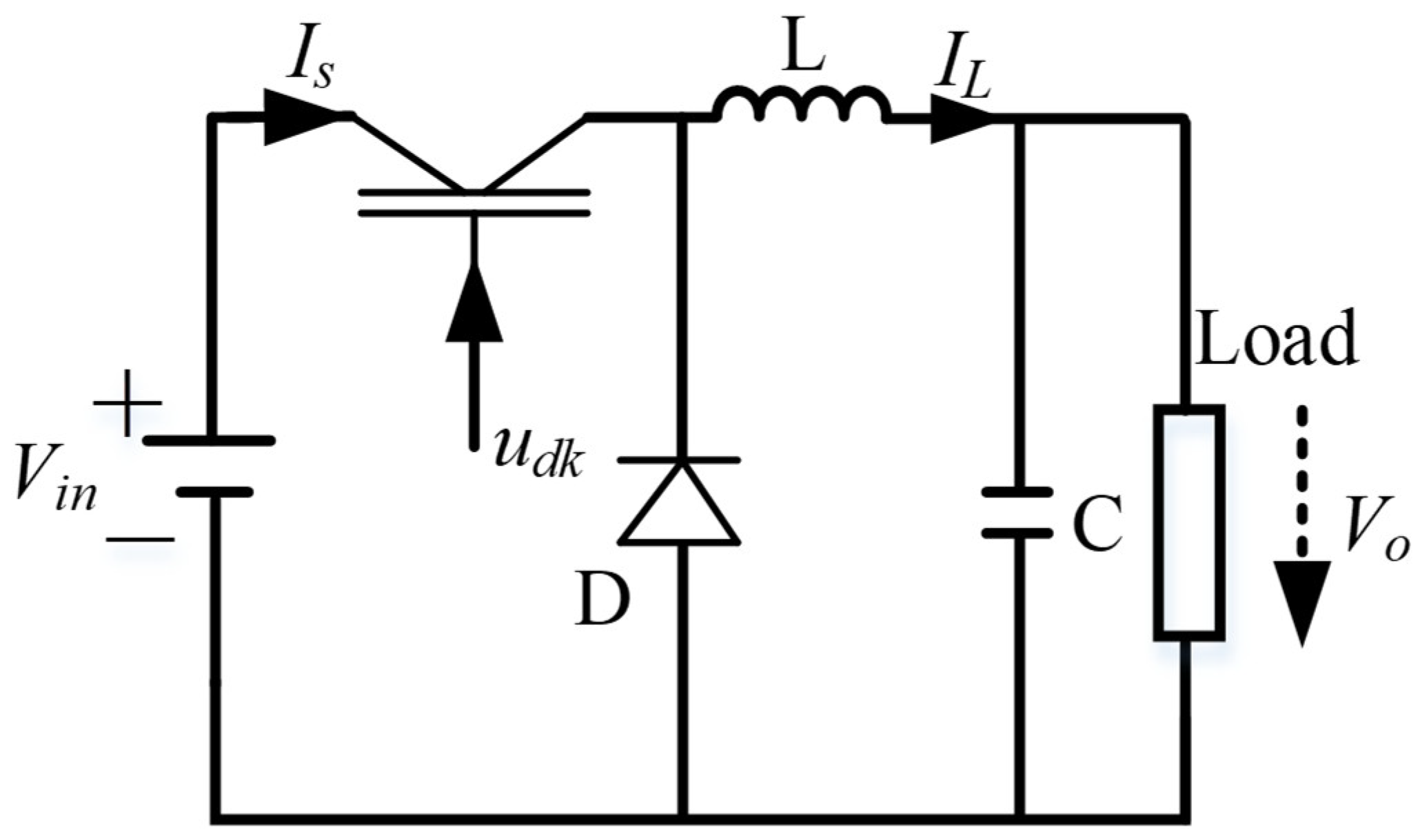
The DBC is presented in diagram form in Figure 1. The circuit includes a power supply input, a power switch, a diode, an inductor, a capacitor, and a load. The output voltage of the PEMFC stack using the average model can be calculated as follows [25]:
V ˙ o = I L C V o R C I ˙ L = u V i n L V o L
where R, C, and L, respectively, represent the load resistor, capacitor, and inductor value; Vo denotes the average values of the load resistance output voltage; and IL defines the current via inductance L over a switching frequency. The duty ratio u ∈ [0, 1] defines the control signal, and this is the duty cycle of the PWM.
By defining the output voltage Vo as the state variable x1, and the inductor current IL as the state variable x2, the DBC can be determined as follows [29]:
x ˙ 1 = 1 C x 2 1 R C x 1 = f 1 x 2 + g 1 + d 1 x ˙ 2 = V i L u 1 L x 1 = f 2 u + g 2 + d 2
where f 1 = 1 C , f 2 = V i L , g 1 = 1 R C , g 2 = 1 L , d 1 = Δ f 1 x 2 + Δ g 1 , d 2 = Δ f 2 u + Δ g 2 .
Δ f 1 , Δ g 1 , Δ f 2 ,   and   Δ g 2 denote the uncertainty terms of f 1 , g 1 , f 2 ,   and   g 2 . d1 and d2 are considered as mismatched and matched disturbances [25].
Assumption 1:
  • The diode and power switch are both ideal. The capacitor is large enough to stabilize the output voltage.
  • The disturbances d1, and d2 and their derivatives are bound to satisfy the conditions d i D i   and   d ˙ i D u i , i = 1 , 2 , where D i   and   D u i are positive constants.

3. Control Strategy Design

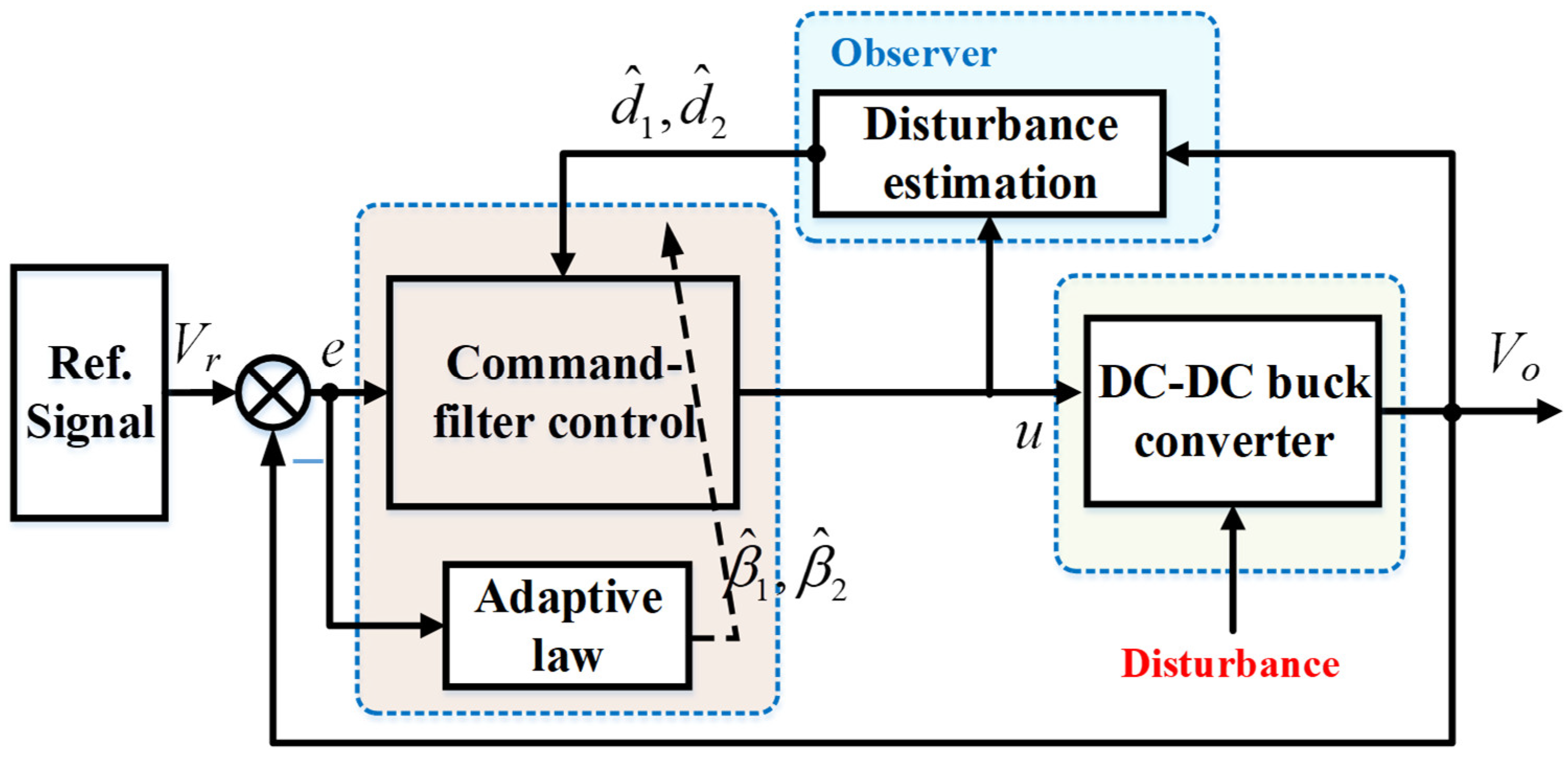
In this section, the proposed control algorithm is designed to close the gap between desired voltage and actual output voltage. Disturbance estimation is carried out to first obtain the disturbance information, then compensate for it. An adaptive command-filter control algorithm is then suggested to improve the control performance. The control structure for the DBC is displayed in Figure 2.

3.1. Disturbance Estimation Design

The simplified extended state observer (SESO) is constructed as follows:
x ^ ˙ 1 = f 1 x 2 + g 1 + x e 1 + α 11 x ˜ 1 x ^ ˙ e 1 = α 12 x ˜ 1
where α1i denotes the observer gain (i = 1,2), xe1 = d1 is the extended state, and x ^ i   and   x ˜ i = x i x ^ i , i = 1 , 2 define the estimation value and estimation error of the system state xi. The estimation value of xe1, known as x ^ e 1 , is computed as follows:
x ^ e 1 = x ^ ˙ 1 f 1 x 2 + g 1 α 11 x ˜ 1 = x ˙ 1 x ˜ ˙ 1 f 1 x 2 + g 1 α 11 x ˜ 1 = d 1 x ˜ ˙ 1 α 11 x ˜ 1 = x e 1 x ˜ ˙ 1 + α 11 x ˜ 1
The observer error can be calculated by x ˜ e 1 = x e 1 x ^ e 1 = x ˜ ˙ 1 + α 11 x ˜ 1 . Then, the SESO can be re-written as follows:
x ^ ˙ 1 = f 1 x 2 + g 1 + x e 1 + α 11 x ˜ 1 x ^ ˙ e 1 = α 12 x ˜ 1 x ˜ e 1 = x e 1 x ^ e 1 = x ˜ ˙ 1 + α 11 x ˜ 1
We formulate the SESO for the matched disturbance d2 as follows:
x ^ ˙ 2 = f 2 u + g 2 + x e 2 + α 21 x ˜ 2 x ^ ˙ e 2 = α 22 x ˜ 2 x ˜ e 2 = x e 2 x ^ e 2 = x ˜ ˙ 2 + α 21 x ˜ 2
where α2i denotes the observer gain (i = 1,2), xe2 = d2 is the extended state, and x ^ e 2   and   x ˜ e 2 denote the estimation value and estimation observer error of the matched disturbance d2.
Observer stability analysis:
Equation (6) can be re-expressed as follows:
x ˜ ˙ e 2 = x ˙ e 2 x ^ ˙ e 2 = d ˙ 2 α 22 x ˜ 2 x ˜ ¨ 2 = x ˜ ˙ e 2 α 21 x ˜ ˙ 2 = d ˙ 2 α 22 x ˜ 2 α 21 x ˜ ˙ 2 x ˜ ˙ 2 = x ˜ e 2 α 21 x ˜ 2 x ˜ ¨ 2 = x ˜ ˙ e 2 α 21 x ˜ ˙ 2 = x ˜ ˙ e 2 α 21 x ˜ e 2 α 21 x ˜ 2
Defining the variable states z 1 = x ˜ 2 , z 2 = x ˜ ˙ 2 , we obtain the following:
z ˙ 1 = z 2 z ˙ 2 = z ¨ 1 = d ˙ 2 α 22 z 1 α 21 z ˙ 1
The characteristic polynomial of the presented system is given by
ξ s = s 2 + a s + b , a = α 21 , b = α 22
From the above selection, α 21 = 2 μ , α 22 = μ 2 , so that Equation (9) becomes ξ s = s + μ 2 . Next, it is noted that because the disturbance d2 is constant, its derivative d ˙ 2 = 0 . According to Hurwitz’s principle, the original point z 1 , z 2 = 0 , 0 is the stabilizing equilibrium of the system ξ s = s + μ 2 = 0 . Because d2’s derivative is bounded, i.e., d ˙ 2 d 2 m , it can be revealed that the observer error is bounded as follows [30]:
x ˜ 2 d 2 m α 22 = d 2 m μ 2 = μ 21 d ˜ 2 = x ˜ e 2 d 2 m α 21 = d 2 m μ = μ 22
Similarly, the convergence of x ˜ 1 ,   and   x ˜ e 1 to the bounded region is verified.
Theorem 1. 
Considering the system (2) under Assumption 1, there exist positive constants μi1 and μi2 > 0 such that the system error states x ˜ i ,   and   x ˜ e i , i = 1 , 2  are bounded, i.e., x ˜ i μ i 1 ,   and   x ˜ e i μ i 2 , i = 1 , 2 .

3.2. Adaptive Command-Filter Controller

Defining the tracking error states, we obtain the following:
e 1 = x 1 x 1 r , e 2 = x 2 x 2 r
where x1r and x2r define the filtered signals of the intermediate controllers x1d and x2d. By utilizing a first-order filter, the command filter is established as follows:
ρ i x ˙ i r + x i r = x i d ; i = 1 , 2
where ρ i > 0 ; x 1 r 0 = x 1 d 0 .
The compensated tracking error signals are then given by εi = eiyi, with the compensation signal yi being defined as follows:
y ˙ 1 = β ^ 1 y 1 + f 1 y 2 + x 1 r x 1 d y ˙ 2 = β ^ 2 y 2
where yi(0) = 0, βi is a nonzero scalar, and β ^ i denotes the estimation value of βi.
The adaptive law for β ^ i can be given as follows:
β ^ ˙ i = Γ i ε i 2 + χ i β ˜ i , i = 1 , 2
where Γ i   and   χ i > 0 .
Taking the derivative of ε1, the following is yielded:
ε ˙ 1 = e ˙ 1 y ˙ 1 = x ˙ 1 x ˙ 1 r + β ^ 1 y 1 f 1 y 2 f 1 x 1 r + f 1 x 1 d = g 1 + d 1 x ˙ 1 r + f 1 x 1 d + β ^ 1 y 1 + f 1 x 2 y 2 x 1 r = g 1 + d 1 x ˙ 1 r + f 1 x 1 d + β ^ 1 y 1 + f 1 ε 2
The control law x1d can be given as follows:
x 1 d = 1 f 1 g 1 d ^ 1 + x ˙ 1 r β ^ 1 e 1
The Lyapunov function can be elaborated as follows:
V 1 = 1 2 ε 1 2 + 1 2 Γ 1 β ˜ 1 2
where β ˜ i = β i β ^ i , i = 1 , 2 denotes the error of the estimated value.
Taking the derivative of V1, and noting (14) and (16), the following is yielded:
V ˙ 1 = ε 1 ε ˙ 1 Γ 1 1 β ˜ 1 β ^ ˙ 1 = ε 1 g 1 + d 1 x ˙ 1 r + f 1 x 1 d + β ^ 1 y 1 + f 1 ε 2 Γ 1 1 β ˜ 1 β ^ ˙ 1 = β 1 ε 1 2 + ε 1 d ˜ 1 + f 1 ε 1 ε 2 + β ˜ 1 ε 1 2 Γ 1 1 β ˜ 1 β ^ ˙ 1 = β 1 ε 1 2 + ε 1 d ˜ 1 + f 1 ε 1 ε 2 β ˜ 1 ε 1 2 + Γ 1 1 β ^ ˙ 1 = β 1 ε 1 2 χ 1 β ˜ 1 2 + ε 1 d ˜ 1 + f 1 ε 1 ε 2
Applying Young’s inequality, the following is yielded:
ε 1 d ˜ 1 1 2 ε 1 2 + 1 2 μ 12 2
V ˙ 1 can now be redesigned as follows:
V ˙ 1 = β 1 1 2 ε 1 2 χ 1 β ˜ 1 2 + 1 2 μ 12 2 + f 1 ε 1 ε 2
Taking the derivative of ε2, the following is yielded:
ε ˙ 2 = e ˙ 2 y ˙ 2 = x ˙ 2 x ˙ 2 r + β ^ 2 y 2 = f 2 u + g 2 + d 2 x ˙ 2 r + β ^ 2 y 2
The control law u can be given as follows:
u = 1 f 2 g 2 d ^ 2 + x ˙ 2 r β ^ 2 e 2 f 1 ε 1
The Lyapunov function can be designed as follows:
V 2 = V 1 + 1 2 ε 2 2 + 1 2 Γ 2 β ˜ 2 2
Taking the derivative of V2, and noting (18) and (22), the following is yielded:
V ˙ 2 = V ˙ 1 + ε 2 ε ˙ 2 Γ 2 1 β ˜ 2 β ^ ˙ 2 = V ˙ 1 + ε 2 f 2 u + g 2 + d 2 x ˙ 2 r + β ^ 2 y 2 Γ 2 1 β ˜ 2 β ^ ˙ 2 = β 1 1 2 ε 1 2 + 1 2 μ 12 2 + f 1 ε 1 ε 2 + ε 2 d ˜ 2 β ^ 2 ε 2 f 1 ε 1 Γ 2 1 β ˜ 2 β ^ ˙ 2 = β 1 ε 1 2 + ε 1 d ˜ 1 + f 1 ε 1 ε 2 β 2 ε 2 2 β ˜ 2 ε 2 2 + Γ 2 1 β ^ ˙ 2
Applying Young’s inequality, the following is yielded:
ε 2 d ˜ 2 1 2 ε 2 2 + 1 2 μ 22 2
Substituting (14) and (25) into (24), V ˙ 2 can be represented as follows:
V ˙ 2 i = 1 2 β i 1 2 ε i 2 i = 1 2 χ i β ˜ i 2 + i = 1 2 1 2 μ i 2 2
Theorem 2. 
Considering the system (2) under assumption 1, if the control law is designed as in (16) and (22), and the SESO is designed as in (5) and (6), all system states ε i   and   β ˜ i  are bounded and converge to a small region in the presence of lumped disturbances.
Proof. 
Select the Lyapunov candidate function V = V2. From (26), V ˙ can be written as follows:
V ˙ H V + M
where H = min λ min β i 1 2 , λ min χ i , M = i = 1 2 1 2 μ i 2 2 . □
From further analysis of (27), the following is obtained:
V V 0 M H e H t + M H Λ ,
where Λ = V 0 + M H .
From (28), limt⟶∞V = M H , and it can be revealed that the variables ε i   and   β ˜ i are uniformly bounded.
Therefore, Theorem 2 is completed.

4. Application Verification

4.1. Numerical Simulation

In this part, simulation studies are carried out using MATLAB/Simulink(Version 2024a). The frequency is set as 5 kHz. The simulation setup parameters of the DBC are as follows: R = 30 Ω; L = 0.01 H; C = 0.01 F. The output voltage of the DBC is required to vary from 0 V to 12 V with an input voltage of Vin = 24 V. In this paper, the load variations (e.g., a 10% RC load change) and system parameter deviations (e.g., a 15% change in inductance) are treated as components of the lumped disturbance. In detail, the lumped disturbances are expressed as d 1 = 0.1 × f 1 x 2 + g 1 , d 2 = 0.15 × f 2 u + g 2 . The initial conditions are x 1 0 = 0 , x 2 0 = 0 . To examine the superior performance of the suggested algorithm (S3), other control strategies are considered: an adaptive command-filtered control strategy (S1) and an observer-based command-filtered backstepping control strategy (S2).
The control gains of the proposed control strategy (S3) are chosen as follows: μ = 30; Γ1 = Γ2 = 0.2; χ1 = χ2 = 0.3; β1 = 130; β2= 45; ρ1 = ρ2 = 0.01. The adaptive command-filtered control strategy (S1) differs from S3 as it does not incorporate disturbance estimation. The observer-based command-filtered backstepping control strategy (S2) differs from S3 in that it does not include the adaptive law. In both cases, all other parameters are kept identical to those of S3.
Remark 1. 
Increasing β1, β2, and μ, and decreasing Γ can effectively reduce the tracking, disturbance, and adaptation errors. Nonetheless, selecting values for these parameters beyond appropriate bounds may impair the overall performance of the DC/DC system, manifesting as overshoot or chattering. Therefore, it is imperative to determine suitable control parameters that align with the operating characteristics of the controlled system.

4.1.1. Case Study 1

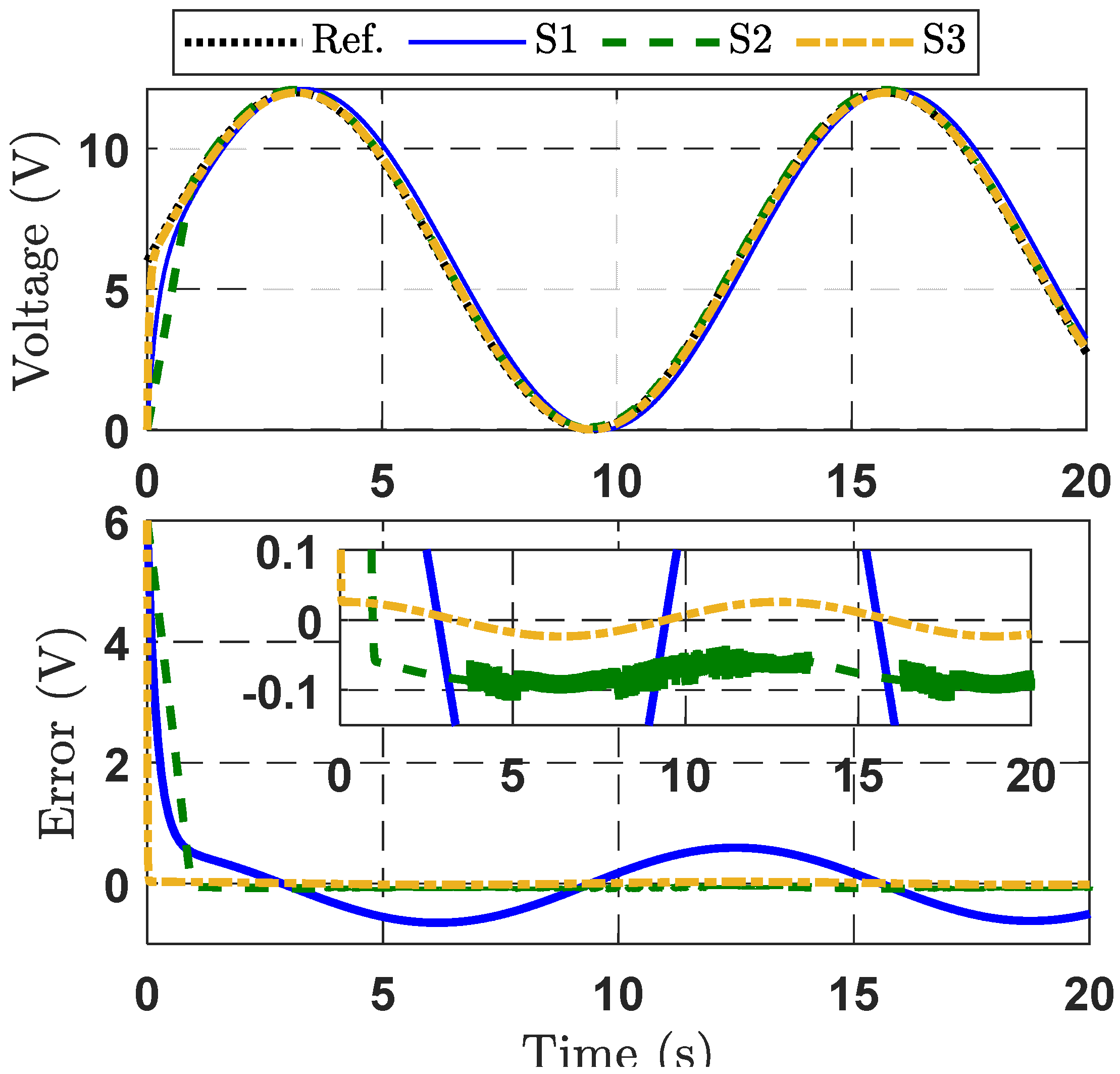
In this case study, the desired output voltage trajectory is given by x 1 d = 6 + 6 sin 0.5 t V to evaluate the results of three control strategies. Tracking performance with respect to output voltage control is plotted in Figure 3. It is obvious that the proposed control strategy (S3) yields a faster response in reaching the set point than the other control strategies (S1 and S2). Furthermore, we can evidently see through the zoomed part in the second subgraph of Figure 3 that the output tracking voltage error of S1 is the largest because of the lack of disturbance compensation. The S2 strategy reduces the tracking error, but it remains greater than under the proposed control strategy. It is apparent from these figures that the suggested controller provides superior output voltage tracking performance in comparison with the other control strategies.

4.1.2. Case Study 2

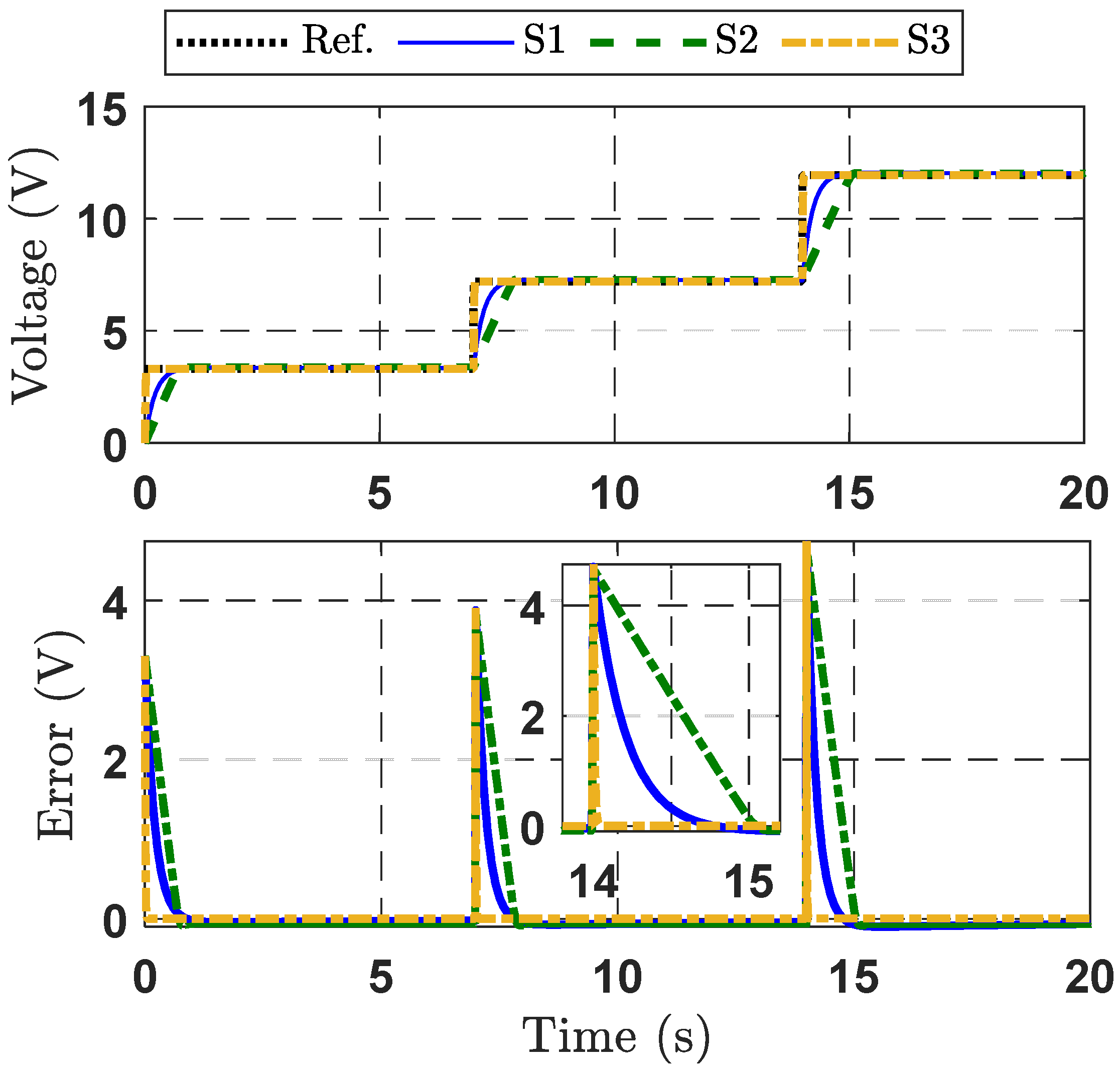
In this case study, to further evaluate the control performance of three control strategies, the desired output voltage trajectory is given by x 1 d = 3.3 V   with   0 t 7 , x 1 d = 7.2 V   with   7 t 14 , x 1 d = 12 V   with   14 t 20 . The tracking performances of the three strategies with respect to output voltage control, including output voltage tracking and tracking error, are shown in Figure 4. The first subgraph of Figure 4 illustrates that the output voltage of the DBC effectively tracks the reference trajectory. In particular, the proposed control strategy (S1) outperforms the other strategies (S2 and S3). The second subgraph of Figure 4 presents the output voltage tracking error. In the zoomed-in view from 13.5 s to 15.5 s, the tracking error of the proposed control strategy converges to zero within 0.02 s. This is significantly faster than S2 and S3, both of which converge after approximately 1 s. As observed, strategy S1 performs better than strategies S2 and S3 in the presence of lumped disturbances. This superior performance is due to S1 being designed by combining the advantages of the SESO and the adaptive command filter technique. In contrast, the absence of disturbance compensation or an adaptive law leads to poorer control performance in S2 and S3. These results demonstrate the key performance benefits of the proposed controller.
To further appraise the quality of the presented control strategies, two performance indices—maximum error (MAXE) and root mean square error (RME) [31] are provided, as shown in Table 1. These values are calculated over the duration of the last 16 s. The indicator values for the S1 strategy are reduced in comparison to the other strategies (S2 and S3), confirming the superior effectiveness of S1.

4.2. Experimental Results

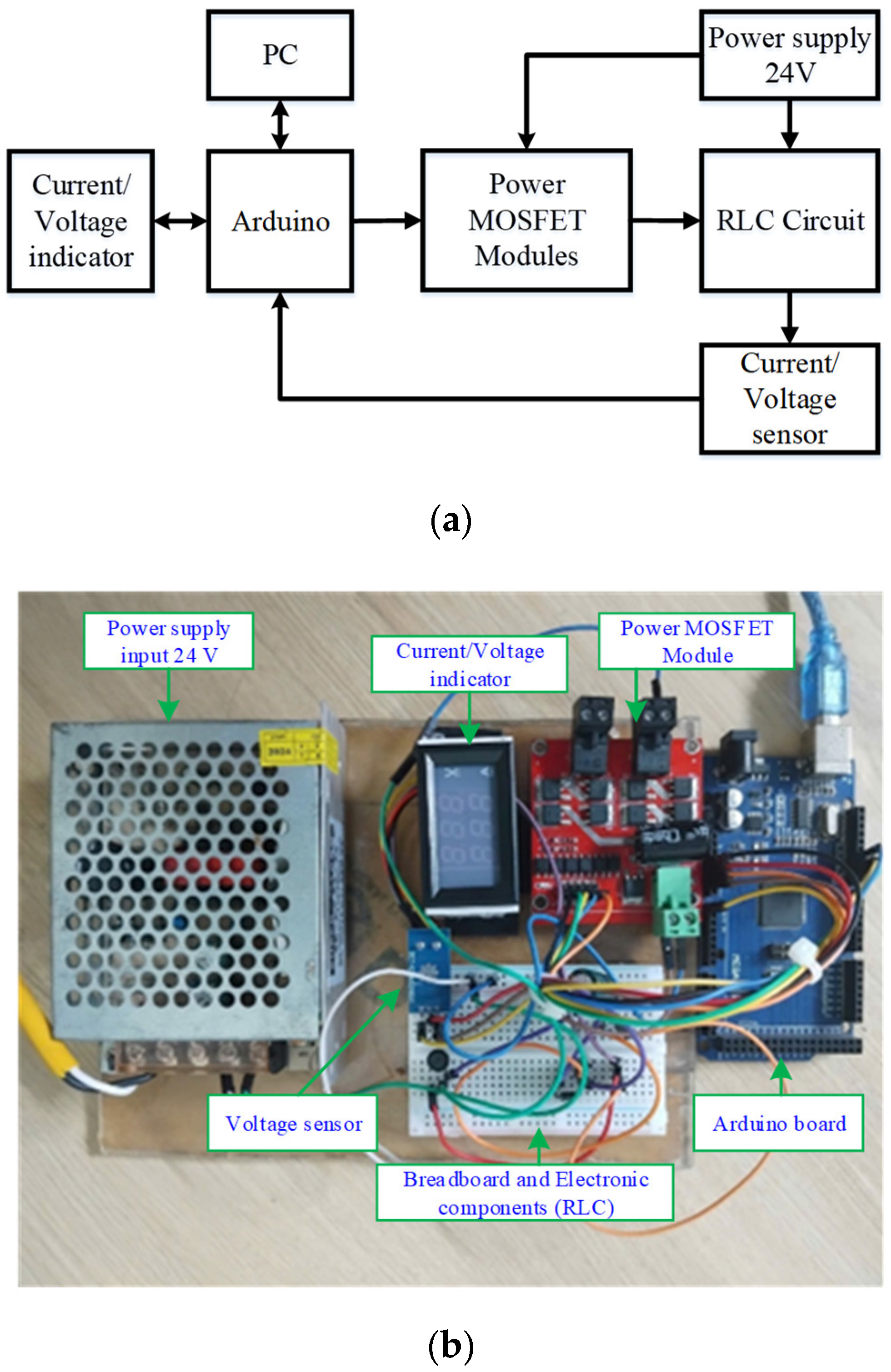
In this subsection, the observer-based adaptive command-filtered controller designed for DBC systems under lumped disturbances is validated on a real-time system through several experiments. The experimental DBC test bench is configured as shown in Figure 5. Figure 5a illustrates the wiring connections of the hardware components, while Figure 5b shows the complete DBC system. The setup includes a 24 V power supply, a current sensor, a voltage sensor, an RLC circuit, integrated PWM and power MOSFET modules, a microprocessor connected to a PC, an electronic test board, and a monitor. As illustrated in the schematic diagram in Figure 5a, MATLAB/Simulink is executed on the laptop PC, and the observer-based adaptive command-filter controller is developed via a MATLAB function. The generated control signal is sent to PWM pin 5 of the Arduino, which subsequently supplies the input to the Power MOSFET module. Accordingly, the embedded control platform comprises the laptop PC running MATLAB/Simulink, the Arduino, and the Power MOSFET module.
The main aim of the experiments is to demonstrate the practical feasibility of the suggested control approach for output voltage tracking in the DBC. The same two scenarios as in the simulation are conducted as a sinusoidal and multistep reference trajectory. During the experiment, the control gains of the proposed control strategy (S3) are re-examined and determined as follows: μ = 40; Γ1 = Γ2 = 0.15; χ1 = χ2 = 0.3; β1 = 150; β2= 50; ρ1 = ρ2 = 0.02.

4.2.1. Experimental Case Study 1

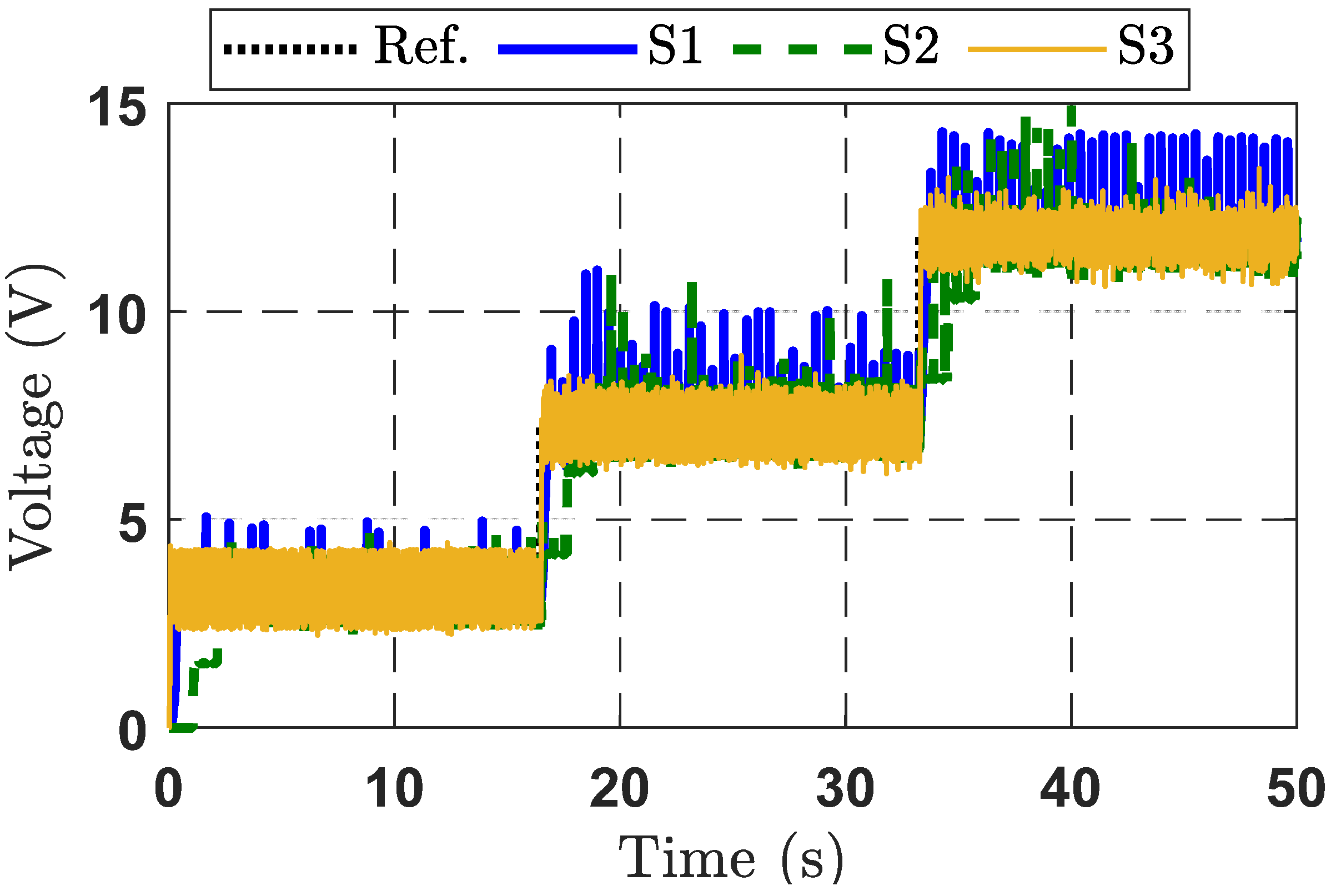
Output voltage tracking performance in Experimental Case Study 1 is shown in Figure 6. It is noteworthy that the suggested control methodology (S3) results in less output voltage fluctuation compared to the other strategies (S1 and S2). It may be observed that the brown line (S3) exhibits the smallest overshoot and the shortest rise time.
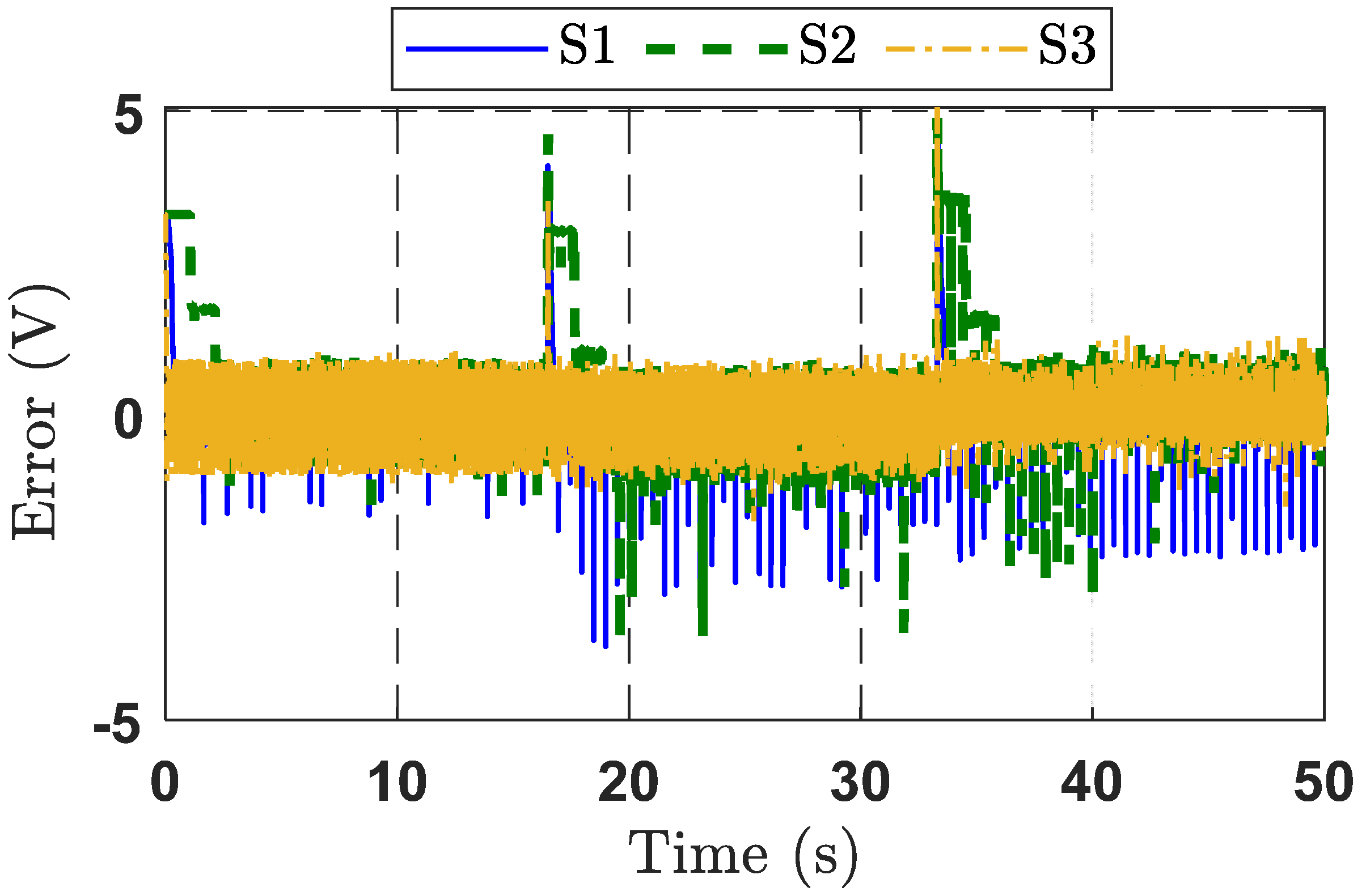
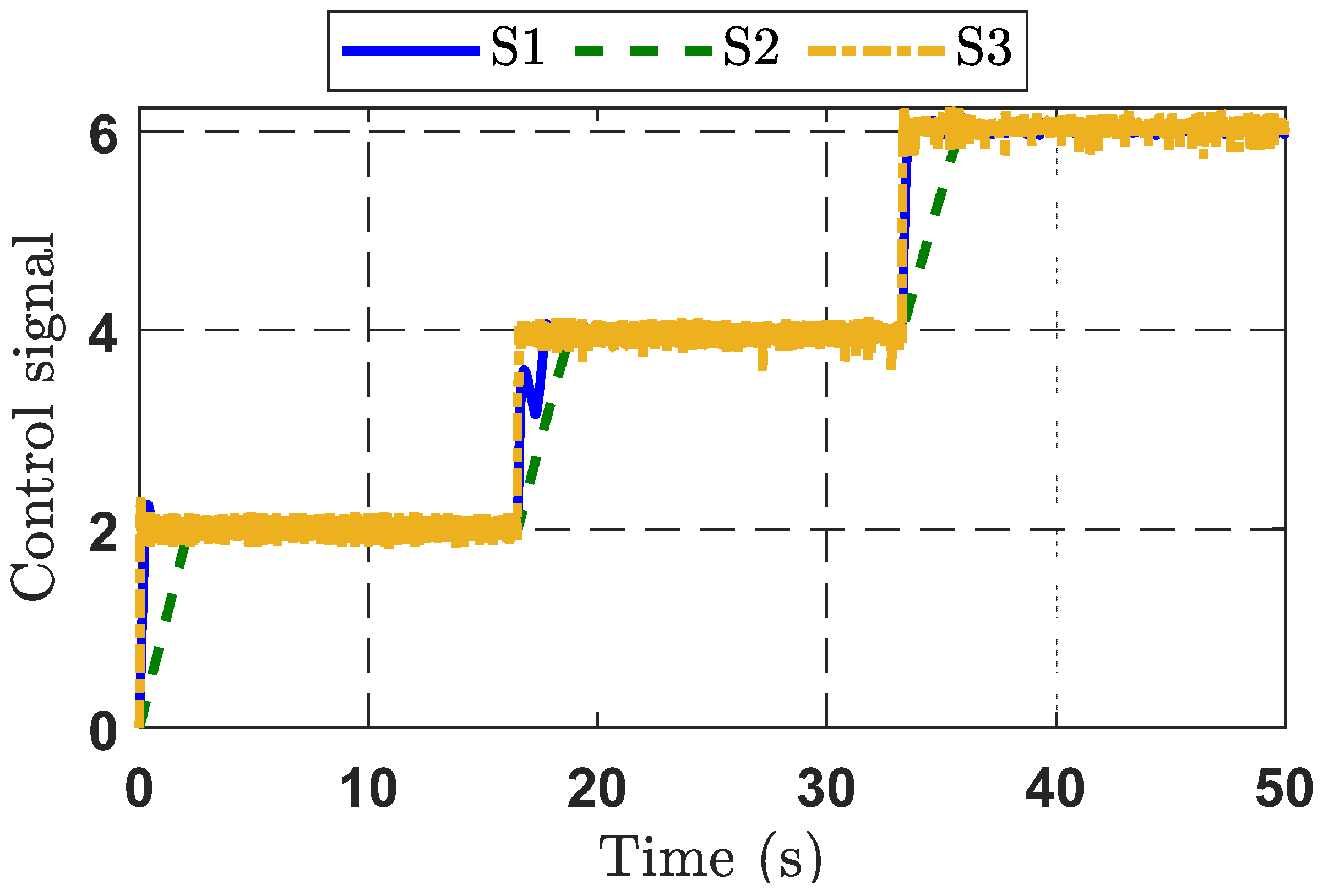
Output voltage tracking errors are presented in Figure 7. The tracking error of the proposed control strategy is significantly reduced thanks to the integration of disturbance compensation and the adaptive law for adjusting control gains. The S2 strategy shows the poorest control performance, particularly at 17 s and 34 s where the desired signal experiences a voltage step. Overall, the analysis confirms that the S3 strategy provides the best output voltage tracking performance, compared to the other control strategies. The control signals of the three control strategies are depicted in Figure 8.

4.2.2. Experimental Case Study 2

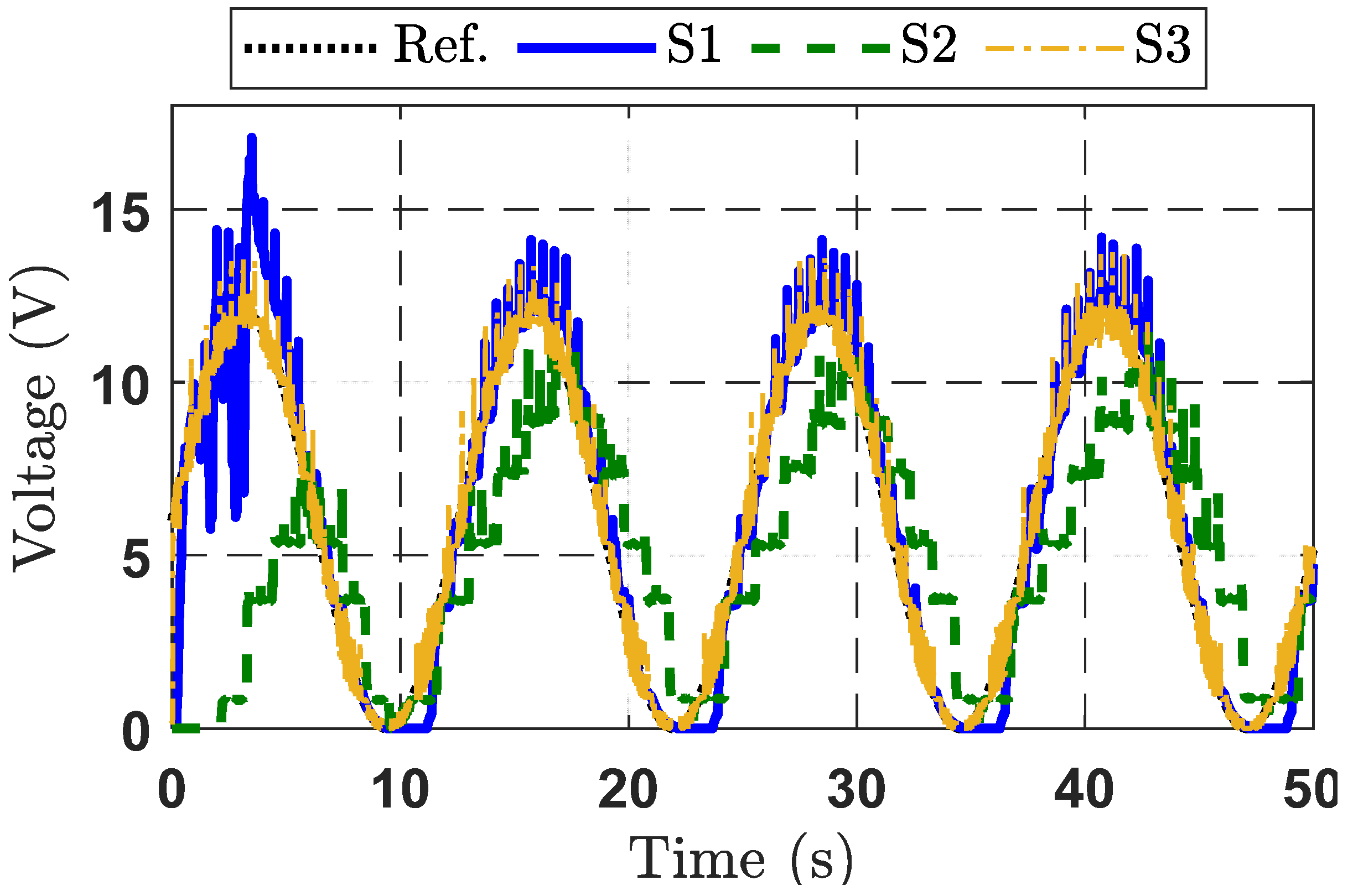
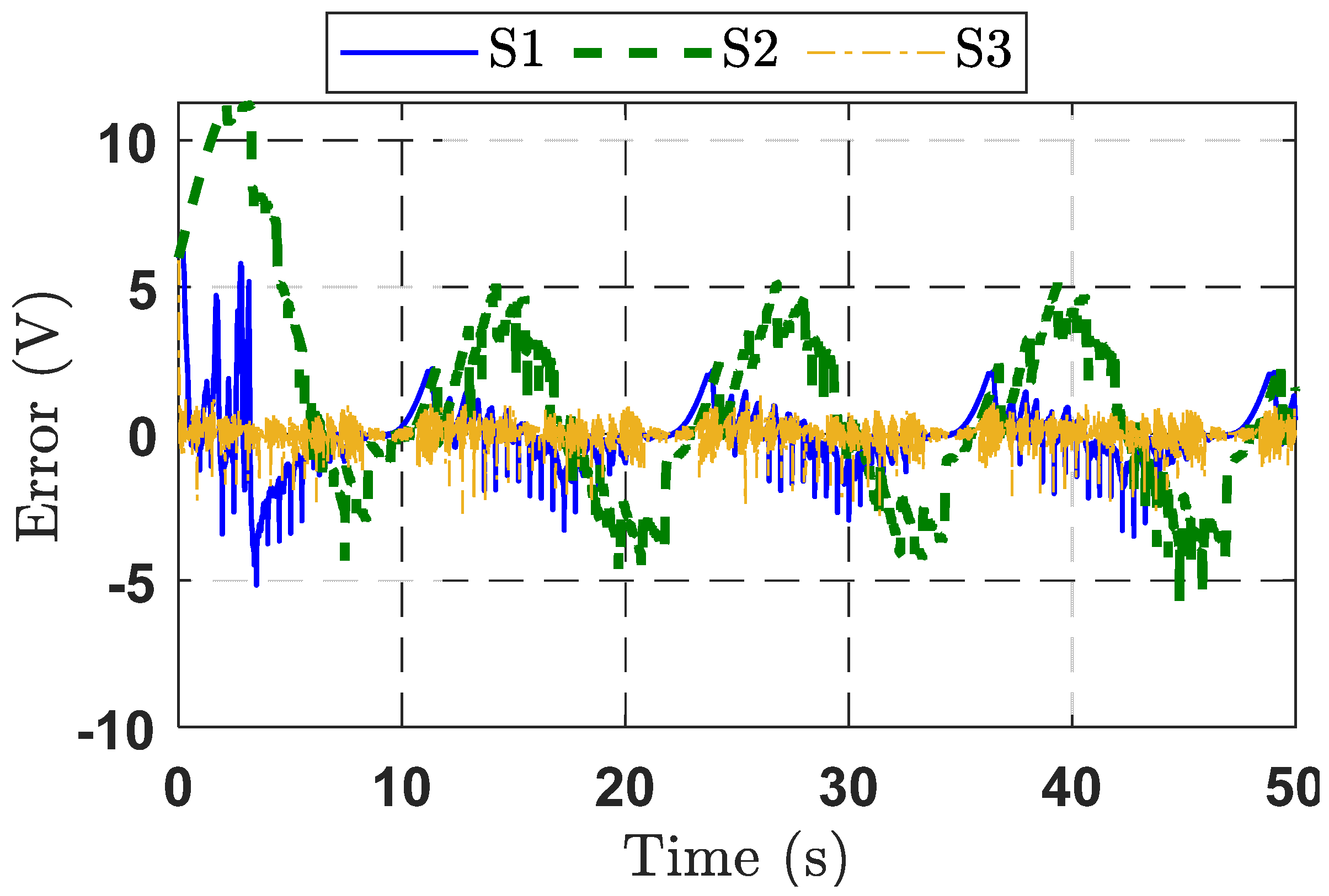
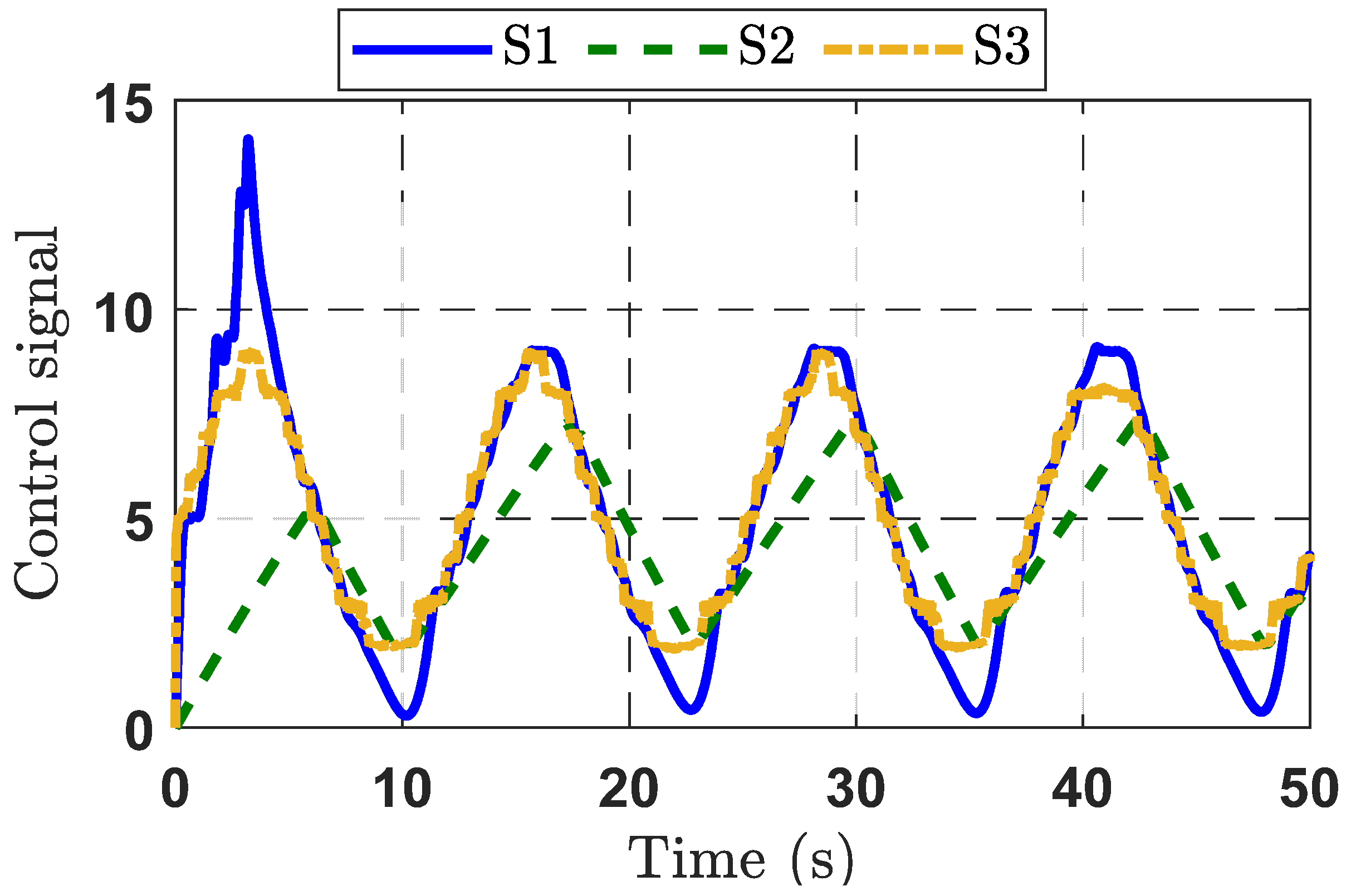
To further validate the output voltage control capability of the observer-based adaptive command-filtered controller, the desired sinusoidal signal was applied to a DBC system. The results of this second experiment are displayed in Figure 9, Figure 10 and Figure 11.
From Figure 9, the responses of the three strategies (S1, S2, and S3) indicate that the proposed control strategy S3 delivers better performance compared to S1 and S2. The S2 strategy fails to track the target signal effectively. Although the S1 strategy improves the rise time, it exhibits noticeable overshoot. Furthermore, from the tracking error response curves for the three control strategies presented in Figure 10, it can be seen that the S1 strategy achieves the smallest error, thanks to the integration of the observer and the adaptive command filter technique. The control signal response characteristics of the three control methods are depicted in Figure 11.
Table 2 presents a quantitative performance analysis demonstrating the benefits of the proposed control strategy. It is worth noting from Table 2 that the indicators MAXE and RME for the S3 strategy are lower than those for the other methods (S1 and S2).
The performance measures obtained in both the simulation and experimental studies clearly demonstrate that the proposed observer-based adaptive command-filtered controller outperforms the other control strategies in all respects. These findings verify the practicality and feasibility of applying the proposed algorithm to real-world DBCs.

5. Conclusions

In this paper, a robust command-filtered control strategy is designed to enhance the output voltage control performance of a DBC. A lumped disturbance that affects output performance is addressed using a simplified extended state observer (SESO). The proposed SESO not only estimates the disturbance but also the system states. Furthermore, a command filter is introduced to eliminate complex deviations. The combination of the SESO and command filter improves the output voltage tracking, bringing it closer to the desired signal. Numerical simulations and various experimental studies were conducted to demonstrate the superiority of the proposed control algorithm. Tracking performance improved by 96.1% and 77.8% in simulations and by 84.4% and 49.1% in experiments under a sinusoidal reference trajectory. Therefore, the suggested control algorithm is effective in boosting efficiency and compensating for the effects of lumped disturbances. In future work, experimental studies on fault-tolerant control of the DBC will be investigated.

Author Contributions

Conceptualization, V.D.P. and V.C.L.; investigation, V.D.P. and D.T.D.; data curation, S.P.H.; writing—original draft preparation, V.D.P. and D.T.D.; writing—review and editing, V.C.L. and S.P.H. All authors have read and agreed to the published version of the manuscript.

Funding

This research received no external funding.

Data Availability Statement

Data are contained within the article.

Conflicts of Interest

The authors declare no conflicts of interest.

References

  1. Wang, Z.; Li, S.; Wang, J.; Li, Q. Robust control for disturbed buck converters based on two GPI observers. Control Eng. Pract. 2017, 66, 13–22. [Google Scholar] [CrossRef]
  2. Lai, C.-K.; Chen, J.-Z.; Chan, S.-T. A Novel Robust Control System Design and Its Application to Servo Motor Drive. Appl. Sci. 2024, 14, 1083. [Google Scholar] [CrossRef]
  3. Phan, V.D.; Dinh, V.N.; Nguyen, P.N.; Duong, D.T.; Ta, H.C.; Le, D.C.; Pham, H.V.; Nguyen, H.T. LQG-based optimal control approach of an electronic throttle valves using DC servo system. Int. J. Power Electron. Drive Syst. 2025, 16, 882–890. [Google Scholar] [CrossRef]
  4. Silaa, M.Y.; Barambones, O.; Uralde, J.; Bencherif, A. Simulation and experimental validation of novel sliding mode control with quick power reaching law for a proton exchange membrane fuel cell system. J. Power Sources 2025, 653, 237632. [Google Scholar] [CrossRef]
  5. Silaa, M.Y.; Bencherif, A.; Barambones, O. A novel robust adaptive sliding mode control using stochastic gradient descent for PEMFC power system. Int. J. Hydrogen Energy 2023, 48, 17277–17292. [Google Scholar] [CrossRef]
  6. Ingilala, J.; Vairavasundaram, I. Investigation of high gain DC/DC converter for solar PV applications. E-Prime-Adv. Electr. Eng. Electron. Energy 2023, 5, 100264. [Google Scholar] [CrossRef]
  7. Anane, Z.; Babes, B.; Hamouda, N.; Benaouda, O.F.; Alotaibi, S.; Alzahrani, T.; Aeggegn, D.B.; Ghoneim, S.S.M. Experimental evaluation of DC-DC buck converter based on adaptive fuzzy fast terminal synergetic controller. Sci. Rep. 2025, 15, 1903. [Google Scholar] [CrossRef]
  8. Rana, N.; Banerjee, S. Development of an Improved Input-Parallel Output-Series Buck-Boost Converter and Its Closed-Loop Control. IEEE Trans. Ind. Electron. 2020, 67, 6428–6438. [Google Scholar] [CrossRef]
  9. Ma, W.; Zhang, B.; Qiu, D.; Sun, H. Switching Control Strategy for DC–DC Converters Based on Polynomial Lyapunov Function and Sum-of-Squares Approach. IEEE Trans. Ind. Electron. 2023, 70, 3663–3673. [Google Scholar] [CrossRef]
  10. Akbari, P.K.M. Optimized Topology Boost DC/DC Converter by using PI Controller. Int. J. Electron. Electr. Eng. Syst. 2023, 6, 1–8. [Google Scholar]
  11. Chamundeeswari, V.; Seyezhai, R. Design and Implementation of Fuzzy sliding mode control (FSMC) approach for a Modified Negative Output Luo DC-DC Converter with its comparative analysis. Automatika 2023, 65, 45–57. [Google Scholar] [CrossRef]
  12. Gheisarnejad, M.; Farsizadeh, H.; Khooban, M.H. A Novel Nonlinear Deep Reinforcement Learning Controller for DC–DC Power Buck Converters. IEEE Trans. Ind. Electron. 2021, 68, 6849–6858. [Google Scholar]
  13. Albira, M.E.; Zohdy, M.A. Adaptive Model Predictive Control for DC-DC Power Converters With Parameters’ Uncertainties. IEEE Access 2021, 9, 135121–135131. [Google Scholar] [CrossRef]
  14. Alam, Z.; Roy, T.K.; Ghosh, S.K.; Mahmud, M.A. Control of DC–DC Buck Converters Using Robust Composite Backstepping and Integral Terminal Sliding Mode Approaches. IEEE J. Emerg. Sel. Top. Ind. Electron. 2023, 4, 866–877. [Google Scholar] [CrossRef]
  15. Nguyen, M.H.; Ahn, K.K. An Improved Voltage Regulation Performance of Floating Interleaved Boost Converters for Fuel Cell Applications Subject to Input Variation and Load Change. Appl. Sci. 2022, 12, 11501. [Google Scholar] [CrossRef]
  16. Alam, M.Z.; Roy, T.K.; Ghosh, S.K.; Mohammad, N.; Paul, L.C. Output Voltage Stability of a DC-DC Buck Converter via an Improved Backstepping Method. In Proceedings of the 2023 International Conference on Electrical, Computer and Communication Engineering (ECCE), Dubai, United Arab Emirates, 30–31 December 2023. [Google Scholar]
  17. Chan, C.-Y. Adaptive Sliding-Mode Control of a Novel Buck-Boost Converter Based on Zeta Converter. IEEE Trans. Circuits Syst. II Express Briefs 2022, 69, 1307–1311. [Google Scholar]
  18. Kareem, V.P.B.A.; Kumara, V. A Second-Order Sliding Mode Control Scheme With Fuzzy Logic-Based Online Sliding Surface Adjustment for Buck Converters. IEEE ACCESS 2025, 13, 48792–48801. [Google Scholar] [CrossRef]
  19. Phan, V.D.; Truong, H.V.A.; Ahn, K.K. Actuator failure compensation-based command filtered control of electro-hydraulic system with position constraint. ISA Trans. 2023, 134, 561–572. [Google Scholar]
  20. Phan, V.D.; Trinh, H.-A.; Ahn, K.K. Finite-Time Command Filtered Control for Oxygen-Excess Ratio of Proton Exchange Membrane Fuel Cell Systems with Prescribed Performance. Mathematics 2023, 11, 914. [Google Scholar]
  21. Nguyen, Q.V.; Tran, H.-T.; Mai, L.T. Evaluation of a fuzzy-based sliding mode control strategy for a DC-DC buck converter. Int. J. Power Electron. Drive Syst. 2025, 16, 891–906. [Google Scholar] [CrossRef]
  22. Ghamari, S.M.; Khavari, F.; Mollaee, H. Adaptive backstepping controller design for DBC optimised by grey wolf algorithm. IET Energy Syst. Integr. 2023, 6, 18–30. [Google Scholar] [CrossRef]
  23. Truong, H.V.A.; Phan, V.D.; Tran, D.T.; Ahn, K.K. A novel observer-based neural-network finite-time output control for high-order uncertain nonlinear systems. Appl. Math. Comput. 2024, 475, 128699. [Google Scholar] [CrossRef]
  24. Alnuman, H.; Hsia, K.-H.; Sepestanaki, M.A.; Ahmed, E.M.; Mobayen, S.; Armghan, A. Design of Continuous Finite-Time Controller Based on Adaptive Tuning Approach for Disturbed Boost Converters. Mathematics 2023, 11, 1757. [Google Scholar] [CrossRef]
  25. Wang, J.; Rong, J.; Yu, L. Dynamic prescribed performance sliding mode control for DC-DC buck converter system with mismatched time-varying disturbances. ISA Trans. 2022, 129, 546–557. [Google Scholar] [CrossRef]
  26. Trinh, H.A.; Nguyen, D.G.; Phan, V.D.; Duong, T.Q.; Truong, H.V.; Choi, S.J.; Ahn, K.K. Robust Adaptive Control Strategy for a Bidirectional DC-DC Converter Based on Extremum Seeking and Sliding Mode Control. Sensors 2023, 23, 457. [Google Scholar] [CrossRef]
  27. Babes, B.; Mekhilef, S.; Boutaghane, A.; Rahmani, L. Fuzzy Approximation-Based Fractional-Order Nonsingular Terminal Sliding Mode Controller for DC–DC Buck Converters. IEEE Trans. Power Electron. 2022, 37, 2749–2760. [Google Scholar] [CrossRef]
  28. Wang, J.; Li, S.; Yang, J.; Wu, B.; Li, Q. Extended state observer-based sliding mode control for PWM-based DC–DC buck power converter systems with mismatched disturbances. IET Control Theory Appl. 2015, 9, 579–586. [Google Scholar] [CrossRef]
  29. Pukrushpan, J.T. Modeling and control of fuel cell systems and fuel processors. Diss. Abstr. Int. 2003, 64, 925. [Google Scholar]
  30. Zhai, J.; Li, S.; Tan, G.; Li, J.; Xu, Z.; Zhang, L. Structural Vibration Suppression Using a Reduced-Order Extended State Observer-Based Nonsingular Terminal Sliding Mode Controller with an Inertial Actuator. Machines 2022, 11, 1. [Google Scholar] [CrossRef]
  31. Phan, V.D.; Vo, C.P.; Dao, H.V.; Ahn, K.K. Actuator Fault-Tolerant Control for an Electro-Hydraulic Actuator Using Time Delay Estimation and Feedback Linearization. IEEE Access 2021, 9, 107111–107123. [Google Scholar] [CrossRef]
Figure 1. Diagram of the DBC.
Micromachines 16 01412 g001
Figure 2. Control structure for DBC with using observer-based adaptive command filter.
Micromachines 16 01412 g002
Figure 3. Response curves for the three control strategies, Case Study 1.
Micromachines 16 01412 g003
Figure 4. Response curves for the three control strategies, Case Study 2.
Micromachines 16 01412 g004
Figure 5. DBC system test bench. (a) Schematic diagram of the setup. (b) Main DBC circuit.
Micromachines 16 01412 g005
Figure 6. Output voltage response curves for the three control strategies in Experimental Case Study 1.
Micromachines 16 01412 g006
Figure 7. Tracking error response curves for the three control strategies in Experimental Case Study 1.
Micromachines 16 01412 g007
Figure 8. Control signal response curves for the three control strategies in Experimental Case Study 1.
Micromachines 16 01412 g008
Figure 9. Output voltage response curves for the three control strategies in Experimental Case Study 2.
Micromachines 16 01412 g009
Figure 10. Tracking error response curves for the three control strategies in Experimental Case Study 2.
Micromachines 16 01412 g010
Figure 11. Control signal response curves for the three control strategies in Experimental Case Study 2.
Micromachines 16 01412 g011
Table 1. Performance indicators for the three control strategies in the simulation.
Control StrategyMAXE (V)RME (V)
Case Study 1S10.65370.4653
S20.11570.0812
S30.02590.0180
Case Study 2S14.69530.4966
S24.74140.8507
S34.65010.1574
Table 2. Performance indicators for the three control strategies in the experimental case studies.
Control StrategyMAXE (V)RME (V)
Case Study 1S15.50521.0141
S25.05520.5229
S34.88430.4633
Case Study 2S13.49660.7852
S25.76342.5688
S32.80340.4003
Disclaimer/Publisher’s Note: The statements, opinions and data contained in all publications are solely those of the individual author(s) and contributor(s) and not of MDPI and/or the editor(s). MDPI and/or the editor(s) disclaim responsibility for any injury to people or property resulting from any ideas, methods, instructions or products referred to in the content.