Review

Cancer Cell Direct Bioprinting: A Focused Review
by
David Angelats Lobo
1,2,
Paola Ginestra
1,*,
Elisabetta Ceretti
1,
Teresa Puig Miquel
2 and
Joaquim Ciurana
3
1
Department of Mechanical and Industrial Engineering, University of Brescia, V. Branze 38, 25123 Brescia, Italy
2
New Therapeutic Targets Laboratory (TargetsLab), Oncology Unit, Department of Medical Sciences, Girona Institute for Biomedical Research, University of Girona, Emili Grahit 77, 17003 Girona, Spain
3
Product, Process and Production Engineering Research Group (GREP), Department of Mechanical Engineering and Industrial Construction, University of Girona, Maria Aurèlia Capmany 61, 17003 Girona, Spain
*
Author to whom correspondence should be addressed.
Micromachines 2021, 12(7), 764; https://doi.org/10.3390/mi12070764
Submission received: 26 May 2021 / Revised: 23 June 2021 / Accepted: 25 June 2021 / Published: 28 June 2021

Abstract

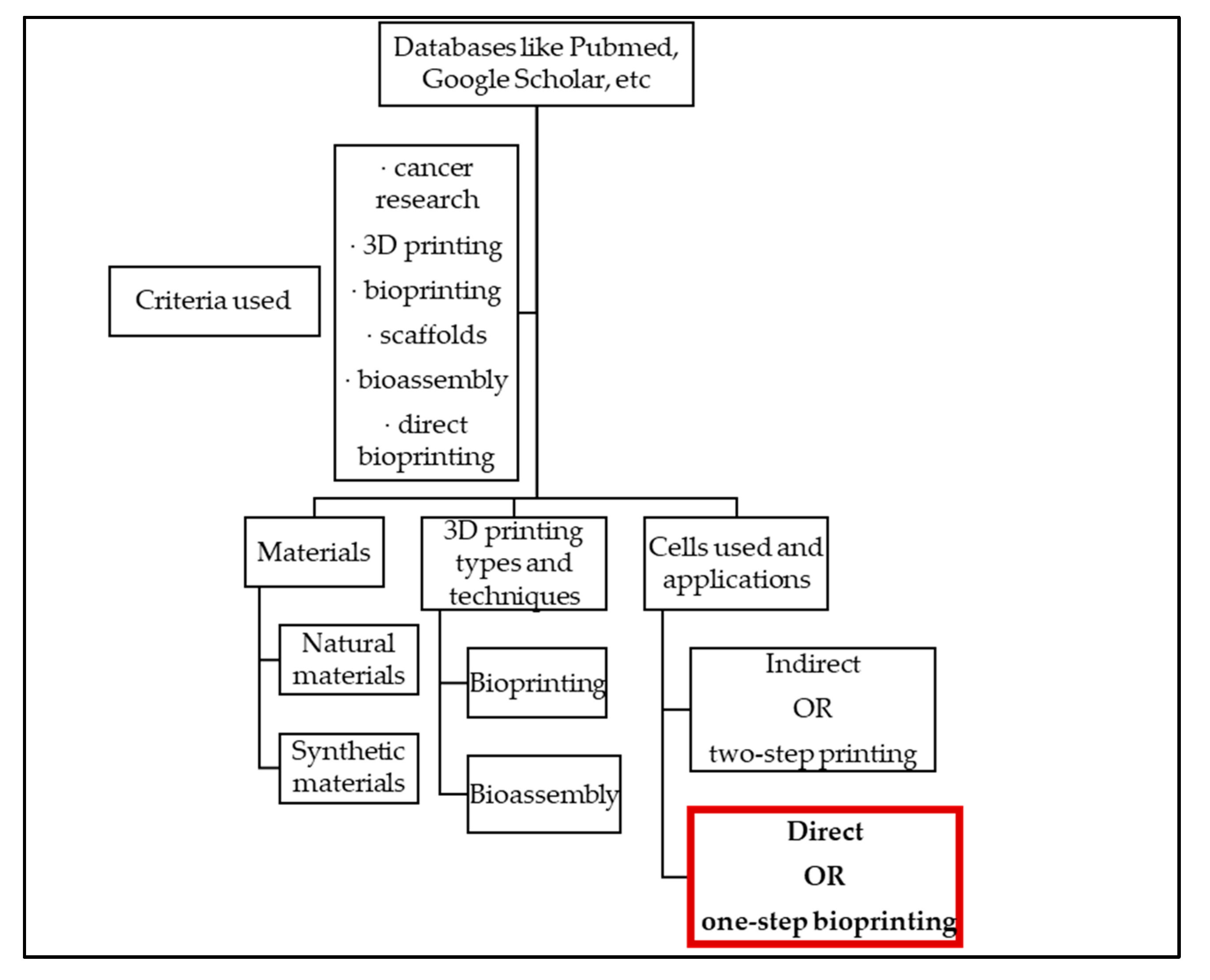
Three-dimensional printing technologies allow for the fabrication of complex parts with accurate geometry and less production time. When applied to biomedical applications, two different approaches, known as direct or indirect bioprinting, may be performed. The classical way is to print a support structure, the scaffold, and then culture the cells. Due to the low efficiency of this method, direct bioprinting has been proposed, with or without the use of scaffolds. Scaffolds are the most common technology to culture cells, but bioassembly of cells may be an interesting methodology to mimic the native microenvironment, the extracellular matrix, where the cells interact between themselves. The purpose of this review is to give an updated report about the materials, the bioprinting technologies, and the cells used in cancer research for breast, brain, lung, liver, reproductive, gastric, skin, and bladder associated cancers, to help the development of possible treatments to lower the mortality rates, increasing the effectiveness of guided therapies. This work introduces direct bioprinting to be considered as a key factor above the main tissue engineering technologies.
Keywords: bioprinting; 3D printing; cancer bioprinting; 3D printing; cancer