Biomarkers, Neurophysiological and Clinical Correlates Following Botulinum Toxin Treatment in Various Clinical Presentations of Cervical Dystonia: A Controlled Study Across Peak and Waning Response Phases

 ,
,  and
and 
Abstract
1. Introduction
2. Results
3. Discussion
4. Materials and Methods
4.1. Participants
4.2. Enrolment Procedure and Criteria
4.3. Assessments
4.3.1. Analysis of NfL and Zonulin Concentration
4.3.2. F-Wave Protocol
4.3.3. CSP Protocol
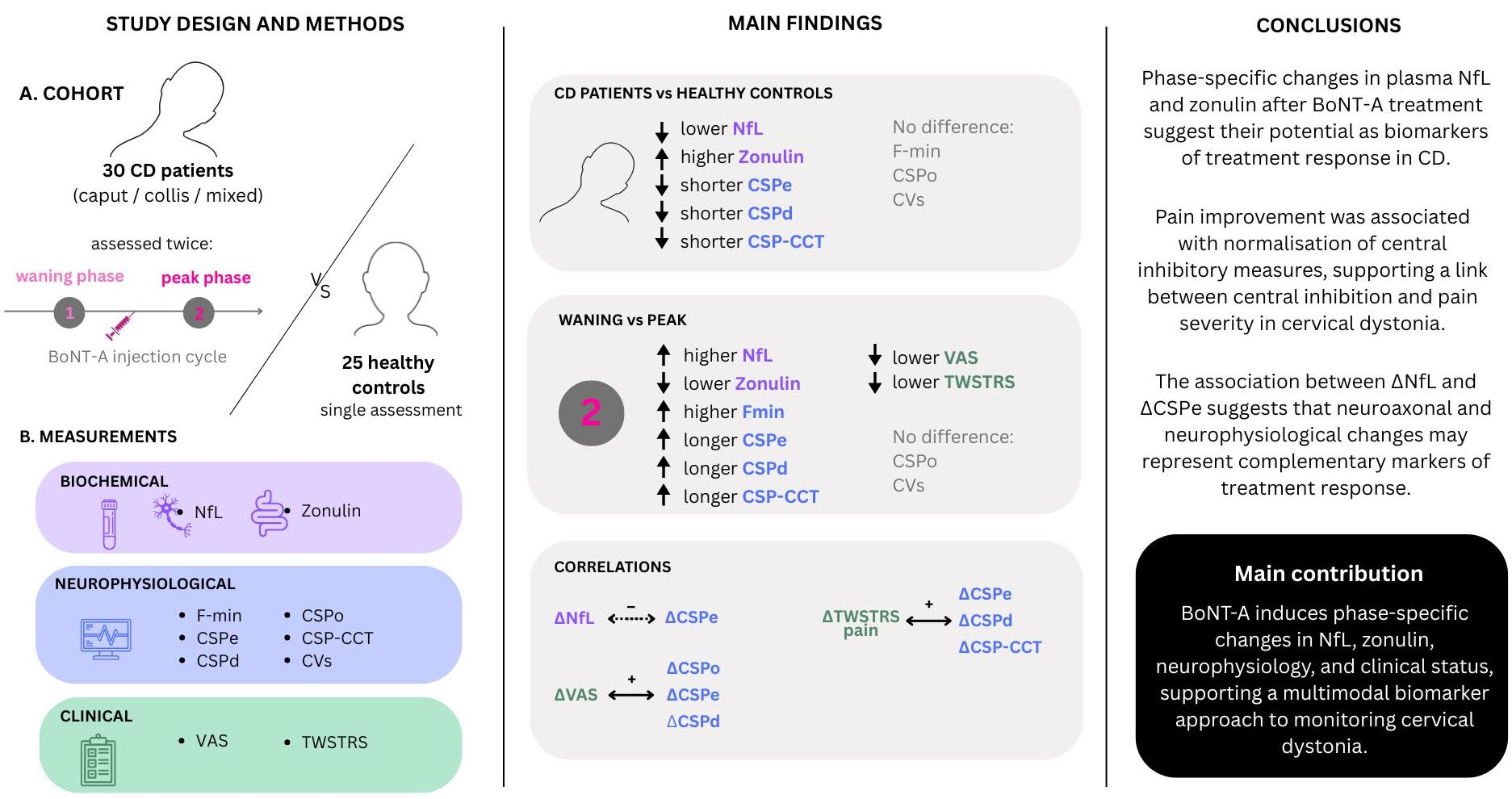
- CSPo (ms): latency at the beginning of muscle activity suppression;
- CSPe (ms): latency at the onset of renewed muscle activity;
- CSPd (ms): duration of the silent period, calculated as CSPe – CSPo;
- CSP–CCT: cutaneous silent period, central conduction time, calculated as CSPd − (Fmin/2).
4.4. Data Collection and Management
4.5. Statistical Analysis
Author Contributions
Funding
Institutional Review Board Statement
Informed Consent Statement
Data Availability Statement
Acknowledgments
Conflicts of Interest
Abbreviations
| BMI | Body Mass Index |
| BoNT-A | Botulinum toxin type A |
| CD | Cervical dystonia |
| CCT | Central conduction time |
| CSP | Cutaneous silent period |
| CSPd | Duration of the silent period, calculated as CSPe − CSPo |
| CSPe | Latency at the onset of renewed muscle activity |
| CSPo | Latency at the beginning of muscle activity suppression |
| CSP-CCT | CSP central conduction time, calculated as CSPd − (Fmin/2) |
| CVs | Sensory conduction velocity in A-delta fibres |
| EMG | Electromyography |
| Fwave | Late motor response generated by antidromic activation of spinal α-motoneurons |
| GCP | Good Clinical Practice |
| HPA | Hypothalamic–pituitary–adrenal |
| NfL | Neurofilament light chain |
| ST | Sensory threshold |
| TWSTRS | Toronto Western Spasmodic Torticollis Rating Scale |
| VAS | Visual analogue scale |
| Zonulin | Endogenous protein that regulates intestinal permeability |
References
- Albanese, A.; Bhatia, K.P.; Cardoso, F.; Comella, C.; Defazio, G.; Fung, V.S.C.; Hallett, M.; Jankovic, J.; Jinnah, H.A.; Kaji, R.; et al. Isolated Cervical Dystonia: Diagnosis and Classification. Mov. Disord. 2023, 38, 1367–1378. [Google Scholar] [CrossRef] [Scilit]
- Sławek, J.; Jost, W.H. Botulinum Neurotoxin in Cervical Dystonia Revisited—Recent Advances and Unanswered Questions. Neurol. Neurochir. Pol. 2021, 55, 125–132. [Google Scholar] [CrossRef] [Scilit] [PubMed]
- Reichel, G.; Stenner, A.; Jahn, A. The phenomenology of cervical dystonia. Fortschr. Neurol. Psychiatr. 2009, 77, 272–277. [Google Scholar] [CrossRef] [Scilit] [PubMed]
- Jost, W.H.; Tatu, L. Selection of Muscles for Botulinum Toxin Injections in Cervical Dystonia. Mov. Disord. Clin. Pract. 2015, 2, 224–226. [Google Scholar] [CrossRef] [Scilit] [PubMed]
- Sławek, J.; Car, H.; Bonikowski, M.; Bogucki, A.; Koziorowski, D.; Potulska-Chromik, A.; Rudzińska, M. Are botulinum toxin type A preparations really the same medication? A comparison of three botulinum toxin A for variations in labelled neurological indications. Neurol. Neurochir. Pol. 2010, 44, 43–64. [Google Scholar] [CrossRef] [Scilit] [PubMed]
- Nemanić, D.; Mustapić, M.; Matak, I.; Bach-Rojecky, L. Botulinum Toxin Type a Antinociceptive Activity in Trigeminal Regions Involves Central Transcytosis. Eur. J. Pharmacol. 2024, 963, 176279. [Google Scholar] [CrossRef] [Scilit] [PubMed]
- Pekny, M.; Wilhelmsson, U.; Stokowska, A.; Tatlisumak, T.; Jood, K.; Pekna, M. Neurofilament Light Chain (NfL) in Blood-A Biomarker Predicting Unfavourable Outcome in the Acute Phase and Improvement in the Late Phase after Stroke. Cells 2021, 10, 1537. [Google Scholar] [CrossRef] [Scilit] [PubMed]
- Samadzadeh, S.; Sleator, R.D. The Role of Neurofilament Light (NfL) and Glial Fibrillary Acidic Protein (GFAP) in MS and AQP4-NMOSD: Advancing Clinical Applications. eNeurologicalSci 2025, 38, 100550. [Google Scholar] [CrossRef] [Scilit] [PubMed]
- Rahmatipour, H.; Shabestari, S.M.; Benisi, S.Z.; Samadikhah, H. Pioneering pain management with botulinum toxin type A: From anti-inflammation to regenerative therapies. Heliyon 2025, 11, e42350. [Google Scholar] [CrossRef] [Scilit] [PubMed]
- Kassaye, S.G.; De Pauw, J.; De Waele, S.; De Hertogh, W.; Gudina, E.K.; Crosiers, D. Interdisciplinary Consensus in Evaluating the Severity Subscale of the Original and Revised Toronto Western Spasmodic Torticollis Rating Scale Through Video-Based Assessment: An Inter-Rater Reliability Study. Mov. Disord. Clin. Pract. 2024, 11, 1587–1591. [Google Scholar] [CrossRef] [Scilit] [PubMed]
- Drużdż, A.; Leśniewska-Furs, E.; Dudzic, M.; Sowińska, A.; Jurga, S.; Jost, W.H. Neurophysiological Assessment of F-Wave, M-Wave, and Cutaneous Silent Period in Patients with Caput-Pattern Cervical Dystonia at Waning and Peak Response Phases of Botulinum Toxin Therapy. Toxins 2025, 18, 21. [Google Scholar] [CrossRef] [Scilit] [PubMed]
- Drużdż, A.; Dudzic, M.; Sowińska, A.; Jurga, S.; Górna, N.; Kaźmierski, R. Neurophysiological Assessment of F-, M-Waves and Cutaneous Silent Period in Patients with Caput Patterns of Cervical Dystonia in the Waning Phase of Botulinum Toxin Therapy. Neurol. Neurochir. Pol. 2026. online ahead of print. [Google Scholar] [CrossRef] [Scilit] [PubMed]
- Streit, S.; Meinhardt, J.; Gimber, N.; Kestenbach, J.; Siewert, C.; Schmoranzer, J.; Meisel, C.; Ruprecht, K.; Heppner, F.L.; Körtvélyessy, P.; et al. Neurofilament Light Chain as a Marker of Peripheral Nerve Damage in Vasculitic Neuropathy? A Cross-Compartmental Correlation Analysis in Patients Undergoing Nerve Biopsy. Brain Pathol. 2026, 36, e70038. [Google Scholar] [CrossRef] [Scilit] [PubMed]
- Ferrazzano, G.; Zingaropoli, M.A.; Costanzo, M.; Belvisi, D.; Dominelli, F.; Pasculli, P.; Ciardi, M.R.; Fabbrini, G.; Defazio, G.; Berardelli, A.; et al. Neurofilament Assessment in Patients with Cervical Dystonia. Park. Relat. Disord. 2022, 98, 70–71. [Google Scholar] [CrossRef] [Scilit] [PubMed]
- Wu, M.-C.; Chang, Y.-Y.; Lan, M.-Y.; Chen, Y.-F.; Tai, C.-H.; Chen, S.-J.; Lin, C.-H. Blood Neurofilament Light Chain as a Surrogate Marker for Dystonia. Eur. J. Neurol. 2023, 30, 3098–3104. [Google Scholar] [CrossRef] [Scilit] [PubMed]
- Quartarone, A.; Ruge, D. How many types of dystonia? Pathophysiological considerations. Front. Neurol. 2018, 9, 12. [Google Scholar] [CrossRef] [Scilit] [PubMed]
- Gilbertson, T.; Humphries, M.; Steele, J.D. Maladaptive striatal plasticity and abnormal reward-learning in cervical dystonia. Eur. J. Neurosci. 2019, 50, 3191–3204. [Google Scholar] [CrossRef] [Scilit] [PubMed]
- Hviid, C.V.B.; Madsen, A.T.; Winther-Larsen, A. Biological variation of serum neurofilament light chain. Clin. Chem. Lab. Med. 2021, 60, 569–575. [Google Scholar] [CrossRef] [Scilit] [PubMed]
- Delnooz, C.C.S.; Pasman, J.W.; Beckmann, C.F.; van de Warrenburg, B.P.C. Task-Free Functional MRI in Cervical Dystonia Reveals Multi-Network Changes That Partially Normalize with Botulinum Toxin. PLoS ONE 2013, 8, e62877. [Google Scholar] [CrossRef] [Scilit] [PubMed]
- Sasaki, Y. Metabolic Aspects of Neuronal Degeneration: From a NAD Point of View. Neurosci. Res. 2019, 139, 9–20. [Google Scholar] [CrossRef] [Scilit] [PubMed]
- Sturgeon, C.; Fasano, A. Zonulin, a Regulator of Epithelial and Endothelial Barrier Functions, and Its Involvement in Chronic Inflammatory Diseases. Tissue Barriers 2016, 4, e1251384. [Google Scholar] [CrossRef] [Scilit] [PubMed]
- Boschetti, E.; Caio, G.; Cervellati, C.; Costanzini, A.; Rosta, V.; Caputo, F.; De Giorgio, R.; Zuliani, G. Serum Zonulin Levels Are Increased in Alzheimer’s Disease but Not in Vascular Dementia. Aging Clin. Exp. Res. 2023, 35, 1835–1843. [Google Scholar] [CrossRef] [Scilit] [PubMed]
- Stuart, C.M.; Varatharaj, A.; Winberg, M.E.; Galea, P.; Larsson, H.B.W.; Cramer, S.P.; Fasano, A.; Maherally, Z.; Pilkington, G.J.; Keita, Å.V.; et al. Zonulin and Blood-Brain Barrier Permeability Are Dissociated in Humans. Clin. Transl. Med. 2022, 12, e965. [Google Scholar] [CrossRef] [Scilit] [PubMed]
- Fasano, A. Zonulin, Regulation of Tight Junctions, and Autoimmune Diseases. Ann. N. Y. Acad. Sci. 2012, 1258, 25–33. [Google Scholar] [CrossRef] [Scilit] [PubMed]
- Dash, U.C.; Bhol, N.K.; Swain, S.K.; Samal, R.R.; Nayak, P.K.; Raina, V.; Panda, S.K.; Kerry, R.G.; Duttaroy, A.K.; Jena, A.B. Oxidative Stress and Inflammation in the Pathogenesis of Neurological Disorders: Mechanisms and Implications. Acta Pharm. Sin. B 2025, 15, 15–34. [Google Scholar] [CrossRef] [Scilit] [PubMed]
- Marino, M.; Mignozzi, S.; Michels, K.B.; Cintolo, M.; Penagini, R.; Gargari, G.; Ciafardini, C.; Ferraroni, M.; Patel, L.; Del Bo’, C.; et al. Serum Zonulin and Colorectal Cancer Risk. Sci. Rep. 2024, 14, 28171. [Google Scholar] [CrossRef] [Scilit] [PubMed]
- ElGhandour, A.M.; Bayoumy, E.M.; Sayed, M.M.; Eskandaros, M.S.; Emam, A.M.M.; Teama, N.M.; Mohamed, M.S.; El-Gaaly, S.A. Value of Zonulin as a Diagnostic and Prognostic Marker in Different Degrees of Nonalcoholic Fatty Liver Disease. Egypt. Liver J. 2024, 14, 43. [Google Scholar] [CrossRef] [Scilit]
- Işık, Ü.; Aydoğan Avşar, P.; Aktepe, E.; Doğuç, D.K.; Kılıç, F.; Büyükbayram, H.İ. Serum Zonulin and Claudin-5 Levels in Children with Obsessive-Compulsive Disorder. Nord. J. Psychiatry 2020, 74, 346–351. [Google Scholar] [CrossRef] [Scilit] [PubMed]
- Erkan, G.C.; Sumnu, A.; Ertugrul, G.; Ulfer, G.; Cakici, C.; Aydin, H.C.; Unal, A. The Relationship between Zonulin and Metabolic Syndrome in Renal Transplant Patients. Clin. Lab. 2023, 69. [Google Scholar] [CrossRef] [Scilit] [PubMed]
- Camara-Lemarroy, C.R.; Silva, C.; Greenfield, J.; Liu, W.-Q.; Metz, L.M.; Yong, V.W. Biomarkers of Intestinal Barrier Function in Multiple Sclerosis Are Associated with Disease Activity. Mult. Scler. 2020, 26, 1340–1350. [Google Scholar] [CrossRef] [Scilit] [PubMed]
- Ülfer, G.; Polat, B.; Yabalak, A.; Çakıcı, Ç. Evaluation of Zonulin Levels in Patients with Migraine. BMC Neurol. 2025, 25, 46. [Google Scholar] [CrossRef] [Scilit] [PubMed]
- Ma, L.; Keng, J.; Cheng, M.; Pan, H.; Feng, B.; Hu, Y.; Feng, T.; Yang, F. Gut Microbiome and Serum Metabolome Alterations Associated with Isolated Dystonia. mSphere 2021, 6, e0028321. [Google Scholar] [CrossRef] [Scilit] [PubMed]
- Timmers, E.R.; Swarte, J.C.; Gacesa, R.; Björk, J.R.; Weersma, R.K.; Tijssen, M.A.J.; de Koning, T.J.; Harmsen, H.J.M.; Niezen-Koning, K.E. Gut Microbiome Composition in Dystonia Patients. Int. J. Mol. Sci. 2023, 24, 2383. [Google Scholar] [CrossRef] [Scilit] [PubMed]
- Yahalom, G.; Fay-Karmon, T.; Livneh, V.; Israeli-Korn, S.; Ephraty, L.; Hassin-Baer, S. Botulinum Injections for Idiopathic Cervical Dystonia: A Longitudinal Study. Neurotox. Res. 2021, 39, 1352–1359. [Google Scholar] [CrossRef] [Scilit] [PubMed]
- Dressler, D.; Paus, S.; Seitzinger, A.; Gebhardt, B.; Kupsch, A. Long-Term Efficacy and Safety of incobotulinumtoxinA Injections in Patients with Cervical Dystonia. J. Neurol. Neurosurg. Psychiatry 2013, 84, 1014–1019. [Google Scholar] [CrossRef] [Scilit] [PubMed]
- Charles, P.D.; Adler, C.H.; Stacy, M.; Comella, C.; Jankovic, J.; Manack Adams, A.; Schwartz, M.; Brin, M.F. Cervical Dystonia and Pain: Characteristics and Treatment Patterns from CD PROBE (Cervical Dystonia Patient Registry for Observation of OnabotulinumtoxinA Efficacy). J. Neurol. 2014, 261, 1309–1319. [Google Scholar] [CrossRef] [Scilit] [PubMed]
- Park, J.; Chung, M.E. Botulinum Toxin for Central Neuropathic Pain. Toxins 2018, 10, 224. [Google Scholar] [CrossRef] [Scilit] [PubMed]
- Rosales, R.L.; Cuffe, L.; Regnault, B.; Trosch, R.M. Pain in Cervical Dystonia: Mechanisms, Assessment and Treatment. Expert Rev. Neurother. 2021, 21, 1125–1134. [Google Scholar] [CrossRef] [Scilit] [PubMed]
- Fisher, M.A.; Hoffen, B.; Hultman, C. Normative F Wave Values and the Number of Recorded F Waves. Muscle Nerve 1994, 17, 1185–1189. [Google Scholar] [CrossRef] [Scilit] [PubMed]
- Puksa, L.; Stålberg, E.; Falck, B. Reference Values of F Wave Parameters in Healthy Subjects. Clin. Neurophysiol. 2003, 114, 1079–1090. [Google Scholar] [CrossRef] [Scilit] [PubMed]
- Kofler, M.; Leis, A.A.; Valls-Solé, J. Cutaneous Silent Periods—Part 1: Update on Physiological Mechanisms. Clin. Neurophysiol. 2019, 130, 588–603. [Google Scholar] [CrossRef] [Scilit] [PubMed]
- Tiric-Campara, M.; Denislic, M.; Djelilovic-Vranic, J.; Alajbegovic, A.; Tupkovic, E.; Gojak, R.; Zorec, R.; Al-Hashel, J.Y. Cutaneous Silent Period in the Evaluation of Small Nerve Fibres. Med. Arch. 2014, 68, 98–101. [Google Scholar] [CrossRef] [Scilit] [PubMed]
- Neves, E.L.d.A.; Silva, J.R.S. Recording Cutaneous Silent Period Parameters in Hereditary and Acquired Neuropathies. Arq. Neuropsiquiatr. 2022, 80, 831–836. [Google Scholar] [CrossRef] [Scilit] [PubMed]

| Parameter | Control Group (N = 25) Mean ± SD Median (25–75 P) | CD Patient Group (N = 30) Mean ± SD Median (25–75 P) | p-Value |
|---|---|---|---|
| NfL (pg/mL) | 971.62 ± 647.99 | 692.19 ± 177.98 | 0.0284 a |
| 836.10 (652.30–1064.00) | 682.10 (562.10–802.30) | ||
| Zonulin (pg/mL) | 35.84 ± 46.41 | 85.41 ± 104.87 | 0.0082 a |
| 23.62 (8.01–46.73) | 55.68 (22.92–125.30) | ||
| CVs (m/s) | 10.72 ± 1.61 | 9.95 ± 1.66 | 0.0894 b |
| 10.80 (9.70–11.71) | 10.40 (8.90–11.26) | ||
| CSPo (ms) | 71.12 ± 13.24 | 73.92 ± 13.53 | 0.4349 a |
| 70.00 (60.00–84.80) | 71.75 (62.20–85.60) | ||
| CSPe (ms) | 129.34 ± 9.72 | 118.23 ± 10.19 | 0.0001 b |
| 131.00 (121.50–135.00) | 117.85 (109.20–128.40) | ||
| CSPd (ms) | 58.23 ± 9.92 | 44.31 ± 12.38 | 0.0001 a |
| 62.50 (52.80–65.00) | 42.90 (37.60–45.30) | ||
| Fmin (ms) | 19.54 ± 1.31 | 20.10 ± 1.67 | 0.1709 b |
| 19.60 (18.40–20.40) | 20.20 (18.70–21.18) | ||
| CSP CCT (ms) | 38.69 ± 10.31 | 24.21 ± 12.63 | 0.0001 a |
| 42.10 (34.10–45.84) | 22.35 (17.10–25.43) |
| Parameter | Waning Phase Mean ± SD Median (25–75 P) | Peak Phase Mean ± SD Median (25–75 P) | p-Value |
|---|---|---|---|
| NfL (pg/mL) | 692.19 ± 177.98 | 853.14 ± 233.38 | <0.0001 a |
| 682.10 (562.10–802.30) | 809.20 (690.90–1060.00) | ||
| Zonulin (pg/mL) | 85.41 ± 104.87 | 48.73 ± 62.96 | 0.0009 b |
| 55.68 (22.92–125.30) | 20.88 (11.12–79.17) | ||
| CVs (m/s) | 9.95 ± 1.66 | 9.69 ± 2.25 | 0.7610 b |
| 10.40 (8.90–11.26) | 10.40 (8.80–11.20) | ||
| CSPo (ms) | 73.92 ± 13.53 | 74.73 ± 14.19 | 0.3003 a |
| 71.75 (62.20–85.60) | 72.20 (63.00–88.90) | ||
| CSPe (ms) | 118.23 ± 10.19 | 125.87 ± 7.71 | <0.0001 a |
| 117.85 (109.20–128.40) | 127.20 (119.00–131.30) | ||
| CSPd (ms) | 44.31 ± 12.38 | 51.14 ± 12.10 | <0.0001 b |
| 42.90 (37.60–45.30) | 48.85 (43.30–55.90) | ||
| Fmin (ms) | 20.10 ± 1.67 | 20.70 ± 1.68 | 0.0045 a |
| 20.20 (18.70–21.18) | 20.70 (19.80–21.80) | ||
| CSP CCT (ms) | 24.21 ± 12.63 | 30.44 ± 12.40 | <0.0001 b |
| 22.35 (17.10–25.43) | 27.93 (21.59–34.75) | ||
| VAS | 4.67 ± 2.29 | 2.63 ± 1.99 | 0.0019 b |
| 4.50 (4.00–6.00) | 2.00 (1.00–4.00) | ||
| TWSTRS total | 37.57 ± 9.88 | 20.53 ± 7.52 | <0.0001 a |
| 38.50 (32.00–45.00) | 20.00 (17.00–24.00) | ||
| TWSTRS severity | 15.53 ± 4.49 | 9.03 ± 4.09 | <0.0001 b |
| 16.00 (14.00–18.00) | 8.00 (7.00–11.00) | ||
| TWSTRS disability | 12.47 ± 3.79 | 6.43 ± 2.36 | <0.0001 b |
| 13.00 (10.00–15.00) | 6.00 (4.00–8.00) | ||
| TWSTRS pain | 9.57 ± 4.47 | 5.07 ± 2.79 | <0.0001 a |
| 9.50 (7.00–13.00) | 4.50 (3.00–7.00) |
| Variable | ΔVAS | ΔTWSTRS | Δseverity | Δdisability | Δpain | ΔCVs | ΔCSPo | ΔCSPe | ΔCSPd | ΔF-min | ΔCSP-CCT | ΔNfL |
|---|---|---|---|---|---|---|---|---|---|---|---|---|
| ↓/→ | ||||||||||||
| ΔTWSTRS | 0.297 | |||||||||||
| Δseverity | 0.066 | 0.810 † | ||||||||||
| Δdisability | 0.130 | 0.850 † | 0.756 † | |||||||||
| Δpain | 0.451 | 0.706 † | 0.254 | 0.303 | ||||||||
| ΔCVs | 0.345 | −0.043 | −0.114 | −0.192 | 0.168 | |||||||
| ΔCSPo | 0.460 | −0.054 | −0.124 | −0.110 | 0.080 | 0.352 | ||||||
| ΔCSPe | 0.504 | 0.246 | 0.117 | 0.065 | 0.362 | 0.429 | 0.392 | |||||
| ΔCSPd | 0.350 | 0.290 | 0.181 | 0.118 | 0.360 | 0.315 | −0.004 | 0.919 † | ||||
| ΔFmin | −0.052 | −0.062 | −0.138 | 0.029 | −0.050 | 0.121 | 0.102 | 0.129 | 0.096 | |||
| ΔCSP-CCT | 0.356 | 0.296 | 0.193 | 0.116 | 0.365 | 0.307 | −0.012 | 0.912 † | 0.997 †‡ | 0.016 | ||
| ΔNfL | −0.374 | 0.026 | 0.132 | 0.134 | −0.164 | −0.122 | −0.019 | −0.440 | −0.470 | 0.230 | −0.491 | |
| Δzonulin | −0.090 | −0.132 | −0.066 | −0.207 | −0.040 | 0.138 | 0.323 | 0.169 | 0.045 | 0.006 | 0.044 | −0.082 |
| Parameter | Control Group (N = 25) | CD Patient Group (N = 30) | p-Value |
|---|---|---|---|
| Age | 54.16 ± 9.12 | 52.98 ± 10.30 | 0.7868 a |
| Sex | 22F, 3M | 24F, 6M | 0.6653 b |
| Treatment time (years) | - | 6.78 ± 4.36 | - |
| BMI | 26.1 ± 1.65 | 26.31 ± 1.84 | - |
| Smoking | 5/25 | 7/30 | - |
Disclaimer/Publisher’s Note: The statements, opinions and data contained in all publications are solely those of the individual author(s) and contributor(s) and not of MDPI and/or the editor(s). MDPI and/or the editor(s) disclaim responsibility for any injury to people or property resulting from any ideas, methods, instructions or products referred to in the content. |
© 2026 by the authors. Licensee MDPI, Basel, Switzerland. This article is an open access article distributed under the terms and conditions of the Creative Commons Attribution (CC BY) license.
Share and Cite
Drużdż, A.; Dudzic, M.; Poszwa, J.; Bednarski, I.; Hojan, K.; Dorszewska, J. Biomarkers, Neurophysiological and Clinical Correlates Following Botulinum Toxin Treatment in Various Clinical Presentations of Cervical Dystonia: A Controlled Study Across Peak and Waning Response Phases. Toxins 2026, 18, 314. https://doi.org/10.3390/toxins18070314
Drużdż A, Dudzic M, Poszwa J, Bednarski I, Hojan K, Dorszewska J. Biomarkers, Neurophysiological and Clinical Correlates Following Botulinum Toxin Treatment in Various Clinical Presentations of Cervical Dystonia: A Controlled Study Across Peak and Waning Response Phases. Toxins. 2026; 18(7):314. https://doi.org/10.3390/toxins18070314
Chicago/Turabian StyleDrużdż, Artur, Małgorzata Dudzic, Joanna Poszwa, Igor Bednarski, Katarzyna Hojan, and Jolanta Dorszewska. 2026. "Biomarkers, Neurophysiological and Clinical Correlates Following Botulinum Toxin Treatment in Various Clinical Presentations of Cervical Dystonia: A Controlled Study Across Peak and Waning Response Phases" Toxins 18, no. 7: 314. https://doi.org/10.3390/toxins18070314
APA StyleDrużdż, A., Dudzic, M., Poszwa, J., Bednarski, I., Hojan, K., & Dorszewska, J. (2026). Biomarkers, Neurophysiological and Clinical Correlates Following Botulinum Toxin Treatment in Various Clinical Presentations of Cervical Dystonia: A Controlled Study Across Peak and Waning Response Phases. Toxins, 18(7), 314. https://doi.org/10.3390/toxins18070314