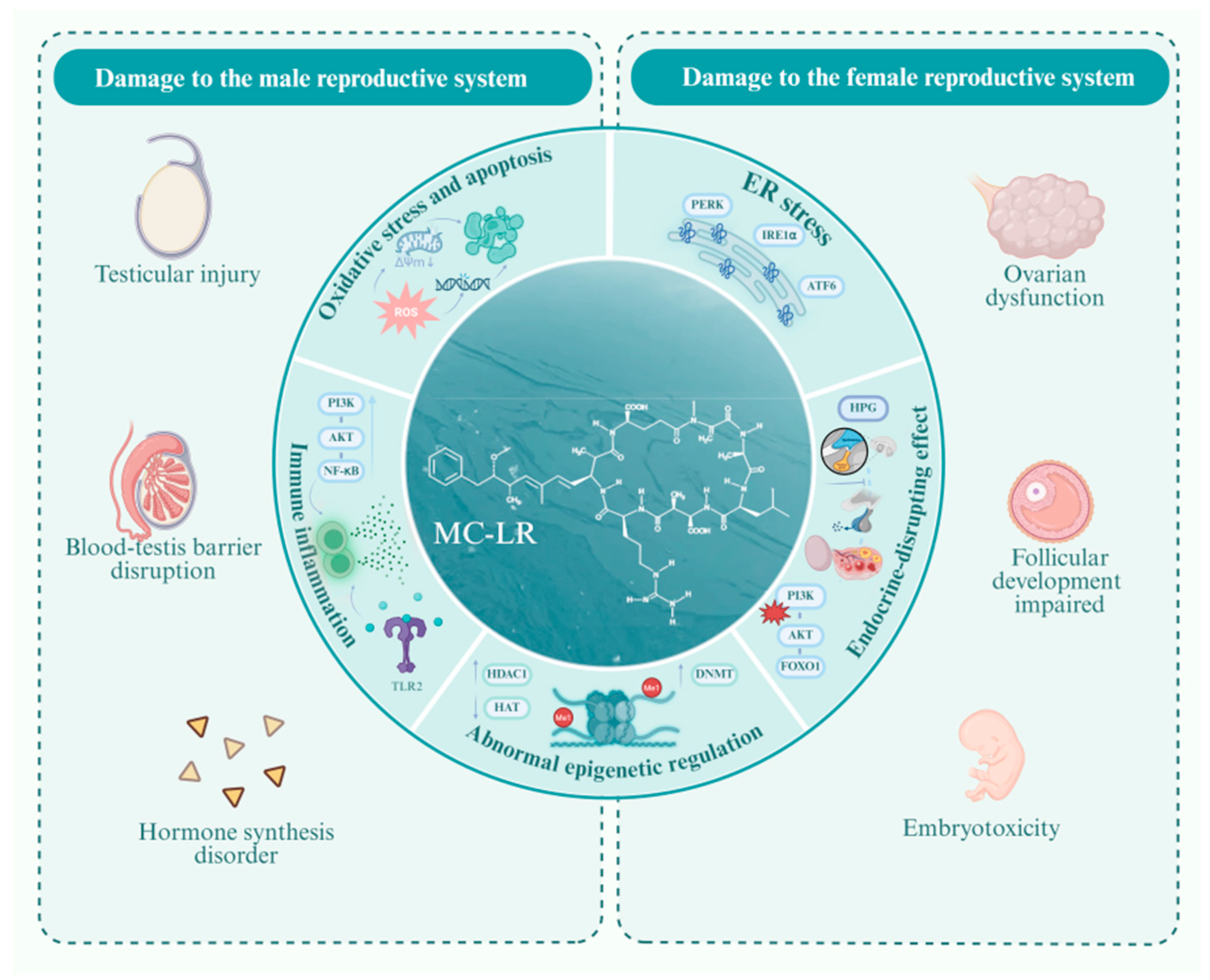
Microcystins and Reproductive Dysfunction: Mechanisms and Consequences


Abstract
1. Introduction
2. Pathological and Reproductive Toxicity Manifestations Induced by MC-LR
2.1. MC-LR-Induced Male Reproductive Toxicity: Targeted Effects on the Male Reproductive System
2.1.1. Sperm and Fertility Outcomes
2.1.2. Histopathological Changes
2.1.3. Cellular and Molecular Mechanisms
2.1.4. Endocrine Effects
2.2. MC-LR-Induced Female Reproductive Toxicity: Targeted Effects on the Reproductive System
2.2.1. Oocyte-Level Effects
2.2.2. Follicular and Ovarian Tissue Effects
2.2.3. Molecular Mechanisms
2.2.4. Reproductive Consequences
2.3. Intergenerational and Developmental Toxicity of MC-LR in Offspring
3. Mechanisms of MC-LR-Induced Reproductive Toxicity
3.1. Primary Molecular Initiating Event: MC-LR Uptake and PP1/PP2A Inhibition
3.2. Secondary Cellular Responses: Oxidative Stress, Mitochondrial Dysfunction, and ER Stress
3.3. Tertiary Signaling Consequences: Apoptosis, Inflammation, and Endocrine Disruption
3.4. Long-Term Consequences: Epigenetic Alterations and Developmental Effects
4. Experimental and Epidemiological Evidence for MC-LR-Induced Reproductive Toxicity
4.1. In Vivo Experimental Models
4.2. In Vitro Experimental Models
4.3. 3D Organoids and Co-Culture Systems
4.4. Population-Based Epidemiological Evidence
5. Critical Controversies and Challenges
6. Conclusions
7. Methods
Author Contributions
Funding
Institutional Review Board Statement
Informed Consent Statement
Data Availability Statement
Acknowledgments
Conflicts of Interest
Abbreviations
| ATF4 | Activating transcription factor 4 |
| ATF6 | Activating transcription factor 6 |
| BDNF | Brain-derived neurotrophic factor |
| cAMP | Cyclic adenosine monophosphate |
| CAT | Catalase |
| CHOP | C/EBP homologous protein |
| Cx43 | Connexin 43 |
| CYP17A1 | Cytochrome P450 17A1 |
| Cyt c | Cytochrome c |
| DNA | Deoxyribonucleic acid |
| DNMT | DNA methyltransferase |
| DRP1 | Dynamin-related protein 1 |
| eIF2α | Eukaryotic initiation factor 2α |
| ER | Endoplasmic reticulum |
| ERK | Extracellular signal-regulated kinase |
| ERS | Endoplasmic reticulum stress |
| FOXM1 | Forkhead box protein M1 |
| FSH | Follicle-stimulating hormone |
| GCs | Germ cells |
| GH | Growth hormone |
| GnRH | Gonadotropin-releasing hormone |
| GPx | Glutathione peroxidase |
| GSDMD | Gasdermin D |
| HATs | Histone acetyltransferases |
| HDACs | Histone deacetylases |
| HPG | Hypothalamic-pituitary-gonadal axis |
| HPT | Hypothalamic-pituitary-testicular axis |
| IGF | Insulin-like growth factor |
| IRE1 | Inositol-requiring enzyme 1 |
| JNK | c-Jun N-terminal kinase |
| LCs | Leydig cells |
| LH | Luteinizing hormone |
| MAPK | Mitogen-activated protein kinase |
| MC-LR | Microcystin-leucine arginine |
| MCs | Microcystins |
| mGCs | Mouse granulosa cells |
| MMP | Mitochondrial membrane potential |
| mtDNA | Mitochondrial DNA |
| NADPH | Nicotinamide adenine dinucleotide phosphate |
| NF-Kβ | Nuclear factor kappa-B |
| PERK | Protein kinase R-like endoplasmic reticulum kinase |
| PI3K | Phosphoinositide 3-kinase |
| PKA | Protein kinase A |
| PPPs | Protein phosphatases |
| PS-MPs | Polystyrene microplastics |
| PTP | Permeability transition pore |
| ROS | Reactive oxygen species |
| SCs | Supporting cells |
| SOD | Superoxide dismutase |
| StAR | Steroidogenic acute regulatory protein |
| TET | Ten-eleven translocation methylcytosine dioxygenase |
| TLR2 | Toll-like receptor 2 |
| TLR4 | Toll-like receptor 4 |
| TNFR1 | Tumor necrosis factor receptor 1 |
| UPR | Unfolded protein response |
| XBP1 | X-box binding protein 1 |
References
- Francis, G.A.; Ray, S.; Mukherjee, A.G.; Gopalakrishnan, A.V.; Vashishth, R. Harmful algal blooms in a changing world: Linking bloom dynamics, biotoxin synthesis, and advanced monitoring strategies. Environ. Monit. Assess. 2026, 198, 414. [Google Scholar] [CrossRef] [PubMed]
- Svirčev, Z.; Lalić, D.; Bojadžija Savić, G.; Tokodi, N.; Backović, D.D.; Chen, L.; Meriluoto, J.; Codd, G.A. Global geographical and historical overview of cyanotoxin distribution and cyanobacterial poisonings. Arch. Toxicol. 2019, 93, 2429–2481. [Google Scholar] [CrossRef] [PubMed]
- Roegner, A.F.; Brena, B.; González-Sapienza, G.; Puschner, B. Microcystins in potable surface waters: Toxic effects and removal strategies. J. Appl. Toxicol. 2014, 34, 441–457. [Google Scholar] [CrossRef] [PubMed]
- Bouaïcha, N.; Miles, C.O.; Beach, D.G.; Labidi, Z.; Djabri, A.; Benayache, N.Y.; Nguyen-Quang, T. Structural Diversity, Characterization and Toxicology of Microcystins. Toxins 2019, 11, 714. [Google Scholar] [CrossRef] [PubMed]
- Arman, T.; Clarke, J.D. Microcystin Toxicokinetics, Molecular Toxicology, and Pathophysiology in Preclinical Rodent Models and Humans. Toxins 2021, 13, 537. [Google Scholar] [CrossRef] [PubMed]
- Faulkner, S.; Sweetman, C.; Hutson, J.; Soole, K.; Hobson, P.; Fallowfield, H. Uptake of the Cyanobacterial Toxin Microcystin by Crop Plants Irrigated with Contaminated Wastewater: A Review. Rev. Environ. Sci. Biotechnol. 2025, 24, 217–238. [Google Scholar] [CrossRef]
- Zhang, D.; Xie, P.; Liu, Y.; Qiu, T. Transfer, distribution and bioaccumulation of microcystins in the aquatic food web in Lake Taihu, China, with potential risks to human health. Sci. Total Environ. 2009, 407, 2191–2199. [Google Scholar] [CrossRef] [PubMed]
- Hasn, A.; JKP, W.; TS, S.; DH, B.; PM, M. Hepatotoxicity of Microcystin-LR in Wistar Rats. Gen. Med. 2023, 7, 1516. [Google Scholar] [CrossRef]
- Yea, S.S.; Kim, H.M.; Oh, H.M.; Paik, K.H.; Yang, K.H. Microcystin-induced down-regulation of lymphocyte functions through reduced IL-2 mRNA stability. Toxicol. Lett. 2001, 122, 21–31. [Google Scholar] [CrossRef] [PubMed]
- Yan, M.; Wu, H.; Wu, T.; Wang, Y.; Su, C.; Li, D.; Han, X. Microcystin-LR Exposure Damages Neurons by Inducing α-Syn Aggregation via MAPK4/GATA2/SNCA and PP2A/GRKs Pathways. Mol. Neurobiol. 2025, 62, 6195–6211. [Google Scholar] [CrossRef] [PubMed]
- Ma, Y.; Wang, J.; Xu, D.; Chen, Y.; Han, X. Chronic MC-LR exposure promoted Aβ and p-tau accumulation via regulating Akt/GSK-3β signal pathway. Sci. Total Environ. 2021, 794, 148732. [Google Scholar] [CrossRef]
- Yang, J.; Zhang, Z.; Du, X.; Wang, Y.; Meng, R.; Ge, K.; Wu, C.; Liang, X.; Zhang, H.; Guo, H. The effect and mechanism of combined exposure of MC-LR and NaNO2 on liver lipid metabolism. Environ. Res. 2024, 252 Pt 4, 119113. [Google Scholar] [CrossRef] [PubMed]
- Chen, L.; Chen, J.; Zhang, X.; Xie, P. A Review of Reproductive Toxicity of Microcystins. J. Hazard. Mater. 2016, 301, 381–399. [Google Scholar] [CrossRef] [PubMed]
- Zhang, S.; Du, X.; Liu, H.; Losiewic, M.D.; Chen, X.; Ma, Y.; Wang, R.; Tian, Z.; Shi, L.; Guo, H.; et al. The latest advances in the reproductive toxicity of microcystin-LR. Environ. Res. 2021, 192, 110254. [Google Scholar] [CrossRef] [PubMed]
- Guo, X.; Meng, R.; Liu, J.; Zhang, S.; Liu, H.; Du, X.; Zhang, H.; Li, Y. Microcystin Leucine Arginine Induces Human Sperm Damage: Involvement of the Ca2+/CaMKKβ/AMPK Pathway. Ecotoxicol. Environ. Saf. 2023, 256, 114845. [Google Scholar] [CrossRef] [PubMed]
- Chen, L.; Zhang, X.; Zhou, W.; Qiao, Q.; Liang, H.; Li, G.; Wang, J.; Cai, F. The Interactive Effects of Cytoskeleton Disruption and Mitochondria Dysfunction Lead to Reproductive Toxicity Induced by Microcystin-LR. PLoS ONE 2013, 8, e53949. [Google Scholar] [CrossRef] [PubMed]
- Chen, Y.; Xu, J.; Li, Y.; Han, X. Decline of Sperm Quality and Testicular Function in Male Mice during Chronic Low-Dose Exposure to Microcystin-LR. Reprod. Toxicol. 2011, 31, 551–557. [Google Scholar] [CrossRef] [PubMed]
- Liu, H.; Zeng, X.; Ma, Y.; Chen, X.; Losiewicz, M.D.; Du, X.; Tian, Z.; Zhang, S.; Shi, L.; Zhang, H.; et al. Long-term exposure to low concentrations of MC-LR induces blood-testis barrier damage through the RhoA/ROCK pathway. Ecotoxicol. Environ. Saf. 2022, 236, 113454. [Google Scholar] [CrossRef] [PubMed]
- Ding, J.; Wang, J.; Jin, H.; Xia, T.; Cheng, Y.; Wu, J.; Han, X. Microcystin-LR Reduces the Synthesis of Gonadotropin-Releasing Hormone by Activating Multiple Signaling Pathways Resulting in Decrease of Testosterone in Mice. Sci. Total Environ. 2018, 643, 496–506. [Google Scholar] [CrossRef] [PubMed]
- Gao, L.; Chen, J.; Li, J.; Cui, A.-Q.; Zhang, W.-W.; Li, X.-L.; Wang, J.; Zhang, X.-Y.; Zhao, Y.; Chen, Y.-H.; et al. Microcystin-LR Inhibits Testosterone Synthesis via Reactive Oxygen Species-Mediated GCN2/eIF2α Pathway in Mouse Testes. Sci. Total Environ. 2021, 781, 146730. [Google Scholar] [CrossRef] [PubMed]
- Shi, F.; Li, W.; Zhao, H.; He, Y.; Jiang, Y.; Ni, J.; Abbasi, B.; Rui, R.; Ju, S. Microcystin-LR Exposure Results in Aberrant Spindles and Induces Apoptosis in Porcine Oocytes. Theriogenology 2020, 158, 358–367. [Google Scholar] [CrossRef] [PubMed]
- Yuan, J.; Li, X.; Yan, S.; Luo, C.; Xian, S.; Li, Y.; Wu, J. Microcystin-LR disrupts ovarian granulosa cell glycolysis via GSK3β-Mediated HK2 mitochondrial dissociation: Evidence from integrated In Vivo and In Vitro models. Reprod. Toxicol. 2025, 137, 109028. [Google Scholar] [CrossRef] [PubMed]
- Wu, J.; Yuan, M.; Song, Y.; Sun, F.; Han, X. MC-LR Exposure Leads to Subfertility of Female Mice and Induces Oxidative Stress in Granulosa Cells. Toxins 2015, 7, 5212–5223. [Google Scholar] [CrossRef] [PubMed]
- Zhan, C.; Zhang, F.; Liu, W.; Zhang, X. Microcystin-LR Promotes Zebrafish (Danio Rerio) Oocyte (in Vivo) Maturation by Activating ERK1/2-MPF Signaling Pathways, and cAMP Is Involved in This Process. Environ. Pollut. 2020, 259, 113843. [Google Scholar] [CrossRef] [PubMed]
- World Health Organization. Cyanobacterial Toxins: Microcystins; World Health Organization: Geneva, Switzerland, 2020. [Google Scholar]
- Zhang, H.; Ruan, Y.; Ding, Z.; Li, Z.; He, J.; Li, J.; Hong, P.; Wu, H.; Shu, Y. The Accumulation of Microcystin-LR in the Gonads of Pelophylax Nigromaculatus during the Reproductive Periods Induces Reproductive Endocrine Disorders in Their Offspring. Ecotoxicol. Environ. Saf. 2025, 294, 118088. [Google Scholar] [CrossRef] [PubMed]
- Zhang, J.; Li, X.; Wang, R.; Feng, X.; Wang, S.; Wang, H.; Wang, Y.; Li, H.; Li, Y.; Guo, Y. DNA Methylation Patterns in Patients with Asthenospermia and Oligoasthenospermia. BMC Genom. 2024, 25, 602. [Google Scholar] [CrossRef] [PubMed]
- Zhao, S.; Xu, J.; Zhang, W.; Yan, W.; Li, G. Paternal Exposure to Microcystin-LR Triggers Developmental Neurotoxicity in Zebrafish Offspring via an Epigenetic Mechanism Involving MAPK Pathway. Sci. Total Environ. 2021, 792, 148437. [Google Scholar] [CrossRef] [PubMed]
- Meng, X.; Zhang, L.; Hou, J.; Ma, T.; Pan, C.; Zhou, Y.; Han, R.; Ding, Y.; Peng, H.; Xiang, Z.; et al. The Mechanisms in the Altered Ontogenetic Development and Lung-Related Pathology in Microcystin-Leucine Arginine (MC-LR)-Paternal-Exposed Offspring Mice. Sci. Total Environ. 2020, 736, 139678. [Google Scholar] [CrossRef]
- Moorhead, G.B.; Trinkle-Mulcahy, L.; Ulke-Lemée, A. Emerging roles of nuclear protein phosphatases. Nat. Rev. Mol. Cell Biol. 2007, 8, 234–244. [Google Scholar] [CrossRef] [PubMed]
- Wang, Y.; Pattarawat, P.; Zhang, J.; Kim, E.; Zhang, D.; Fang, M.; Jannaman, E.A.; Yuan, Y.; Chatterjee, S.; Kim, J.-Y.J.; et al. Effects of Cyanobacterial Harmful Algal Bloom Toxin Microcystin-LR on Gonadotropin-Dependent Ovarian Follicle Maturation and Ovulation in Mice. Environ. Health Perspect. 2023, 131, 67010. [Google Scholar] [CrossRef] [PubMed]
- Moreno, I.; Pichardo, S.; Jos, A.; Gómez-Amores, L.; Mate, A.; Vazquez, C.M.; Cameán, A.M. Antioxidant Enzyme Activity and Lipid Peroxidation in Liver and Kidney of Rats Exposed to Microcystin-LR Administered Intraperitoneally. Toxicon 2005, 45, 395–402. [Google Scholar] [CrossRef]
- Yuan, L.; Liu, H.; Liu, X.; Zhang, X.; Wu, J.; Wang, Y.; Du, X.; Wang, R.; Ma, Y.; Chen, X.; et al. Epigenetic Modification of H3K4 and Oxidative Stress Are Involved in MC-LR-induced Apoptosis in Testicular Cells of SD Rats. Environ. Toxicol. 2020, 35, 277–291. [Google Scholar] [CrossRef]
- Liu, Y.; Liu, J.; Zhu, X.; Wei, J.; Mi, S.; Liu, S.; Li, X.; Zhang, W.; Zhao, L.; Wang, H.; et al. Pubertal Exposure to Microcystin-LR Arrests Spermatogonia Proliferation by Inducing DSB and Inhibiting SIRT6 Dependent DNA Repair in Vivo and in Vitro. Ecotoxicol. Environ. Saf. 2024, 274, 116191. [Google Scholar] [CrossRef] [PubMed]
- Zhu, J.; Liu, K.; Pei, L.; Hu, X.; Cai, Y.; Ding, J.; Li, D.; Han, X.; Wu, J. The Mechanisms of Mitochondrial Dysfunction and Glucose Intake Decrease Induced by Microcystin-LR in Ovarian Granulosa Cells. Ecotoxicol. Environ. Saf. 2021, 212, 111931. [Google Scholar] [CrossRef] [PubMed]
- Zhang, D.; Lin, W.; Liu, Y.; Guo, H.; Wang, L.; Yang, L.; Li, L.; Li, D.; Tang, R. Chronic Microcystin-LR Exposure Induces Abnormal Lipid Metabolism via Endoplasmic Reticulum Stress in Male Zebrafish. Toxins 2020, 12, 107. [Google Scholar] [CrossRef] [PubMed]
- Liu, H.; Zhang, X.; Zhang, S.; Huang, H.; Wu, J.; Wang, Y.; Yuan, L.; Liu, C.; Zeng, X.; Cheng, X.; et al. Oxidative Stress Mediates Microcystin-LR-Induced Endoplasmic Reticulum Stress and Autophagy in KK-1 Cells and C57BL/6 Mice Ovaries. Front. Physiol. 2018, 9, 1058. [Google Scholar] [CrossRef] [PubMed]
- Wu, H.; Zhang, Y.; Liang, J.; Wu, J.; Zhang, Y.; Su, H.; Zhang, Q.; Shen, Y.; Shen, S.; Wang, L.; et al. Lithium Chloride Induces Apoptosis by Activating Endoplasmic Reticulum Stress in Pancreatic Cancer. Transl. Oncol. 2023, 38, 101792. [Google Scholar] [CrossRef] [PubMed]
- Zhan, C.; Liu, W.; Zhang, F.; Zhang, X. Microcystin-LR Triggers Different Endoplasmic Reticulum Stress Pathways in the Liver, Ovary, and Offspring of Zebrafish (Danio Rerio). J. Hazard. Mater. 2020, 386, 121939. [Google Scholar] [CrossRef] [PubMed]
- Wang, X.; Song, Y.; Lu, X.; Zhang, H.; Wang, T. Microcystin-LR Regulates Interaction between Tumor Cells and Macrophages via the IRE1α/XBP1 Signaling Pathway to Promote the Progression of Colorectal Cancer. Cells 2024, 13, 1439. [Google Scholar] [CrossRef] [PubMed]
- Roy, A.; da Silva, M.T.; Bhat, R.; Bohnert, K.R.; Iwawaki, T.; Kumar, A. The IRE1/XBP1 Signaling Axis Promotes Skeletal Muscle Regeneration through a Cell Non-Autonomous Mechanism. bioRxiv 2021. [Google Scholar] [CrossRef]
- Buonfiglio, F.; Böhm, E.W.; Pfeiffer, N.; Gericke, A. Oxidative Stress: A Suitable Therapeutic Target for Optic Nerve Diseases? Antioxidants 2023, 12, 1465. [Google Scholar] [CrossRef] [PubMed]
- Wang, Y.; Liu, H.; Liu, X.; Zhang, X.; Wu, J.; Yuan, L.; Du, X.; Wang, R.; Ma, Y.; Chen, X.; et al. Histone Acetylation Plays an Important Role in MC-LR-Induced Apoptosis and Cycle Disorder in SD Rat Testicular Cells. Chemosphere 2020, 241, 125073. [Google Scholar] [CrossRef] [PubMed]
- Guo, H.; Hassan, H.M.; Ding, P.; Wang, S.; Chen, X.; Wang, T.; Sun, L.; Zhang, L.; Jiang, Z. Pyrazinamide-Induced Hepatotoxicity Is Alleviated by 4-PBA via Inhibition of the PERK-eIF2α-ATF4-CHOP Pathway. Toxicology 2017, 378, 65–75. [Google Scholar] [CrossRef] [PubMed]
- Qin, W.; Xu, L.; Zhang, X.; Wang, Y.; Meng, X.; Miao, A.; Yang, L. Endoplasmic Reticulum Stress in Murine Liver and Kidney Exposed to Microcystin-LR. Toxicon 2010, 56, 1334–1341. [Google Scholar] [CrossRef] [PubMed]
- Du, X.; Fu, Y.; Tian, Z.; Liu, H.; Xin, H.; Fu, X.; Wang, F.; Zhang, H.; Zeng, X. Microcystin-LR Accelerates Follicular Atresia in Mice via JNK-Mediated Adherent Junction Damage of Ovarian Granulosa Cells. Ecotoxicol. Environ. Saf. 2023, 252, 114592. [Google Scholar] [CrossRef] [PubMed]
- Chen, Y.; Wang, J.; Zhang, Q.; Xiang, Z.; Li, D.; Han, X. Microcystin-Leucine Arginine Exhibits Immunomodulatory Roles in Testicular Cells Resulting in Orchitis. Environ. Pollut. 2017, 229, 964–975. [Google Scholar] [CrossRef] [PubMed]
- Chen, Y.; Zhou, Y.; Wang, J.; Wang, L.; Xiang, Z.; Li, D.; Han, X. Microcystin-Leucine Arginine Causes Cytotoxic Effects in Sertoli Cells Resulting in Reproductive Dysfunction in Male Mice. Sci. Rep. 2016, 6, 39238. [Google Scholar] [CrossRef] [PubMed]
- Liu, K.; Zhao, X.; Guo, M.; Zhu, J.; Li, D.; Ding, J.; Han, X.; Wu, J. Microcystin-Leucine Arginine (MC-LR) Induces Mouse Ovarian Inflammation by Promoting Granulosa Cells to Produce Inflammatory Cytokine via Activation of cGAS-STING Signaling. Toxicol. Lett. 2022, 358, 6–16. [Google Scholar] [CrossRef] [PubMed]
- Lee, E.B.; Chakravarthi, V.P.; Wolfe, M.W.; Rumi, M.A.K. ERβ Regulation of Gonadotropin Responses during Folliculogenesis. Int. J. Mol. Sci. 2021, 22, 10348. [Google Scholar] [CrossRef] [PubMed]
- Riobó, A.; Martínez Acosta, A.; Martinez-Rocca, L.; Taboas, E.; López De Uralde, B.; Fernandez, I.; Garrido, N.; Muñoz, E. Dual Triggering for Final Oocyte Maturation. A Narrative Review. Front. Endocrinol. 2025, 16, 1556732. [Google Scholar] [CrossRef] [PubMed]
- Edson, M.A.; Nagaraja, A.K.; Matzuk, M.M. The Mammalian Ovary from Genesis to Revelation. Endocr. Rev. 2009, 30, 624–712. [Google Scholar] [CrossRef] [PubMed]
- Zhan, T.; Zhang, J.; Zhang, Y.; Zhao, Q.; Chemerinski, A.; Douglas, N.C.; Zhang, Q.; Xiao, S. Dose-Response Functional and Transcriptomic Effects of Follicle-Stimulating Hormone on Ex Vivo Mouse Folliculogenesis. bioRxiv 2024. [Google Scholar] [PubMed]
- Shimada, M.; Yamashita, Y. The Key Signaling Cascades in Granulosa Cells During Follicular Development and Ovulation Process. J. Mamm. Ova Res. 2011, 28, 25–31. [Google Scholar] [CrossRef]
- Gotlieb, N.; Moeller, J.; Kriegsfeld, L.J. Development and Modulation of Female Reproductive Function by Circadian Signals. In Developmental Neuroendocrinology; Wray, S., Blackshaw, S., Eds.; Masterclass in Neuroendocrinology; Springer International Publishing: Cham, Switzerland, 2020; Volume 9, pp. 413–446. ISBN 978-3-030-40001-9. [Google Scholar]
- Jeing, O. Reproductive Endocrinology: Understanding the Complexities of Human Fertility. J. Genit. Syst. Disord. 2023, 12, 2. [Google Scholar] [CrossRef]
- Liu, W.; Chen, C.; Chen, L.; Wang, L.; Li, J.; Chen, Y.; Jin, J.; Kawan, A.; Zhang, X. Sex-Dependent Effects of Microcystin-LR on Hypothalamic-Pituitary-Gonad Axis and Gametogenesis of Adult Zebrafish. Sci. Rep. 2016, 6, 22819. [Google Scholar] [CrossRef] [PubMed]
- Fröhlich, A.-K.; Porthun, J.; Talha, K.M.; Lena, A.; Hadzibegovic, S.; Wilkenshoff, U.; Sonntag, F.; Nikolski, A.; Ramer, L.V.; Zeller, T.; et al. Association of an Impaired GH-IGF-I Axis with Cardiac Wasting in Patients with Advanced Cancer. Clin. Res. Cardiol. 2025, 114, 1118–1132. [Google Scholar] [CrossRef] [PubMed]
- Hou, J.; Su, Y.; Lin, W.; Guo, H.; Xie, P.; Chen, J.; Gu, Z.; Li, L. Microcystin-LR Retards Gonadal Maturation through Disrupting the Growth Hormone/Insulin-like Growth Factors System in Zebrafish. Ecotoxicol. Environ. Saf. 2017, 139, 27–35. [Google Scholar] [CrossRef] [PubMed]
- Duan, S.; Jia, Z.; Zheng, L.; Wu, Y.; Xu, Z.; Peng, H.; Xue, J. Research Advances on Epigenetic Modifications in Dendritic Cells in Allergic Rhinitis. Front. Immunol. 2025, 16, 1682821. [Google Scholar] [CrossRef] [PubMed]
- Xu, J.; Zhang, W.; Zhong, S.; Xie, X.; Che, H.; Si, W.; Tuo, X.; Xu, D.; Zhao, S. Microcystin-Leucine-Arginine Affects Brain Gene Expression Programs and Behaviors of Offspring through Paternal Epigenetic Information. Sci. Total Environ. 2023, 857, 159032. [Google Scholar] [CrossRef] [PubMed]
- Xue, W.; Tianrun, W.; Jiaqi, Y.; Xin, L.; Ruxue, D.; Peng, Z. Bta-miR-149–3p Suppresses Inflammatory Response in Bovine Sertoli Cells Exposed to Microcystin-Leucine Arginine (MC-LR) through TLR4/NF-kB Signaling Pathway. Ecotoxicol. Environ. Saf. 2024, 281, 116636. [Google Scholar] [CrossRef] [PubMed]
- Ueffing, M.; Langeheine, M.; Gniesmer, S.; Rode, K.; Staggenborg, S.; Wirth, G.; Rohn, K.; Koch, R.; Blume, I.; Pfarrer, C.; et al. The Impact of Connexin 43 Deficiency on the Cell Shape and Cytoskeleton of Murine Sertoli Cells: A House with Ramshackle Walls? PLoS ONE 2025, 20, e0321292. [Google Scholar] [CrossRef] [PubMed]
- Adegoke, E.O.; Xue, W.; Machebe, N.S.; Adeniran, S.O.; Hao, W.; Chen, W.; Han, Z.; Guixue, Z.; Peng, Z. Sodium Selenite +yInhibits Mitophagy, Downregulation and Mislocalization of Blood-Testis Barrier Proteins of Bovine Sertoli Cell Exposed to Microcystin-Leucine Arginine (MC-LR) via TLR4/NF-kB and Mitochondrial Signaling Pathways Blockage. Ecotoxicol. Environ. Saf. 2018, 166, 165–175. [Google Scholar] [CrossRef] [PubMed]
- Sakib, S.; Uchida, A.; Valenzuela-Leon, P.; Yu, Y.; Valli-Pulaski, H.; Orwig, K.; Ungrin, M.; Dobrinski, I. Formation of Organotypic Testicular Organoids in Microwell Culture. Biol. Reprod. 2019, 100, 1648–1660. [Google Scholar] [CrossRef] [PubMed]
- Di Nisio, V.; Li, T.; Xiao, Z.; Papaikonomou, K.; Damdimopoulos, A.; Végvári, Á.; Lebre, F.; Alfaro-Moreno, E.; Pedersen, M.; Svingen, T.; et al. Silk-Ovarioids: Establishment and Characterization of a Human Ovarian Primary Cell 3D-Model System. Hum. Reprod. Open 2025, 2025, hoaf042. [Google Scholar] [CrossRef] [PubMed]
- Xu, D.; Yu, W.; Ma, Y.; Luo, Y.; Xu, G.; Xiang, Z.; Chen, Y.; Han, X. Association between Semen Microcystin Levels and Reproductive Quality: A Cross-Sectional Study in Jiangsu and Anhui Provinces, China. Environ. Health Perspect. 2021, 129, 127702. [Google Scholar] [CrossRef] [PubMed]
- Zhao, W.; Liu, Y.; Li, H.; Ma, J.; Li, X. Seasonal Rise in the Contents of Microcystin-LR and Odorous Substances Due to Cyanobacterial Blooms in a Drinking Water Reservoir Supplying Xinyang City, China. Toxins 2024, 16, 448. [Google Scholar] [CrossRef] [PubMed]
- Mohamed, Z.A.; Fathi, A.A.; Mostafa, Y.; Alamri, S.; Hashem, M.; Alrumman, S.; Basha, O.R. Microcystin levels in irrigation water and field-vegetable plants, and food safety risk assessment: A case study from Egypt. Toxicon 2024, 247, 107846. [Google Scholar] [CrossRef] [PubMed]
- Rajpoot, R.; Rajput, S.; Koiri, R.K. Microcystin-LR and its health impacts: Chemistry, transmission routes, mechanisms of toxicity and target organs. Toxicol. Rep. 2025, 14, 101996. [Google Scholar] [CrossRef] [PubMed]


| Subject | Exposure Conditions | Toxicity Manifestations | Reference |
|---|---|---|---|
| Male Wistar rats | 1, 10 μg/kg; 50 days | Enlarged spaces between the seminiferous tubules, enlargement of the lumen of the seminiferous tubules, swollen mitochondria | [16] |
| Male SPF mice | 1, 3.2, 10 μg/L; 3, 6 months | Sperm quality ↓, T ↓, loss and derangement of spermatogenic cells, enlargement of the lumen of the seminiferous tubules, thinning of the spermatogenic epithelium | [17] |
| Male SPF Balb/c mice | 20 μg/kg; 7 days | GnRH ↓, GnRH mRNA ↓ | [19] |
| Male ICR mice | 20 μg/kg; 35 days | CYP11A1 ↓, CYP17A1 ↓, T ↓, StAR ↓, ROS ↑ | [20] |
| Porcine oocytes | 0, 20, 40 and 60 μM/L; 44 h | PP2A ↓, p53 ↑, BAX ↑, BCL2 ↓, apoptosis in porcine oocytes ↑ | [21] |
| Female mice | 0, 1, 10, 40 μg/L; 3, 6 months | Estrus ↓, stillbirth rate ↑, number of living pups per litter ↓, CAT ↓, SOD ↓ | [23] |
| Female zebrafish | 0, 1, 5, 20 μg/L; 30 days | Deformation rate of the offspring ↑, oocyte vacuolation, oocyte nuclear pyknosis, intercellular enlargement of oocytes | [24] |
| Adult P. nigromaculatus | 1 μg/L; 14 d | F1 DNA methylation level ↑, egg weight ↓, egg diameter ↓, sperm deformities ↑ | [26] |
| Zebrafish | 0, 5, 20 μg/L; 6 weeks | tgf β1 genes hypomethylation, p-p38, p-Erk1/2, and pJNK proteins in zebrafish larvae ↑ | [28] |
| Male Balb/c mice | 1, 7.5, 15, or 30 μg/L; 6 months | Thickened alveolar wall and the deposition of collagen | [29] |
Disclaimer/Publisher’s Note: The statements, opinions and data contained in all publications are solely those of the individual author(s) and contributor(s) and not of MDPI and/or the editor(s). MDPI and/or the editor(s) disclaim responsibility for any injury to people or property resulting from any ideas, methods, instructions or products referred to in the content. |
© 2026 by the authors. Licensee MDPI, Basel, Switzerland. This article is an open access article distributed under the terms and conditions of the Creative Commons Attribution (CC BY) license.
Share and Cite
Chen, Z.; Shi, Z.; Chai, Z.; Su, J.; Yao, X. Microcystins and Reproductive Dysfunction: Mechanisms and Consequences. Toxins 2026, 18, 281. https://doi.org/10.3390/toxins18070281
Chen Z, Shi Z, Chai Z, Su J, Yao X. Microcystins and Reproductive Dysfunction: Mechanisms and Consequences. Toxins. 2026; 18(7):281. https://doi.org/10.3390/toxins18070281
Chicago/Turabian StyleChen, Zhixin, Zhihan Shi, Ziyu Chai, Jiayue Su, and Xueqiong Yao. 2026. "Microcystins and Reproductive Dysfunction: Mechanisms and Consequences" Toxins 18, no. 7: 281. https://doi.org/10.3390/toxins18070281
APA StyleChen, Z., Shi, Z., Chai, Z., Su, J., & Yao, X. (2026). Microcystins and Reproductive Dysfunction: Mechanisms and Consequences. Toxins, 18(7), 281. https://doi.org/10.3390/toxins18070281