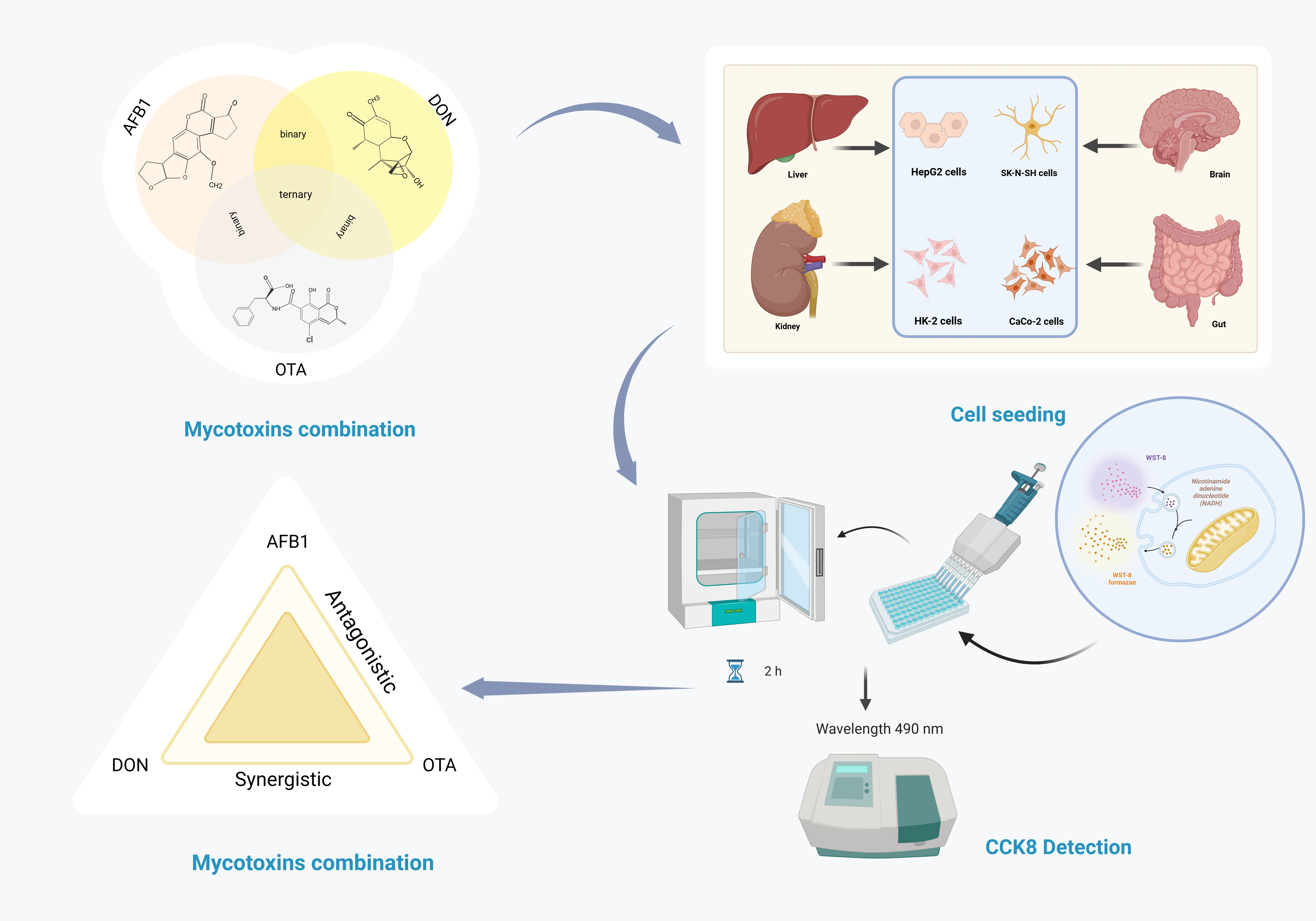
Analysis of the Combined Toxic Effects of AFB1, DON, and OTA Complex Contamination in Caco-2, HK-2, SK-N-SH and HepG2 Cells


Abstract
1. Introduction
2. Results
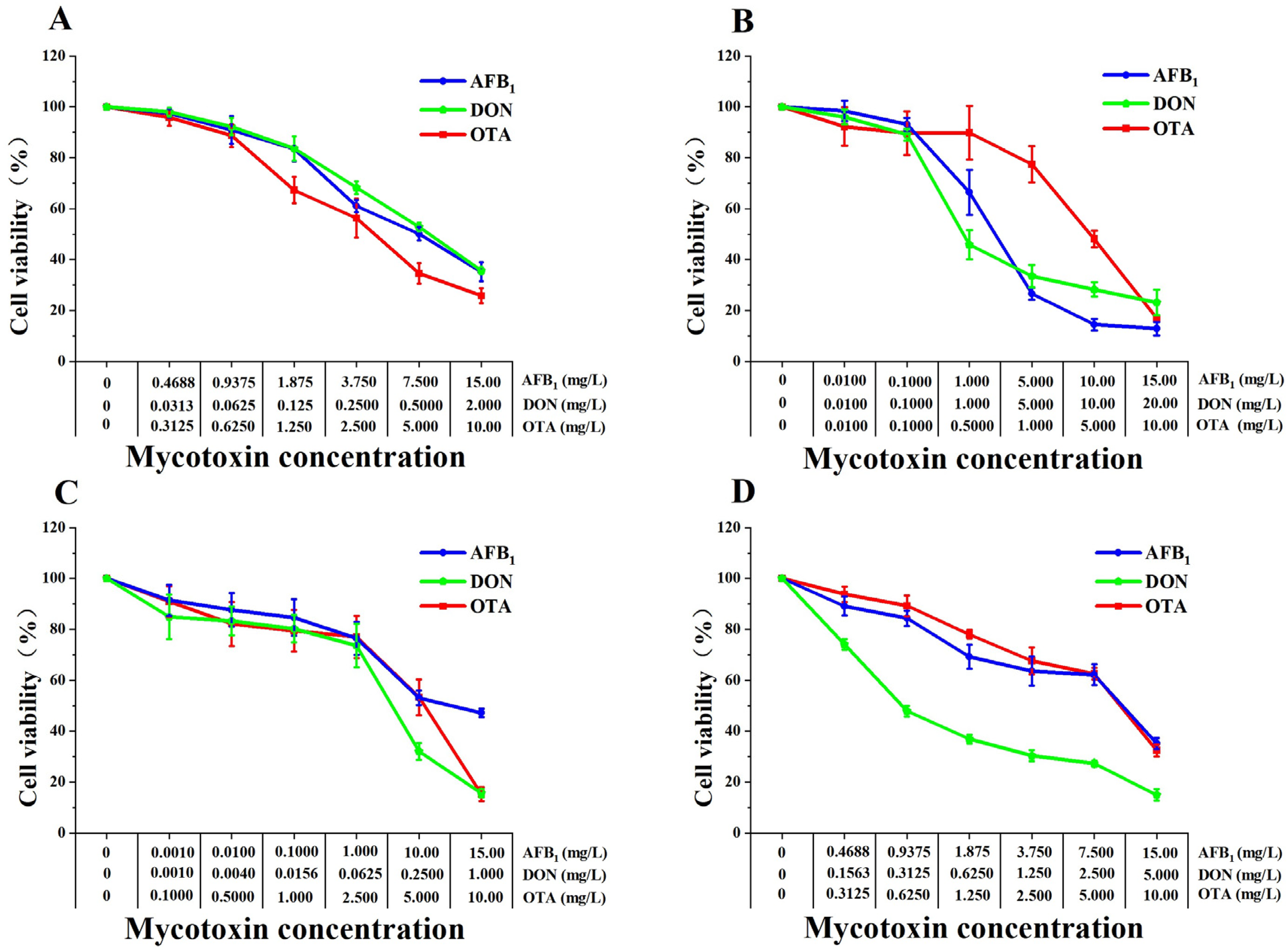
2.1. Comparative Cytotoxic Effects of AFB1, DON and OTA on Four Types of Cell Lines
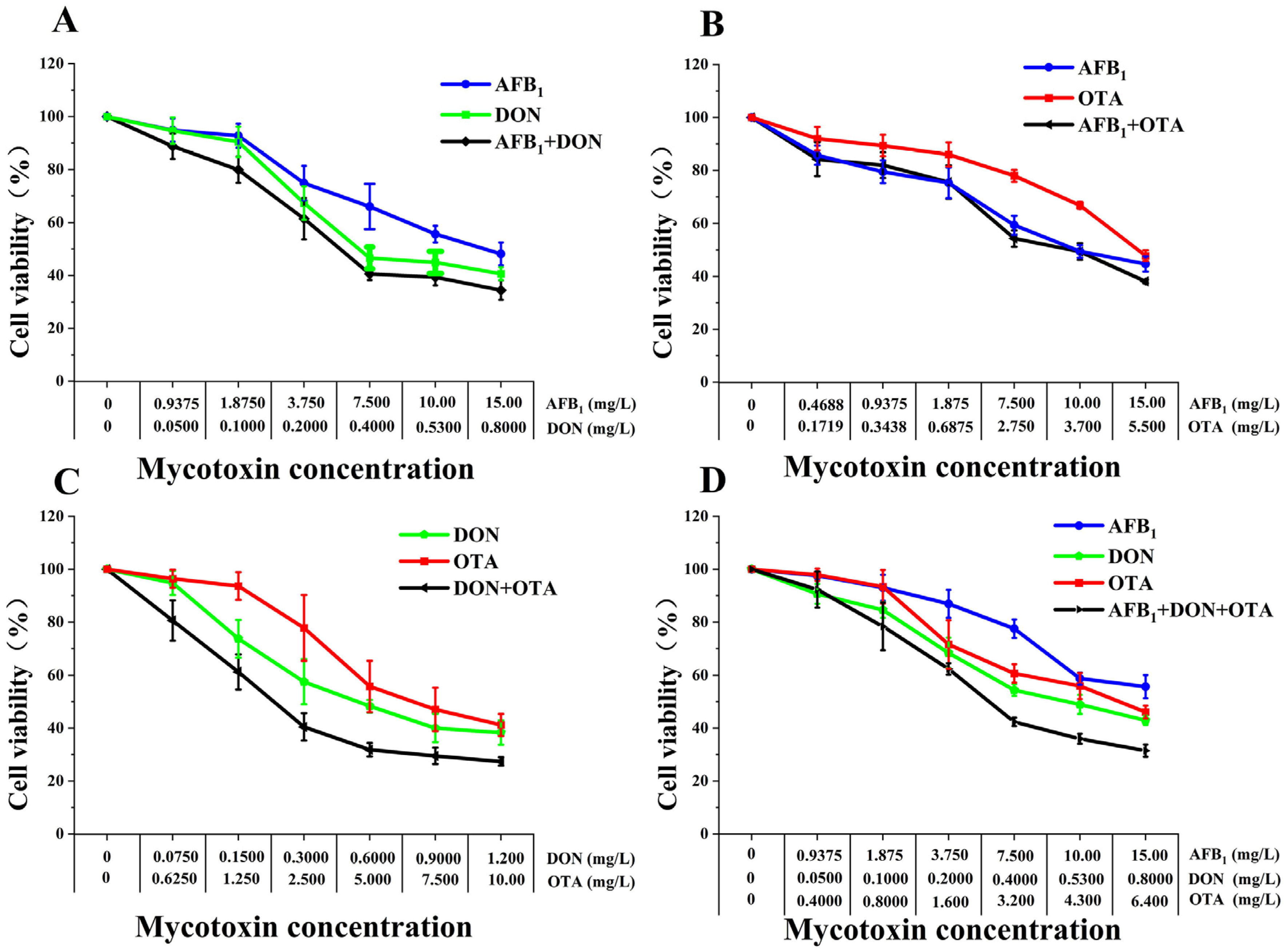
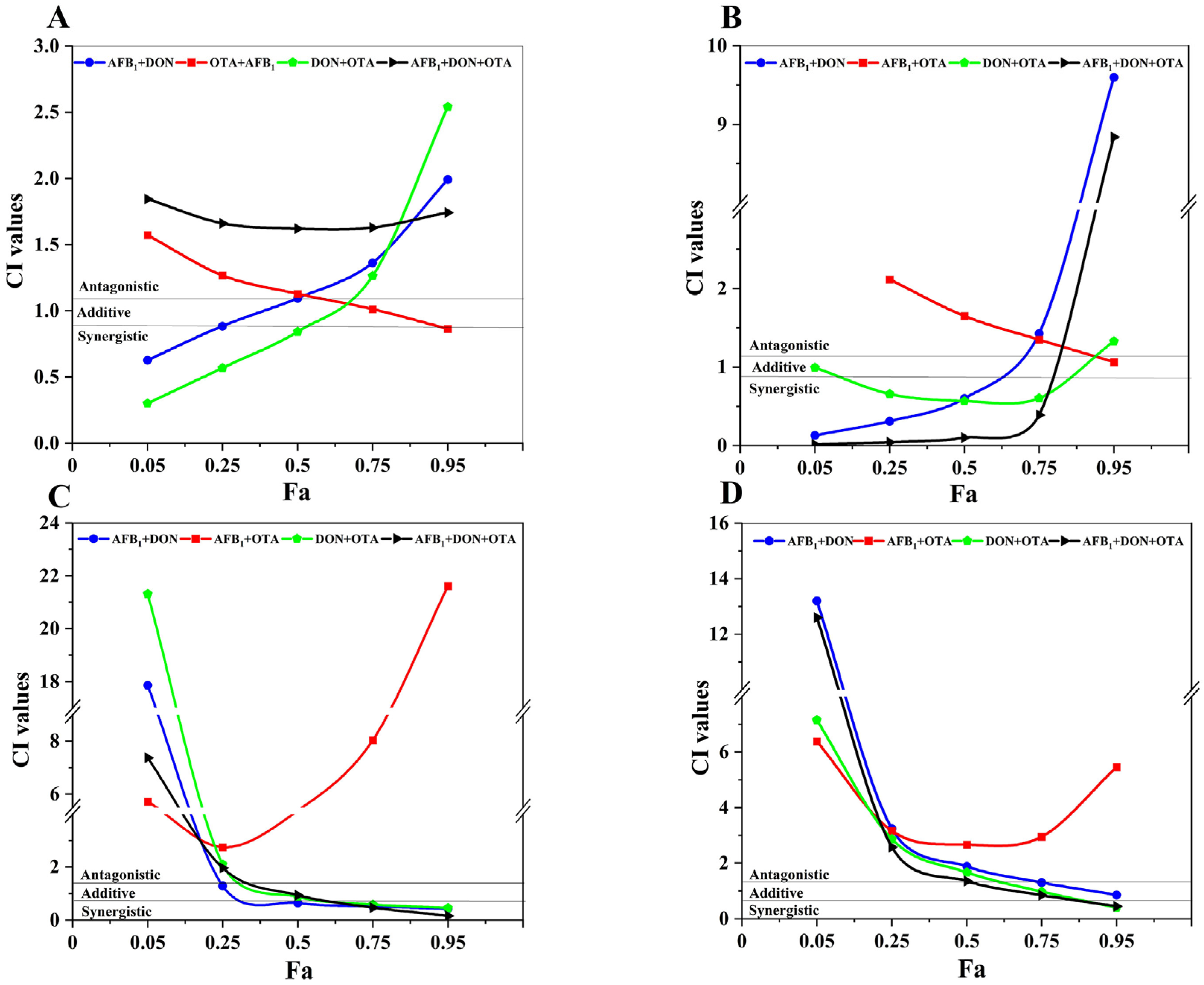
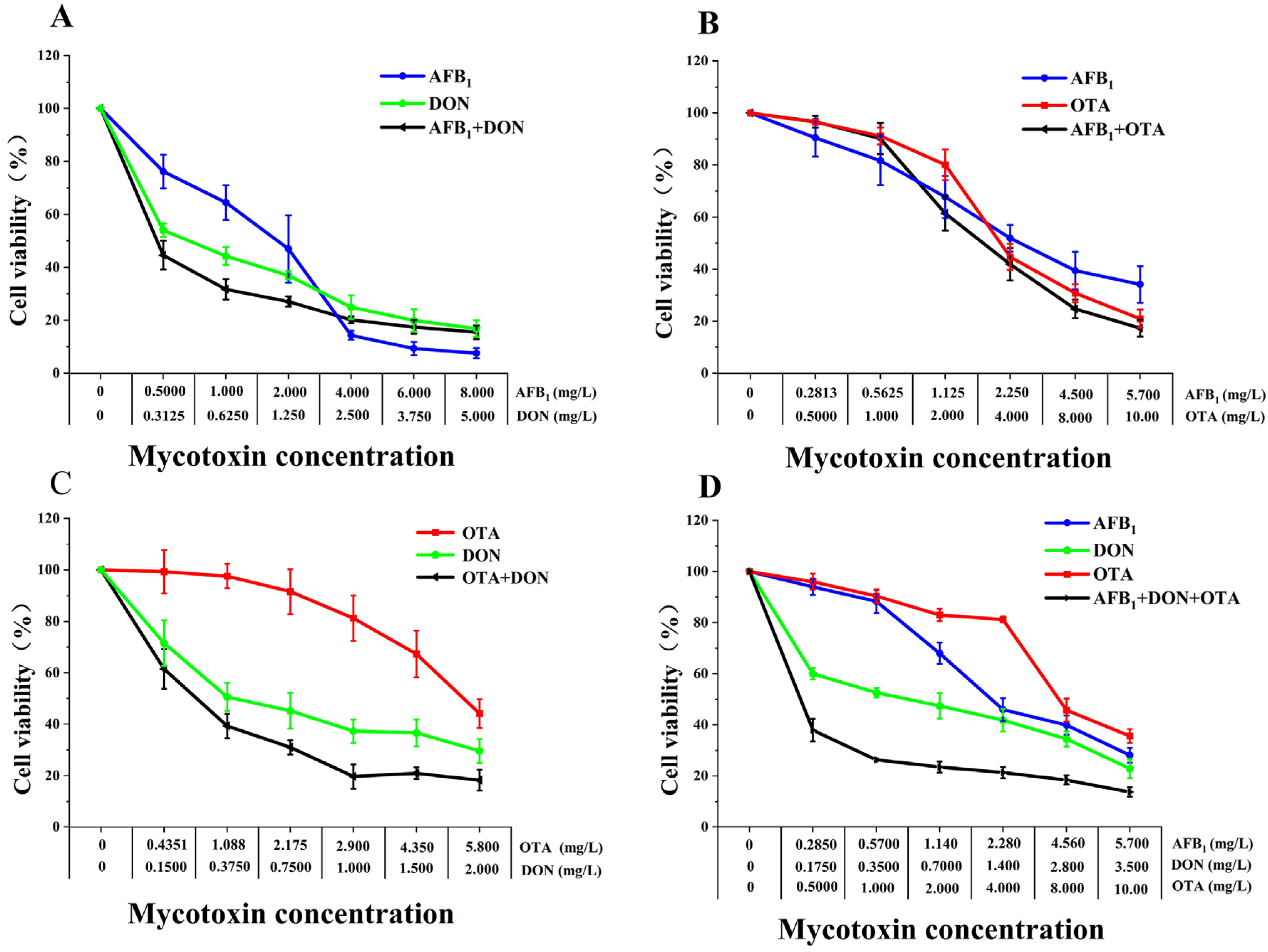
2.2. Combined Cytotoxic Effects of AFB1, DON, and OTA on Caco-2 Cells
2.3. Combined Cytotoxic Effects of AFB1, DON, and OTA on HepG2 Cells
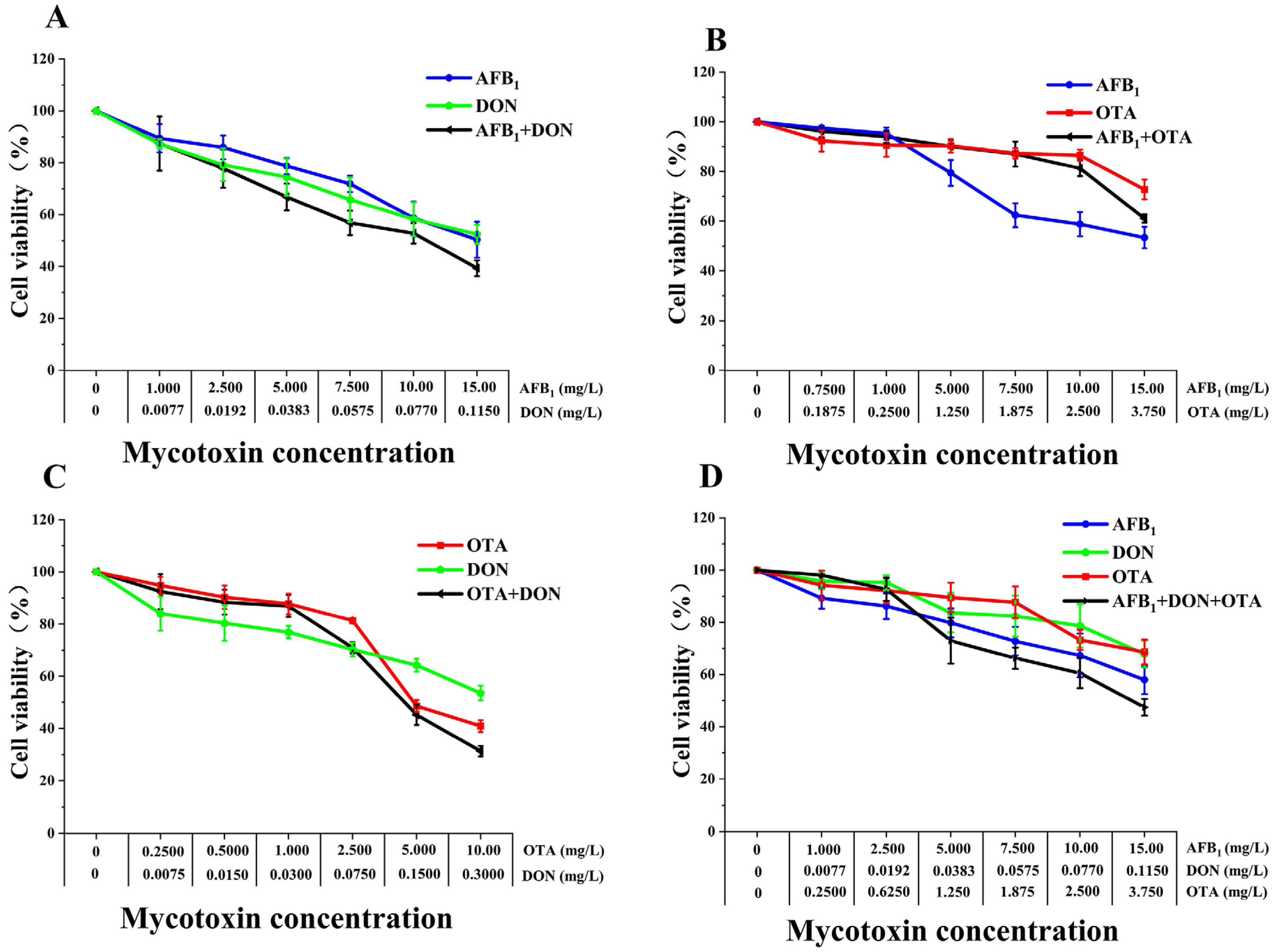
2.4. Combined Cytotoxic Effects of AFB1, DON, and OTA on HK-2 Cells
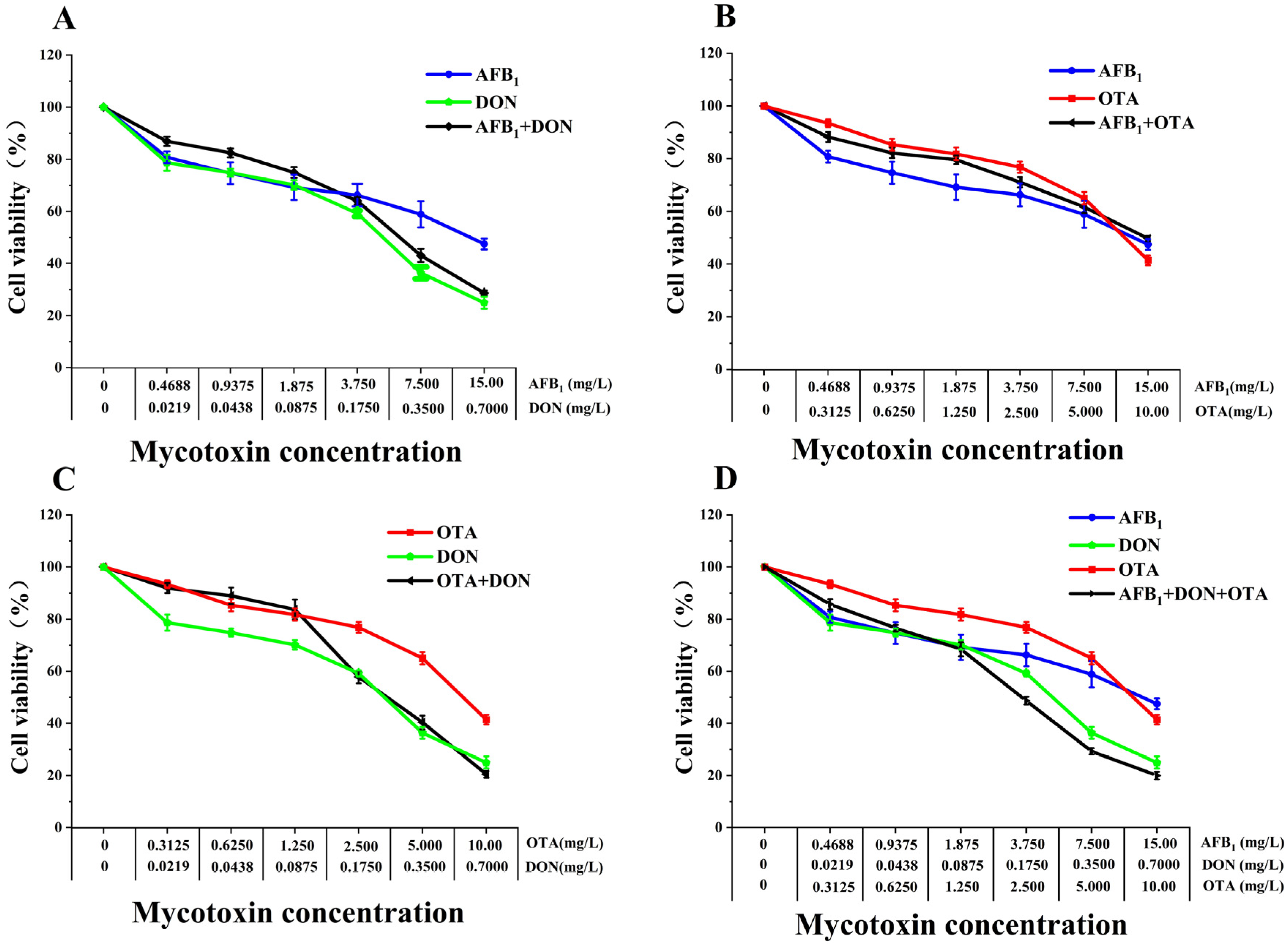
2.5. Combined Cytotoxic Effects of AFB1, DON, and OTA on SK-N-SH Cells
3. Discussion
4. Conclusions
5. Materials and Methods
5.1. Chemicals
5.2. Cell Culture
5.3. Mycotoxin Exposure Design for Individual and Combined Treatments
5.4. Cell Viability Assay
5.5. Combined Index Analysis of Mycotoxin Mixtures
5.6. Statistical Analysis
Author Contributions
Funding
Institutional Review Board Statement
Informed Consent Statement
Data Availability Statement
Conflicts of Interest
References
- Skrzydlewski, P.; Twarużek, M.; Grajewski, J. Cytotoxicity of Mycotoxins and Their Combinations on Different Cell Lines: A Review. Toxins 2022, 14, 244. [Google Scholar] [CrossRef] [Scilit]
- Zhang, Z.; Qi, X.; Wang, Y.; Li, Y.; Cheng, L.; Yang, Q.; Yan, X.; Li, X.; Luo, J. Fungi and mycotoxin types, toxicity, mechanisms, and control of mycotoxin contamination: A review. Food Addit. Contam. Part A Chem. Anal. Control Expo. Risk Assess. 2025, 42, 1692–1716. [Google Scholar] [CrossRef] [Scilit] [PubMed]
- Nešić, K.; Habschied, K.; Mastanjević, K. Modified Mycotoxins and Multitoxin Contamination of Food and Feed as Major Analytical Challenges. Toxins 2023, 15, 511. [Google Scholar] [CrossRef] [Scilit] [PubMed]
- Twarużek, M.; Skrzydlewski, P.; Kosicki, R.; Grajewski, J. Mycotoxins survey in feed materials and feedingstuffs in years 2015–2020. Toxicon 2021, 202, 27–39. [Google Scholar] [CrossRef] [Scilit] [PubMed]
- Tassis, P.; Pierron, A.; Kauffold, J. Editorial: Mycotoxins in pig feed: Health risks, reproductive impacts, and diagnostic innovations. Front. Vet. Sci. 2025, 12, 1675111. [Google Scholar] [CrossRef] [Scilit]
- Hao, W.; Guan, S.; Li, A.; Wang, J.; An, G.; Hofstetter, U.; Schatzmayr, G. Mycotoxin Occurrence in Feeds and Raw Materials in China: A Five-Year Investigation. Toxins 2023, 15, 63. [Google Scholar] [CrossRef] [Scilit]
- Sun, X.D.; Su, P.; Shan, H. Mycotoxin Contamination of Rice in China. J. Food Sci. 2017, 82, 573–584. [Google Scholar] [CrossRef] [Scilit]
- Gratz, S.W.; Currie, V.; Duncan, G.; Jackson, D. Multimycotoxin Exposure Assessment in UK Children Using Urinary Biomarkers—A Pilot Survey. J. Agric. Food Chem. 2020, 68, 351–357. [Google Scholar] [CrossRef] [Scilit]
- Streit, E.; Schatzmayr, G.; Tassis, P.; Tzika, E.; Marin, D.; Taranu, I.; Tabuc, C.; Nicolau, A.; Aprodu, I.; Puel, O.; et al. Current situation of mycotoxin contamination and co-occurrence in animal feed—Focus on Europe. Toxins 2012, 4, 788–809. [Google Scholar] [CrossRef] [Scilit]
- Zhu, Z.; Guo, W.; Cheng, H.; Zhao, H.; Wang, J.; Abdallah, M.F.; Zhou, X.; Lei, H.; Tu, W.; Wang, H.; et al. Co-contamination and interactions of multiple mycotoxins and heavy metals in rice, maize, soybeans, and wheat flour marketed in Shanghai City. J. Hazard. Mater. 2024, 474, 134695. [Google Scholar] [CrossRef] [Scilit]
- Leite, M.; Freitas, A.; Silva, A.S.; Barbosa, J.; Ramos, F. Maize food chain and mycotoxins: A review on occurrence studies. Trends Food Sci. Technol. 2021, 115, 307–331. [Google Scholar] [CrossRef] [Scilit]
- Huang, W.; Cao, Z.; Yao, Q.; Ji, Q.; Zhang, J.; Li, Y. Mitochondrial damage are involved in Aflatoxin B(1)-induced testicular damage and spermatogenesis disorder in mice. Sci. Total Environ. 2020, 701, 135077. [Google Scholar] [CrossRef] [Scilit] [PubMed]
- Awuchi, C.G.; Ondari, E.N.; Nwozo, S.; Odongo, G.A.; Eseoghene, I.J.; Twinomuhwezi, H.; Ogbonna, C.U.; Upadhyay, A.K.; Adeleye, A.O.; Okpala, C.O.R. Mycotoxins’ Toxicological Mechanisms Involving Humans, Livestock and Their Associated Health Concerns: A Review. Toxins 2022, 14, 167. [Google Scholar] [CrossRef] [Scilit] [PubMed]
- Kang, R.; Li, R.; Dai, P.; Li, Z.; Li, Y.; Li, C. Deoxynivalenol induced apoptosis and inflammation of IPEC-J2 cells by promoting ROS production. Environ. Pollut. 2019, 251, 689–698. [Google Scholar] [CrossRef] [Scilit]
- Wang, G.; Qin, S.; Zheng, Y.; Xia, C.; Zhang, P.; Zhang, L.; Yao, J.; Yi, Y.; Deng, L. T-2 Toxin Induces Ferroptosis by Increasing Lipid Reactive Oxygen Species (ROS) and Downregulating Solute Carrier Family 7 Member 11 (SLC7A11). J. Agric. Food Chem. 2021, 69, 15716–15727. [Google Scholar] [CrossRef] [Scilit]
- Sun, Y.; Huang, K.; Long, M.; Yang, S.; Zhang, Y. An update on immunotoxicity and mechanisms of action of six environmental mycotoxins. Food Chem. Toxicol. 2022, 163, 112895. [Google Scholar] [CrossRef] [Scilit]
- You, L.; Nepovimova, E.; Valko, M.; Wu, Q.; Kuca, K. Mycotoxins and cellular senescence: The impact of oxidative stress, hypoxia, and immunosuppression. Arch. Toxicol. 2023, 97, 393–404. [Google Scholar] [CrossRef] [Scilit]
- Lei, Y.; Guanghui, Z.; Xi, W.; Yingting, W.; Xialu, L.; Fangfang, Y.; Goldring, M.B.; Xiong, G.; Lammi, M.J. Cellular responses to T-2 toxin and/or deoxynivalenol that induce cartilage damage are not specific to chondrocytes. Sci. Rep. 2017, 7, 2231. [Google Scholar] [CrossRef] [Scilit]
- Zhang, J.; You, L.; Wu, W.; Wang, X.; Chrienova, Z.; Nepovimova, E.; Wu, Q.; Kuca, K. The neurotoxicity of trichothecenes T-2 toxin and deoxynivalenol (DON): Current status and future perspectives. Food Chem. Toxicol. 2020, 145, 111676. [Google Scholar] [CrossRef] [Scilit]
- Wang, Y.; Wang, X.; Li, Q.; Toxicon, T.M. Aflatoxin B1 in poultry liver: Toxic mechanism. Toxicon 2023, 233, 107262. [Google Scholar] [CrossRef] [Scilit]
- Huang, W.; Song, C.; Hua, Y.; Liu, A. NNMT is involved in deoxynivalenol-induced hepatocyte toxicity via promoting ferroptosis. Toxicology 2025, 513, 154084. [Google Scholar] [CrossRef] [Scilit] [PubMed]
- Ma, W.; Fu, Y.; Zhu, S.; Xia, D.; Zhai, S.; Xiao, D.; Zhu, Y.; Dione, M.; Ben, L.; Yang, L.; et al. Ochratoxin A induces abnormal tryptophan metabolism in the intestine and liver to activate AMPK signaling pathway. J. Anim. Sci. Biotechnol. 2023, 14, 125. [Google Scholar] [CrossRef] [Scilit] [PubMed]
- Lei, M.; Zhang, N.; Qi, D. In vitro investigation of individual and combined cytotoxic effects of aflatoxin B1 and other selected mycotoxins on the cell line porcine kidney 15. Exp. Toxicol. Pathol. 2013, 65, 1149–1157. [Google Scholar] [CrossRef] [Scilit]
- Sun, L.H.; Lei, M.Y.; Zhang, N.Y.; Gao, X.; Li, C.; Krumm, C.S.; Qi, D.S. Individual and combined cytotoxic effects of aflatoxin B1, zearalenone, deoxynivalenol and fumonisin B1 on BRL 3A rat liver cells. Toxicon 2015, 95, 6–12. [Google Scholar] [CrossRef] [Scilit] [PubMed]
- Sobral, M.M.C.; Faria, M.A.; Cunha, S.C.; Ferreira, I. Toxicological interactions between mycotoxins from ubiquitous fungi: Impact on hepatic and intestinal human epithelial cells. Chemosphere 2018, 202, 538–548. [Google Scholar] [CrossRef] [Scilit]
- Eskola, M.; Kos, G.; Elliott, C.T.; Hajšlová, J.; Mayar, S.; Krska, R. Worldwide contamination of food-crops with mycotoxins: Validity of the widely cited ‘FAO estimate’ of 25. Crit. Rev. Food Sci. Nutr. 2020, 60, 2773–2789. [Google Scholar] [CrossRef] [Scilit]
- Goldoni, M.; Johansson, C. A mathematical approach to study combined effects of toxicants in vitro: Evaluation of the Bliss independence criterion and the Loewe additivity model. Toxicol. In Vitro 2007, 21, 759–769. [Google Scholar] [CrossRef] [Scilit]
- Chou, T.C. Drug combination studies and their synergy quantification using the Chou-Talalay method. Cancer Res. 2010, 70, 440–446. [Google Scholar] [CrossRef] [Scilit]
- Che, L.; Huang, J.; Lin, J.X.; Xu, C.Y.; Wu, X.M.; Du, Z.B.; Wu, J.S.; Lin, Z.N.; Lin, Y.C. Aflatoxin B1 exposure triggers hepatic lipotoxicity via p53 and perilipin 2 interaction-mediated mitochondria-lipid droplet contacts: An in vitro and in vivo assessment. J. Hazard. Mater. 2023, 445, 130584. [Google Scholar] [CrossRef] [Scilit]
- Juan-García, A.; Juan, C.; König, S.; Ruiz, M.J. Cytotoxic effects and degradation products of three mycotoxins: Alternariol, 3-acetyl-deoxynivalenol and 15-acetyl-deoxynivalenol in liver hepatocellular carcinoma cells. Toxicol. Lett. 2015, 235, 8–16. [Google Scholar] [CrossRef] [Scilit]
- García-Pérez, E.; Ryu, D.; Lee, C.; Lee, H.J. Ochratoxin A Induces Oxidative Stress in HepG2 Cells by Impairing the Gene Expression of Antioxidant Enzymes. Toxins 2021, 13, 271. [Google Scholar] [CrossRef] [Scilit] [PubMed]
- He, Y.; Yin, X.; Dong, J.; Yang, Q.; Wu, Y.; Gong, Z. Transcriptome Analysis of Caco-2 Cells upon the Exposure of Mycotoxin Deoxynivalenol and Its Acetylated Derivatives. Toxins 2021, 13, 167. [Google Scholar] [CrossRef] [Scilit] [PubMed]
- Arunachalam, C.; Doohan, F.M. Trichothecene toxicity in eukaryotes: Cellular and molecular mechanisms in plants and animals. Toxicol. Lett. 2013, 217, 149–158. [Google Scholar] [CrossRef] [Scilit] [PubMed]
- Romero, A.; Ares, I.; Ramos, E.; Castellano, V.; Martínez, M.; Martínez-Larrañaga, M.R.; Anadón, A.; Martínez, M.A. Mycotoxins modify the barrier function of Caco-2 cells through differential gene expression of specific claudin isoforms: Protective effect of illite mineral clay. Toxicology 2016, 353–354, 21–33. [Google Scholar] [CrossRef] [Scilit]
- Alizadeh, A.; Braber, S.; Akbari, P.; Garssen, J.; Fink-Gremmels, J. Deoxynivalenol Impairs Weight Gain and Affects Markers of Gut Health after Low-Dose, Short-Term Exposure of Growing Pigs. Toxins 2015, 7, 2071–2095. [Google Scholar] [CrossRef] [Scilit]
- Pei, X.; Zhang, W.; Jiang, H.; Liu, D.; Liu, X.; Li, L.; Li, C.; Xiao, X.; Tang, S.; Li, D. Food-Origin Mycotoxin-Induced Neurotoxicity: Intend to Break the Rules of Neuroglia Cells. Oxid. Med. Cell. Longev. 2021, 2021, 9967334. [Google Scholar] [CrossRef] [Scilit]
- Chou, T.C.; Talalay, P. quantitative analysis of dose-effect relationships: The combined effects of multiple drugs or enzyme inhibitors. Adv. Enzym. Regul. 1984, 22, 27–55. [Google Scholar] [CrossRef] [Scilit]



| Mycotoxins | Caco-2 Cells | HepG2 Cells | Hk-2 Cells | SK-N-SH Cells | ||||
|---|---|---|---|---|---|---|---|---|
| IC50 | Ratio vs. AFB1 | IC50 | Ratio vs. AFB1 | IC50 | Ratio vs. AFB1 | IC50 | Ratio vs. AFB1 | |
| AFB1 (mg/L) | 8.33 ± 0.49 a | 1 | 1.95 ± 0.63 b | 1 | 17.65 ± 4.68 a | 1 | 8.82 ± 1.84 a | 1 |
| DON (mg/L) | 0.65 ± 0.06 c | 0.08 | 1.20 ± 0.20 b | 0.62 | 0.14 ± 0.05 c | 0.01 | 0.39 ± 0.04 c | 0.05 |
| OTA (mg/L) | 3.07 ± 0.79 b | 0.37 | 3.43 ± 1.28 b | 1.76 | 4.49 ± 1.27 b | 0.25 | 5.94 ± 0.69 a | 0.67 |
| Cell Types | Toxin Combinations | Combination Ratio | 25% Cytotoxicity | 50% Cytotoxicity | 75% Cytotoxicity | ||||||
|---|---|---|---|---|---|---|---|---|---|---|---|
| CI Values | DRI | CI Values | DRI | CI Values | DRI | ||||||
| Caco-2 | AFB1 + DON | 1:0.08 | 0.88 | 2.82 | ++ | 1.09 | 2.50 | ± | 1.36 | \ | -- |
| 1.89 | 1.44 | \ | |||||||||
| AFB1 + OTA | 1:0.37 | 1.27 | \ | -- | 1.11 | \ | - | 1.01 | 1.45 | ± | |
| \ | \ | 2.89 | |||||||||
| DON + OTA | 1:8.33 | 0.57 | 2.78 | +++ | 0.84 | 2.03 | ++ | 1.26 | \ | -- | |
| 4.78 | 2.85 | \ | |||||||||
| AFB1 + DON + OTA | 1:0.05:0.42 | 1.66 | \ | --- | 1.62 | \ | --- | 1.63 | \ | --- | |
| \ | \ | \ | |||||||||
| Cell Types | Toxin Combinations | Combination Ratio | 25% Cytotoxicity | 50% Cytotoxicity | 75% Cytotoxicity | ||||||
|---|---|---|---|---|---|---|---|---|---|---|---|
| CI Values | DRI | CI Values | DRI | CI Values | DRI | ||||||
| HepG2 | AFB1 + DON | 1:0.007 | 0.31 | 19.32 | +++ | 0.60 | 4.85 | +++ | 1.43 | \ | -- |
| 3.87 | 2.53 | \ | |||||||||
| AFB1 + OTA | 1:0.25 | 2.11 | \ | --- | 1.6481 | \ | ---- | 1.34 | \ | ---- | |
| \ | \ | \ | |||||||||
| DON + OTA | 1:33.33 | 0.66 | 2.88 | +++ | 0.5680 | 2.17 | +++ | 0.60 | 1.6366 | +++ | |
| 3.89 | 9.30 | 22.252 | |||||||||
| AFB1 + DON + OTA | 1:0.007:0.41 | 0.04 | 384.02 | +++ | 0.10 | 47.92 | +++ | 0.39 | 5.9808 | +++ | |
| 27.04 | 14.59 | 7.8770 | |||||||||
| 640.39 | 82.35 | 10.591 | |||||||||
| Cell Types | Toxin Combinations | Combination Ratio | 25% Cytotoxicity | 50% Cytotoxicity | 75% Cytotoxicity | ||||||
|---|---|---|---|---|---|---|---|---|---|---|---|
| CI Values | DRI | CI Values | DRI | CI Values | DRI | ||||||
| HK-2 | AFB1 + DON | 1:0.63 | 0.51 | 829.91 | +++ | 0.64 | 1.84 | +++ | 1.29 | \ | -- |
| 26.31 | 9.50 | \ | |||||||||
| AFB1 + OTA | 1:0.56 | 8.04 | \ | --- | 4.50 | \ | --- | 2.74 | \ | -- | |
| \ | \ | \ | |||||||||
| DON + OTA | 1:2.9 | 0.59 | 267.08 | +++ | 0.88 | 3.29 | + | 2.10 | \ | --- | |
| 31.88 | 1.72 | \ | |||||||||
| AFB1 + DON + OTA | 1:0.61:1.75 | 0.46 | 26.23 | +++ | 0.94 | 2.45 | ± | 1.97 | \ | --- | |
| 20.69 | 3.04 | \ | |||||||||
| 2.01 | 2.92 | \ | |||||||||
| Cell Types | Toxin Combinations | Combination Ratio | 25% Cytotoxicity | 50% Cytotoxicity | 75% Cytotoxicity | ||||||
|---|---|---|---|---|---|---|---|---|---|---|---|
| CI Values | DRI | CI Values | DRI | CI Values | DRI | ||||||
| SK-N-SH | AFB1 + DON | 1:0.05 | 3.24 | \ | --- | 1.88 | \ | --- | 1.30 | \ | -- |
| \ | \ | \ | |||||||||
| AFB1 + OTA | 1:0.67 | 3.16 | \ | --- | 2.66 | \ | --- | 2.95 | \ | --- | |
| \ | \ | \ | |||||||||
| DON + OTA | 1:14.28 | 2.87 | \ | --- | 1.67 | \ | --- | 0.97 | 1.39 | ± | |
| \ | \ | 3.92 | |||||||||
| AFB1 + DON + OTA | 1:0.05:0.67 | 2.58 | \ | --- | 1.36 | \ | -- | 0.84 | 13.39 | ++ | |
| \ | \ | 1.76 | |||||||||
| \ | \ | 4.95 | |||||||||
| Cell Line | Toxin | Concentrations (mg/L) |
|---|---|---|
| HK-2 | AFB1 | 0.001, 0.01, 0.1, 1, 10, 15 |
| DON | 0.001, 0.004, 0.0156, 0.0625, 0.25 | |
| OTA | 0.1, 0.5, 1, 2.5, 5, 10 | |
| Caco-2 | AFB1 | 0.3125, 0.625, 1.25, 2.5, 5, 15 |
| DON | 0.0313, 0.0625, 0.125, 0.25, 0.5, 2 | |
| OTA | 0.3125, 0.625, 1.25, 2.5, 5, 10 | |
| HepG-2 | AFB1 | 0.001, 0.1, 0.5, 1, 5, 10, 15 |
| DON | 0.01, 1, 5, 10, 20 | |
| OTA | 0.01, 0.1, 0.5, 1, 5, 10 | |
| SK-N-SH | AFB1 | 0.4688, 0.9375, 1.875, 3.75, 7.5, 15 |
| DON | 0.1563, 0.3125, 0.625, 1.25, 2.5, 5 | |
| OTA | 0.3125, 0.625, 1.25, 2.5, 5, 10 |
| Combination Index Value | Description | Graded Symbols |
|---|---|---|
| <0.10 | Very strong synergism | + + + + + |
| 0.10~0.30 | Strong synergism | + + + + |
| 0.30~0.70 | Common synergism | + + + |
| 0.70~0.85 | Moderate synergism | + + |
| 0.85~0.90 | Slight synergism | + |
| 0.90~1.10 | Nearly additive | ± |
| 1.10~1.20 | Slight antagonism | − |
| 1.20~1.45 | Moderate antagonism | − − |
| 1.45~3.30 | Common antagonism | − − − |
| 3.30~10.0 | Strong antagonism | − − − − |
| >10.0 | Very strong antagonism | − − − − − |
Disclaimer/Publisher’s Note: The statements, opinions and data contained in all publications are solely those of the individual author(s) and contributor(s) and not of MDPI and/or the editor(s). MDPI and/or the editor(s) disclaim responsibility for any injury to people or property resulting from any ideas, methods, instructions or products referred to in the content. |
© 2026 by the authors. Licensee MDPI, Basel, Switzerland. This article is an open access article distributed under the terms and conditions of the Creative Commons Attribution (CC BY) license.
Share and Cite
Zhao, H.; Zhai, X.; He, W.; Jing, Z.; Wang, D.; Yang, J. Analysis of the Combined Toxic Effects of AFB1, DON, and OTA Complex Contamination in Caco-2, HK-2, SK-N-SH and HepG2 Cells. Toxins 2026, 18, 41. https://doi.org/10.3390/toxins18010041
Zhao H, Zhai X, He W, Jing Z, Wang D, Yang J. Analysis of the Combined Toxic Effects of AFB1, DON, and OTA Complex Contamination in Caco-2, HK-2, SK-N-SH and HepG2 Cells. Toxins. 2026; 18(1):41. https://doi.org/10.3390/toxins18010041
Chicago/Turabian StyleZhao, Hanke, Xiaohu Zhai, Weihua He, Zheng Jing, Dengyan Wang, and Junhua Yang. 2026. "Analysis of the Combined Toxic Effects of AFB1, DON, and OTA Complex Contamination in Caco-2, HK-2, SK-N-SH and HepG2 Cells" Toxins 18, no. 1: 41. https://doi.org/10.3390/toxins18010041
APA StyleZhao, H., Zhai, X., He, W., Jing, Z., Wang, D., & Yang, J. (2026). Analysis of the Combined Toxic Effects of AFB1, DON, and OTA Complex Contamination in Caco-2, HK-2, SK-N-SH and HepG2 Cells. Toxins, 18(1), 41. https://doi.org/10.3390/toxins18010041