Peanut and Peanut-Based Foods Contamination by Toxigenic Fungi and Mycotoxins: Potential Risks for Beninese Consumers

 ,
,  , , , , and
Abstract
1. Introduction
2. Results and Discussion
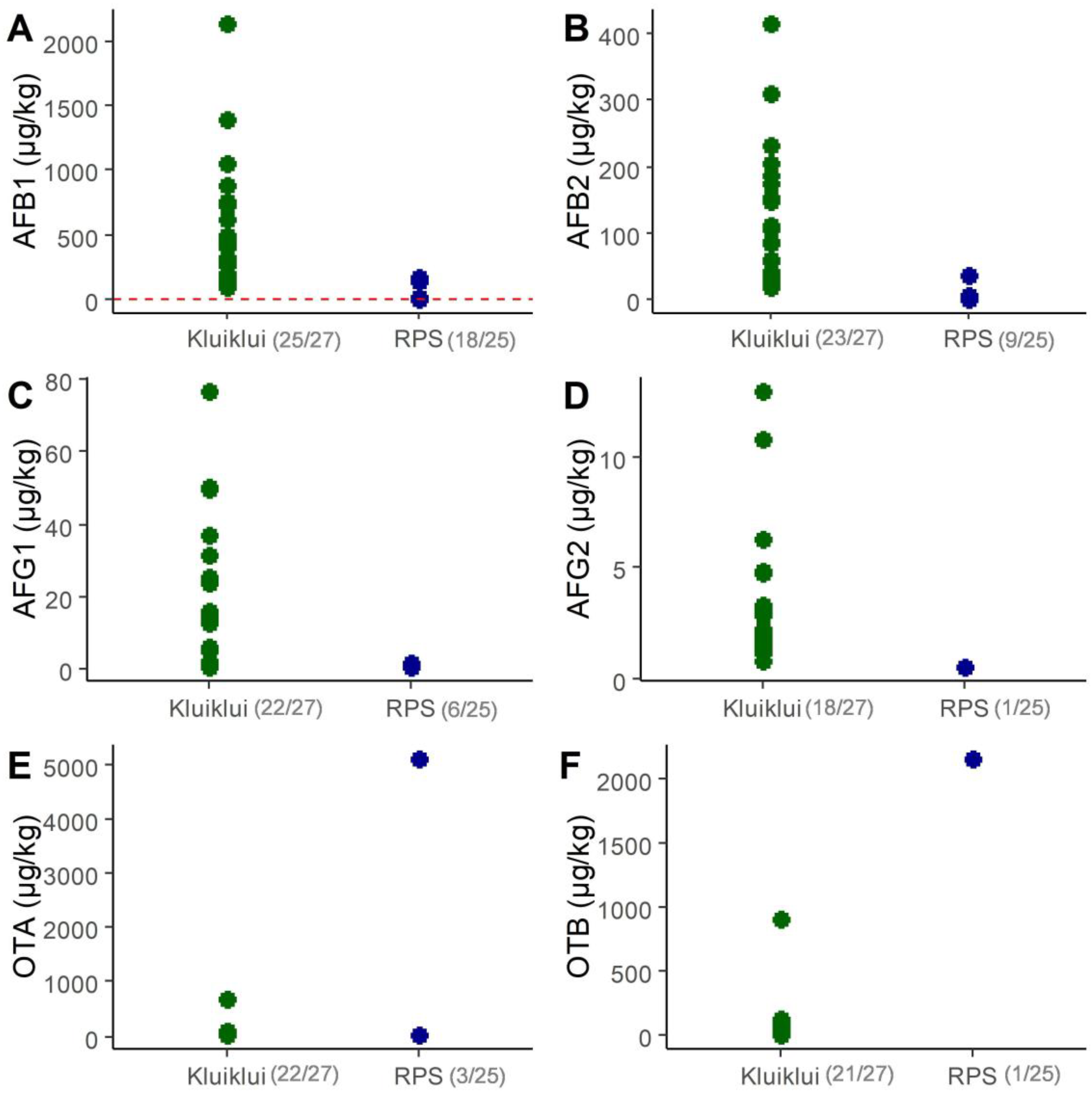
2.1. Occurrence of Mycotoxins in Marketed Roasted Peanut Snack and Kluiklui
2.2. Contribution of Processing Practices to Mycotoxin Contamination
2.2.1. Occurrence of Mycotoxins in Raw Peanuts Used for Kluiklui and Roasted Peanut Snacks Production
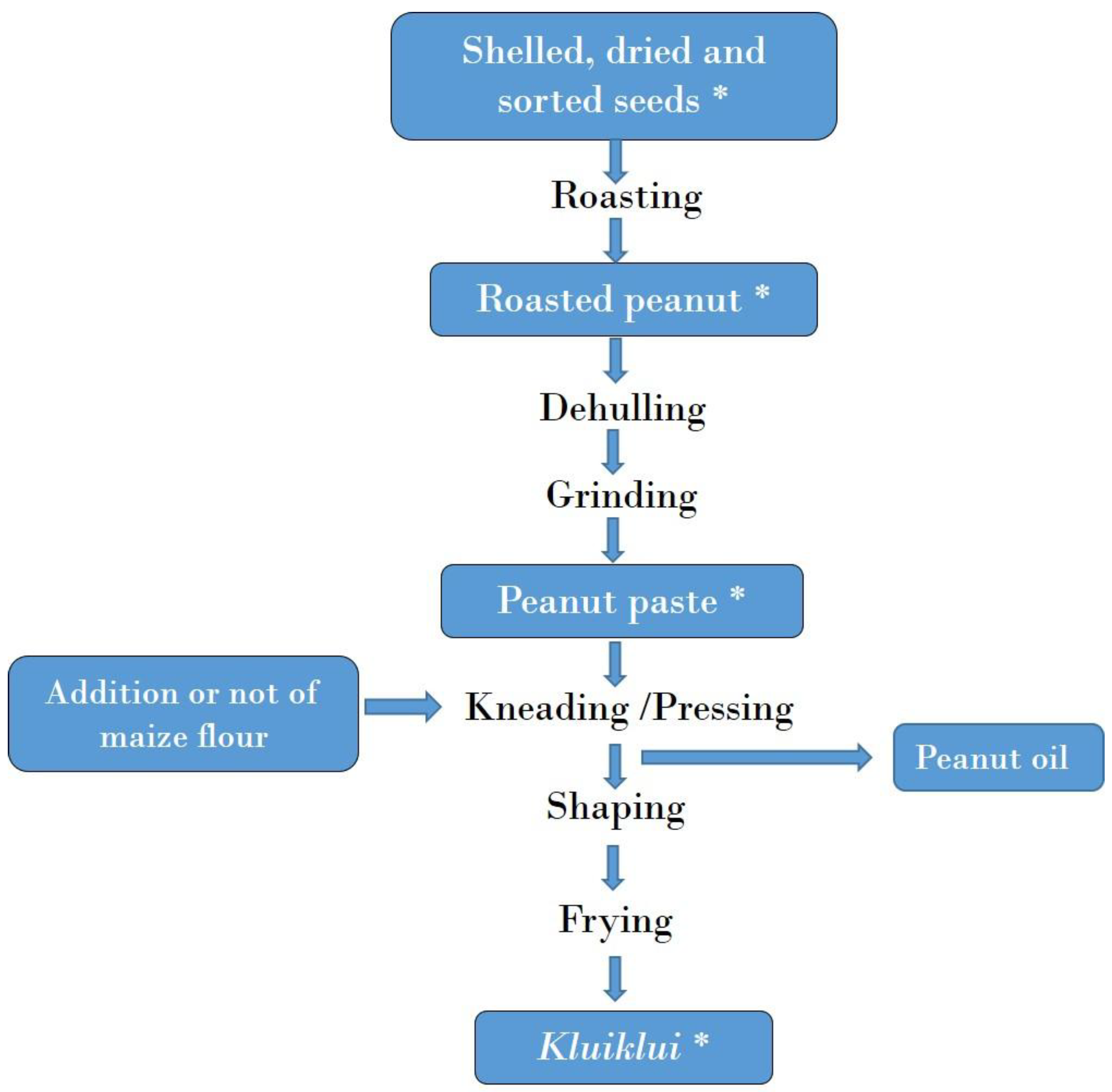
2.2.2. Kluiklui Processing Practices and Mycotoxins Contamination
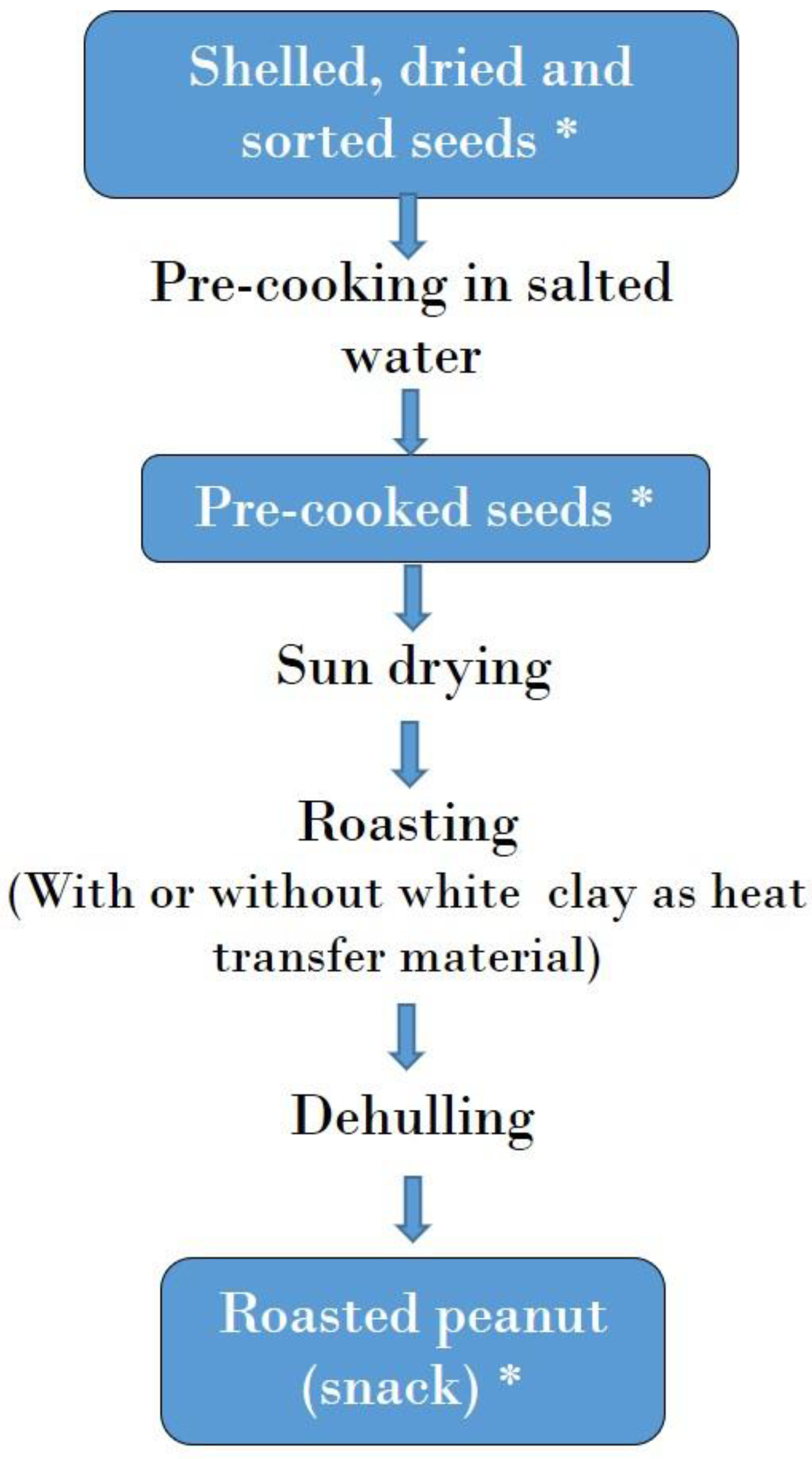
2.2.3. Roasted Peanut Processing Practices and Mycotoxin Contamination
2.3. Dietary Exposure to Aflatoxins and Risk Characterisation
2.3.1. Consumer Exposure to Aflatoxins Through Marketed Peanut-Based Food Consumption
2.3.2. Consumer Exposure to Aflatoxins Through “Just-Produced” Peanut-Based Foods Consumption
2.4. Dietary Exposure to OTA and Risk Characterisation
2.4.1. Consumer Exposure to OTA Through Marketed Peanut-Based Foods Consumption
2.4.2. Consumer Exposure to OTA Through “Just-Produced” Peanut-Based Foods Consumption
2.5. Microorganisms Isolated from Peanut-Based Foods
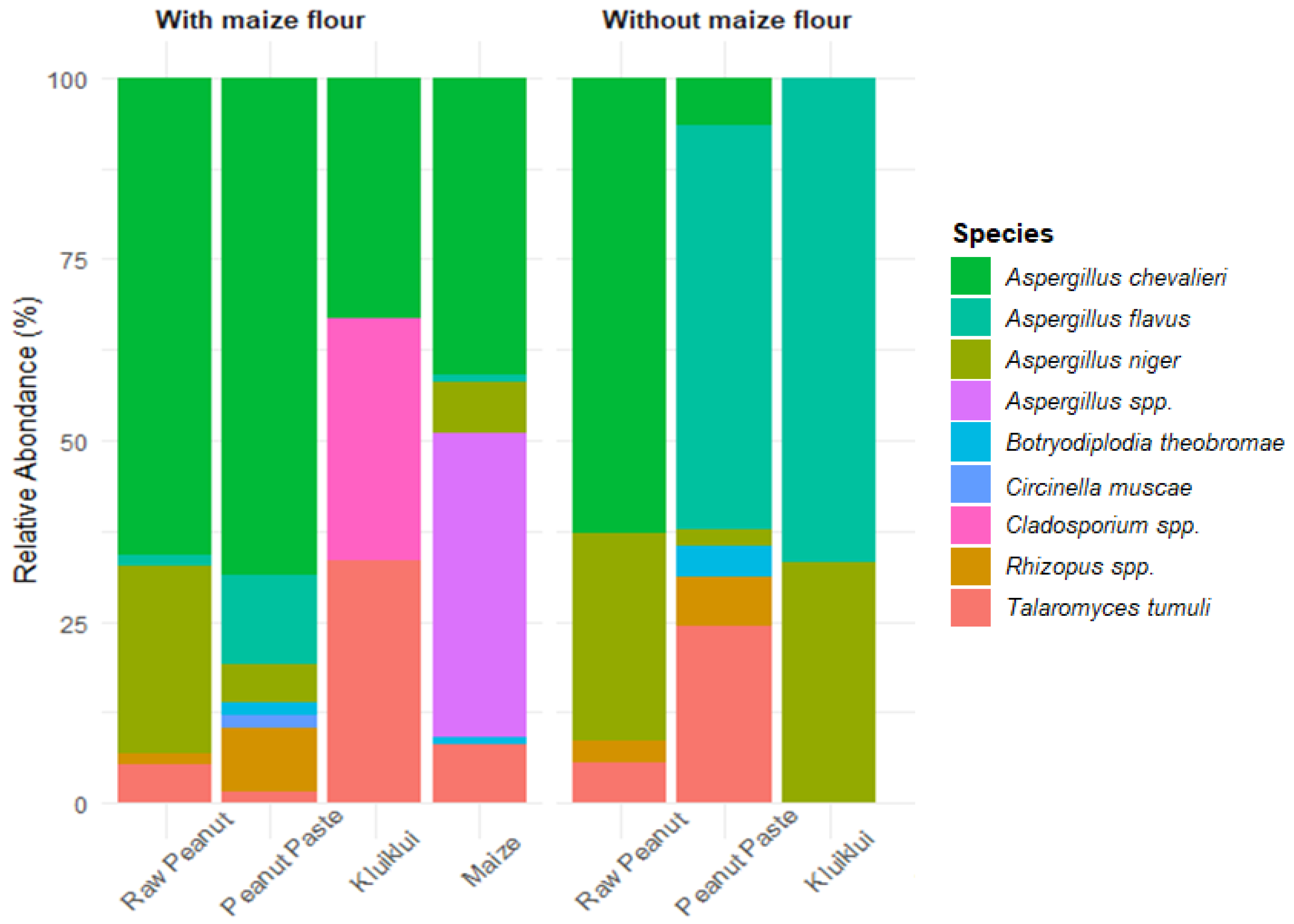
2.5.1. Distribution of Moulds in Samples from Kluiklui Processing
2.5.2. Fungal Species Isolated on Samples from Kluiklui Processing
2.5.3. Distribution of Moulds and Fungal Isolates on Samples from Roasted Peanut Snack Processing
3. Conclusions
4. Methods
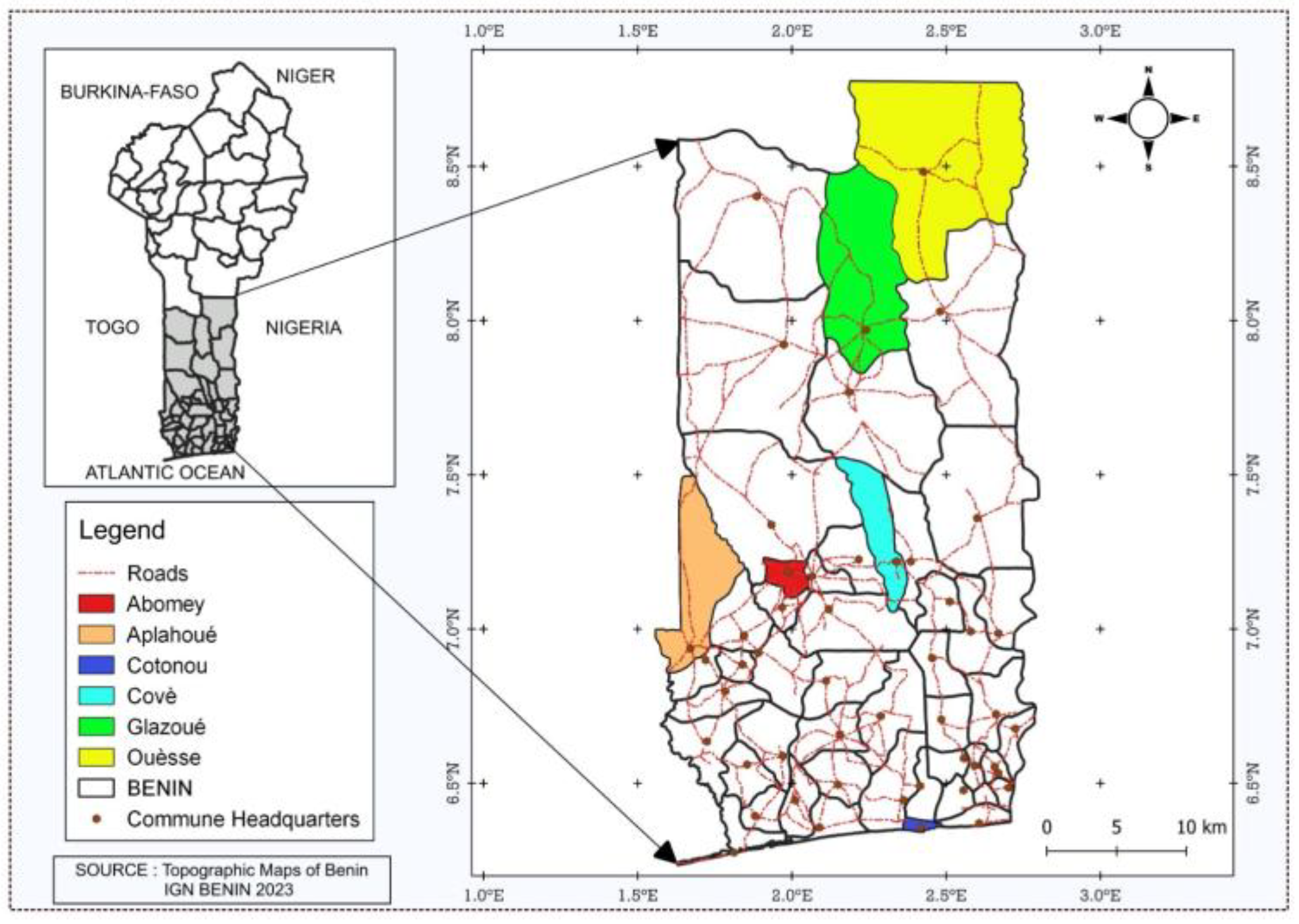
4.1. Study Area
4.2. Sampling of Peanut-Based Foods from Beninese Markets
4.3. Follow-Up of Kluiklui and Roasted Peanut Snacks Production and Sampling
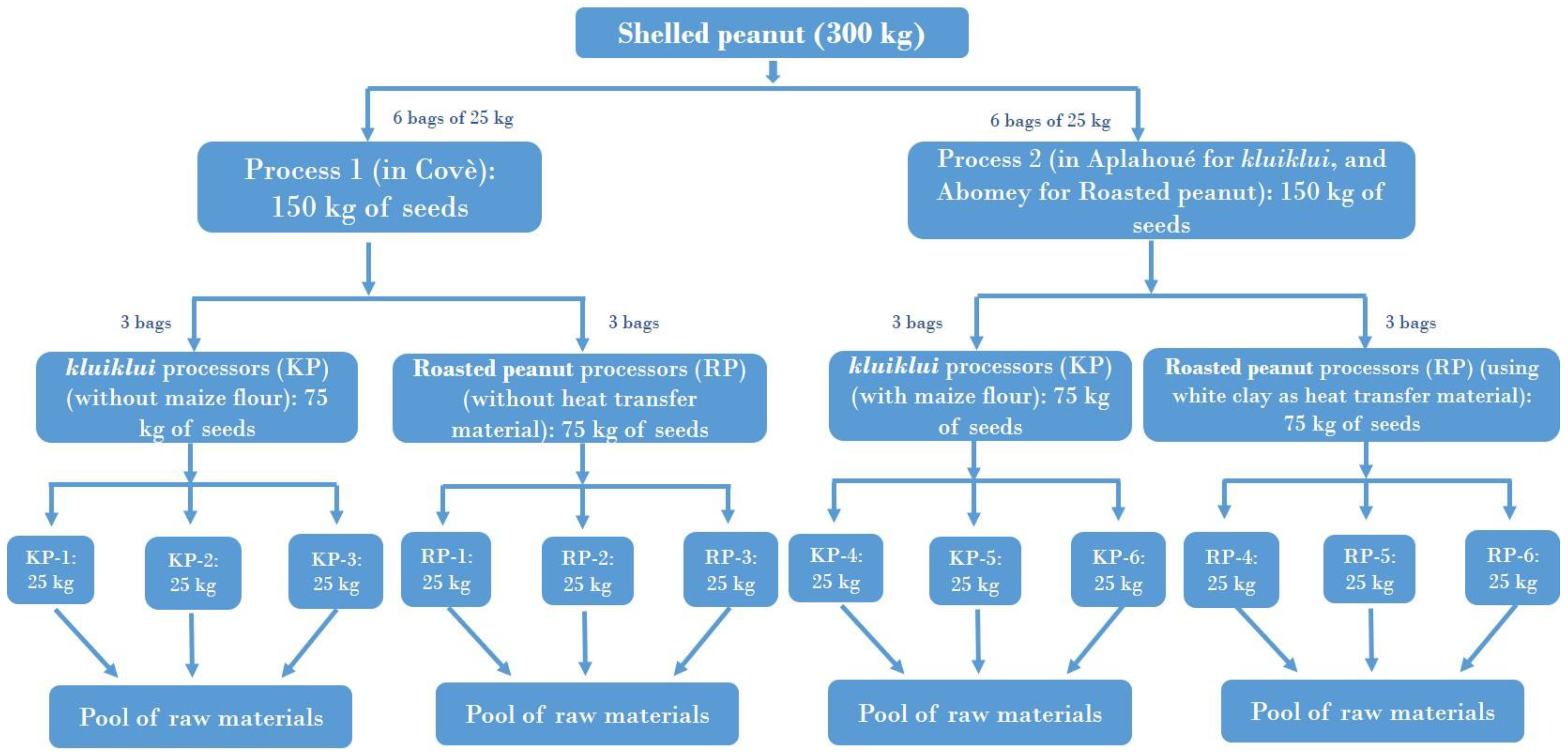
4.3.1. Experimental Design
4.3.2. Samples Collected During Follow-Up Experiments
4.4. Determination of Mycotoxins in Peanut-Based Foods Samples
4.4.1. Standards and Chemicals
4.4.2. Determination of Mycotoxins
4.4.3. Method Validation
4.5. Fungal Analysis
4.5.1. Fungal Enumeration and Isolation
4.5.2. Molecular Identification
4.5.3. Ammonia Vapour Test
4.6. Estimation of Mycotoxins Daily Intake and Risk Characterisation
4.6.1. Estimation of Mycotoxins Daily Intake
4.6.2. Risk Characterisation Related to Mycotoxin Ingestion Through Kluiklui and Roasted Peanut Snack Consumption
Risk Characterisation Related to the Exposure to Aflatoxin B1 and Total Aflatoxins
Risk Characterization Related to Ochratoxin a Exposure Through Peanut-Based Food Consumption
4.7. Data Analysis
Supplementary Materials
Author Contributions
Funding
Institutional Review Board Statement
Informed Consent Statement
Data Availability Statement
Conflicts of Interest
References
- Eskola, M.; Kos, G.; Elliott, C.T.; Hajšlová, J.; Mayar, S.; Krska, R. Worldwide contamination of food-crops with mycotoxins: Validity of the widely cited ‘FAO estimate’ of 25%. Crit. Rev. Food Sci. Nutr. 2020, 60, 2773–2789. [Google Scholar] [CrossRef]
- Battilani, P.; Palumbo, R.; Giorni, P.; Dall’Asta, C.; Dellafiora, L.; Gkrillas, A.; Toscano, P.; Crisci, A.; Brera, C.; De Santis, B.; et al. Mycotoxin mixtures in food and feed: Holistic, innovative, flexible risk assessment modelling approach. EFSA Support. Publ. 2020, 17, 1757E. [Google Scholar] [CrossRef]
- Ismaiel, A.A.; Papenbrock, J. Mycotoxins: Producing Fungi and Mechanisms of Phytotoxicity. Agriculture 2015, 5, 492–537. [Google Scholar] [CrossRef]
- IARC. Improving Public Health Through Mycotoxin Control. IARC Scientific Publication No. 158; International Agency for Research on Cancer: Lyon, France, 2012; Volume 158, p. 168. [Google Scholar]
- Garello, M.; Piombo, E.; Buonsenso, F.; Prencipe, S.; Valente, S.; Meloni, G.R.; Marcet-Houben, M.; Gabaldón, T.; Spadaro, D. Several secondary metabolite gene clusters in the genomes of ten Penicillium spp. raise the risk of multiple mycotoxin occurrence in chestnuts. Food Microbiol. 2024, 122, 104532. [Google Scholar] [CrossRef] [PubMed]
- Hellany, H.; Assaf, J.C.; El-Badan, D.; Khalil, M. Quantification, Prevalence, and Pretreatment Methods of Mycotoxins in Groundnuts and Tree Nuts: An Update. Processes 2023, 11, 3428. [Google Scholar] [CrossRef]
- Yang, Y.; Li, G.; Wu, D.; Liu, J.; Li, X.; Luo, P.; Hu, N.; Wang, H.; Wu, Y. Recent advances on toxicity and determination methods of mycotoxins in foodstuffs. Trends Food Sci. Technol. 2020, 96, 233–252. [Google Scholar] [CrossRef]
- IARC. Chemical Agents and Related Occupations; IARC: Lyon, France, 2012; Volume 100F, pp. 1–599. [Google Scholar]
- Cimbalo, A.; Alonso-Garrido, M.; Font, G.; Manyes, L. Toxicity of mycotoxins in vivo on vertebrate organisms: A review. Food Chem. Toxicol. 2020, 137, 111161. [Google Scholar] [CrossRef]
- Nejad, B.G.; Mostafaei, Z.; Rezaabad, A.B.; Mehravar, F.; Zarei, M.; Dehghani, A.; Estabragh, M.A.R.; Karami-Mohajeri, S.; Alizadeh, H. A systematic review with meta-analysis of the relation of aflatoxin B1 to growth impairment in infants/children. BMC Pediatr. 2023, 23, 614. [Google Scholar] [CrossRef]
- Bondy, G. Immunological toxicity of mycotoxins. Stewart Postharvest Rev. 2008, 4, 1–6. [Google Scholar] [CrossRef]
- EFSA. Risk assessment of aflatoxins in food. EFSA J. 2020, 18, 112. [Google Scholar] [CrossRef]
- IARC. Some Naturally Occurring Substances: Food Items and Constituents, Heterocyclic Aromatic Amines and Mycotoxins. IARC Monographs on the Evaluation of Carcinogenic Risks to Humans; IARC: Lyon, France, 1993; Volume 56, pp. 1–599. [Google Scholar]
- IARC. Some Traditional Herbal Medicines, Some Mycotoxins, Naphthalene and Styrene, IARC Monographs on the Evaluation of Carcinogenic Risks to Humans; IARC: Lyon, France, 2002; Volume 82, pp. 1–557. [Google Scholar]
- Gruber-Dorninger, C.; Novak, B.; Nagl, V.; Berthiller, F. Emerging Mycotoxins: Beyond Traditionally Determined Food Contaminants. J. Agric. Food Chem. 2017, 65, 7052–7070. [Google Scholar] [CrossRef] [PubMed]
- Stockmann-Juvala, H.; Savolainen, K. A review of the toxic effects and mechanisms of action of fumonisin B1. Hum. Exp. Toxicol. 2008, 27, 799–809. [Google Scholar] [CrossRef] [PubMed]
- Li, K.; Cai, H.; Luo, B.; Duan, S.; Yang, J.; Zhang, N.; He, Y.; Wu, A.; Liu, H. Recent Progress of Mycotoxin in Various Food Products—Human Exposure and Health Risk Assessment. Foods 2025, 14, 865. [Google Scholar] [CrossRef] [PubMed]
- Winter, G.; Pereg, L. A review on the relation between soil and mycotoxins: Effect of aflatoxin on field, food and finance. Eur. J. Soil Sci. 2019, 70, 882–897. [Google Scholar] [CrossRef]
- El-Sayed, R.A.; Jebur, A.B.; Kang, W.; El-Demerdash, F.M. An overview on the major mycotoxins in food products: Characteristics, toxicity, and analysis. J. Future Foods 2022, 2, 91–102. [Google Scholar] [CrossRef]
- USDA. Oilseeds: World Markets and Trade; USDA: Washington, DC, USA, 2024; Volume 39. [Google Scholar]
- Valentine, H. The Role of Peanuts in Global Food Security. In Peanuts; Academic Press: Champaign, IL, USA; AOCS Press: Urbana, IL, USA, 2016; pp. 447–461. [Google Scholar]
- Chang, A.S.; Sreedharan, A.; Schneider, K.R. Peanut and peanut products: A food safety perspective. Food Control 2013, 32, 296–303. [Google Scholar] [CrossRef]
- Variath, M.; Pasupuleti, J. Economic and Academic Importance of Peanut. In The Peanut Genome, Compendium of Plant Genomes; Springer International Publishing AG: Berlin/Heidelberg, Germany, 2017; pp. 7–26. [Google Scholar]
- Adjile, A.; Mongbo, R.; Floquet, A. Les exploitations agricoles familiales arachidières de la commune de Ouessè au centre Bénin: État des lieux, typologies et dynamiques des systèmes de cultures. Ahoho Rev. Géogr. Lomé 2015, 15, 55–67. [Google Scholar]
- Arya, S.S.; Salve, A.R.; Chauhan, S. Peanuts as functional food: A review. J. Food Sci. Technol. 2016, 53, 31–41. [Google Scholar] [CrossRef]
- Bediako, K.A.; Ofori, K.; Offei, S.K.; Dzidzienyo, D.; Asibuo, J.Y.; Amoah, R.A. Aflatoxin contamination of groundnut (Arachis hypogaea L.): Predisposing factors and management interventions. Food Control 2019, 98, 61–67. [Google Scholar] [CrossRef]
- Darko, C.B. Effect of Storage Conditions on Aspergillus Growth and Aflatoxin Production in Peanuts: A Study in Ghana; Virginia Polytechnic Institute and State University: Blacksburg, VA, USA, 2016. [Google Scholar]
- Adjou, E.S.; Yehouenou, B.; Sossou, C.M.; Soumanou, M.M.; De Souza, C.A. Occurrence of mycotoxins and associated mycoflora in peanut cake product (kulikuli) marketed in Benin. Afr. J. Biotechnol. 2012, 11, 14354–14360. [Google Scholar] [CrossRef]
- Awuah, R.T.; Fialor, S.C.; Binns, A.D.; Kagochi, J.; Jolly, C.M. Factors Influencing Market Participants Decision to Sort Groundnuts along the Marketing Chain in Ghana. Peanut Sci. 2009, 36, 68–76. [Google Scholar] [CrossRef]
- Bankole, S.A.; Ogunsanwo, B.M.; Eseigbe, D.A. Aflatoxins in Nigerian dry-roasted groundnuts. Food Chem. 2005, 89, 503–506. [Google Scholar] [CrossRef]
- Ezekiel, C.N.; Sulyok, M.; Warth, B.; Odebode, A.C.; Krska, R. Natural occurrence of mycotoxins in peanut cake from Nigeria. Food Control 2012, 27, 338–342. [Google Scholar] [CrossRef]
- Ingenbleek, L.; Sulyok, M.; Adegboye, A.; Hossou, E.S.; Koné, A.Z.; Oyedele, D.A.; Kisito, C.S.K.J.; Dembélé, K.Y.; Leblanc, J.-C.; Le Bizec, B.; et al. Regional Sub-Saharan Africa Total Diet Study in Benin, Cameroon, Mali and Nigeria Reveals the Presence of 164 Mycotoxins and Other Secondary Metabolites in Foods. Toxins 2019, 11, 54. [Google Scholar] [CrossRef]
- Tedihou, E.; Hell, K.; Aziato, K.; Nyaku, A. Évaluation de la Prévalence des Aflatoxines Dans les Produits D’arachide au Togo; Bulletin de la Recherche Agronomique du Gronomique du Bénin (BRAB); Numéro Spécial Productions Végétales, Animales et Halieutiques, Économie Rurale, Sociologie Rurale, Agronomie, Environnement, Développement Durable & Sécurité Alimentaire de l’Institut Togolais de Recherche Agronomique (ITRA); ITRA: Lausanne, Switzerland, 2019; pp. 129–136. [Google Scholar]
- Waliyar, F.; Umeh, V.C.; Traore, A.; Osiru, M.; Ntare, B.R.; Diarra, B.; Sudini, H. Prevalence and distribution of aflatoxin contamination in groundnut (Arachis hypogaea L.) in Mali, West Africa. Crop Prot. 2015, 70, 1–7. [Google Scholar] [CrossRef]
- Watson, S.; Diedhiou, P.M.; Atehnkeng, J.; Dem, A.; Bandyopadhyay, R.; Srey, C.; Gong, Y.Y. Seasonal and geographical differences in aflatoxin exposures in Senegal. World Mycotoxin J. 2015, 8, 525–531. [Google Scholar] [CrossRef]
- European Commission. Commission Regulation (EU) 2023/915 of 25 April 2023 on Maximum Levels for Certain Contaminants in Food and Repealing Regulation (EC) No 1881/2006 (Text with EEA Relevance); C/2023/35; European Commission: Luxembourg, 2023; pp. 103–157. [Google Scholar]
- Videgla, E.G.; Floquet, A.; Mongbo, R.; Garba, K.; Tossou, H.S.; Toukourou, F. Liens à l’origine et qualité spécifique d’un produit de l’artisanat agroalimentaire du Bénin—Le kluiklui d’Agonlin. Cah. Agric. 2016, 25, 35003. [Google Scholar] [CrossRef][Green Version]
- Njumbe Ediage, E.; Diana Di Mavungu, J.; Monbaliu, S.; Van Peteghem, C.; De Saeger, S. A Validated Multianalyte LC–MS/MS Method for Quantification of 25 Mycotoxins in Cassava Flour, Peanut Cake and Maize Samples. J. Agric. Food Chem. 2011, 59, 5173–5180. [Google Scholar] [CrossRef]
- Bakherad, Z.; Feizy, J. Preliminary Survey of Aflatoxins in Mashhad’s Roasted Red Skin Peanut Kernels during February to May 2016. J. Community Health Res. 2018, 7, 112–118. [Google Scholar]
- Sombie, J.I.N.; Ezekiel, C.N.; Sulyok, M.; Ayeni, K.I.; Jonsyn-Ellis, F.; Krska, R. Survey of roasted street-vended nuts in Sierra Leone for toxic metabolites of fungal origin. Food Addit. Contam. Part A 2018, 35, 1573–1580. [Google Scholar] [CrossRef] [PubMed]
- Chen, D.; Chen, H.W. Using the Köppen classification to quantify climate variation and change: An example for 1901–2010. Environ. Dev. 2013, 6, 69–79. [Google Scholar] [CrossRef]
- World Bank. Benin Country Climate and Development Report. Available online: https://www.worldbank.org/en/country/benin/publication/benin-country-climate-and-development-report (accessed on 16 October 2025).
- Yu, P.; Xu, R.; Yang, Z.; Ye, T.; Liu, Y.; Li, S.; Abramson, M.J.; Kimlin, M.; Guo, Y. Cancer and Ongoing Climate Change: Who Are the Most Affected? ACS Environ. Au 2023, 3, 5–11. [Google Scholar] [CrossRef] [PubMed]
- MAEP. Arrêté 2007 N°0362 MAEP/D-CAB/SGM/DRH/DP/SA Portant Fixation des Teneurs Maximales Pour Certains Contaminants Dans les Denrées Alimentaires en République du Bénin; MAEP: Cotonou, Benin, 2007; p. 17. [Google Scholar]
- Ndung’u, J.W.; Makokha, A.; Onyango, C.A.; Mutegi, C.; Wagacha, M.; Christie, M.; Wanjoya, A. Prevalence and potential for aflatoxin contamination in groundnuts and peanut butter from farmers and traders in Nairobi and Nyanza provinces of Kenya. J. Appl. Biosci. 2013, 65, 4922–4934. [Google Scholar] [CrossRef][Green Version]
- Fandohan, P.; Gnonlonfin, B.; Hell, K.; Marasas, W.F.O.; Wingfield, M.J. Natural occurrence of Fusarium and subsequent fumonisin contamination in preharvest and stored maize in Benin, West Africa. Int. J. Food Microbiol. 2005, 99, 173–183. [Google Scholar] [CrossRef] [PubMed]
- Kayode, O.F.; Sulyok, M.; Fapohunda, S.O.; Ezekiel, C.N.; Krska, R.; Oguntona, C.R. Mycotoxins and fungal metabolites in groundnut- and maize-based snacks from Nigeria. Food Addit. Contam. Part B Surveill. 2013, 6, 294–300. [Google Scholar] [CrossRef]
- Martins, L.M.; Sant’Ana, A.S.; Iamanaka, B.T.; Berto, M.I.; Pitt, J.I.; Taniwaki, M.H. Kinetics of aflatoxin degradation during peanut roasting. Food Res. Int. 2017, 97, 178–183. [Google Scholar] [CrossRef]
- N’pagyendou, L.; Rassimwaï, P.; Tchaou, B.; Banfitebiyi, G.; Essohouna, A.; Simplice, K.D. Impact of traditional transformation processes on the level of aflatoxin B1 in groundnut seeds sold in northern Togo. Int. J. Nov. Res. Life Sci. 2022, 9, 22–30. [Google Scholar]
- Diedhiou, P.M.; Ba, F.; Kane, A.; Mbaye, N. Effect of different cooking methods on aflatoxin fate in peanut products. Afr. J. Food Sci. Technol. 2012, 3, 53–58. [Google Scholar]
- Adeniran, H.A.; Ikujenlola, A.V.; Nd’janton, G.N. Effect of Processing Conditions on the Aflatoxin Content of Kulikuli-A Groundnut-Based Fried Snack. Ann. Clin. Nutr. 2022, 5, 1023. [Google Scholar]
- Teixido-Orries, I.; Molino, F.; Castro-Criado, B.; Jodkowska, M.; Medina, A.; Marín, S.; Verheecke-Vaessen, C. Mapping Variability of Mycotoxins in Individual Oat Kernels from Batch Samples: Implications for Sampling and Food Safety. Toxins 2025, 17, 34. [Google Scholar] [CrossRef]
- JECFA. Safety Evaluation of Certain Contaminants in Food; World Health Organization: Geneva, Switzerland, 2018; Volume 74, p. 992. [Google Scholar]
- Oyedele, O.A.; Ezekiel, C.N.; Sulyok, M.; Adetunji, M.C.; Warth, B.; Atanda, O.O.; Krska, R. Mycotoxin risk assessment for consumers of groundnut in domestic markets in Nigeria. Int. J. Food Microbiol. 2017, 251, 24–32. [Google Scholar] [CrossRef] [PubMed]
- Kortei, N.K.; Annan, T.; Akonor, P.T.; Richard, S.A.; Annan, H.A.; Kwagyan, M.W.; Ayim-Akonor, M.; Akpaloo, P.G. Aflatoxins in randomly selected groundnuts (Arachis hypogaea) and its products from some local markets across Ghana: Human risk assessment and monitoring. Toxicol. Rep. 2021, 8, 186–195. [Google Scholar] [CrossRef] [PubMed]
- Aydemir Atasever, M.; Güler İnce, M.B.; Alkan Polat, B.; Özlü, H.; Atasever, M. Aflatoxin B1 levels, dietary exposure and cancer risk assessment in sesame and nut-based foods in Türkiye. Mycotoxin Res. 2025, 41, 447–455. [Google Scholar] [CrossRef] [PubMed]
- Kooprasertying, P.; Maneeboon, T.; Hongprayoon, R.; Mahakarnchanakul, W. Exposure assessment of aflatoxins in Thai peanut consumption. Cogent Food Agric. 2016, 2, 1204683. [Google Scholar] [CrossRef]
- Ezekiel, C.N.; Ayeni, K.I.; Akinyemi, M.O.; Sulyok, M.; Oyedele, O.A.; Babalola, D.A.; Ogara, I.M.; Krska, R. Dietary Risk Assessment and Consumer Awareness of Mycotoxins among Household Consumers of Cereals, Nuts and Legumes in North-Central Nigeria. Toxins 2021, 13, 635. [Google Scholar] [CrossRef]
- EFSA. Risk assessment of ochratoxin A in food. EFSA J. 2020, 18, e06113. [Google Scholar] [CrossRef]
- Kouadio, J. Risk Assessment of Mycotoxins Intake through the Consumption of Maize, Peanuts, Rice and Cassava in Côte d’Ivoire. Food Nutr. Sci. 2022, 13, 41–54. [Google Scholar] [CrossRef]
- Nuhu, A.H.; Dorleku, W.-P.; Blay, B.; Derban, E.; McArthur, C.O.; Alobuia, S.E.; Incoom, A.; Dontoh, D.; Ofosu, I.W.; Oduro-Mensah, D. Exposure to aflatoxins and ochratoxin A from the consumption of selected staples and fresh cow milk in the wet and dry seasons in Ghana. Food Control 2025, 168, 110968. [Google Scholar] [CrossRef]
- Norlia, M.; Nor-Khaizura, M.A.R.; Selamat, J.; Abu Bakar, F.; Radu, S.; Chin, C.K. Evaluation of aflatoxin and Aspergillus sp. contamination in raw peanuts and peanut-based products along this supply chain in Malaysia. Food Addit. Contam. Part A 2018, 35, 1787–1802. [Google Scholar] [CrossRef]
- Hussain, A.; Rahman, Z.; Amin, M.; Khan, M.; Bangash, J. Diversity of fungal contamination in peanut products locally available in Peshawar Region, Pakistan. Agric. Sci. Res. J. 2021, 11, 169–172. [Google Scholar]
- Kamarudin, N.; Zakaria, L. Characterization of two xerophilic Aspergillus spp. from peanuts (Arachis hypogaea). Malays. J. Microbiol. 2018, 14, 41–48. [Google Scholar] [CrossRef]
- Xing, F.; Ding, N.; Liu, X.; Selvaraj, J.N.; Wang, L.; Zhou, L.; Zhao, Y.; Wang, Y.; Liu, Y. Variation in fungal microbiome (mycobiome) and aflatoxins during simulated storage of in-shell peanuts and peanut kernels. Sci. Rep. 2016, 6, 25930. [Google Scholar] [CrossRef] [PubMed]
- Hubka, V.; Kolařík, M.; Kubátová, A.; Peterson, S.W. Taxonomic revision of Eurotium and transfer of species to Aspergillus. Mycologia 2013, 105, 912–937. [Google Scholar] [CrossRef] [PubMed]
- Molina-Hernandez, J.B.; Landi, L.; De Flaviis, R.; Laika, J.; Romanazzi, G.; Chaves-Lopez, C. Understanding the mechanisms of action of atmospheric cold plasma towards the mitigation of the stress induced in molds: The case of Aspergillus chevalieri. Innov. Food Sci. Emerg. Technol. 2023, 90, 103492. [Google Scholar] [CrossRef]
- Pitt, J.I.; Hocking, A.D. Fungi and Food Spoilage; Springer: Berlin/Heidelberg, Germany, 2009; p. 520. [Google Scholar] [CrossRef]
- Escrivá, L.; Font, G.; Manyes, L.; Berrada, H. Studies on the Presence of Mycotoxins in Biological Samples: An Overview. Toxins 2017, 9, 251. [Google Scholar] [CrossRef]
- Magan, N.; Medina, A.; Aldred, D. Possible climate-change effects on mycotoxin contamination of food crops pre- and postharvest. Plant Pathol. 2011, 60, 150–163. [Google Scholar] [CrossRef]
- Nji, Q.N.; Babalola, O.O.; Ekwomadu, T.I.; Nleya, N.; Mwanza, M. Six Main Contributing Factors to High Levels of Mycotoxin Contamination in African Foods. Toxins 2022, 14, 318. [Google Scholar] [CrossRef]
- Paterson, R.R.M.; Lima, N. How will climate change affect mycotoxins in food? Food Res. Int. 2010, 43, 1902–1914. [Google Scholar] [CrossRef]
- Jonard, C.; Chandelier, A.; Eylenbosch, D.; Pannecoucque, J.; Godin, B.; Douny, C.; Scippo, M.-L.; Gofflot, S. Multi-Mycotoxin Analyses by UPLC-MS/MS in Wheat: The Situation in Belgium in 2023 and 2024. Foods 2025, 14, 2300. [Google Scholar] [CrossRef]
- ISO 6887-1:2017; Microbiology of the Food Chain—Preparation of Test Samples, Initial Suspension and Decimal Dilutions for Microbiological Examination Part 1: General Rules for the Preparation of the Initial Suspension and Decimal Dilutions. International Organization for Standardization: Geneva, Switzerland, 2017.
- ISO 21527-2:2008; Microbiology of Food and Animal Feeding Stuffs—Horizontal Method for the Enumeration of Yeasts and Molds Part 2: Colony Count Technique in Products with Water Activity Less Than or Equal to 0,95. International Organization for Standardization: Geneva, Switzerland, 2008.
- Karthikeyan, V.; Patharajan, S.; Palani, P.; Spadaro, D. Modified simple protocol for efficient fungal DNA extraction highly. Glob. J. Mol. Sci. 2010, 5, 37–42. [Google Scholar]
- Saito, M.; Machida, S. A rapid identification method for aflatoxin-producing strains of Aspergillus flavus and A. parasiticus by ammonia vapor. Mycoscience 1999, 40, 205–208. [Google Scholar] [CrossRef]
- Abd El-Aziz, A.R.M.; Shehata, S.M.; Hisham, S.M.; Alobathani, A.A. Molecular profile of aflatoxigenic and non-aflatoxigenic isolates of Aspergillus flavus isolated from stored maize. Saudi J. Biol. Sci. 2021, 28, 1383–1391. [Google Scholar] [CrossRef]
- AFSCA. Agence Fédérale Pour la Sécurité de la Chaîne Alimentaire: Terminologie en Matière D’analyse des Dangers et des Risques Selon le Codex Alimentarius; AFSCA: Brussels, Belgium, 2005; 46p. [Google Scholar]
- Kpossou, A.R.; Paraiso, M.N.; Sokpon, C.N.; Alassan, K.S.; Vignon, R.K.; Keke, R.K.; Bigot, C.; Domonhédo, C.; Sossa Gbédo, E.; Séhonou, J.; et al. Seroprevalence of viral hepatitis B and its associated factors determined based on data from a screening campaign targeting the general population in Benin. Pan Afr. Med. J. 2020, 37, 247. [Google Scholar] [CrossRef]




| Parameters | AFB1 * | AFB2 | AFG1 | AFG2 | AFtot | FUM B1 | FUM B2 | OTA | OTB |
|---|---|---|---|---|---|---|---|---|---|
| Sample > LOQ ** | 3 | 1 | 0 | 0 | - | 0 | 0 | 0 | 0 |
| Min | 0.02 | 0.07 | <LOD | <LOD | 0.09 | <LOD | <LOD | <LOD | <LOD |
| Med | 0.02 | 0.07 | <LOD | <LOD | 0.09 | <LOD | <LOD | <LOD | <LOD |
| Max | 2.63 | 0.34 | <LOD | <LOD | 2.97 | <LOD | <LOD | <LOQ | <LOQ |
| % Sample > EU ML *** | 0 | NA | NA | NA | 0 | NA | NA | NA | NA |
| Process | Sample | AFB1 * | AFB2 | AFG1 | AFG2 | AFtot | AOH | FUM B1 | FUM B2 | OTA | OTB |
|---|---|---|---|---|---|---|---|---|---|---|---|
| Without maize flour (Covè) | Roasted peanut (n = 9) | <LOD (0) | <LOD (0) | <LOD (0) | <LOD (0) | - | <LOD (0) | <LOD (0) | <LOD (0) | <LOD (0) | <LOD (0) |
| Peanut paste (n = 9) | 50.56 ± 19.74 a (9) | 7.82 ± 2.29 a (9) | 2.20 ± 1.00 a (6) | 0.33 ± 0.30 (1) | 60.91 ± 21.98 a - | 10.31 ± 4.00 (1) | <LOD (0) | <LOD (0) | 3.70 ± 0.11 a (7) | 1.79 ± 0.13 a (6) | |
| Kluiklui (n = 9) | 37.78 ± 14.35 1 (9) | 7.37 ± 2.26 1 (9) | 1.60 ± 0.20 1 (5) | 0.23 ± 0.18 (1) | 46.99 ± 16.88 1 - | 10.20 ± 3.80 (1) | 4.09 ± 2.93 (0) | <LOQ (0) | 7.05 ± 3.71 1 (7) | 3.37 ± 1.97 1 (7) | |
| With maize flour (Aplahoué) | Roasted peanut (n = 9) | <LOD (0) | <LOD (0) | <LOD (0) | <LOD (0) | - | <LOD (0) | <LOD (0) | <LOD (0) | <LOD (0) | < LOD (0) |
| Peanut paste (n = 9) | 14.65 ± 9.54 b (9) | 6.58 ± 6.77 a (9) | 0.25 ± 0.15 b (1) | <LOD (0) | 21.60 ± 10.08 b - | <LOD (0) | <LOD (0) | <LOD (0) | 6.13 ± 5.00 a (4) | 2.94 ± 3.99 a (4) | |
| Maize flour (n = 6) | 24.11 ± 17.08 (6) | 2.61 ± 1.97 (6) | 0.42 ± 0.01 (4) | <LOD (0) | 27.26 ± 19.06 - | <LOD (0) | 991.51 ± 277.26 (6) | 333.84 ± 78.72 (6) | 2.32 ± 3.71 (2) | 0.62 ± 0.46 (2) | |
| Kluiklui (n = 9) | 11.73 ± 7.09 2 (9) | 4.14 ± 2.29 1 (9) | 0.24 ± 0.14 2 (1) | <LOD (0) | 16.24 ± 7.87 2 - | <LOD (0) | 31.28 ± 47.84 1 (3) | 14.14 ± 9.50 1 (2) | 6.70 ± 2.71 1 (5) | 4.51 ± 6.09 1 (5) |
| Roasting Process | Sample | AFB1 * | AFB2 | AFG1 | AFG2 | AFtot | OTA |
|---|---|---|---|---|---|---|---|
| Without heat transfer material | Raw peanut (n = 9) | <LOQ (0) | <LOD (0) | <LOD (0) | <LOD (0) | - | <LOD (0) |
| Roasted peanut snack (n = 9) | 0.50 ± 0.29 a (3) | 0.20 ± 0.09 a (2) | <LOD (0) | <LOD (0) | 1.56 ± 1.14 a - | <LOD (0) | |
| With heat transfer material | Raw peanut (n = 9) | 0.35 ± 0.47 (1) | <LOQ (1) | <LOD (0) | <LOD (0) | 0.37 ± 0.53 - | <LOQ (0) |
| Roasted peanut snack (n = 9) | 0.12 ± 0.12 a (1) | 0.11 ± 0.04 a (2) | <LOD (0) | <LOD (0) | 0.43 ± 0.51 a - | <LOD (0) |
| Consumer Category | Descriptive Level | Aflatoxin B1 | Total Aflatoxins | ||||||||
|---|---|---|---|---|---|---|---|---|---|---|---|
| Estimated Daily Intake (EDI) (µg/kg bw/day) | MOE BMDL10 * = 0.4 µg/kg bw per Day | Cancer Risk ** (Cases/100,000 persons/year) | Estimated Daily Intake (EDI) (µg/kg bw/day) | MOE BMDL10 * = 0.4 µg/kg bw per Day | |||||||
| Scenario 1 | Scenario 2 | Scenario 1 | Scenario 2 | Scenario 1 | Scenario 2 | Scenario 1 | Scenario 2 | Scenario 1 | Scenario 2 | ||
| Consumers of roasted peanut snacks only | |||||||||||
| n = 50 | Min | 0.00002 | 0.004 | 16,327 | 97 | 0.1 | 16 | 0.00003 | 0.004 | 10,205 | 96 |
| P50 | 0.0003 | 0.04 | 1577 | 9 | 1 | 166 | 0.0003 | 0.04 | 1160 | 9 | |
| P95 | 0.001 | 0.18 | 385 | 2 | 4 | 681 | 0.001 | 0.18 | 283 | 2 | |
| Max | 0.003 | 0.49 | 139 | 0.8 | 11 | 1887 | 0.004 | 0.49 | 102 | 0.8 | |
| Consumers of kluiklui only | |||||||||||
| n = 117 | Min | 0.01 | 0.05 | 47 | 9 | 33 | 178 | 0.01 | 0.06 | 39 | 7 |
| P50 | 0.12 | 0.63 | 3 | 1 | 450 | 2447 | 0.14 | 0.78 | 3 | 1 | |
| P95 | 0.45 | 2.45 | 1 | 0.2 | 1748 | 9495 | 0.55 | 3.02 | 1 | 0.1 | |
| Max | 1.55 | 8.42 | 0.3 | 0.05 | 6002 | 32,604 | 1.88 | 10.38 | 0.2 | 0.04 | |
| Consumers of roasted peanut snacks and kluiklui | |||||||||||
| n = 233 | Min | 0.003 | 0.03 | 135 | 13 | 11 | 119 | 0.004 | 0.02 | 111 | 18 |
| P50 | 0.09 | 0.44 | 4 | 0.9 | 359 | 1712 | 0.11 | 0.66 | 4 | 1 | |
| P95 | 0.52 | 2.28 | 0.8 | 0.2 | 1997 | 8811 | 0.63 | 3.51 | 1 | 0.1 | |
| Max | 1.25 | 5.77 | 0.3 | 0.1 | 4845 | 22,326 | 1.52 | 8.73 | 0.3 | 0.05 | |
| Products | Descriptive Level | Aflatoxin B1 | Total Aflatoxins | ||||||||
|---|---|---|---|---|---|---|---|---|---|---|---|
| Estimated Daily Intake (EDI) (µg/kg bw/day) | MOE BMDL10 * = 0.4 µg/kg bw per Day | Cancer Risk ** (Cases/100,000 persons/year) | Estimated Daily Intake (EDI) (µg/kg bw/day) | MOE BMDL10 * = 0.4 µg/kg bw per Day | |||||||
| Scenario 1 | Scenario 2 | Scenario 1 | Scenario 2 | Scenario 1 | Scenario 2 | Scenario 1 | Scenario 2 | Scenario 1 | Scenario 2 | ||
| kluiklui made without maize flour | |||||||||||
| Min | 0.001 | 0.002 | 630 | 175 | 2 | 9 | 0.001 | 0.003 | 477 | 144 | |
| P50 | 0.01 | 0.03 | 46 | 13 | 34 | 122 | 0.01 | 0.04 | 35 | 10 | |
| P95 | 0.03 | 0.1 | 12 | 3 | 131 | 472 | 0.04 | 0.1 | 9 | 3 | |
| Max | 0.1 | 0.4 | 3 | 1 | 450 | 1620 | 0.2 | 0.5 | 2.6 | 0.8 | |
| kluiklui made with maize flour | |||||||||||
| Min | 0.0001 | 0.001 | 5698 | 532 | 0.3 | 3 | 0.0001 | 0.001 | 3842 | 437 | |
| P50 | 0.001 | 0.01 | 415 | 39 | 4 | 40 | 0.001 | 0.01 | 280 | 32 | |
| P95 | 0.004 | 0.04 | 107 | 10 | 14 | 155 | 0.01 | 0.05 | 72 | 8 | |
| Max | 0.01 | 0.1 | 31 | 3 | 50 | 532 | 0.02 | 0.2 | 21 | 2 | |
| Consumer Category | Descriptive Level | Dietary Exposure to OTA (µg/kg bw/day) | MOE (Neoplastic Effects) BMDL10 * = 14.5 µg/kg bw/day | MOE (Non-Neoplastic Effects) BMDL10 * = 4.73 µg/kg bw/day | |||
|---|---|---|---|---|---|---|---|
| Scenario 1 * | Scenario 2 * | Scenario 1 | Scenario 2 | Scenario 1 | Scenario 2 | ||
| Consumer of roasted peanut snacks only | |||||||
| n = 50 | Min | 0.00001 | 0.12 | 1,479,613 | 116 | 482,660 | 38 |
| P50 | 0.0001 | 1.29 | 142,958 | 11 | 46,634 | 4 | |
| P95 | 0.0004 | 5.29 | 34,847 | 3 | 11,367 | 1 | |
| Max | 0.001 | 14.67 | 12,564 | 1 | 4099 | 0.3 | |
| Consumer of kluiklui only | |||||||
| n = 117 | Min | 0.0005 | 0.01 | 29,039 | 1011 | 9473 | 330 |
| P50 | 0.01 | 0.20 | 2115 | 74 | 690 | 24 | |
| P95 | 0.03 | 0.76 | 545 | 19 | 178 | 6 | |
| Max | 0.10 | 2.62 | 159 | 6 | 52 | 2 | |
| Consumer of both roasted peanut snacks and kluiklui | |||||||
| n = 233 | Min | 0.0002 | 0.1 | 80,894 | 234 | 26,388 | 76 |
| P50 | 0.01 | 1.52 | 2654 | 15 | 866 | 5 | |
| P95 | 0.03 | 5.25 | 475 | 3 | 155 | 1 | |
| Max | 0.10 | 12.83 | 195 | 1 | 64 | 0.4 | |
| Consumer Category | Descriptive Level | Dietary Exposure to OTA (µg/kg bw/day) | MOE (Neoplastic Effects) BMDL10 * = 14.5 µg/kg bw/day | MOE (Non-Neoplastic Effects) BMDL10 * = 4.73 µg/kg bw/day | |||
|---|---|---|---|---|---|---|---|
| Scenario 1 | Scenario 2 | Scenario 1 | Scenario 2 | Scenario 1 | Scenario 2 | ||
| Consumer of kluiklui without maize flour | |||||||
| n = 117 | Min | 0.0001 | 0.0005 | 121,267 | 27,762 | 39,558 | 9056 |
| P50 | 0.002 | 0.007 | 8832 | 2022 | 2881 | 660 | |
| P95 | 0.006 | 0.03 | 2276 | 521 | 743 | 170 | |
| Max | 0.02 | 0.1 | 663 | 152 | 216 | 50 | |
| Consumer of kluiklui with maize flour | |||||||
| n = 117 | Min | 0.0002 | 0.0004 | 91,155 | 33,094 | 29,735 | 10,796 |
| P50 | 0.002 | 0.006 | 6639 | 2410 | 2166 | 786 | |
| P95 | 0.008 | 0.02 | 1711 | 621 | 558 | 203 | |
| Max | 0.03 | 0.10 | 498 | 181 | 163 | 59 | |
| Process | Sample | Mold Count (Log10 CFU/g) * | Total Number of Genera * | Total Number of Fungal Isolates | Total Number of Aspergillus spp. Isolates | Detected and Quantified Mycotoxins |
|---|---|---|---|---|---|---|
| Without maize flour | Raw peanut (n = 9) | 1.95 ± 0.00 | 3 | 35 | 32 | - |
| Peanut paste (n = 9) | 1.42 ± 0.33 | 4 | 45 | 29 | AFB1, AFB2, AFG1, AFG2, AOH, OTA, OTB | |
| Kluiklui (n = 9) | 1.10 ± 0.41 | 2 | 15 | 15 | AFB1, AFB2, AFG1, AFG2, AOH, OTA, OTB | |
| With maize flour | Raw peanut (n = 9) | 2.22 ± 0.00 | 3 | 73 | 6 | - |
| Peanut paste (n = 9) | 1.44 ± 0.19 | 5 | 57 | 49 | AFB1, AFB2, AFG1, OTA, OTB | |
| Maize flour (n = 6) | 2.12 ± 0.31 | 2 | 140 | 136 | AFB1, AFB2, AFG1, FUM B1, FUM B2, OTA, OTB | |
| Kluiklui (n = 9) | 0.83 ± 0.06 | 1 | 3 | 1 | AFB1, AFB2, AFG1, FUM B1, FUM B2, OTA, OTB |
| Roasting Process | Samples | Mould Count (Log10 CFU/g) | Total Number of Genera | Total Number of Fungal Isolates | Fungal Isolates | Detected and Quantified Mycotoxins |
|---|---|---|---|---|---|---|
| Without heat transfer material | Raw peanut (n = 3) | 2.09 ± 1.04 | 3 | 7 | T. tumuli A. niger, Rhizopus spp. | - |
| Roasted peanut snack (n = 3) | 0.80 ± 0.17 | 0 | 0 | - | AFB1, AFB2 | |
| With heat transfer material | Raw peanut (n = 3) | 1.85 ± 0.14 | 3 | 5 | A. niger Rhizopus spp. Fusarium spp. | AFB1 |
| Roasted peanut snack (n = 3) | 1.30 ± 0.52 | 4 | 4 | T. tumuli A. niger, B. theobromae P. citrinum | AFB1, AFB2 |
| Peanut-Based Foods | Municipality | Processing Technology Considered | Number of Processors | Number of Trials |
|---|---|---|---|---|
| Kluiklui | Covè | Technology excluding maize flour during kneading of the peanut paste | 3 | 9 * |
| Aplahoué | Technology involving maize flour addition during kneading of the peanut paste | 3 | 9 | |
| Roasted peanut snack | Covè | Roasting without heat transfer material | 3 | 9 |
| Abomey | Roasting with heat transfer material | 3 | 9 |
| Mycotoxin | LOD (µg/kg) | Recovery in Roasted Peanuts (%) | Recovery in Peanut Paste (%) | Recovery in Maize Flour (%) |
|---|---|---|---|---|
| Aflatoxin B1 | 0.024 | 74 | 69 | 95 |
| Aflatoxin B2 | 0.066 | 69 | 67 | 88 |
| Aflatoxin G1 | 0.16 | 68 | 63 | 94 |
| Aflatoxin G2 | 0.13 | 69 | 67 | 99 |
| Fumonisin B1 | 2.4 | 58 | 51 | 100 |
| Fumonisin B2 | 8.0 | 67 | 60 | 69 |
| Fumonisin B3 | 6.8 | 64 | 56 | 110 |
| Ochratoxin A | 0.5 | 84 | 91 | 120 |
| Ochratoxin B | 0.5 | 82 | 88 | 107 |
| Mycotoxin | Variation Coefficient of Intra-Day Repeatability (%) | Variation Coefficient of Inter-Day Reproducibility (%) |
|---|---|---|
| Aflatoxin B1 | 5.9 | 5.0 |
| Aflatoxin B2 | 5.6 | 7.9 |
| Aflatoxin G1 | 4.8 | 5.1 |
| Aflatoxin G2 | 6.9 | 8.6 |
| Fumonisin B1 | 17.0 | 25.1 |
| Fumonisin B2 | 7.8 | 13.1 |
| Fumonisin B3 | 2.5 | 3.7 |
| Ochratoxin A | 7.8 | 10.4 |
| Ochratoxin B | 3.1 | 7.3 |
Disclaimer/Publisher’s Note: The statements, opinions and data contained in all publications are solely those of the individual author(s) and contributor(s) and not of MDPI and/or the editor(s). MDPI and/or the editor(s) disclaim responsibility for any injury to people or property resulting from any ideas, methods, instructions or products referred to in the content. |
© 2025 by the authors. Licensee MDPI, Basel, Switzerland. This article is an open access article distributed under the terms and conditions of the Creative Commons Attribution (CC BY) license (https://creativecommons.org/licenses/by/4.0/).
Share and Cite
Sogbossi Gbétokpanou, C.; Jonard, C.; Mehinto, O.A.; Gofflot, S.; Adjéniya, M.J.M.; Iko Afe, O.H.; Anihouvi, D.G.; Boutaleb, S.; Bragard, C.; Azokpota, P.; et al. Peanut and Peanut-Based Foods Contamination by Toxigenic Fungi and Mycotoxins: Potential Risks for Beninese Consumers. Toxins 2025, 17, 532. https://doi.org/10.3390/toxins17110532
Sogbossi Gbétokpanou C, Jonard C, Mehinto OA, Gofflot S, Adjéniya MJM, Iko Afe OH, Anihouvi DG, Boutaleb S, Bragard C, Azokpota P, et al. Peanut and Peanut-Based Foods Contamination by Toxigenic Fungi and Mycotoxins: Potential Risks for Beninese Consumers. Toxins. 2025; 17(11):532. https://doi.org/10.3390/toxins17110532
Chicago/Turabian StyleSogbossi Gbétokpanou, Christin, Camille Jonard, Ornella Anaïs Mehinto, Sébastien Gofflot, Mawougnon Jaurès Martial Adjéniya, Ogouyôm Herbert Iko Afe, Dona Gildas Anihouvi, Samiha Boutaleb, Claude Bragard, Paulin Azokpota, and et al. 2025. "Peanut and Peanut-Based Foods Contamination by Toxigenic Fungi and Mycotoxins: Potential Risks for Beninese Consumers" Toxins 17, no. 11: 532. https://doi.org/10.3390/toxins17110532
APA StyleSogbossi Gbétokpanou, C., Jonard, C., Mehinto, O. A., Gofflot, S., Adjéniya, M. J. M., Iko Afe, O. H., Anihouvi, D. G., Boutaleb, S., Bragard, C., Azokpota, P., Mahillon, J., Sindic, M., Scippo, M.-L., Madodé, Y. E., & Douny, C. (2025). Peanut and Peanut-Based Foods Contamination by Toxigenic Fungi and Mycotoxins: Potential Risks for Beninese Consumers. Toxins, 17(11), 532. https://doi.org/10.3390/toxins17110532