Article

Proteomic Deep Mining the Venom of the Red-Headed Krait, Bungarus flaviceps


by
Alex Chapeaurouge
1,*,
Andreza Silva
2,
Paulo Carvalho
3,
Ryan J. R. McCleary
4,
Cassandra Marie Modahl
5,
Jonas Perales
2,
R. Manjunatha Kini
5 and
Stephen P. Mackessy
6,*
1
Fundação Oswaldo Cruz-Ceará, Rua São José, 2º Pavimento, Precabura, Eusébio 61760-000, Brazil
2
Laboratório de Toxinologia, Instituto Oswaldo Cruz, Fiocruz, Rio de Janeiro 21045-900, Brazil
3
Computational Mass Spectrometry& Proteomics Group, Carlos Chagas Institute, Fiocruz, Paraná 81350-010, Brazil
4
Department of Biology, Stetson University, 421 N. Woodland Blvd, DeLand, FL 32723, USA
5
Department of Biological Sciences, National University of Singapore, 14 Science Drive 4, Singapore 117543, Singapore
6
School of Biological Sciences, University of Northern Colorado, 501 20th St., CB 92, Greeley, CO 80639-0017, USA
*
Authors to whom correspondence should be addressed.
Toxins 2018, 10(9), 373; https://doi.org/10.3390/toxins10090373

Submission received: 13 June 2018 / Revised: 28 August 2018 / Accepted: 1 September 2018 / Published: 13 September 2018
(This article belongs to the Section Animal Venoms)

Abstract

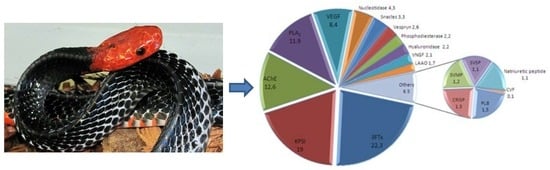
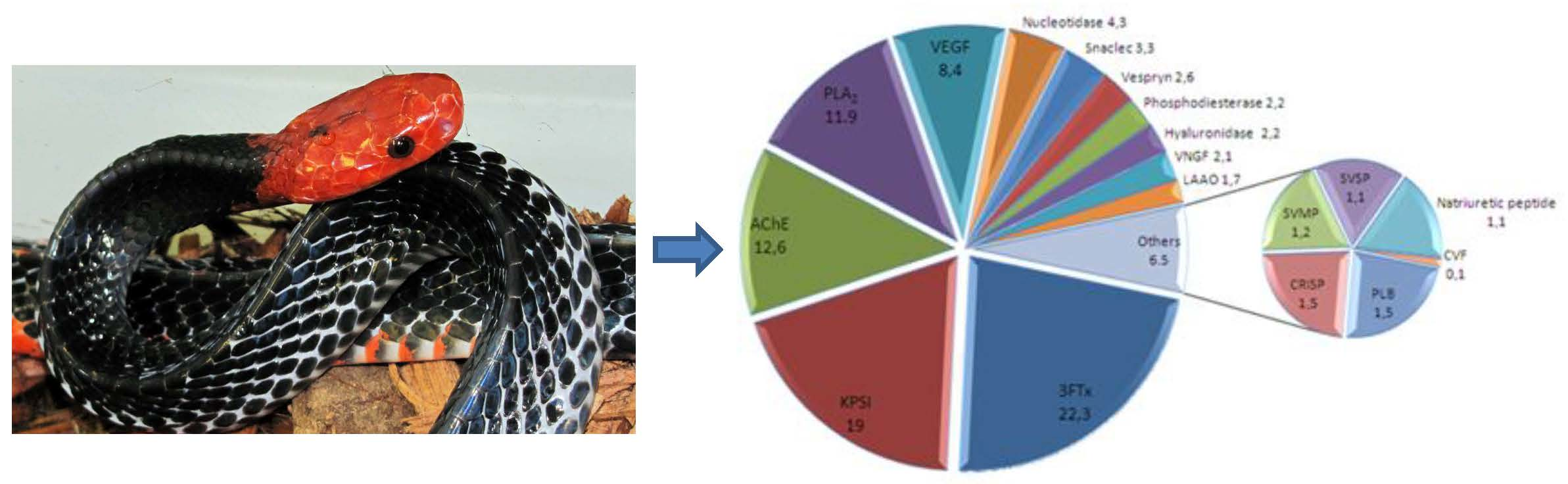
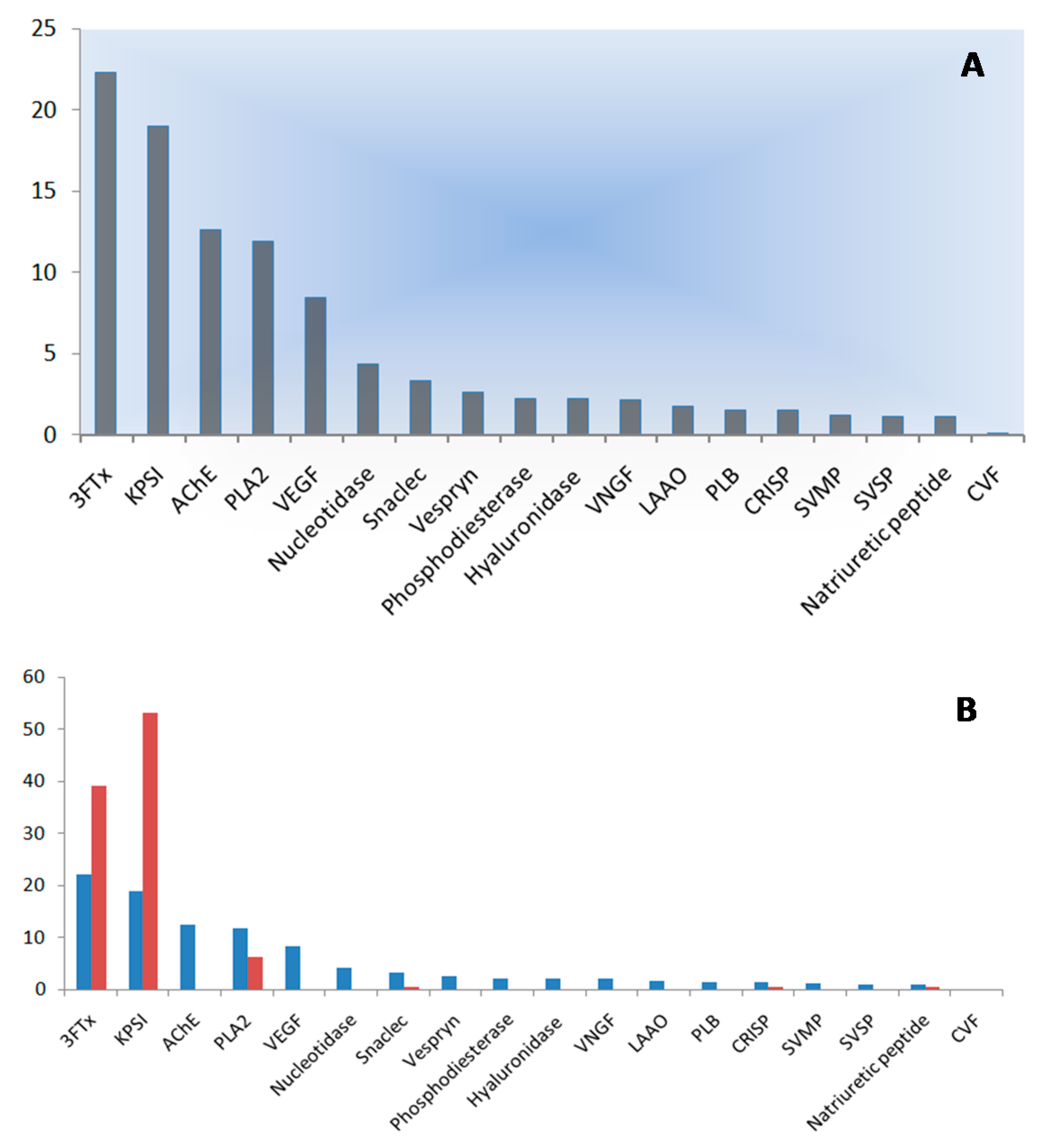
The use of -omics technologies allows for the characterization of snake venom composition at a fast rate and at high levels of detail. In the present study, we investigated the protein content of Red-headed Krait (Bungarus flaviceps) venom. This analysis revealed a high diversity of snake venom protein families, as evidenced by high-throughput mass spectrometric analysis. We found all six venom protein families previously reported in a transcriptome study of the venom gland of B. flaviceps, including phospholipases A2 (PLA2s), Kunitz-type serine proteinase inhibitors (KSPIs), three-finger toxins (3FTxs), cysteine-rich secretory proteins (CRISPs), snaclecs, and natriuretic peptides. A combined approach of automated database searches and de novo sequencing of tandem mass spectra, followed by sequence similarity searches, revealed the presence of 12 additional toxin families. De novo sequencing alone was able to identify 58 additional peptides, and this approach contributed significantly to the comprehensive description of the venom. Abundant protein families comprise 3FTxs (22.3%), KSPIs (19%), acetylcholinesterases (12.6%), PLA2s (11.9%), venom endothelial growth factors (VEGFs, 8.4%), nucleotidases (4.3%), and C-type lectin-like proteins (snaclecs, 3.3%); an additional 11 toxin families are present at significantly lower concentrations, including complement depleting factors, a family not previously detected in Bungarus venoms. The utility of a multifaceted approach toward unraveling the proteome of snake venoms, employed here, allowed detection of even minor venom components. This more in-depth knowledge of the composition of B. flaviceps venom facilitates a better understanding of snake venom molecular evolution, in turn contributing to more effective treatment of krait bites.
Keywords: Bungarus flaviceps; enzymes; Red-headed Krait; snake venom; toxins; proteome Bungarus flaviceps; enzymes; Red-headed Krait; snake venom; toxins; proteome
Graphical Abstract