A Dual Malnutrition Challenge in Tanzania Explored Through Logistic Regression Analysis



Abstract
1. Introduction
2. Methods
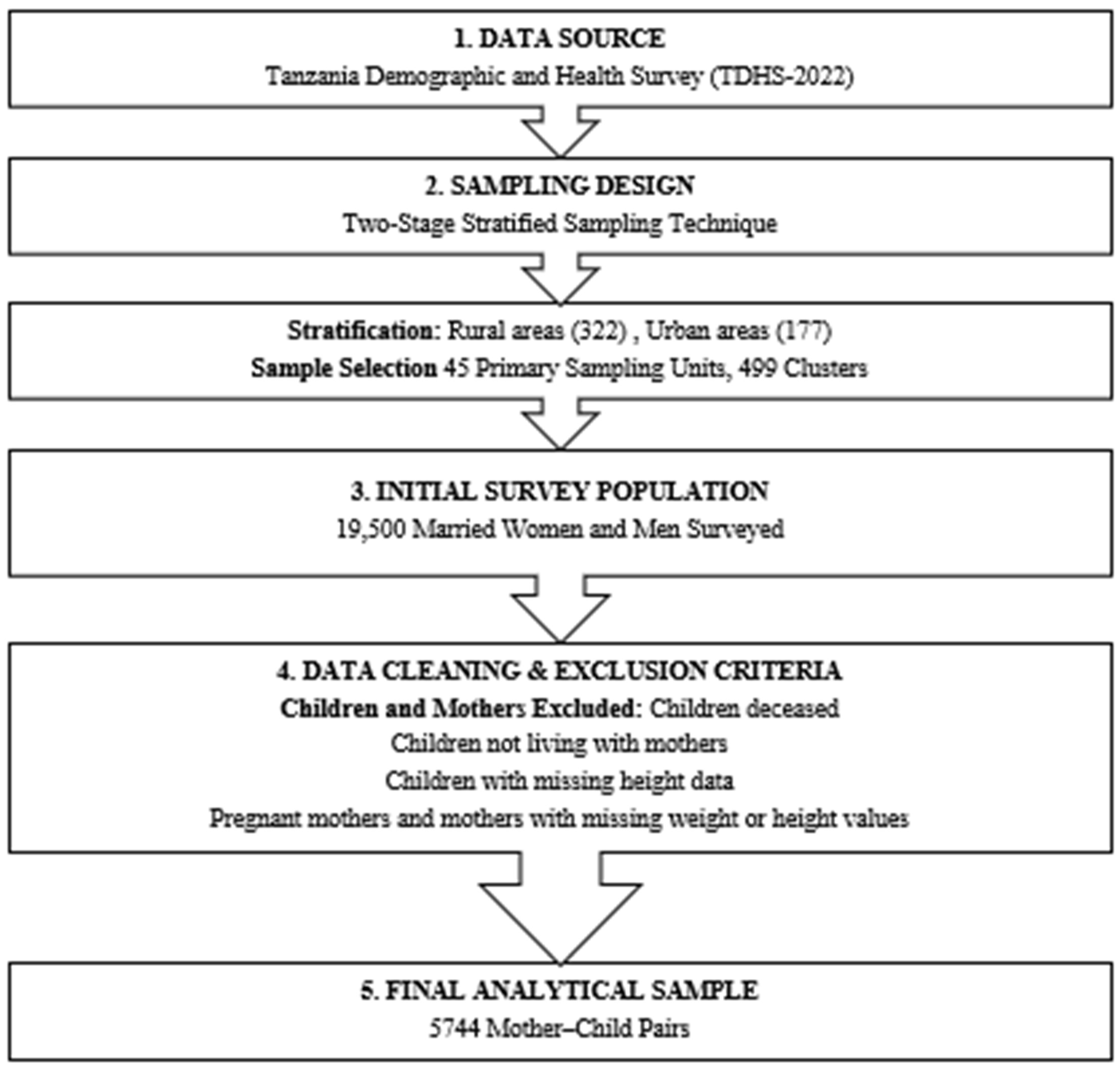
2.1. Data Source and Study Design
2.2. Outcome Variable
2.3. Operational Definitions
2.4. Independent Variables
2.5. Statistical Analysis
3. Results
4. Discussion
4.1. Strengths and Limitations
4.2. Policy Implications
5. Conclusions
Author Contributions
Funding
Institutional Review Board Statement
Informed Consent Statement
Data Availability Statement
Conflicts of Interest
Abbreviations
| DBM | Double-burden malnutrition |
| CIAF | Composite Index Anthropometric Failure |
| TDHS | Tanzania Demographic and Health survey |
| BMI | Body Mass Index |
References
- World Health Organization. Regional Office for the Eastern Mediterranean, WHO EMRO Home Page. Available online: http://www.emro.who.int/index.php (accessed on 1 September 2025).
- World Health Organization. Malnutrition. Available online: https://www.who.int/news-room/fact-sheets/detail/malnutrition (accessed on 1 March 2024).
- Mukisa, G.G.W.; Shumba, T.T.; Lourens, A.A.L. Determinants of undernutrition in children under five years in the Southern Africa sub-region: A scoping review. J. Health Res. 2024, 38, 10. [Google Scholar] [CrossRef]
- World Health Organization. Global Nutrition Targets 2025: Wasting. Available online: https://www.who.int/publications/i/item/WHO-NMH-NHD-14.8 (accessed on 30 December 2014).
- Feyisa, B.B.; Dabu, G.T. Determinant of under nutrition among under five children in Ambo town during COVID 19 pandemic in 2020. A community-based cross-sectional study. BMC Nutr. 2023, 9, 103. [Google Scholar] [CrossRef] [PubMed]
- Hagag, S.; Nasser, S.; Elden, N.M.K.; Taha, A.M. Prevalence and Determinants of Malnutrition among Under-Five Children in a Rural Village in Giza Governorate. Open Access Maced. J. Med. Sci. 2022, 10, 1125–1131. [Google Scholar] [CrossRef]
- Juma, O.A.; Enumah, Z.O.; Wheatley, H.; Rafiq, M.Y.; Shekalaghe, S.; Ali, A.; Mgonia, S.; Abdulla, S. Prevalence and assessment of malnutrition among children attending the Reproductive and Child Health clinic at Bagamoyo District Hospital, Tanzania. BMC Public Health 2016, 16, 1094. [Google Scholar] [CrossRef]
- World Health Organization. The Double Burden of Malnutrition. Policy Brief. 2017. Available online: https://www.who.int/publications/i/item/WHO-NMH-NHD-17.3 (accessed on 17 May 2017).
- Popkin, B.M.; Corvalan, C.; Grummer-Strawn, L.M. Dynamics of the double burden of malnutrition and the changing nutrition reality. Lancet 2020, 395, 65–74. [Google Scholar] [CrossRef]
- Siddiqa, M.; Shah, G.; Asif, T.; Kamal, A.; Shah, B. Socioeconomic and Environmental Factors Associated with Child Undernutrition and Growth Failure in Eastern Africa. Nutrients 2026, 18, 607. [Google Scholar] [CrossRef]
- Garrett, J.L.; Ruel, M.T. Stunted Child–Overweight Mother Pairs: Prevalence and Association with Economic Development and Urbanization. Food Nutr. Bull. 2005, 26, 209–221. [Google Scholar] [CrossRef] [PubMed]
- Santos, R.; Jerome, C.S.; Azandjeme, C.; Mizehoun-Adissoda, C.; Metonnou, C. Prevalence and Predictors of Double Burden of Malnutrition within Households in Africa: A Systematic Review. Food Nutr. Sci. 2023, 14, 908–927. [Google Scholar] [CrossRef]
- Addae, H.Y.; Sulemana, M.; Yakubu, T.; Atosona, A.; Tahiru, R.; Azupogo, F. Low birth weight; household socio-economic status, water and sanitation are associated with stunting and wasting among children aged 6–23 months: Results from a national survey in Ghana. PLoS ONE 2024, 19, e0297698. [Google Scholar] [CrossRef]
- Holliday, N.; Muhali, M.K.; Lembani, M.; Nonkeneza, H.; Feni, M.; Mchiza, Z.J.-R.; Hill, J.; Klinger, C.; Rehfuess, E.A.; von Philipsborn, P.; et al. Drivers and levers of the double burden of malnutrition in Cape Town, South Africa: Insights from in-depth interviews with multi-sectoral stakeholders. BMC Public Health 2025, 25, 2966. [Google Scholar] [CrossRef]
- Bernabé-Ortiz, A.; Quinteros-Reyes, C.; Carrillo-Larco, R.M. Double burden of malnutrition as a risk factor for overweight and obesity. Rev. Saude Publica 2022, 56, 93. [Google Scholar] [CrossRef]
- Belay, M.A.; Bogale, E.K.; Haile, M.T.; Bogale, S.K.; Getachew, E.; Andarge, G.A.; Seid, K.; Lakew, G.; Yirsaw, A.N.; Gebreegziabher, Z.A.; et al. Double burden of malnutrition among households in Ethiopia: A systematic review and meta-analysis. Front. Public Health 2025, 12, 1417289. [Google Scholar] [CrossRef]
- Christian, A.K.; Dake, F.A. Profiling household double and triple burden of malnutrition in sub-Saharan Africa: Prevalence and influencing household factors. Public Health Nutr. 2022, 25, 1563–1576. [Google Scholar] [CrossRef]
- Mekonnen, S.; Birhanu, D.; Menber, Y.; Gebreegziabher, Z.A.; Belay, M.A. Double burden of malnutrition and associated factors among mother–child pairs at household level in Bahir Dar City, Northwest Ethiopia: Community based cross-sectional study design. Front. Nutr. 2024, 11, 1340382. [Google Scholar] [CrossRef] [PubMed]
- Fumbwe, F.; Lihawa, R.; Andrew, F.; Kinyanjui, G.; Mkuna, E. Examination on level of scale efficiency in public hospitals in Tanzania. Cost Eff. Resour. Alloc. 2021, 19, 49. [Google Scholar] [CrossRef] [PubMed]
- Elisaria, E.; Caeyers, B.; Nkuba, E.; van der Erve, L.; Kuwawenaruwa, A. Thirty years of declining stunting in Tanzania: Trends and ongoing challenges. PLoS ONE 2025, 20, e0327779. [Google Scholar] [CrossRef]
- The World Bank Group. The World Bank in Tanzania. Available online: https://www.worldbank.org/ext/en/country/tanzania (accessed on 12 February 2026).
- Ministry of Health, Community Development, Gender, Elderly and Children; UNICEF. Tanzania National Nutrition Survey 2018. 2019. Available online: https://tzdpg.or.tz/document/tanzania-national-nutrition-survey-2018/ (accessed on 30 June 2019).
- Faustini, F.T.; Mniachi, A.R.; Msengwa, A.S. Coexistence and correlates of forms of malnutrition among mothers and under-five child pairs in Tanzania. J. Nutr. Sci. 2022, 11, e103. [Google Scholar] [CrossRef]
- Von Salmuth, V.; Buijs, L.; Chirangi, B.; Vreugdenhil, A.C.E.; Van Schayck, O.C.P. Health needs assessment for the double burden of malnutrition: A community-based study on nutrition facilitators and barriers in rural Tanzania. Public Health Nutr. 2023, 26, 2450–2459. [Google Scholar] [CrossRef] [PubMed]
- Gebremichael, B.; Abera, A.; Biadgilign, S.; Baye, K.; Zhou, S.J.; Haile, D. Double burden of malnutrition among under-five children in Eastern and Southern African countries. Sci. Rep. 2025, 15, 11042. [Google Scholar] [CrossRef]
- Chen, S.; Shimpuku, Y.; Honda, T.; Mwakawanga, D.L.; Mwilike, B. Dietary diversity moderates household economic inequalities in the double burden of malnutrition in Tanzania. Public Health Nutr. 2024, 27, e141. [Google Scholar] [CrossRef]
- Lukwa, A.T.; Chiwire, P.; Akinsolu, F.T.; Okova, D.; Hongoro, C. Double burden of malnutrition among women and children in Zimbabwe: A pooled logistic regression and Oaxaca-Blinder decomposition analysis. Front. Public Health 2024, 12, 1451898. [Google Scholar] [CrossRef]
- Tanzania Food and Nutrition Centre. Fill the Nutrient Gap Tanzania Findings. 2019. Available online: https://www.wfp.org/publications/fill-nutrient-gap (accessed on 13 April 2026).
- UNICEF. Committing to Child Survival: A Promise Renewed; Progress Report; UNICEF: New York, NY, USA, 2017. [Google Scholar]
- Kanire, E.; Erick, S.B.; Mdoe, C.N. Exploring the Factors Influencing Undernutrition Among Children Under Five in Tanzania. Afr. J. Empir. Res. 2024, 5, 240–249. [Google Scholar] [CrossRef]
- Byrne, E.; Sæbø, J.I. Routine use of DHIS2 data: A scoping review. BMC Health Serv. Res. 2022, 22, 1234. [Google Scholar] [CrossRef]
- Corsi, D.J.; Neuman, M.; Finlay, J.E.; Subramanian, S. Demographic and health surveys: A profile. Int. J. Epidemiol. 2012, 41, 1602–1613. [Google Scholar] [CrossRef] [PubMed]
- Seferidi, P.; Hone, T.; Duran, A.C.; Bernabe-Ortiz, A.; Millett, C. Global inequalities in the double burden of malnutrition and associations with globalisation: A multilevel analysis of Demographic and Health Surveys from 55 low-income and middle-income countries, 1992–2018. Lancet Glob. Health 2022, 10, e482–e490. [Google Scholar] [CrossRef]
- Yigezu, M.; Oumer, A.; Damtew, B.; Birhanu, D.; Workie, S.G.; Hamza, A.; Atle, A.; Kebede, N. The dual burden of malnutrition and its associated factors among mother-child pairs at the household level in Ethiopia: An urgent public health issue demanding sector-wide collaboration. PLoS ONE 2024, 19, e0307175. [Google Scholar] [CrossRef]
- Nandy, S.; Irving, M.; Gordon, D.; Subramanian, S.V.; Smith, G.D. Poverty, child undernutrition and morbidity: New evidence from India. Bull. World Health Organ. 2005, 83, 210–216. [Google Scholar]
- Svedberg, P. Poverty and Undernutrition: Theory, Measurement, and Policy; Oxford University Press: Oxford, UK, 2000. [Google Scholar] [CrossRef]
- Wambua, M.; Kariuki, S.M.; Abdullahi, H.; Abdullahi, O.A.; Ngari, M.M. Wasting coexisting with underweight and stunting among children aged 6–59 months hospitalised in Garissa County Referral Hospital, Kenya. Matern. Child Nutr. 2025, 21, e13754. [Google Scholar] [CrossRef] [PubMed]
- Gausman, J.; Kim, R.; Li, Z.; Tu, L.; Rajpal, S.; Joe, W.; Subramanian, S.V. Comparison of Child Undernutrition Anthropometric Indicators Across 56 Low- and Middle-Income Countries. JAMA Netw. Open 2022, 5, e221223. [Google Scholar] [CrossRef] [PubMed]
- Ayres, A.; Dawed, Y.A.; Wedajo, S.; Alene, T.D.; Gedefie, A.; Getahun, F.B.; Muche, A. Anthropometric failures and its predictors among under five children in Ethiopia: Multilevel logistic regression model using 2019 Ethiopian demographic and health survey data. BMC Public Health 2024, 24, 1149. [Google Scholar] [CrossRef]
- StataCorp LLC. Stata User’s Guide, Release 17; StataCorp LLC: College Station, TX, USA, 2021. [Google Scholar]
- Njelekela, M.; Muhini, A.; Mpembeni, R.; Anaeli, A.; Chillo, O.; Kubhoja, S.; Lujani, B.; Ngarashi, D.; Maghembe, M. Knowledge and attitudes towards obesity among primary school children in Dar es Salaam, Tanzania. Niger. Med. J. 2015, 56, 103. [Google Scholar] [CrossRef]
- Danquah, F.I.; Ansu-Mensah, M.; Bawontuo, V.; Yeboah, M.; Kuupiel, D. Prevalence, incidence, and trends of childhood overweight/obesity in Sub-Saharan Africa: A systematic scoping review. Arch. Public Health 2020, 78, 109. [Google Scholar] [CrossRef] [PubMed]
- Alem, A.Z.; Yeshaw, Y.; Liyew, A.M.; Tessema, Z.T.; Worku, M.G.; Tesema, G.A.; Alamneh, T.S.; Teshale, A.B.; Chilot, D.; Ayalew, H.G. Double burden of malnutrition and its associated factors among women in low and middle income countries: Findings from 52 nationally representative data. BMC Public Health 2023, 23, 1479. [Google Scholar] [CrossRef]
- Khaliq, A.; Godil, M.S.; Taseen, S.; Usmani, I.A.; Chowdhury, T.S. Prevalence; Trends, and Determinants of Double Burden of Malnutrition Among the Mother–Child Dyads of Pakistan. Int. J. Pediatr. 2025, 2025, 8816802. [Google Scholar] [CrossRef]
- Okyere, J.; Donkoh, I.E.; Seidu, A.-A.; Ahinkorah, B.O.; Aboagye, R.G.; Yaya, S. Mother–child dyads of overnutrition and undernutrition in sub-Saharan Africa. J. Health Popul. Nutr. 2024, 43, 1. [Google Scholar] [CrossRef]
- Nyanhanda, T.; Mwanri, L.; Mude, W. Double Burden of Malnutrition: A Population Level Comparative Cross-Sectional Study across Three Sub-Saharan African Countries—Malawi, Namibia and Zimbabwe. Int. J. Environ. Res. Public Health 2023, 20, 5860. [Google Scholar] [CrossRef]
- Harper, A.; Goudge, J.; Chirwa, E.; Rothberg, A.; Sambu, W.; Mall, S. Dietary diversity, food insecurity and the double burden of malnutrition among children, adolescents and adults in South Africa: Findings from a national survey. Front. Public Health 2022, 10, 948090. [Google Scholar] [CrossRef] [PubMed]
- Farah, A.M.; Nour, T.Y.; Endris, B.S.; Gebreyesus, S.H. Concurrence of stunting and overweight/obesity among children: Evidence from Ethiopia. PLoS ONE 2021, 16, e0245456. [Google Scholar] [CrossRef]
- Fente, B.M.; Tesema, G.A.; Gudayu, T.W.; Asaye, M.M. Development and validation of a nomogram for predicting low birth weight among pregnant women who had antenatal care visits at Debre Markos Comprehensive and Specialized Hospital, Ethiopia. Front. Med. 2023, 10, 1253490. [Google Scholar] [CrossRef] [PubMed]
- Haider, B.A.; Bhutta, Z.A. Multiple-micronutrient supplementation for women during pregnancy. In Cochrane Database of Systematic Reviews; Bhutta, Z.A., Ed.; John Wiley & Sons, Ltd.: Chichester, UK, 2015. [Google Scholar] [CrossRef]
- Hembrom, S.S.; Kujur, M.; Sagar, V.; Anand, P.; Sahu, S.; Murmu, M.P.; Kiran, K.A. Double Burden of Malnutrition Among Pregnant Women in Rural Jharkhand: Evidence from a Cross-Sectional Study. Cureus 2024, 16, e74692. [Google Scholar] [CrossRef]
- United Nations Children’s Fund (UNICEF) Tanzania. Improving Maternal Nutrition in Tanzania (IMAN Project). 2025. Available online: https://www.unicef.org/tanzania/documents/improving-maternal-nutrition-tanzania (accessed on 12 January 2026).
- COUNSENUTH. Mwanzo Bora Nutrition Program (MBNP) 2011–2018. 2024. Available online: https://counsenuth.or.tz/mwanzo-bora-nutrition-program-2011-2018/ (accessed on 2 December 2025).
- Tanzania Food and Nutrition Centre & Partners. Mwanzo Bora Nutrition Program SBCC Kit Scale-Up. 2024. Available online: https://global.comminit.com/content/mwanzo-bora-nutrition-program-mbnp/ (accessed on 23 November 2025).



| Group | CIAF | Wasting | Stunting | Underweight |
|---|---|---|---|---|
| A | No failure | No | No | No |
| Anthropometric Failure group | ||||
| B | Wasting only | Yes | No | No |
| C | Wasting and underweight | Yes | No | Yes |
| D | Wasting, underweight, and stunting | Yes | Yes | Yes |
| E | Stunting and underweight | No | Yes | Yes |
| F | Stunting only | No | Yes | No |
| Y | Underweight only | No | No | Yes |
| Variable | Indicator/Cut-Off | Coding | Description |
|---|---|---|---|
| Maternal BMI | BMI ≥ 25 kg/m2 | 1 | Overweight/Obese |
| BMI < 25 kg/m2 | 0 | Not Overweight/Obese | |
| Child Anthropometric Failure (CIAF) | Any Anthropometric Failure group | 1 | Yes (Anthropometric Failure Present) |
| No anthropometric failure | 0 | No (Anthropometric Failure Absent) | |
| Double Burden of Malnutrition (DBM) | Mother (BMI ≥ 25) and Child (CIAF = 1) | 1 | Yes (DBM Present) |
| Otherwise | 0 | No (DBM Absent) |
| Characteristics | Tanzania (TDHS-2022) | ||
|---|---|---|---|
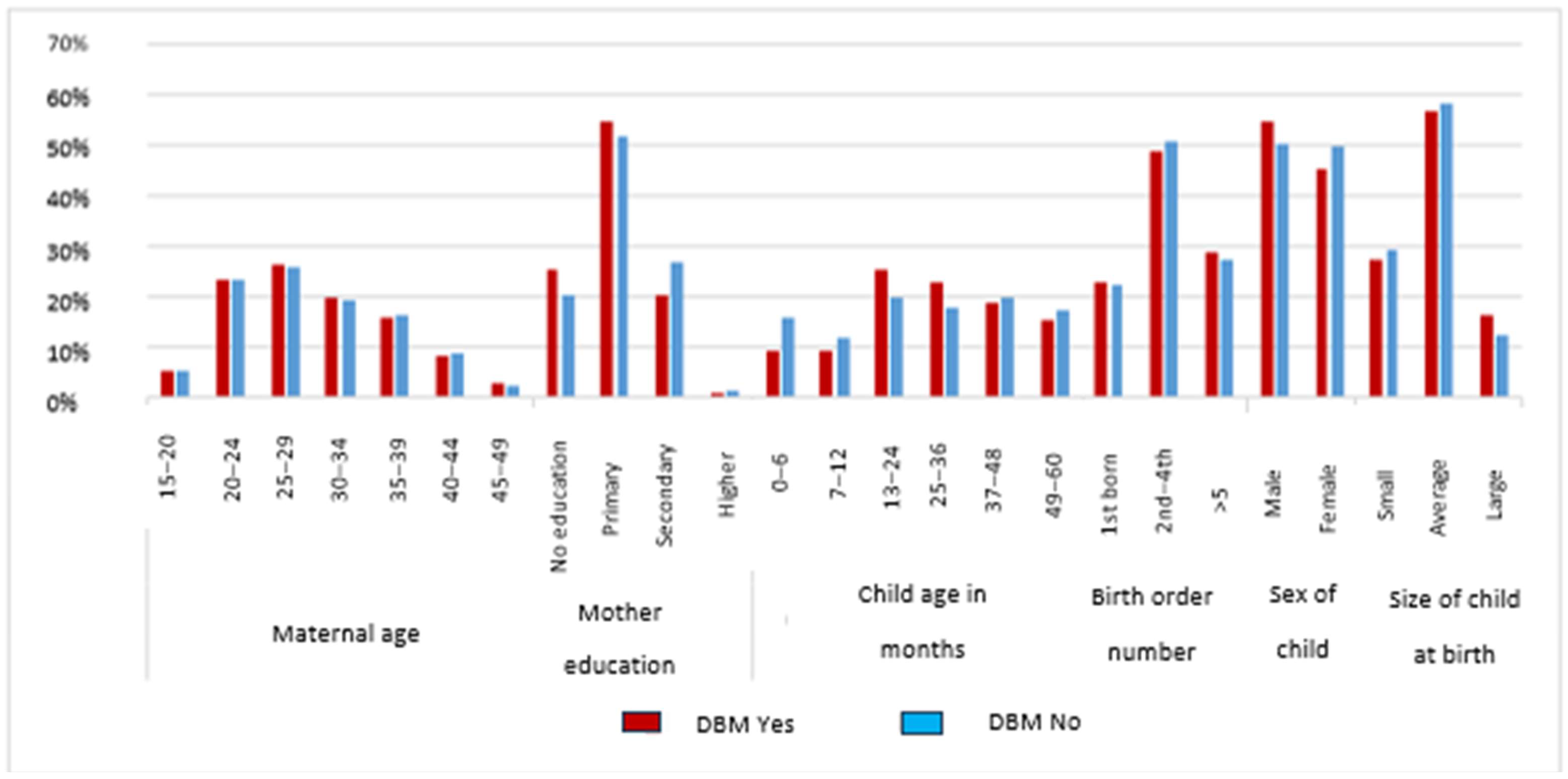
| Double-burden malnutrition (DBM) | No DBM Frequency (%) | Yes DBM Frequency (%) | /p-values |
| Societal Characteristics | |||
| Place of residence | 36.910/<0.001 | ||
| Urban | 2565 (87.30) | 373 (12.70) | |
| Rural | 6469 (82.46) | 1376 (17.54) | |
| Source of drinking water | 0.084/0.772 | ||
| Unimproved | 7261 (83.73) | 1411 (16.27) | |
| Improved | 1773 (83.99) | 338 (16.01) | |
| Toilet facility | 6.197/0.013 | ||
| Unimproved | 2876 (82.50) | 610 (17.50) | |
| Improved | 6158 (84.39) | 1139 (15.61) | |
| Socioeconomic status | 77.771/<0.001 | ||
| Poor | 3566 (80.75) | 850 (19.25) | |
| Middle | 1835 (82.58) | 387 (17.42) | |
| Rich | 3633 (87.65) | 512 (12.35) | |
| Child Characteristics | |||
| Milk consumption | 1.918/0.166 | ||
| No | 5146 (83.21) | 1038 (16.79) | |
| Yes | 412 (85.65) | 69 (14.35) | |
| Initiation of breastfeeding | 6.751/0.034 | ||
| Immediately | 4758 (82.89) | 982 (17.11) | |
| Within 1st hour | 1156 (85.06) | 203 (14.94) | |
| Within 1st day | 48 (92.31) | 4 (7.69) | |
| Birth order number | 2.748/0.253 | ||
| 1st born | 2017 (83.59) | 396 (16.41) | |
| 2nd–4th | 4571 (84.32) | 850 (15.68) | |
| >5 | 2446 (82.94) | 503 (17.06) | |
| Sex of child | 12.882/<0.001 | ||
| Male | 4530 (82.53) | 959 (17.47) | |
| Female | 4504 (85.08) | 790 (14.92) | |
| Size of child at birth | 13.976/0.001 | ||
| Small | 1598 (83.93) | 306 (16.07) | |
| Average | 3179 (83.22) | 641 (16.78) | |
| Large | 666 (78.35) | 184 (21.65) | |
| Baby postnatal checkup within 2 months | 1.248/0.264 | ||
| No | 1314 (82.59) | 277 (17.41) | |
| Yes | 2646 (83.87) | 509 (16.13) | |
| Child’s age in months | 75.855/<0.001 | ||
| 0–6 | 507 (77.52) | 147 (22.48) | |
| 7–12 | 378 (72.14) | 146 (27.86) | |
| 13–24 | 650 (61.03) | 415 (38.97) | |
| 25–36 | 579 (60.76) | 374 (39.24) | |
| 37–48 | 604 (65.30) | 321 (34.70) | |
| 49–60 | 567 (69.66) | 247 (30.34) | |
| Parental Characteristics | |||
| Breastfed ever | 0.632/0.426 | ||
| No | 4307 (83.49) | 852 (16.51) | |
| Yes | 4727 (84.05) | 897 (15.95) | |
| Maternal smoking | 0.422/0.516 | ||
| No | 9002 (83.79) | 1741 (16.21) | |
| Yes | 32 (80.00) | 8 (20.00) | |
| Intake of iron during Pregnancy | 2.420/0.120 | ||
| No | 845 (81.64) | 190 (18.36) | |
| Yes | 4006 (83.63) | 784 (16.37) | |
| Maternal age | 2.697/0.846 | ||
| 15–19 | 438 (83.27) | 88 (16.73) | |
| 20–24 | 2079 (83.56) | 409 (16.44) | |
| 25–29 | 2378 (84.24) | 445 (15.76) | |
| 30–34 | 1793 (84.14) | 338 (15.86) | |
| 35–39 | 1391 (83.04) | 284 (16.96) | |
| 40–44 | 723 (83.10) | 147 (16.90) | |
| 45–49 | 232 (85.93) | 38 (14.07) | |
| Mother’s education | 55.882/<0.001 | ||
| No education | 1835 (80.69) | 439 (19.31) | |
| Primary | 4667 (83.03) | 954 (16.97) | |
| Secondary | 2424 (87.35) | 351 (12.65) | |
| Higher | 108 (95.58) | 5 (4.42) | |
| Mother’s occupation | 0.482/0.487 | ||
| Not working | 3063 (84.13) | 578 (15.87) | |
| Working | 5971 (83.60) | 1171 (16.40) | |
| Father’s education | 46.078/<0.001 | ||
| No education | 1181 (81.90) | 261 (18.10) | |
| Primary | 4205 (82.06) | 919 (17.94) | |
| Secondary | 1923 (87.21) | 282 (12.79) | |
| Higher | 233 (92.09) | 20 (7.91) | |
| Variables | Categories | Tanzania (TDHS-2022) Overall Model | ||
|---|---|---|---|---|
| OR | C.I | p-values | ||
| Societal Characteristics | ||||
| Place of residence | Urban * | - | - | - |
| Rural | 1.462 | (1.293–1.654) | <0.001 | |
| Source of drinking water | Unimproved * | - | - | - |
| Improved | 0.981 | (0.861–1.116) | (0.772) | |
| Toilet facility | Unimproved * | - | - | - |
| Improved | 0.872 | (0.782–0.971) | (0.013) | |
| Socioeconomic status | Poor * | - | - | - |
| Middle | 0.884) | (0.774–1.010) | (0.071) | |
| Rich | 0.591 | (0.524–0.665) | (<0.001) | |
| Child Characteristics | ||||
| Milk consumption | No * | - | - | - |
| Yes | 0.830 | (0.637–1.080) | (0.167) | |
| Initiation of breastfeeding | Immediately * | - | - | |
| Within 1st hour | 0.850 | (0.721–1.002) | (0.054) | |
| Within 1st day | 0.403 | (0.145–1.122) | (0.082) | |
| Birth order number | 1st born * | - | - | - |
| 2nd-4th | 0.947 | (0.831–1.078 | (0.414) | |
| >5 | 1.047 | (0.906–1.209) | (0.529) | |
| Sex of child | Male * | - | - | - |
| Female | 0.828 | (0.747–0.918) | (<0.001) | |
| Size of child at birth | Small * | - | - | - |
| Average | 1.052 | (0.907–1.222) | (0.497) | |
| Large | 0.442 | (0.176–0.769) | (<0.001) | |
| Baby postnatal checkup within 2 months | No * | - | - | - |
| Yes | 0.912 | (0.777–1.071) | (0.264) | |
| Child’s age in months | 0–6 * | - | - | - |
| 7–12 | 0.332 | (0.122–0.836) | (0.034) | |
| 13–24 | 2.202 | (1.76–2.746) | (<0.001) | |
| 25–36 | 2.227 | (1.779–2.789) | (<0.001) | |
| 37–48 | 1.832 | (1.459–2.302) | (<0.001) | |
| 49–60 | 1.502 | (1.185–1.903) | (0.001) | |
| Parental Characteristics | ||||
| Breastfed ever | No * | - | - | - |
| Yes | 0.959 | (0.865–1.062) | (0.426) | |
| Maternal smoking | No * | - | - | - |
| Yes | 1.292 | (0.594–2.809) | (0.517) | |
| Intake of iron during Pregnancy | No * | - | - | - |
| Yes | 0.870 | (0.730–1.036) | (0.120) | |
| Maternal age | 15–19 * | - | - | - |
| 20–24 | 0.979 | (0.760–1.260) | (0.870) | |
| 25–29 | 0.931 | (0.725–1.196) | (0.578) | |
| 30–34 | 0.938 | (0.725–1.212) | (0.627) | |
| 35–39 | 1.016 | (0.781–1.320) | (0.904) | |
| 40–44 | 1.011 | (0.757–1.351) | (0.936) | |
| 45–49 | 0.815 | (0.539–1.231) | (0.332) | |
| Mother’s education | No education * | - | - | - |
| Primary | 0.854 | (0.753–0.968) | (0.014) | |
| Secondary | 0.605 | (0.519–0.705) | (<0.001) | |
| Higher | 0.193 | (0.0784–0.477) | (<0.001) | |
| Mother’s occupation | Not working * | - | - | - |
| Working | 1.039 | (0.932–1.158) | (0.487) | |
| Father’s education | No education * | - | ||
| Primary | 0.988 | (0.849–1.151) | (0.886) | |
| Secondary | 0.663 | (0.552–0.797) | (<0.001) | |
| Higher | 0.388 | (0.241–0.625) | (<0.001) | |
| Variables | Categories | Tanzania (TDHS-2022) Overall Model | ||
| AOR | C.I | p-values | ||
| Socio-demographic Characteristics | ||||
| Place of residence | Urban * | - | - | - |
| Rural | 1.268 | (0.876–1.836) | (0.207) | |
| Source of drinking water | Unimproved * | - | - | - |
| Improved | 0.978 | (0.697–1.373) | (0.900) | |
| Toilet facility | Unimproved * | - | - | - |
| Improved | 1.037 | (0.747–1.440) | (0.825) | |
| Socioeconomic status | Poor * | - | - | - |
| Middle | 1.077 | (0.739–1.570) | (0.698) | |
| Rich | 0.927 | (0.612–1.403) | (0.720) | |
| Child Characteristics | ||||
| Milk consumption | No * | - | - | - |
| Yes | 1.244 | (0.730–2.120) | (0.422) | |
| Initiation of breastfeeding | Immediately * | - | - | - |
| Within 1st hour | 0.803 | (0.555–1.161) | (0.245) | |
| Within 1st day | 0.568 | (0.468–1.164) | (0.366) | |
| Birth order number | 1st born * | - | - | - |
| 2nd–4th | 0.611 | (0.391–0.945) | (0.030) | |
| >5 | 0.783 | (0.431–1.422) | (0.422) | |
| Sex of child | Male * | - | - | - |
| Female | 0.708 | (0.542–0.924) | (0.011) | |
| Size of child at birth | Small * | - | - | - |
| Average | 0.946 | (0.703–1.272) | (0.715) | |
| Large | 0.270 | (0.162–0.695) | (0.004) | |
| Baby postnatal checkup within 2 months | No * | - | - | - |
| Yes | 1.070 | (0.806–1.420) | (0.638) | |
| Child’s age in months | 0–6 * | - | - | - |
| 7–12 | 1.267 | (0.869–1.848) | (0.218) | |
| 13–24 | 0.474 | (0.237–0.827) | (<0.001) | |
| 25–36 | 0.779 | (0.589–1.114) | (0.434) | |
| 37–48 | 1.357 | (0.987–1.514) | (0.378) | |
| 49–60 | 1.124 | (0.746–1.865) | (0.577) | |
| Parental Characteristics | ||||
| Breastfed ever | No * | - | - | - |
| Yes | 0.752 | (0.525–1.077) | (0.121) | |
| Maternal smoking | No * | - | - | - |
| Yes | 0.767 | (0.688–1.201) | (0.356) | |
| Intake of iron during Pregnancy | No * | - | - | - |
| Yes | 0.921 | (0.646–1.312) | (0.649) | |
| Maternal age | 15–19 * | - | - | - |
| 20–24 | 1.368 | (0.744–2.515) | (0.312) | |
| 25–29 | 0.599 | (0.215–0.737) | (0.045) | |
| 30–34 | 1.727 | (0.834–2.578) | (0.141) | |
| 35–39 | 1.915) | (0.876–2.185) | (0.103) | |
| 40–44 | 1.924 | (0.807–4.483) | (0.140) | |
| 45–49 | 1.317 | (0.350–1.951) | (0.41) | |
| Mother’s education | No education * | - | - | - |
| Primary | 0.664 | (0.459–0.960) | (0.030) | |
| Secondary | 0.604 | (0.377–0.965) | (0.035) | |
| Higher | 0.787 | (0.579–1.235) | (0.346) | |
| Mother’s occupation | Not working * | - | - | - |
| Working | 1.110 | (0.842–1.465) | (0.457) | |
| Father’s education | No education * | - | - | - |
| Primary | 1.261 | (0.841–1.890) | (0.261) | |
| Secondary | 1.157 | (0.705–1.898) | (0.563) | |
| Higher | 0.829 | (0.283–1.426) | (0.732) | |
Disclaimer/Publisher’s Note: The statements, opinions and data contained in all publications are solely those of the individual author(s) and contributor(s) and not of MDPI and/or the editor(s). MDPI and/or the editor(s) disclaim responsibility for any injury to people or property resulting from any ideas, methods, instructions or products referred to in the content. |
© 2026 by the authors. Licensee MDPI, Basel, Switzerland. This article is an open access article distributed under the terms and conditions of the Creative Commons Attribution (CC BY) license.
Share and Cite
Siddiqa, M.; Shah, G.H.; Butt, M.S.; Asif, T.; Shah, B. A Dual Malnutrition Challenge in Tanzania Explored Through Logistic Regression Analysis. Nutrients 2026, 18, 1301. https://doi.org/10.3390/nu18081301
Siddiqa M, Shah GH, Butt MS, Asif T, Shah B. A Dual Malnutrition Challenge in Tanzania Explored Through Logistic Regression Analysis. Nutrients. 2026; 18(8):1301. https://doi.org/10.3390/nu18081301
Chicago/Turabian StyleSiddiqa, Maryam, Gulzar H. Shah, Mahnoor Shahid Butt, Tehreem Asif, and Bushra Shah. 2026. "A Dual Malnutrition Challenge in Tanzania Explored Through Logistic Regression Analysis" Nutrients 18, no. 8: 1301. https://doi.org/10.3390/nu18081301
APA StyleSiddiqa, M., Shah, G. H., Butt, M. S., Asif, T., & Shah, B. (2026). A Dual Malnutrition Challenge in Tanzania Explored Through Logistic Regression Analysis. Nutrients, 18(8), 1301. https://doi.org/10.3390/nu18081301