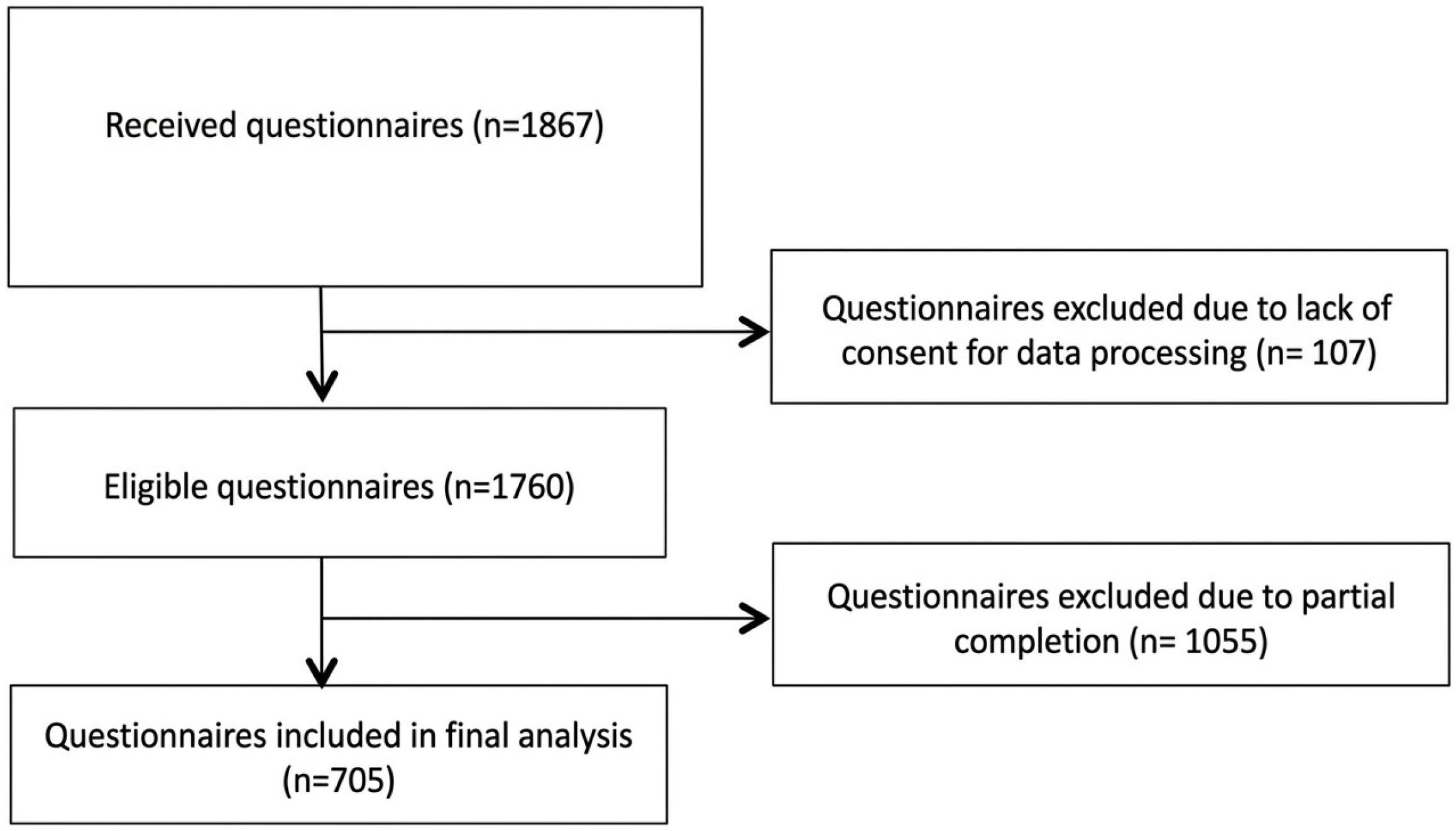
Nutritional Risk in Patients with IBD: Results from a National Survey

 , , , , ,
Abstract
1. Introduction
2. Materials and Methods
2.1. Study Design and Population
- Age ≥ 18 years;
- Self-reported diagnosis of Crohn’s disease (CD), ulcerative colitis (UC), or indeterminate colitis;
- Not hospitalized at the time of survey completion;
- Provision of electronic informed consent.
- Exclusive enteral or parenteral nutrition;
- Duplicate responses;
- Incomplete questionnaires.
2.2. Questionnaire Development
- Age, Gender, Region of residence, Education level, Comorbidities, Smoking habits, Level of physical activity;
- Self-reported weight, height, and weight 6 months prior;
- Body Mass Index (BMI);
- Gastrointestinal symptoms and appetite reduction;
- Recent inflammation markers (<2 weeks) as C-Reactive Protein;
- Disease history, medical therapy, and prior surgeries;
- Use of vitamins, minerals and oral nutritional supplements (ONS);
- Access to dietary counselling.
2.3. Nutritional Risk Assessment
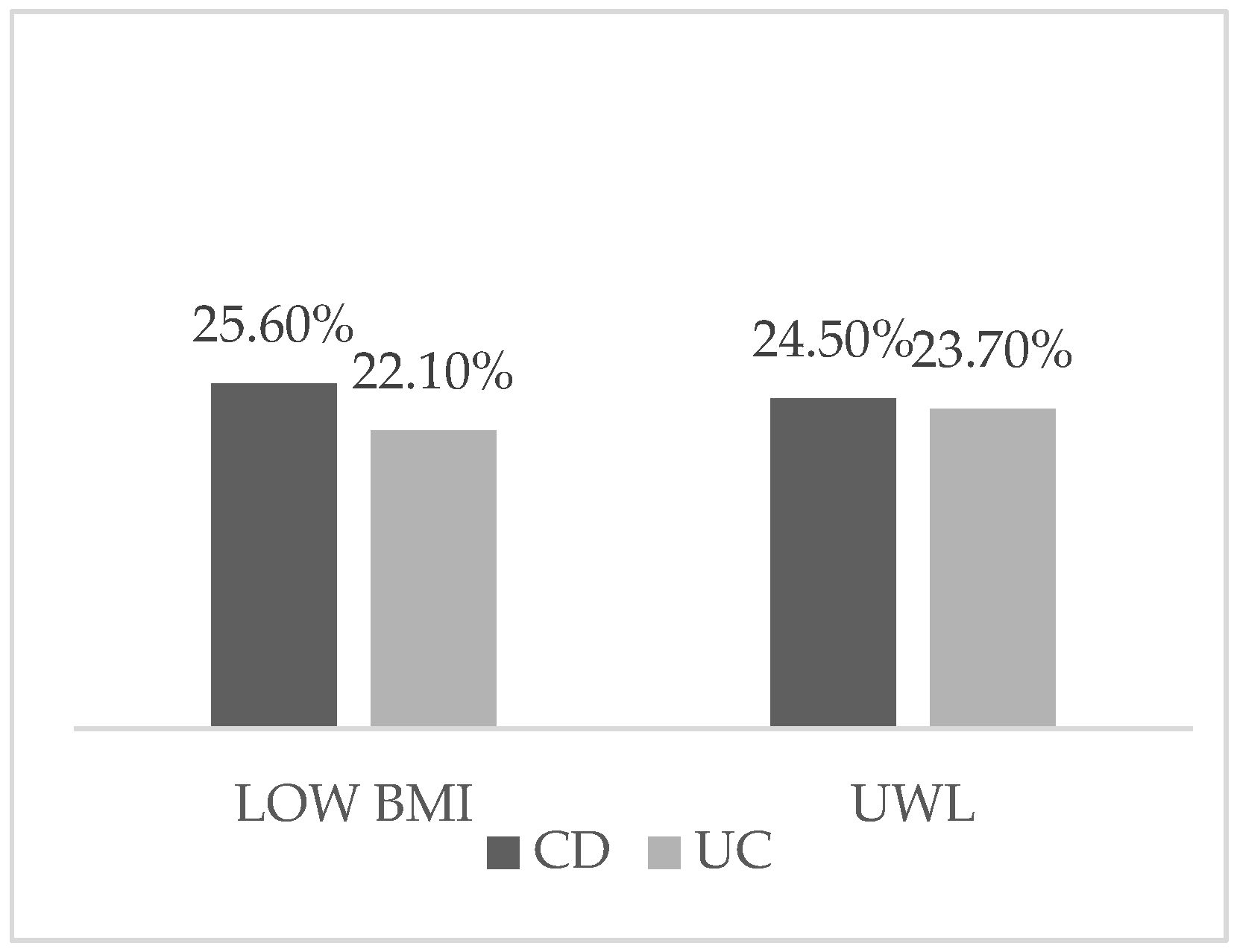
- BMI: This was calculated using the patient’s self-reported height and weight.
- Unintentional weight loss (UWL): This was determined as the percentage of UWL over the past three to six months. For this reason, patients were asked to report their weight from six months prior.
- Acute Disease Effect: This element assessed the patient’s self-reported disease activity combined with a reduced/no nutritional intake for more than five days. Specifically, this item was determined from self-reported data by asking participants whether they had consistently reduced their daily food intake over the past week (defined as a reduction of less than 50% of their usual portions).
2.4. Statistical Analysis
2.5. Data Quality
2.6. Ethical Consideration
3. Results
3.1. Participants
3.2. Nutritional Screening According to MUST
3.3. Correlation Between Nutritional Risk and Clinical Characteristics, Lifestyle and Access to Nutritional Care
3.4. Multivariate Analysis of Factors Associated with Nutritional Risk (MUST ≥ 2)
4. Discussion
Strengths and Limitations
5. Conclusions
Author Contributions
Funding
Institutional Review Board Statement
Informed Consent Statement
Data Availability Statement
Conflicts of Interest
Abbreviations
| IBD | Inflammatory Bowel Diseases |
| CD | Crohn Disease |
| UC | Ulcerative Colitis |
| MUST | Malnutrition Universal Screening Tool |
| GLIM | Global Leadership Initiative on Malnutrition |
| BMI | Body Mass Index |
| UWL | Unintentional weight loss |
| GI | Gastrointestinal |
| ONS | Oral Nutritional Supplement |
References
- Goh, J.; O’Morain, C.A. Review article: Nutrition and adult inflammatory bowel disease. Aliment. Pharmacol. Ther. 2003, 17, 307–320. [Google Scholar] [CrossRef] [PubMed]
- Hartman, C.; Eliakim, R.; Shamir, R. Nutritional status and nutritional therapy in inflammatory bowel diseases. World J. Gastroenterol. 2009, 15, 2570–2578. [Google Scholar] [CrossRef] [PubMed] [PubMed Central]
- Spooren, C.E.G.M.; Wintjens, D.S.J.; de Jong, M.J.; van der Meulen-de Jong, A.E.; Romberg-Camps, M.J.; Becx, M.C.; Maljaars, J.P.; van Bodegraven, A.A.; Mahmmod, N.; Markus, T.; et al. Risk of impaired nutritional status and flare occurrence in IBD outpatients. Dig. Liver Dis. 2019, 51, 1265–1269. [Google Scholar] [CrossRef] [PubMed]
- Wędrychowicz, A.; Zając, A.; Tomasik, P. Advances in nutritional therapy in inflammatory bowel diseases: Review. World J. Gastroenterol. 2016, 22, 1045–1066. [Google Scholar] [CrossRef] [PubMed] [PubMed Central]
- Bischoff, S.C.; Bager, P.; Escher, J.; Forbes, A.; Hébuterne, X.; Hvas, C.L.; Joly, F.; Klek, S.; Krznaric, Z.; Ockenga, J.; et al. ESPEN guideline on Clinical Nutrition in inflammatory bowel disease. Clin. Nutr. 2023, 42, 352–379. [Google Scholar] [CrossRef] [PubMed]
- Jonkers, D.M. Microbial perturbations and modulation in conditions associated with malnutrition and malabsorption. Best Pract. Res. Clin. Gastroenterol. 2016, 30, 161–172. [Google Scholar] [CrossRef] [PubMed]
- de Castro, M.M.; Pascoal, L.B.; Steigleder, K.M.; Siqueira, B.P.; Corona, L.P.; Ayrizono, M.L.S.; Milanski, M.; Leal, R.F. Role of diet and nutrition in inflammatory bowel disease. World J. Exp. Med. 2021, 11, 1–16. [Google Scholar] [CrossRef] [PubMed] [PubMed Central]
- Lomer, M.C.E.; Wilson, B.; Wall, C.L. British Dietetic Association consensus guidelines on the nutritional assessment and dietary management of patients with inflammatory bowel disease. J. Hum. Nutr. Diet. 2023, 36, 336–377. [Google Scholar] [CrossRef] [PubMed] [PubMed Central]
- Saibeni, S.; Zanetti, M.; Bezzio, C.; Pironi, L.; Armuzzi, A.; Riso, S.; Caprioli, F.; Lezo, A.; Macaluso, F.S.; Pugliese, D.; et al. Nutritional care at centres managing patients with inflammatory bowel disease: A nationwide survey in Italy. Dig. Liver Dis. 2023, 55, 1028–1033. [Google Scholar] [CrossRef] [PubMed]
- Keetarut, K.; Zacharopoulou-Otapasidou, S.; Bloom, S.; Majumdar, A.; Patel, P.S. An evaluation of the feasibility and validity of a patient-administered malnutrition universal screening tool (‘MUST’) compared to healthcare professional screening in an inflammatory bowel disease (IBD) outpatient clinic. J. Hum. Nutr. Diet. 2017, 30, 737–745. [Google Scholar] [CrossRef] [PubMed]
- Sandhu, A.; Mosli, M.; Yan, B.; Wu, T.; Gregor, J.; Chande, N.; Ponich, T.; Beaton, M.; Rahman, A. Self-Screening for Malnutrition Risk in Outpatient Inflammatory Bowel Disease Patients Using the Malnutrition Universal Screening Tool (MUST). J. Parenter. Enteral Nutr. 2016, 40, 507–510. [Google Scholar] [CrossRef] [PubMed]
- Cawood, A.L.; Walters, E.R.; Sharp, S.K.E.; Elia, M.; Stratton, R.J. ‘Self-screening’ for malnutrition with an electronic version of the Malnutrition Universal Screening Tool (‘MUST’) in hospital outpatients: Concurrent validity, preference and ease of use. Br. J. Nutr. 2018, 120, 528–536. [Google Scholar] [CrossRef] [PubMed]
- Cederholm, T.; Jensen, G.L.; Correia, M.I.T.D.; Gonzalez, M.C.; Fukushima, R.; Higashiguchi, T.; Baptista, G.; Barazzoni, R.; Blaauw, R.; Coats, A.; et al. GLIM criteria for the diagnosis of malnutrition—A consensus report from the global clinical nutrition community. J. Cachexia Sarcopenia Muscle 2019, 10, 207–217. [Google Scholar] [CrossRef] [PubMed]
- Hebuterne, X.; Filippi, J.; Al-Jaouni, R.; Schneider, S. Nutritional consequences and nutrition therapy in Crohn’s disease. Gastroenterol. Clin. Biol. 2009, 33, S235–S244. [Google Scholar] [CrossRef] [PubMed]
- Lucendo, A.J.; De Rezende, L.C. Importance of nutrition in inflammatory bowel disease. World J. Gastroenterol. 2009, 15, 2081–2088. [Google Scholar] [CrossRef] [PubMed]
- Casanova, M.J.; Chaparro, M.; Molina, B.; Merino, O.; Batanero, R.; Dueñas-Sadornil, C.; Robledo, P.; Garcia-Albert, A.M.; Gómez-Sánchez, M.B.; Calvet, X.; et al. Prevalence of Malnutrition and Nutritional Characteristics of Patients With Inflammatory Bowel Disease. J. Crohn’s Colitis 2017, 11, 1430–1439. [Google Scholar] [CrossRef] [PubMed]
- Fiorindi, C.; Coppolino, G.; Leone, S.; Previtali, E.; Cei, G.; Luceri, C.; Ficari, F.; Russo, E.; Giudici, F. Inadequate food literacy is related to the worst health status and limitations in daily life in subjects with inflammatory bowel disease. Clin. Nutr. ESPEN 2022, 52, 151–157. [Google Scholar] [CrossRef] [PubMed]



| IBD | CD | UC | p * | |
|---|---|---|---|---|
| n° of subjects | 705 | 327 (46.4%) | 358 (50.8%) | |
| Age, mean (SD) | 52.18 (±14.29) | 51.74 (±14.34) | 52.58 (±14.24) | 0.440 |
| Male, n° | 305 (44.5%) | 149 (45.6%) | 156 (43.6%) | 0.600 |
| Disease duration, years, mean (SD) | 18.12 (±12.63) | 19.21 (±12.6) | 17.14 (±12.6) | 0.032 |
| Previous surgery, n° of subjects | 232 (32.9%) | 190 (58.1%) | 38 (10.6%) | 0.001 |
| Number of abdominal surgeries for IBD, mean (SD) | 2.37 (±1.66) | 2.35 (±1.75) | 2.44 (±1.17) | 0.378 |
| Self-reported active disease, n° | 184 (26.1%) | 94 (28.7%) | 82 (22.9%) | 0.097 |
| ONS intake, n° of subjects | 87 (12.3%) | 43 (13.1%) | 38 (10.6%) | 0.364 |
| Intake of vitamins, n° of subjects | 367 (52.1%) | 193 (59.0%) | 166 (46.4%) | 0.001 |
| Vitamin D3, n° of subjects | 227 (62%) | 110 (57.0%) | 111 (67.0%) | 0.513 |
| Vitamin B12, n° of subjects | 123 (34%) | 81 (42.0%) | 41 (25.0%) | 0.001 |
| Vitamin B9, n° of subjects | 107 (29%) | 66 (34.0%) | 38 (23.0%) | 0.001 |
| Vitamin B complex, n° of subjects | 77 (21%) | 37 (19.0%) | 39 (23.0%) | 0.957 |
| Multivitamin supplement, n° of subjects | 112 (31%) | 60 (31%) | 49 (30%) | 0.118 |
| Intake of minerals, n° of subjects | 245 (34.8%) | 125 (38.2%) | 111 (31.0%) | 0.057 |
| Iron. n° of subjects | 81 (33%) | 44 (35.0%) | 31 (28.0%) | 0.059 |
| Zinc. n° of subjects | 41 (17%) | 16 (13.0%) | 22 (20.0%) | 0.584 |
| Selenium. n° of subjects | 14 (6%) | 5 (4.0%) | 8 (7.0%) | 0.692 |
| Calcium. n° of subjects | 53 (22%) | 29 (23.0%) | 23 (21.0%) | 0.288 |
| Potassium, n° of subjects | 67 (27%) | 28 (22.0%) | 35 (32.0%) | 0.677 |
| Magnesium, n° of subjects | 99 (40%) | 43 (34.0%) | 52 (47.0%) | 0.682 |
| Multimineral supplement, n° of subjects | 367 (150%) | 71 (57.0%) | 51 (46.0%) | 0.014 |
| Practice of physical activity, n° of subjects | 391 (55.5%) | 184 (56.3%) | 196 (54.7%) | 0.747 |
| Presence of at least one GI symptom, n° of subjects | 263 (37.7%) | 125 (38.2%) | 128 (35.8%) | 0.555 |
| Access to dietary consultation, n° of subjects | 153 (21.7%) | 86 (26.2%) | 60 (16.7%) | 0.001 |
| IBD | CD | UC | p * | |
|---|---|---|---|---|
| Low risk of malnutrition (MUST 0), n° | 402 (57.0%) | 182 (55.7%) | 209 (58.4%) | 0.052 |
| Medium risk of malnutrition (MUST 1), n° | 86 (12.2%) | 45 (13.8%) | 38 (10.6%) | 0.253 |
| High risk of malnutrition (MUST ≥ 2), n° | 217 (30.8%) | 100 (30.6%) | 111 (31.0%) | 0.970 |
| MUST 0 | MUST 1 | MUST ≥ 2 | p * | |
|---|---|---|---|---|
| n° of subjects | 402 (57%) | 86 (12.2%) | 217 (30.8%) | |
| Disease duration, years, mean (SD) | 18.8 (±12.8) | 16.7 (±12.3) | 16.9 (±12.4) | 0.042 |
| Previous surgery, n° of subjects | 132 (32.8%) | 30 (34.9%) | 71 (32.7%) | 0.916 |
| Number of abdominal surgeries for IBD, mean (SD) | 2.51 (±2.08) | 2.17 (±1.84) | 2.96 (±2.49) | 0.391 |
| Self-reported active disease, n° of subjects | 92 (22.9%) | 24 (27.9%) | 68 (31.3%) | 0.067 |
| ONS intake, n° of subjects | 38 (9.5%) | 11 (12.8%) | 38 (17.5%) | 0.014 |
| Intake of vitamins, n° of subjects | 196 (48.8%) | 51 (59.3%) | 120 (55.3%) | 0.106 |
| Vitamin D3, n° of subjects | 119 (60.7%) | 33 (67.4%) | 75 (62.5%) | 0.858 |
| Vitamin B12, n° of subjects | 69 (35.2%) | 18 (35.3%) | 36 (30%) | 0.609 |
| Vitamin B9, n° of subjects | 53 (27%) | 15 (29.4%) | 39 (32.5%) | 0.584 |
| Vitamin B complex, n° of subjects | 41 (20.9%) | 10 (19.6%) | 26 (21.7%) | 0.954 |
| Multivitamin supplement, n° of subjects | 56 (30.1%) | 11 (21.6%) | 45 (37.5%) | 0.080 |
| Intake of minerals, n° of subjects | 117 (29.1%) | 37 (43%) | 91 (41.9%) | 0.001 |
| Iron, n° of subjects | 36 (30.8%) | 8 (21.6%) | 35 (38.5%) | 0.162 |
| Zinc, n° of subjects | 14 (12%) | 7 (18.9%) | 20 (22%) | 0.147 |
| Selenium, n° of subjects | 4 (3.4%) | 1 (2.7%) | 9 (9.9%) | 0.094 |
| Calcium, n° of subjects | 24 (20.5%) | 8 (21.6%) | 20 (22%) | 0.965 |
| Potassium, n° of subjects | 32 (27.4%) | 8 (21.6%) | 27 (29.7%) | 0.651 |
| Magnesium, n° of subjects | 42 (35.9%) | 21 (56.8%) | 36 (42.9%) | 0.077 |
| Multimineral supplement, n° of subjects | 57 (48.7%) | 16 (43.2%) | 48 (52.7%) | 0.609 |
| Practice of physical activity, n° of subjects | 230 (57.2%) | 53 (61.6%) | 108 (49.8%) | 0.096 |
| Presence of at least one GI symptom, n° of subjects | 122 (30.3%) | 36 (41.9%) | 105 (48.4%) | 0.001 |
| Access to dietary consultation, n° of subjects | 58 (14.4%) | 24 (27.9%) | 71 (32.7%) | 0.001 |
| Variable | OR | CI_Low (2.5%) | CI_High (97.5%) | p * |
|---|---|---|---|---|
| Age | 0.987 | 0.974 | 1.000 | 0.050 |
| Sex | 2.523 | 1.807 | 3.539 | 0.001 |
| Disease duration | 1.004 | 0.988 | 1.020 | 0.607 |
| Crohn’s disease | 0.948 | 0.650 | 1.382 | 0.780 |
| Self-reported active disease | 1.027 | 0.676 | 1.566 | 0.902 |
| Presence of at least one GI symptom | 1.654 | 1.130 | 2.426 | 0.010 |
| Previous surgery | 0.945 | 0.614 | 1.451 | 0.796 |
| Access to dietary consultation | 2.124 | 1.423 | 3.189 | 0.001 |
Disclaimer/Publisher’s Note: The statements, opinions and data contained in all publications are solely those of the individual author(s) and contributor(s) and not of MDPI and/or the editor(s). MDPI and/or the editor(s) disclaim responsibility for any injury to people or property resulting from any ideas, methods, instructions or products referred to in the content. |
© 2026 by the authors. Licensee MDPI, Basel, Switzerland. This article is an open access article distributed under the terms and conditions of the Creative Commons Attribution (CC BY) license.
Share and Cite
Fiorindi, C.; Cei, G.; Leone, S.; Previtali, E.; Burbui, G.; Celli, C.; Giudici, F. Nutritional Risk in Patients with IBD: Results from a National Survey. Nutrients 2026, 18, 1261. https://doi.org/10.3390/nu18081261
Fiorindi C, Cei G, Leone S, Previtali E, Burbui G, Celli C, Giudici F. Nutritional Risk in Patients with IBD: Results from a National Survey. Nutrients. 2026; 18(8):1261. https://doi.org/10.3390/nu18081261
Chicago/Turabian StyleFiorindi, Camilla, Giulia Cei, Salvatore Leone, Enrica Previtali, Giorgia Burbui, Chiara Celli, and Francesco Giudici. 2026. "Nutritional Risk in Patients with IBD: Results from a National Survey" Nutrients 18, no. 8: 1261. https://doi.org/10.3390/nu18081261
APA StyleFiorindi, C., Cei, G., Leone, S., Previtali, E., Burbui, G., Celli, C., & Giudici, F. (2026). Nutritional Risk in Patients with IBD: Results from a National Survey. Nutrients, 18(8), 1261. https://doi.org/10.3390/nu18081261