Beyond 25(OH)D: Carboxylated Osteocalcin and the Undercarboxylated/Carboxylated Osteocalcin Ratio as Superior Biomarkers for Vitamin D Recovery in Offspring Affected by Maternal Deficiency

 , , , and
Abstract
1. Introduction
2. Materials and Methods
2.1. Ethics Statement and Animal Maintenance
2.2. Generation of Maternal Vitamin D Deficiency Model
2.3. Post-Weaning Supplementation and Experimental Grouping
- Control group (C): Received saline vehicle, no vitamin D supplementation.
- Standard-dose group (S): Supplemented with 1500 IU/kg vitamin D. This dosage was selected to mirror the standard physiological maintenance requirement typical of standard rodent chow (Laboratory Autoclavable Rodent Diet 5010; LabDiet, St. Louis, MO, USA).
- High-dose group (H): Supplemented with 4500 IU/kg vitamin D. This 3-fold higher dosage was established to represent a therapeutic intervention designed to rapidly rescue depleted stores without inducing hypervitaminosis.
2.4. Analysis
2.5. Statistical Analysis
3. Results
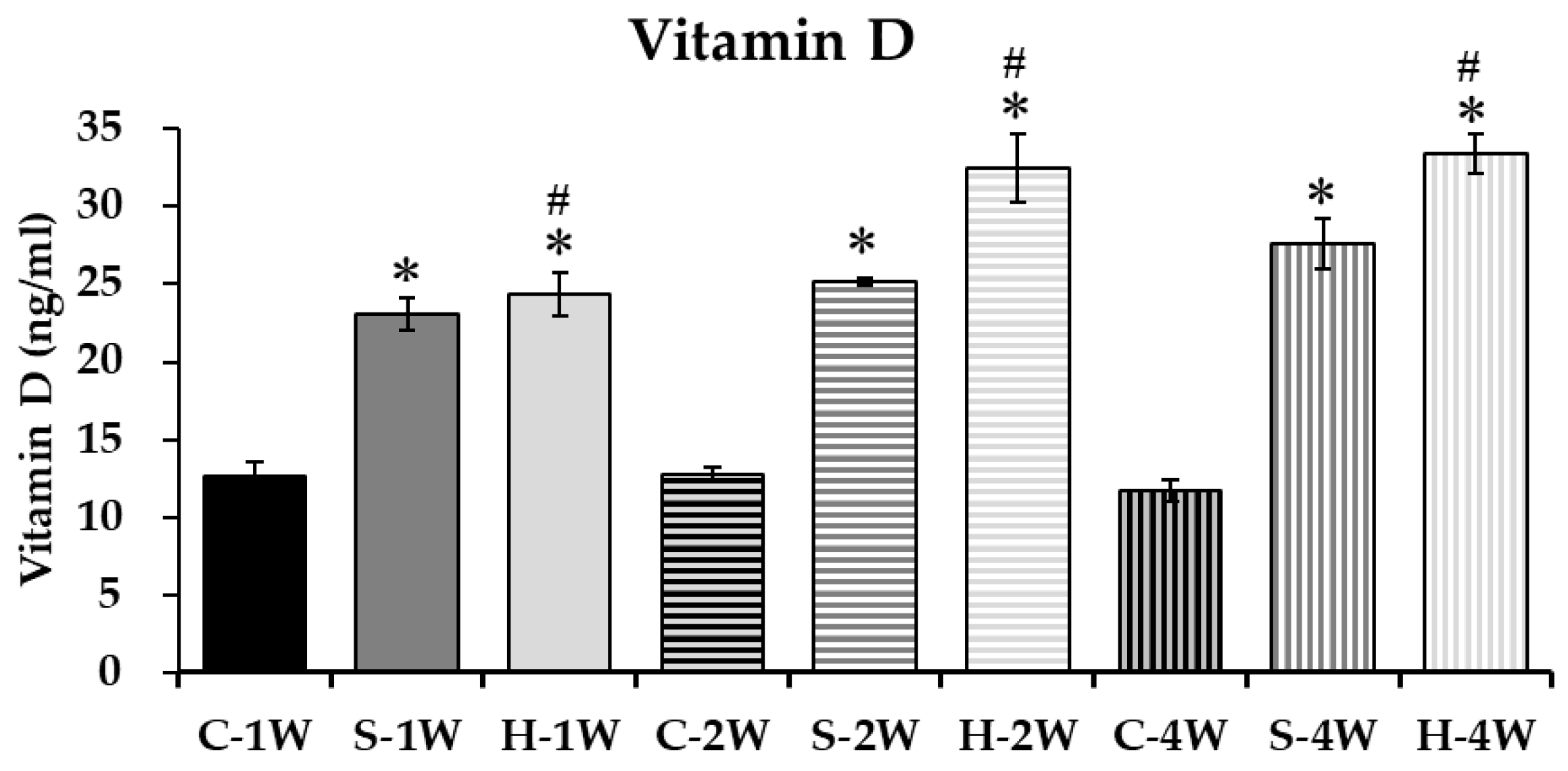
3.1. Restoration of Serum Vitamin D Levels via Supplementation
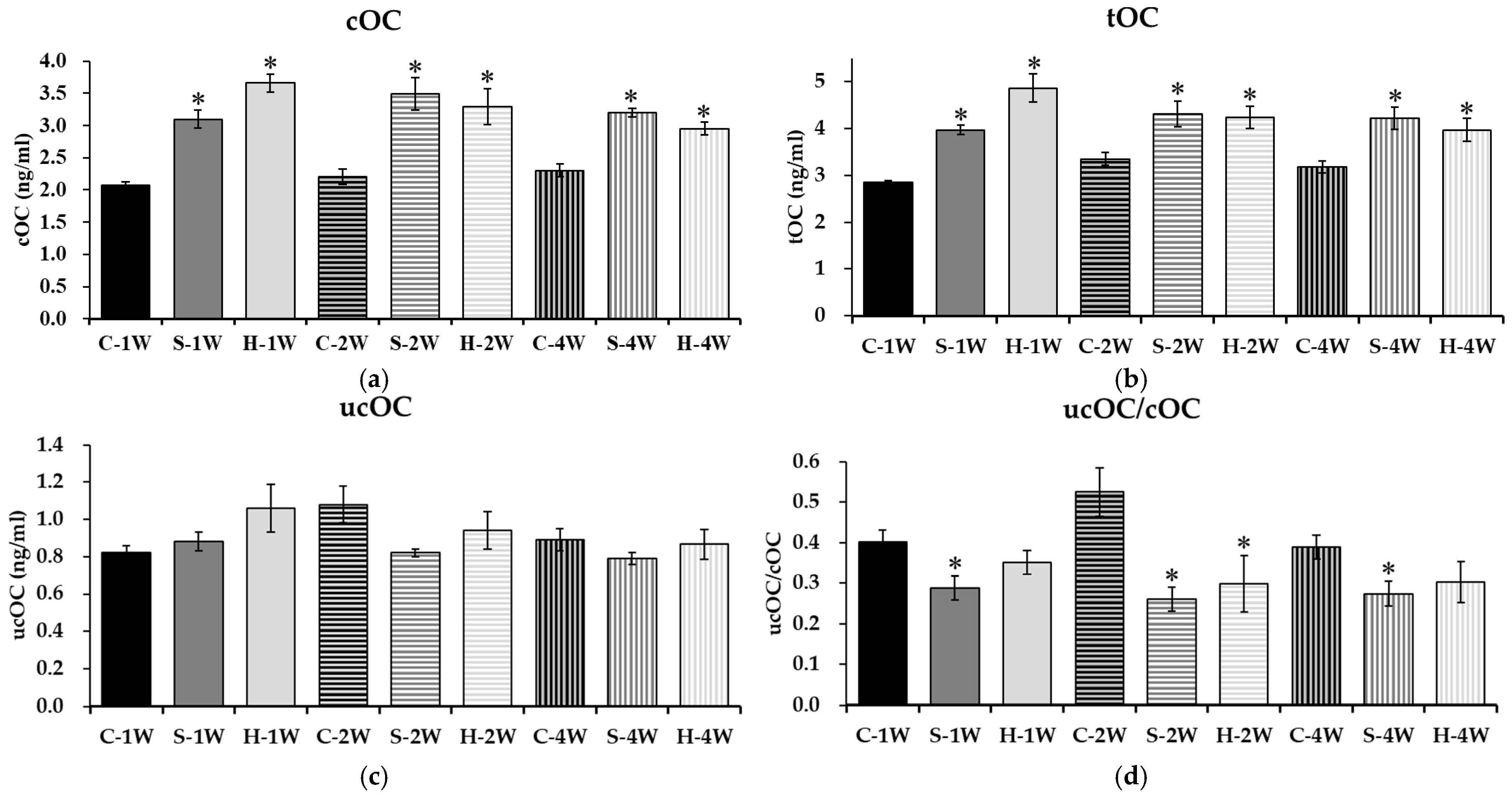
3.2. Effect of Supplementation on Carboxylated Osteocalcin (cOC)
3.3. Changes in Total Osteocalcin (tOC)
3.4. Stability of Undercarboxylated Osteocalcin (ucOC)
3.5. Improvement in Carboxylation Efficiency (ucOC/cOC Ratio)
3.6. Relationships Between Serum 25(OH)D Levels and Osteocalcin Parameters
4. Discussion
4.1. Summary of Main Findings
4.2. Maternal Nutritional Programming and Postnatal Rescue
4.3. Mechanistic Insights: The Vitamin D and Vitamin K Synergy
4.4. Resolving the Biomarker Controversy
4.5. Nutritional Implications and Limitations
4.6. Translational Relevance and Clinical Application
4.7. Limitations
5. Conclusions
Author Contributions
Funding
Institutional Review Board Statement
Informed Consent Statement
Data Availability Statement
Acknowledgments
Conflicts of Interest
Abbreviations
References
- Paterson, C.R.; Ayoub, D. Congenital rickets due to vitamin D deficiency in the mothers. Clin. Nutr. 2015, 34, 793–798. [Google Scholar] [CrossRef]
- Specker, B.L. Do North American women need supplemental vitamin D during pregnancy or lactation? Am. J. Clin. Nutr. 1994, 59, 484S–490S; discussion 490S–491S. [Google Scholar] [CrossRef]
- Hauschka, P.V.; Lian, J.B.; Cole, D.E.; Gundberg, C.M. Osteocalcin and matrix Gla protein: Vitamin K-dependent proteins in bone. Physiol. Rev. 1989, 69, 990–1047. [Google Scholar] [CrossRef]
- Bowden, S.A.; Robinson, R.F.; Carr, R.; Mahan, J.D. Prevalence of vitamin D deficiency and insufficiency in children with osteopenia or osteoporosis referred to a pediatric metabolic bone clinic. Pediatrics 2008, 121, e1585–e1590. [Google Scholar] [CrossRef]
- DeLuca, H.F. Overview of general physiologic features and functions of vitamin D. Am. J. Clin. Nutr. 2004, 80, 1689s–1696s. [Google Scholar] [CrossRef] [PubMed]
- Karsenty, G. Osteocalcin: A Multifaceted Bone-Derived Hormone. Annu. Rev. Nutr. 2023, 43, 55–71. [Google Scholar] [CrossRef]
- Hughes-Fulford, M.; Li, C.F. The role of FGF-2 and BMP-2 in regulation of gene induction, cell proliferation and mineralization. J. Orthop. Surg. Res. 2011, 6, 8. [Google Scholar] [CrossRef] [PubMed]
- Berezovska, O.; Yildirim, G.; Budell, W.C.; Yagerman, S.; Pidhaynyy, B.; Bastien, C.; van der Meulen, M.C.H.; Dowd, T.L. Osteocalcin affects bone mineral and mechanical properties in female mice. Bone 2019, 128, 115031. [Google Scholar] [CrossRef]
- Delmas, P.D.; Christiansen, C.; Mann, K.G.; Price, P.A. Bone Gla protein (osteocalcin) assay highization report. J. Bone Miner. Res. 1990, 5, 5–11. [Google Scholar] [CrossRef] [PubMed]
- Torbergsen, A.C.; Watne, L.O.; Wyller, T.B.; Frihagen, F.; Strømsøe, K.; Bøhmer, T.; Mowe, M. Vitamin K1 and 25(OH)D are independently and synergistically associated with a risk for hip fracture in an elderly population: A case control study. Clin. Nutr. 2015, 34, 101–106. [Google Scholar] [CrossRef]
- Bunyaratavej, N.; Buranasinsup, S.; Jangsangthong, A. The reality of osteocalcin as a marker of vitamin K2. J. Med. Assoc. Thail. 2011, 94, S87–S89. [Google Scholar]
- Szulc, P.; Chapuy, M.C.; Meunier, P.J.; Delmas, P.D. Serum undercarboxylated osteocalcin is a marker of the risk of hip fracture in elderly women. J. Clin. Investig. 1993, 91, 1769–1774. [Google Scholar] [CrossRef] [PubMed]
- Sharma, D.K.; Bahnisch, R.; Schultz, C.G.; Rogers, M.; Furst, C.; Solomon, L.B.; Callary, S.A.; Ramasamy, B. Higher carboxylated osteocalcin is an independent predictor of improved femoral bone strength: A cross-sectional study. Bone 2025, 200, 117610. [Google Scholar] [CrossRef]
- Popko, J.; Karpiński, M.; Chojnowska, S.; Maresz, K.; Milewski, R.; Badmaev, V.; Schurgers, L.J. Decreased Levels of Circulating Carboxylated Osteocalcin in Children with Low Energy Fractures: A Pilot Study. Nutrients 2018, 10, 734. [Google Scholar] [CrossRef]
- Yeung, C.Y.; Chiang Chiau, J.S.; Cheng, M.L.; Chan, W.T.; Jiang, C.B.; Chang, S.W.; Liu, C.Y.; Chang, C.W.; Lee, H.C. Effects of Vitamin D-Deficient Diet on Intestinal Epithelial Integrity and Zonulin Expression in a C57BL/6 Mouse Model. Front. Med. 2021, 8, 649818. [Google Scholar] [CrossRef]
- Hiam, D.; Landen, S.; Jacques, M.; Voisin, S.; Alvarez-Romero, J.; Byrnes, E.; Chubb, P.; Levinger, I.; Eynon, N. Osteocalcin and its forms respond similarly to exercise in males and females. Bone 2021, 144, 115818. [Google Scholar] [CrossRef]
- Leonardi, R.; Mattia, C.; Decembrino, N.; Polizzi, A.; Ruggieri, M.; Betta, P. The Critical Role of Vitamin D Supplementation for Skeletal and Neurodevelopmental Outcomes in Preterm Neonates. Nutrients 2025, 17, 1381. [Google Scholar] [CrossRef]
- Jullien, S. Vitamin D prophylaxis in infancy. BMC Pediatr. 2021, 21, 319. [Google Scholar] [CrossRef]
- McDonnell, D.P.; Scott, R.A.; Kerner, S.A.; O’Malley, B.W.; Pike, J.W. Functional domains of the human vitamin D3 receptor regulate osteocalcin gene expression. Mol. Endocrinol. 1989, 3, 635–644. [Google Scholar] [CrossRef]
- Javed, A.; Gutierrez, S.; Montecino, M.; van Wijnen, A.J.; Stein, J.L.; Stein, G.S.; Lian, J.B. Multiple Cbfa/AML sites in the rat osteocalcin promoter are required for basal and vitamin D-responsive transcription and contribute to chromatin organization. Mol. Cell. Biol. 1999, 19, 7491–7500. [Google Scholar] [CrossRef] [PubMed]
- Binkley, N.C.; Krueger, D.C.; Kawahara, T.N.; Engelke, J.A.; Chappell, R.J.; Suttie, J.W. A high phylloquinone intake is required to achieve maximal osteocalcin gamma-carboxylation. Am. J. Clin. Nutr. 2002, 76, 1055–1060. [Google Scholar] [CrossRef] [PubMed]
- Sokoll, L.J.; Booth, S.L.; O’Brien, M.E.; Davidson, K.W.; Tsaioun, K.I.; Sadowski, J.A. Changes in serum osteocalcin, plasma phylloquinone, and urinary gamma-carboxyglutamic acid in response to altered intakes of dietary phylloquinone in human subjects. Am. J. Clin. Nutr. 1997, 65, 779–784. [Google Scholar] [CrossRef] [PubMed]
- Saadi, H.F.; Nagelkerke, N.; Benedict, S.; Qazaq, H.S.; Zilahi, E.; Mohamadiyeh, M.K.; Al-Suhaili, A.I. Predictors and relationships of serum 25 hydroxyvitamin D concentration with bone turnover markers, bone mineral density, and vitamin D receptor genotype in Emirati women. Bone 2006, 39, 1136–1143. [Google Scholar] [CrossRef] [PubMed]


| Parameter | Time Point | Control | Standard-Dose | High-Dose |
|---|---|---|---|---|
| 25(OH)D (ng/mL) | week 1 | 12.7 ± 1.9 | 23.1 ± 2.3 * | 24.4 ± 3.1 *# |
| week 2 | 12.7 ± 1.0 | 25.2 ± 0.6 * | 32.5 ± 4.5 *# | |
| week 4 | 11.7 ± 1.6 | 27.6 ± 3.7 * | 33.4 ± 2.9 *# | |
| cOC (ng/mL) | week 1 | 2.1 ± 0.1 | 3.1 ± 0.3 * | 3.7 ± 0.3 * |
| week 2 | 2.2 ± 0.3 | 3.5 ± 0.5 * | 3.5 ± 0.7 * | |
| week 4 | 2.3 ± 0.2 | 3.2 ± 0.1 * | 3.0 ± 0.2 * | |
| tOC (ng/mL) | week 1 | 2.9 ± 0.1 | 4.0 ± 0.2 * | 4.9 ± 0.7 * |
| week 2 | 3.4 ± 0.3 | 4.3 ± 0.5 * | 4.3 ± 0.4 * | |
| week 4 | 3.2 ± 0.3 | 4.2 ± 0.5 * | 4.0 ± 0.6 * | |
| ucOC (ng/mL) | week 1 | 0.8 ± 0.1 | 0.9 ± 0.1 | 1.1 ± 0.3 |
| week 2 | 1.1 ± 0.2 | 0.8 ± 0.1 | 0.9 ± 0.2 | |
| week 4 | 0.9 ± 0.1 | 0.8 ± 0.1 | 0.9 ± 0.2 | |
| ucOC/cOC ratio | week 1 | 0.4 ± 0.1 | 0.3 ± 0.1 * | 0.4 ± 0.1 |
| week 2 | 0.5 ± 0.1 | 0.3 ± 0.1 * | 0.2 ± 0.2 * | |
| week 4 | 0.4 ± 0.1 | 0.3 ± 0.1 * | 0.4 ± 0.1 |
| Target | p Value | ||
|---|---|---|---|
| Time | Dose | Interaction | |
| Vitamin D | <0.001 | <0.001 | 0.001 |
| cOC | 0.176 | <0.001 | 0.043 |
| tOC | 0.159 | 0.093 | 0.054 |
| ucOC | 0.521 | <0.001 | 0.016 |
| ucOC/cOC | 0.957 | <0.001 | 0.053 |
| Vitamin D | ||||
|---|---|---|---|---|
| cOC | tOC | ucOC | ucOC/cOC | |
| rpartial | 0.718 | 0.694 | −0.102 | −0.433 |
| p value | <0.001 | <0.001 | 0.544 | 0.006 |
Disclaimer/Publisher’s Note: The statements, opinions and data contained in all publications are solely those of the individual author(s) and contributor(s) and not of MDPI and/or the editor(s). MDPI and/or the editor(s) disclaim responsibility for any injury to people or property resulting from any ideas, methods, instructions or products referred to in the content. |
© 2026 by the authors. Licensee MDPI, Basel, Switzerland. This article is an open access article distributed under the terms and conditions of the Creative Commons Attribution (CC BY) license.
Share and Cite
Chan, W.-T.; Lee, H.-C.; Yeung, C.-Y.; Chiang Chiau, J.-S.; Cheng, M.-L.; Chang, S.-W.; Weng, S.-C.; Jiang, C.-B. Beyond 25(OH)D: Carboxylated Osteocalcin and the Undercarboxylated/Carboxylated Osteocalcin Ratio as Superior Biomarkers for Vitamin D Recovery in Offspring Affected by Maternal Deficiency. Nutrients 2026, 18, 1243. https://doi.org/10.3390/nu18081243
Chan W-T, Lee H-C, Yeung C-Y, Chiang Chiau J-S, Cheng M-L, Chang S-W, Weng S-C, Jiang C-B. Beyond 25(OH)D: Carboxylated Osteocalcin and the Undercarboxylated/Carboxylated Osteocalcin Ratio as Superior Biomarkers for Vitamin D Recovery in Offspring Affected by Maternal Deficiency. Nutrients. 2026; 18(8):1243. https://doi.org/10.3390/nu18081243
Chicago/Turabian StyleChan, Wai-Tao, Hung-Chang Lee, Chun-Yan Yeung, Jen-Shiu Chiang Chiau, Mei-Lein Cheng, Szu-Wen Chang, Shu-Chao Weng, and Chuen-Bin Jiang. 2026. "Beyond 25(OH)D: Carboxylated Osteocalcin and the Undercarboxylated/Carboxylated Osteocalcin Ratio as Superior Biomarkers for Vitamin D Recovery in Offspring Affected by Maternal Deficiency" Nutrients 18, no. 8: 1243. https://doi.org/10.3390/nu18081243
APA StyleChan, W.-T., Lee, H.-C., Yeung, C.-Y., Chiang Chiau, J.-S., Cheng, M.-L., Chang, S.-W., Weng, S.-C., & Jiang, C.-B. (2026). Beyond 25(OH)D: Carboxylated Osteocalcin and the Undercarboxylated/Carboxylated Osteocalcin Ratio as Superior Biomarkers for Vitamin D Recovery in Offspring Affected by Maternal Deficiency. Nutrients, 18(8), 1243. https://doi.org/10.3390/nu18081243