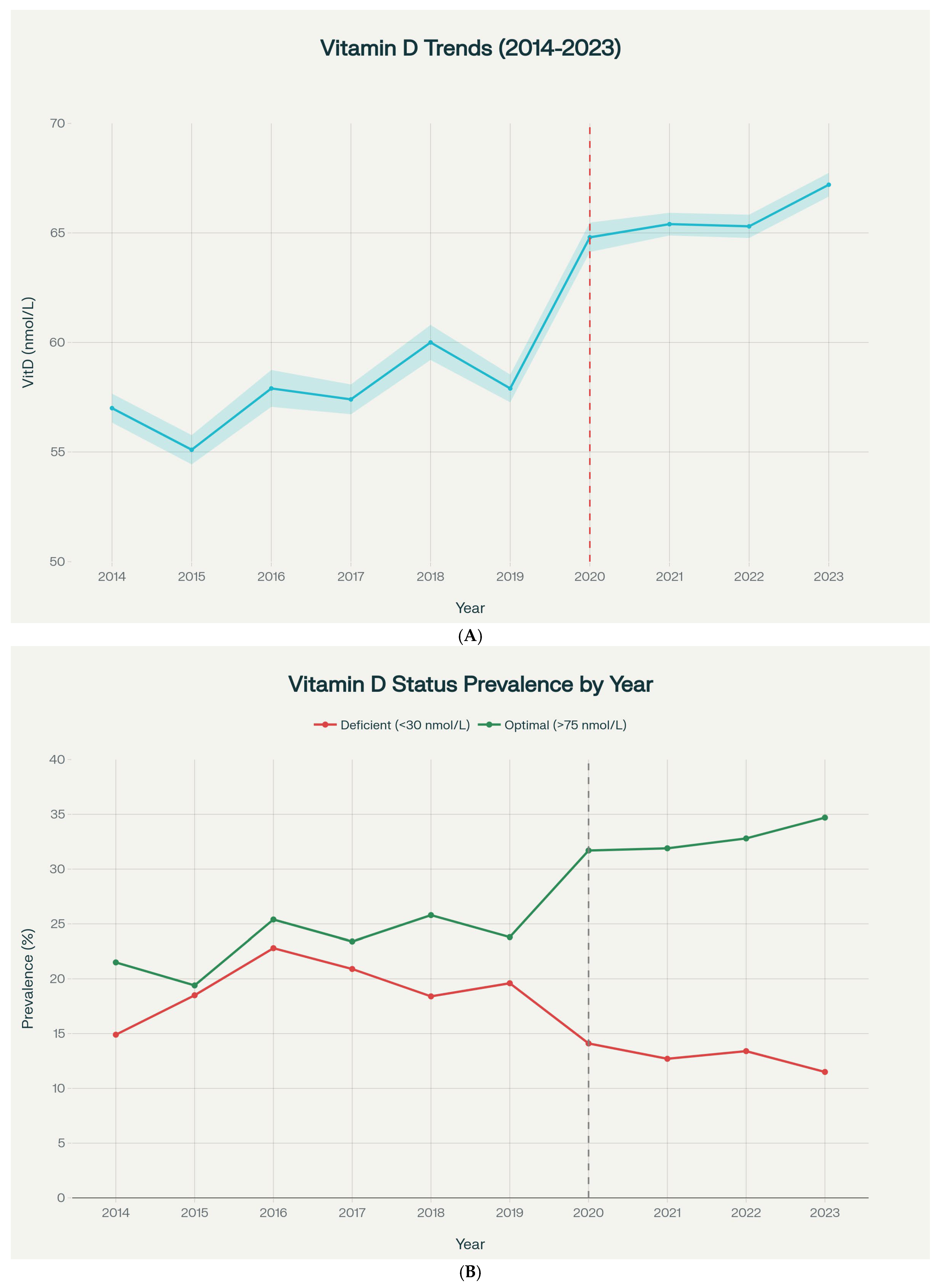
Ten-Year Trends in Serum 25-Hydroxyvitamin D in Slovenia (2014–2023): Laboratory-Based Data from Tested Individuals and COVID-19-Period Changes


Abstract
1. Introduction
2. Methods and Materials
2.1. Study Design and Setting
2.2. Study Population
2.3. Data Collection
2.4. Laboratory Measurements
2.5. Variable Definitions
2.6. Statistical Analysis
2.7. Sample Size and Power
3. Results
3.1. Study Population and Baseline Characteristics
3.2. Temporal Trends and COVID-19 Pandemic Impact
3.3. Seasonal Variation
3.4. Age-Related Differences
3.5. Sex Differences
4. Discussion
4.1. Principal Findings
4.2. Temporal Trends and COVID-19 Pandemic Effect
4.3. Seasonal Variation: Implications for Public Health
4.4. Age-Related Decline
4.5. Sex Differences
4.6. Strengths and Limitations
4.7. Clinical and Public Health Implications
5. Conclusions
Future Directions and Research Implications
Supplementary Materials
Author Contributions
Funding
Institutional Review Board Statement
Informed Consent Statement
Data Availability Statement
Conflicts of Interest
References
- Holick, M.F. Vitamin D deficiency. N. Engl. J. Med. 2007, 357, 266–281. [Google Scholar] [CrossRef] [Scilit] [PubMed]
- Bikle, D.D. Vitamin D metabolism, mechanism of action, and clinical applications. Chem. Biol. 2014, 21, 319–329. [Google Scholar] [CrossRef] [Scilit] [PubMed]
- Hewison, M. An update on vitamin D and human immunity. Clin. Endocrinol. 2012, 76, 315–325. [Google Scholar] [CrossRef] [Scilit]
- Wacker, M.; Holick, M.F. Sunlight and Vitamin D: A global perspective for health. Dermato-Endocrinol. 2013, 5, 51–108. [Google Scholar] [CrossRef] [Scilit] [PubMed]
- Ross, A.C.; Manson, J.E.; Abrams, S.A. The 2011 report on dietary reference intakes for calcium and vitamin D from the Institute of Medicine. J. Clin. Endocrinol. Metab. 2011, 96, 53–58. [Google Scholar] [CrossRef] [Scilit]
- Palacios, C.; Gonzalez, L. Is vitamin D deficiency a major global public health problem? J. Steroid Biochem. Mol. Biol. 2014, 144, 138–145. [Google Scholar] [CrossRef] [Scilit]
- Lips, P.; van Schoor, N.M. The effect of vitamin D on bone and osteoporosis. Best Pract. Res. Clin. Endocrinol. Metab. 2011, 25, 585–591. [Google Scholar] [CrossRef] [Scilit]
- Aranow, C. Vitamin D and the immune system. J. Investig. Med. 2011, 59, 881–886. [Google Scholar] [CrossRef] [Scilit]
- Grant, W.B.; Boucher, B.J. Randomized controlled trials of vitamin D and cancer incidence: A modeling study. PLoS ONE 2017, 12, e0176448. [Google Scholar] [CrossRef] [Scilit]
- Holick, M.F.; Chen, T.C. Vitamin D deficiency: A worldwide problem with health consequences. Am. J. Clin. Nutr. 2008, 87, 1080S–1086S. [Google Scholar] [CrossRef] [Scilit]
- Cashman, K.D.; Dowling, K.G.; Škrabáková, Z. Vitamin D deficiency in Europe: Pandemic? Am. J. Clin. Nutr. 2016, 103, 1033–1044. [Google Scholar] [CrossRef] [Scilit]
- Webb, A.R.; Kline, L.; Holick, M.F. Influence of season and latitude on the cutaneous synthesis of vitamin D3. J. Clin. Endocrinol. Metab. 1988, 67, 373–378. [Google Scholar] [CrossRef] [Scilit]
- Kimlin, M.G. Geographic location and vitamin D synthesis. Mol. Aspects Med. 2008, 29, 453–461. [Google Scholar] [CrossRef] [Scilit] [PubMed]
- Martineau, A.R.; Jolliffe, D.A.; Hooper, R.L. Vitamin D supplementation to prevent acute respiratory tract infections: Systematic review and meta-analysis. BMJ 2017, 356, i6583. [Google Scholar] [CrossRef] [Scilit] [PubMed]
- Laaksi, I.; Ruohola, J.P.; Tuohimaa, P. An association of serum vitamin D concentrations < 40 nmol/L with acute respiratory tract infection in young Finnish men. Am. J. Clin. Nutr. 2007, 86, 714–717. [Google Scholar] [CrossRef] [Scilit] [PubMed]
- MacLaughlin, J.; Holick, M.F. Aging decreases the capacity of human skin to produce vitamin D3. J. Clin. Investig. 1985, 76, 1536–1538. [Google Scholar] [CrossRef] [Scilit]
- Gallagher, J.C.; Yalamanchili, V.; Smith, L.M. The effect of vitamin D supplementation on serum 25(OH)D in thin and obese women. J. Steroid Biochem. Mol. Biol. 2013, 136, 195–200. [Google Scholar] [CrossRef] [Scilit]
- Ebeling, P.R.; Sandgren, M.E.; DiMagno, E.P. Evidence of an age-related decrease in intestinal responsiveness to vitamin D. J. Clin. Endocrinol. Metab. 1992, 75, 176–182. [Google Scholar] [CrossRef] [Scilit]
- Semba, R.D.; Houston, D.K.; Bandinelli, S. Relationship of 25-hydroxyvitamin D with all-cause and cardiovascular disease mortality in older community-dwelling adults. Eur. J. Clin. Nutr. 2010, 64, 203–209. [Google Scholar] [CrossRef] [Scilit]
- Meltzer, D.O.; Best, T.J.; Zhang, H. Association of Vitamin D Status and Other Clinical Characteristics With COVID-19 Test Results. JAMA Netw. Open. 2020, 3, e2019722. [Google Scholar] [CrossRef] [Scilit]
- Pereira, M.; Damascena, A.D.; Azevedo, L.M.G. Vitamin D deficiency aggravates COVID-19: Systematic review and meta-analysis. Crit. Rev. Food Sci. Nutr. 2022, 62, 1308–1316. [Google Scholar] [CrossRef] [Scilit] [PubMed]
- Kaufman, H.W.; Niles, J.K.; Kroll, M.H. SARS-CoV-2 positivity rates associated with circulating 25-hydroxyvitamin D levels. PLoS ONE 2020, 15, e0239252. [Google Scholar] [CrossRef] [Scilit] [PubMed]
- Castillo, M.E.; Costa, L.M.E.; Barrios, J.M.V. Effect of calcifediol treatment and best available therapy on intensive care unit admission and mortality among patients hospitalized for COVID-19. J. Steroid Biochem. Mol. Biol. 2020, 203, 105751. [Google Scholar] [CrossRef] [Scilit] [PubMed]
- Pugach, I.Z.; Pugach, S. Strong correlation between prevalence of severe vitamin D deficiency and population mortality rate from COVID-19 in Europe. Wien. Klin. Wochenschr. 2021, 133, 403–405. [Google Scholar] [CrossRef] [Scilit]
- Jolliffe, D.A.; Camargo, C.A.; Sluyter, J.D. Vitamin D supplementation to prevent acute respiratory infections: A systematic review and meta-analysis. Lancet Diabetes Endocrinol. 2021, 9, 276–292. [Google Scholar] [CrossRef] [Scilit]
- Jolliffe, D.A.; Holt, H.; Greenig, M. Effect of a test-and-treat approach to vitamin D supplementation on risk of all cause acute respiratory tract infection and COVID-19. BMJ 2022, 378, e071230. [Google Scholar] [CrossRef] [Scilit]
- Heaney, R.P.; Armas, L.A.; Shary, J.R.; Bell, N.H.; Binkley, N.; Hollis, B.W. 25-Hydroxylation of vitamin D3: Relation to circulating vitamin D3 under various input conditions. Am. J. Clin. Nutr. 2008, 87, 1738–1742. [Google Scholar] [CrossRef] [Scilit]
- Schmid, A.; Walther, B. Natural vitamin D content in animal products. Adv. Nutr. 2013, 4, 453–462. [Google Scholar] [CrossRef] [Scilit]
- Mithal, A.; Wahl, D.A.; Bonjour, J.P. Global vitamin D status and determinants of hypovitaminosis D. Osteoporos. Int. 2009, 20, 1807–1815. [Google Scholar] [CrossRef] [Scilit]
- ISO 15189:2022; Medical Laboratories—Requirements for Quality and Competence. International Organization for Standardization: Geneva, Switzerland, 2022.
- Holick, M.F.; Binkley, N.C.; Bischoff-Ferrari, H.A. Evaluation, treatment, and prevention of vitamin D deficiency: An Endocrine Society clinical practice guideline. J. Clin. Endocrinol. Metab. 2011, 96, 1911–1930. [Google Scholar] [CrossRef] [Scilit]
- Holick, M.F. Revisiting Vitamin D Guidelines: A Critical Appraisal of the Literature. Endocr. Pract. 2024, 30, 1227–1241. [Google Scholar] [CrossRef] [Scilit]
- McCartney, C.R.; McDonnell, M.E.; Corrigan, M.D.; Lash, R.W. Vitamin D Insufficiency and Epistemic Humility: An Endocrine Society Guideline Communication. J. Clin. Endocrinol. Metab. 2024, 109, 1948–1954. [Google Scholar] [CrossRef] [Scilit]
- World Health Organization. WHO Director-General’s Opening Remarks at the Media Briefing on COVID-19—11 March 2020. Available online: https://www.who.int/news-room/speeches/item/who-director-general-s-opening-remarks-at-the-media-briefing-on-covid-19---11-march-2020 (accessed on 1 January 2024).
- Mukaka, M.M. Statistics corner: A guide to appropriate use of correlation coefficient in medical research. Malawi Med. J. 2012, 24, 69–71. [Google Scholar] [PubMed] [PubMed Central]
- Mitchell, F. Vitamin D and COVID-19: Do deficient risk a poorer outcome? Lancet Diabetes Endocrinol. 2020, 8, 570. [Google Scholar] [CrossRef] [Scilit] [PubMed]
- Rhodes, J.M.; Subramanian, S.; Laird, E. Low population mortality from COVID-19 in countries south of latitude 35 degrees North supports vitamin D as a factor determining severity. Aliment. Pharmacol. Ther. 2020, 51, 1434–1437. [Google Scholar] [CrossRef] [Scilit] [PubMed]
- Goddek, S. Vitamin D3 and K2 and their potential contribution to reducing the COVID-19 mortality rate. Int. J. Infect. Dis. 2020, 99, 286–290. [Google Scholar] [CrossRef] [Scilit] [PubMed]
- Ilie, P.C.; Stefanescu, S.; Smith, L. The role of vitamin D in the prevention of coronavirus disease 2019 infection and mortality. Aging Clin. Exp. Res. 2020, 32, 1195–1198. [Google Scholar] [CrossRef] [Scilit]
- Radujkovic, A.; Hippchen, T.; Tiwari-Heckler, S. Vitamin D Deficiency and Outcome of COVID-19 Patients. Nutrients 2020, 12, 2757. [Google Scholar] [CrossRef] [Scilit]
- Konstari, S.; Sääksjärvi, K.; Heliovaara, M. Seasonal variations in serum 25-hydroxyvitamin D concentrations in a Finnish cohort. Public Health Nutr. 2014, 17, 1322–1330. [Google Scholar]
- Hastie, C.E.; Mackay, D.F.; Ho, F. Vitamin D concentrations and COVID-19 infection in UK Biobank. Diabetes Metab. Syndr. Clin. Res. Rev. 2020, 14, 561–565. [Google Scholar] [CrossRef] [Scilit]
- Merzon, E.; Tworowski, D.; Gorohovski, A. Low plasma 25(OH) vitamin D level is associated with increased risk of COVID-19 infection: An Israeli population-based study. FEBS J. 2020, 287, 3693–3702. [Google Scholar] [CrossRef] [Scilit] [PubMed]
- Chiodini, I.; Gatti, D.; Soranna, D. Vitamin D Status and SARS-CoV-2 Infection and COVID-19 Clinical Outcomes. Front. Public Health 2021, 9, 736665. [Google Scholar] [CrossRef] [Scilit] [PubMed]
- Aysin, E.; Urhan, M. Dramatic Increase in Dietary Supplement Use During COVID-19. Curr. Dev. Nutr. 2021, 5, 207. [Google Scholar] [CrossRef] [Scilit]
- Cui, A.; Zhang, T.; Xiao, P.; Fan, Z.; Wang, H.; Zhuang, Y. Global and regional prevalence of vitamin D deficiency in population-based studies from 2000 to 2022: A pooled analysis of 7.9 million participants. Front. Nutr. 2023, 10, 1070808. [Google Scholar] [CrossRef] [Scilit]
- Lips, P.; Cashman, K.D.; Lamberg-Allardt, C. Current vitamin D status in European and Middle East countries and strategies to prevent vitamin D deficiency: A position statement of the European Calcified Tissue Society. Eur. J. Endocrinol. 2019, 180, P23–P54. [Google Scholar] [CrossRef] [Scilit]
- Macdonald, H.M.; Mavroeidi, A.; Barr, R.J. Vitamin D status in postmenopausal women living at higher latitudes in the UK in relation to bone health, overweight, sunlight exposure and dietary vitamin D. Bone 2008, 42, 996–1003. [Google Scholar] [CrossRef] [Scilit]
- Zgaga, L.; Theodoratou, E.; Farrington, S.M. Diet, environmental factors, and lifestyle underlie the high prevalence of vitamin D deficiency in healthy adults in Scotland. J. Nutr. 2011, 141, 1535–1542. [Google Scholar] [CrossRef] [Scilit]
- Seamans, K.M.; Cashman, K.D. Existing and potentially novel functional markers of vitamin D status: A systematic review. Am. J. Clin. Nutr. 2009, 89, 1997S–2008S. [Google Scholar] [CrossRef] [Scilit]
- Pilz, S.; März, W.; Cashman, K.D. Rationale and Plan for Vitamin D Food Fortification: A Review and Guidance Paper. Front. Endocrinol. 2018, 9, 373. [Google Scholar] [CrossRef] [Scilit]
- Romagnoli, E.; Mascia, M.L.; Cipriani, C. Short and long-term variations in serum calciotropic hormones after a single very large dose of ergocalciferol (vitamin D2) or cholecalciferol (vitamin D3) in the elderly. J. Clin. Endocrinol. Metab. 2008, 93, 3015–3020. [Google Scholar] [CrossRef] [Scilit]
- Sanders, K.M.; Stuart, A.L.; Williamson, E.J. Annual high-dose oral vitamin D and falls and fractures in older women: A randomized controlled trial. JAMA 2010, 303, 1815–1822. [Google Scholar] [CrossRef] [Scilit] [PubMed]
- Lips, P. Vitamin D physiology. Prog. Biophys. Mol. Biol. 2006, 92, 4–8. [Google Scholar] [CrossRef] [Scilit] [PubMed]
- Zittermann, A.; Pilz, S.; Hoffmann, H. Vitamin D and airway infections: A European perspective. Eur. J. Med. Res. 2016, 21, 14. [Google Scholar] [CrossRef] [Scilit] [PubMed]
- Gallagher, J.C. Vitamin D and aging. Endocrinol. Metab. Clin. N. Am. 2013, 42, 319–332. [Google Scholar] [CrossRef] [Scilit]
- van der Wielen, R.P.; Löwik, M.R.; van den Berg, H. Serum vitamin D concentrations among elderly people in Europe. Lancet 1995, 346, 207–210. [Google Scholar] [CrossRef] [Scilit]
- Wortsman, W.; Matsuoka, L.Y.; Chen, T.C. Decreased bioavailability of vitamin D in obesity. Am. J. Clin. Nutr. 2000, 72, 690–693. [Google Scholar] [CrossRef] [Scilit]
- Robien, K.; Oppeneer, S.J.; Kelly, J.A. Drug-vitamin D interactions: A systematic review of the literature. Nutr. Clin. Pract. 2013, 28, 194–208. [Google Scholar] [CrossRef] [Scilit]
- Roizen, J.D.; Levine, M.A. Response to: Obesity and Vitamin D Metabolism Modifications. J. Bone Miner. Res. 2019, 34, 1384. [Google Scholar] [CrossRef] [Scilit]
- Bischoff-Ferrari, H.A.; Willett, W.C.; Manson, J.E. Fracture prevention with vitamin D supplementation: A meta-analysis of randomized controlled trials. JAMA 2005, 293, 2257–2264. [Google Scholar] [CrossRef] [Scilit]
- Muir, S.W.; Montero-Odasso, M. Effect of vitamin D supplementation on muscle strength, gait and balance in older adults: A systematic review and meta-analysis. J. Am. Geriatr. Soc. 2011, 59, 2291–2300. [Google Scholar] [CrossRef] [Scilit]
- Ginde, A.A.; Scragg, R.; Schwartz, R.S. Prospective study of serum 25-hydroxyvitamin D level, cardiovascular disease mortality, and all-cause mortality in older U.S. adults. J. Am. Geriatr. Soc. 2009, 57, 1595–1603. [Google Scholar] [CrossRef] [Scilit] [PubMed]
- Pilz, S.; Tomaschitz, A.; März, W. Vitamin D, cardiovascular disease and mortality. Clin. Endocrinol. 2011, 75, 575–584. [Google Scholar] [CrossRef] [Scilit] [PubMed]
- Wagner, C.L.; Greer, F.R. Prevention of rickets and vitamin D deficiency in infants, children, and adolescents. Pediatrics 2008, 122, 1142–1152. [Google Scholar] [CrossRef] [Scilit] [PubMed]
- Bischoff-Ferrari, H.A.; Giovannucci, E.; Willett, W.C. Estimation of optimal serum concentrations of 25-hydroxyvitamin D for multiple health outcomes. Am. J. Clin. Nutr. 2006, 84, 18–28. [Google Scholar] [CrossRef] [Scilit]
- Veldurthy, V.; Wei, R.; Oz, L. Vitamin D, calcium homeostasis and aging. Bone Res. 2016, 4, 16041. [Google Scholar] [CrossRef] [Scilit]
- Drincic, A.T.; Armas, L.A.G.; Van Diest, E.E.; Heaney, R.P. Volumetric dilution, rather than sequestration best explains the low vitamin D status of obesity. Obesity 2012, 20, 1444–1448. [Google Scholar] [CrossRef] [Scilit]
- Pérez-López, F.R.; Chedraui, P.; Fernandez-Alonso, A.M. Vitamin D and aging: Beyond calcium and bone metabolism. Maturitas 2011, 69, 27–36. [Google Scholar] [CrossRef] [Scilit]
- Schwetz, V.; Scharnagl, H.; Trummer, C. Vitamin D supplementation and lipoprotein metabolism: A randomized controlled trial. J. Clin. Lipidol. 2018, 12, 588–596. [Google Scholar] [CrossRef] [Scilit]
- Bertakis, K.D.; Azari, R.; Helms, L.J.; Callahan, E.J.; Robbins, J.A. Gender differences in the utilization of health care services. J. Fam. Pract. 2000, 49, 147–152. [Google Scholar]
- Kovacs, C.S. Vitamin D in pregnancy and lactation: Maternal, fetal, and neonatal outcomes from human and animal studies. Am. J. Clin. Nutr. 2008, 88, 520S–528S. [Google Scholar] [CrossRef] [Scilit]
- Tripkovic, L.; Lambert, H.; Hart, K. Comparison of vitamin D2 and vitamin D3 supplementation in raising serum 25-hydroxyvitamin D status: A systematic review and meta-analysis. Am. J. Clin. Nutr. 2012, 95, 1357–1364. [Google Scholar] [CrossRef] [Scilit]
- Wang, Z.; Qu, G. Qualitative comparative analysis of policies implemented by 26 European countries during the 2020 great lockdown. Front. Public Health 2024, 12, 1396013. [Google Scholar] [CrossRef] [Scilit]



| Characteristic | Overall (n = 106,875) |
|---|---|
| Age (years), mean ± SD | 47.7 ± 27.6 |
| Age range (min–max) | 0.0–100 |
| Female, n (%) | 60,913 (56.5%) |
| Male, n (%) | 46,987 (43.5%) |
| 25(OH)D (nmol/L), mean ± SD | 61.9 ± 34.2 |
| 25(OH)D (nmol/L), median (IQR) | 59.0 (39.0–79.0) |
| 25(OH)D range (min–max) | 1.0–150.0 |
| Deficient (<30 nmol/L), n (%) | 17,059 (16.0%) |
| Insufficient (30–50 nmol/L), n (%) | 24,354 (22.8%) |
| Adequate (50–75 nmol/L), n (%) | 35,096 (32.8%) |
| Optimal (>75 nmol/L), n (%) | 30,366 (28.4%) |
| Severe deficiency (<12.5 nmol/L), n (%) | 1247 (1.2%) |
| Measurement completion rate, % | 99.1% |
| Characteristic | Pre-COVID (2014–2019) | COVID/Post-COVID (2020–2023) | p-Value |
|---|---|---|---|
| n | 52,435 | 55,465 | - |
| Age (years), mean ± SD | 48.2 ± 27.9 | 47.2 ± 27.4 | <0.001 |
| Female, n (%) | 29,548 (56.4%) | 31,365 (56.5%) | >0.05 |
| Mean ± SD (nmol/L) | 57.6 ± 34.0 | 66.0 ± 33.8 | <0.001 * |
| Median (IQR) (nmol/L) | 54.0 (35.0–74.0) | 63.0 (44.0–83.0) | <0.001 * |
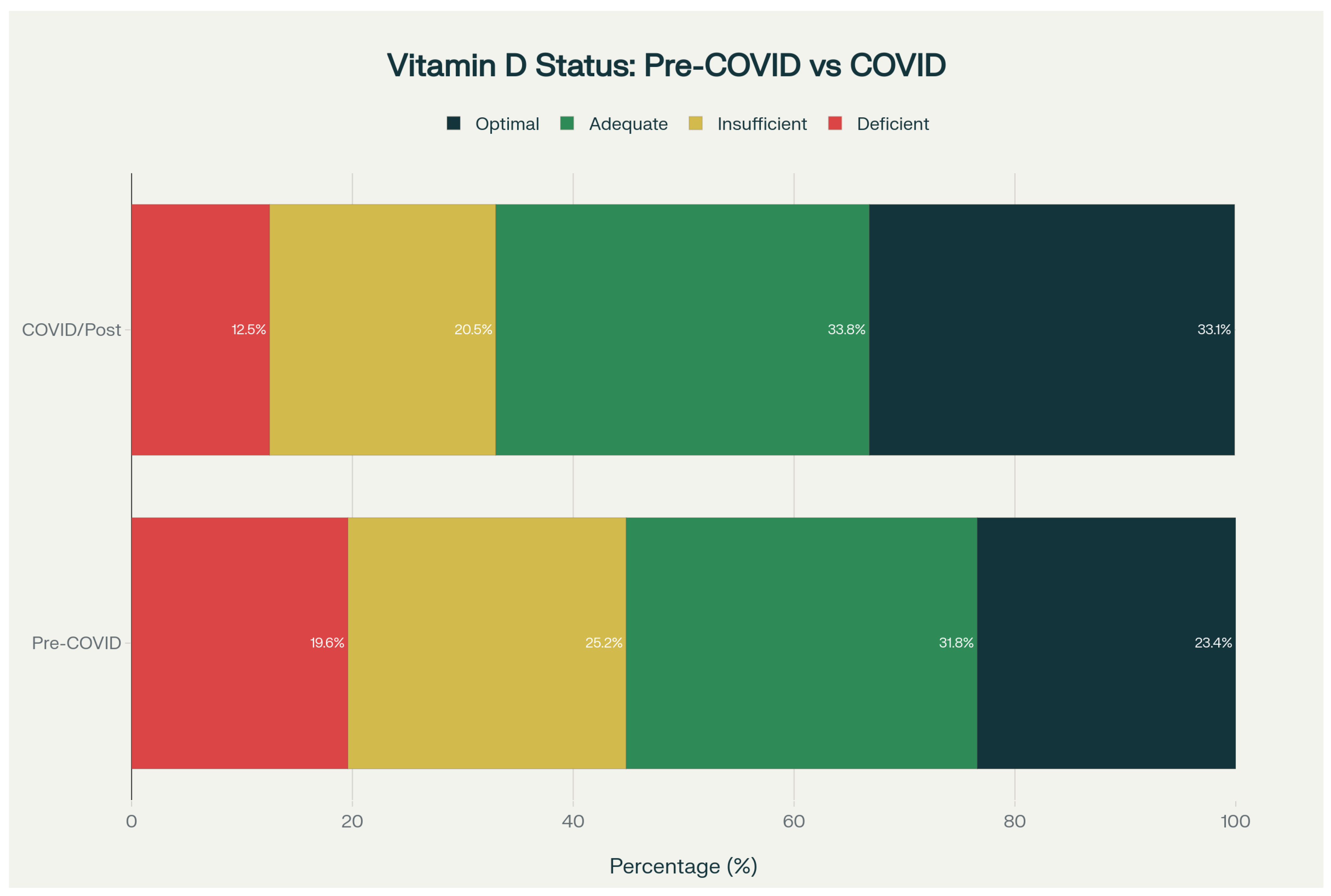
| Deficient (<30 nmol/L), n (%) | 10,163 (19.6%) | 6896 (12.5%) | <0.001 † |
| Insufficient (30–50 nmol/L), n (%) | 13,051 (25.2%) | 11,303 (20.5%) | <0.001 † |
| Adequate (50–75 nmol/L), n (%) | 16,475 (31.8%) | 18,621 (33.8%) | <0.001 † |
| Optimal (>75 nmol/L), n (%) | 12,116 (23.4%) | 18,250 (33.1%) | <0.001 † |
| Season | n | Mean ± SD (nmol/L) | Median (IQR) | Deficient < 30, n (%) | Insufficient 30–50, n (%) | Adequate 50–75, n (%) | Optimal > 75, n (%) |
|---|---|---|---|---|---|---|---|
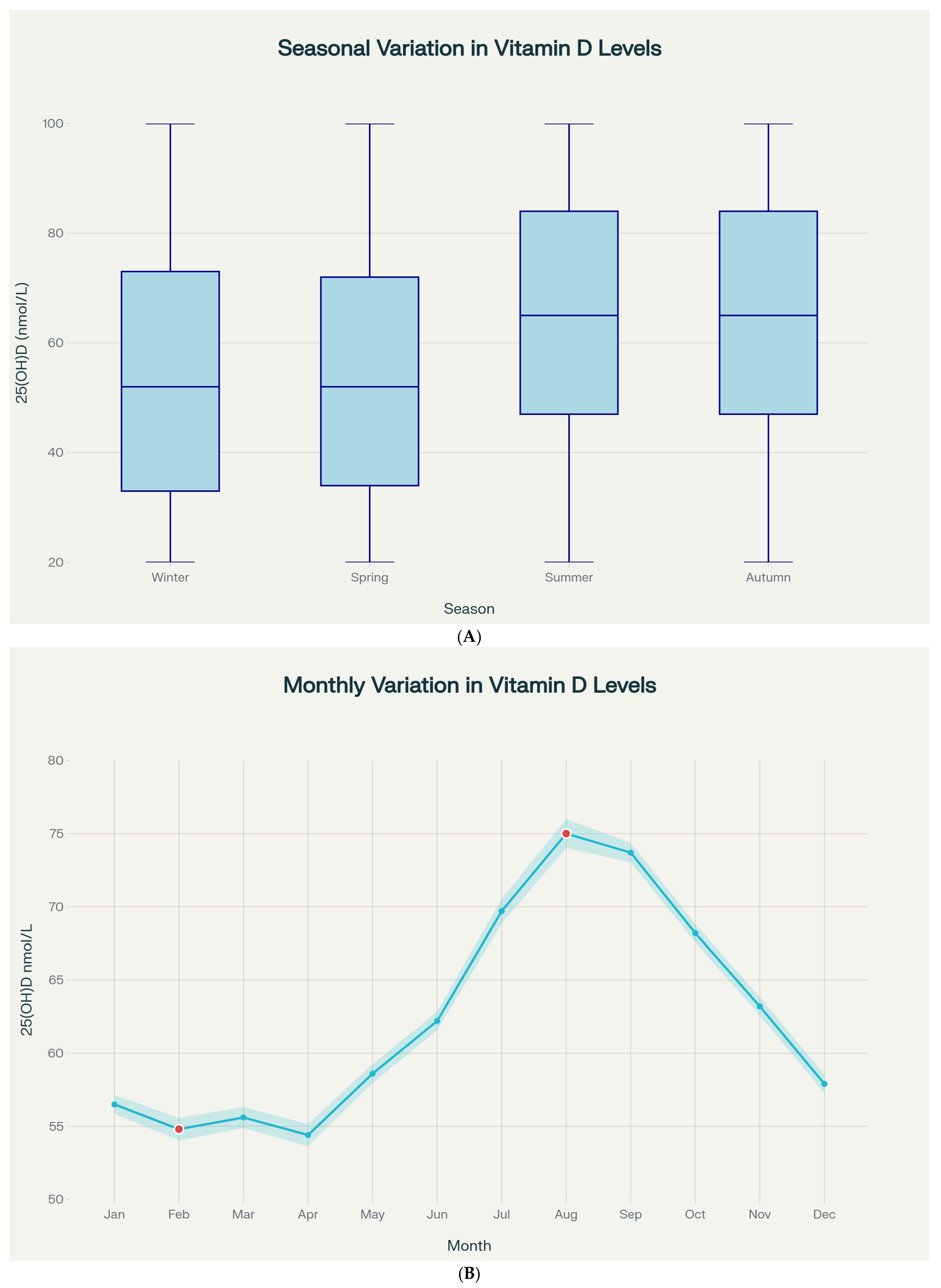
| Winter | 27,700 | 56.5 ± 33.1 | 52.0 (33.0–73.0) | 5884 (21.2%) | 7279 (26.3%) | 8306 (30.0%) | 6231 (22.5%) |
| Spring | 28,383 | 56.3 ± 35.1 | 52.0 (34.0–72.0) | 5970 (21.0%) | 7557 (26.6%) | 8764 (30.9%) | 6092 (21.5%) |
| Summer | 20,253 | 68.0 ± 33.7 | 65.0 (47.0–84.0) | 2102 (10.4%) | 3842 (19.0%) | 7187 (35.5%) | 7122 (35.2%) |
| Autumn | 30,539 | 68.1 ± 32.8 | 65.0 (47.0–84.0) | 3103 (10.2%) | 5676 (18.6%) | 10,839 (35.5%) | 10,921 (35.8%) |
| Age Group (Years) | n | Mean ± SD (nmol/L) | Median (IQR) (nmol/L) | Female, n (%) | Deficient < 30, n (%) |
|---|---|---|---|---|---|
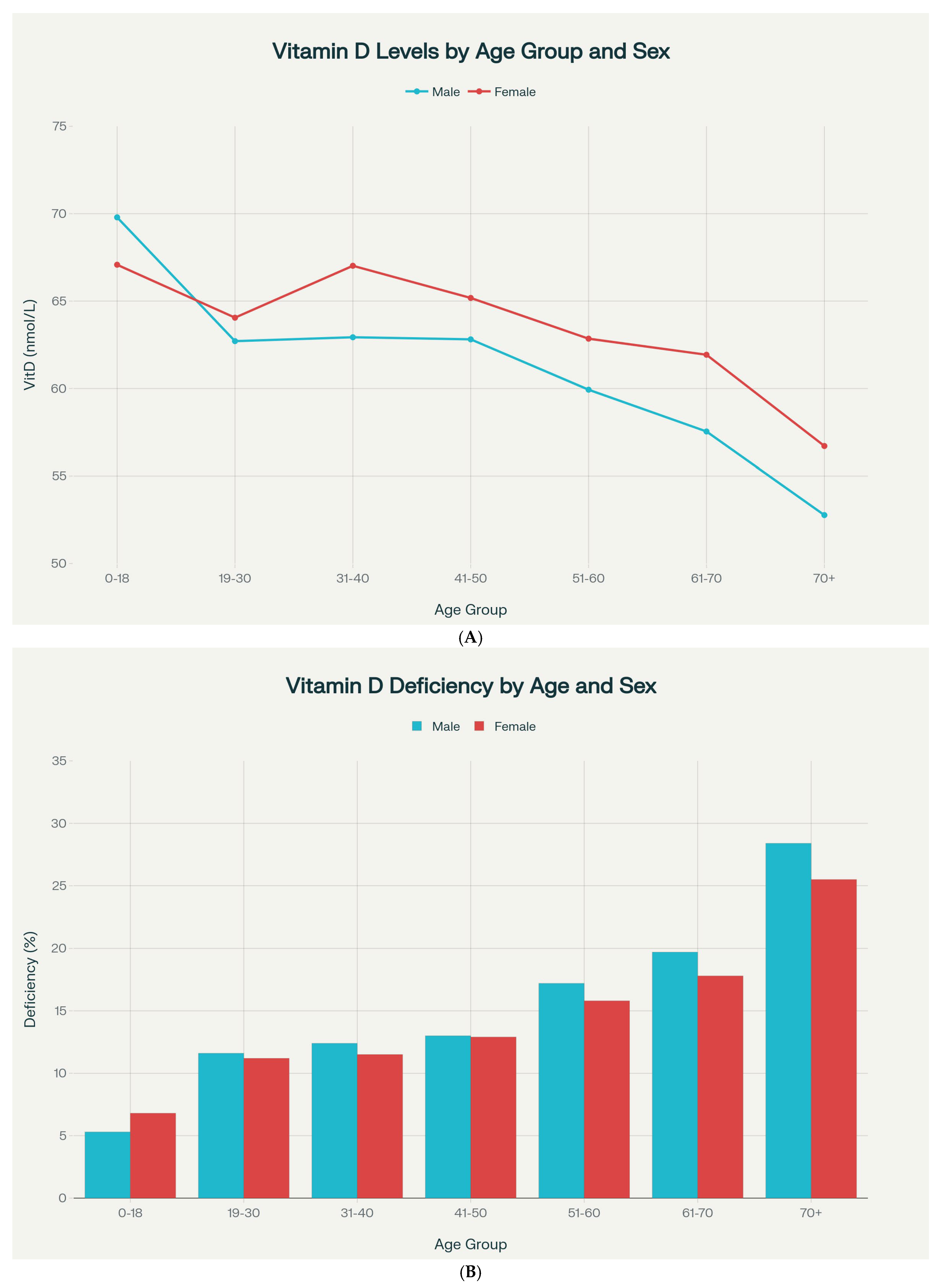
| 0–18 | 25,434 | 68.4 ± 30.7 | 64.0 (49.0–83.0) | 12,767 (50.1%) | 1543 (6.1%) |
| 19–30 | 8443 | 63.5 ± 33.8 | 60.0 (42.0–78.0) | 5173 (61.1%) | 959 (11.4%) |
| 31–40 | 8475 | 65.7 ± 38.5 | 61.0 (42.0–81.0) | 5679 (66.8%) | 1006 (11.9%) |
| 41–50 | 9239 | 64.2 ± 41.6 | 59.0 (41.0–79.0) | 5500 (59.2%) | 1194 (12.9%) |
| 51–60 | 11,914 | 61.6 ± 37.5 | 58.0 (38.0–78.0) | 6904 (57.5%) | 1953 (16.4%) |
| 61–70 | 14,793 | 59.9 ± 31.6 | 57.0 (36.0–78.0) | 7911 (52.9%) | 2766 (18.7%) |
| ≥70 | 28,562 | 55.1 ± 31.5 | 52.0 (29.0–75.0) | 16,978 (58.2%) | 7638 (26.7%) |
| Characteristic | Male | Female | p-Value |
|---|---|---|---|
| n | 46,987 | 60,913 | - |
| Age (years), mean ± SD | 46.4 ± 28.2 | 48.7 ± 27.2 | <0.001 |
| Age (years), median | 46.0 | 50.0 | <0.001 |
| Mean ± SD (nmol/L) | 61.0 ± 34.0 | 62.6 ± 34.3 | <0.001 * |
| Median (IQR) (nmol/L) | 58.0 (38.0–78.0) | 60.0 (40.0–79.0) | <0.001 * |
| Deficient (<30 nmol/L), n (%) | 7779 (16.7%) | 9280 (15.4%) | <0.001 † |
| Insufficient (30–50 nmol/L), n (%) | 11,076 (23.8%) | 13,278 (22.0%) | <0.001 † |
| Adequate (50–75 nmol/L), n (%) | 14,960 (32.1%) | 20,136 (33.4%) | <0.001 † |
| Optimal (>75 nmol/L), n (%) | 12,760 (27.4%) | 17,606 (29.2%) | <0.001 † |
Disclaimer/Publisher’s Note: The statements, opinions and data contained in all publications are solely those of the individual author(s) and contributor(s) and not of MDPI and/or the editor(s). MDPI and/or the editor(s) disclaim responsibility for any injury to people or property resulting from any ideas, methods, instructions or products referred to in the content. |
© 2026 by the authors. Licensee MDPI, Basel, Switzerland. This article is an open access article distributed under the terms and conditions of the Creative Commons Attribution (CC BY) license.
Share and Cite
Osredkar, J.; Siuka, D.; Jerin, A.; Štabuc, B.; Godnov, U. Ten-Year Trends in Serum 25-Hydroxyvitamin D in Slovenia (2014–2023): Laboratory-Based Data from Tested Individuals and COVID-19-Period Changes. Nutrients 2026, 18, 1168. https://doi.org/10.3390/nu18071168
Osredkar J, Siuka D, Jerin A, Štabuc B, Godnov U. Ten-Year Trends in Serum 25-Hydroxyvitamin D in Slovenia (2014–2023): Laboratory-Based Data from Tested Individuals and COVID-19-Period Changes. Nutrients. 2026; 18(7):1168. https://doi.org/10.3390/nu18071168
Chicago/Turabian StyleOsredkar, Joško, Darko Siuka, Aleš Jerin, Borut Štabuc, and Uroš Godnov. 2026. "Ten-Year Trends in Serum 25-Hydroxyvitamin D in Slovenia (2014–2023): Laboratory-Based Data from Tested Individuals and COVID-19-Period Changes" Nutrients 18, no. 7: 1168. https://doi.org/10.3390/nu18071168
APA StyleOsredkar, J., Siuka, D., Jerin, A., Štabuc, B., & Godnov, U. (2026). Ten-Year Trends in Serum 25-Hydroxyvitamin D in Slovenia (2014–2023): Laboratory-Based Data from Tested Individuals and COVID-19-Period Changes. Nutrients, 18(7), 1168. https://doi.org/10.3390/nu18071168