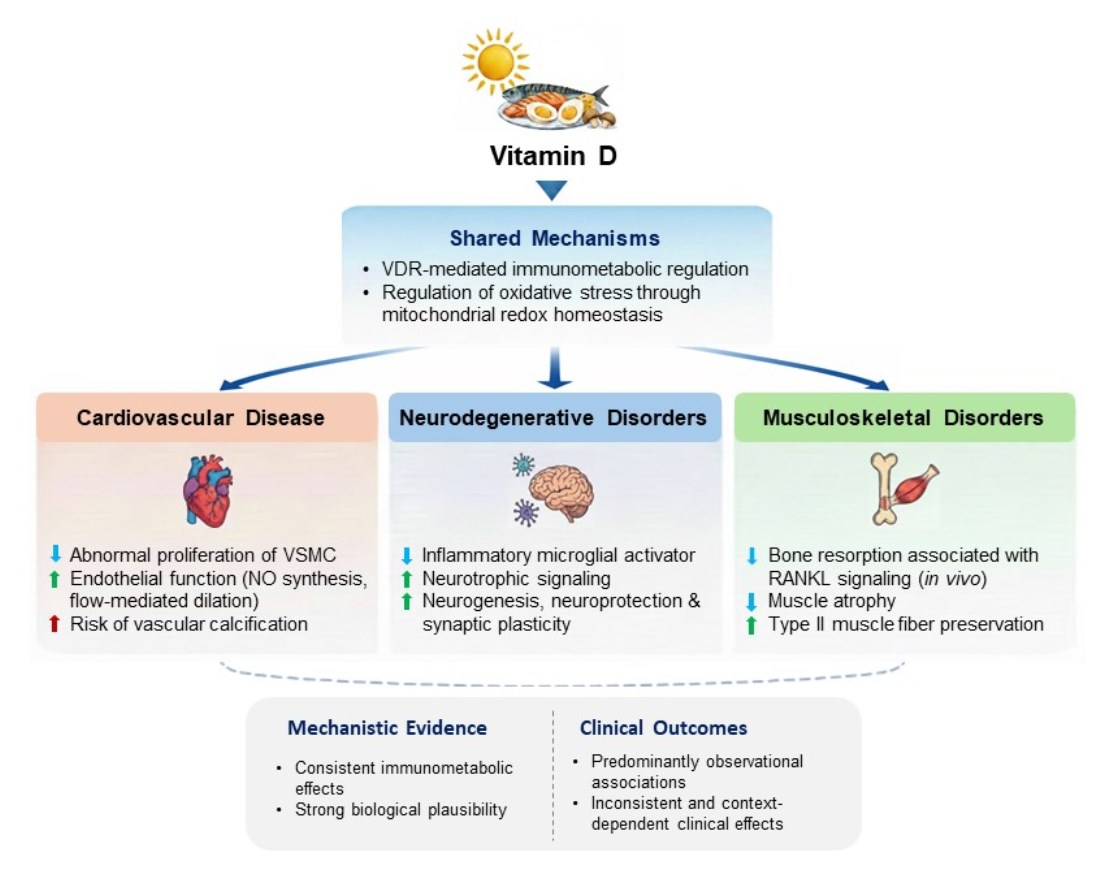
Vitamin D-Mediated Immunoregulation in Degenerative Diseases: Insights into Cardiovascular, Neurodegenerative and Musculoskeletal Disorders

Abstract
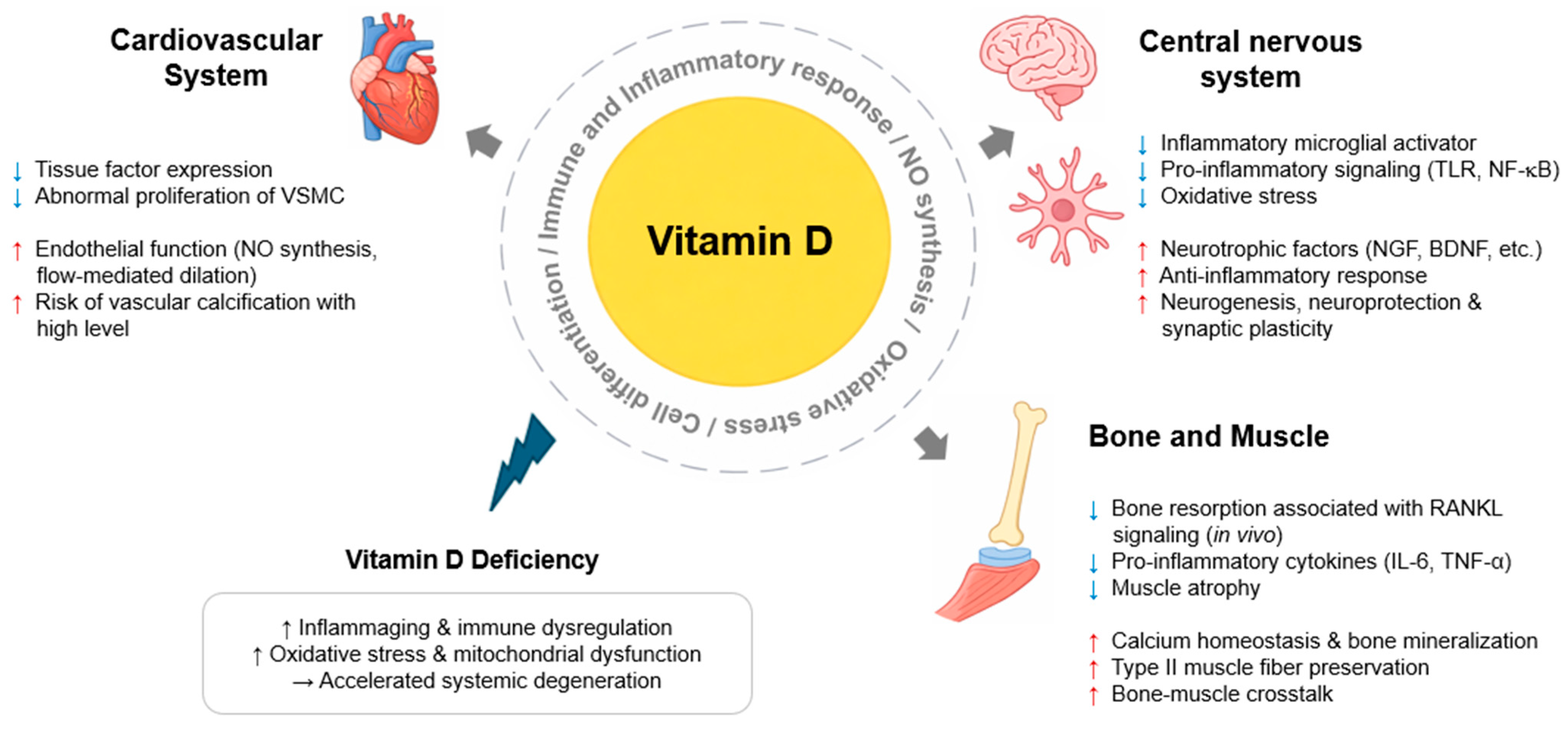
1. Introduction
2. Cardiovascular Diseases
2.1. Vitamin D and Endothelial Cells
2.2. Vitamin D and Vascular Smooth Muscle Cells
2.3. Vitamin D and the Incidence of Cardiovascular Disease
3. Neurodegeneration
3.1. Neuroprotective and Immunometabolic Roles of Vitamin D in the Brain
3.2. Neurodegenerative Diseases: Biological Mechanisms and Clinical Evidence Related to Vitamin D
3.2.1. Alzheimer’s Disease
3.2.2. Parkinson’s Disease
3.2.3. Other Neurodegenerative Diseases
4. Musculoskeletal Disorders
4.1. Vitamin D-Mediated Immune Regulation in Bone and Muscle
4.2. Musculoskeletal Disorders: Biological Mechanisms and Clinical Evidence Related to Vitamin D
4.2.1. Osteoporosis
4.2.2. Sarcopenia

| Vitamin D status and muscle diseases | |||
| Study design | Status of participants | Outcome | Reference |
| Prospective cohort study | 1339 adults from the Longitudinal Aging Study Amsterdam, 55–85y, follow-up 3 y | Low baseline 25(OH)D (<25 nmol/L) was associated with an increased risk of sarcopenia compared to individuals with high levels (>50 nmol/L), with a 2.57-fold increase based on grip strength and a 2.14-fold increase based on muscle mass | [208] |
| Prospective cohort study | 1604 women from the OPRA study, 75 y, mean follow-up 3 y | Severe deficiency in vitamin D (<20 ng/mL) was associated with higher fracture risk, possibly due to reduced physical activity and impaired postural stability | [218] |
| Cross-sectional study | 976 adults from the InCHIANTI study, mean age of 75 y | Vitamin D levels was negatively correlated with poor physical performance | [219] |
| Cross-sectional study | 91 women, age 60–69 y | Vitamin D deficiency was linked to decreased paraspinal muscle mass and greater fatty infiltration | [220] |
| Systematic review and meta-analysis | 30 clinical trials involving 5615 adults, mean age 61 y | Low vitamin D status was related with reduced muscle function and elevated risk for muscle-related disorders | [214] |
| Effect of vitamin D supplementation on muscle diseases | |||
| Study design | Status of participants | Outcome | Reference |
| RCT | 11 women with bone loss and muscle weakness, 65–81 y Received 1–2 μg 1α-hydroxycholecalciferol + 1 g of calcium, 3–6 mo | Combined administration of the active form of vitamin D analogue (1α-hydroxycholecalciferol) and calcium can improve myopathy associated with age-related bone loss | [155] |
| RCT | 38 adults with chronic low back pain (19 men and 19 women), 45–52 y Received 3200 IU/day vitamin D3 or placebo, 5 wk | Vitamin D supplementation enhanced muscle protein synthesis signaling, suppressed muscle atrophy pathways, and improved mitochondrial oxidative capacity | [207] |
| RCT | 89 adults, age over 65 y Received 0.25 μg of vitamin D3 twice daily or placebo, 6 mon | Oral administration of vitamin D did not improve muscle strength in older people | [215] |
| RCT | 243 adults, age 78–80 y Four groups: Exercise + Vitamin D3 Exercise + Placebo, No Exercise + Vitamin D3 No Exercise + Placebo. Oral Vitamin D3 supplementation (300,000 IU/day), 10 wk | Vitamin D supplementation, whether alone or combined with exercise, showed minimal or no effect on muscle strength, function, or fall prevention | [216] |
| Systematic review and meta-analysis | 10 clinical trials involving 1862 adults, age 58–80 y | Vitamin D supplementation showed no benefit on muscle mass, muscle strength, or overall physical performance | [217] |
5. Conclusions
Author Contributions
Funding
Data Availability Statement
Acknowledgments
Conflicts of Interest
References
- Wimalawansa, S.J. Vitamin D Deficiency: Effects on Oxidative Stress, Epigenetics, Gene Regulation, and Aging. Biology 2019, 8, 30. [Google Scholar] [CrossRef] [Scilit] [PubMed]
- Ryan, J.W.; Anderson, P.H.; Morris, H.A. Pleiotropic Activities of Vitamin D Receptors—Adequate Activation for Multiple Health Outcomes. Clin. Biochem. Rev. 2015, 36, 53–61. [Google Scholar]
- Tague, S.E.; Smith, P.G. Vitamin D receptor and enzyme expression in dorsal root ganglia of adult female rats: Modulation by ovarian hormones. J. Chem. Neuroanat. 2011, 41, 1–12. [Google Scholar] [CrossRef] [Scilit] [PubMed]
- Smolders, J.; Schuurman, K.G.; van Strien, M.E.; Melief, J.; Hendrickx, D.; Hol, E.M.; van Eden, C.; Luchetti, S.; Huitinga, I. Expression of vitamin D receptor and metabolizing enzymes in multiple sclerosis-affected brain tissue. J. Neuropathol. Exp. Neurol. 2013, 72, 91–105. [Google Scholar] [CrossRef] [Scilit] [PubMed]
- Naveilhan, P.; Neveu, I.; Baudet, C.; Ohyama, K.Y.; Brachet, P.; Wion, D. Expression of 25(OH) vitamin D3 24-hydroxylase gene in glial cells. Neuroreport 1993, 5, 255–257. [Google Scholar] [CrossRef] [Scilit] [PubMed]
- Chen, M.M.; Li, Y.; Deng, S.L.; Zhao, Y.; Lian, Z.X.; Yu, K. Mitochondrial Function and Reactive Oxygen/Nitrogen Species in Skeletal Muscle. Front. Cell Dev. Biol. 2022, 10, 826981. [Google Scholar] [CrossRef] [Scilit] [PubMed]
- Sandri, M.; Sandri, C.; Gilbert, A.; Skurk, C.; Calabria, E.; Picard, A.; Walsh, K.; Schiaffino, S.; Lecker, S.H.; Goldberg, A.L. Foxo transcription factors induce the atrophy-related ubiquitin ligase atrogin-1 and cause skeletal muscle atrophy. Cell 2004, 117, 399–412. [Google Scholar] [CrossRef] [Scilit] [PubMed]
- St-Pierre, J.; Drori, S.; Uldry, M.; Silvaggi, J.M.; Rhee, J.; Jäger, S.; Handschin, C.; Zheng, K.; Lin, J.; Yang, W.; et al. Suppression of reactive oxygen species and neurodegeneration by the PGC-1 transcriptional coactivators. Cell 2006, 127, 397–408. [Google Scholar] [CrossRef] [Scilit]
- Anderson, R.; Prolla, T. PGC-1alpha in aging and anti-aging interventions. Biochim. Biophys. Acta 2009, 1790, 1059–1066. [Google Scholar] [CrossRef] [Scilit] [PubMed]
- Tran, H.; Brunet, A.; Griffith, E.C.; Greenberg, M.E. The many forks in FOXO’s road. Sci. STKE 2003, 2003, Re5. [Google Scholar] [CrossRef] [PubMed]
- Brenkman, A.B.; van den Broek, N.J.; de Keizer, P.L.; van Gent, D.C.; Burgering, B.M. The DNA damage repair protein Ku70 interacts with FOXO4 to coordinate a conserved cellular stress response. FASEB J. 2010, 24, 4271–4280. [Google Scholar] [CrossRef] [Scilit]
- Holick, M.F. Vitamin D deficiency. N. Engl. J. Med. 2007, 357, 266–281. [Google Scholar] [CrossRef] [Scilit] [PubMed]
- Ministry of Health and Welfare (Ed.) Dietary Reference Intakes for Koreans 2020; The Korean Nutrition Society: Seoul, Republic of Korea, 2020. [Google Scholar]
- Holick, M.F.; Binkley, N.C.; Bischoff-Ferrari, H.A.; Gordon, C.M.; Hanley, D.A.; Heaney, R.P.; Murad, M.H.; Weaver, C.M. Evaluation, Treatment, and Prevention of Vitamin D Deficiency: An Endocrine Society Clinical Practice Guideline. J. Clin. Endocrinol. Metab. 2011, 96, 1911–1930. [Google Scholar] [CrossRef] [Scilit] [PubMed]
- Demay, M.B.; Pittas, A.G.; Bikle, D.D.; Diab, D.L.; Kiely, M.E.; Lazaretti-Castro, M.; Lips, P.; Mitchell, D.M.; Murad, M.H.; Powers, S.; et al. Vitamin D for the Prevention of Disease: An Endocrine Society Clinical Practice Guideline. J. Clin. Endocrinol. Metab. 2024, 109, 1907–1947. [Google Scholar] [CrossRef] [Scilit]
- Tanaka, K.; Ao, M.; Tamaru, J.; Kuwabara, A. Vitamin D insufficiency and disease risk in the elderly. J. Clin. Biochem. Nutr. 2024, 74, 9–16. [Google Scholar] [CrossRef] [Scilit] [PubMed]
- Wang, W.; Li, Y.; Meng, X. Vitamin D and neurodegenerative diseases. Heliyon 2023, 9, e12877. [Google Scholar] [CrossRef] [Scilit] [PubMed]
- Albahrani, A.A.; Greaves, R.F. Fat-Soluble Vitamins: Clinical Indications and Current Challenges for Chromatographic Measurement. Clin. Biochem. Rev. 2016, 37, 27–47. [Google Scholar] [PubMed]
- Ghaseminejad-Raeini, A.; Ghaderi, A.; Sharafi, A.; Nematollahi-Sani, B.; Moossavi, M.; Derakhshani, A.; Sarab, G.A. Immunomodulatory actions of vitamin D in various immune-related disorders: A comprehensive review. Front. Immunol. 2023, 14, 950465. [Google Scholar] [CrossRef] [Scilit]
- Charoenngam, N.; Holick, M.F. Immunologic Effects of Vitamin D on Human Health and Disease. Nutrients 2020, 12, 2097. [Google Scholar] [CrossRef] [Scilit]
- Janubová, M.; Žitňanová, I. The effects of vitamin D on different types of cells. Steroids 2024, 202, 109350. [Google Scholar] [CrossRef] [Scilit] [PubMed]
- Kose, M.; Senkal, N.; Tukek, T.; Cebeci, T.; Atalar, S.C.; Altinkaynak, M.; Arici, H.; Genc, S.; Catma, Y.; Kocaaga, M.; et al. Severe vitamin D deficiency is associated with endothelial inflammation in healthy individuals even in the absence of subclinical atherosclerosis. Eur. Rev. Med. Pharmacol. Sci. 2022, 26, 7046–7052. [Google Scholar] [CrossRef] [Scilit] [PubMed]
- Ni, W.; Watts, S.W.; Ng, M.; Chen, S.; Glenn, D.J.; Gardner, D.G. Elimination of vitamin D receptor in vascular endothelial cells alters vascular function. Hypertension 2014, 64, 1290–1298. [Google Scholar] [CrossRef] [Scilit]
- Haas, M.J.; Jafri, M.; Wehmeier, K.R.; Onstead-Haas, L.M.; Mooradian, A.D. Inhibition of endoplasmic reticulum stress and oxidative stress by vitamin D in endothelial cells. Free. Radic. Biol. Med. 2016, 99, 1–10. [Google Scholar] [CrossRef] [Scilit]
- Chen, Y.; Chen, D.; Peng, Y.; Wang, M.; Wang, W.; Shi, F.; Wang, Y.; Hua, L. The effect of vitamin D supplementation on endothelial function: An umbrella review of interventional meta-analyses. Nutr. Metab. Cardiovasc. Dis. 2025, 35, 103871. [Google Scholar] [CrossRef] [Scilit] [PubMed]
- Shi, J.; Yang, Y.; Cheng, A.; Xu, G.; He, F. Metabolism of vascular smooth muscle cells in vascular diseases. Am. J. Physiol. Heart Circ. Physiol. 2020, 319, H613–H631. [Google Scholar] [CrossRef] [Scilit]
- Zhang, X.; Liu, J.; Han, L.; Luo, G.; Jiang, P.; Jing, J.; Quan, J. Vitamin D reduces VSMC foam cell formation and protects against AS progression. J. Endocrinol. 2025, 265, e240056. [Google Scholar] [CrossRef] [Scilit] [PubMed]
- Wang, J.; Zhou, J.J.; Robertson, G.R.; Lee, V.W. Vitamin D in Vascular Calcification: A Double-Edged Sword? Nutrients 2018, 10, 652. [Google Scholar] [CrossRef] [Scilit]
- Covic, A.; Kanbay, M.; Voroneanu, L.; Turgut, F.; Serban, D.N.; Serban, I.L.; Goldsmith, D.J. Vascular calcification in chronic kidney disease. Clin. Sci. 2010, 119, 111–121. [Google Scholar] [CrossRef] [Scilit] [PubMed]
- Huong, N.T.; Long, T.D.; Bouissou, F.; Liem, N.T.; Truong, D.M.; Nga, D.K.; Chien, T.T.; Bascands, J.L. Chronic kidney disease in children: The National Paediatric Hospital experience in Hanoi, Vietnam. Nephrology 2009, 14, 722–727. [Google Scholar] [CrossRef] [Scilit] [PubMed]
- Tukaj, C.; Kubasik-Juraniec, J.; Kraszpulski, M. Morphological changes of aortal smooth muscle cells exposed to calcitriol in culture. Med. Sci. Monit. 2000, 6, 668–674. [Google Scholar] [PubMed]
- Qin, X.; Corriere, M.A.; Matrisian, L.M.; Guzman, R.J. Matrix metalloproteinase inhibition attenuates aortic calcification. Arterioscler Thromb. Vasc. Biol. 2006, 26, 1510–1516. [Google Scholar] [CrossRef] [Scilit]
- Ginsberg, C.; Hoofnagle, A.N.; Katz, R.; Cheng, J.H.; Hsu, S.; Budoff, M.J.; Kado, D.M.; Kestenbaum, B.; Siscovick, D.S.; Michos, E.D.; et al. Vitamin D Metabolite Ratio and Coronary Artery Calcification in the Multi-Ethnic Study of Atherosclerosis. Circ. Cardiovasc. Imaging 2023, 16, e015055. [Google Scholar] [CrossRef] [Scilit]
- Carvalho, L.S.F.; Sposito, A.C. Vitamin D for the prevention of cardiovascular disease: Are we ready for that? Atherosclerosis 2015, 241, 729–740. [Google Scholar] [CrossRef] [Scilit] [PubMed]
- Aleksova, A.; Beltrami, A.P.; Belfiore, R.; Barbati, G.; Di Nucci, M.; Scapol, S.; De Paris, V.; Carriere, C.; Sinagra, G. U-shaped relationship between vitamin D levels and long-term outcome in large cohort of survivors of acute myocardial infarction. Int. J. Cardiol. 2016, 223, 962–966. [Google Scholar] [CrossRef] [Scilit]
- Eyles, D.W.; Smith, S.; Kinobe, R.; Hewison, M.; McGrath, J.J. Distribution of the vitamin D receptor and 1 alpha-hydroxylase in human brain. J. Chem. Neuroanat. 2005, 29, 21–30. [Google Scholar] [CrossRef] [Scilit]
- Cui, X.; Pelekanos, M.; Liu, P.Y.; Burne, T.H.; McGrath, J.J.; Eyles, D.W. The vitamin D receptor in dopamine neurons; its presence in human substantia nigra and its ontogenesis in rat midbrain. Neuroscience 2013, 236, 77–87. [Google Scholar] [CrossRef] [Scilit] [PubMed]
- Clemens, T.L.; Garrett, K.P.; Zhou, X.Y.; Pike, J.W.; Haussler, M.R.; Dempster, D.W. Immunocytochemical localization of the 1,25-dihydroxyvitamin D3 receptor in target cells. Endocrinology 1988, 122, 1224–1230. [Google Scholar] [CrossRef] [Scilit]
- Johnson, J.A.; Grande, J.P.; Windebank, A.J.; Kumar, R. 1,25-Dihydroxyvitamin D(3) receptors in developing dorsal root ganglia of fetal rats. Brain Res. Dev. Brain Res. 1996, 92, 120–124. [Google Scholar] [CrossRef] [Scilit] [PubMed]
- Prüfer, K.; Veenstra, T.D.; Jirikowski, G.F.; Kumar, R. Distribution of 1,25-dihydroxyvitamin D3 receptor immunoreactivity in the rat brain and spinal cord. J. Chem. Neuroanat. 1999, 16, 135–145. [Google Scholar] [CrossRef] [Scilit] [PubMed]
- Margolis, R.N.; Christakos, S. The nuclear receptor superfamily of steroid hormones and vitamin D gene regulation. An update. Ann. N. Y. Acad. Sci. 2010, 1192, 208–214. [Google Scholar] [CrossRef] [Scilit]
- Landel, V.; Stephan, D.; Cui, X.; Eyles, D.; Feron, F. Differential expression of vitamin D-associated enzymes and receptors in brain cell subtypes. J. Steroid Biochem. Mol. Biol. 2018, 177, 129–134. [Google Scholar] [CrossRef] [Scilit] [PubMed]
- Burkert, R.; McGrath, J.; Eyles, D. Vitamin D receptor expression in the embryonic rat brain. Neurosci. Res. Commun. 2003, 33, 63–71. [Google Scholar] [CrossRef] [Scilit]
- Stumpf, W.E.; Sar, M.; Clark, S.A.; DeLuca, H.F. Brain target sites for 1,25-dihydroxyvitamin D3. Science 1982, 215, 1403–1405. [Google Scholar] [CrossRef] [Scilit]
- Sailike, B.; Onzhanova, Z.; Akbay, B.; Tokay, T.; Molnár, F. Vitamin D in Central Nervous System: Implications for Neurological Disorders. Int. J. Mol. Sci. 2024, 25, 7809. [Google Scholar] [CrossRef] [Scilit] [PubMed]
- Farghali, M.; Ruga, S.; Morsanuto, V.; Uberti, F. Can Brain Health Be Supported by Vitamin D-Based Supplements? A Critical Review. Brain Sci. 2020, 10, 660. [Google Scholar] [CrossRef] [Scilit] [PubMed]
- Pardridge, W.M.; Sakiyama, R.; Coty, W.A. Restricted transport of vitamin D and A derivatives through the rat blood-brain barrier. J. Neurochem. 1985, 44, 1138–1141. [Google Scholar] [CrossRef] [Scilit] [PubMed]
- Fernandes de Abreu, D.A.; Eyles, D.; Féron, F. Vitamin D, a neuro-immunomodulator: Implications for neurodegenerative and autoimmune diseases. Psychoneuroendocrinology 2009, 34, S265–S277. [Google Scholar] [CrossRef] [Scilit] [PubMed]
- Pertile, R.A.N.; Cui, X.; Hammond, L.; Eyles, D.W. Vitamin D regulation of GDNF/Ret signaling in dopaminergic neurons. FASEB J. 2018, 32, 819–828. [Google Scholar] [CrossRef] [Scilit] [PubMed]
- Brown, J.; Bianco, J.I.; McGrath, J.J.; Eyles, D.W. 1,25-dihydroxyvitamin D3 induces nerve growth factor, promotes neurite outgrowth and inhibits mitosis in embryonic rat hippocampal neurons. Neurosci. Lett. 2003, 343, 139–143. [Google Scholar] [CrossRef] [Scilit] [PubMed]
- Taniura, H.; Ito, M.; Sanada, N.; Kuramoto, N.; Ohno, Y.; Nakamichi, N.; Yoneda, Y. Chronic vitamin D3 treatment protects against neurotoxicity by glutamate in association with upregulation of vitamin D receptor mRNA expression in cultured rat cortical neurons. J. Neurosci. Res. 2006, 83, 1179–1189. [Google Scholar] [CrossRef] [Scilit]
- Shirazi, H.A.; Rasouli, J.; Ciric, B.; Rostami, A.; Zhang, G.X. 1,25-Dihydroxyvitamin D3 enhances neural stem cell proliferation and oligodendrocyte differentiation. Exp. Mol. Pathol. 2015, 98, 240–245. [Google Scholar] [CrossRef] [Scilit] [PubMed]
- Shi, Y.; Shi, Y.; Jie, R.; He, J.; Luo, Z.; Li, J. Vitamin D: The crucial neuroprotective factor for nerve cells. Neuroscience 2024, 560, 272–285. [Google Scholar] [CrossRef] [Scilit] [PubMed]
- Neveu, I.; Naveilhan, P.; Jehan, F.; Baudet, C.; Wion, D.; De Luca, H.F.; Brachet, P. 1,25-dihydroxyvitamin D3 regulates the synthesis of nerve growth factor in primary cultures of glial cells. Brain Res. Mol. Brain Res. 1994, 24, 70–76. [Google Scholar] [CrossRef] [Scilit] [PubMed]
- Féron, F.; Burne, T.H.; Brown, J.; Smith, E.; McGrath, J.J.; Mackay-Sim, A.; Eyles, D.W. Developmental Vitamin D3 deficiency alters the adult rat brain. Brain Res. Bull. 2005, 65, 141–148. [Google Scholar] [CrossRef] [Scilit]
- Cui, X.; McGrath, J.J.; Burne, T.H.; Mackay-Sim, A.; Eyles, D.W. Maternal vitamin D depletion alters neurogenesis in the developing rat brain. Int. J. Dev. Neurosci. 2007, 25, 227–232. [Google Scholar] [CrossRef] [Scilit]
- Ko, P.; Burkert, R.; McGrath, J.; Eyles, D. Maternal vitamin D3 deprivation and the regulation of apoptosis and cell cycle during rat brain development. Brain. Res. Dev. Brain Res. 2004, 153, 61–68. [Google Scholar] [CrossRef] [Scilit]
- Pertile, R.A.N.; Brigden, R.; Raman, V.; Cui, X.; Du, Z.; Eyles, D. Vitamin D: A potent regulator of dopaminergic neuron differentiation and function. J. Neurochem. 2023, 166, 779–789. [Google Scholar] [CrossRef] [Scilit]
- Pertile, R.A.; Cui, X.; Eyles, D.W. Vitamin D signaling and the differentiation of developing dopamine systems. Neuroscience 2016, 333, 193–203. [Google Scholar] [CrossRef] [Scilit]
- Cui, X.; Pertile, R.; Liu, P.; Eyles, D.W. Vitamin D regulates tyrosine hydroxylase expression: N-cadherin a possible mediator. Neuroscience 2015, 304, 90–100. [Google Scholar] [CrossRef] [Scilit]
- de Viragh, P.A.; Haglid, K.G.; Celio, M.R. Parvalbumin increases in the caudate putamen of rats with vitamin D hypervitaminosis. Proc. Natl. Acad. Sci. USA 1989, 86, 3887–3890. [Google Scholar] [CrossRef] [Scilit]
- Garcion, E.; Nataf, S.; Berod, A.; Darcy, F.; Brachet, P. 1,25-Dihydroxyvitamin D3 inhibits the expression of inducible nitric oxide synthase in rat central nervous system during experimental allergic encephalomyelitis. Brain Res. Mol. Brain Res. 1997, 45, 255–267. [Google Scholar] [CrossRef] [Scilit]
- Villaggio, B.; Soldano, S.; Cutolo, M. 1,25-dihydroxyvitamin D3 downregulates aromatase expression and inflammatory cytokines in human macrophages. Clin. Exp. Rheumatol. 2012, 30, 934–938. [Google Scholar] [CrossRef] [Scilit]
- Sadeghi, K.; Wessner, B.; Laggner, U.; Ploder, M.; Tamandl, D.; Friedl, J.; Zügel, U.; Steinmeyer, A.; Pollak, A.; Roth, E.; et al. Vitamin D3 down-regulates monocyte TLR expression and triggers hyporesponsiveness to pathogen-associated molecular patterns. Eur. J. Immunol. 2006, 36, 361–370. [Google Scholar] [CrossRef] [Scilit]
- Dickie, L.J.; Church, L.D.; Coulthard, L.R.; Mathews, R.J.; Emery, P.; McDermott, M.F. Vitamin D3 down-regulates intracellular Toll-like receptor 9 expression and Toll-like receptor 9-induced IL-6 production in human monocytes. Rheumatology 2010, 49, 1466–1471. [Google Scholar] [CrossRef] [Scilit]
- Park, C.Y.; Han, S.N. The Role of Vitamin D in Adipose Tissue Biology: Adipocyte Differentiation, Energy Metabolism, and Inflammation. J. Lipid Atheroscler. 2021, 10, 130–144. [Google Scholar] [CrossRef] [Scilit]
- Cohen-Lahav, M.; Shany, S.; Tobvin, D.; Chaimovitz, C.; Douvdevani, A. Vitamin D decreases NFkappaB activity by increasing IkappaBalpha levels. Nephrol. Dial. Transplant. 2006, 21, 889–897. [Google Scholar] [CrossRef] [Scilit] [PubMed]
- Chen, Y.; Zhang, J.; Ge, X.; Du, J.; Deb, D.K.; Li, Y.C. Vitamin D receptor inhibits nuclear factor κB activation by interacting with IκB kinase β protein. J. Biol. Chem. 2013, 288, 19450–19458. [Google Scholar] [CrossRef] [Scilit] [PubMed]
- Sierra, A.; Gottfried-Blackmore, A.C.; McEwen, B.S.; Bulloch, K. Microglia derived from aging mice exhibit an altered inflammatory profile. Glia 2007, 55, 412–424. [Google Scholar] [CrossRef] [Scilit] [PubMed]
- Norden, D.M.; Godbout, J.P. Review: Microglia of the aged brain: Primed to be activated and resistant to regulation. Neuropathol. Appl. Neurobiol. 2013, 39, 19–34. [Google Scholar] [CrossRef] [Scilit]
- Boontanrart, M.; Hall, S.D.; Spanier, J.A.; Hayes, C.E.; Olson, J.K. Vitamin D3 alters microglia immune activation by an IL-10 dependent SOCS3 mechanism. J. Neuroimmunol. 2016, 292, 126–136. [Google Scholar] [CrossRef] [Scilit]
- He, J.; Guo, X.; Liu, Z.Q.; Yang, P.C.; Yang, S. Vitamin D inhibits the Staphylococcal enterotoxin B-induced expression of tumor necrosis factor in microglial cells. Immunol. Res. 2017, 65, 913–919. [Google Scholar] [CrossRef] [Scilit]
- Calvello, R.; Cianciulli, A.; Nicolardi, G.; De Nuccio, F.; Giannotti, L.; Salvatore, R.; Porro, C.; Trotta, T.; Panaro, M.A.; Lofrumento, D.D. Vitamin D Treatment Attenuates Neuroinflammation and Dopaminergic Neurodegeneration in an Animal Model of Parkinson’s Disease, Shifting M1 to M2 Microglia Responses. J. Neuroimmune Pharmacol. 2017, 12, 327–339. [Google Scholar] [CrossRef] [Scilit]
- Jiao, K.P.; Li, S.M.; Lv, W.Y.; Jv, M.L.; He, H.Y. Vitamin D3 repressed astrocyte activation following lipopolysaccharide stimulation in vitro and in neonatal rats. Neuroreport 2017, 28, 492–497. [Google Scholar] [CrossRef] [Scilit] [PubMed]
- de Siqueira, E.A.; Magalhães, E.P.; de Menezes, R.; Sampaio, T.L.; Lima, D.B.; da Silva Martins, C.; Neves, K.R.T.; de Castro Brito, G.A.; Martins, A.M.C.; de Barros Viana, G.S. Vitamin D3 actions on astrocyte cells: A target for therapeutic strategy in Parkinson’s disease? Neurosci. Lett. 2023, 793, 136997. [Google Scholar] [CrossRef] [Scilit]
- Gauthier, S.; Webster, C.; Servaes, S.; Morais, J.; Rosa-Neto, P. World Alzheimer Report 2022: Life after Diagnosis: Navigating Treatment, Care and Support; Alzheimer’s Disease International: London, UK, 2023. [Google Scholar]
- Gammon, K. Neurodegenerative disease: Brain windfall. Nature 2014, 515, 299–300. [Google Scholar] [CrossRef] [Scilit] [PubMed]
- Su, D.; Cui, Y.; He, C.; Yin, P.; Bai, R.; Zhu, J.; Lam, J.S.T.; Zhang, J.; Yan, R.; Zheng, X.; et al. Projections for prevalence of Parkinson’s disease and its driving factors in 195 countries and territories to 2050: Modelling study of Global Burden of Disease Study 2021. BMJ 2025, 388, e080952. [Google Scholar] [CrossRef] [Scilit]
- Chen, G.F.; Xu, T.H.; Yan, Y.; Zhou, Y.R.; Jiang, Y.; Melcher, K.; Xu, H.E. Amyloid beta: Structure, biology and structure-based therapeutic development. Acta Pharmacol. Sin. 2017, 38, 1205–1235. [Google Scholar] [CrossRef] [Scilit] [PubMed]
- Kadowaki, H.; Nishitoh, H.; Urano, F.; Sadamitsu, C.; Matsuzawa, A.; Takeda, K.; Masutani, H.; Yodoi, J.; Urano, Y.; Nagano, T.; et al. Amyloid beta induces neuronal cell death through ROS-mediated ASK1 activation. Cell Death Differ. 2005, 12, 19–24. [Google Scholar] [CrossRef] [Scilit]
- Whitwell, J.L. Progression of atrophy in Alzheimer’s disease and related disorders. Neurotox Res. 2010, 18, 339–346. [Google Scholar] [CrossRef] [Scilit]
- Sobue, A.; Komine, O.; Yamanaka, K. Neuroinflammation in Alzheimer’s disease: Microglial signature and their relevance to disease. Inflamm. Regen. 2023, 43, 26. [Google Scholar] [CrossRef] [Scilit]
- Grimm, M.O.W.; Thiel, A.; Lauer, A.A.; Winkler, J.; Lehmann, J.; Regner, L.; Nelke, C.; Janitschke, D.; Benoist, C.; Streidenberger, O.; et al. Vitamin D and Its Analogues Decrease Amyloid-β (Aβ) Formation and Increase Aβ-Degradation. Int. J. Mol. Sci. 2017, 18, 2764. [Google Scholar] [CrossRef] [Scilit] [PubMed]
- Durk, M.R.; Han, K.; Chow, E.C.; Ahrens, R.; Henderson, J.T.; Fraser, P.E.; Pang, K.S. 1α,25-Dihydroxyvitamin D3 reduces cerebral amyloid-β accumulation and improves cognition in mouse models of Alzheimer’s disease. J. Neurosci. 2014, 34, 7091–7101. [Google Scholar] [CrossRef] [Scilit]
- Morello, M.; Landel, V.; Lacassagne, E.; Baranger, K.; Annweiler, C.; Féron, F.; Millet, P. Vitamin D Improves Neurogenesis and Cognition in a Mouse Model of Alzheimer’s Disease. Mol. Neurobiol. 2018, 55, 6463–6479. [Google Scholar] [CrossRef] [Scilit] [PubMed]
- Wu, T.Y.; Zhao, L.X.; Zhang, Y.H.; Fan, Y.G. Activation of vitamin D receptor inhibits Tau phosphorylation is associated with reduction of iron accumulation in APP/PS1 transgenic mice. Neurochem. Int. 2022, 153, 105260. [Google Scholar] [CrossRef] [Scilit] [PubMed]
- Grant, W.B. Does vitamin D reduce the risk of dementia? J. Alzheimers Dis. 2009, 17, 151–159. [Google Scholar] [CrossRef] [Scilit]
- Pogge, E. Vitamin D and Alzheimer’s disease: Is there a link? Consult. Pharm. 2010, 25, 440–450. [Google Scholar] [CrossRef] [Scilit]
- Kalra, A.; Teixeira, A.L.; Diniz, B.S. Association of Vitamin D Levels with Incident All-Cause Dementia in Longitudinal Observational Studies: A Systematic Review and Meta-analysis. J. Prev. Alzheimers Dis. 2020, 7, 14–20. [Google Scholar] [CrossRef] [Scilit]
- Zhang, X.X.; Wang, H.R.; Meng, W.; Hu, Y.Z.; Sun, H.M.; Feng, Y.X.; Jia, J.J. Association of Vitamin D Levels with Risk of Cognitive Impairment and Dementia: A Systematic Review and Meta-Analysis of Prospective Studies. J. Alzheimers Dis. 2024, 98, 373–385. [Google Scholar] [CrossRef] [Scilit]
- Pinzon, R.T.; Handayani, T.; Wijaya, V.O.; Buana, R.B. Low vitamin D serum levels as risk factor of Alzheimer’s disease: A systematic review and meta-analysis. Egypt. J. Neurol. Psychiatry Neurosurg. 2023, 59, 88. [Google Scholar] [CrossRef] [Scilit]
- Navale, S.S.; Mulugeta, A.; Zhou, A.; Llewellyn, D.J.; Hyppönen, E. Vitamin D and brain health: An observational and Mendelian randomization study. Am. J. Clin. Nutr. 2022, 116, 531–540. [Google Scholar] [CrossRef] [Scilit]
- Jayedi, A.; Rashidy-Pour, A.; Shab-Bidar, S. Vitamin D status and risk of dementia and Alzheimer’s disease: A meta-analysis of dose-response. Nutr. Neurosci. 2019, 22, 750–759. [Google Scholar] [CrossRef] [Scilit]
- Chai, B.; Gao, F.; Wu, R.; Dong, T.; Gu, C.; Lin, Q.; Zhang, Y. Vitamin D deficiency as a risk factor for dementia and Alzheimer’s disease: An updated meta-analysis. BMC Neurol. 2019, 19, 284. [Google Scholar] [CrossRef] [Scilit]
- Chen, H.; Xue, W.; Li, J.; Fu, K.; Shi, H.; Zhang, B.; Teng, W.; Tian, L. 25-Hydroxyvitamin D Levels and the Risk of Dementia and Alzheimer’s Disease: A Dose-Response Meta-Analysis. Front. Aging Neurosci. 2018, 10, 368. [Google Scholar] [CrossRef] [Scilit]
- Jia, J.; Hu, J.; Huo, X.; Miao, R.; Zhang, Y.; Ma, F. Effects of vitamin D supplementation on cognitive function and blood Aβ-related biomarkers in older adults with Alzheimer’s disease: A randomised, double-blind, placebo-controlled trial. J. Neurol. Neurosurg Psychiatry 2019, 90, 1347–1352. [Google Scholar] [CrossRef] [Scilit]
- Stein, M.S.; Scherer, S.C.; Ladd, K.S.; Harrison, L.C. A randomized controlled trial of high-dose vitamin D2 followed by intranasal insulin in Alzheimer’s disease. J. Alzheimers Dis. 2011, 26, 477–484. [Google Scholar] [CrossRef] [Scilit]
- Lönnroos, E.; Ylilauri, M.; Lamberg-Allardt, C.; Manson, J.E.; Nurmi, T.; Uusitupa, M.; Voutilainen, A.; Hantunen, S.; Tuomainen, T.P.; Virtanen, J.K. The Effect of Vitamin D3 Supplementation on the Incidence of Diagnosed Dementia Among Healthy Older Adults-The Finnish Vitamin D Trial. J. Gerontol. A Biol. Sci. Med. Sci. 2025, 80, glaf077. [Google Scholar] [CrossRef] [Scilit]
- Du, Y.; Liang, F.; Zhang, L.; Liu, J.; Dou, H. Vitamin D Supplement for Prevention of Alzheimer’s Disease: A Systematic Review and Meta-Analysis. Am. J. Ther. 2020, 28, e638–e648. [Google Scholar] [CrossRef] [Scilit] [PubMed]
- Annweiler, C.; Rolland, Y.; Schott, A.M.; Blain, H.; Vellas, B.; Herrmann, F.R.; Beauchet, O. Higher vitamin D dietary intake is associated with lower risk of alzheimer’s disease: A 7-year follow-up. J. Gerontol. A Biol. Sci. Med. Sci. 2012, 67, 1205–1211. [Google Scholar] [CrossRef] [Scilit] [PubMed]
- Khatoon, R. Unlocking the Potential of Vitamin D: A Comprehensive Exploration of Its Role in Neurological Health and Diseases. Biology 2025, 14, 280. [Google Scholar] [CrossRef] [Scilit] [PubMed]
- SanMartin, C.D.; Henriquez, M.; Chacon, C.; Ponce, D.P.; Salech, F.; Rogers, N.K.; Behrens, M.I. Vitamin D Increases Aβ140 Plasma Levels and Protects Lymphocytes from Oxidative Death in Mild Cognitive Impairment Patients. Curr. Alzheimer Res. 2018, 15, 561–569. [Google Scholar] [CrossRef] [Scilit]
- Owusu, J.E.; Islam, S.; Katumuluwa, S.S.; Stolberg, A.R.; Usera, G.L.; Anwarullah, A.A.; Shieh, A.; Dhaliwal, R.; Ragolia, L.; Mikhail, M.B.; et al. Cognition and Vitamin D in Older African-American Women- Physical performance and Osteoporosis prevention with vitamin D in older African Americans Trial and Dementia. J. Am. Geriatr. Soc. 2019, 67, 81–86. [Google Scholar] [CrossRef] [Scilit]
- Lai, R.H.; Hsu, C.C.; Yu, B.H.; Lo, Y.R.; Hsu, Y.Y.; Chen, M.H.; Juang, J.L. Vitamin D supplementation worsens Alzheimer’s progression: Animal model and human cohort studies. Aging Cell 2022, 21, e13670. [Google Scholar] [CrossRef] [Scilit]
- Miller, B.J.; Whisner, C.M.; Johnston, C.S. Vitamin D Supplementation Appears to Increase Plasma Aβ40 in Vitamin D Insufficient Older Adults: A Pilot Randomized Controlled Trial. J. Alzheimers Dis. 2016, 52, 843–847. [Google Scholar] [CrossRef] [Scilit]
- Dugger, B.N.; Dickson, D.W. Pathology of Neurodegenerative Diseases. Cold Spring Harb. Perspect. Biol. 2017, 9, a028035. [Google Scholar] [CrossRef] [Scilit] [PubMed]
- Kalia, L.V.; Lang, A.E. Parkinson’s disease. Lancet 2015, 386, 896–912. [Google Scholar] [CrossRef] [Scilit]
- Brewer, L.D.; Porter, N.M.; Kerr, D.S.; Landfield, P.W.; Thibault, O. Chronic 1alpha,25-(OH)2 vitamin D3 treatment reduces Ca2+-mediated hippocampal biomarkers of aging. Cell Calcium 2006, 40, 277–286. [Google Scholar] [CrossRef] [Scilit]
- Bayo-Olugbami, A.; Nafiu, A.B.; Amin, A.; Ogundele, O.M.; Lee, C.C.; Owoyele, B.V. Vitamin D attenuated 6-OHDA-induced behavioural deficits, dopamine dysmetabolism, oxidative stress, and neuro-inflammation in mice. Nutr. Neurosci. 2022, 25, 823–834. [Google Scholar] [CrossRef] [Scilit] [PubMed]
- Magdy, A.; Farrag, E.A.E.; Hamed, S.M.; Abdallah, Z.; El Nashar, E.M.; Alghamdi, M.A.; Ali, A.A.H.; Abd El-Kader, M. Neuroprotective and therapeutic effects of calcitriol in rotenone-induced Parkinson’s disease rat model. Front. Cell Neurosci. 2022, 16, 967813. [Google Scholar] [CrossRef] [Scilit]
- Lima, L.A.R.; Lopes, M.J.P.; Costa, R.O.; Lima, F.A.V.; Neves, K.R.T.; Calou, I.B.F.; Andrade, G.M.; Viana, G.S.B. Vitamin D protects dopaminergic neurons against neuroinflammation and oxidative stress in hemiparkinsonian rats. J. Neuroinflammation 2018, 15, 249. [Google Scholar] [CrossRef] [Scilit]
- Rcom-H’cheo-Gauthier, A.N.; Meedeniya, A.C.; Pountney, D.L. Calcipotriol inhibits α-synuclein aggregation in SH-SY5Y neuroblastoma cells by a Calbindin-D28k-dependent mechanism. J. Neurochem. 2017, 141, 263–274. [Google Scholar] [CrossRef] [Scilit] [PubMed]
- Xu, J.; Li, J.; Sun, Y.J.; Quan, W.; Qin, Y.D.; Song, J.; Chen, J.J. Effect of vitamin D supplementation on motor symptoms in Parkinson’s disease: A meta-analysis of randomized controlled trials. Front. Nutr. 2025, 12, 1500875. [Google Scholar] [CrossRef] [Scilit]
- Sanchez, B.; Relova, J.L.; Gallego, R.; Ben-Batalla, I.; Perez-Fernandez, R. 1,25-Dihydroxyvitamin D3 administration to 6-hydroxydopamine-lesioned rats increases glial cell line-derived neurotrophic factor and partially restores tyrosine hydroxylase expression in substantia nigra and striatum. J. Neurosci. Res. 2009, 87, 723–732. [Google Scholar] [CrossRef] [Scilit]
- Kosakai, A.; Ito, D.; Nihei, Y.; Yamashita, S.; Okada, Y.; Takahashi, K.; Suzuki, N. Degeneration of mesencephalic dopaminergic neurons in klotho mouse related to vitamin D exposure. Brain Res. 2011, 1382, 109–117. [Google Scholar] [CrossRef] [Scilit]
- Buell, J.S.; Dawson-Hughes, B. Vitamin D and neurocognitive dysfunction: Preventing “D”ecline? Mol. Aspects Med. 2008, 29, 415–422. [Google Scholar] [CrossRef] [Scilit]
- Zhou, Z.; Zhou, R.; Zhang, Z.; Li, K. The Association Between Vitamin D Status, Vitamin D Supplementation, Sunlight Exposure, and Parkinson’s Disease: A Systematic Review and Meta-Analysis. Med. Sci.Monit. 2019, 25, 666–674. [Google Scholar] [CrossRef] [Scilit] [PubMed]
- Evatt, M.L.; Delong, M.R.; Khazai, N.; Rosen, A.; Triche, S.; Tangpricha, V. Prevalence of vitamin d insufficiency in patients with Parkinson disease and Alzheimer disease. Arch. Neurol. 2008, 65, 1348–1352. [Google Scholar] [CrossRef] [Scilit] [PubMed]
- Evatt, M.L.; DeLong, M.R.; Kumari, M.; Auinger, P.; McDermott, M.P.; Tangpricha, V. High prevalence of hypovitaminosis D status in patients with early Parkinson disease. Arch. Neurol. 2011, 68, 314–319. [Google Scholar] [CrossRef] [Scilit]
- Lv, Z.; Qi, H.; Wang, L.; Fan, X.; Han, F.; Wang, H.; Bi, S. Vitamin D status and Parkinson’s disease: A systematic review and meta-analysis. Neurol Sci 2014, 35, 1723–1730. [Google Scholar] [CrossRef] [Scilit]
- Luo, X.; Ou, R.; Dutta, R.; Tian, Y.; Xiong, H.; Shang, H. Association Between Serum Vitamin D Levels and Parkinson’s Disease: A Systematic Review and Meta-Analysis. Front. Neurol. 2018, 9, 909. [Google Scholar] [CrossRef] [Scilit]
- Shen, L.; Ji, H.F. Associations between Vitamin D Status, Supplementation, Outdoor Work and Risk of Parkinson’s Disease: A Meta-Analysis Assessment. Nutrients 2015, 7, 4817–4827. [Google Scholar] [CrossRef] [Scilit] [PubMed]
- Rahnemayan, S.; Ahari, S.G.; Rikhtegar, R.; Riyahifar, S.; Sanaie, S. An umbrella review of systematic reviews with meta-analysis on the role of vitamins in Parkinson’s disease. Acta Neurol. Belg. 2023, 123, 69–83. [Google Scholar] [CrossRef] [Scilit]
- Li, D.; Ma, X.; Zhang, W.; Zhong, P.; Li, M.; Liu, S. Impact of vitamin D3 supplementation on motor functionality and the immune response in Parkinson’s disease patients with vitamin D deficiency. Sci. Rep. 2025, 15, 25154. [Google Scholar] [CrossRef] [Scilit]
- Suzuki, M.; Yoshioka, M.; Hashimoto, M.; Murakami, M.; Noya, M.; Takahashi, D.; Urashima, M. Randomized, double-blind, placebo-controlled trial of vitamin D supplementation in Parkinson disease. Am. J. Clin. Nutr. 2013, 97, 1004–1013. [Google Scholar] [CrossRef] [Scilit]
- Bytowska, Z.K.; Korewo-Labelle, D.; Berezka, P.; Kowalski, K.; Przewłócka, K.; Libionka, W.; Kloc, W.; Kaczor, J.J. Effect of 12-Week BMI-Based Vitamin D(3) Supplementation in Parkinson’s Disease with Deep Brain Stimulation on Physical Performance, Inflammation, and Vitamin D Metabolites. Int. J. Mol. Sci. 2023, 24, 10200. [Google Scholar] [CrossRef] [Scilit] [PubMed]
- Ding, H.; Dhima, K.; Lockhart, K.C.; Locascio, J.J.; Hoesing, A.N.; Duong, K.; Trisini-Lipsanopoulos, A.; Hayes, M.T.; Sohur, U.S.; Wills, A.M.; et al. Unrecognized vitamin D3 deficiency is common in Parkinson disease: Harvard Biomarker Study. Neurology 2013, 81, 1531–1537. [Google Scholar] [CrossRef] [Scilit] [PubMed]
- Fullard, M.E.; Xie, S.X.; Marek, K.; Stern, M.; Jennings, D.; Siderowf, A.; Willis, A.W.; Chen-Plotkin, A.S. Vitamin D in the Parkinson Associated Risk Syndrome (PARS) study. Mov. Disord. 2017, 32, 1636–1640. [Google Scholar] [CrossRef] [Scilit]
- Thouvenot, E.; Laplaud, D.; Lebrun-Frenay, C.; Derache, N.; Le Page, E.; Maillart, E.; Froment-Tilikete, C.; Castelnovo, G.; Casez, O.; Coustans, M.; et al. High-Dose Vitamin D in Clinically Isolated Syndrome Typical of Multiple Sclerosis: The D-Lay MS Randomized Clinical Trial. JAMA 2025, 333, 1413–1422. [Google Scholar] [CrossRef] [Scilit] [PubMed]
- Weiner, H.L. Multiple Sclerosis Is an Inflammatory T-Cell–Mediated Autoimmune Disease. Arch. Neurol. 2004, 61, 1613–1615. [Google Scholar] [CrossRef] [Scilit]
- Munger, K.L.; Levin, L.I.; Hollis, B.W.; Howard, N.S.; Ascherio, A. Serum 25-hydroxyvitamin D levels and risk of multiple sclerosis. JAMA 2006, 296, 2832–2838. [Google Scholar] [CrossRef] [Scilit]
- Mahler, J.V.; Solti, M.; Apóstolos-Pereira, S.L.; Adoni, T.; Silva, G.D.; Callegaro, D. Vitamin D(3) as an add-on treatment for multiple sclerosis: A systematic review and meta-analysis of randomized controlled trials. Mult. Scler. Relat. Disord. 2024, 82, 105433. [Google Scholar] [CrossRef] [Scilit]
- Shirazi, H.A.; Rasouli, J.; Ciric, B.; Wei, D.; Rostami, A.; Zhang, G.X. 1,25-Dihydroxyvitamin D(3) suppressed experimental autoimmune encephalomyelitis through both immunomodulation and oligodendrocyte maturation. Exp. Mol. Pathol. 2017, 102, 515–521. [Google Scholar] [CrossRef] [Scilit]
- Vincenzi, F.; Smirne, C.; Tonello, S.; Sainaghi, P.P. The Role of Vitamin D in Autoimmune Diseases. Int. J. Mol. Sci. 2026, 27, 555. [Google Scholar] [CrossRef] [Scilit]
- Smolders, J.; Damoiseaux, J.; Menheere, P.; Hupperts, R. Vitamin D as an immune modulator in multiple sclerosis, a review. J. Neuroimmunol. 2008, 194, 7–17. [Google Scholar] [CrossRef] [Scilit] [PubMed]
- Mahon, B.D.; Gordon, S.A.; Cruz, J.; Cosman, F.; Cantorna, M.T. Cytokine profile in patients with multiple sclerosis following vitamin D supplementation. J. Neuroimmunol. 2003, 134, 128–132. [Google Scholar] [CrossRef] [Scilit] [PubMed]
- Swank, R.L.; Lerstad, O.; Strøm, A.; Backer, J. Multiple sclerosis in rural Norway its geographic and occupational incidence in relation to nutrition. N. Engl. J. Med. 1952, 246, 721–728. [Google Scholar] [CrossRef] [Scilit]
- van der Mei, I.A.; Ponsonby, A.L.; Blizzard, L.; Dwyer, T. Regional variation in multiple sclerosis prevalence in Australia and its association with ambient ultraviolet radiation. Neuroepidemiology 2001, 20, 168–174. [Google Scholar] [CrossRef] [Scilit] [PubMed]
- Pierrot-Deseilligny, C.; Souberbielle, J.C. Is hypovitaminosis D one of the environmental risk factors for multiple sclerosis? Brain 2010, 133, 1869–1888. [Google Scholar] [CrossRef] [Scilit]
- Orton, S.M.; Wald, L.; Confavreux, C.; Vukusic, S.; Krohn, J.P.; Ramagopalan, S.V.; Herrera, B.M.; Sadovnick, A.D.; Ebers, G.C. Association of UV radiation with multiple sclerosis prevalence and sex ratio in France. Neurology 2011, 76, 425–431. [Google Scholar] [CrossRef] [Scilit]
- Balasooriya, N.N.; Elliott, T.M.; Neale, R.E.; Vasquez, P.; Comans, T.; Gordon, L.G. The association between vitamin D deficiency and multiple sclerosis: An updated systematic review and meta-analysis. Mult. Scler. Relat. Disord. 2024, 90, 105804. [Google Scholar] [CrossRef] [Scilit]
- Mokry, L.E.; Ross, S.; Ahmad, O.S.; Forgetta, V.; Smith, G.D.; Goltzman, D.; Leong, A.; Greenwood, C.M.; Thanassoulis, G.; Richards, J.B. Vitamin D and Risk of Multiple Sclerosis: A Mendelian Randomization Study. PLoS Med. 2015, 12, e1001866. [Google Scholar] [CrossRef] [Scilit]
- Rhead, B.; Bäärnhielm, M.; Gianfrancesco, M.; Mok, A.; Shao, X.; Quach, H.; Shen, L.; Schaefer, C.; Link, J.; Gyllenberg, A.; et al. Mendelian randomization shows a causal effect of low vitamin D on multiple sclerosis risk. Neurol. Genet. 2016, 2, e97. [Google Scholar] [CrossRef] [Scilit]
- Sintzel, M.B.; Rametta, M.; Reder, A.T. Vitamin D and Multiple Sclerosis: A Comprehensive Review. Neurol. Ther. 2018, 7, 59–85. [Google Scholar] [CrossRef] [Scilit]
- Gianforcaro, A.; Hamadeh, M.J. Vitamin D as a potential therapy in amyotrophic lateral sclerosis. CNS Neurosci. Ther. 2014, 20, 101–111. [Google Scholar] [CrossRef] [Scilit] [PubMed]
- Long, K.; Nguyễn, L.T. Roles of vitamin D in amyotrophic lateral sclerosis: Possible genetic and cellular signaling mechanisms. Mol. Brain 2013, 6, 16. [Google Scholar] [CrossRef] [Scilit] [PubMed]
- Laird, E.; Ward, M.; McSorley, E.; Strain, J.J.; Wallace, J. Vitamin D and bone health: Potential mechanisms. Nutrients 2010, 2, 693–724. [Google Scholar] [CrossRef] [Scilit] [PubMed]
- Piemonti, L.; Monti, P.; Sironi, M.; Fraticelli, P.; Leone, B.E.; Dal Cin, E.; Allavena, P.; Di Carlo, V. Vitamin D3 affects differentiation, maturation, and function of human monocyte-derived dendritic cells. J. Immunol. 2000, 164, 4443–4451. [Google Scholar] [CrossRef] [Scilit]
- Daryabor, G.; Gholijani, N.; Kahmini, F.R. A review of the critical role of vitamin D axis on the immune system. Exp. Mol. Pathol. 2023, 132–133, 104866. [Google Scholar] [CrossRef] [Scilit]
- Crescioli, C. Vitamin D, exercise, and immune health in athletes: A narrative review. Front. Immunol. 2022, 13, 954994. [Google Scholar] [CrossRef] [Scilit]
- Kitazawa, S.; Kajimoto, K.; Kondo, T.; Kitazawa, R. Vitamin D3 supports osteoclastogenesis via functional vitamin D response element of human RANKL gene promoter. J. Cell Biochem. 2003, 89, 771–777. [Google Scholar] [CrossRef] [Scilit]
- Lanske, B.; Densmore, M.J.; Erben, R.G. Vitamin D endocrine system and osteocytes. Bonekey Rep. 2014, 3, 494. [Google Scholar] [CrossRef] [Scilit]
- Morelli, S.; de Boland, A.R.; Boland, R.L. Generation of inositol phosphates, diacylglycerol and calcium fluxes in myoblasts treated with 1,25-dihydroxyvitamin D3. Biochem. J. 1993, 289 Pt 3, 675–679. [Google Scholar] [CrossRef] [Scilit]
- Selles, J.; Boland, R. Rapid stimulation of calcium uptake and protein phosphorylation in isolated cardiac muscle by 1,25-dihydroxyvitamin D3. Mol. Cell Endocrinol. 1991, 77, 67–73. [Google Scholar] [CrossRef] [Scilit] [PubMed]
- Sørensen, O.H.; Lund, B.; Saltin, B.; Lund, B.; Andersen, R.B.; Hjorth, L.; Melsen, F.; Mosekilde, L. Myopathy in bone loss of ageing: Improvement by treatment with 1 alpha-hydroxycholecalciferol and calcium. Clin. Sci. 1979, 56, 157–161. [Google Scholar] [CrossRef] [Scilit]
- McComas, A.J. Skeletal Muscle: Form and Function; Human Kinetics: Champaign, IL, USA, 1996. [Google Scholar]
- Bischoff-Ferrari, H.A.; Dietrich, T.; Orav, E.J.; Hu, F.B.; Zhang, Y.; Karlson, E.W.; Dawson-Hughes, B. Higher 25-hydroxyvitamin D concentrations are associated with better lower-extremity function in both active and inactive persons aged > or =60 y. Am. J. Clin. Nutr. 2004, 80, 752–758. [Google Scholar] [CrossRef] [Scilit]
- Glerup, H.; Mikkelsen, K.; Poulsen, L.; Hass, E.; Overbeck, S.; Andersen, H.; Charles, P.; Eriksen, E. Hypovitaminosis D myopathy without biochemical signs of osteomalacic bone involvement. Calcif. Tissue Int. 2000, 66, 419–424. [Google Scholar] [CrossRef] [Scilit]
- Lips, P.; van Schoor, N.M. The effect of vitamin D on bone and osteoporosis. Best Pract. Res. Clin. Endocrinol. Metab. 2011, 25, 585–591. [Google Scholar] [CrossRef] [Scilit] [PubMed]
- Ryan, Z.C.; Craig, T.A.; Folmes, C.D.; Wang, X.; Lanza, I.R.; Schaible, N.S.; Salisbury, J.L.; Nair, K.S.; Terzic, A.; Sieck, G.C.; et al. 1α,25-Dihydroxyvitamin D3 Regulates Mitochondrial Oxygen Consumption and Dynamics in Human Skeletal Muscle Cells. J. Biol. Chem. 2016, 291, 1514–1528. [Google Scholar] [CrossRef] [Scilit]
- Dzik, K.; Skrobot, W.; Flis, D.J.; Karnia, M.; Libionka, W.; Kloc, W.; Kaczor, J.J. Vitamin D supplementation attenuates oxidative stress in paraspinal skeletal muscles in patients with low back pain. Eur. J. Appl. Physiol. 2018, 118, 143–151. [Google Scholar] [CrossRef] [Scilit]
- De la Fuente, M.; Miquel, J. An update of the oxidation-inflammation theory of aging: The involvement of the immune system in oxi-inflamm-aging. Curr. Pharm. Des. 2009, 15, 3003–3026. [Google Scholar] [CrossRef] [Scilit]
- Rosa, M.D.; Distefano, G.; Gagliano, C.; Rusciano, D.; Malaguarnera, L. Autophagy in Diabetic Retinopathy. Curr. Neuropharmacol. 2016, 14, 810–825. [Google Scholar] [CrossRef] [Scilit] [PubMed]
- Chen, S.; Villalta, S.A.; Agrawal, D.K. FOXO1 Mediates Vitamin D Deficiency-Induced Insulin Resistance in Skeletal Muscle. J. Bone Miner. Res. 2016, 31, 585–595. [Google Scholar] [CrossRef] [Scilit]
- Braga, M.; Simmons, Z.; Norris, K.C.; Ferrini, M.G.; Artaza, J.N. Vitamin D induces myogenic differentiation in skeletal muscle derived stem cells. Endocr. Connect. 2017, 6, 139–150. [Google Scholar] [CrossRef] [Scilit]
- Lara-Castillo, N.; Johnson, M.L. Bone-Muscle Mutual Interactions. Curr. Osteoporos. Rep. 2020, 18, 408–421. [Google Scholar] [CrossRef] [Scilit]
- Kirk, B.; Feehan, J.; Lombardi, G.; Duque, G. Muscle, Bone, and Fat Crosstalk: The Biological Role of Myokines, Osteokines, and Adipokines. Curr. Osteoporos. Rep. 2020, 18, 388–400. [Google Scholar] [CrossRef] [Scilit]
- Baeke, F.; Takiishi, T.; Korf, H.; Gysemans, C.; Mathieu, C. Vitamin D: Modulator of the immune system. Curr. Opin. Pharmacol. 2010, 10, 482–496. [Google Scholar] [CrossRef] [Scilit] [PubMed]
- Yu, S.; Ren, B.; Chen, H.; Goltzman, D.; Yan, J.; Miao, D. 1,25-Dihydroxyvitamin D deficiency induces sarcopenia by inducing skeletal muscle cell senescence. Am. J. Transl. Res. 2021, 13, 12638–12649. [Google Scholar]
- Pludowski, P.; Holick, M.F.; Pilz, S.; Wagner, C.L.; Hollis, B.W.; Grant, W.B.; Shoenfeld, Y.; Lerchbaum, E.; Llewellyn, D.J.; Kienreich, K.; et al. Vitamin D effects on musculoskeletal health, immunity, autoimmunity, cardiovascular disease, cancer, fertility, pregnancy, dementia and mortality-a review of recent evidence. Autoimmun. Rev. 2013, 12, 976–989. [Google Scholar] [CrossRef] [Scilit] [PubMed]
- Cosman, F.; de Beur, S.J.; LeBoff, M.S.; Lewiecki, E.M.; Tanner, B.; Randall, S.; Lindsay, R. Clinician’s Guide to Prevention and Treatment of Osteoporosis. Osteoporos. Int. 2014, 25, 2359–2381. [Google Scholar] [CrossRef] [Scilit]
- Abdelmagid, S.M.; Barbe, M.F.; Safadi, F.F. Role of inflammation in the aging bones. Life Sci. 2015, 123, 25–34. [Google Scholar] [CrossRef] [Scilit] [PubMed]
- Li, X.; Li, C.; Zhang, W.; Wang, Y.; Qian, P.; Huang, H. Inflammation and aging: Signaling pathways and intervention therapies. Signal Transduct. Target Ther. 2023, 8, 239. [Google Scholar] [CrossRef] [Scilit]
- Ferrucci, L.; Fabbri, E. Inflammageing: Chronic inflammation in ageing, cardiovascular disease, and frailty. Nat. Rev. Cardiol. 2018, 15, 505–522. [Google Scholar] [CrossRef] [Scilit]
- Andonian, B.J.; Hippensteel, J.A.; Abuabara, K.; Boyle, E.M.; Colbert, J.F.; Devinney, M.J.; Faye, A.S.; Kochar, B.; Lee, J.; Litke, R.; et al. Inflammation and aging-related disease: A transdisciplinary inflammaging framework. Geroscience 2025, 47, 515–542. [Google Scholar] [CrossRef] [Scilit]
- Schett, G.; Kiechl, S.; Weger, S.; Pederiva, A.; Mayr, A.; Petrangeli, M.; Oberhollenzer, F.; Lorenzini, R.; Redlich, K.; Axmann, R. High-sensitivity C-reactive protein and risk of nontraumatic fractures in the Bruneck study. Arch. Intern. Med. 2006, 166, 2495–2501. [Google Scholar] [CrossRef] [Scilit]
- Bergwitz, C.; Jüppner, H. Regulation of phosphate homeostasis by PTH, vitamin D, and FGF23. Annu. Rev. Med. 2010, 61, 91–104. [Google Scholar] [CrossRef] [Scilit]
- Jiang, M.; Li, G.; Yang, K.; Tao, L. Role of vitamins in the development and treatment of osteoporosis (Review). Int. J. Mol. Med. 2025, 56, 109. [Google Scholar] [CrossRef] [Scilit]
- Montero-Odasso, M.; Duque, G. Vitamin D in the aging musculoskeletal system: An authentic strength preserving hormone. Mol. Asp. Med. 2005, 26, 203–219. [Google Scholar] [CrossRef] [Scilit] [PubMed]
- van de Peppel, J.; van Leeuwen, J.P. Vitamin D and gene networks in human osteoblasts. Front. Physiol. 2014, 5, 137. [Google Scholar] [CrossRef] [Scilit] [PubMed]
- Clowes, J.A.; Riggs, B.L.; Khosla, S. The role of the immune system in the pathophysiology of osteoporosis. Immunol. Rev. 2005, 208, 207–227. [Google Scholar] [CrossRef] [Scilit] [PubMed]
- Jilka, R.L.; Hangoc, G.; Girasole, G.; Passeri, G.; Williams, D.C.; Abrams, J.S.; Boyce, B.; Broxmeyer, H.; Manolagas, S.C. Increased osteoclast development after estrogen loss: Mediation by interleukin-6. Science 1992, 257, 88–91. [Google Scholar] [CrossRef] [Scilit]
- Collin-Osdoby, P.; Rothe, L.; Anderson, F.; Nelson, M.; Maloney, W.; Osdoby, P. Receptor activator of NF-kappa B and osteoprotegerin expression by human microvascular endothelial cells, regulation by inflammatory cytokines, and role in human osteoclastogenesis. J. Biol. Chem. 2001, 276, 20659–20672. [Google Scholar] [CrossRef] [Scilit]
- Bendixen, A.C.; Shevde, N.K.; Dienger, K.M.; Willson, T.M.; Funk, C.D.; Pike, J.W. IL-4 inhibits osteoclast formation through a direct action on osteoclast precursors via peroxisome proliferator-activated receptor γ1. Proc. Natl. Acad. Sci. USA 2001, 98, 2443–2448. [Google Scholar] [CrossRef] [Scilit] [PubMed]
- Ershler, W.B.; Keller, E.T. Age-associated increased interleukin-6 gene expression, late-life diseases, and frailty. Annu. Rev. Med. 2000, 51, 245–270. [Google Scholar] [CrossRef] [Scilit] [PubMed]
- Palmqvist, P.; Persson, E.; Conaway, H.H.; Lerner, U.H. IL-6, leukemia inhibitory factor, and oncostatin M stimulate bone resorption and regulate the expression of receptor activator of NF-κB ligand, osteoprotegerin, and receptor activator of NF-κB in mouse calvariae. J. Immunol. 2002, 169, 3353–3362. [Google Scholar] [CrossRef] [Scilit]
- Kuchuk, N.O.; Pluijm, S.M.; van Schoor, N.M.; Looman, C.W.; Smit, J.H.; Lips, P. Relationships of serum 25-hydroxyvitamin D to bone mineral density and serum parathyroid hormone and markers of bone turnover in older persons. J. Clin. Endocrinol. Metab. 2009, 94, 1244–1250. [Google Scholar] [CrossRef] [Scilit]
- Peris, C.H.; Selvam, S.; Swaminathan, S.; Rangarajan, R.; Raj, T.; Thankachan, P. Associations of bone health biomarkers and bone mineral density with dietary intakes in vitamin D deficient women: A cross-sectional study. Sci. Rep. 2025, 15, 43213. [Google Scholar] [CrossRef] [Scilit]
- El-Shafaey, S.W.; El Brashy, A.W.S.E.D.; Faheem, M.H.; Ibrahim, N.H. Relationship of vitamin D levels, bone mineral density, and primary knee osteoarthritis in postmenopausal women: A cross-sectional study. Egypt. Rheumatol. Rehabil. 2025, 52, 44. [Google Scholar] [CrossRef] [Scilit]
- Segheto, K.J.; Pereira, M.; Silva, D.; Carvalho, C.J.; Massardi, F.R.; Kakehasi, A.M.; Juvanhol, L.L.; Longo, G.Z. Vitamin D and bone health in adults: A systematic review and meta-analysis. Cien Saude Colet 2021, 26, 3221–3244. [Google Scholar] [CrossRef] [Scilit]
- Inanir, A.; Ozoran, K.; Tutkak, H.; Mermerci, B. The effects of calcitriol therapy on serum interleukin-1, interleukin-6 and tumour necrosis factor-alpha concentrations in post-menopausal patients with osteoporosis. J. Int. Med. Res. 2004, 32, 570–582. [Google Scholar] [CrossRef] [Scilit]
- Macdonald, H.M.; Reid, I.R.; Gamble, G.D.; Fraser, W.D.; Tang, J.C.; Wood, A.D. 25-Hydroxyvitamin D Threshold for the Effects of Vitamin D Supplements on Bone Density: Secondary Analysis of a Randomized Controlled Trial. J. Bone Miner. Res. 2018, 33, 1464–1469. [Google Scholar] [CrossRef] [Scilit]
- Reid, I.R.; Horne, A.M.; Mihov, B.; Gamble, G.D.; Al-Abuwsi, F.; Singh, M.; Taylor, L.; Fenwick, S.; Camargo, C.A.; Stewart, A.W.; et al. Effect of monthly high-dose vitamin D on bone density in community-dwelling older adults substudy of a randomized controlled trial. J. Intern. Med. 2017, 282, 452–460. [Google Scholar] [CrossRef] [Scilit] [PubMed]
- Burt, L.A.; Billington, E.O.; Rose, M.S.; Raymond, D.A.; Hanley, D.A.; Boyd, S.K. Effect of High-Dose Vitamin D Supplementation on Volumetric Bone Density and Bone Strength: A Randomized Clinical Trial. JAMA 2019, 322, 736–745. [Google Scholar] [CrossRef] [Scilit]
- Reid, I.R.; Bolland, M.J.; Grey, A. Effects of vitamin D supplements on bone mineral density: A systematic review and meta-analysis. Lancet 2014, 383, 146–155. [Google Scholar] [CrossRef] [Scilit] [PubMed]
- Goodpaster, B.H.; Park, S.W.; Harris, T.B.; Kritchevsky, S.B.; Nevitt, M.; Schwartz, A.V.; Simonsick, E.M.; Tylavsky, F.A.; Visser, M.; Newman, A.B. The loss of skeletal muscle strength, mass, and quality in older adults: The health, aging and body composition study. J. Gerontol. A Biol. Sci. Med. Sci. 2006, 61, 1059–1064. [Google Scholar] [CrossRef] [Scilit]
- Santilli, V.; Bernetti, A.; Mangone, M.; Paoloni, M. Clinical definition of sarcopenia. Clin. Cases Miner. Bone Metab. 2014, 11, 177–180. [Google Scholar] [CrossRef] [Scilit] [PubMed]
- Huang, W.-F.; Chen, Y.-C.; Chang, C.-S.; Wu, C.-H. Definition and diagnosis of sarcopenia: Asia-Pacific perspectives. Osteoporos. Sarcopenia 2025, 11, 2–10. [Google Scholar] [CrossRef] [Scilit]
- Dzik, K.P.; Kaczor, J.J. Mechanisms of vitamin D on skeletal muscle function: Oxidative stress, energy metabolism and anabolic state. Eur. J. Appl. Physiol. 2019, 119, 825–839. [Google Scholar] [CrossRef] [Scilit] [PubMed]
- Girgis, C.M.; Brennan-Speranza, T.C. Vitamin D and Skeletal Muscle: Current Concepts From Preclinical Studies. JBMR Plus 2021, 5, e10575. [Google Scholar] [CrossRef] [Scilit]
- Yu, X.; Xing, C.; Pan, Y.; Ma, H.; Zhang, J.; Li, W. IGF-1 alleviates ox-LDL-induced inflammation via reducing HMGB1 release in HAECs. Acta Biochim. Biophys. Sin. 2012, 44, 746–751. [Google Scholar] [CrossRef] [Scilit]
- Carlberg, C.; Velleuer, E. Vitamin D and Aging: Central Role of Immunocompetence. Nutrients 2024, 16, 398. [Google Scholar] [CrossRef] [Scilit]
- Endo, I.; Inoue, D.; Mitsui, T.; Umaki, Y.; Akaike, M.; Yoshizawa, T.; Kato, S.; Matsumoto, T. Deletion of vitamin D receptor gene in mice results in abnormal skeletal muscle development with deregulated expression of myoregulatory transcription factors. Endocrinology 2003, 144, 5138–5144. [Google Scholar] [CrossRef] [Scilit]
- Lee, Y.J.; Kim, G.H.; Lee, D.S.; Jeong, H.J.; Lim, J.H. Activation of the apelin/APJ system by vitamin D attenuates age-related muscle atrophy. Life Sci. 2024, 359, 123205. [Google Scholar] [CrossRef] [Scilit]
- Ascenzi, F.; Barberi, L.; Dobrowolny, G.; Villa Nova Bacurau, A.; Nicoletti, C.; Rizzuto, E.; Rosenthal, N.; Scicchitano, B.M.; Musarò, A. Effects of IGF-1 isoforms on muscle growth and sarcopenia. Aging Cell 2019, 18, e12954. [Google Scholar] [CrossRef] [Scilit]
- Chakhtoura, M.; Bacha, D.S.; Gharios, C.; Ajjour, S.; Assaad, M.; Jabbour, Y.; Kahale, F.; Bassatne, A.; Antoun, S.; Akl, E.A.; et al. Vitamin D Supplementation and Fractures in Adults: A Systematic Umbrella Review of Meta-Analyses of Controlled Trials. J. Clin. Endocrinol. Metab. 2021, 107, 882–898. [Google Scholar] [CrossRef] [Scilit]
- Dzik, K.P.; Skrobot, W.; Kaczor, K.B.; Flis, D.J.; Karnia, M.J.; Libionka, W.; Antosiewicz, J.; Kloc, W.; Kaczor, J.J. Vitamin D Deficiency Is Associated with Muscle Atrophy and Reduced Mitochondrial Function in Patients with Chronic Low Back Pain. Oxid. Med. Cell Longev. 2019, 2019, 6835341. [Google Scholar] [CrossRef] [Scilit]
- Visser, M.; Deeg, D.J.; Lips, P. Low vitamin D and high parathyroid hormone levels as determinants of loss of muscle strength and muscle mass (sarcopenia): The Longitudinal Aging Study Amsterdam. J. Clin. Endocrinol. Metab. 2003, 88, 5766–5772. [Google Scholar] [CrossRef] [Scilit] [PubMed]
- Latham, C.M.; Brightwell, C.R.; Keeble, A.R.; Munson, B.D.; Thomas, N.T.; Zagzoog, A.M.; Fry, C.S.; Fry, J.L. Vitamin D Promotes Skeletal Muscle Regeneration and Mitochondrial Health. Front. Physiol. 2021, 12, 660498. [Google Scholar] [CrossRef] [Scilit] [PubMed]
- Srikuea, R.; Hirunsai, M.; Charoenphandhu, N. Regulation of vitamin D system in skeletal muscle and resident myogenic stem cell during development, maturation, and ageing. Sci. Rep. 2020, 10, 8239. [Google Scholar] [CrossRef] [Scilit] [PubMed]
- Srikuea, R.; Hirunsai, M. Effects of intramuscular administration of 1α,25(OH)2D3 during skeletal muscle regeneration on regenerative capacity, muscular fibrosis, and angiogenesis. J. Appl. Physiol. 2016, 120, 1381–1393. [Google Scholar] [CrossRef] [Scilit]
- Puangthong, C.; Sukhong, P.; Saengnual, P.; Srikuea, R.; Chanda, M. A single bout of high-intensity exercise modulates the expression of vitamin D receptor and vitamin D-metabolising enzymes in horse skeletal muscle. Equine Vet. J. 2021, 53, 796–805. [Google Scholar] [CrossRef] [Scilit]
- van Driel, M.; van Leeuwen, J. Vitamin D and Bone: A Story of Endocrine and Auto/Paracrine Action in Osteoblasts. Nutrients 2023, 15, 480. [Google Scholar] [CrossRef] [Scilit]
- Beaudart, C.; Buckinx, F.; Rabenda, V.; Gillain, S.; Cavalier, E.; Slomian, J.; Petermans, J.; Reginster, J.-Y.; Bruyère, O. The Effects of Vitamin D on Skeletal Muscle Strength, Muscle Mass, and Muscle Power: A Systematic Review and Meta-Analysis of Randomized Controlled Trials. J. Clin. Endocrinol. Metab. 2014, 99, 4336–4345. [Google Scholar] [CrossRef] [Scilit] [PubMed]
- Grady, D.; Halloran, B.; Cummings, S.; Leveille, S.; Wells, L.; Black, D.; Byl, N. 1, 25-Dihydroxyvitamin D3 and muscle strength in the elderly: A randomized controlled trial. J. Clin. Endocrinol. Metab. 1991, 73, 1111–1117. [Google Scholar] [CrossRef] [Scilit]
- Latham, N.K.; Anderson, C.S.; Lee, A.; Bennett, D.A.; Moseley, A.; Cameron, I.D. A randomized, controlled trial of quadriceps resistance exercise and vitamin D in frail older people: The Frailty Interventions Trial in Elderly Subjects (FITNESS). J. Am. Geriatr. Soc. 2003, 51, 291–299. [Google Scholar] [CrossRef] [Scilit]
- Prokopidis, K.; Giannos, P.; Katsikas Triantafyllidis, K.; Kechagias, K.S.; Mesinovic, J.; Witard, O.C.; Scott, D. Effect of vitamin D monotherapy on indices of sarcopenia in community-dwelling older adults: A systematic review and meta-analysis. J. Cachexia Sarcopenia Muscle 2022, 13, 1642–1652. [Google Scholar] [CrossRef] [Scilit] [PubMed]
- Gerdhem, P.; Ringsberg, K.A.; Obrant, K.J.; Akesson, K. Association between 25-hydroxy vitamin D levels, physical activity, muscle strength and fractures in the prospective population-based OPRA Study of Elderly Women. Osteoporos. Int. 2005, 16, 1425–1431. [Google Scholar] [CrossRef] [Scilit] [PubMed]
- Houston, D.K.; Cesari, M.; Ferrucci, L.; Cherubini, A.; Maggio, D.; Bartali, B.; Johnson, M.A.; Schwartz, G.G.; Kritchevsky, S.B. Association between vitamin D status and physical performance: The InCHIANTI study. J. Gerontol. Ser. A Biol. Sci. Med. Sci. 2007, 62, 440–446. [Google Scholar] [CrossRef] [Scilit]
- Bang, W.-S.; Lee, D.-H.; Kim, K.-T.; Cho, D.-C.; Sung, J.-K.; Han, I.-B.; Kim, D.-H.; Kwon, B.K.; Kim, C.H.; Park, K.-S. Relationships between vitamin D and paraspinal muscle: Human data and experimental rat model analysis. Spine J. 2018, 18, 1053–1061. [Google Scholar] [CrossRef] [Scilit]

| Vitamin D status and dementia | |||
| Study design | Status of participants | Outcome | Reference |
| Meta-analysis of dose–response | Seven prospective cohort studies and one retrospective cohort study (n = 28,354; dementia cases = 1953; AD cases = 1607) | Significantly higher pooled HR of dementia and AD for vitamin D deficiency (<10 ng/mL) but not in insufficiency (10–20 ng/mL). | [93] |
| Meta-analysis of prospective studies | Nine studies for risk of dementia and four studies for risk of AD | Significantly 1.42 times higher risk for dementia and 1.57 higher risk for AD. | [90] |
| Meta-analysis | Twelve prospective cohort studies and four cross-sectional studies | Significantly higher pooled HR (1.32 and 1.48) of dementia and AD for vitamin D deficiency (<20 ng/mL) | [94] |
| Meta-analysis of dose–response | Ten cohort studies, with 28,640 participants | Significant inverse association between 25(OH)D levels and the risk of dementia and AD. Linear dose–response relationship between 25(OH)D levels and reduced risk of dementia or AD. | [95] |
| Effect of vitamin D supplementation on dementia | |||
| Study design | Status of participants | Outcome | Reference |
| RCT | AD patients (n = 210); vitamin D 800 IU/day vs. placebo (starch), 12 months | Daily oral vitamin D (800 IU/day for 12 months: improved cognitive function and reduced Aβ-related biomarkers. | [96] |
| RCT | Community-dwelling older adults (n = 63; age > 60 years; 32 with mild–moderate disease); high- vs. low-dose vitamin D (1000 IU/day) for 8 weeks, followed by intranasal insulin. | High-dose vitamin D showed no additional benefit over low-dose vitamin D for cognition or disability in patients with mild-moderate AD | [97] |
| RCT | Finnish Vitamin D Trial participants (n = 2492; dementia-free at baseline); vitamin D3 1600 or 3200 IU/day for up to 5 years | Five-year supplementation with medium- or high-dose vitamin D did not reduce the risk of dementia. | [98] |
| Meta-Analysis | Nine RCTs with 2345 participants | No significant preventive effect of vitamin D supplementation on AD, with no improvements in verbal fluency, verbal memory, visual ability, or attention scores. | [99] |
| Vitamin D status and PD | |||
| Study design | Status of participants | Outcome | Reference |
| Meta-analysis | Seven observational studies (1008 patients and 4536 controls) | Patients with vitamin D deficiency or insufficiency: significantly increased PD risk (OR: 1.5, 95% CI 1.1–2.0; OR: 2.2, 95% CI 1.5–3.4) | [120] |
| Meta-analysis | Eight studies (five case–control, one cohort, and two RCTs) | Vitamin D deficiency or insufficiency: significantly increased PD risk (OR: 2.55, 95% CI 1.98–3.27; OR: 1.77, 95% CI 1.29–2.43) Sunlight exposure (15 min/week): significantly reduced PD risk (OR: 0.02; 95% CI 0.00–0.10). | [117] |
| Meta-analysis | Twenty studies (2866 patients with PD and 2734 controls) | Lower serum vitamin D levels in PD patients compared with controls Serum vitamin D levels were inversely correlated with PD severity (r = −0.55, 95%CI −0.73, −0.29) and UPDRS III scores (r = −0.36, 95%CI −0.53, −0.16), but showed no association with disease duration or patient age | [121] |
| Meta-analysis | Seven studies (5690 patients with PD and 21,251 matched controls). | Vitamin D deficiency and insufficiency were associated with higher PD risk compared with matched-controls (OR: 2.08, 95% CI: 1.63 to 2.65, and 1.29, 95% CI: 1.10 to 1.51). Outdoor work was associated with a reduced risk of PD (OR: 0.72, 95% CI: 0.63 to 0.81) | [122] |
| Umbrella review | 14 meta-analyses were included in the meta-review | Lower serum vitamin D and B12 levels in patients with PD. | [123] |
| Effect of vitamin D supplementation on PD | |||
| Study design | Status of participants | Outcome | Reference |
| Meta-analysis | Eight studies (five case–control studies, one cohort study, and two RCTs) | Vitamin D supplementation showed no significant effect on motor function in patients with PD. | [117] |
| Meta-analysis | Seven studies (5690 PD patients and 21,251 matched controls). | Vitamin D supplementation was associated with reduced risk of PD (OR: 0.62, 95% CI: 0.35 to 0.90). | [122] |
| RCT | 30 PD patients with vitamin D deficiency were received vitamin D3 (n = 15) or placebo (n = 15) for three months. | Vitamin D3 supplementation significantly increased 25(OH)D3 levels, reduced Th17 cells, and elevated Tregs. Vitamin D supplementation improved motor function. | [124] |
| RCT | Patients with PD (n = 114) were randomly assigned to vitamin D3 supplementation (n = 56; 1200 IU/d) or a placebo (n = 58) for 12 months | Vitamin D supplementation was associated with reduced deterioration of the HY stage, particularly in patients with FokI TT or CT genotypes. | [125] |
| RCT | Patients with PD were randomly assigned to receive vitamin D3 supplementation (n = 13) or placebo (n = 16) | Vitamin D supplementation significantly improved Up and Go and the 6 MWT, with no effect on serum hs-CRP levels. | [126] |
| Vitamin D status and bone diseases | |||
| Study design | Status of participants | Outcome | Reference |
| Cross-sectional study | 1319 adults (643 men and 676 women), 65–88 y | Higher serum 25(OH)D concentrations above 50–60 nmol/L were linked to high BMD at hip, trochanter, and total body BMD; low 25(OH)D was correlated with decreased BMD and elevated PTH | [187] |
| Cross-sectional study | 203 women, 18–35 years | Serum 25(OH)D levels were negatively associated with PTH and osteocalcin | [188] |
| Cross-sectional study | 54 postmenopausal women, age over 45 y | Vitamin D deficiency is significantly associated with increased severity, flares, and functional disability linked to knee osteoarthritis among postmenopausal women | [189] |
| A systematic review and meta-analysis | 35 studies, mean age of 20–59 y | Serum 25(OH)D levels were positively associated with bone health in adult individuals | [190] |
| Effect of vitamin D supplementation on bone diseases | |||
| Study design | Status of participants | Outcome | Reference |
| RCT | 70 postmenopausal women with osteoporosis, 51–69 y Received either 0.5 μg/day vitamin D3 combined with 1000 mg/day of calcium or placebo, 6 mo | Combination therapy with calcitriol and calcium significantly higher BMD and lower IL-1 and TNF-α levels in postmenopausal women with osteoporosis compared to those in the placebo group | [191] |
| RCT | 305 postmenopausal women, 60–70 y Received 400 or 1000 IU/day Vitamin D3 vs placebo, 1 y | Vitamin D supplementation significantly increased bone density primarily in adults with vitamin D deficiency (25(OH)D ≤ 30 nmol/L) | [192] |
| RCT | 452 community-resident adults, 50–84 y Received 100,000 IU/month of Vitamin D3, 2 y | No significant change in BMD was observed following vitamin D supplementation, although an increase in BMD was found in those with baseline 25(OH)D ≤ 30 nmol/L | [193] |
| RCT | 311 healthy adults, mean age 62 y Received 4000 IU/ day or 10,000 IU/day compared to 400 IU/day, 3 y | Vitamin D supplementation at doses of 4000 IU/day or 10,000 IU/day resulted in significantly lower radial BMD | [194] |
| A systematic review and meta-analysis | 23 clinical trials involving 4082 adults, mean age of 59 y | Combined treatment with the active vitamin D analogue (1α-hydroxycholecalciferol) and calcium can improve myopathy associated with age-related bone loss | [155] |
| A systematic review and meta-analysis | 23 studies involving 4082 adults, mean age of 59 y | Vitamin D supplementation did not show a significant change in bone mineral density in healthy adults and older individuals | [195] |
Disclaimer/Publisher’s Note: The statements, opinions and data contained in all publications are solely those of the individual author(s) and contributor(s) and not of MDPI and/or the editor(s). MDPI and/or the editor(s) disclaim responsibility for any injury to people or property resulting from any ideas, methods, instructions or products referred to in the content. |
© 2026 by the authors. Licensee MDPI, Basel, Switzerland. This article is an open access article distributed under the terms and conditions of the Creative Commons Attribution (CC BY) license.
Share and Cite
Lee, G.Y.; Park, C.Y.; Han, S.N. Vitamin D-Mediated Immunoregulation in Degenerative Diseases: Insights into Cardiovascular, Neurodegenerative and Musculoskeletal Disorders. Nutrients 2026, 18, 629. https://doi.org/10.3390/nu18040629
Lee GY, Park CY, Han SN. Vitamin D-Mediated Immunoregulation in Degenerative Diseases: Insights into Cardiovascular, Neurodegenerative and Musculoskeletal Disorders. Nutrients. 2026; 18(4):629. https://doi.org/10.3390/nu18040629
Chicago/Turabian StyleLee, Ga Young, Chan Yoon Park, and Sung Nim Han. 2026. "Vitamin D-Mediated Immunoregulation in Degenerative Diseases: Insights into Cardiovascular, Neurodegenerative and Musculoskeletal Disorders" Nutrients 18, no. 4: 629. https://doi.org/10.3390/nu18040629
APA StyleLee, G. Y., Park, C. Y., & Han, S. N. (2026). Vitamin D-Mediated Immunoregulation in Degenerative Diseases: Insights into Cardiovascular, Neurodegenerative and Musculoskeletal Disorders. Nutrients, 18(4), 629. https://doi.org/10.3390/nu18040629