Effects of Menthol Mouth Rinsing on Performance and Surface EMG Activity During Heat-Stressed Cycling


Abstract
1. Introduction
2. Materials and Methods
2.1. Participants
2.2. Study Design
2.3. Testing Protocols
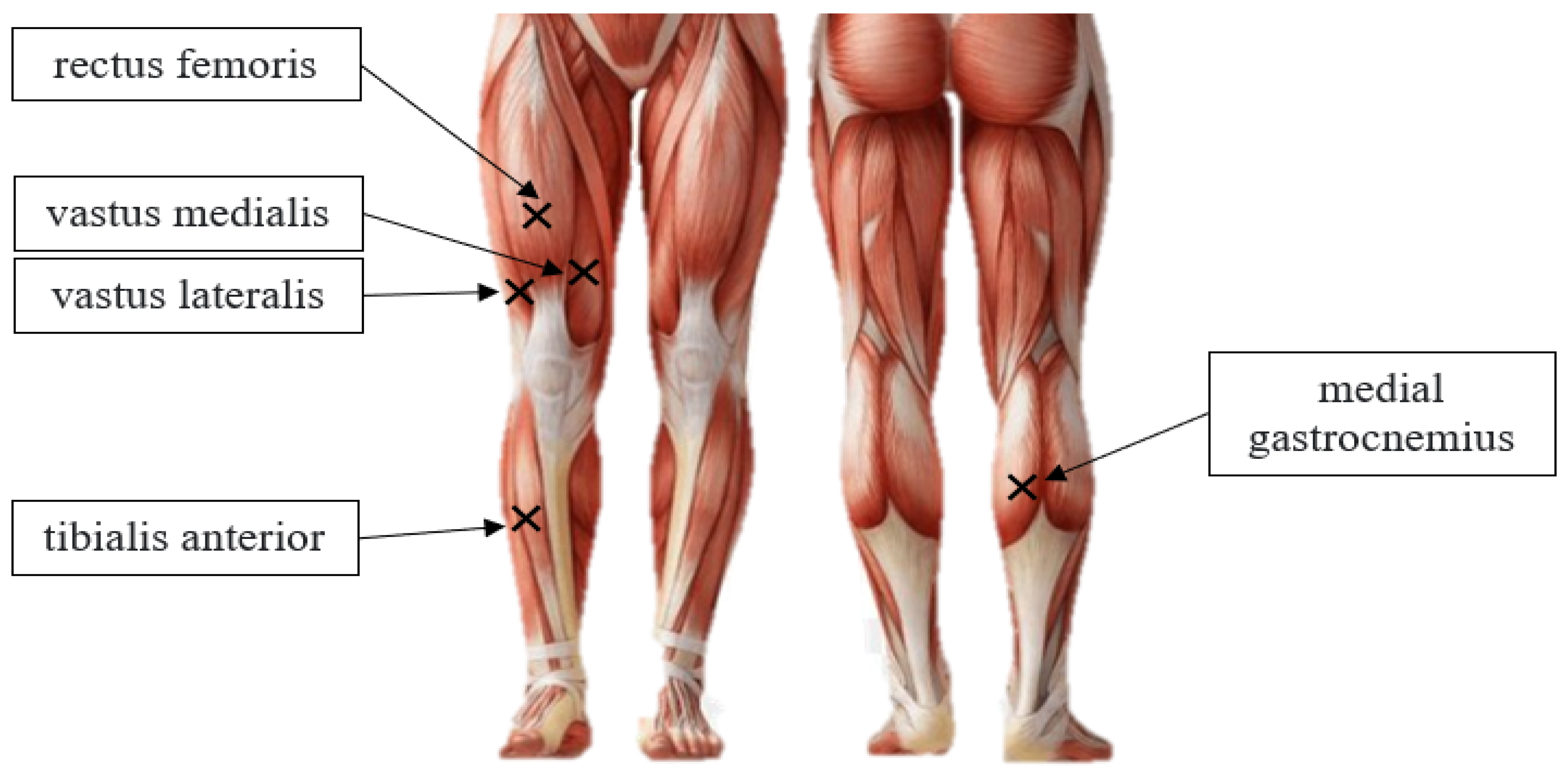
2.4. Surface Electromyography (sEMG) Measurements

3. Statistical Analysis
3.1. Cycling, Physiological, and Subjective Measures
3.2. EMG Measures
4. Results
4.1. MEN/PLA Experimental Sessions in the Heat
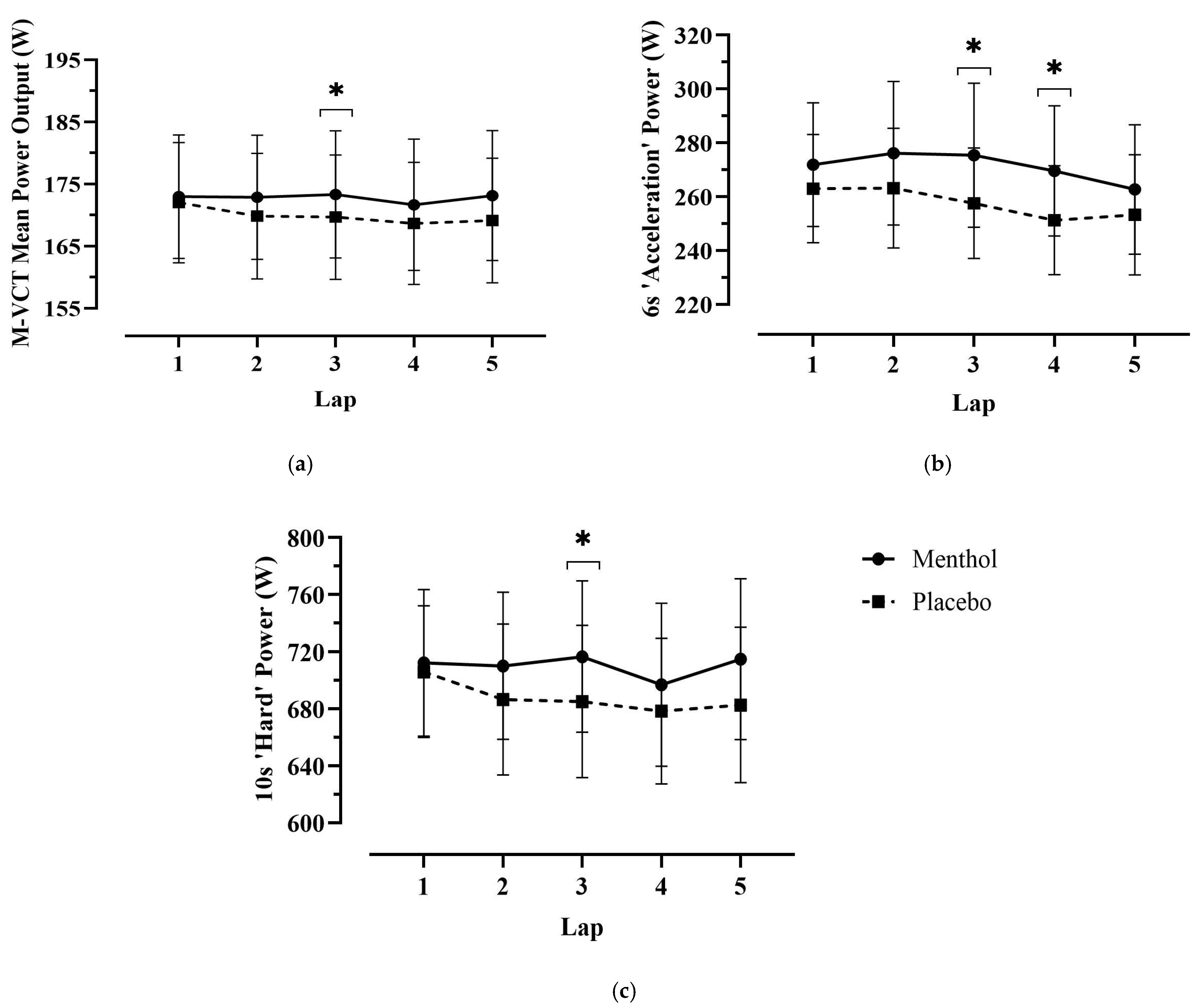
4.2. M-VCT Performance and Menthol Mouth Rinsing
4.3. Peak Power Output (PPO)—1 s
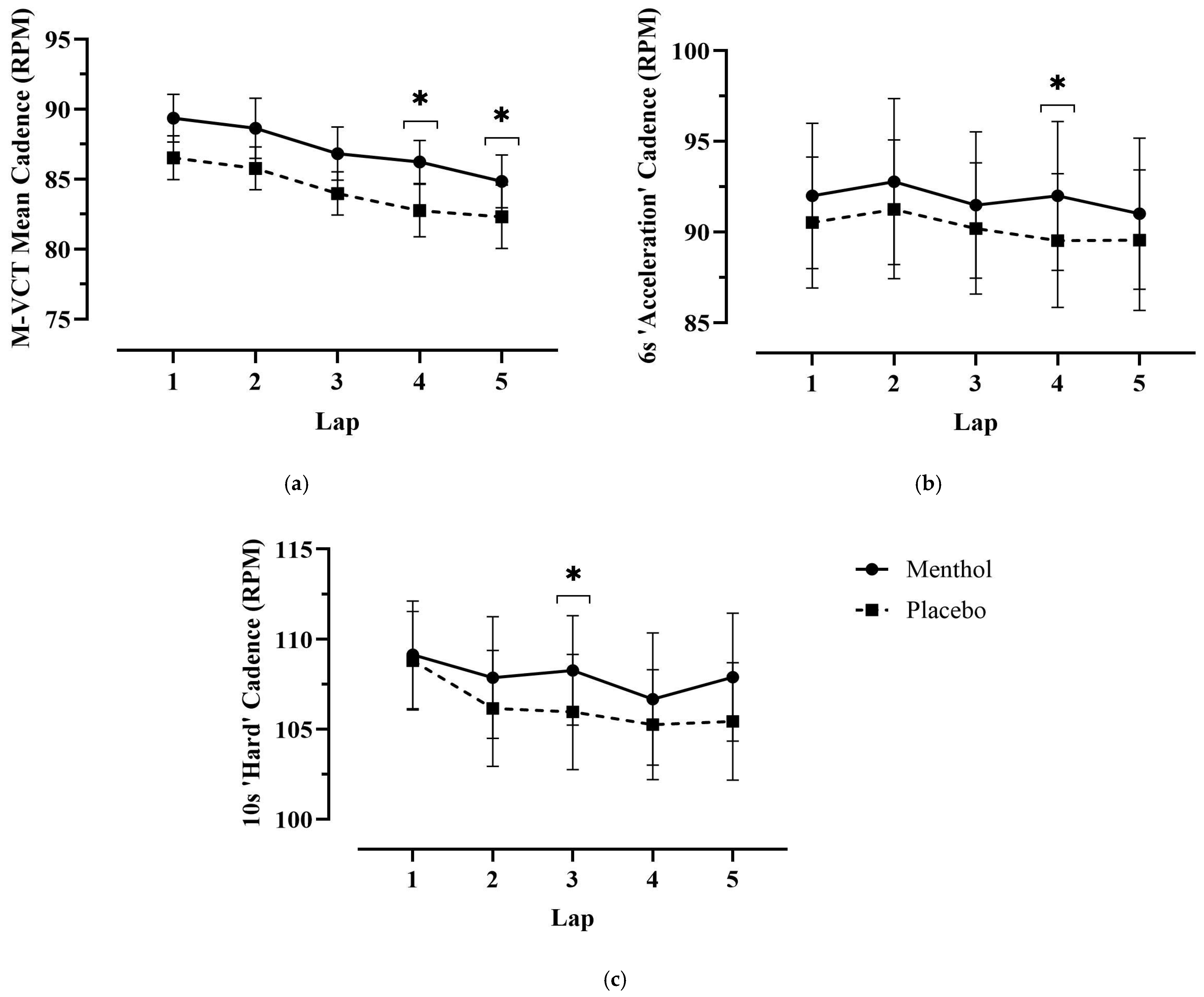
4.4. Cadence (RPM)
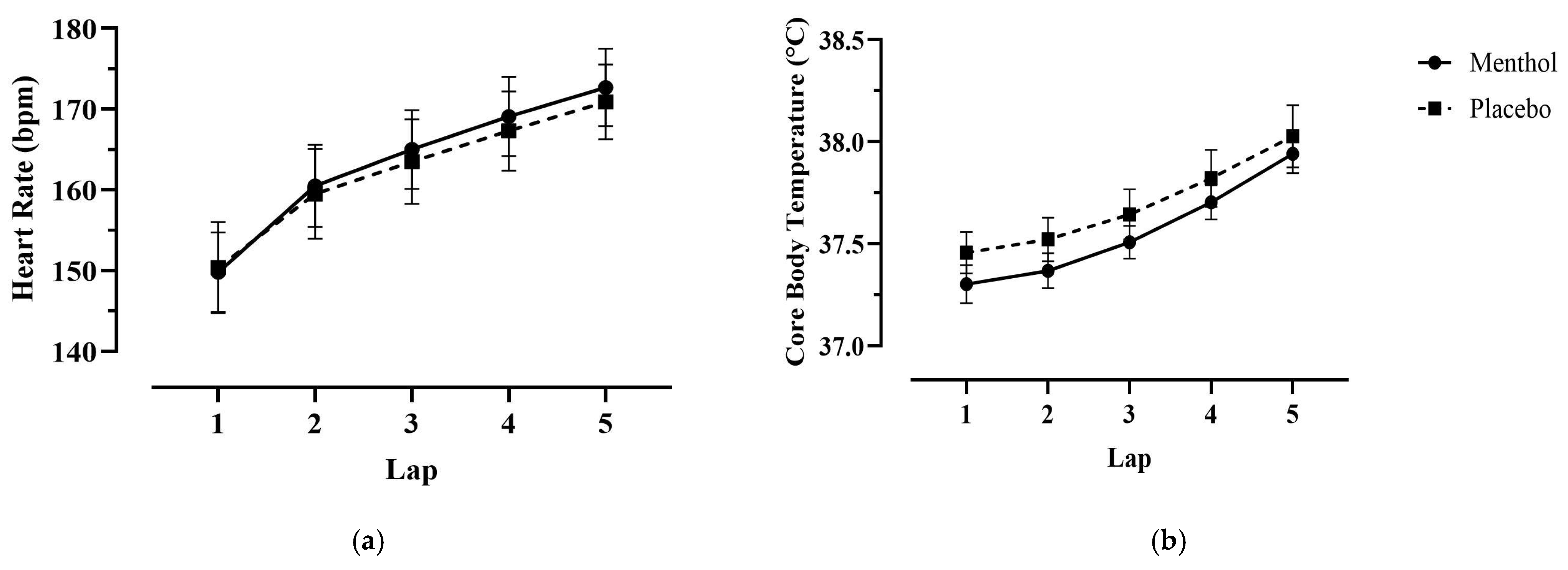
4.5. Cardiovascular and Thermoregulatory Responses
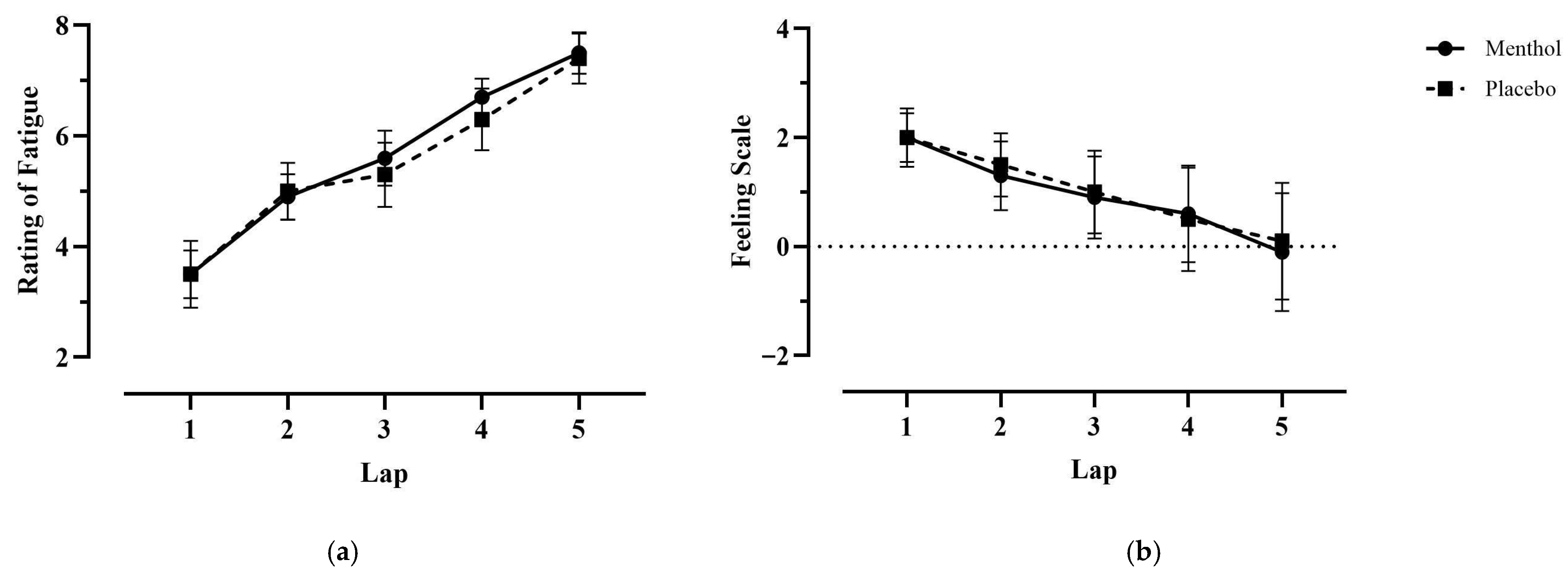
4.6. Perceptual Scales
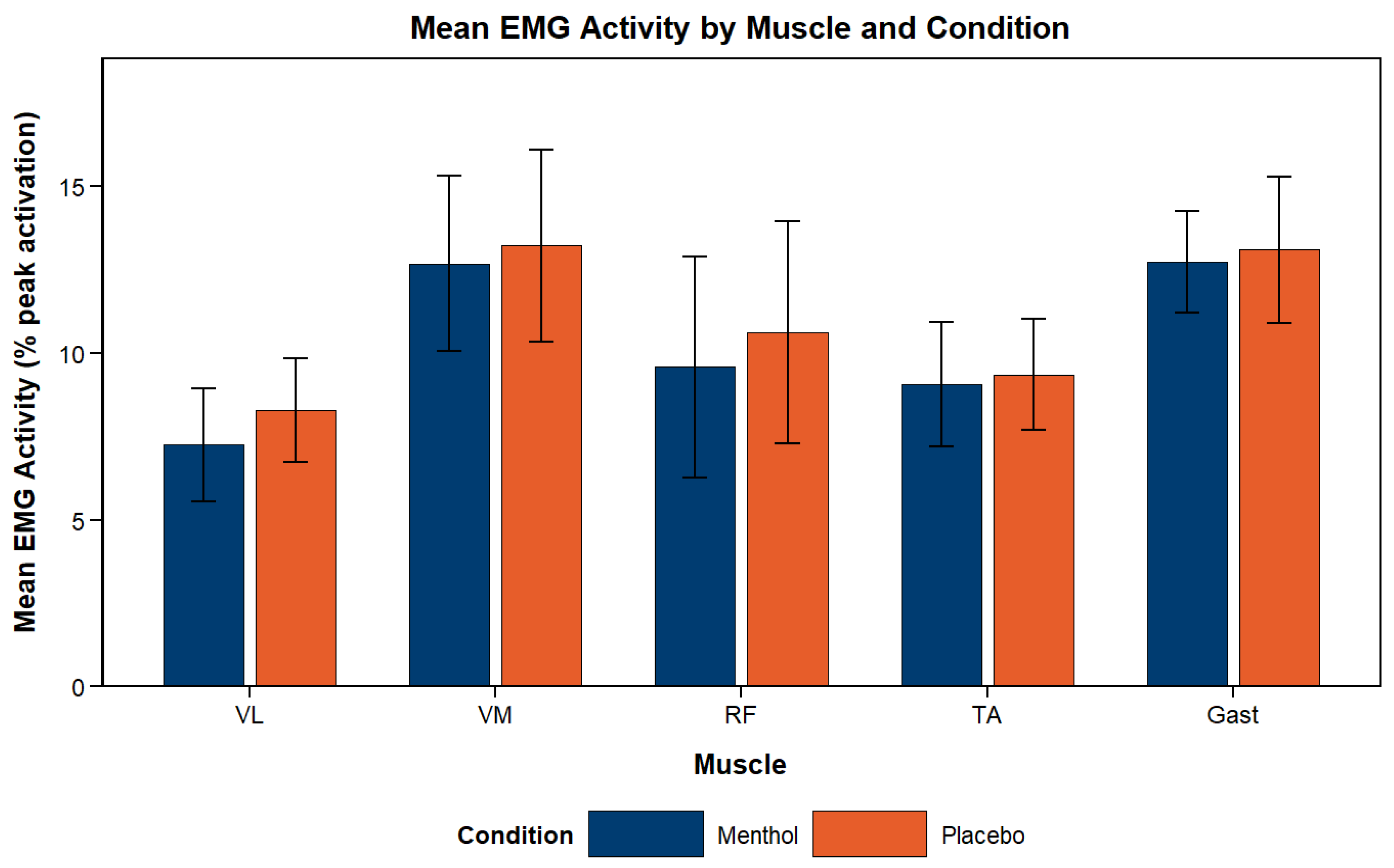
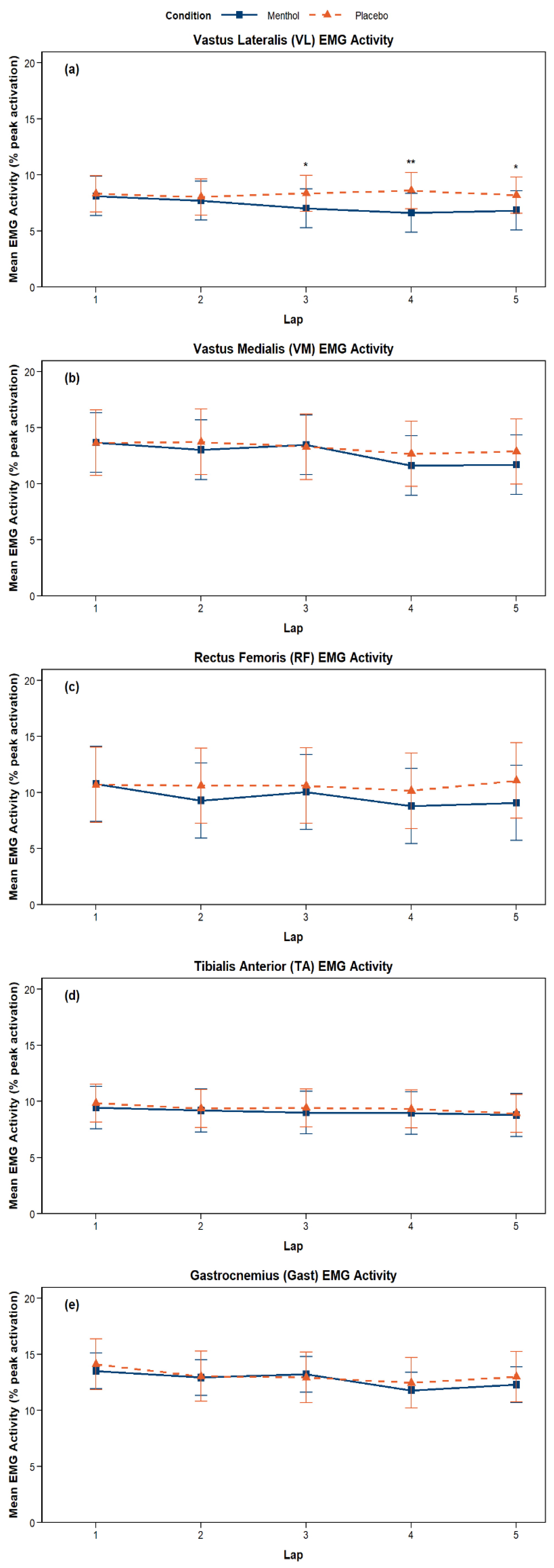
4.7. Surface Electromyography (sEMG)
5. Discussion
Limitations and Future Directions
6. Conclusions
Practical Applications
- Athletes and coaches: MEN MR represents a low-risk, non-thermal cooling strategy that may enhance cycling performance in hot conditions by supporting higher power output and cadence without increasing perceived fatigue. Researchers: These findings position MEN as a useful future model for examining sensory-driven modulation of neuromuscular fatigue under thermal stress, with relevance for age-specific responses
Author Contributions
Funding
Institutional Review Board Statement
Informed Consent Statement
Data Availability Statement
Conflicts of Interest
Abbreviations
| MEN | menthol |
| PLA | placebo |
| MR | mouth rinse |
| TRPM8 | transient receptor potential melastatin 8 |
| M-VCT | modified variable cycle test |
| PO | power output (W) |
| PPO | peak power output (W) |
| RPM | revolutions per minute |
| HR | heart rate (bpm) |
| Tc | core body temperature (°C) |
| ROF | rating of fatigue |
| FS | feeling scale |
| sEMG | surface electromyography |
| VL | vastus lateralis |
| VM | vastus medialis |
| RF | rectus femoris |
| TA | tibialis anterior |
| Gast | gastrocnemius |
References
- Abbiss, C.R.; Laursen, P.B. Models to explain fatigue during prolonged endurance cycling. Sports Med. 2005, 35, 865–898. [Google Scholar] [CrossRef]
- Enoka, R.M.; Duchateau, J. Muscle fatigue: What, why and how it influences muscle function. J. Physiol. 2008, 586, 11–23. [Google Scholar] [CrossRef]
- Wan, J.-J.; Qin, Z.; Wang, P.-Y.; Sun, Y.; Liu, X. Muscle fatigue: General understanding and treatment. Exp. Mol. Med. 2017, 49, e384. [Google Scholar] [CrossRef]
- Thomas, K.; Goodall, S.; Stone, M.; Howatson, G.; St Clair Gibson, A.; Ansley, L. Central and peripheral fatigue in male cyclists after 4-, 20-, and 40-km time trials. Med. Sci. Sports Exerc. 2015, 47, 537–546. [Google Scholar] [CrossRef]
- Taylor, J.L.; Amann, M.; Duchateau, J.; Meeusen, R.; Rice, C.L. Neural Contributions to Muscle Fatigue: From the Brain to the Muscle and Back Again. Med. Sci. Sports Exerc. 2016, 48, 2294–2306. [Google Scholar] [CrossRef]
- Birat, A.; Bourdier, P.; Piponnier, E.; Blazevich, A.J.; Maciejewski, H.; Duché, P.; Ratel, S. Metabolic and Fatigue Profiles Are Comparable Between Prepubertal Children and Well-Trained Adult Endurance Athletes. Front. Physiol. 2018, 9, 387. [Google Scholar] [CrossRef] [PubMed]
- Chlif, M.; Keochkerian, D.; Temfemo, A.; Choquet, D.; Ahmaidi, S. Relationship Between Electromyogram Spectrum Parameters and the Tension-Time Index During Incremental Exercise in Trained Subjects. J. Sports Sci. Med. 2018, 17, 509–514. [Google Scholar] [PubMed]
- Marco, G.; Alberto, B.; Taian, V. Surface EMG and muscle fatigue: Multi-channel approaches to the study of myoelectric manifestations of muscle fatigue. Physiol. Meas. 2017, 38, R27–R60. [Google Scholar] [CrossRef] [PubMed]
- Sun, J.; Liu, G.; Sun, Y.; Lin, K.; Zhou, Z.; Cai, J. Application of Surface Electromyography in Exercise Fatigue: A Review. Front. Syst. Neurosci. 2022, 16, 893275. [Google Scholar] [CrossRef]
- Chang, K.-M.; Liu, S.-H.; Wu, X.-H. A wireless sEMG recording system and its application to muscle fatigue detection. Sensors 2012, 12, 489–499. [Google Scholar] [CrossRef]
- Prilutsky, B.I.; Gregory, R.J. Analysis of muscle coordination strategies in cycling. IEEE Trans. Rehabil. Eng. 2000, 8, 362–370. [Google Scholar] [CrossRef]
- Smith, L.H.; Hargrove, L.J. Comparison of surface and intramuscular EMG pattern recognition for simultaneous wrist/hand motion classification. In Proceedings of the 2013 35th Annual International Conference of the IEEE Engineering in Medicine and Biology Society (EMBC), Osaka, Japan, 3–7 July 2013; pp. 4223–4226. [Google Scholar] [CrossRef]
- Nybo, L.; Rasmussen, P.; Sawka, M.N. Performance in the heat-physiological factors of importance for hyperthermia-induced fatigue. Compr. Physiol. 2014, 4, 657–689. [Google Scholar] [CrossRef]
- González-Alonso, J. Human thermoregulation and the cardiovascular system. Exp. Physiol. 2012, 97, 340–346. [Google Scholar] [CrossRef]
- Gillis, D.J.; House, J.R.; Tipton, M.J. The influence of menthol on thermoregulation and perception during exercise in warm, humid conditions. Eur. J. Appl. Physiol. 2010, 110, 609–618. [Google Scholar] [CrossRef]
- Stevens, C.J.; Thoseby, B.; Sculley, D.V.; Callister, R.; Taylor, L.; Dascombe, B.J. Running performance and thermal sensation in the heat are improved with menthol mouth rinse but not ice slurry ingestion. Scand. J. Med. Sci. Sports 2016, 26, 1209–1216. [Google Scholar] [CrossRef]
- Hawke, K.V.; Gavel, E.H.; Bentley, D.J.; Logan-Sprenger, H.M. Menthol Mouth Rinsing Improves Cycling Performance in Trained Adolescent Males Under Heat Stress. Int. J. Sport. Nutr. Exerc. Metab. 2025, 35, 34–42. [Google Scholar] [CrossRef]
- Hibbert, A.W.; Billaut, F.; Varley, M.C.; Polman, R.C.J. Familiarization Protocol Influences Reproducibility of 20-km Cycling Time-Trial Performance in Novice Participants. Front. Physiol. 2017, 8, 488. [Google Scholar] [CrossRef] [PubMed]
- Micklewright, D.; St Clair Gibson, A.; Gladwell, V.; Al Salman, A. Development and Validity of the Rating-of-Fatigue Scale. Sports Med. 2017, 47, 2375–2393. [Google Scholar] [CrossRef] [PubMed]
- Hardy, C.J.; Rejeski, W.J. Not What, but How One Feels: The Measurement of Affect during Exercise. J. Sport Exerc. Psychol. 1989, 11, 304–317. [Google Scholar] [CrossRef]
- Barwood, M.J.; Gibson, O.R.; Gillis, D.J.; Jeffries, O.; Morris, N.B.; Pearce, J.; Ross, M.L.; Stevens, C.; Rinaldi, K.; Kounalakis, S.N.; et al. Menthol as an Ergogenic Aid for the Tokyo 2021 Olympic Games: An Expert-Led Consensus Statement Using the Modified Delphi Method. Sports Med 2020, 50, 1709–1727. [Google Scholar] [CrossRef] [PubMed]
- Gavel, E.H.; Hawke, K.V.; Bentley, D.J.; Logan-Sprenger, H.M. Menthol Mouth Rinsing Is More Than Just a Mouth Wash—Swilling of Menthol to Improve Physiological Performance. Front. Nutr. 2021, 8, 691695. [Google Scholar] [CrossRef] [PubMed]
- Stevens, C.J.; Best, R. Menthol: A Fresh Ergogenic Aid for Athletic Performance. Sports Med. 2017, 47, 1035–1042. [Google Scholar] [CrossRef] [PubMed]
- Gavel, E.H.; Logan-Sprenger, H.M.; Good, J.; Jacobs, I.; Thomas, S.G. Menthol Mouth Rinsing and Cycling Performance in Females Under Heat Stress. Int. J. Sports Physiol. Perform. 2021, 16, 1014–1020. [Google Scholar] [CrossRef] [PubMed]
- Hermens, H.; Freriks, B.; Merletti, R.; Stegeman, D.; Blok, J.; Rau, G.; Disselhorst-Klug, C.; Hägg, G.; Hermens, I.H.J.B.; Freriks. European recommendations for surface electromyography: Results of the SENIAM Project. 1999. Available online: https://www.semanticscholar.org/paper/European-recommendations-for-surface-Results-of-the-Hermens-Freriks/1ab28b8afcb1216cab1b2f8da0de246c3d5ed6e8 (accessed on 25 September 2025).
- Rouffet, D.M.; Hautier, C.A. EMG normalization to study muscle activation in cycling. J. Electromyogr. Kinesiol. 2008, 18, 866–878. [Google Scholar] [CrossRef]
- Ryan, M.M.; Gregor, R.J. EMG profiles of lower extremity muscles during cycling at constant workload and cadence. J. Electromyogr. Kinesiol. 1992, 2, 69–80. [Google Scholar] [CrossRef]
- So, R.C.H.; Ng, J.K.F.; Ng, G.Y.F. Muscle recruitment pattern in cycling: A review. Phys. Ther. Sport 2005, 6, 89–96. [Google Scholar] [CrossRef]
- Albertus-Kajee, Y.; Tucker, R.; Derman, W.; Lambert, M. Alternative methods of normalising EMG during cycling. J. Electromyogr. Kinesiol. 2010, 20, 1036–1043. [Google Scholar] [CrossRef]
- Wang, J.; Sun, S.; Sun, Y. A Muscle Fatigue Classification Model Based on LSTM and Improved Wavelet Packet Threshold. Sensors 2021, 21, 6369. [Google Scholar] [CrossRef]
- Hopkins, W.G.; Marshall, S.W.; Batterham, A.M.; Hanin, J. Progressive statistics for studies in sports medicine and exercise science. Med. Sci. Sports Exerc. 2009, 41, 3–13. [Google Scholar] [CrossRef]
- Brown, V.A. An introduction to linear mixed-effects modeling in R. Adv. Methods Pract. Psychol. Sci. 2021, 4. [Google Scholar] [CrossRef]
- Voeten, C.C. Package ‘buildmer.’ Computer Software. 2021. Available online: https://cran.r-project.org/web/packages/buildmer/index.html (accessed on 2 October 2025).
- Kuznetsova, A.; Brockhoff, P.B.; Christensen, R.H.B. lmerTest Package: Tests in Linear Mixed Effects Models. J. Stat. Softw. 2017, 82, 1–26. [Google Scholar] [CrossRef]
- Lenth, R. emmeans: Estimated Marginal Means, aka Least-Squares Means_. R Package Version 1.8.5. 2023. Available online: https://cir.nii.ac.jp/crid/1370584340724217473 (accessed on 2 October 2025).
- Crosby, S.; Butcher, A.; McDonald, K.; Berger, N.; Bekker, P.J.; Best, R. Menthol Mouth Rinsing Maintains Relative Power Production during Three-Minute Maximal Cycling Performance in the Heat Compared to Cold Water and Placebo Rinsing. Int. J. Environ. Res. Public Health 2022, 19, 3527. [Google Scholar] [CrossRef]
- Melo, A.d.A.; Bastos-Silva, V.J.; Moura, F.A.; Bini, R.R.; Lima-Silva, A.E.; de Araujo, G.G. Caffeine mouth rinse enhances performance, fatigue tolerance and reduces muscle activity during moderate-intensity cycling. Biol. Sport 2021, 38, 517–523. [Google Scholar] [CrossRef]
- Bontemps, B.; Piponnier, E.; Chalchat, E.; Blazevich, A.J.; Julian, V.; Bocock, O.; Duclos, M.; Martin, V.; Ratel, S. Children Exhibit a More Comparable Neuromuscular Fatigue Profile to Endurance Athletes Than Untrained Adults. Front. Physiol. 2019, 10, 119. [Google Scholar] [CrossRef] [PubMed]
- Patikas, D.; Williams, C.; Ratel, S. Exercise-induced fatigue in young people: Advances and future perspectives. Eur. J. Appl. Physiol. 2018, 118, 899–910. [Google Scholar] [CrossRef] [PubMed]
- Streckis, V.; Skurvydas, A.; Ratkevicius, A. Children are more susceptible to central fatigue than adults. Muscle Nerve 2007, 36, 357–363. [Google Scholar] [CrossRef] [PubMed]



| Variable | MEN | PLA | p Value | 95% CI | ES |
|---|---|---|---|---|---|
| Total mean power (W) | 177.1 ± 33.0 | 174.1 ± 32.1 | 0.002 * | [1.48 to 4.47] | 1.42 |
| 1 s peak power (PPO) (W) | 1150.8 ± 252.2 | 1125.7 ± 247.2 | 0.202 | [−16.2 to 66.4] | 0.44 |
| 6 s “acceleration” PPO (W) | 441.0 ± 138.6 | 436.6 ± 96.7 | 0.933 | [−110.62 to 119.42] | 0.03 |
| 10 s “hard” PPO (W) | 1030.1 ± 229.0 | 963.6 ± 188.3 | 0.138 | [−25.99 to 158.99] | 0.51 |
| Final sprint PPO (W) | 1116.9 ± 248.9 | 1110.1 ± 272.3 | 0.71 | [−33.7 to 47.3] | 0.12 |
| Total mean cadence (RPM) | 87.4 ± 5.1 | 84.5 ± 5.2 | 0.027 * | [0.42 to 5.37] | 0.84 |
| 6 s “acceleration” mean cadence (RPM) | 92.4 ± 12.4 | 90.6 ± 11.2 | 0.078 | [−0.25 to 3.92] | 0.63 |
| 10 s “hard” mean cadence (RPM) | 107.4 ± 10.0 | 106.0 ± 9.4 | 0.022 * | [0.26 to 2.66] | 0.87 |
| Final sprint mean cadence (RPM) | 123.5 ± 10.2 | 123.7 ± 10.5 | 0.857 | [−3.06 to 2.59] | 0.06 |
| Trial distance (m) | 21,727.5 ± 4004.5 | 21,404.1 ± 3884.2 | 0.005 * | [127.2 to 519.5] | 1.18 |
| Mean heart rate (bpm) | 163.4 ± 15.2 | 162.5 ± 16.2 | 0.373 | [−1.27 to 3.07] | 0.3 |
| Max heart rate (bpm) | 185.3 ± 12.3 | 184.9 ± 11.8 | 0.653 | [−1.54 to 2.34] | 0.15 |
| Mean core temperature (°C) | 37.6 ± 0.3 | 37.7 ± 0.4 | 0.237 | [−0.38 to 0.11] | 0.4 |
| Max core temperature (°C) | 38.1 ± 0.3 | 38.1 ± 0.5 | 0.610 | [−0.35 to 0.22] | 0.17 |
| Rating of fatigue (ROF) | 5.64 ± 1.27 | 5.50 ± 1.43 | 0.56 | N/A | N/A |
| Feeling scale (FS) | 0.94 ± 2.43 | 1.02 ± 2.36 | 0.67 | N/A | N/A |
| Muscle sEMG (% Peak Activation) | MEN | PLA | p Value | 95% CI | ES |
|---|---|---|---|---|---|
| Vastus lateralis (VL) | 7.25 ± 0.75 | 8.29 ± 0.69 | 0.057 | [−2.12 to 0.04] | 0.48 |
| Vastus medialis (VM) | 12.7 ± 1.16 | 13.2 ± 1.27 | 0.598 | [−2.78 to 1.7] | 0.22 |
| Rectus femoris (RF) | 9.59 ± 1.47 | 10.62 ± 1.47 | 0.252 | [−2.94 to 0.87] | 0.42 |
| Tibialis anterior (TA) | 9.07 ± 0.81 | 9.36 ± 0.72 | 0.69 | [−1.94 to 1.35] | 0.16 |
| Medial gastrocnemius (Gast) | 12.7 ± 0.67 | 13.1 ± 0.97 | 0.562 | [−1.73 to 1] | 0.14 |
Disclaimer/Publisher’s Note: The statements, opinions and data contained in all publications are solely those of the individual author(s) and contributor(s) and not of MDPI and/or the editor(s). MDPI and/or the editor(s) disclaim responsibility for any injury to people or property resulting from any ideas, methods, instructions or products referred to in the content. |
© 2026 by the authors. Licensee MDPI, Basel, Switzerland. This article is an open access article distributed under the terms and conditions of the Creative Commons Attribution (CC BY) license.
Share and Cite
Hawke, K.V.; Foley, R.C.A.; La Delfa, N.J.; Logan-Sprenger, H.M. Effects of Menthol Mouth Rinsing on Performance and Surface EMG Activity During Heat-Stressed Cycling. Nutrients 2026, 18, 1134. https://doi.org/10.3390/nu18071134
Hawke KV, Foley RCA, La Delfa NJ, Logan-Sprenger HM. Effects of Menthol Mouth Rinsing on Performance and Surface EMG Activity During Heat-Stressed Cycling. Nutrients. 2026; 18(7):1134. https://doi.org/10.3390/nu18071134
Chicago/Turabian StyleHawke, Kierstyn V., Ryan C. A. Foley, Nicholas J. La Delfa, and Heather M. Logan-Sprenger. 2026. "Effects of Menthol Mouth Rinsing on Performance and Surface EMG Activity During Heat-Stressed Cycling" Nutrients 18, no. 7: 1134. https://doi.org/10.3390/nu18071134
APA StyleHawke, K. V., Foley, R. C. A., La Delfa, N. J., & Logan-Sprenger, H. M. (2026). Effects of Menthol Mouth Rinsing on Performance and Surface EMG Activity During Heat-Stressed Cycling. Nutrients, 18(7), 1134. https://doi.org/10.3390/nu18071134