Accuracy of AI-Based Nutrient Estimation from Standardized Hospital Meal Images: A Comparison with Registered Dietitians

Abstract
1. Introduction
2. Materials and Methods
2.1. Meal Samples and Ground Truth
2.2. Image Acquisition
2.3. Participants (Registered Dietitians)
2.4. AI Models and Prompts
2.5. Screening and Selection Criteria
2.6. Statistical Analysis
- Pearson’s Correlation Coefficient (r) to evaluate the linear association between estimations and ground truth.
- Mean Absolute Error (MAE) and Mean Bias (%) to quantify the magnitude and direction of estimation errors.
- Bland–Altman Analysis to identify systematic bias and calculate the 95% limits of agreement (LoA).
- Paired t-tests to determine if the mean difference between the estimated values and the ground truth was statistically significant. A p-value < 0.05 was considered statistically significant.
2.7. Ethical Considerations
3. Results
3.1. Screening of AI Models and Identification of Top Performers
3.2. Comparative Accuracy of Top AI Models and RDs
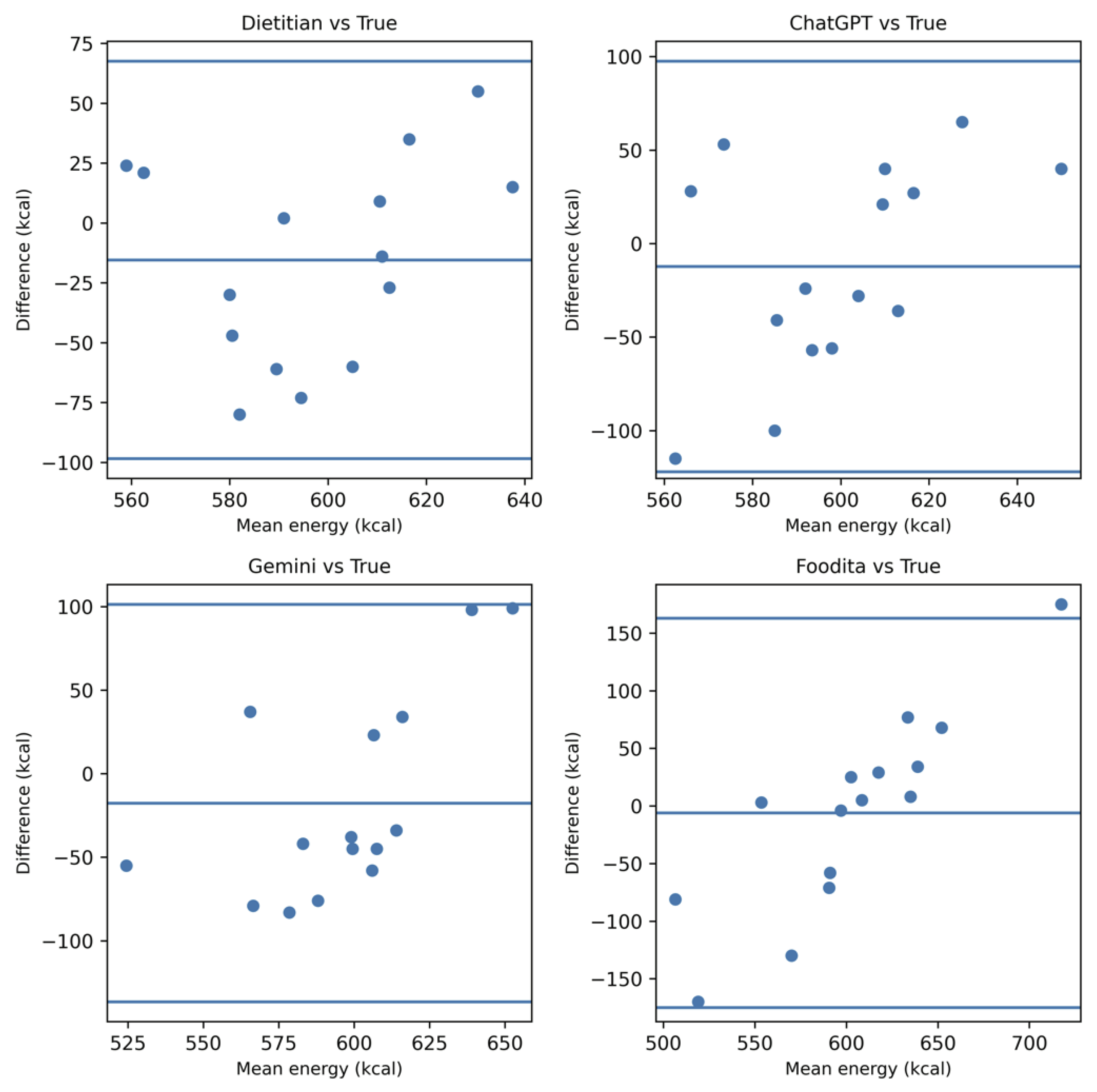
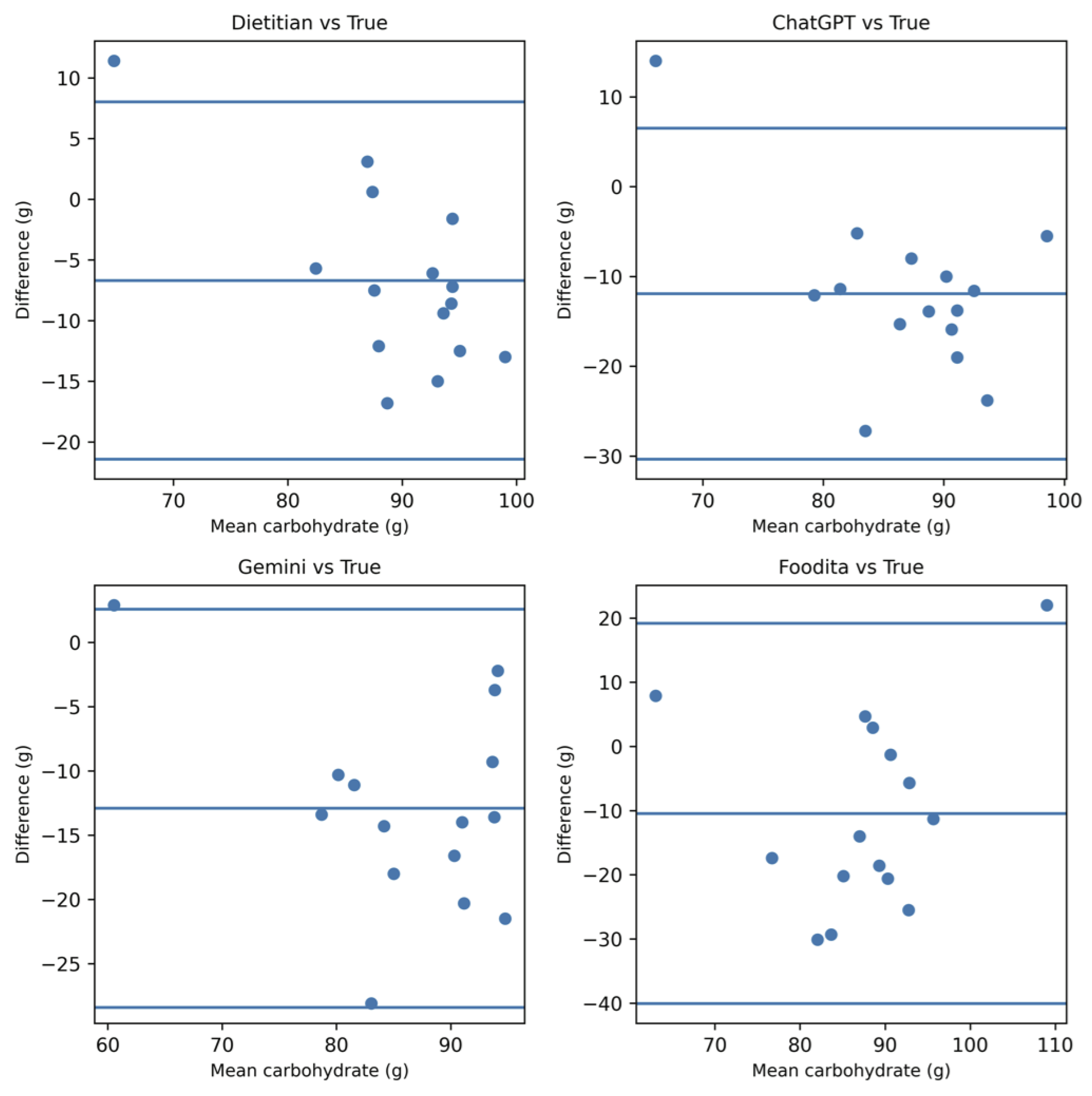
- Energy and Carbohydrates: For total energy and carbohydrates, both the RDs and the top three AI models demonstrated high accuracy. No statistically significant differences were observed between their estimations and the ground truth (p > 0.05). The Mean Bias (%) for energy was minimal, ranging from −1.0% to −2.9%, which was comparable to the RD group’s performance (−0.8%).
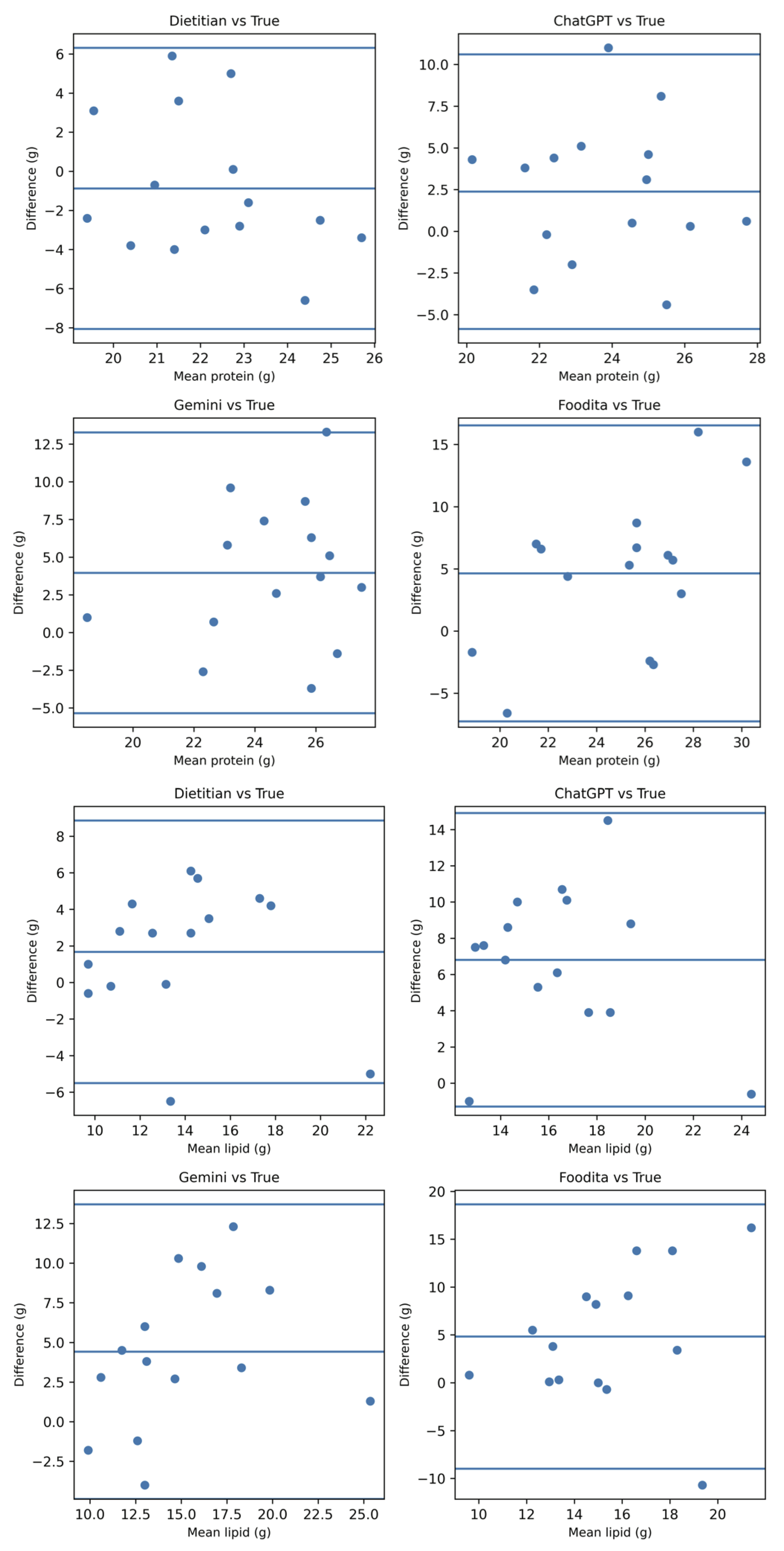
- Protein and Lipids: In contrast, significant discrepancies were observed for protein and lipids. While the RD group maintained high accuracy (Bias < 5%), the AI models showed a clear tendency toward overestimation. For protein, ChatGPT-4o and Gemini 1.5 Pro showed a significant overestimation (p < 0.05). The most substantial errors occurred in lipid estimation, where all three top AI models exhibited a massive systematic overestimation, with Mean Bias (%) ranging from +23.6% to +30.4% (p < 0.01).
3.3. Systematic Bias Analysis (Bland–Altman Analysis)
3.4. Within ±10% Accuracy Rates
4. Discussion
4.1. Comparison with Registered Dietitians and Previous AI Research
4.2. Clinical Implications and Digital Health Integration
4.3. Limitations and Future Perspectives
5. Conclusions
Supplementary Materials
Author Contributions
Funding
Institutional Review Board Statement
Informed Consent Statement
Data Availability Statement
Acknowledgments
Conflicts of Interest
References
- Atwater, W.O.; Bryant, A.P. The Availability and Fuel Value of Food Materials; U.S. Department of Agriculture, Office of Experiment Stations Bulletin: Washington, DC, USA, 1900; Volume 85.
- Widdowson, E.M.; McCance, R.A. The Nutritive Value of Fruits, Vegetables and Nuts; Medical Research Council Special Report Series No. 213; HMSO: London, UK, 1936. [Google Scholar]
- Beaton, G.H.; Milner, J.; Corey, P.; McGuire, V.; Cousins, M.; Stewart, E.; de Ramos, M.; Hewitt, D.; Grambsch, P.V.; Kassim, N.; et al. Sources of variance in 24-h dietary recall data: Implications for nutrition study design and interpretation. Am. J. Clin. Nutr. 1979, 32, 2546–2559. [Google Scholar] [CrossRef] [PubMed]
- Willett, W. Nutritional Epidemiology, 3rd ed.; Oxford University Press: New York, NY, USA, 2012. [Google Scholar]
- Subar, A.F.; Kipnis, V.; Troiano, R.P.; Midthune, D.; Schoeller, D.A.; Bingham, S.; Sharbaugh, C.; Trabulsi, J.; Runswick, S.; Ballard-Barbash, R.; et al. Using intake biomarkers to evaluate the extent of dietary misreporting. J. Am. Diet. Assoc. 2003, 103, 1002–1007. [Google Scholar]
- Livingstone, M.B.E.; Black, A.E. Markers of the validity of reported energy intake. J. Nutr. 2003, 133, 895S–920S. [Google Scholar] [CrossRef] [PubMed]
- Shim, J.S.; Oh, K.; Kim, H.C. Dietary assessment methods in epidemiologic studies. Epidemiol. Health 2014, 36, e2014009. [Google Scholar] [CrossRef] [PubMed]
- Dhurandhar, N.V.; Schoeller, D.; Brown, A.W.; Heymsfield, S.B.; Thomas, D.; Sorensen, T.I.A.; Speakman, J.R.; Jeansonne, M.; Allison, D.B. Energy balance measurement: When something is not better than nothing. Int. J. Obes. 2015, 39, 1109–1113. [Google Scholar] [CrossRef] [PubMed]
- Gemming, L.; Utter, J.; Ni Mhurchu, C. Image-assisted dietary assessment: A systematic review. J. Med. Internet Res. 2013, 15, e150. [Google Scholar] [CrossRef] [PubMed]
- Zhu, F.; Bosch, M.; Woo, I.; Kim, S.; Boushey, C.J.; Ebert, D.S.; Delp, E.J. The use of mobile devices in aiding dietary assessment and evaluation. Glob. Food Secur. 2015, 4, 18–25. [Google Scholar]
- Puri, M.; Zhu, Z.; Yu, Q.; Divakaran, A.; Sawhney, H. Recognition of food images using deep learning. In Proceedings of the IEEE International Conference on Multimedia and Expo (ICME), Seattle, WA, USA, 11–15 July 2016; pp. 1–6. [Google Scholar]
- Liu, C.; Cao, Y.; Luo, Y.; Chen, G.; Vokkarane, V.; Ma, Y. A deep learning-based food image recognition system for dietary assessment. J. Food Eng. 2019, 241, 1–10. [Google Scholar] [CrossRef]
- Subhi, R.; Daniel, L. Reliability and validity of a smartphone app for dietary assessment in clinical settings. Clin. Nutr. 2019, 38, 2115–2122. [Google Scholar]
- Lu, Y.; Stathopoulou, T.; Vasiloglou, M.F.; Fritsche, A.; Stathopoulos, S.; Mougiakakou, S. An artificial intelligence-based system for food image recognition and nutrient estimation. Comput. Biol. Med. 2020, 116, 103558. [Google Scholar]
- Hassannejad, H.; Matrella, G.; Ciampolini, P.; De Munari, I.; Mordonini, M.; Cagnoni, S. Food image recognition using deep learning. In Proceedings of the International Conference on Smart Objects and Technologies for Social Good, Venice, Italy, 30 November–1 December 2016; pp. 1–6. [Google Scholar]
- Ege, T.; Yanai, K. Simultaneous estimation of food categories and calories with multi-task CNN. In Proceedings of the ACM Multimedia Asia (MMAsia 2019), Beijing, China, 16–18 December 2019. [Google Scholar]
- Lo, F.P.; Sun, Y.; Qiu, J.; Lo, B. Food volume estimation based on deep learning view synthesis from a single image. IEEE J. Biomed. Health Inform. 2020, 24, 3376–3388. [Google Scholar]
- Kayashita, J. Accuracy of nutrient intake calculated from hospital meal records: A comparison between registered dietitians and computerized systems. Jpn. J. Clin. Nutr. 2021, 42, 150–158. [Google Scholar]
- Rollo, M.E.; Hutchesson, M.J.; Burrows, T.L.; Krukowski, R.; Harvey, J.; Hogle, L.B.; Collins, C.E. What are the most appropriate dietary assessment methods in health research? Nutrients 2020, 12, 1412. [Google Scholar]
- Tapsell, L.C.; Neale, E.P.; Satija, A.; Hu, F.B. The role of clinical dietitians in the digital age. Nutr. Diet. 2021, 78, 5–12. [Google Scholar]
- World Health Organization. Digital Education for Building Capacities of Health Workers; World Health Organization: Geneva, Switzerland, 2020. [Google Scholar]
- Cinar, E.N.; Wahlström, R.; Neves, A.L. Image-Based Nutritional Assessment: Evaluating the Performance of ChatGPT-4o on Simple and Complex Meals. Nutrients 2024, 16, 1245. [Google Scholar] [CrossRef]
- Fridolfsson, J.; Borjesson, U.; Sandborg, J. Performance Evaluation of Three Large Language Models for Nutritional Content Estimation from Food Images. JMIR Form. Res. 2024, 8, e55421. [Google Scholar]
- Ase, A.; Borowicz, J.; Rakocy, K.; Piekarska, B. Large Language Models for Real-World Nutrition Assessment: Structured Prompts, Multi-Model Validation and Expert Oversight. Nutrients 2026, 18, 23. [Google Scholar] [CrossRef] [PubMed]
- Salari, N.; Darvishi, N.; Bartina, Y.; Keshavarzi, F.; Hosseinian-Far, M.; Mohammadi, M. Global prevalence of malnutrition in older adults: A comprehensive systematic review and meta-analysis. Public Health Pract. 2025, 9, 100583. [Google Scholar] [CrossRef] [PubMed]
- Tabassum, N.; Biediger-Friedman, L.; Johnson, C.; Lane, M.; Marceaux, S. Digital and Technology-Based Nutrition Interventions, Including Medically Tailored Meals (MTMs) for Older Adults in the U.S.: A Scoping Review. Nutrients 2026, 18, 385. [Google Scholar] [CrossRef]



| ID | Staple Food | Main Dish | Side Dish 1 | Side Dish 2 | Drink/Fruit | Others |
|---|---|---|---|---|---|---|
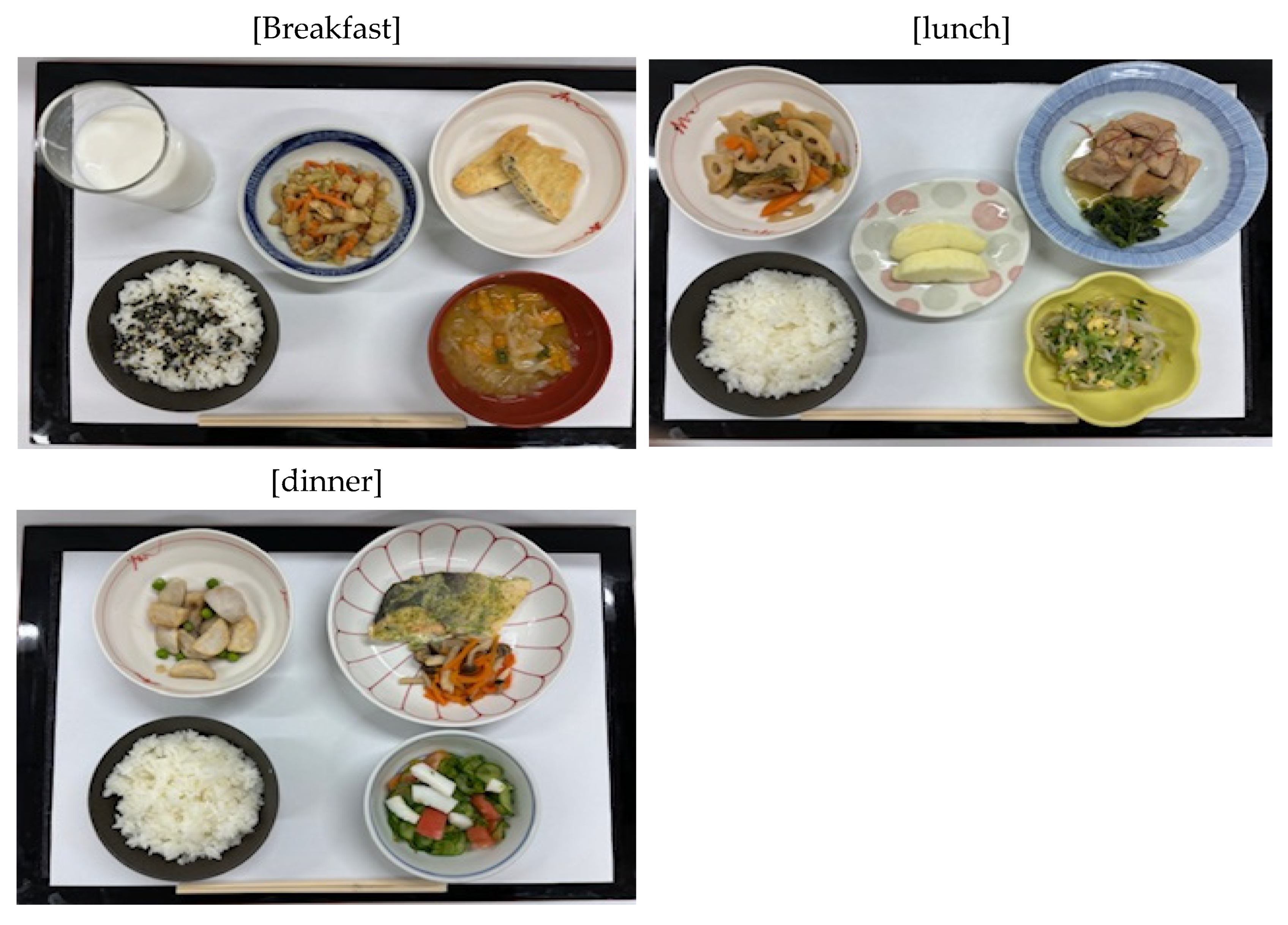
| 1B | Steamed rice 200 g | Simmered fried tofu roll 71.2 g | Stir-fried Chinese cabbage with egg 82 g | Miso soup 195.9 g | Milk 200 g | Nori furikake (seaweed seasoning) 1.6 g |
| 1D | Steamed rice 200 g | Grilled salmon with seaweed 76.3 g | Deep-fried taro in broth 101 g | Cucumber and tomato dressed with soy sauce 79.5 g | Shimeji mushrooms and carrots sautéed in butter 31.4 g | |
| 1L | Steamed rice 200 g | Braised pork belly 122.6 g | Stir-fried burdock, carrot, and konjac 80.5 g | Vinegared bean sprout salad 83.1 g | Apple 35 g | Spinach 20.5 g |
| 2B | Steamed rice 200 g | Stir-fried cabbage and green peppers with shio-koji 79.0 g | Pumpkin dumpling 46.5 g | Miso soup 197 g | Milk 200 g | Mekabu seaweed simmered in soy sauce 5 g |
| 2D | Steamed rice 200 g | Grilled salmon with seaweed 76.3 g | Simmered eggplant with bacon 112 g | Komatsuna greens with vinegared miso dressing 73.7 g | Green beans 20.5 g·Sweet potato salad 40 g, Nori furikake (seaweed seasoning) 1.6 g | |
| 2L | Steamed rice 200 g | Pork fillet cutlet 55 g | Tofu with shrimp thickened sauce 126 g | Okra and pickled radish with sesame dressing 60.5 g | Mango jelly 67.9 g | Corn and bean sprout sauté 37.7 g·Tomato 20 g |
| 3B | Bread 60 g | Tender teriyaki chicken 70 g | Spinach and corn sautéed with butter 40 g | Soy milk soup 187 g | Milk 200 g | Strawberry jam 15 g |
| 3D | Steamed rice 200 g | Japanese-style hamburger steak 179 g | Simmered pumpkin 94.5 g | Lettuce with sesame dressing 48.5 g | Tomato 20 g·Soft kelp simmered with perilla 6 g | |
| 3L | Steamed rice 200 g | Simmered alfonsino (kinmedai) with soy sauce 85.0 g | Sautéed asparagus and squid 72.5 g | Soft-boiled egg (“onsen tamago”) 56.7 g | Pineapple 35 g | Komatsuna greens 30 g·Carrot 10 g |
| 4B | Steamed rice 200 g | Grilled horse mackerel with salt 40.2 g | Dried daikon radish simmered in soy sauce 25 g | Miso soup 195.9 g | Milk 200 g | Okra 20 g |
| 4D | Steamed rice 200 g | Grilled white fish with sweet soy glaze 73 g | Deep-fried stuffed eggplant 76.1 g | Tokoroten (gelatinous noodle) salad 83 g | Stir-fried chikuwa and bok choy with mayonnaise 38.8 g·Tomato 15 g | |
| 4L | Steamed rice 200 g | Stir-fried beef and green onion with miso sauce 98.2 g | Stir-fried Chinese cabbage with shrimp 97 g | Homemade tofu 87.4 g | Banana 65 g | |
| 5B | Steamed rice 200 g | Simmered soy milk ganmodoki (fried tofu ball) 60 g | Sautéed cabbage with clams 66.7 g | Miso soup 176.6 g | Milk 200 g | |
| 5D | Steamed rice 200 g | Tandoori chicken 87.5 g | Simmered bamboo shoots with bonito flakes (Tosa-style) 87.5 g | Cucumber and crab salad 85 g | Edamame and corn 20 g·Tomato 10 g | |
| 5L | Steamed rice 200 g | Grilled Spanish mackerel with Saikyo miso 78 g | Spicy stir-fried konjac 98.1 g | Vinegared maroni (potato starch noodle) salad 50.9 g | Apple 35 g | Komatsuna greens and carrot dressed with soy sauce 35.5 g |
| Nutrient | Group | Ground Truth | Mean ± SD | Mean Bias (kcal or g) | Mean Bias (%) | MAE (kcal or g) | Pearson’s r | p-Value | Within ±5% | Within ±10% |
|---|---|---|---|---|---|---|---|---|---|---|
| Energy (Kcal) | 605.2 ± 26.5 | |||||||||
| RD (Mean) | 589.8 ± 35.2 | −15.4 | −2.5 | 22.4 | 0.92 | 0.65 | 46.7% | 86.7% | ||
| ChatGPT | 593.0 ± 44.3 | −12.2 | −2.0 | 38.5 | 0.89 | 0.82 | 33.3% | 73.3% | ||
| Gemini | 587.6 ± 55.5 | −17.6 | −2.9 | 42.1 | 0.85 | 0.78 | 40.0% | 60.0% | ||
| Foodita | 599.2 ± 92.8 | −6.0 | −1.0 | 48.9 | 0.82 | 0.91 | 20.0% | 46.7% | ||
| Protein (g) | 22.6 ± 3.0 | |||||||||
| RD (Mean) | 21.8 ± 2.1 | −0.8 | −3.5% | 3.2 | 0.88 | 0.42 | 33.3% | 66.7% | ||
| ChatGPT | 25.0 ± 2.8 | +2.4 | 10.6% | 5.8 | 0.71 | 0.04 | 20.0% | 46.7% | ||
| Gemini | 26.6 ± 3.6 | +4.0 | 17.7% | 6.2 | 0.68 | 0.03 | 6.7% | 40.0% | ||
| Foodita | 27.3 ± 5.5 | +4.7 | 20.8% | 4.1 | 0.75 | 0.12 | 13.3% | 20.0% | ||
| Fat (g) | 13.0 ± 4.0 | |||||||||
| RD (Mean) | 14.7 ± 3.7 | +1.7 | 13.1% | 2.8 | 0.85 | 0.15 | 13.3% | 40.0% | ||
| ChatGPT | 19.8 ± 3.4 | +6.8 | 52.3% | 13.6 | 0.45 | <0.01 | 0.0% | 6.7% | ||
| Gemini | 17.4 ± 5.3 | +4.4 | 33.8% | 16.2 | 0.41 | <0.01 | 13.3% | 20.0% | ||
| Foodita | 17.8 ± 5.3 | +4.8 | 36.9% | 12.4 | 0.48 | <0.01 | 6.7% | 33.3% | ||
| Carbohydrate (g) | 92.8 ± 11.0 | |||||||||
| RD (Mean) | 86.1 ± 6.1 | −6.7 | −7.2% | 4.5 | 0.91 | 0.72 | 53.3% | 73.3% | ||
| ChatGPT | 80.9 ± 6.4 | −11.9 | −12.8% | 6.8 | 0.82 | 0.88 | 13.3% | 40.0% | ||
| Gemini | 79.9 ± 8.7 | −12.9 | −13.9% | 7.5 | 0.80 | 0.75 | 20.0% | 46.7% | ||
| Foodita | 82.4 ± 13.7 | −10.4 | −11.2% | 9.2 | 0.76 | 0.64 | 40.0% | 46.7% |
Disclaimer/Publisher’s Note: The statements, opinions and data contained in all publications are solely those of the individual author(s) and contributor(s) and not of MDPI and/or the editor(s). MDPI and/or the editor(s) disclaim responsibility for any injury to people or property resulting from any ideas, methods, instructions or products referred to in the content. |
© 2026 by the authors. Licensee MDPI, Basel, Switzerland. This article is an open access article distributed under the terms and conditions of the Creative Commons Attribution (CC BY) license.
Share and Cite
Isobe, T.; Zhang, L.W.; Murakami, H.; Kadono, M.; Aso, M.; Kayashita, A.; Kayashita, J. Accuracy of AI-Based Nutrient Estimation from Standardized Hospital Meal Images: A Comparison with Registered Dietitians. Nutrients 2026, 18, 966. https://doi.org/10.3390/nu18060966
Isobe T, Zhang LW, Murakami H, Kadono M, Aso M, Kayashita A, Kayashita J. Accuracy of AI-Based Nutrient Estimation from Standardized Hospital Meal Images: A Comparison with Registered Dietitians. Nutrients. 2026; 18(6):966. https://doi.org/10.3390/nu18060966
Chicago/Turabian StyleIsobe, Tomomi, Lim Wan Zhang, Hana Murakami, Miyu Kadono, Megumi Aso, Atsuko Kayashita, and Jun Kayashita. 2026. "Accuracy of AI-Based Nutrient Estimation from Standardized Hospital Meal Images: A Comparison with Registered Dietitians" Nutrients 18, no. 6: 966. https://doi.org/10.3390/nu18060966
APA StyleIsobe, T., Zhang, L. W., Murakami, H., Kadono, M., Aso, M., Kayashita, A., & Kayashita, J. (2026). Accuracy of AI-Based Nutrient Estimation from Standardized Hospital Meal Images: A Comparison with Registered Dietitians. Nutrients, 18(6), 966. https://doi.org/10.3390/nu18060966