Ultra-Processed Foods and Mental Health in Children and Adolescents: Evidence from a Systematic Review


Abstract
1. Introduction
2. Materials and Methods
2.1. Search Strategy and Eligibility Criteria
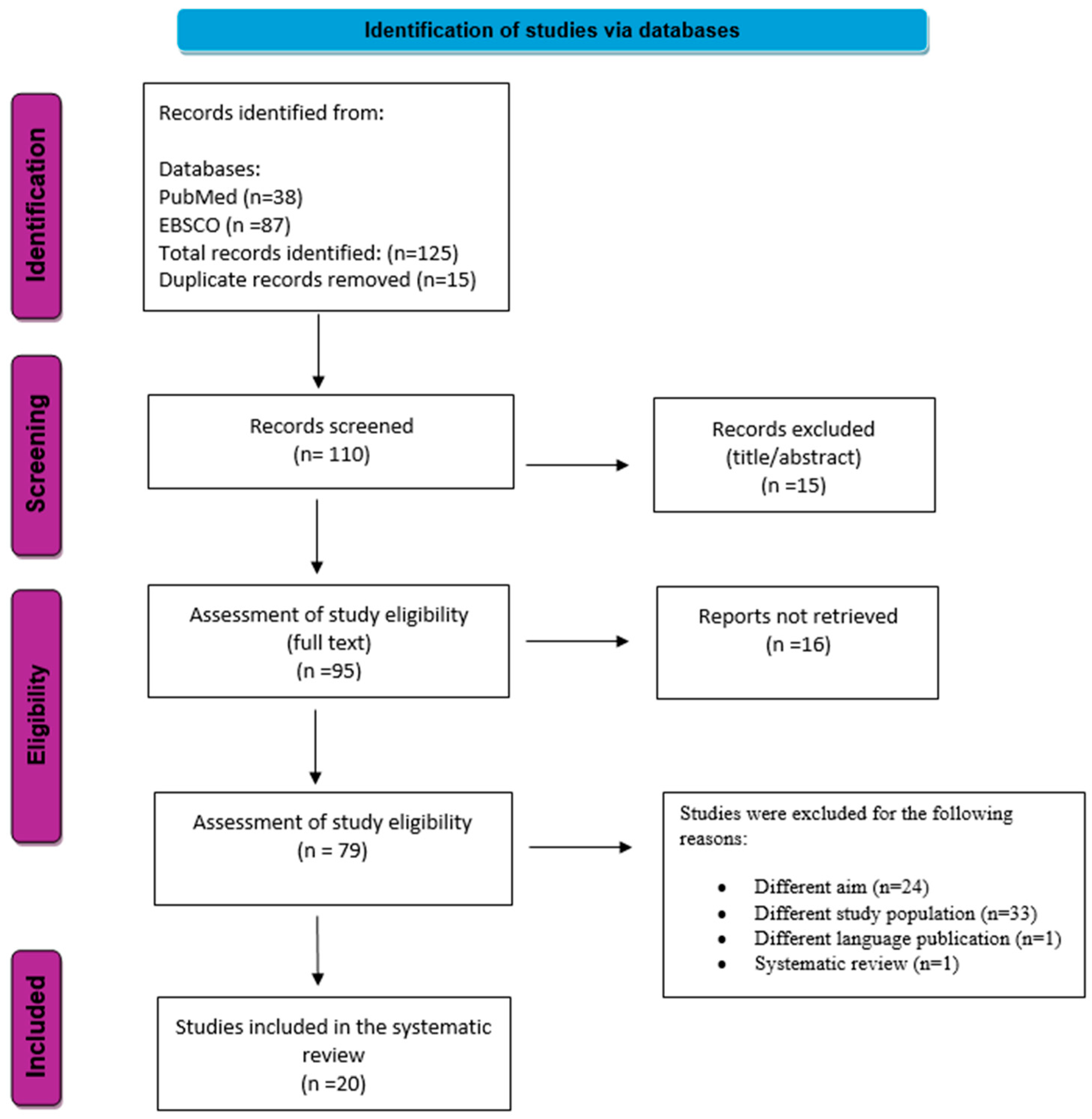
2.2. Study Selection and Data Extraction
2.3. Quality Assessment
3. Results
3.1. Main Findings of the Included Studies
3.2. Methodological Quality

| Author, Year | Country | Sample | Assessment/Tools | Exposure | Outcome | Main Findings |
|---|---|---|---|---|---|---|
| Vilija et al., 2014 [36] | Lithuania | 13–14 years n = 1747 | Self-administered questionnaire assessing PTSSs, dietary habits and mental health indicators | Frequent consumption of unhealthy foods | PTSSs after traumatic life events | Higher consumption of unhealthy foods was significantly associated with increased PTSSs. Light alcoholic drinks: OR = 1.58, 95% CI: 1.09–2.29; energy drinks: OR = 1.47, 95% CI: 1.07–2.02; soft drinks: OR = 1.44, 95% CI: 1.09–1.92; coffee: OR = 1.49, 95% CI: 1.12–1.98. Consumption of sweets and frozen products was not significantly associated with PTSSs. |
| Zahra et al., 2014 [35] | United Kingdom | 12–16 years n = 10,645 | Self-reported mental and physical health dietary habits. | Fast food consumption | SDQ | Moderate consumption: OR = 1.31 (95% CI: 1.02–1.65, p = 0.03); high consumption: OR = 1.65 (95% CI: 1.27–2.12, p < 0.001); daily consumption: OR = 2.00 (95% CI: 1.46–2.75, p < 0.001). |
| Park et al., 2016 [34] | South Korea | 12–18 years n = 68,043 | Dietary behaviors and mental health | Energy drink consumption: ≥5 times/week, <1 time/week and combined consumption of junk food and energy drinks | Sleep disturbance, anxiety, depressive mood, suicidal ideation, suicide planning, and suicide attempts | Frequent energy drink consumption (≥5 times/week) was associated with higher risk of mental health problems: Sleep disturbance: AOR = 1.64 (95% CI: 1.61–1.67); anxiety: AOR = 2.23 (95% CI: 2.19–2.27); depressive mood: AOR = 2.59 (95% CI: 2.54–2.65); suicidal ideation: AOR = 3.14 (95% CI: 3.07–3.21); suicide attempts: AOR = 6.79 (95% CI: 6.59–7.00). Junk food+ energy drinks combination further increased the risk: suicide attempts: AOR = 5.01 (95% CI: 4.89–5.14); suicidal ideation: AOR = 2.55 (95% CI: 2.52–2.59). |
| Parad et al., 2019 [25] | India | 13–16 years n = 401 | TAI, 24HR, and overall academic performance (school records and MCQ tests) | Fast food consumption | Academic performance and exam anxiety | In the sample from towns, frequent fast food consumption was not significantly associated with increased exam anxiety (r = 0.127, p < 0.1), and fast food intake was negatively associated with academic performance (r = −0.125, p = 0.012). No significant associations were identified in the rural subgroup (p < 0.1). |
| Jacob et al., 2020 [33] | 32 countries: 4 low-income, 13 lower–middle-income, 9 upper-middle-income and 6 high-income | 12 years n = 105,061 | Consumption of fast food, alcohol, sugary drinks, fruits and vegetables, as well as tobacco use and physical activity. Questionnaire for suicides. | Fast food consumption | Suicide attempts in the past 12 months | Higher frequency of fast food consumption was associated with increased odds of suicide attempts. Across countries, 8.3% of adolescents reported suicide attempt. Poorer OR from meta-analysis across 32 countries: OR = 1.31, 95% CI: 1.17–1.46 for higher fast food consumption. |
| Werneck et al., 2021 [31] | Brazil | 14.3 years (mean age) n = 99,791 | 7-day recall GSHS single-item question | Daily consumption of UPFs | Anxiety-related sleep disturbance | Daily UPF consumption was associated with increased likelihood of anxiety-induced sleep disturbance: boys: OR = 1.48, (95% CI: 1.30–1.70); girls: OR = 1.46, (95%CI: 1.34–1.60). |
| Álvarez-Villaseñor et al., 2020 [26] | Mexico | 8–13 years n = 406 | Questionnaires: EAT for eating anxiety and FFQ for dietary habits and focused on fast food | Fast food consumption | EAT (anxiety triggered by presence of fast food) | No significant association was found between fast food consumption and eating anxiety: OR = 1.61, 95% CI: 0.44–2.3, p = 0.95. |
| Silva et al., 2021 [32] | Brazil | 12–17 years n = 70,427 | GHQ-12 | Unhealthy dietary pattern with high UPF consumption and low- or non-processed foods | CMDs | The UPF-rich dietary pattern was associated with higher odds of CMDs: OR = 1.68, 95% CI: 1.51–1.87 |
| Horsager et al., 2022 [23] | Denmark | 13–17 years n = 423 | Online parent-reported questionnaire | UPF-dependence behaviors (food addiction symptoms) | Severity of food addiction symptoms | Higher UPF-dependence scores were observed among adolescents with mental disorders. Mean dependence score: 13.8 (95% CI: 12.6–14.9). |
| Faisal-Cury et al., 2022 [30] | Brazil | 14–15 years n = 2680 | FFQ and IS-SBQ | UPFs | Internalizing symptoms (anxiety, sadness, and isolation) | Higher UPF consumption was positively associated with internalizing symptoms in both crude (β = 0.14, p < 0.001) and adjusted (β = 0.12, p < 0.001) models. |
| Mesas et al., 2022 [29] | Brazil | 13–17 years n = 94,767 | UPF intake, mental health and sociodemographic factors | UPF consumption in the last 24 h | Mental health: depressing feelings, feelings that life is not worth living and that no one cares, and nervousness. Excessive worries about everyday matters. | Higher daily UPF consumption was associated with increased frequency of mental health symptoms: boys: (β = 0.27, 95% CI: 0.03–0.51); girls: (β = 0.31, 95% CI: 0.13–0.50) |
| Lane et al., 2022 [24] | Iran | 12–18 years (girls) n = 733 | UPF consumption and quality of life | UPF consumption | Quality of life, daytime sleepiness and insomnia | High UPF consumption was associated with increased odds of reduced quality of life (OR = 1.87, 95% CI: 1.13–3.11, p < 0.01) and insomnia (OR = 4.04, 95% CI:1.83–8.94, p < 0.01). No significant association was found between UPF consumption and daytime sleepiness. |
| Gketsios et al., 2023 [27] | Greece | 10–12 years n = 1728 | Dietary habits, consumption of UPFs and emotional/behavioral symptoms with emphasis on aggression and feelings of loneliness | Combined consumption of soda drinks and sweet/salty snacks, differentiated by intake level (low vs. at least moderate) | Emotional and behavioral symptoms (which worsen in aggression and loneliness) | Moderate consumption of sweets/salty snacks was associated with higher odds of aggressive behavior (OR = 1.50, 95% CI: 1.19–1.88) and feelings of loneliness (OR = 1.56, 95% CI: 1.20–2.01). Moderate consumption of soda drinks was associated with increased odds of aggression (OR = 1.15, 95% CI: 1.15–1.81) and loneliness (OR = 1.81, 95% CI: 1.41–2.32). The combined model (moderate soda + salty/sweet snacks) showed positive associations with loneliness (OR = 2.36, 95% CI: 1.88–3.25) and aggression (OR = 1.90, 95% CI: 1.53–2.45). In normal-weight children, moderate intake of both soda and salty/sweet snacks was associated with higher odds of aggression (OR = 1.52, 95% CI: 1.31–2.03) and loneliness (OR = 1.92, 95% CI: 1.44–2.35). Obese children had markedly higher odds of aggression (OR = 3.75, 95% CI: 2.38–4.81) and loneliness (OR = 3.70, 95% CI: 2.58–6.61); association was significant (aggression: p < 0.002; loneliness: p < 0.001). |
| Gratão et al., 2024 [37] | Brazil | 12–17 years n = 71,553 | Dietary patterns, UPF consumption and mental health symptoms | UPF consumption | Mental health disorders: anxiety symptoms, depressive symptoms and somatic complaints | Higher UPF consumption was positively associated with increased risk of mental health disorders. Adolescents in the highest quartile of UPF consumption had higher odds of mental health problems (OR = 1.20; 95% CI:1.18–1.22). |
| Rurgo et al., 2024 [21] | Italy | 9–18 years n = 56 AN | CDI-2 MASC-2 SR SDSC 24HR categorized according to NOVA | UPF consumption | Depressive symptoms, anxiety symptoms and sleep disturbance | Participants with high UPF consumption (≥2 times/day) were at higher risk of depressive symptoms CDI-2 (p = 0.011). High UPF intake was also associated with greater nighttime sleep disturbances (nocturnal hyperhidrosis) according to the SDSC (mean = 2.94, SD = 1.48, vs. 2.01, SD = 0.86, p = 0.026). |
| Huang et al., 2025 [22] | China | 3–7 years: 18 kindergartens in Wuxi, N = 3727 | SDQ, DDS and 24HR | UPF consumption | Emotional and behavioral problems: hyperactivity, difficulties in peer relationships and social withdrawal | Daily UPF consumption was associated with increased risk of psychological problems in young children (OR = 1.202, 95% CI: 1.051–1.376). |
| Yang et al., 2026 [28] | China | 10–19 years, N = 24,711 | Psychological distress: SCL-90 and UPF Intake | UPF consumption | PD | Νο PD: High UPF consumption increased danger of PD (OR = 1.710, 95% CI: 1.486–1.968, p < 0.001. High PD: High UPF consumption increased danger (OR = 1.179, 95% CI: 1.054–1.319, p < 0.001). High internalized PD: High UPF consumption increased danger (OR = 1.226, 95% CI: 1.050–1.432, p < 0.001). |
| Author/Year | Country | Sample | Assessment | Duration | Exposure | Outcome | Main Findings |
|---|---|---|---|---|---|---|---|
| Davison et al., 2021 [38] | Ireland | 13–14 years n = 1208 | sWEMWBS, KS-10, FAS and FFQ | 2 years | Frequency of consumption: junk food, fruits/vegetables, meat, bread/dairy, and protein | Mental well-being and HRQoL | Higher consumption of UPFs/junk food was negatively associated with quality of life (KS-10: Est = −0.165, p < 0.001). Although the association with sWEMWBS was not statistically significant in the multivariable model (Est = −0.027, p = 0.096), in the structural model, negative association with junk food intake, as well as stability of dietary patterns over time, was observed. |
| Peacock et al., 2011 [39] | United Kingdom | n = 12,942 | FFQ and SDQ | 16 months | ‘Junk food’ consumption | Mental health: behavioral changes | No strong evidence of an association between junk food consumption and behavioral problems. The total difficulties score showed no significant association (OR = 1.05 (95% CI: 0.92–1.21, p = 0.45)). |
| Study | Country | Sample | Assessment/Instruments | Exposure | Outcome | Results |
|---|---|---|---|---|---|---|
| Kim et al., 2015 [40] | Korea | 12–18 years (girls only), n = 849 | K-BDI FFQ | Consumption of fast food and UPFs | Presence or absence of depression (score > 16) | Positive association between fast food consumption and depression (OR: 1.88, 95%CI: 1.13–3.14, p < 0.001); UPFs food consumption was also associated with higher odds of depression (OR: 2.16, 95% CI: 1.14–3.62, p < 0.05). |
| Author/Year | Selection * | Comparability ** | Outcome | Total Score | ||||
|---|---|---|---|---|---|---|---|---|
| (1) Representativeness of the Sample | (2) Sample Size | (3) Non Respondents | (4) Ascertainment of Exposure | (1) Control for Confounding Factors | (1) Assessment of Outcome | (2) Statistical Test | ||
| Vilija et al., 2014 [36] | ☆ | ☆ | ☆ | ☆ | ☆☆ | ☆ | ☆☆ | 9/10 |
| Zahra et al., 2014 [35] | ☆ | ☆ | - | ☆ | ☆☆ | ☆ | ☆☆☆ | 9/10 |
| Park et al., 2016 [34] | ☆ | ☆ | ☆ | ☆ | ☆☆ | ☆ | ☆ ☆ | 9/10 |
| Parad et al., 2019 [25] | - | ☆ | ☆ | ☆ | ☆ ☆ | ☆ | ☆ ☆ | 8/10 |
| Jacob et al., 2020 [33] | ☆ | ☆ | ☆ | ☆ | ☆ ☆ | ☆ | ☆ ☆ | 9/10 |
| Werneck et al., 2021 [31] | ☆ | ☆ | - | ☆ | ☆ ☆ | ☆ | ☆ ☆ | 9/10 |
| Álvarez-Villaseñor et al., 2020 [26] | - | ☆ | ☆ | ☆ | ☆ | ☆ | ☆ ☆ | 7/10 |
| Silva et al., 2021 [32] | ☆ | ☆ | - | ☆ | ☆ ☆ | ☆ | ☆ ☆ | 8/10 |
| Horsager et al., 2022 [23] | - | ☆ | - | ☆ | ☆ ☆ | ☆ | ☆ ☆ | 7/10 |
| Faisal-Cury et al., 2022 [30] | ☆ | ☆ | ☆ | ☆ | ☆ ☆ | ☆ | ☆ ☆ | 910 |
| Mesas et al., 2022 [29] | ☆ | ☆ | ☆ | ☆ | ☆ ☆ | ☆ | ☆ ☆ | 9/10 |
| Lane et al., 2022 [24] | - | ☆ | - | ☆ | ☆ ☆ | ☆ | ☆ ☆ ☆ | 8/10 |
| Gketsios et al., 2023 [27] | ☆ | ☆ | - | ☆ | ☆ ☆ | ☆ | ☆ ☆ | 8/10 |
| Gratão et al., 2024 [37] | ☆ | ☆ | - | ☆ | ☆ ☆ | ☆ | ☆ ☆ ☆ | 9/10 |
| Rurgo et al., 2024 [21] | - | - | - | ☆ | ☆ ☆ | ☆ | ☆ ☆ ☆ | 7/10 |
| Huang et al., 2025 [22] | ☆ | ☆ | - | ☆ | ☆ ☆ | ☆ | ☆ ☆ | 8/10 |
| Yang et al., 2026 [28] | ☆ | ☆ | ☆ | ☆ | ☆ ☆ | ☆ | ☆ ☆ | 9/10 |
| Authors/Year | Selection | Comparability | Outcome | Total Score | |||||
|---|---|---|---|---|---|---|---|---|---|
| (1) Representativeness of the Exposed Cohort | (2) Selection of the Non-Exposed Cohort | (3) Ascertainment of Exposure | (4) Demostration That the Outcome of Interest Was Not Present at the Start of the Study | (1) Comparability of Cohorts on the Basis of the Study Design or Analysis, Controlling for Confounding Factors | (1) Assessment of Outcome | (2) Was Follow-Up Long Enough for Outcomes to Occur | (3) Adequacy of Follow-Up of Cohorts | ||
| Davison et al., 2021 [38] | ☆ | - | ☆ | - | ☆ ☆ | ☆ | ☆ | ☆ | 7/9 |
| Peacock et al., 2011 [39] | ☆ | ☆ | ☆ | ☆ | ☆ ☆ | ☆ | ☆ | ☆ | 9/9 |
| Author/Year | Selection | Comparability | Exposure | Total Score | |||||
|---|---|---|---|---|---|---|---|---|---|
| (1) Adequate Case Definition | (2) Representativeness of the Cases | (3) Selection of Controls | (4) Definition of Controls | (1) Comparability of Cases and Controls on the Basis of the Study Design or Analysis, Controlling for Confounding Factors | (1) Ascertainment of Exposure | (2) Same Method of Ascertainment for Cases and Controls | (3) Non-Response Rate | ||
| Kim et al., 2015 [40] | ☆ | - | - | - | ☆ ☆ | ☆ | ☆ | ☆ | 6/9 |
3.3. UPFs and Mental Health—Cross-Sectional Studies
3.4. UPFs and Mental Health—Cohort Studies
3.5. UPFs and Mental Health—Case–Control Study
4. Discussion
5. Conclusions
Supplementary Materials
Author Contributions
Funding
Institutional Review Board Statement
Informed Consent Statement
Data Availability Statement
Conflicts of Interest
References
- Monteiro, C.A.; Cannon, G.; Levy, R.B.; Moubarac, J.C.; Louzada, M.L.; Rauber, F.; Khandpur, N.; Cediel, G.; Neri, D.; Martinez-Steele, E.; et al. Ultra-processed foods: What they are and how to identify them. Public Health Nutr. 2019, 22, 936–941. [Google Scholar] [CrossRef]
- Monteiro, C.A.; Cannon, G.; Levy, R.; Moubarac, J.C.; Jaime, P.; Martins, A.P.; Canella, D.; Louzada, M.; Parra, D. NOVA. The star shines bright. World Nutr. 2016, 7, 28–38. [Google Scholar]
- Gibney, M.J. Ultra-processed foods: Definitions and policy issues. Curr. Dev. Nutr. 2019, 3, nzy077. [Google Scholar] [CrossRef] [PubMed]
- Wang, L.; Martínez Steele, E.; Du, M.; Pomeranz, J.L.; O’Connor, L.E.; Herrick, K.A.; Luo, H.; Zhang, X.; Mozaffarian, D.; Zhang, F.F. Trends in Consumption of Ultraprocessed Foods Among US Youths Aged 2–19 Years, 1999–2018. JAMA 2021, 326, 519–530. [Google Scholar] [CrossRef]
- Poti, J.M.; Braga, B.; Qin, B. Ultra-processed Food Intake and Obesity: What Really Matters for Health-Processing or Nutrient Content? Curr. Obes. Rep. 2017, 6, 420–431. [Google Scholar] [CrossRef]
- Neri, D.; Steele, E.M.; Khandpur, N.; Cediel, G.; Zapata, M.E.; Rauber, F.; Marrón-Ponce, J.A.; Machado, P.; da Costa Louzada, M.L.; Andrade, G.C.; et al. Ultraprocessed food consumption and dietary nutrient profiles associated with obesity: A multicountry study of children and adolescents. Obes. Rev. 2022, 23, e13387. [Google Scholar] [CrossRef]
- Conway, R.E.; Heuchan, G.N.; Heggie, L.; Rauber, F.; Lowry, N.; Hallen, H.; Llewellyn, C.H. Ultra-processed food intake in toddlerhood and mid-childhood in the UK: Cross sectional and longitudinal perspectives. Eur. J. Nutr. 2024, 63, 3149–3160. [Google Scholar] [CrossRef]
- Khandpur, N.; Neri, D.A.; Monteiro, C.; Mazur, A.; Frelut, M.L.; Boyland, E.; Weghuber, D.; Thivel, D. Ultra-Processed Food Consumption among the Paediatric Population: An Overview and Call to Action from the European Childhood Obesity Group. Ann. Nutr. Metab. 2020, 76, 109–113. [Google Scholar] [CrossRef] [PubMed]
- Bremner, J.D.; Moazzami, K.; Wittbrodt, M.T.; Nye, J.A.; Lima, B.B.; Gillespie, C.F.; Rapaport, M.H.; Pearce, B.D.; Shah, A.J.; Vaccarino, V. Diet, Stress and Mental Health. Nutrients 2020, 12, 2428. [Google Scholar] [CrossRef] [PubMed]
- Fardet, A. Minimally processed foods are more satiating and less hyperglycemic than ultra-processed foods: A preliminary study with 98 ready-to-eat foods. Food Funct. 2016, 7, 2338–2346. [Google Scholar] [CrossRef]
- Zinöcker, M.K.; Lindseth, I.A. The Western Diet-Microbiome-Host Interaction and Its Role in Metabolic Disease. Nutrients 2018, 10, 365. [Google Scholar] [CrossRef] [PubMed]
- Moubarac, J.C.; Batal, M.; Louzada, M.L.; Steele, E.M.; Monteiro, C.A. Consumption of ultra-processed foods predicts diet quality in Canada. Appetite 2017, 108, 512–520. [Google Scholar] [CrossRef]
- da Costa Louzada, M.L.; Baraldi, L.G.; Steele, E.M.; Martins, A.P.B.; Canella, D.S.; Moubarac, J.C.; Levy, R.B.; Cannon, G.; Afshin, A.; Imamura, F.; et al. Consumption of ultra-processed foods and obesity in Brazilian adolescents and adults. Prev. Med. 2015, 81, 9–15. [Google Scholar] [CrossRef]
- Mendonça, R.D.D.; Lopes, A.C.S.; Pimenta, A.M.; Gea, A.; Martinez-Gonzalez, M.A.; Bes-Rastrollo, M. Ultra-Processed Food Consumption and the Incidence of Hypertension in a Mediterranean Cohort: The Seguimiento Universidad de Navarra Project. Am. J. Hypertens 2017, 30, 358–366. [Google Scholar] [CrossRef]
- Lavigne-Robichaud, M.; Moubarac, J.C.; Lantagne-Lopez, S.; Johnson-Down, L.; Batal, M.; Sidi, E.A.L.; Lucas, M. Diet quality indices in relation to metabolic syndrome in an Indigenous Cree (Eeyouch) population in northern Québec, Canada. Public Health Nutr. 2018, 21, 172–180. [Google Scholar] [CrossRef]
- Mental Health of Adolescents. Available online: https://www.who.int/news-room/fact-sheets/detail/adolescent-mental-health (accessed on 27 February 2026).
- Malmir, H.; Mahdavi, F.S.; Ejtahed, H.S.; Kazemian, E.; Chaharrahi, A.; Mohammadian Khonsari, N.; Mahdavi-Gorabi, A.; Qorbani, M. Junk food consumption and psychological distress in children and adolescents: A systematic review and meta-analysis. Nutr. Neurosci. 2023, 26, 807–827. [Google Scholar] [CrossRef]
- Lane, M.M.; Gamage, E.; Travica, N.; Dissanayaka, T.; Ashtree, D.N.; Gauci, S.; Lotfaliany, M.; O’Neil, A.; Jacka, F.N.; Marx, W. Ultra-Processed Food Consumption and Mental Health: A Systematic Review and Meta-Analysis of Observational Studies. Nutrients 2022, 14, 2568. [Google Scholar] [CrossRef]
- Ottawa Hospital Research Institute. Newcastle-Ottawa Scale (NOS). Available online: https://ohri.ca/en/who-we-are/core-facilities-and-platforms/ottawa-methods-centre/newcastle-ottawa-scale (accessed on 27 February 2026).
- Page, M.J.; McKenzie, J.E.; Bossuyt, P.M.; Boutron, I.; Hoffmann, T.C.; Mulrow, C.D.; Shamseer, L.; Tetzlaff, J.M.; Akl, E.A.; Brennan, S.E.; et al. The PRISMA 2020 statement: An updated guideline for reporting systematic reviews. BMJ 2021, 372, 71. [Google Scholar] [CrossRef]
- Rurgo, S.; Marchili, M.R.; Spina, G.; Roversi, M.; Cirillo, F.; Raucci, U.; Sarnelli, G.; Raponi, M.; Villani, A. Prevalence of Rome IV Pediatric Diagnostic Questionnaire-Assessed Disorder of Gut-Brain Interaction, Psychopathological Comorbidities and Consumption of Ultra-Processed Food in Pediatric Anorexia Nervosa. Nutrients 2024, 16, 817. [Google Scholar] [CrossRef] [PubMed]
- Huang, Z.; Han, J.; Jiang, Y.; Li, S.; Wang, G.; Zhou, Z.; Zhu, H. Correlation Study Between Dietary Behaviors, Lifestyle, and Psychological Problems in Chinese Children Aged 3–7. Nutrients 2025, 17, 176. [Google Scholar] [CrossRef] [PubMed]
- Horsager, C.; Færk, E.; Gearhardt, A.N.; Lauritsen, M.B.; Østergaard, S.D. Food addiction comorbid to mental disorders in adolescents: A nationwide survey and register-based study. Eat. Weight Disord. 2022, 27, 945–959. [Google Scholar] [CrossRef]
- Lane, K.E.; Davies, I.G.; Darabi, Z.; Ghayour-Mobarhan, M.; Khayyatzadeh, S.S.; Mazidi, M. The Association between Ultra-Processed Foods, Quality of Life and Insomnia among Adolescent Girls in Northeastern Iran. Int. J. Environ. Res. Public Health 2022, 19, 6338. [Google Scholar] [CrossRef]
- Parad, M.; Kajale, N.; Vartak, V.; Khadilkar, A.V. Scholastic Performance, Test Anxiety, Dietary Intakes and their Interrelationship in Urban and Rural Adolescents. Indian J. Pediatr. 2019, 86, 790–796. [Google Scholar] [CrossRef]
- Álvarez-Villaseñor, A.S.; Flores-Osuna, U.; Torres-Barrera, J.S.; Reyes Aguirre, L.L.; Barbosa Camacho, F.J.; Guzmán Ramírez, B.G. Anxiety in the presence of food in schoolchildren of Baja California Sur. Nutr. Hosp. 2020, 37, 692–697. [Google Scholar]
- Gketsios, I.; Tsiampalis, T.; Kanellopoulou, A.; Vassilakou, T.; Notara, V.; Antonogeorgos, G.; Rojas-Gil, A.P.; Kornilaki, E.N.; Lagiou, A.; Panagiotakos, D.B.; et al. The Synergetic Effect of Soft Drinks and Sweet/Salty Snacks Consumption and the Moderating Role of Obesity on Preadolescents’ Emotions and Behavior: A School-Based Epidemiological Study. Life 2023, 13, 633. [Google Scholar] [CrossRef]
- Yang, Z.; Yang, Y.; Gao, Y.; Hu, Y.; Lai, X.; Zhao, L.; Zhang, Z.; Sui, W.; Ma, S.; Zhang, S. Risk factors of adolescent psychological distress: A study based on latent class analysis. J. Affect. Disord. 2026, 393, 120460. [Google Scholar] [CrossRef]
- Mesas, A.E.; González, A.D.; de Andrade, S.M.; Martínez-Vizcaíno, V.; López-Gil, J.F.; Jiménez-López, E. Increased Consumption of Ultra-Processed Food Is Associated with Poor Mental Health in a Nationally Representative Sample of Adolescent Students in Brazil. Nutrients 2022, 14, 5207. [Google Scholar] [CrossRef] [PubMed]
- Faisal-Cury, A.; Leite, M.A.; Escuder, M.M.L.; Levy, R.B.; Peres, M.F.T. The relationship between ultra-processed food consumption and internalising symptoms among adolescents from São Paulo city, Southeast Brazil. Public Health Nutr. 2022, 25, 2498–2506. [Google Scholar] [CrossRef]
- Werneck, A.O.; Hoare, E.; Silva, D.R. Do TV viewing and frequency of ultra-processed food consumption share mediators in relation to adolescent anxiety-induced sleep disturbance? Public Health Nutr. 2021, 24, 5491–5497. [Google Scholar] [CrossRef] [PubMed]
- Silva, S.A.; do Carmo, A.S.; Carvalho, K.M.B. Lifestyle patterns associated with common mental disorders in Brazilian adolescents: Results of the Study of Cardiovascular Risks in Adolescents (ERICA). PLoS ONE 2021, 16, e0261261. [Google Scholar] [CrossRef] [PubMed]
- Jacob, L.; Stubbs, B.; Firth, J.; Smith, L.; Haro, J.M.; Koyanagi, A. Fast food consumption and suicide attempts among adolescents aged 12–15 years from 32 countries. J. Affect. Disord. 2020, 266, 63–70. [Google Scholar] [CrossRef]
- Park, S.; Lee, Y.; Lee, J.H. Association between energy drink intake, sleep, stress, and suicidality in Korean adolescents: Energy drink use in isolation or in combination with junk food consumption. Nutr. J. 2016, 15, 87. [Google Scholar] [CrossRef]
- Zahra, J.; Ford, T.; Jodrell, D. Cross-sectional survey of daily junk food consumption, irregular eating, mental and physical health and parenting style of British secondary school children. Child. Care Health Dev. 2014, 40, 481–491. [Google Scholar] [CrossRef] [PubMed]
- Vilija, M.; Romualdas, M. Unhealthy food in relation to posttraumatic stress symptoms among adolescents. Appetite 2014, 74, 86–91. [Google Scholar] [CrossRef] [PubMed]
- Gratão, L.H.A.; Silva, T.P.R.D.; Rocha, L.L.; Jardim, M.Z.; Oliveira, T.R.P.R.D.; Cunha, C.D.F.; Mendes, L.L. Common mental disorders in Brazilian adolescents: Association with school characteristics, consumption of ultra-processed foods and waist-to-height ratio. Cad. Saude Publica 2024, 40, e00068423. [Google Scholar] [CrossRef] [PubMed]
- Davison, J.; Stewart-Knox, B.; Connolly, P.; Lloyd, K.; Dunne, L.; Bunting, B. Exploring the association between mental wellbeing, health-related quality of life, family affluence and food choice in adolescents. Appetite 2021, 158, 105020. [Google Scholar] [CrossRef]
- Peacock, P.J.; Lewis, G.; Northstone, K.; Wiles, N.J. Childhood diet and behavioural problems: Results from the ALSPAC cohort. Eur. J. Clin. Nutr. 2011, 65, 720–726. [Google Scholar] [CrossRef]
- Kim, T.H.; Choi, J.Y.; Lee, H.H.; Park, Y. Associations Between Dietary Pattern and Depression in Korean Adolescent Girls. J. Pediatr. Adolesc. Gynecol. 2015, 28, 533–537. [Google Scholar] [CrossRef]
- Kiecolt-Glaser, J.K.; Derry, H.M.; Fagundes, C.P. Inflammation: Depression fans the flames and feasts on the heat. Am. J. Psychiatry 2015, 172, 1075–1091. [Google Scholar] [CrossRef]
- Merlo, G.; Bachtel, G.; Sugden, S.G. Gut microbiota, nutrition, and mental health. Front. Nutr. 2024, 11, 1337889. [Google Scholar] [CrossRef]
- García-Blanco, L.; de la O, V.; Santiago, S.; Pouso, A.; Martínez-González, M.Á.; Martín-Calvo, N. High consumption of ultra-processed foods is associated with increased risk of micronutrient inadequacy in children: The SENDO project. Eur. J. Pediatr. 2023, 182, 3537–3547. [Google Scholar] [CrossRef]
- Benton, D. Micronutrient status, cognition and behavioral problems in childhood. Eur. J. Nutr. 2008, 47, 38–50. [Google Scholar] [CrossRef] [PubMed]
- LaFata, E.M.; Allison, K.C.; Audrain-McGovern, J.; Forman, E.M. Ultra-Processed Food Addiction: A Research Update. Curr. Obes. Rep. 2024, 13, 214–223. [Google Scholar] [CrossRef] [PubMed]
- Sudo, N. Brain–Gut Axis and Gut Microbiota: Possible Role of Gut Microbiota in Childhood Mental Health and Diseases. J. Pediatr. Biochem. 2015, 5, 77–80. [Google Scholar] [CrossRef]
- Cryan, J.F.; Dinan, T.G. Mind-altering microorganisms: The impact of the gut microbiota on brain and behaviour. Nat. Rev. Neurosci. 2012, 13, 701–712. [Google Scholar] [CrossRef]
- Cheung, F.Y.L.; Tang, C.S.K. The effect of emotional dissonance and emotional intelligence on work-family interference. Can. J. Behav. Sci. 2012, 44, 50–58. [Google Scholar] [CrossRef]
- Health Behaviour in School-Aged Children (HBSC) Study. Available online: https://www.who.int/europe/initiatives/health-behaviour-in-school-aged-children-(hbsc)-study/policy-and-governance-for-health-through-the-life-course (accessed on 27 February 2026).

| Keywords | PUBMED | EBSCO | |
|---|---|---|---|
| Ultra-Processed Food Exposure |
| 1062 | 13,543 |
| 116 | 2019 | |
| 2896 | 45,672 | |
| 520 | 2812 | |
| 898 | 5 777 | |
| 5492 | 69,823 | |
| Mental Health Outcome |
| 277,134 | 3,768,815 |
| 41,524 | 709,207 | |
| 308,823 | 1,638,932 | |
| 482,388 | 2,408,613 | |
| 929,013 | 128,639 | |
| 2,038,882 | 8,654,206 | |
| Children and Adolescents |
| 72,718 | 8 628 693 |
| 2,264,370 | 10,177,613 | |
| 273,742 | 6,361,726 | |
| 2,323,806 | 6,361,726 | |
| 4,660,894 | 315,229,758 | |
| Study Design |
| 2,738,680 | 2,057,677 |
| 1,598,669 | 1,079,214 | |
| 541,626 | 2,281,127 | |
| 951,831 | 3,648,014 | |
| 172,884 | 1,355,903 | |
| 626,742 | 2,787,652 | |
| 6,630,432 | 13,209,587 | |
| 13,335,700 | 337,093,551 | |
| 38 records | 87 records | ||
Disclaimer/Publisher’s Note: The statements, opinions and data contained in all publications are solely those of the individual author(s) and contributor(s) and not of MDPI and/or the editor(s). MDPI and/or the editor(s) disclaim responsibility for any injury to people or property resulting from any ideas, methods, instructions or products referred to in the content. |
© 2026 by the authors. Licensee MDPI, Basel, Switzerland. This article is an open access article distributed under the terms and conditions of the Creative Commons Attribution (CC BY) license.
Share and Cite
Georgiou, A.; Chrysostomou, S.; Kantilafti, M. Ultra-Processed Foods and Mental Health in Children and Adolescents: Evidence from a Systematic Review. Nutrients 2026, 18, 899. https://doi.org/10.3390/nu18060899
Georgiou A, Chrysostomou S, Kantilafti M. Ultra-Processed Foods and Mental Health in Children and Adolescents: Evidence from a Systematic Review. Nutrients. 2026; 18(6):899. https://doi.org/10.3390/nu18060899
Chicago/Turabian StyleGeorgiou, Antonia, Stavri Chrysostomou, and Maria Kantilafti. 2026. "Ultra-Processed Foods and Mental Health in Children and Adolescents: Evidence from a Systematic Review" Nutrients 18, no. 6: 899. https://doi.org/10.3390/nu18060899
APA StyleGeorgiou, A., Chrysostomou, S., & Kantilafti, M. (2026). Ultra-Processed Foods and Mental Health in Children and Adolescents: Evidence from a Systematic Review. Nutrients, 18(6), 899. https://doi.org/10.3390/nu18060899