Early Life Added Sugars and Associated Appetite, Satiety, Growth and Adiposity in the First 2 Years of Life

 ,
,  , , ,
, , ,  , , and
 Highlights
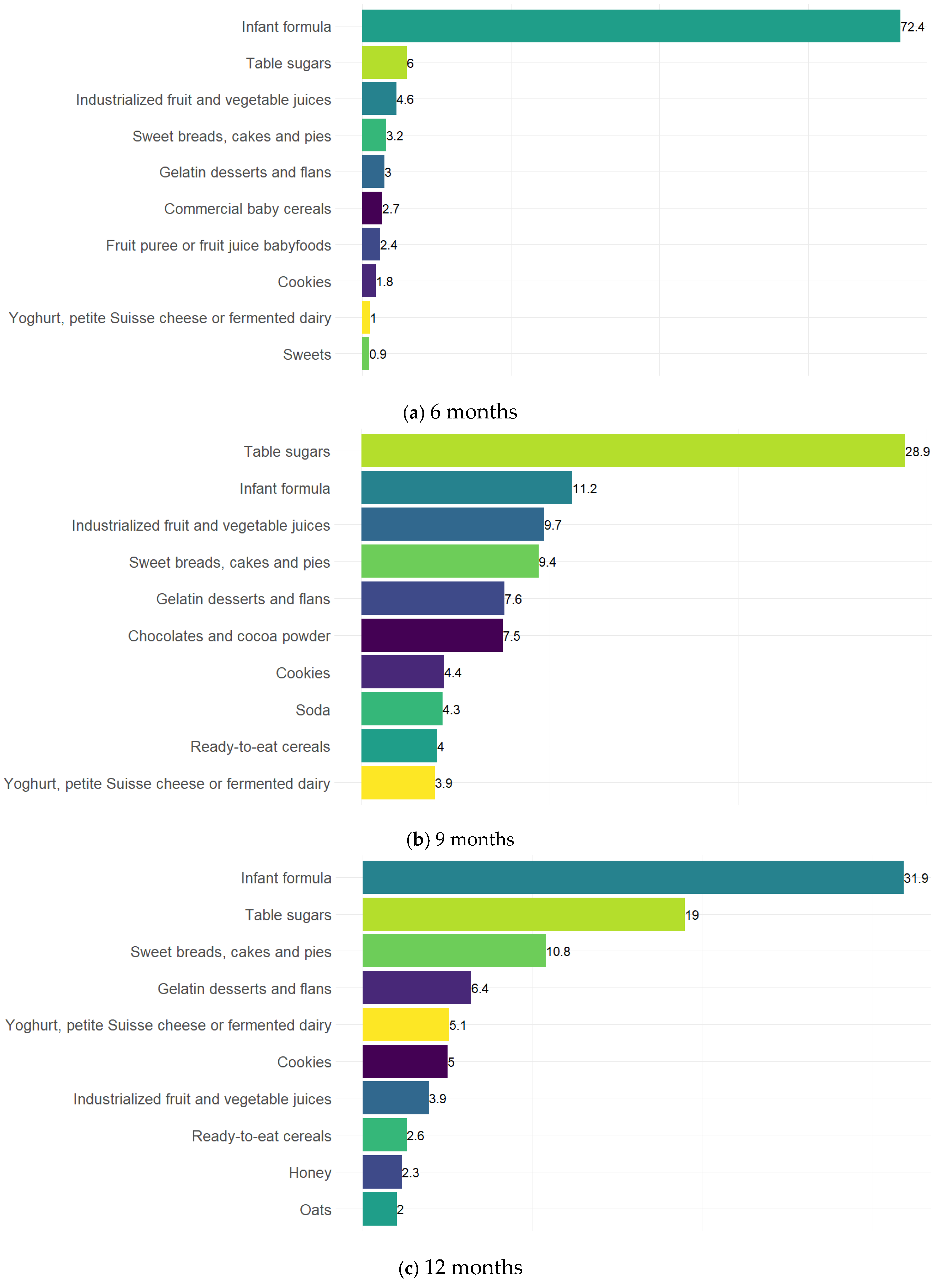
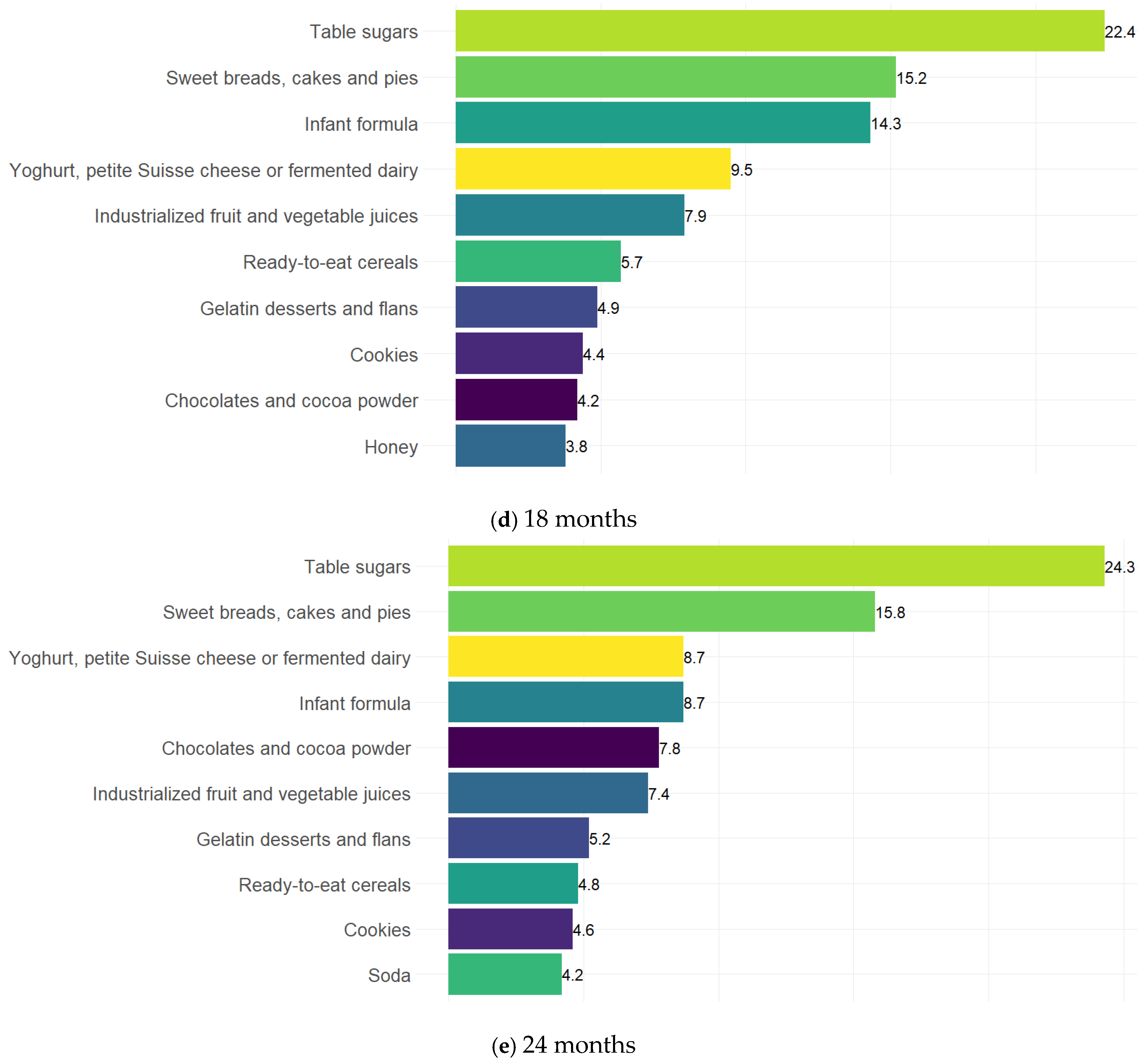
- Added sugar intake increased rapidly over the first two years of life, mainly driven by the consumption of foods typically classified as ultra processed and the use of table sugars during food preparation.
- Higher added sugar intake (≥7 g/day) was associated with higher emotional overeating, food fussiness, waist circumference and lower length for age.
- Longer exclusive and continued breastfeeding were associated with lower added sugar intake.
Abstract
1. Introduction
2. Materials and Methods
2.1. Design and Study Population
2.2. Added Sugars
2.3. Adiposity and Growth
2.4. Appetite and Satiety Indicators
2.5. Breastfeeding Duration
2.6. Covariates
2.7. Statistical Analysis
3. Results
3.1. Participant Characteristics and Descriptive Statistics
3.2. Association Between Breastfeeding Duration and Added Sugar Intake
3.3. Food Group Contributions to Total Added Sugar Intake
3.4. Associations Between Added Sugar Intake and Appetite and Satiety Indicators
3.5. Association Between Added Sugar Intake and Child Growth and Adiposity
4. Discussion
5. Conclusions
- Strengthen programmes that support exclusive and continued breastfeeding.
- Establish clear regulatory limits for added sugars in commercial infant formulas and require transparent carbohydrate-source labelling.
- Implement stricter marketing controls for commercial baby foods and apply WHO Code for breast milk substitute marketing
- Strengthen public health messaging on added sugar avoidance for babies and infants, including juice drinks and desserts
- Establish evidence surrounding potential benefits of applying front-of-pack warning labels to commercial baby foods and infant formula products containing added sugars
- Integrate guidance that encourages nutrient-dense foods and discourages table sugar addition during food preparation.
Author Contributions
Funding
Institutional Review Board Statement
Informed Consent Statement
Data Availability Statement
Acknowledgments
Conflicts of Interest
Abbreviations
| AS | Added sugars |
| BMI | Body mass index |
| BMI-for-age Z score | BMI Z score relative to WHO standards |
| ZLA | Length-for-age Z score |
| CEBQ | Child Eating Behaviour Questionnaire |
| EBF | Exclusive breastfeeding |
| CBF | Continued breastfeeding |
| FTO | Fat mass and obesity-associated gene |
| MAS-Lactancia | Name of the birth cohort |
| BAM | Mexican food composition database |
| ENSANUT | National Health and Nutrition Survey |
| IMSS | Mexican Social Security Institute |
| WHO | World Health Organization |
| CONACYT | National Council of Science and Technology |
Appendix A

| Included N = 248 (21.2%) | Excluded N = 921 (78.8%) | p Value | |
|---|---|---|---|
| Maternal Characteristics | |||
| Education, n (%) | |||
| ≤9 years | 61 (24.6) | 261 (28.8) | 0.009 |
| 10–12 years | 101 (40.7) | 420 (46.3) | |
| ≥13 years | 86 (34.7) | 226 (24.9) | |
| Missings | 14 | ||
| Household Wealth Index, n (%) | |||
| Low | 78 (31.5) | 278 (33.9) | 0.581 |
| Medium | 81 (32.7) | 276 (33.6) | |
| High | 89 (35.9) | 267 (32.5) | |
| Missings | 100 | ||
| Occupation, n (%) | |||
| Not employed/homemaker | 80 (32.3) | 338 (37.3) | 0.222 |
| Informal employment or student | 37 (14.9) | 107 (11.8) | |
| Formal employment | 131 (52.8) | 462 (50.9) | |
| Missings | 14 | ||
| Pregestational BMI (Kg/m2), μ ± D.E. | 24.8 ± 4.3 | 24.9 ± 4.5 | 0.499 |
| Missings | 230 | ||
| Gestational weigth gain (Kg), p50 (p25, p75). | 9.2 (5.7, 12.1) | 9.1 (5.5, 12.4) | 0.621 |
| Missings | 710 | ||
| Child’s characteristics | |||
| Sex, n (%) | |||
| Male vs. Female | 118 (47.6) | 242 (51.9) | 0.268 |
| Missings, n | 455 | ||
| Birthweight (Kg), μ ± D.E. | 3.1 ± 0.5 | 3.1 ± 0.4 | 0.499 |
| Missings | 455 | ||
References
- Mela, D.J.; Woolner, E.M. Perspective: Total, Added, or Free? What Kind of Sugars Should We Be Talking About? Adv. Nutr. 2018, 9, 63–69. [Google Scholar] [CrossRef] [PubMed]
- Vos, M.B.; Kaar, J.L.; Welsh, J.A.; Van Horn, L.V.; Feig, D.I.; Anderson, C.A.M.; Patel, M.J.; Cruz Munos, J.; Krebs, N.F.; Xanthakos, S.A.; et al. Added Sugars and Cardiovascular Disease Risk in Children: A Scientific Statement From the American Heart Association. Circulation 2017, 135, e1017–e1034. [Google Scholar] [CrossRef] [PubMed]
- U.S. Department of Agriculture; U.S. Department of Health and Human Services. Dietary Guidelines for Americans, 2020–2025, 9th ed.; U.S. Department of Agriculture: Washington, DC, USA, 2020.
- Scientific Advisory Committee on Nutrition. Carbohydrates and Health; Scientific Advisory Committee on Nutrition: London, UK, 2015. [Google Scholar]
- Ventura, A.K.; Worobey, J. Early Influences on the Development of Food Preferences. Curr. Biol. 2013, 23, R401–R408. [Google Scholar] [CrossRef] [PubMed]
- Forestell, C.A. Flavor Perception and Preference Development in Human Infants. Ann. Nutr. Metab. 2017, 70, 17–25. [Google Scholar] [CrossRef]
- Capucho, A.M.; Conde, S.V. Impact of Sugars on Hypothalamic Satiety Pathways and Its Contribution to Dysmetabolic States. Diabetology 2022, 4, 1–10. [Google Scholar] [CrossRef]
- Joyce, T.; Gibney, M.J. The Impact of Added Sugar Consumption on Overall Dietary Quality in Irish Children and Teenagers. J. Hum. Nutr. Diet. 2008, 21, 438–450. [Google Scholar] [CrossRef]
- Bhargava, A.; Amialchuk, A. Added Sugars Displaced the Use of Vital Nutrients in the National Food Stamp Program Survey. J. Nutr. 2007, 137, 453–460. [Google Scholar] [CrossRef][Green Version]
- Sánchez-Pimienta, T.G.; Batis, C.; Lutter, C.K.; Rivera, J.A. Sugar-Sweetened Beverages Are the Main Sources of Added Sugar Intake in the Mexican Population. J. Nutr. 2016, 146, 1888S–1896S. [Google Scholar] [CrossRef]
- Rodríguez-Ramírez, S.; Muñoz-Espinosa, A.; Rivera, J.A.; González-Castell, D.; González de Cosío, T. Mexican Children under 2 Years of Age Consume Food Groups High in Energy and Low in Micronutrients. J. Nutr. 2016, 146, 1916S–1923S. [Google Scholar] [CrossRef]
- Cantoral, A.; Téllez-Rojo, M.M.; Ettinger, A.S.; Hu, H.; Hernández-Ávila, M.; Peterson, K. Early Introduction and Cumulative Consumption of Sugar-sweetened Beverages during the Pre-school Period and Risk of Obesity at 8–14 Years of Age. Pediatr. Obes. 2016, 11, 68–74. [Google Scholar] [CrossRef]
- Ramirez-Silva, I.; Pérez Ferrer, C.; Ariza, A.C.; Tamayo-Ortiz, M.; Barragán, S.; Batis, C.; Cantoral, A.; Sánchez, M.; Zambrano, E.; Burguete-García, A.I.; et al. Infant Feeding, Appetite and Satiety Regulation, and Adiposity during Infancy: A Study Design and Protocol of the ‘MAS-Lactancia’ Birth Cohort. BMJ Open 2021, 11, e051400. [Google Scholar] [CrossRef]
- Blanton, C.A.; Moshfegh, A.J.; Baer, D.J.; Kretsch, M.J. The USDA Automated Multiple-Pass Method Accurately Estimates Group Total Energy and Nutrient Intake. J. Nutr. 2006, 136, 2594–2599. [Google Scholar] [CrossRef]
- López-Olmedo, N.; Carriquiry, A.L.; Rodríguez-Ramírez, S.; Ramírez-Silva, I.; Espinosa-Montero, J.; Hernández-Barrera, L.; Campirano, F.; Martínez-Tapia, B.; Rivera, J.A. Usual Intake of Added Sugars and Saturated Fats Is High While Dietary Fiber Is Low in the Mexican Population. J. Nutr. 2016, 146, 1856S–1865S. [Google Scholar] [CrossRef] [PubMed]
- Kent, J.C.; Mitoulas, L.R.; Cregan, M.D.; Ramsay, D.T.; Doherty, D.A.; Hartmann, P.E. Volume and Frequency of Breastfeedings and Fat Content of Breast Milk Throughout the Day. Pediatrics 2006, 117, e387–e395. [Google Scholar] [CrossRef]
- Rios-Leyvraz, M.; Yao, Q. The Volume of Breast Milk Intake in Infants and Young Children: A Systematic Review and Meta-Analysis. Breastfeed. Med. 2023, 18, 188–197. [Google Scholar] [CrossRef]
- Ramírez-Silva, I.; Rodríguez-Ramírez, S.; Barragán-Vázquez, S.; Castellanos, A.; Reyes-García, A.; Martínez-Piña, A.; Pedroza, A. Prevalence of Inadequate Intake of Vitamins and Minerals in the Mexican Population Correcting by Nutrient Retention Factors, ENSANUT 2016. Rev. De Salud Pública De México 2020, 62, 521–531. [Google Scholar] [CrossRef] [PubMed]
- Ramírez Silva, I.; Barragán-Vázquez, S.; Rodríguez Ramírez, S.; Rivera Dommarco, J.A.; Mejía-Rodríguez, F.; Barquera Cervera, S.; Tolentino Mayo, L.; Flores Aldana, M.; Villalpando Hernández, S.; Ancira Moreno, M. Base de Alimentos de México (BAM): Compilación de La Composición de Los Alimentos Frecuentemente Consumidos En El País. Version 18.1.1. Available online: https://www.insp.mx/informacion-relevante/bam-bienvenida (accessed on 26 September 2023).
- Louie, J.C.Y.; Moshtaghian, H.; Boylan, S.; Flood, V.M.; Rangan, A.M.; Barclay, A.W.; Brand-Miller, J.C.; Gill, T.P. A Systematic Methodology to Estimate Added Sugar Content of Foods. Eur. J. Clin. Nutr. 2015, 69, 154–161. [Google Scholar] [CrossRef]
- Ancira-Moreno M, O.I.B.-V.S.L.-G.N.R.-S.I. Application of a Systematic Methodology of Added Sugar Estimation in Frequently Consumed Mexican Foods. [Unpublished].
- Lohman, T.G.; Roche, A.F.; Martorell, R. Anthropometric Standardization Reference Manual; Human Kinetics Books: Champaign, IL, USA, 1988. [Google Scholar]
- Habicht, J.-P. Estandarización de Métodos Epidemiológicos Cuantitativos Sobre El Terreno. Oficina Sanit. Panam. 1974, LXXV, 375–384. [Google Scholar]
- de Onis, M.; Garza, C.; Victora, C.G.; Onyango, A.W.; Frongillo, E.A.; Martines, J. The WHO Multicentre Growth Reference Study: Planning, study design, and methodology. Food Nutr. Bull. 2004, 25, S15–S26. [Google Scholar] [CrossRef]
- Wardle, J.; Guthrie, C.A.; Sanderson, S.; Rapoport, L. Development of the Children’s Eating Behaviour Questionnaire. J. Child Psychol. Psychiatry 2001, 42, 963–970. [Google Scholar] [CrossRef]
- Carnell, S.; Wardle, J. Measuring Behavioural Susceptibility to Obesity: Validation of the Child Eating Behaviour Questionnaire. Appetite 2007, 48, 104–113. [Google Scholar] [CrossRef]
- Sleddens, E.F.; Kremers, S.P.; Thijs, C. The Children’s Eating Behaviour Questionnaire: Factorial Validity and Association with Body Mass Index in Dutch Children Aged 6–7. Int. J. Behav. Nutr. Phys. Act. 2008, 5, 49. [Google Scholar] [CrossRef]
- Ramírez-Silva, I.; Ariza, A.C.; Barragán-Vázquez, S.; Mendoza Jiménez, M.; Ortiz-Panozo, E.; Batis, C.; Burguete-García, A.; Ávila-Jimenez, L.; Zambrano, E.; Rivera, J.A. Longitudinal Patterns of Breastfeeding and Its Association with Adiposity and Subjective Indicators of Satiety/Appetite in the First 2 Years of Life. Appetite 2023, 190, 107030. [Google Scholar] [CrossRef]
- Tomova, G.D.; Arnold, K.F.; Gilthorpe, M.S.; Tennant, P.W. Adjustment for Energy Intake in Nutritional Research: A Causal Inference Perspective. Am. J. Clin. Nutr. 2022, 115, 189–198. [Google Scholar] [CrossRef]
- Gutiérrez, J.P. Clasificación Socioeconómica de Los Hogares En La ENSANUT 2012. Salud Publica Mex. 2013, 55, 341. [Google Scholar] [CrossRef]
- Kim-Herrera, E.Y.; Ramírez-Silva, I.; Rodríguez-Oliveros, G.; Ortiz-Panozo, E.; Sánchez-Estrada, M.; Rivera-Pasquel, M.; Pérez-Escamilla, R.; Rivera-Dommarco, J.A. Parental Feeding Styles and Their Association with Complementary Feeding Practices and Growth in Mexican Children. Front. Pediatr. 2021, 9, 786397. [Google Scholar] [CrossRef] [PubMed]
- Posit Team RStudio: Integrated Development Environment for R. 2025. Available online: https://www.scirp.org/reference/referencespapers?referenceid=4177066 (accessed on 25 February 2026).
- Wickham, H. Ggplot2: Elegant Graphics for Data Analysis; Springer: New York, NY, USA, 2016; ISBN 978-3-319-24277-4. [Google Scholar]
- Rupérez, A.I.; Mesana, M.I.; Moreno, L.A. Dietary Sugars, Metabolic Effects and Child Health. Curr. Opin. Clin. Nutr. Metab. Care 2019, 22, 206–216. [Google Scholar] [CrossRef] [PubMed]
- Kong, K.L.; Burgess, B.; Morris, K.S.; Faith, M.S.; Paluch, R.A. High Intake of Added Sugars Is Linked to Rapid Weight Gain in Infancy, Breastfeeding ≥12 Months May Protect against This: A Preliminary Investigation. Pediatr. Obes. 2021, 16, e12728. [Google Scholar] [CrossRef]
- Abanto, J.; Maruyama, J.M.; Pinheiro, E.; Matijasevich, A.; Antunes, J.L.F.; Bönecker, M.; Cardoso, M.A. Prolonged Breastfeeding, Sugar Consumption and Dental Caries at 2 Years of Age: A Birth Cohort Study. Community Dent. Oral Epidemiol. 2023, 51, 575–582. [Google Scholar] [CrossRef]
- Perrine, C.G.; Galuska, D.A.; Thompson, F.E.; Scanlon, K.S. Breastfeeding Duration Is Associated with Child Diet at 6 Years. Pediatrics 2014, 134, S50–S55. [Google Scholar] [CrossRef] [PubMed]
- Kong, K.L.; Burgess, B.; Morris, K.S.; Re, T.; Hull, H.R.; Sullivan, D.K.; Paluch, R.A. Association Between Added Sugars from Infant Formulas and Rapid Weight Gain in US Infants and Toddlers. J. Nutr. 2021, 151, 1572–1580. [Google Scholar] [CrossRef]
- Jacques, A.; Chaaya, N.; Beecher, K.; Ali, S.A.; Belmer, A.; Bartlett, S. The Impact of Sugar Consumption on Stress Driven, Emotional and Addictive Behaviors. Neurosci. Biobehav. Rev. 2019, 103, 178–199. [Google Scholar] [CrossRef]
- Samuel, T.M.; Musa-Veloso, K.; Ho, M.; Venditti, C.; Shahkhalili-Dulloo, Y. A Narrative Review of Childhood Picky Eating and Its Relationship to Food Intakes, Nutritional Status, and Growth. Nutrients 2018, 10, 1992. [Google Scholar] [CrossRef]
- Wang, J.; Wu, R.; Wei, X.; Chang, Y.-S.; Tang, X.; Zhu, B.; Cao, Y.; Wu, Y.; Zhu, D. Bidirectional Associations between Parental Feeding Practices and Child Eating Behaviors in a Chinese Sample. Nutrients 2023, 16, 44. [Google Scholar] [CrossRef] [PubMed]
- Afonso, L.; Lopes, C.; Severo, M.; Santos, S.; Real, H.; Durão, C.; Moreira, P.; Oliveira, A. Bidirectional Association between Parental Child-Feeding Practices and Body Mass Index at 4 and 7 y of Age. Am. J. Clin. Nutr. 2016, 103, 861–867. [Google Scholar] [CrossRef] [PubMed]
- Nowson, C.A.; Crozier, S.R.; Robinson, S.M.; Godfrey, K.M.; Lawrence, W.T.; Law, C.M.; Cooper, C.; Inskip, H.M. Association of Early Childhood Abdominal Circumference and Weight Gain with Blood Pressure at 36 Months of Age: Secondary Analysis of Data from a Prospective Cohort Study. BMJ Open 2014, 4, e005412. [Google Scholar] [CrossRef]
- Kumala Putri, D.S.; Widodo, Y.; Gunardi, H.; Kusharisupeni; Besral; Djahari, A.B.; Syafiq, A.; Achadi, E.L.; Bhutta, Z.A. When Did the Substantial Loss of Child Linear Growth Occur? PLoS ONE 2023, 18, e0291176. [Google Scholar] [CrossRef]
- Herbst, A.; Diethelm, K.; Cheng, G.; Alexy, U.; Icks, A.; Buyken, A.E. Direction of Associations between Added Sugar Intake in Early Childhood and Body Mass Index at Age 7 Years May Depend on Intake Levels. J. Nutr. 2011, 141, 1348–1354. [Google Scholar] [CrossRef]
- Paglia, L. The Sweet Danger of Added Sugars. Eur. J. Paediatr. Dent. 2019, 20, 89. [Google Scholar] [CrossRef]
- Pan American Health Organization Pan American Health Organization Nutrient Profile Model. Available online: https://iris.paho.org/items/38d7ee18-e9c0-4c01-838d-eec14a75e43a (accessed on 13 February 2026).
- Rips-Goodwin, A.R.; Jun, D.; Griebel-Thompson, A.; Kong, K.L.; Fazzino, T.L. US Infant Formulas Contain Primarily Added Sugars: An Analysis of Infant Formulas on the US Market. J. Food Compos. Anal. 2025, 141, 107369. [Google Scholar] [CrossRef]
- Pan American Health Organization; United Nations Children’s Fund. ProPAN: Process for the Promotion of Child Feeding: Field Manual. Available online: https://iris.paho.org/server/api/core/bitstreams/d82c6157-fd02-47c8-b29a-5d23eba8a12f/content (accessed on 13 February 2026).
- World Health Organization. WHO Guideline for Complementary Feeding of Infants and Young Children 6–23 Months of Age. Available online: https://www.who.int/publications/i/item/9789240081864 (accessed on 13 February 2026).
- Diario Oficial de la Federacion NORMA Oficial Mexicana NOM-131-SSA1-2012, Productos y Servicios. Fórmulas Para Lactantes, de Continuación y Para Necesidades Especiales de Nutrición. Alimentos y Bebidas No Alcohólicas Para Lactantes y Niños de Corta Edad. Disposiciones y Especificaciones Sanitarias y Nutrimentales. Etiquetado y Métodos de Prueba. Available online: https://mexicanlaws.com/SALUD/NOM-131-SSA1-2012.htm (accessed on 29 January 2026).
- Diario Oficial de la Federacion NORMA Oficial Mexicana NOM-051-SCFI/SSA1-2010, Especificaciones Generales de Etiquetado Para Alimentos y Bebidas No Alcohólicas Preenvasados-Información Comercial y Sanitaria. Available online: https://www.sweetware.com/Mexico_NOM-051_English.pdf (accessed on 29 January 2026).


| Maternal Characteristics | Subsample N = 248 |
|---|---|
| Education, n (%) | |
| ≤9 years | 61 (24.6) |
| 10–12 years | 101 (40.7) |
| ≥13 years | 86 (34.7) |
| Household Wealth Index, n (%) | |
| Low | 78 (31.5) |
| Medium | 81 (32.7) |
| High | 89 (35.9) |
| Occupation, n (%) | |
| Not employed/homemaker | 80 (32.3) |
| Informal employment or student | 37 (14.9) |
| Formal employment | 131 (52.8) |
| Pregestational BMI (Kg/m2), μ ± D.E. | 24.8 ± 4.3 |
| Gestational weight gain (Kg), p50 (p25, p75). | 9.2 (5.7, 12.1) |
| Child’s characteristics | |
| Sex, n (%) | |
| Male vs. Female | 118 (47.6) |
| Birthweight (Kg), μ ± D.E. | 3.1 ± 0.5 |
| Exclusive breastfeeding duration, n (%) | |
| <1 month or no exclusive breastfeeding | 85 (34.3) |
| 1–3 months | 53 (21.4) |
| >3 months | 110 (44.4) |
| Added sugar intake (g/day), p50 (p25, p75) | |
| 6 months | 0.0 (0.0, 1.8) |
| 9 months | 0.0 (0.0, 6.3) |
| 12 months | 5.9 (1.5, 16.6) |
| 18 months | 10.4 (3.5, 21.4) |
| 24 months | 19.4 (6.6, 37.5) |
| Added sugar contribution to total energy intake (%), p50 (p25, p75) | |
| 6 months | 0.0 (0.0, 0.8) |
| 9 months | 0.1 (0.0, 5.1) |
| 12 months | 2.6 (0.5, 6.4) |
| 18 months | 3.8 (1.6, 7.7) |
| 24 months | 6.0 (2.5, 11.1) |
| Assessment Times | |||
|---|---|---|---|
| 6 Months | 12 Months | 24 Months | |
| Adiposity and growth, μ ± D.E | |||
| BMI-for-age (Z score) | −0.01 ± 1.04 | 0.12 ± 1.12 | 0.02 ± 0.94 |
| Waist circumference (cm) | 42.38 ± 2.76 | 43.53 ± 3.01 | 45.59 ± 2.84 |
| Skinfold sum (mm) | 28.84 ± 6.22 | 26.86 ± 6.24 | 22.41 ± 5.74 |
| Length-for-age (Z score) | −0.80 ± 0.96 | −1.15 ± 1.14 | −1.01 ± 0.90 |
| Child Eating Behaviour Subscales, p50 (p25, p75) | |||
| Food responsiveness | 10 (7, 14) | 11 (9, 14) | 12 (8, 16) |
| Emotional over-eating | 4 (4, 7) | 6 (4, 8) | 7 (4, 8) |
| Enjoyment of food | 18 (15.5, 20) | 18 (15, 20) | 17 (15, 20) |
| Desire to drink | 6 (4, 9) | 8 (5, 10) | 9 (6, 12) |
| Satiety responsiveness | 13 (11, 15) | 13 (11, 15) | 13 (10, 15) |
| Slowness in eating | 12 (9, 14) | 12 (10, 14) | 11 (10, 13) |
| Emotional under-eating | 10 (8, 14) | 12 (9, 16) | 12.5 (9, 16) |
| Food fussiness | 12 (9, 16) | 12 (10, 15) | 15 (12, 18) |
| Breastfeeding | Added Sugar Intake (g/Day) | ||
|---|---|---|---|
| Exclusive breastfeeding | β | 95% CI | p value |
| <1 month or no exclusive breastfeeding | Ref. | ||
| 1–3 months | −2.80 | −6.27, 0.68 | 0.114 |
| >3 months | −3.59 | −6.34, −0.84 | 0.011 |
| Continued breastfeeding | |||
| Yes vs. No | −9.78 | −13.20, −6.34 | <0.001 |
| Child Eating Behaviour Subscales | ||||||||||||
|---|---|---|---|---|---|---|---|---|---|---|---|---|
| Food Responsiveness | Emotional Over-Eating | Food Enjoyment | Desire to Drink | |||||||||
| β | 95% CI | p Value | β | 95% CI | p Value | β | 95% CI | p Value | β | 95% CI | p Value | |
| Added Sugar Intake | ||||||||||||
| Low (0 g) | Ref. | Ref. | Ref. | Ref. | ||||||||
| Medium (0.01–6.96 g) | −0.35 | −1.30, 0.60 | 0.472 | 0.15 | −0.35, 0.65 | 0.555 | −0.13 | −0.77, 0.51 | 0.696 | −0.28 | −0.98, 0.42 | 0.431 |
| High (>6.96 g) | −0.09 | −0.93, 1.12 | 0.857 | 0.58 | 0.04, 1.12 | 0.035 | −0.60 | −1.30, 0.09 | 0.087 | 0.46 | −0.30, 1.21 | 0.235 |
| p for tendency | 0.829 | 0.033 | 0.083 | 0.213 | ||||||||
| Satiety Responsiveness | Slowness in Eating | Emotional Under-Eating | Food Fussiness | |||||||||
| β | 95% CI | p value | β | 95% CI | p value | β | 95% CI | p value | β | 95% CI | p value | |
| Added Sugar Intake | ||||||||||||
| Low (0 g) | Ref. | Ref. | Ref. | Ref. | ||||||||
| Medium (0.01–6.96 g) | 0.76 | 0.01, 1.52 | 0.048 | 0.11 | −0.54, 0.76 | 0.737 | 0.20 | −0.69, 1.09 | 0.657 | 0.47 | −0.53, 1.48 | 0.357 |
| High (>6.96 g) | 0.77 | −0.04, 1.58 | 0.063 | 0.13 | −0.57, 0.82 | 0.715 | 0.64 | −0.32, 1.60 | 0.189 | 1.45 | 0.38, 2.53 | 0.008 |
| p for tendency | 0.069 | 0.719 | 0.185 | 0.008 | ||||||||
| Child Growth and Adiposity | ||||||||||||
|---|---|---|---|---|---|---|---|---|---|---|---|---|
| BMI-for-Age (Z Score) | Length-for-Age (Z Score) | Waist Circumference (cm) | Skinfold Sum (mm) | |||||||||
| β | 95% CI | p Value | β | 95% CI | p Value | β | 95% CI | p Value | β | 95% CI | p Value | |
| Added Sugar Intake | ||||||||||||
| Low (0 g) | Ref. | Ref. | Ref. | Ref. | ||||||||
| Medium (0.01–6.96 g) | −0.04 | −0.19, 0.11 | 0.583 | −0.09 | −0.23, 0.04 | 0.183 | 1.30 | 0.67, 1.93 | <0.001 | 0.26 | −0.84, 1.37 | 0.643 |
| High (>6.96 g) | −0.03 | −0.20, 0.13 | 0.686 | −0.17 | −0.32, −0.01 | 0.037 | 2.02 | 1.32, 2.73 | <0.001 | −0.19 | −1.44, 1.07 | 0.771 |
| p for tendency | 0.654 | 0.034 | <0.001 | 0.832 | ||||||||
Disclaimer/Publisher’s Note: The statements, opinions and data contained in all publications are solely those of the individual author(s) and contributor(s) and not of MDPI and/or the editor(s). MDPI and/or the editor(s) disclaim responsibility for any injury to people or property resulting from any ideas, methods, instructions or products referred to in the content. |
© 2026 by the authors. Licensee MDPI, Basel, Switzerland. This article is an open access article distributed under the terms and conditions of the Creative Commons Attribution (CC BY) license.
Share and Cite
Barragán-Vázquez, S.; Ramírez-Silva, I.; Olvera-Mayorga, G.; Ancira-Moreno, M.; Dommarco, J.A.R.; Cantoral, A.; Ávila-Jimenez, L.; Terrazas Meraz, M.A.; Moran, S.A.H.; Threapleton, D. Early Life Added Sugars and Associated Appetite, Satiety, Growth and Adiposity in the First 2 Years of Life. Nutrients 2026, 18, 833. https://doi.org/10.3390/nu18050833
Barragán-Vázquez S, Ramírez-Silva I, Olvera-Mayorga G, Ancira-Moreno M, Dommarco JAR, Cantoral A, Ávila-Jimenez L, Terrazas Meraz MA, Moran SAH, Threapleton D. Early Life Added Sugars and Associated Appetite, Satiety, Growth and Adiposity in the First 2 Years of Life. Nutrients. 2026; 18(5):833. https://doi.org/10.3390/nu18050833
Chicago/Turabian StyleBarragán-Vázquez, Sofía, Ivonne Ramírez-Silva, Gabriela Olvera-Mayorga, Mónica Ancira-Moreno, Juan A. Rivera Dommarco, Alejandra Cantoral, Laura Ávila-Jimenez, María Alejandra Terrazas Meraz, Santiago Andrés Henao Moran, and Diane Threapleton. 2026. "Early Life Added Sugars and Associated Appetite, Satiety, Growth and Adiposity in the First 2 Years of Life" Nutrients 18, no. 5: 833. https://doi.org/10.3390/nu18050833
APA StyleBarragán-Vázquez, S., Ramírez-Silva, I., Olvera-Mayorga, G., Ancira-Moreno, M., Dommarco, J. A. R., Cantoral, A., Ávila-Jimenez, L., Terrazas Meraz, M. A., Moran, S. A. H., & Threapleton, D. (2026). Early Life Added Sugars and Associated Appetite, Satiety, Growth and Adiposity in the First 2 Years of Life. Nutrients, 18(5), 833. https://doi.org/10.3390/nu18050833