


Micronutrient Deficiencies in the Era of Second-Generation Incretin-Based Therapies for Obesity


Abstract
1. Introduction
2. Baseline Micronutrient Vulnerability in Obesity
3. Evidence for Micronutrient-Related Outcomes During Incretin-Based Therapy
3.1. Real-World Signals of Nutritional Deficiency and Related Complications
3.2. Pharmacovigilance Evidence: Dehydration as Nutritional Signal
3.3. Dietary Intake Patterns and Risk of Micronutrient Inadequacy
3.4. Biochemical and Functional Evidence of Micronutrient Alterations
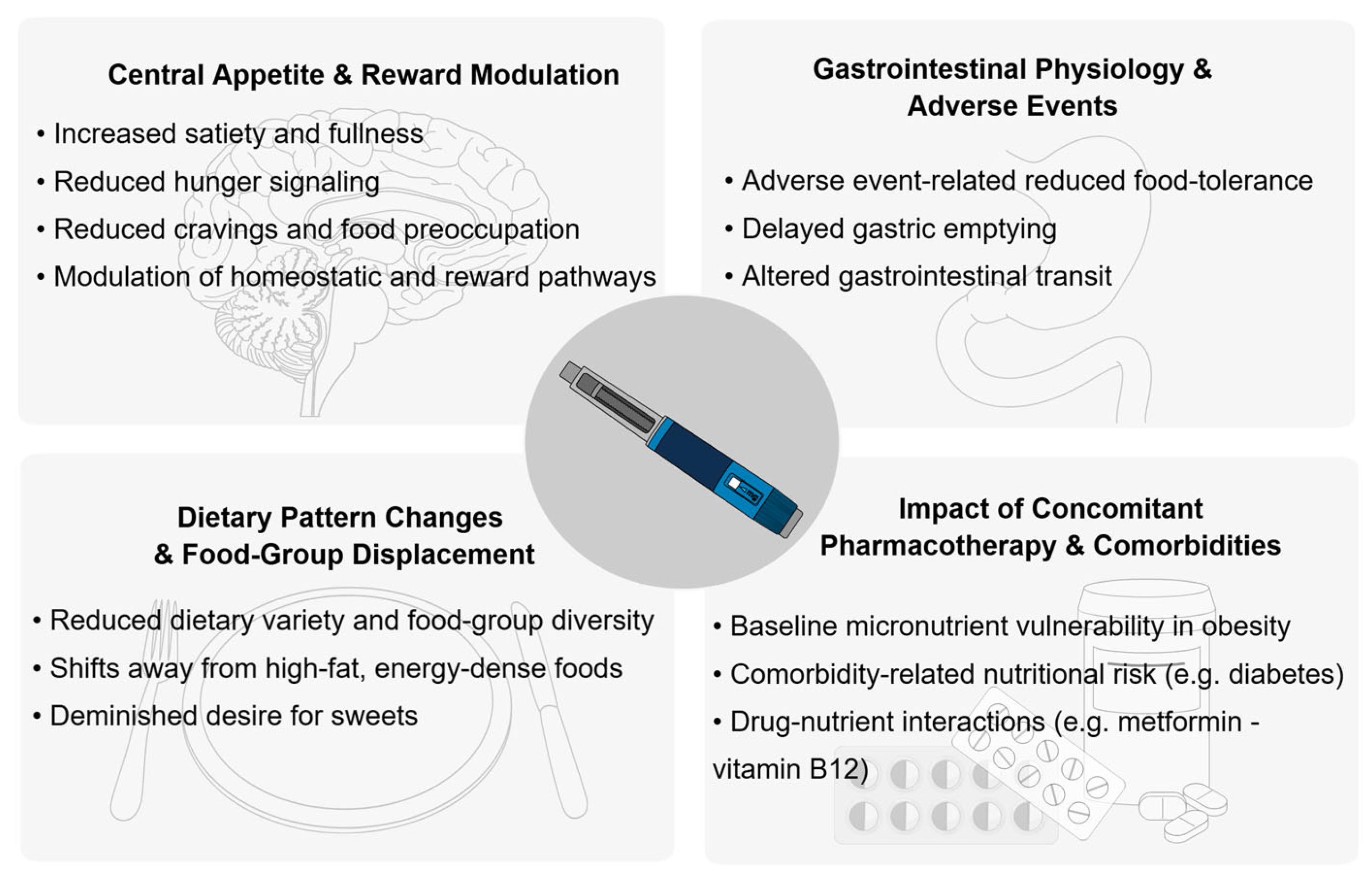
4. Mechanisms Linking Incretin-Based Therapy to Micronutrient Risk
4.1. Reduced Food Intake and Absolute Micronutrient Exposure
4.2. Dietary Pattern Changes and Food-Group Displacement
4.3. Gastrointestinal Physiology and Adverse Events
4.4. Interaction with Concomitant Pharmacotherapy and Comorbidities
5. Nutritional Monitoring During Incretin-Based Therapy
6. Limitations and Future Directions
7. Conclusions
Author Contributions
Funding
Data Availability Statement
Conflicts of Interest
References
- Wilding, J.P.H.; Batterham, R.L.; Calanna, S.; Davies, M.; Van Gaal, L.F.; Lingvay, I.; McGowan, B.M.; Rosenstock, J.; Tran, M.T.D.; Wadden, T.A.; et al. Once-Weekly Semaglutide in Adults with Overweight or Obesity. N. Engl. J. Med. 2021, 384, 989–1002. [Google Scholar] [CrossRef] [Scilit] [PubMed]
- Davies, M.; Færch, L.; Jeppesen, O.K.; Pakseresht, A.; Pedersen, S.D.; Perreault, L.; Rosenstock, J.; Shimomura, I.; Viljoen, A.; Wadden, T.A.; et al. Semaglutide 2·4 mg once a week in adults with overweight or obesity, and type 2 diabetes (STEP 2): A randomised, double-blind, double-dummy, placebo-controlled, phase 3 trial. Lancet 2021, 397, 971–984. [Google Scholar] [CrossRef] [Scilit] [PubMed]
- Jastreboff, A.M.; Aronne, L.J.; Ahmad, N.N.; Wharton, S.; Connery, L.; Alves, B.; Kiyosue, A.; Zhang, S.; Liu, B.; Bunck, M.C.; et al. Tirzepatide Once Weekly for the Treatment of Obesity. N. Engl. J. Med. 2022, 387, 205–216. [Google Scholar] [CrossRef] [Scilit] [PubMed]
- Garvey, W.T.; Frias, J.P.; Jastreboff, A.M.; Le Roux, C.W.; Sattar, N.; Aizenberg, D.; Mao, H.; Zhang, S.; Ahmad, N.N.; Bunck, M.C.; et al. Tirzepatide once weekly for the treatment of obesity in people with type 2 diabetes (SURMOUNT-2): A double-blind, randomised, multicentre, placebo-controlled, phase 3 trial. Lancet 2023, 402, 613–626. [Google Scholar] [CrossRef] [Scilit]
- Jensterle, M.; Ferjan, S.; Ležaič, L.; Sočan, A.; Goričar, K.; Zaletel, K.; Janez, A. Semaglutide delays 4-hour gastric emptying in women with polycystic ovary syndrome and obesity. Diabetes Obes. Metab. 2023, 25, 975–984. [Google Scholar] [CrossRef] [Scilit]
- Halawi, H.; Khemani, D.; Eckert, D.; O’Neill, J.; Kadouh, H.; Grothe, K.; Clark, M.M.; Burton, D.D.; Vella, A.; Acosta, A.; et al. Effects of liraglutide on weight, satiation, and gastric functions in obesity: A randomised, placebo-controlled pilot trial. Lancet Gastroenterol. Hepatol. 2017, 2, 890–899. [Google Scholar] [CrossRef] [Scilit]
- Badulescu, S.; Tabassum, A.; Le, G.H.; Wong, S.; Phan, L.; Gill, H.; Llach, C.-D.; McIntyre, R.S.; Rosenblat, J.; Mansur, R. Glucagon-like peptide 1 agonist and effects on reward behaviour: A systematic review. Physiol. Behav. 2024, 283, 114622. [Google Scholar] [CrossRef] [Scilit]
- Park, J.S.; Kim, K.S.; Choi, H.J. Glucagon-Like Peptide-1 and Hypothalamic Regulation of Satiation: Cognitive and Neural Insights from Human and Animal Studies. Diabetes Metab. J. 2025, 49, 333–347. [Google Scholar] [CrossRef] [Scilit]
- Astrup, A.; Bügel, S. Overfed but undernourished: Recognizing nutritional inadequacies/deficiencies in patients with overweight or obesity. Int. J. Obes. 2019, 43, 219–232. [Google Scholar] [CrossRef] [Scilit]
- Jansson, A.K.; Gómez-Martín, M.; Hedin, L.; Clarke, E.D.; Cross, V.; Stanford, J.; Taylor, R.M.; Bogl, L.H.; De Vlieger, N.; Koochek, A.; et al. A Systematic Review Identifying Critical Evidence Gaps in Reporting Dietary Change in Randomized Controlled Trials Prescribing Liraglutide, Semaglutide, or Tirzepatide. Obes. Rev. 2026, 27, e70077. [Google Scholar] [CrossRef] [Scilit]
- Sibal, R.; Balamurugan, G.; Langley, J.; Graham, Y.; Mahawar, K. Macronutrient, Micronutrient Supplementation and Monitoring for Patients on GLP-1 Agonists: Can We Learn from Metabolic and Bariatric Surgery? Nutrients 2025, 17, 3659. [Google Scholar] [CrossRef] [Scilit]
- Berger, M.M.; Shenkin, A.; Schweinlin, A.; Amrein, K.; Augsburger, M.; Biesalski, H.-K.; Bischoff, S.C.; Casaer, M.P.; Gundogan, K.; Lepp, H.-L.; et al. ESPEN micronutrient guideline. Clin. Nutr. 2022, 41, 1357–1424. [Google Scholar] [CrossRef] [Scilit] [PubMed]
- Lapik, I.A.; Galchenko, A.V.; Gapparova, K.M. Micronutrient status in obese patients: A narrative review. Obes. Med. 2020, 18, 100224. [Google Scholar] [CrossRef] [Scilit]
- Peterson, L.A.; Cheskin, L.J.; Furtado, M.; Papas, K.; Schweitzer, M.A.; Magnuson, T.H.; Steele, K.E. Malnutrition in Bariatric Surgery Candidates: Multiple Micronutrient Deficiencies Prior to Surgery. Obes. Surg. 2016, 26, 833–838. [Google Scholar] [CrossRef] [Scilit] [PubMed]
- Pereira-Santos, M.; Costa, P.R.F.; Assis, A.M.O.; Santos, C.A.S.T.; Santos, D.B. Obesity and vitamin D deficiency: A systematic review and meta-analysis. Obes. Rev. 2015, 16, 341–349. [Google Scholar] [CrossRef] [Scilit]
- Sánchez, A.; Rojas, P.; Basfi-fer, K.; Carrasco, F.; Inostroza, J.; Codoceo, J.; Valencia, A.; Papapietro, K.; Csendes, A.; Ruz, M. Micronutrient Deficiencies in Morbidly Obese Women Prior to Bariatric Surgery. Obes. Surg. 2016, 26, 361–368. [Google Scholar] [CrossRef] [Scilit]
- Lefebvre, P.; Letois, F.; Sultan, A.; Nocca, D.; Mura, T.; Galtier, F. Nutrient deficiencies in patients with obesity considering bariatric surgery: A cross-sectional study. Surg. Obes. Relat. Dis. 2014, 10, 540–546. [Google Scholar] [CrossRef] [Scilit]
- Pellegrini, M.; Rahimi, F.; Boschetti, S.; Devecchi, A.; De Francesco, A.; Mancino, M.V.; Toppino, M.; Morino, M.; Fanni, G.; Ponzo, V.; et al. Pre-operative micronutrient deficiencies in patients with severe obesity candidates for bariatric surgery. J. Endocrinol. Investig. 2021, 44, 1413–1423. [Google Scholar] [CrossRef] [Scilit]
- Blum, M.; Dolnikowski, G.; Seyoum, E.; Harris, S.S.; Booth, S.L.; Peterson, J.; Saltzman, E.; Dawson-Hughes, B. Vitamin D3 in fat tissue. Endocrine 2008, 33, 90–94. [Google Scholar] [CrossRef] [Scilit]
- Almandoz, J.P.; Wadden, T.A.; Tewksbury, C.; Apovian, C.M.; Fitch, A.; Ard, J.D.; Li, Z.; Richards, J.; Butsch, W.S.; Jouravskaya, I.; et al. Nutritional considerations with antiobesity medications. Obesity 2024, 32, 1613–1631. [Google Scholar] [CrossRef] [Scilit]
- Bonet, M.L.; Ribot, J.; Galmés, S.; Serra, F.; Palou, A. Carotenoids and carotenoid conversion products in adipose tissue biology and obesity: Pre-clinical and human studies. Biochim. Biophys. Acta BBA-Mol. Cell Biol. Lipids 2020, 1865, 158676. [Google Scholar] [CrossRef] [Scilit]
- Botella-Carretero, J.I.; Balsa, J.A.; Vázquez, C.; Peromingo, R.; Díaz-Enriquez, M.; Escobar-Morreale, H.F. Retinol and α-Tocopherol in Morbid Obesity and Nonalcoholic Fatty Liver Disease. Obes. Surg. 2010, 20, 69–76. [Google Scholar] [CrossRef] [Scilit] [PubMed]
- Aasheim, E.T.; Hofsø, D.; Hjelmesæth, J.; Birkeland, K.I.; Bøhmer, T. Vitamin status in morbidly obese patients: A cross-sectional study. Am. J. Clin. Nutr. 2008, 87, 362–369. [Google Scholar] [CrossRef] [Scilit] [PubMed]
- Gunanti, I.R.; Marks, G.C.; Al-Mamun, A.; Long, K.Z. Low Serum Vitamin B-12 and Folate Concentrations and Low Thiamin and Riboflavin Intakes Are Inversely Associated with Greater Adiposity in Mexican American Children. J. Nutr. 2014, 144, 2027–2033. [Google Scholar] [CrossRef] [Scilit] [PubMed]
- Mahabir, S.; Ettinger, S.; Johnson, L.; Baer, D.J.; Clevidence, B.A.; Hartman, T.J.; Taylor, P.R. Measures of adiposity and body fat distribution in relation to serum folate levels in postmenopausal women in a feeding study. Eur. J. Clin. Nutr. 2008, 62, 644–650. [Google Scholar] [CrossRef] [Scilit]
- McClung, J.P.; Karl, J.P. Iron deficiency and obesity: The contribution of inflammation and diminished iron absorption. Nutr. Rev. 2009, 67, 100–104. [Google Scholar] [CrossRef] [Scilit]
- Rios-Lugo, M.J.; Madrigal-Arellano, C.; Gaytán-Hernández, D.; Hernández-Mendoza, H.; Romero-Guzmán, E.T. Association of Serum Zinc Levels in Overweight and Obesity. Biol. Trace Elem. Res. 2020, 198, 51–57. [Google Scholar] [CrossRef] [Scilit]
- Fatani, S.H.; Saleh, S.A.K.; Adly, H.M.; Abdulkhaliq, A.A. Trace Element Alterations in the Hair of Diabetic and Obese Women. Biol. Trace Elem. Res. 2016, 174, 32–39. [Google Scholar] [CrossRef] [Scilit]
- Scott Butsch, W.; Sulo, S.; Chang, A.T.; Kim, J.A.; Kerr, K.W.; Williams, D.R.; Hegazi, R.; Panchalingam, T.; Goates, S.; Heymsfield, S.B. Nutritional deficiencies and muscle loss in adults with type 2 diabetes using GLP-1 receptor agonists: A retrospective observational study. Obes. Pillars 2025, 15, 100186. [Google Scholar] [CrossRef] [Scilit]
- He, L.; Li, Q.; Yang, Y.; Li, J.; Luo, W.; Huang, Y.; Zhong, X. Pharmacovigilance study of GLP-1 receptor agonists for metabolic and nutritional adverse events. Front. Pharmacol. 2024, 15, 1416985. [Google Scholar] [CrossRef] [Scilit]
- Johnson, B.; Milstead, M.; Thomas, O.; McGlasson, T.; Green, L.; Kreider, R.; Jones, R. Investigating nutrient intake during use of glucagon-like peptide-1 receptor agonist: A cross-sectional study. Front. Nutr. 2025, 12, 1566498. [Google Scholar] [CrossRef] [Scilit]
- Kanai, R.; Kinoshita, S.; Kanbe, I.; Sameda, M.; Yamaoka, S.; Horikawa, O.; Watanabe, Y.; Tatsuno, I.; Shirai, K.; Oshiro, T.; et al. Once-weekly semaglutide administered after laparoscopic sleeve gastrectomy: Effects on body weight, glycemic control, and measured nutritional metrics in Japanese patients having both obesity and type 2 diabetes. Obes. Pillars 2024, 9, 100098. [Google Scholar] [CrossRef] [Scilit] [PubMed]
- Melis, P.; Lucijanic, M.; Kranjcec, B.; Cigrovski Berkovic, M.; Marusic, S. The effect of semaglutide on intestinal iron absorption in patients with type 2 diabetes mellitus—A pilot study. Diabetes Obes. Metab. 2025, 27, 3542–3545. [Google Scholar] [CrossRef] [Scilit] [PubMed]
- Johnson, B.V.B.; Milstead, M.; Green, L.; Kreider, R.; Jones, R. Diet quality and nutrient distribution while using glucagon-like-peptide-1 receptor agonist: A secondary cross-sectional analysis. Obes. Pillars 2025, 16, 100195. [Google Scholar] [CrossRef] [Scilit] [PubMed]
- Gras, C.; De Wit, V.; Oussedik, N.; Daclin, S.; Bourdin, V.; Callot, D.; Chegrani, G.; Rives-Lange, C.; Chouchana, L. Semaglutide-induced Wernicke encephalopathy: A comprehensive analysis. Eur. J. Clin. Nutr. 2025, 79, 1160–1163. [Google Scholar] [CrossRef] [Scilit]
- Lev, D.; Leibowitz, A.; Lang, A.; Shlomai, G.; Twig, G.; Eden-Friedman, Y.; Engel, T.; Cukierman-Yaffe, T.; Dankner, R.; Gerstein, H.C.; et al. Glucagon-like peptide-1 receptor agonists and Wernicke encephalopathy: A pharmacovigilance study and literature review. Clin. Nutr. 2026, 57, 106571. [Google Scholar] [CrossRef] [Scilit]
- Moiz, A.; Filion, K.B.; Tsoukas, M.A.; Yu, O.H.; Peters, T.M.; Eisenberg, M.J. Mechanisms of GLP-1 Receptor Agonist-Induced Weight Loss: A Review of Central and Peripheral Pathways in Appetite and Energy Regulation. Am. J. Med. 2025, 138, 934–940. [Google Scholar] [CrossRef] [Scilit]
- Gibbons, C.; Blundell, J.; Tetens Hoff, S.; Dahl, K.; Bauer, R.; Bækdal, T. Effects of oral semaglutide on energy intake, food preference, appetite, control of eating and body weight in subjects with type 2 diabetes. Diabetes Obes. Metab. 2021, 23, 581–588. [Google Scholar] [CrossRef] [Scilit]
- Blundell, J.; Finlayson, G.; Axelsen, M.; Flint, A.; Gibbons, C.; Kvist, T.; Hjerpsted, J.B. Effects of once-weekly semaglutide on appetite, energy intake, control of eating, food preference and body weight in subjects with obesity. Diabetes Obes. Metab. 2017, 19, 1242–1251. [Google Scholar] [CrossRef] [Scilit]
- Friedrichsen, M.; Breitschaft, A.; Tadayon, S.; Wizert, A.; Skovgaard, D. The effect of semaglutide 2.4 mg once weekly on energy intake, appetite, control of eating, and gastric emptying in adults with obesity. Diabetes Obes. Metab. 2021, 23, 754–762. [Google Scholar] [CrossRef] [Scilit]
- Van Can, J.; Sloth, B.; Jensen, C.B.; Flint, A.; Blaak, E.E.; Saris, W.H.M. Effects of the once-daily GLP-1 analog liraglutide on gastric emptying, glycemic parameters, appetite and energy metabolism in obese, non-diabetic adults. Int. J. Obes. 2014, 38, 784–793. [Google Scholar] [CrossRef] [Scilit] [PubMed]
- Heise, T.; DeVries, J.H.; Urva, S.; Li, J.; Pratt, E.J.; Thomas, M.K.; Mather, K.J.; Karanikas, C.A.; Dunn, J.; Haupt, A.; et al. Tirzepatide Reduces Appetite, Energy Intake, and Fat Mass in People With Type 2 Diabetes. Diabetes Care 2023, 46, 998–1004. [Google Scholar] [CrossRef] [Scilit] [PubMed]
- Tronieri, J.S.; Wadden, T.A.; Walsh, O.; Berkowitz, R.I.; Alamuddin, N.; Gruber, K.; Leonard, S.; Bakizada, Z.M.; Chao, A.M. Effects of liraglutide on appetite, food preoccupation, and food liking: Results of a randomized controlled trial. Int. J. Obes. 2020, 44, 353–361. [Google Scholar] [CrossRef] [Scilit] [PubMed]
- Christensen, S.; Robinson, K.; Thomas, S.; Williams, D.R. Dietary intake by patients taking GLP-1 and dual GIP/GLP-1 receptor agonists: A narrative review and discussion of research needs. Obes. Pillars 2024, 11, 100121. [Google Scholar] [CrossRef] [Scilit]
- Zhang, W.; Chen, P.; Huo, S.; Huang, X.; Zhao, Y. Requirements for essential micronutrients during caloric restriction and fasting. Front. Nutr. 2024, 11, 1363181. [Google Scholar] [CrossRef] [Scilit]
- Mozaffarian, D.; Agarwal, M.; Aggarwal, M.; Alexander, L.; Apovian, C.M.; Bindlish, S.; Bonnet, J.; Butsch, W.S.; Christensen, S.; Gianos, E.; et al. Nutritional Priorities to Support GLP-1 Therapy for Obesity: A Joint Advisory From the American College of Lifestyle Medicine, the American Society for Nutrition, the Obesity Medicine Association, and the Obesity Society. Am. J. Lifestyle Med. 2025, 122, 15598276251344828. [Google Scholar] [CrossRef] [Scilit]
- Spreckley, M.; Ruggiero, C.F.; Brown, A. Nutrition Strategies for Next-Generation Incretin Therapies: A Systematic Scoping Review of the Current Evidence. Obes. Rev. 2026, 27, e70079. [Google Scholar] [CrossRef] [Scilit]
- Borda, M.G.; Samuelsson, J.; Cederholm, T.; Baldera, J.P.; Pérez-Zepeda, M.U.; Barreto, G.E.; Zettergren, A.; Kern, S.; Rydén, L.; Gonzalez-Lara, M.; et al. Nutrient Intake and Its Association with Appendicular Total Lean Mass and Muscle Function and Strength in Older Adults: A Population-Based Study. Nutrients 2024, 16, 568. [Google Scholar] [CrossRef] [Scilit]
- Kennedy, S.F.; Knights, A.; Ravussin, E.; Sanchez-Delgado, G.; Nishiyama, H.; Qian, H.; Pratt, E.J.; Milicevic, Z.; Haupt, A.; Coskun, T.; et al. Impact of tirzepatide treatment on participant-reported food craving and food preference: Secondary analyses of a phase 1 randomised controlled trial in people with obesity with dietary restriction. Diabetes Obes. Metab. 2025, 27, 6784–6789. [Google Scholar] [CrossRef] [Scilit]
- Hironaka, J.; Ushigome, E.; Kondo, Y.; Hashimoto, Y.; Osaka, T.; Majima, S.; Nakanishi, N.; Okada, H.; Senmaru, T.; Hamaguchi, M.; et al. Changes in food preferences after oral semaglutide administration in Japanese patients with type 2 diabetes: KAMOGAWA-DM cohort. Diab. Vasc. Dis. Res. 2025, 22, 14791641251318309. [Google Scholar] [CrossRef] [Scilit]
- Molani-Gol, R.; Kheirouri, S.; Alizadeh, M. Does the high dietary diversity score predict dietary micronutrients adequacy in children under 5 years old? A systematic review. J. Health Popul. Nutr. 2023, 42, 2. [Google Scholar] [CrossRef] [Scilit]
- Nguyen, P.H.; Huybregts, L.; Sanghvi, T.G.; Tran, L.M.; Frongillo, E.A.; Menon, P.; Ruel, M.T. Dietary Diversity Predicts the Adequacy of Micronutrient Intake in Pregnant Adolescent Girls and Women in Bangladesh, but Use of the 5-Group Cutoff Poorly Identifies Individuals with Inadequate Intake. J. Nutr. 2018, 148, 790–797. [Google Scholar] [CrossRef] [Scilit]
- Quast, D.R.; Nauck, M.A.; Schenker, N.; Menge, B.A.; Kapitza, C.; Meier, J.J. Macronutrient intake, appetite, food preferences and exocrine pancreas function after treatment with short- and long-acting glucagon-like peptide-1 receptor agonists in type 2 diabetes. Diabetes Obes. Metab. 2021, 23, 2344–2353. [Google Scholar] [CrossRef] [Scilit]
- De Jager, J.; Kooy, A.; Lehert, P.; Wulffele, M.G.; Van Der Kolk, J.; Bets, D.; Verburg, J.; Donker, A.J.M.; Stehouwer, C.D.A. Long term treatment with metformin in patients with type 2 diabetes and risk of vitamin B-12 deficiency: Randomised placebo controlled trial. BMJ 2010, 340, c2181. [Google Scholar] [CrossRef] [Scilit]
- Lorenzo-López, L.; Maseda, A.; De Labra, C.; Regueiro-Folgueira, L.; Rodríguez-Villamil, J.L.; Millán-Calenti, J.C. Nutritional determinants of frailty in older adults: A systematic review. BMC Geriatr. 2017, 17, 108. [Google Scholar] [CrossRef] [Scilit]
- Alvarez-Nuncio, M.D.C.; Ziegler, T.R. Micronutrient status and protein-energy malnutrition in free-living older adults: A current perspective. Curr. Opin. Gastroenterol. 2024, 40, 99–105. [Google Scholar] [CrossRef] [Scilit] [PubMed]

| Micronutrient | Typical Findings in Obesity | Key Mechanistic Drivers | References |
|---|---|---|---|
| Vitamin D | Lower circulating 25(OH)D | Volumetric dilution/adipose sequestration. Altered metabolism in obesity. | [15,16,17,19] |
| Vitamin A/ carotenoids | Lower serum carotenoids | Oxidative stress/inflammation. Altered metabolism and distribution. | [17,21,22] |
| B vitamins (B1, B6, folate, B12) | Variable lower values depending on population and concomitant medications | Diet quality. Increased metabolic demand. Concomitant medications. | [13,16,18,23,24,25] |
| Vitamin C | Lower intake/status more frequent | Low fruit/vegetable intake. Oxidative stress. | [13] |
| Iron | Functional iron deficiency tendency | Low-grade inflammation, higher hepcidin, and lower absorption and iron mobilization. | [16,17,18,26] |
| Zinc | Lower serum zinc reported in obesity | Lower intake/diet quality. Increased requirement/inflammation. | [16,27] |
| Magnesium | Often lower intake/status | Diet quality. | [13,17] |
| Population and Design | Therapy | Outcome Assessed | Key Findings | Limitations |
|---|---|---|---|---|
| Adults with type 2 diabetes (large real-world cohort; N = 461,382) [29] | GLP-1 RAs (class level) | ICD-coded nutritional deficiencies/complications | Higher incidence of ICD-coded diagnoses of vitamin D deficiency, B vitamin deficiency, iron deficiency, anemia, mineral deficiency and volume depletion. | Strongest signal dataset, but diagnosis code-based. No biochemical assessment. Detection or surveillance bias. |
| Adults using GLP-1 and dual GLP-1/GIP therapies (cross-sectional dietary assessment, N = 69) with 3-day records [31] | Semaglutide (53.6%) Tirzepatide (33.3%) Dulaglutide (11.6%) Liraglutide (1.4%) | 3-day food records; MyPlate food group servings | Multiple nutrient intakes below daily reference intakes (fiber, calcium, iron, magnesium, potassium, vitamins A, C, D, E, K and choline). Lower intake in fruit, vegetables, grains and dairy. Excess intake in total and saturated fat. Protein intake ≥1.6 g/kg/day only in 10%. | Cross-sectional study. No biochemical assessment. No baseline comparison. |
| Post-sleeve gastrectomy patients with obesity and type 2 diabetes (retrospective single-center cohort, N = 29) [32] | Semaglutide | Serial serum nutritional metrics and reported macronutrient shift | Lower levels of B12 and zinc concentration. | Small sample. Selected high-risk population (post-metabolic surgery). |
| Type 2 diabetes (mechanistic study) [33] | Semaglutide | Iron | Reduction in iron absorption. | Short duration. |
| Case reports of GLP-1 RA-associated events (real-world pharmacovigilance and case literature) [35] | Semaglutide Tirzepatide | Clinically overt thiamine deficiency | 15 reported Wernicke encephalopathy cases in the context of prolonged vomiting, gastrointestinal side-effects and reduced intake. | Rare but clinically important outcome/signal. Causal attribution is limited. |
Disclaimer/Publisher’s Note: The statements, opinions and data contained in all publications are solely those of the individual author(s) and contributor(s) and not of MDPI and/or the editor(s). MDPI and/or the editor(s) disclaim responsibility for any injury to people or property resulting from any ideas, methods, instructions or products referred to in the content. |
© 2026 by the authors. Licensee MDPI, Basel, Switzerland. This article is an open access article distributed under the terms and conditions of the Creative Commons Attribution (CC BY) license.
Share and Cite
Koceva, A.; Janež, A.; Pečko, T.; Jensterle, M. Micronutrient Deficiencies in the Era of Second-Generation Incretin-Based Therapies for Obesity. Nutrients 2026, 18, 677. https://doi.org/10.3390/nu18040677
Koceva A, Janež A, Pečko T, Jensterle M. Micronutrient Deficiencies in the Era of Second-Generation Incretin-Based Therapies for Obesity. Nutrients. 2026; 18(4):677. https://doi.org/10.3390/nu18040677
Chicago/Turabian StyleKoceva, Andrijana, Andrej Janež, Tajda Pečko, and Mojca Jensterle. 2026. "Micronutrient Deficiencies in the Era of Second-Generation Incretin-Based Therapies for Obesity" Nutrients 18, no. 4: 677. https://doi.org/10.3390/nu18040677
APA StyleKoceva, A., Janež, A., Pečko, T., & Jensterle, M. (2026). Micronutrient Deficiencies in the Era of Second-Generation Incretin-Based Therapies for Obesity. Nutrients, 18(4), 677. https://doi.org/10.3390/nu18040677

