Efficacy of Probiotic Treatment in Alcoholic Liver Disease: A Systematic Review of Animal Studies


Abstract
1. Introduction
2. Materials and Methods
2.1. Review Protocol
2.2. Search Strategy
2.3. Eligibility Criteria
- Population: Non-human, mammal animal models of alcoholic liver disease (ALD).
- Intervention: Any probiotic treatment consisting of a singular strain, irrespective of dose, or formulation.
- Comparator: Placebo or untreated control groups.
- Outcomes: Primary outcomes included histopathological indices of liver injury and serum biomarkers (ALT and AST activity). Secondary outcomes included measures of lipid profile, systemic inflammation, gut barrier integrity, and gut microbiota composition.
2.4. Study Selection and Data Extraction
2.5. Risk of Bias Assessment
2.6. Data Synthesis
3. Results
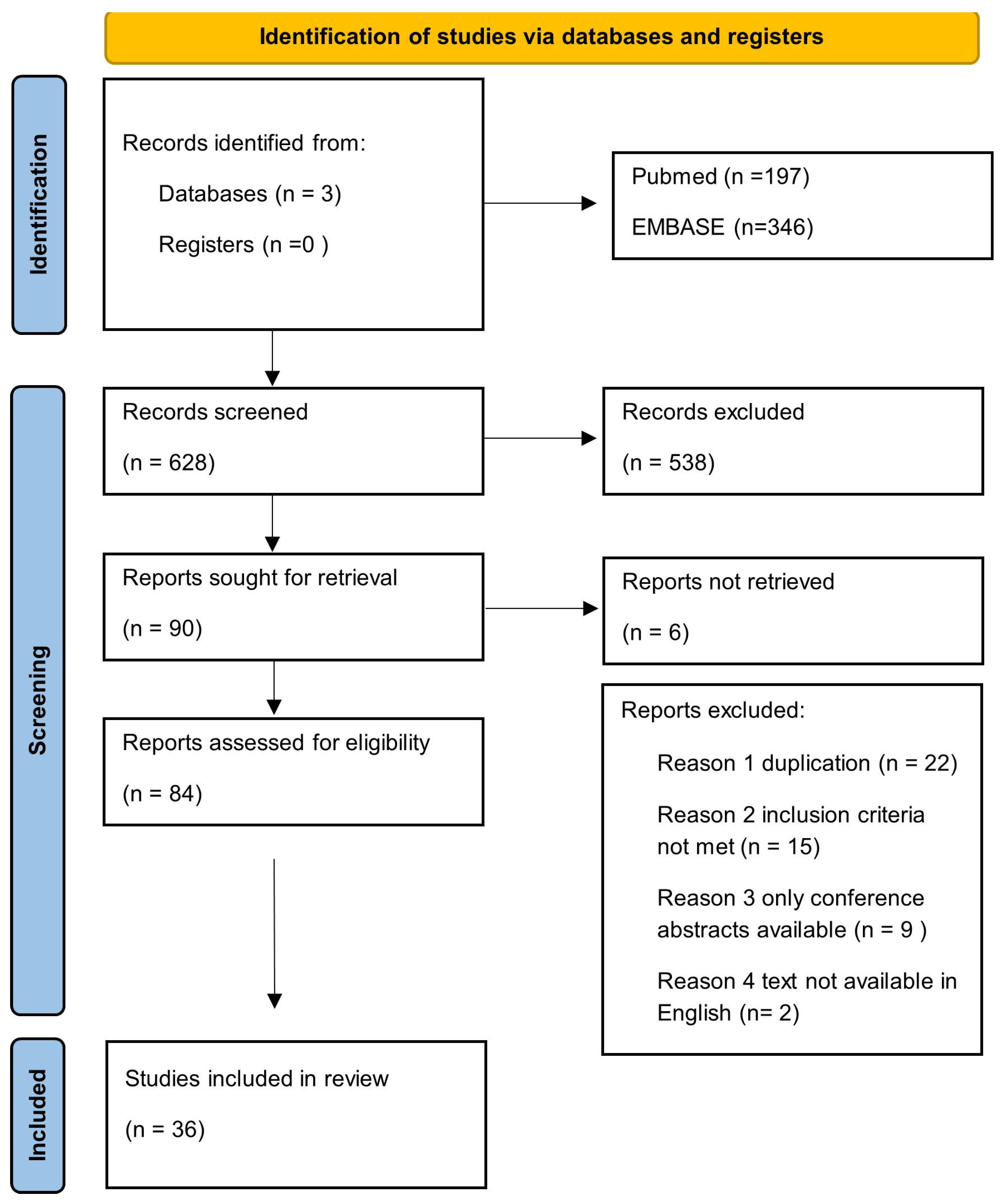
3.1. PRISMA Workflow Chart
3.2. General Information
3.2.1. Alcohol Induction Protocols
3.2.2. Probiotic Intervention
3.3. Impact of Probiotics on Alcohol-Induced Liver Injury
3.3.1. Liver Injury Markers
3.3.2. Histopathological Findings
3.3.3. Effects on Oxidative Stress and Antioxidant Enzymes
3.3.4. Modulation of Inflammatory Pathways
3.4. Probiotic Efficacy in Mitigating Alcohol-Induced Hepatic Steatosis
3.4.1. Histopathological Assessment of Steatosis
3.4.2. Modulation of Systemic and Hepatic Lipid Content
3.5. Effects on the Gut Barrier and Endotoxemia
Gut Barrier
3.6. The Impact of Alcohol on the Gut Microbiota
3.7. The Effects of Probiotic Intervention on the Gut Microbiota
3.8. Risk of Bias Analysis
4. Discussion
5. Conclusions
Supplementary Materials
Author Contributions
Funding
Institutional Review Board Statement
Informed Consent Statement
Data Availability Statement
Conflicts of Interest
Abbreviations
| ALD | Alcohol-associated liver disease |
| ALT | Alanine aminotransferase |
| AST | Aspartate aminotransferase |
| CAT | Catalase |
| CFU | Colony-forming units |
| GSH | Glutathione |
| HDL-C | High-density lipoprotein cholesterol |
| IL-1β | Interleukin 1 beta |
| IL-6 | Interleukin 6 |
| IL-10 | Interleukin 10 |
| LDL-C | Low-density lipoprotein cholesterol |
| LPS | Lipopolysaccharide |
| MDA | Malondialdehyde |
| mRNA | Messenger ribonucleic acid |
| Muc2 | Mucin 2 |
| NF-κB | Nuclear factor kappa B |
| SOD | Superoxide dismutase |
| TC | Total cholesterol |
| TG | Triglycerides |
| TNF-α | Tumor necrosis factor alpha |
| ZO-1 | Zonula occludens-1 |
References
- Asrani, S.K.; Devarbhavi, H.; Eaton, J.; Kamath, P.S. Burden of liver diseases in the world. J. Hepatol. 2019, 70, 151–171. [Google Scholar] [CrossRef]
- Danpanichkul, P.; Díaz, L.A.; Suparan, K.; Tothanarungroj, P.; Sirimangklanurak, S.; Auttapracha, T.; Blaney, H.L.; Sukphutanan, B.; Pang, Y.; Kongarin, S.; et al. Global epidemiology of alcohol-related liver disease, liver cancer, and alcohol use disorder, 2000–2021. Clin. Mol. Hepatol. 2025, 31, 525–547. [Google Scholar] [CrossRef]
- Alvarado-Tapias, E.; Pose, E.; Gratacós-Ginès, J.; Clemente-Sánchez, A.; López-Pelayo, H.H.; Bataller, R. Alcohol-associated liver disease: Natural history, management and novel targeted therapies. Clin. Mol. Hepatol. 2025, 31, S112–S133. [Google Scholar] [CrossRef]
- Jophlin, L.L.; Singal, A.K.; Bataller, R.; Wong, R.J.; Sauer, B.G.; Terrault, N.A.; Shah, V.H. ACG Clinical Guideline: Alcohol-Associated Liver Disease. Am. J. Gastroenterol. 2024, 119, 30–54. [Google Scholar] [CrossRef]
- Milosevic, I.; Vujovic, A.; Barac, A.; Djelic, M.; Korac, M.; Radovanovic Spurnic, A.; Gmizic, I.; Stevanovic, O.; Djordjevic, V.; Lekic, N.; et al. Gut-Liver Axis, Gut Microbiota, and Its Modulation in the Management of Liver Diseases: A Review of the Literature. Int. J. Mol. Sci. 2019, 20, 395. [Google Scholar] [CrossRef]
- Scarpellini, E.; Forlino, M.; Lupo, M.; Rasetti, C.; Fava, G.; Abenavoli, L.; Adriano, D. Gut Microbiota and Alcoholic Liver Disease. Rev. Recent Clin. Trials 2016, 11, 213–219. [Google Scholar] [CrossRef]
- Sosnowski, K.; Przybyłkowski, A. Ethanol-induced changes to the gut microbiome compromise the intestinal homeostasis: A review. Gut Microbes 2024, 16, 2393272. [Google Scholar] [CrossRef]
- Szabo, G. Gut-liver axis in alcoholic liver disease. Gastroenterology 2015, 148, 30–36. [Google Scholar] [CrossRef]
- Li, F.; Duan, K.; Wang, C.; Mcclain, C.; Feng, W. Probiotics and Alcoholic Liver Disease: Treatment and Potential Mechanisms. Gastroenterol. Res. Pract. 2016, 2016, 5491465. [Google Scholar] [CrossRef]
- Liu, J.; Yang, D.; Wang, X.; Asare, P.T.; Zhang, Q.; Na, L.; Shao, L. Gut Microbiota Targeted Approach in the Management of Chronic Liver Diseases. Front. Cell. Infect. Microbiol. 2022, 12, 774335. [Google Scholar] [CrossRef]
- Xiong, S.-Y.; Wu, G.-S.; Li, C.; Ma, W.; Luo, H.-R. Clinical efficacy of probiotics in the treatment of alcoholic liver disease: A systematic review and meta-analysis. Front. Cell. Infect. Microbiol. 2024, 14, 1358063. [Google Scholar] [CrossRef]
- Saadh, M.J.; Sabah Ghnim, Z.; Salih Mahdi, M.; Arora, V.; Rekha, M.M.; Sharma, A.; Juneja, B.; Aminov, Z.; Taher, W.M.; Alwan, M.; et al. Effects of probiotics on liver function, inflammation, and gut microbiota in alcoholic liver injury: A systematic review and meta-analysis. Front. Nutr. 2025, 12, 1717393. [Google Scholar] [CrossRef]
- Hooijmans, C.R.; Rovers, M.M.; de Vries, R.B.M.; Leenaars, M.; Ritskes-Hoitinga, M.; Langendam, M.W. SYRCLE’s risk of bias tool for animal studies. BMC Med. Res. Methodol. 2014, 14, 43. [Google Scholar] [CrossRef]
- Yang, Z.; Lian, J.; Yang, Y.; Li, J.; Guo, W.; Lv, X.; Ni, L.; Chen, Y. Selenium enrichment enhances the alleviating effect of Lactobacillus rhamnosus GG on alcoholic liver injury in mice. Curr. Res. Food Sci. 2025, 10, 100964. [Google Scholar] [CrossRef]
- Yi, H.-W.; Zhu, X.-X.; Huang, X.-L.; Lai, Y.-Z.; Tang, Y. Selenium-enriched Bifidobacterium longum protected alcohol and high fat diet induced hepatic injury in mice. Chin. J. Nat. Med. 2020, 18, 169–177. [Google Scholar] [CrossRef]
- Zhu, Y.; Pan, Y.; Wang, X.; Wei, L.; Zhu, L.; Guo, Y.; Jin, H.; Gu, Y.; Wang, Y.; Chen, Y.; et al. Lactobacillus rhamnosus GG Combined with Metformin Alleviates Alcohol-Induced Liver Inflammation in Mice by Maintaining the Intestinal Barrier and Regulating Treg/Th1 Cells. J. Med. Food 2025, 28, 354–365. [Google Scholar] [CrossRef]
- Ding, Q.; Cao, F.; Lai, S.; Zhuge, H.; Chang, K.; Valencak, T.G.; Liu, J.; Li, S.; Ren, D. Lactobacillus plantarum ZY08 relieves chronic alcohol-induced hepatic steatosis and liver injury in mice via restoring intestinal flora homeostasis. Food Res. Int. 2022, 157, 111259. [Google Scholar] [CrossRef]
- He, Q.; Yang, C.; Kang, X.; Chen, Y.; Zhang, T.; Zhang, H.; Kwok, L.-Y. Intake of Bifidobacterium lactis Probio-M8 fermented milk protects against alcoholic liver disease. J. Dairy Sci. 2022, 105, 2908–2921. [Google Scholar] [CrossRef]
- Huang, H.; Lin, Z.; Zeng, Y.; Lin, X.; Zhang, Y. Probiotic and glutamine treatments attenuate alcoholic liver disease in a rat model. Exp. Ther. Med. 2019, 18, 4733–4739. [Google Scholar] [CrossRef]
- Hong, M.; Kim, S.W.; Han, S.H.; Kim, D.J.; Suk, K.T.; Kim, Y.S.; Kim, M.J.; Kim, M.Y.; Baik, S.K.; Ham, Y.L. Probiotics (Lactobacillus rhamnosus R0011 and acidophilus R0052) reduce the expression of toll-like receptor 4 in mice with alcoholic liver disease. PLoS ONE 2015, 10, e0117451. [Google Scholar] [CrossRef]
- Li, H.; Shi, J.; Zhao, L.; Guan, J.; Liu, F.; Huo, G.; Li, B. Lactobacillus plantarum KLDS1.0344 and Lactobacillus acidophilus KLDS1.0901 Mixture Prevents Chronic Alcoholic Liver Injury in Mice by Protecting the Intestinal Barrier and Regulating Gut Microbiota and Liver-Related Pathways. J. Agric. Food Chem. 2021, 69, 183–197. [Google Scholar] [CrossRef]
- Roychowdhury, S.; Glueck, B.; Han, Y.; Mohammad, M.A.; Cresci, G.A.M. A Designer Synbiotic Attenuates Chronic-Binge Ethanol-Induced Gut-Liver Injury in Mice. Nutrients 2019, 11, 97. [Google Scholar] [CrossRef]
- Chang, B.; Sang, L.; Wang, Y.; Tong, J.; Zhang, D.; Wang, B. The protective effect of VSL#3 on intestinal permeability in a rat model of alcoholic intestinal injury. BMC Gastroenterol. 2013, 13, 151. [Google Scholar] [CrossRef]
- Zhu, Y.; Wang, X.; Zhu, L.; Tu, Y.; Chen, W.; Gong, L.; Pan, T.; Lin, H.; Lin, J.; Sun, H.; et al. Lactobacillus rhamnosus GG combined with inosine ameliorates alcohol-induced liver injury through regulation of intestinal barrier and Treg/Th1 cells. Toxicol. Appl. Pharmacol. 2022, 439, 115923. [Google Scholar] [CrossRef]
- Liu, H.; Kang, X.; Yang, X.; Yang, H.; Kuang, X.; Ren, P.; Yan, H.; Shen, X.; Kang, Y.; Li, L.; et al. Compound Probiotic Ameliorates Acute Alcoholic Liver Disease in Mice by Modulating Gut Microbiota and Maintaining Intestinal Barrier. Probiotics Antimicrob. Proteins 2023, 15, 185–201. [Google Scholar] [CrossRef]
- Lu, J.; Zhu, X.; Zhang, C.; Lu, F.; Lu, Z.; Lu, Y. Co-expression of alcohol dehydrogenase and aldehyde dehydrogenase in Bacillus subtilis for alcohol detoxification. Food Chem. Toxicol. 2020, 135, 110890. [Google Scholar] [CrossRef]
- Bruch-Bertani, J.P.; Uribe-Cruz, C.; Pasqualotto, A.; Longo, L.; Ayres, R.; Beskow, C.B.; Barth, A.L.; Lima-Morales, D.; Meurer, F.; Guerreiro, G.T.S.; et al. Hepatoprotective Effect of Probiotic Lactobacillus rhamnosus GG Through the Modulation of Gut Permeability and Inflammasomes in a Model of Alcoholic Liver Disease in Zebrafish. J. Am. Coll. Nutr. 2020, 39, 163–170. [Google Scholar] [CrossRef]
- Gao, Y.; Zhang, P.; Wei, Y.; Ye, C.; Mao, D.; Xia, D.; Luo, Y. Porphyromonas gingivalis exacerbates alcoholic liver disease by altering gut microbiota composition and host immune response in mice. J. Clin. Periodontol. 2023, 50, 1253–1263. [Google Scholar] [CrossRef]
- Wen, X.; Wang, Z.; Liu, Q.; Lessing, D.J.; Chu, W. Acetobacter pasteurianus BP2201 alleviates alcohol-induced hepatic and neuro-toxicity and modulate gut microbiota in mice. Microb. Biotechnol. 2023, 16, 1834–1857. [Google Scholar] [CrossRef]
- Fang, C.; Cheng, J.; Jia, W.; Xu, Y. Akkermansia muciniphila Ameliorates Alcoholic Liver Disease in Experimental Mice by Regulating Serum Metabolism and Improving Gut Dysbiosis. Metabolites 2023, 13, 1057. [Google Scholar] [CrossRef] [PubMed]
- Gan, Y.; Chen, X.; Yi, R.; Zhao, X. Antioxidative and Anti-Inflammatory Effects of Lactobacillus plantarum ZS62 on Alcohol-Induced Subacute Hepatic Damage. Oxid. Med. Cell. Longev. 2021, 2021, 7337988. [Google Scholar] [CrossRef] [PubMed]
- Liu, Z.; Liu, T.; Zhang, Z.; Fan, Y. Bacillus coagulans regulates gut microbiota and ameliorates the alcoholic-associated liver disease in mice. Front. Microbiol. 2024, 15, 1337185. [Google Scholar] [CrossRef]
- Tian, X.; Li, R.; Jiang, Y.; Zhao, F.; Yu, Z.; Wang, Y.; Dong, Z.; Liu, P.; Li, X. Bifidobacterium breve ATCC15700 pretreatment prevents alcoholic liver disease through modulating gut microbiota in mice exposed to chronic alcohol intake. J. Funct. Foods 2020, 72, 104045. [Google Scholar] [CrossRef]
- Zhao, M.; Chen, C.; Yuan, Z.; Li, W.; Zhang, M.; Cui, N.; Duan, Y.; Zhang, X.; Zhang, P. Dietary Bacillus subtilis supplementation alleviates alcohol-induced liver injury by maintaining intestinal integrity and gut microbiota homeostasis in mice. Exp. Ther. Med. 2021, 22, 1312. [Google Scholar] [CrossRef]
- Arora, S.; Kaur, I.P.; Chopra, K.; Rishi, P. Efficiency of double layered microencapsulated probiotic to modulate proinflammatory molecular markers for the management of alcoholic liver disease. Mediat. Inflamm. 2014, 2014, 715130. [Google Scholar] [CrossRef]
- Nam, Y.; Kim, J.-H.; Konkit, M.; Kim, W. Hepatoprotective effects of Lactococcus chungangensis CAU 1447 in alcoholic liver disease. J. Dairy Sci. 2019, 102, 10737–10747. [Google Scholar] [CrossRef]
- Lin, D.; Jiang, X.; Zhao, Y.; Zhai, X.; Yang, X. Komagataeibacter hansenii CGMCC 3917 alleviates alcohol-induced liver injury by regulating fatty acid metabolism and intestinal microbiota diversity in mice. Food Funct. 2020, 11, 4591–4604. [Google Scholar] [CrossRef]
- Lv, J.; Lang, G.; Wang, Q.; Zhao, W.; Shi, D.; Zhou, Z.; Shen, Y.; Xia, H.; Han, S.; Li, L. Lactobacillus helveticus attenuates alcoholic liver injury via regulation of gut microecology in mice. Microb. Biotechnol. 2024, 17, e70016. [Google Scholar] [CrossRef]
- Gu, J.; Chen, Y.; Wang, J.; Gao, Y.; Gai, Z.; Zhao, Y.; Xu, F. Lacticaseibacillus rhamnosus LRa05 alleviated liver injury in mice with alcoholic fatty liver disease by improving intestinal permeability and balancing gut microbiota. Benef. Microbes 2024, 15, 481–493. [Google Scholar] [CrossRef]
- Li, H.; Cheng, S.; Huo, J.; Dong, K.; Ding, Y.; Man, C.; Zhang, Y.; Jiang, Y. Lactobacillus plantarum J26 Alleviating Alcohol-Induced Liver Inflammation by Maintaining the Intestinal Barrier and Regulating MAPK Signaling Pathways. Nutrients 2022, 15, 190. [Google Scholar] [CrossRef] [PubMed]
- Li, H.; Cheng, S.; Wang, Y.; Sun, Y.; Zhang, J.; Sun, M.; Man, C.; Zhang, Y.; Jiang, Y. Lactobacillus plantarum J26 alleviates alcohol-induced oxidative liver injury by regulating the Nrf2 signaling pathway. Food Sci. Hum. Wellness 2024, 13, 2068–2078. [Google Scholar] [CrossRef]
- Zhang, Z.; Zhou, H.; Bai, L.; Lv, Y.; Yi, H.; Zhang, L.; Li, R. Protective effects of probiotics on acute alcohol-induced liver injury in mice through alcohol metabolizing enzymes activation and hepatic TNF-α response reduction. J. Funct. Foods 2019, 59, 234–241. [Google Scholar] [CrossRef]
- Tian, F.; Chi, F.; Wang, G.; Liu, X.; Zhang, Q.; Chen, Y.; Zhang, H.; Chen, W. Lactobacillus rhamnosus CCFM1107 treatment ameliorates alcohol-induced liver injury in a mouse model of chronic alcohol feeding. J. Microbiol. 2015, 53, 856–863. [Google Scholar] [CrossRef] [PubMed]
- Wang, Y.; Kirpich, I.; Liu, Y.; Ma, Z.; Barve, S.; McClain, C.J.; Feng, W. Lactobacillus rhamnosus GG treatment potentiates intestinal hypoxia-inducible factor, promotes intestinal integrity and ameliorates alcohol-induced liver injury. Am. J. Pathol. 2011, 179, 2866–2875. [Google Scholar] [CrossRef]
- Gu, Z.; Wu, Y.; Wang, Y.; Sun, H.; You, Y.; Piao, C.; Liu, J.; Wang, Y. Lactobacillus rhamnosus Granules Dose-Dependently Balance Intestinal Microbiome Disorders and Ameliorate Chronic Alcohol-Induced Liver Injury. J. Med. Food 2020, 23, 114–124. [Google Scholar] [CrossRef]
- Liu, H.; Fan, D.; Wang, J.; Wang, Y.; Li, A.; Wu, S.; Zhang, B.; Liu, J.; Wang, S. Lactobacillus rhamnosus NKU FL1-8 Isolated from Infant Feces Ameliorates the Alcoholic Liver Damage by Regulating the Gut Microbiota and Intestinal Barrier in C57BL/6J Mice. Nutrients 2024, 16, 2139. [Google Scholar] [CrossRef]
- Jung, H.; You, S.; Choi, S.-I.; Kang, C.-H.; Kim, G.-H. Levilactobacillus brevis MG5311 Alleviates Ethanol-Induced Liver Injury by Suppressing Hepatic Oxidative Stress in C57BL/6 Mice. Microorganisms 2022, 10, 2488. [Google Scholar] [CrossRef]
- Zheng, T.-X.; Pu, S.-L.; Tan, P.; Du, Y.-C.; Qian, B.-L.; Chen, H.; Fu, W.-G.; Huang, M.-Z. Liver Metabolomics Reveals the Effect of Lactobacillus reuteri on Alcoholic Liver Disease. Front. Physiol. 2020, 11, 595382. [Google Scholar] [CrossRef]
- Bull-Otterson, L.; Feng, W.; Kirpich, I.; Wang, Y.; Qin, X.; Liu, Y.; Gobejishvili, L.; Joshi-Barve, S.; Ayvaz, T.; Petrosino, J.; et al. Metagenomic Analyses of Alcohol Induced Pathogenic Alterations in the Intestinal Microbiome and the Effect of Lactobacillus rhamnosus GG Treatment. PLoS ONE 2013, 8, e53028. [Google Scholar] [CrossRef]
- Jiang, X.-W.; Li, Y.-T.; Ye, J.-Z.; Lv, L.-X.; Yang, L.-Y.; Bian, X.-Y.; Wu, W.-R.; Wu, J.-J.; Shi, D.; Wang, Q.; et al. New strain of Pediococcus pentosaceus alleviates ethanol-induced liver injury by modulating the gut microbiota and short-chain fatty acid metabolism. World J. Gastroenterol. 2020, 26, 6224–6240. [Google Scholar] [CrossRef]
- Fang, T.J.; Guo, J.-T.; Lin, M.-K.; Lee, M.-S.; Chen, Y.-L.; Lin, W.-H. Protective effects of Lactobacillus plantarum against chronic alcohol-induced liver injury in the murine model. Appl. Microbiol. Biotechnol. 2019, 103, 8597–8608. [Google Scholar] [CrossRef] [PubMed]
- Wei, L.; Pan, Y.; Guo, Y.; Zhu, Y.; Jin, H.; Gu, Y.; Li, C.; Wang, Y.; Lin, J.; Chen, Y.; et al. Symbiotic combination of Akkermansia muciniphila and inosine alleviates alcohol-induced liver injury by modulating gut dysbiosis and immune responses. Front. Microbiol. 2024, 15, 1355225. [Google Scholar] [CrossRef] [PubMed]
- Singh, A.K.; Pandey, S.K.; Naresh Kumar, G. Pyrroloquinoline quinone-secreting probiotic Escherichia coli Nissle 1917 ameliorates ethanol-induced oxidative damage and hyperlipidemia in rats. Alcohol. Clin. Exp. Res. 2014, 38, 2127–2137. [Google Scholar] [CrossRef] [PubMed]
- Sangineto, M.; Grander, C.; Grabherr, F.; Mayr, L.; Enrich, B.; Schwärzler, J.; Dallio, M.; Bukke, V.N.; Moola, A.; Moschetta, A.; et al. Recovery of Bacteroides thetaiotaomicron ameliorates hepatic steatosis in experimental alcohol-related liver disease. Gut Microbes 2022, 14, 2089006. [Google Scholar] [CrossRef]
- Liang, X.; Shan, T.; Zheng, X.; Zhang, Z.; Fan, Y.; Zhang, H.; Zhang, L.; Liang, H. Study on the Regulatory Mechanism of Niacin Combined with B. animalis F1-7 in Alleviating Alcoholic Fatty Liver Disease by Up-Regulating GPR109A. Nutrients 2024, 16, 4170. [Google Scholar] [CrossRef]
- Ge, Y.; Sun, H.; Xu, L.; Zhang, W.; Lv, J.; Chen, Y. The amelioration of alcohol-induced liver and intestinal barrier injury by Lactobacillus rhamnosus Gorbach-Goldin (LGG) is dependent on Interleukin 22 (IL-22) expression. Bioengineered 2022, 13, 12650–12660. [Google Scholar] [CrossRef]
- Li, X.; Wang, Y.; Zhang, J.; Lu, G.; You, Y.; Wang, Y.; Sun, H.; Nan, B.; Wang, Y. The effect of Lactobacillus rhamnosus B10on alcoholic liver injury and intestinal microbiota in alcohol-induced mice model. J. Food Biochem. 2022, 46, e14372. [Google Scholar] [CrossRef]
- Lee, S.-J.; Yang, J.; Keum, G.B.; Kwak, J.; Doo, H.; Choi, S.; Park, D.-G.; Kim, C.-H.; Kim, H.B.; Lee, J.-H. Therapeutic Potential of Lactiplantibacillus plantarum FB091 in Alleviating Alcohol-Induced Liver Disease through Gut-Liver Axis. J. Microbiol. Biotechnol. 2024, 34, 2100–2111. [Google Scholar] [CrossRef]
- Wang, Y.; Liu, Y.; Kirpich, I.; Ma, Z.; Wang, C.; Zhang, M.; Suttles, J.; McClain, C.; Feng, W. Lactobacillus rhamnosus GG reduces hepatic TNFα production and inflammation in chronic alcohol-induced liver injury. J. Nutr. Biochem. 2013, 24, 1609–1615. [Google Scholar] [CrossRef]
- Shi, X.; Wei, X.; Yin, X.; Wang, Y.; Zhang, M.; Zhao, C.; Zhao, H.; McClain, C.J.; Feng, W.; Zhang, X. Hepatic and fecal metabolomic analysis of the effects of Lactobacillus rhamnosus GG on alcoholic fatty liver disease in mice. J. Proteome Res. 2015, 14, 1174–1182. [Google Scholar] [CrossRef]
- Barone, R.; Rappa, F.; Macaluso, F.; Bavisotto, C.C.; Sangiorgi, C.; Di Paola, G.; Tomasello, G.; Di Felice, V.; Marcianò, V.; Farina, F.; et al. Alcoholic Liver Disease: A Mouse Model Reveals Protection by Lactobacillus fermentum. Clin. Transl. Gastroenterol. 2016, 7, e138. [Google Scholar] [CrossRef]
- Zhu, Y.; Zhang, X.; Huang, W.; Luo, M.; Feng, X.; Zhang, H.; Qi, Q. Protective Effect of Enterococcus faecium Against Alcohol-Induced Acute Liver Injury Via Extracellular Vesicles in Rats. Foodborne Pathog. Dis. 2025. Online ahead of print. [Google Scholar] [CrossRef]
- Niu, B.; Huang, L.; Cheng, X.; Pei, Z.; Wang, H.; Tian, F.; Lu, W. Lacticaseibacillus rhamnosus CCFM1060 Modulates gut microbiota and intestinal barrier Function: Alcoholic liver disease Mitigation through Nrf2/HO-1 and NF-κB Pathways. J. Funct. Foods 2024, 122, 106516. [Google Scholar] [CrossRef]
- Forsyth, C.B.; Farhadi, A.; Jakate, S.M.; Tang, Y.; Shaikh, M.; Keshavarzian, A. Lactobacillus GG treatment ameliorates alcohol-induced intestinal oxidative stress, gut leakiness, and liver injury in a rat model of alcoholic steatohepatitis. Alcohol 2009, 43, 163–172. [Google Scholar] [CrossRef]
- Litwinowicz, K.; Choroszy, M.; Waszczuk, E. Changes in the composition of the human intestinal microbiome in alcohol use disorder: A systematic review. Am. J. Drug Alcohol Abuse 2020, 46, 4–12. [Google Scholar] [CrossRef]
- An, L.; Wirth, U.; Koch, D.; Schirren, M.; Drefs, M.; Koliogiannis, D.; Nieß, H.; Andrassy, J.; Guba, M.; Bazhin, A.V.; et al. The Role of Gut-Derived Lipopolysaccharides and the Intestinal Barrier in Fatty Liver Diseases. J. Gastrointest. Surg. 2022, 26, 671–683. [Google Scholar] [CrossRef]
- Kawaratani, H.; Tsujimoto, T.; Douhara, A.; Takaya, H.; Moriya, K.; Namisaki, T.; Noguchi, R.; Yoshiji, H.; Fujimoto, M.; Fukui, H. The effect of inflammatory cytokines in alcoholic liver disease. Mediat. Inflamm. 2013, 2013, 495156. [Google Scholar] [CrossRef]
- Gao, B.; Bataller, R. Alcoholic liver disease: Pathogenesis and new therapeutic targets. Gastroenterology 2011, 141, 1572–1585. [Google Scholar] [CrossRef]
- Jeon, S.; Carr, R. Alcohol effects on hepatic lipid metabolism. J. Lipid Res. 2020, 61, 470–479. [Google Scholar] [CrossRef]


| Parameter | Acetobacter pasteurianus BP2201, Wen et al., 2023 [29] | Akkermansia municiphila, Fang et al., 2023 [30] | Lactobacillus fermentum, Barone et al., 2016 [61] | Lactobacillus plantarum ZS62, Gan et al., 2021 [31] | Bacillus coagulans BC01, Liu et al., 2024 [32] | Bifidobacterium breve ATCC15700, Tian et al., 2020 [33] | Bacillus subtilis (CMCC 1.3358), Zhao et al., 2021 [34] | Lactobacillus plantarum (MTCC 1325), Arora et al., 2014 [35] | Lactobacillus rhamnosus GG, Shi et al., 2015 [60] | Lactococcus chungangensis CAU 1447, Nam et al., 2019 [36] | Komagataeibacter hansenii CGMCC 3917, Lin et al., 2020 [37] | Lacticaseibacillus rhamnosus CCFM1060, Niu et al., 2024 [63] | Lacticaseibacillus rhamnosus LRa05., Gu et al., 2024 [39] | Lactobacillus GG, Forsyth et al., 2009 [64] | Lactobacillus helveticus (and Others), Lv et al., 2024 [38] | Lactobacillus plantarum J26, Li et al., 2024 [41] | Lactobacillus plantarum J26, Li et al., 2022 [40] | Bifidobacterium bifidum YRT3115, Zhang et al., 2019 [42] | ||||||||||||||||||||||||
|---|---|---|---|---|---|---|---|---|---|---|---|---|---|---|---|---|---|---|---|---|---|---|---|---|---|---|---|---|---|---|---|---|---|---|---|---|---|---|---|---|---|---|
| Alcohol | Probiotic | Alcohol | Probiotic | Alcohol | Probiotic | Alcohol | Probiotic | Alcohol | Probiotic | Alcohol | Probiotic | Alcohol | Probiotic | Alcohol | Probiotic | Alcohol | Probiotic | Alcohol | Probiotic | Alcohol | Probiotic | Alcohol | Probiotic | Alcohol | Probiotic | Alcohol | Probiotic | Alcohol | Lactobacillus helveticus | Lactobacillus casei | Lactobacillus paracasei | Lactobacillus sakei | Lactobacillus delbrueckii | Alcohol | Probiotic | Alcohol | Probiotic | Alcohol | B. bifidum | B. animalis subsp. Lactis | ||
| ALT | ↑ | ↓ | ↑ | ↓ | ↑ | ↓ | ↑ | ↓ | ↑ | ↓ | ↑ | ↓ | ↑ | ↓ | ↑ | ↓ | n.d. | n.d. | ↑ | ↓ | ↑ | ↓ | ↑ | ↓ | ↑ | ↓ | n.d. | n.d. | ↑ | ↓ | ↓ | ↔ | ↓ | ↓ | n.d. | n.d. | ↑ | ↓ | ↑ | ↔ | ↓ | |
| AST | ↑ | ↓ | ↑ | ↓ | ↑ | ↓ | ↑ | ↓ | ↑ | ↓ | ↑ | ↓ | ↑ | ↓ | ↑ | ↓ | n.d. | n.d. | ↑ | ↓ | ↑ | ↓ | ↑ | ↓ | ↑ | ↓ | n.d. | n.d. | ↑ | ↓ | ↓ | ↔ | ↓ | ↓ | n.d. | n.d. | ↑ | ↓ | ↑ | ↔ | ↓ | |
| Hepatocellular damage and inflammation | ↑ | ↓ | ↑ | ↓ | ↔ | ↔ | ↑ | ↓ | n.d. | n.d. | ↑ | ↓ | ↑ | ↓ | ↑ | ↓ | n.d. | n.d. | ↑ | ↓ | ↑ | ↓ | ↑ | ↓ | ↑ | ↓ | ↑ | ↓ | ↑ | ↓ | ↓ | ↓ | ↓ | ↓ | ↑ | ↓ | ↑ | ↓ | n.d. | n.d. | n.d. | |
| Lactobacillus rhamnosus GG, Wang et al., 2013 [59] | Lactobacillus rhamnosus GG, Wang et al. 2011 [44] | Lactobacillus rhamnosus GG (ATCC 53103), Gu et al., 2020 [45] | Lactobacillus rhamnosus NKU FL1-8, Liu et al. 2024 [46] | Levilactobacillus brevis MG5311, Jung et al., 2022 [47] | Lactobacillus reuteri, Zheng et al. 2020 [48] | Lactobacillus rhamnosus GG, Bull-Otterson et al., 2013 [49] | Pediococcus pentosaceus CGMCC 7049, Jiang et al. 2020 [50] | Lactobacillus plantarum CMU995 (DSM 23780), Fang et al., 2019 [51] | Lactobacillus rhamnosus CCFM1107 Tian et al., 2015 [43] | Escherichia coli Nissle 1917 (EcN), Singh et al., 2014 [53] | Bacteroides thetaiotaomicron DSM 2079, Sangineto et al., 2022 [54] | Bifidobacterium animalis F1-7, Liang et al. 2024 [55] | Lactobacillus rhamnosus GG, Ge et al. 2022 [56] | Lactobacillus rhamnosus B10, Li et al., 2022 [57] | Lactobacillus plantarum FB091, Lee et al. 2024 [58] | Akkermansia muciniphila, ATCC, Wei et al. 2024 [52] | Lactobacillus rhamnosus GG, Wang et al., 2013 [59] | |||||||||||||||||||||||||
| Alcohol | Probiotic | Alcohol | Probiotic | Alcohol | Low dose | Medium dose | High dose | Alcohol | Probiotic | Alcohol | Probiotic | Alcohol | Probiotic | Alcohol | Probiotic | Alcohol | Probiotic | Alcohol | Probiotic | Alcohol | Lactobacillus rhamnosus CCFM1107 | Lactobacillus plantarum CCFM1112 | Lactobacillus rhamnosus GG | Alcohol | EcN-2 | EcN-3 | EcN-4 | Alcohol | Probiotic | Alcohol | Probiotic | Alcohol | Probiotic | Alcohol | Probiotic | Alcohol | Probiotic | Alcohol | Probiotic | Alcohol | Probiotic | |
| ALT | n.d. | n.d. | ↑ | ↓ | ↑ | ↓ | ↓ | ↓ | ↑ | ↓ | ↑ | ↓ | ↑ | ↓ | ↑ | ↓ | ↑ | ↓ | ↑ | ↓ | ↑ | ↓ | ↔ | ↔ | n.d. | n.d. | n.d. | n.d. | ↑ | ↔ | ↑ | ↓ | ↑ | ↓ | ↑ | ↓ | ↑ | ↓ | ↑ | ↓ | ↑ | ↓ |
| AST | n.d. | n.d. | n.d. | n.d. | ↑ | ↓ | ↓ | ↓ | ↑ | ↓ | ↑ | ↓ | ↑ | ↓ | ↑ | ↓ | ↑ | ↓ | ↑ | ↓ | ↑ | ↓ | ↔ | ↓ | n.d. | n.d. | n.d. | n.d. | n.d. | n.d. | ↑ | ↓ | ↑ | ↓ | ↑ | ↓ | ↑ | ↓ | ↑ | ↓ | ↑ | ↑ |
| Hepatocellular damage and inflammation | ↑ | ↓ | ↑ | ↓ | ↑ | ↓ | ↓ | ↓ | ↑ | ↓ | ↑ | ↓ | ↑ | ↓ | ↑ | ↓ | ↑ | ↓ | ↑ | ↓ | ↑ | ↓ | ↔ | ↓ | ↑ | n.d. | ↔ | ↓ | n.d. | n.d. | ↑ | ↓ | ↑ | ↓ | n.d. | n.d. | ↑ | ↓ | ↑ | ↓ | ↑ | ↓ |
| Parameter | Acetobacter pasteurianus BP2201, Wen et al., 2023 [29] | Lactobacillus plantarum ZS62, Gan et al., 2021 [31] | Bifidobacterium breve ATCC15700, Tian et al., 2020 [33] | Bacillus subtilis (CMCC 1.3358), Zhao et al., 2021 [34] | Lactococcus chungangensis CAU 1447, Nam et al., 2019 [36] | Komagataeibacter hansenii CGMCC 3917, Lin et al., 2020 [37] | Lacticaseibacillus rhamnosus CCFM1060, Niu et al., 2024 [63] | Lacticaseibacillus rhamnosus LRa05., Gu et al., 2024 [39] | Lactobacillus plantarum J26, Li et al., 2024 [41] | Lactobacillus plantarum J26, Li et al., 2022 [40] | Lactobacillus rhamnosus CCFM1107 Tian et al., 2015 [43] | Lactobacillus rhamnosus NKU FL1-8, Liu et al. 2024 [46] | Levilactobacillus brevis MG5311, Jung et al., 2022 [47] | Lactobacillus reuteri, Zheng et al. 2020 [48] | Escherichia coli Nissle 1917 (EcN), Singh et al., 2014 [53] | Bacteroides thetaiotaomicron DSM 2079, Sangineto et al., 2022 [54] | Bifidobacterium animalis F1-7, Liang et al. 2024 [55] | Lactobacillus rhamnosus B10, Li et al., 2022 [57] | ||||||||||||||||||||||
|---|---|---|---|---|---|---|---|---|---|---|---|---|---|---|---|---|---|---|---|---|---|---|---|---|---|---|---|---|---|---|---|---|---|---|---|---|---|---|---|---|
| Alcohol | Probiotic | Alcohol | Probiotic | Alcohol | Probiotic | Alcohol | Probiotic | Alcohol | Probiotic | Alcohol | Probiotic | Alcohol | Probiotic | Alcohol | Probiotic | Alcohol | Probiotic | Alcohol | Probiotic | Alcohol | L. rhamnosus CCFM1107 | L. plantarum CCFM1112 | L. rhamnosus GG | Alcohol | Probiotic | Alcohol | Probiotic | Alcohol | Probiotic | Alcohol | EcN-2 | EcN-3 | EcN-4 | Alcohol | Probiotic | Alcohol | Probiotic | Alcohol | Probiotic | |
| Serum TC | ↑ | ↓ | ↑ | ↓ | n.d. | n.d. | ↑ | ↓ | n.d. | n.d. | n.d. | n.d. | ↑ | ↓ | n.d. | n.d. | ↑ | ↓ | ↑ | ↓ | ↑ | ↓ | ↔ | ↓ | ↑ | ↓ | ↓ | ↑ | ↑ | ↓ | ↑ | ↔ | ↔ | ↓ | n.d. | n.d. | ↑ | ↓ | ↑ | ↓ |
| Serum TG | ↑ | ↓ | ↑ | ↓ | ↑ | ↓ | n.d. | n.d. | ↑ | ↓ | ↑ | ↓ | ↑ | ↓ | ↑ | ↓ | ↑ | ↓ | ↑ | ↓ | ↑ | ↓ | ↔ | ↓ | ↑ | ↓ | ↓ | ↑ | ↑ | ↓ | ↑ | ↔ | ↔ | ↓ | ↑ | ↓ | ↑ | ↓ | ↑ | ↓ |
| Parameter | Akkermansia municiphila, Fang et al., 2023 [30] | Bacillus coagulans BC01, Liu et al., 2024 [32] | Bacillus subtilis (CMCC 1.3358), Zhao et al., 2021 [34] | Lacticaseibacillus rhamnosus LRa05., Gu et al., 2024 [39] | Lactobacillus rhamnosus GG (ATCC 53103), Gu et al., 2020 [45] | Escherichia coli Nissle 1917 (EcN), Singh et al., 2014 [53] | Lactobacillus plantarum CMU995 (DSM 23780), Fang et al., 2019 [51] | Lactobacillus rhamnosus CCFM1107 Tian et al., 2015 [43] | Lactobacillus rhamnosus GG, Wang et al. 2011 [44] | Lactobacillus helveticus (and Others), Lv et al., 2024 [38] | Lactobacillus rhamnosus B10, Li et al., 2022 [57] | Bacteroides thetaiotaomicron DSM 2079, Sangineto et al., 2022 [54] | ||||||||||||||||||||||
|---|---|---|---|---|---|---|---|---|---|---|---|---|---|---|---|---|---|---|---|---|---|---|---|---|---|---|---|---|---|---|---|---|---|---|
| Alcohol | Probiotic | Alcohol | Probiotic | Alcohol | Probiotic | Alcohol | Probiotic | Alcohol | Low dose | Medium dose | High dose | Alcohol | EcN-2 | EcN-3 | EcN-4 | Alcohol | Probiotic | Alcohol | L. rhamnosus CCFM1107 | L. plantarum CCFM1112 | L. rhamnosus GG | Alcohol | Probiotic | Alcohol | L. helveticus | L. casei | L. paracasei | L. sakei | L. delbrueckii | Alcohol | Probiotic | Alcohol | Probiotic | |
| Hepatic TC | n.d. | n.d. | n.d. | n.d. | n.d. | n.d. | n.d. | n.d. | n.d. | n.d. | n.d. | n.d. | ↑ | ↔ | ↔ | ↓ | ↑ | ↓ | ↑ | ↓ | ↔ | ↓ | ↑ | ↓ | n.d. | n.d. | n.d. | n.d. | n.d. | n.d. | n.d. | n.d. | n.d. | n.d. |
| Hepatic TG | ↓ | ↑ | ↑ | ↓ | ↑ | ↓ | ↑ | ↓ | ↑ | ↓ | ↓ | ↓ | ↑ | ↔ | ↔ | ↓ | ↑ | ↓ | ↑ | ↓ | ↔ | ↓ | ↑ | ↓ | ↑ | ↓ | ↓ | ↔ | ↑ | ↑ | ↑ | ↓ | ↑ | ↓ |
| Parameter | Claudin-1 | Occludin | ZO-1 | Endotoxins | |
|---|---|---|---|---|---|
| Akkermansia municiphila, Fang et al., 2023 [30] | Alcohol | n.d. | ↓ | ↓ | n.d. |
| Probiotic | n.d. | ↑ | ↑ | n.d. | |
| Bacillus coagulans BC01, Liu et al., 2024 [32] | Alcohol | ↓ | ↓ | ↓ | ↑ |
| Probiotic | ↑ | ↑ | ↑ | ↓ | |
| Bifidobacterium breve ATCC15700, Tian et al., 2020 [33] | Alcohol | ↓ | ↓ | ↓ | ↑ |
| Probiotic | ↑ | ↑ | ↑ | ↓ | |
| Bacillus subtilis (CMCC 1.3358), Zhao et al., 2021 [34] | Alcohol | n.d. | ↓ | ↓ | ↑ |
| Probiotic | n.d. | ↑ | ↑ | ↓ | |
| Lactobacillus plantarum (MTCC 1325), Arora et al., 2014 [35] | Alcohol | n.d. | n.d. | n.d. | ↑ |
| Probiotic | n.d. | n.d. | n.d. | ↓ | |
| Komagataeibacter hansenii CGMCC 3917, Lin et al., 2020 [37] | Alcohol | n.d. | n.d. | n.d. | ↑ |
| Probiotic | n.d. | n.d. | n.d. | ↓ | |
| Lacticaseibacillus rhamnosus CCFM1060, Niu et al., 2024 [63] | Alcohol | ↓ | ↓ | ↓ | n.d. |
| Probiotic | ↑ | ↑ | ↑ | n.d. | |
| Lacticaseibacillus rhamnosus LRa05., Gu et al., 2024 [39] | Alcohol | n.d. | n.d. | n.d. | ↑ |
| Probiotic | n.d. | n.d. | n.d. | ↓ | |
| Lactobacillus GG, Forsyth et al., 2009 [64] | Alcohol | ↓ | ↓ | n.d. | n.d. |
| Probiotic | ↑ | ↑ | n.d. | n.d. | |
| Lactobacillus helveticus (and Others), Lv et al., 2024 [38] | Alcohol | ↓ | ↓ | n.d. | ↑ |
| Lactobacillus helveticus (LH, ATCC 15009) | ↑ | ↑ | n.d. | ↓ | |
| Lactobacillus casei (LC, ATCC 393) | n.d. | n.d. | n.d. | n.d. | |
| Lactobacillus paracasei (LP, ATCC 25302) | ↔ | ↔ | n.d. | ↓ | |
| Lactobacillus sakei (LS, ATCC 15521) | n.d. | n.d. | n.d. | n.d. | |
| Lactobacillus delbrueckii (LD, ATCC 9649) | n.d. | n.d. | n.d. | n.d. | |
| Lactobacillus plantarum J26, Li et al., 2024 [41] | Alcohol | n.d. | n.d. | n.d. | ↑ |
| Probiotic | n.d. | n.d. | n.d. | ↓ | |
| Lactobacillus plantarum J26, Li et al., 2022 [40] | Alcohol | ↓ | ↓ | ↓ | ↑ |
| Probiotic | ↑ | ↑ | ↑ | ↓ | |
| Lactobacillus rhamnosus CCFM1107 Tian et al., 2015 [43] | Alcohol | n.d. | n.d. | n.d. | ↑ |
| Lactobacillus rhamnosus CCFM1107 | n.d. | n.d. | n.d. | ↓ | |
| Lactobacillus plantarum CCFM1112 | n.d. | n.d. | n.d. | ↓ | |
| Lactobacillus rhamnosus GG | n.d. | n.d. | n.d. | ↓ | |
| Lactobacillus rhamnosus GG, Wang et al. 2011 [44] | Alcohol | ↓ | ↓ | ↓ | ↑ |
| Probiotic | ↑ | ↑ | ↑ | ↓ | |
| Lactobacillus rhamnosus GG (ATCC 53103), Gu et al., 2020 [45] | Alcohol | n.d. | n.d. | n.d. | ↑ |
| Low dose | n.d. | n.d. | n.d. | ↓ | |
| Medium dose | n.d. | n.d. | n.d. | ↓ | |
| High dose | n.d. | n.d. | n.d. | ↓ | |
| Lactobacillus rhamnosus NKU FL1-8, Liu et al. 2024 [46] | Alcohol | n.d. | ↓ | ↓ | ↑ |
| Probiotic | n.d. | ↑ | ↑ | ↓ | |
| Lactobacillus reuteri, Zheng et al. 2020 [48] | Alcohol | n.d. | ↔ | ↓ | ↑ |
| Probiotic | n.d. | ↔ | ↑ | ↓ | |
| Lactobacillus rhamnosus GG, Bull-Otterson et al., 2013 [49] | Alcohol | ↓ | ↓ | ↓ | ↑ |
| Probiotic | ↑ | ↑ | ↑ | ↓ | |
| Pediococcus pentosaceus CGMCC 7049, Jiang et al. 2020 [50] | Alcohol | n.d. | n.d. | ↓ | ↑ |
| Probiotic | n.d. | n.d. | ↑ | ↓ | |
| Lactobacillus plantarum CMU995 (DSM 23780), Fang et al., 2019 [51] | Alcohol | n.d. | n.d. | ↓ | ↑ |
| Probiotic | n.d. | n.d. | ↑ | ↓ | |
| Bacteroides thetaiotaomicron DSM 2079, Sangineto et al., 2022 [54] | Alcohol | ↓ | ↓ | ↓ | ↑ |
| Probiotic | ↑ | ↑ | ↑ | ↓ | |
| Bifidobacterium animalis F1-7, Liang et al. 2024 [55] | Alcohol | n.d. | n.d. | n.d. | ↑ |
| Probiotic | n.d. | n.d. | n.d. | ↓ | |
| Lactobacillus rhamnosus B10, Li et al., 2022 [57] | Alcohol | n.d. | n.d. | n.d. | ↑ |
| Probiotic | n.d. | n.d. | n.d. | ↓ | |
| Akkermansia muciniphila, ATCC, Wei et al. 2024 [52] | Alcohol | ↓ | ↓ | ↓ | ↑ |
| Probiotic | ↑ | ↑ | ↑ | ↓ |
| Study | Firmicutes | Bacteroidetes | Proteobacteria | |
|---|---|---|---|---|
| Acetobacter pasteurianus BP2201, Wen et al., 2023 [29] | Alcohol | ↑ | ↓ | ↑ |
| A. pasteurianus | ↔ | ↑ | ↓ | |
| Akkermansia municiphila, Fang et al., 2023 [30] | Alcohol | ↓ | ↓ | ↑ |
| A. muciniphila | ↑ | ↑ | ↓ | |
| Bacillus coagulans BC01, Liu et al., 2024 [32] | Alcohol | ↓ | ↓ | ↑ |
| B. coagulans | ↑ | ↑ | ↓ | |
| Bifidobacterium breve ATCC15700, Tian et al., 2020 [33] | Alcohol | ↑ | ↓ | ↔ |
| B. breve | ↓ | ↑ | ↓ | |
| Bacillus subtilis (CMCC 1.3358), Zhao et al., 2021 [34] | Alcohol | ↓ | ↔ | ↑ |
| B. subtlis | ↑ | ↔ | ↓ | |
| Komagataeibacter hansenii CGMCC 3917, Lin et al., 2020 [37] | Alcohol | ↑ | ↓ | ↑ |
| K. hansenii | ↓ | ↑ | ↓ | |
| Lacticaseibacillus rhamnosus LRa05., Gu et al., 2024 [39] | Alcohol | ↓ | ↓ | ↑ |
| L. rhamnosus LRa05 | ↑ | ↑ | ↓ * | |
| Lactobacillus helveticus (and others), Lv et al., 2024 [38] | Alcohol | ↑ | ↑ | ↓ |
| L. helveticus | ↔ | ↔ | ↔ | |
| L. casei | n.d. | n.d. | n.d. | |
| L. paracasei | ↓ | ↔ | ↓ | |
| L. sakei | n.d. | n.d. | n.d. | |
| L. delbrueckii | n.d. | n.d. | n.d. | |
| Lactobacillus plantarum J26, Li et al., 2022 [40] | Alcohol | ↓ | ↑ | ↑ |
| L. plantarum | ↑ | ↔ | ↓ | |
| Lactobacillus rhamnosus GG (ATCC 53103), Gu et al., 2020 [45] | Alcohol | ↓ | ↔ | ↑ |
| Low dose | ↑ | ↔ | ↓ | |
| Medium dose | ↔ | ↔ | ↑ | |
| High dose | ↑ | ↑ | ↓ | |
| Lactobacillus rhamnosus NKU FL1-8, Liu et al. 2024 [46] | Alcohol | ↔ | ↔ | ↑ |
| L. rhamnosus NKU FL1-8 | ↑ | ↑ | ↓ | |
| Lactobacillus rhamnosus GG, Bull-Otterson et al., 2013 [49] | Alcohol | ↓ | ↓ | ↑ |
| L. rhamnosus GG | ↑ | ↔ | ↓ | |
| Pediococcus pentosaceus CGMCC 7049, Jiang et al. 2020 [50] | Alcohol | ↑ | ↓ | ↔ |
| P. penosaceus | ↓ | ↑ | ↓ | |
| Bifidobacterium animalis F1-7, Liang et al. 2024 [55] | Alcohol | ↑ | ↑ | ↔ |
| B. animalis | ↔ | ↔ | ↔ | |
| Lactobacillus rhamnosus B10, Li et al., 2022 [57] | Alcohol | ↔ | n.d. | ↑ |
| L. rhamnosus B10 | ↑ | n.d. | ↓ | |
| Lactobacillus plantarum FB091, Lee et al. 2024 [58] | Alcohol | ↔ | ↔ | ↔ |
| L. plantarum FB091 | ↔ | ↔ | ↓ | |
| Akkermansia muciniphila, ATCC, Wei et al. 2024 [52] | Alcohol | ↑ | ↓ | ↑ |
| A. muciniphila | ↓ | ↑ | ↓ | |
Disclaimer/Publisher’s Note: The statements, opinions and data contained in all publications are solely those of the individual author(s) and contributor(s) and not of MDPI and/or the editor(s). MDPI and/or the editor(s) disclaim responsibility for any injury to people or property resulting from any ideas, methods, instructions or products referred to in the content. |
© 2026 by the authors. Licensee MDPI, Basel, Switzerland. This article is an open access article distributed under the terms and conditions of the Creative Commons Attribution (CC BY) license.
Share and Cite
Sosnowski, K.; Kucharski, R.; Przybyłkowski, A. Efficacy of Probiotic Treatment in Alcoholic Liver Disease: A Systematic Review of Animal Studies. Nutrients 2026, 18, 608. https://doi.org/10.3390/nu18040608
Sosnowski K, Kucharski R, Przybyłkowski A. Efficacy of Probiotic Treatment in Alcoholic Liver Disease: A Systematic Review of Animal Studies. Nutrients. 2026; 18(4):608. https://doi.org/10.3390/nu18040608
Chicago/Turabian StyleSosnowski, Konrad, Robert Kucharski, and Adam Przybyłkowski. 2026. "Efficacy of Probiotic Treatment in Alcoholic Liver Disease: A Systematic Review of Animal Studies" Nutrients 18, no. 4: 608. https://doi.org/10.3390/nu18040608
APA StyleSosnowski, K., Kucharski, R., & Przybyłkowski, A. (2026). Efficacy of Probiotic Treatment in Alcoholic Liver Disease: A Systematic Review of Animal Studies. Nutrients, 18(4), 608. https://doi.org/10.3390/nu18040608